New research from CUPA-HR on the state of the faculty workforce in higher education shows that despite some growth in representation among tenure-track women and faculty of color in new hires, advancement to higher faculty ranks remains a barrier. What’s more, these promotion gaps are found in every faculty discipline.
CUPA-HR’s research team analyzed data from the Faculty in Higher Education Survey, a comprehensive data source that collects salary and demographic data by tenure status, rank, and faculty discipline, to evaluate representation and pay equity for women and faculty of color from 2016-17 to 2022-23.
In addition to the finding that women and faculty of color are not being promoted to senior faculty ranks at the same rate as White men, the data also show that women, Black, and Hispanic or Latina/o faculty are better represented in non-tenure-track than in tenure-track positions, and that pay gaps in non-tenure-track positions persist for these groups. Combined with the fact that these groups are less likely to be promoted to higher ranks in tenure-track positions, the result is that a substantial segment of faculty, primarily women and people of color, are employed in positions that pay lower salaries throughout their careers.
Other Findings
Tenure-track faculty positions are on the decline. There has been a decline in tenure-track positions and a corresponding increase in non-tenure-track positions over the past seven years. In 2016-17, tenure-track roles accounted for 73% of faculty, but by 2022-23, this proportion fell to 66%, with a marked increase in non-tenure-track positions over the last two years. Additionally, the percentage of new tenure-track assistant professor hires dropped in recent years, indicating a trend toward more new non-tenure-track hires.
The representation of women and people of color in tenure-track faculty positions is increasing, yet challenges remain. There was a notable increase in the representation of tenure-track (TT) women and faculty of color from 2016-17 to 2022-23. In 2022-23, more than one-fourth (26%) of TT faculty were people of color. This marks a 28% increase over the span of seven years, compared to 2016-17, when faculty of color constituted closer to one-fifth (21%) of all TT faculty. However, the growth in racial/ethnic representation still lags when compared to the demographic composition of U.S. doctoral degree holders. Further, despite strides toward pay equity for tenure-track faculty of color, White women in tenure-track positions still face persistent pay gaps in 2022-23.
On April 10, the White House Office of Information and Regulatory Affairs (OIRA) announced it had concluded review of the Department of Education’s (ED) final rule to amend Title IX. OIRA review is the final step in the regulatory process, and we expect the ED will issue the final rule any day now. We will send another alert as soon as ED publishes the final rule.
The ED released the text of the proposed rule on June 23, 2022, though the Federal Register did not officially publish the proposal until several weeks later on July 12, 2022. The agency received over 240,000 comments in response, including CUPA-HR comments seeking clarification on the overlaps between the ED’s proposal with institutions’ existing obligations to address employment discrimination. CUPA-HR also joined comments led by the American Council on Education.
The Federal Government’s Fall 2022 Regulatory Agenda had set the target release date of the final rule for May 2023, but the Department had to further delay that timeline to review all comments submitted in response to the proposed rule and address them in the final rule. Most recently, the ED indicated a March 2024 release of the final rule in the Fall 2023 Regulatory Agenda.
CUPA-HR plans to hold a timely webinar on the final rule after publication. In the meantime, CUPA-HR will keep members apprised of additional updates on the Title IX final rule, including completion of the review and publication of the rule.
On April 11, 2024, the White House Office of Information and Regulatory Affairs (OIRA) announced it had concluded review of the U.S. Department of Labor’s (DOL) final overtime pay rule. The rule is expected to increase the minimum salary threshold for the executive, administrative and professional (EAP or white collar) employee exemptions to overtime pay requirements under the Fair Labor Standards Act (FLSA) regulations. OIRA review is the final step in the regulatory process, and we expect DOL will release the final rule any day now. We will send another alert as soon as the final rule is released.
On April 4, 2024, CUPA-HR’s president and CEO, government relations team and board members met with officials from DOL and OIRA to express our concerns with the September 2023 proposed rule. The proposal sought to increase the threshold from its current level of $35,568 annually to $60,209 — a nearly 70% increase. DOL also proposed increasing the salary threshold automatically every three years to the 35th percentile of weekly earnings of full-time salaried workers. Finally, DOL proposed that all employers would need to implement these changes within 60 days of the final rule’s release.
During our OIRA meeting, CUPA-HR reiterated the concerns that were addressed in our comments submitted in November 2023. The comments made the following four recommendations for DOL to consider prior to issuing a final rule:
DOL should not update the salary threshold at this time.
If DOL implements an increase, it should lower the proposed minimum salary threshold and account for room and board.
DOL should not implement automatic updates to the salary threshold.
DOL should extend the effective date of any final rule implementing a higher salary threshold.
We expect lawsuits challenging the final rule are forthcoming. CUPA-HR will keep members apprised of all updates related to the overtime regulations. Once the new regulations are released, we will plan and share registration information for a webinar. We will also provide an update for members who attend the spring conference in Minneapolis next week.
Earlier this year, I had the pleasure of consulting for the Education Design Lab (EDL) on their search for a Learning Management System (LMS) that would accommodate Competency-Based Education (CBE). While many platforms, especially in the corporate Learning and Development space, talked about skill tracking and pathways in their marketing, the EDL team found a bewildering array of options that looked good in theory but failed in practice. My job was to help them separate the signal from the noise.
It turns out that only a few defining architectural features of an LMS will determine its fitness for CBE. These features are significant but not prohibitive development efforts. Rather, many of the firms we talked to, once they understood the true core requirements, said they could modify their platforms to accommodate CBE but do not currently see enough demand among customers to invest the resources required.
This white paper, which outlines the architectural principles I discovered during the engagement, is based on my consulting work with EDL and is released with their blessing. In addition to the white paper itself, I provide some suggestions for how to move the vendors and a few comments about other missing pieces in the CBE ecosystem that may be underappreciated.
The core principles
The four basic principles for an LMS or learning platform to support CBE are simple:
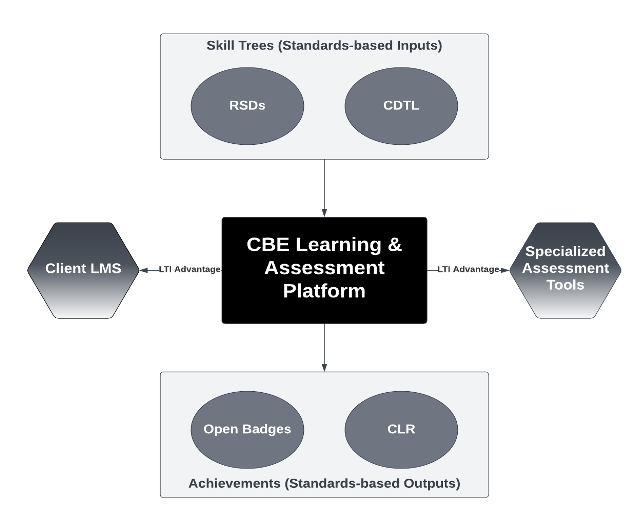
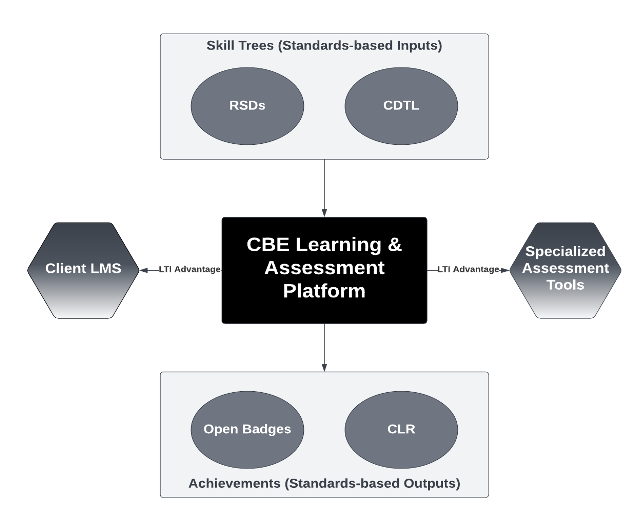
Separate skill tree: Most systems have learning objectives that are attached to individual courses. The course is about the learning objectives. One of the goals of CBE is to create more granular tracking of progress that may run across courses. A skill learned in one course may count toward another. So a CBE platform must include a skill tree as a first-class citizen of the architecture, separate from the course.
Mastery learning: This heading includes a range of features, from standardized and simplified grading (e.g., competent/non-yet) to gates in which learners may only pass to the next competency after mastering the one they’re on. Many learning platforms already have these features. But they are not tied to a separate skill tree in a coherent way that supports mastery learning. This is not a huge development effort if the skill tree exists. And in a true CBE platform, it could mean being able to get rid of the grade book, which is a hideous, painful, never-ending time sink for LMS product developers.
Integration: In a traditional learning platform, the main integration points are with the registrar or talent management system (tracking registrations and final scores) and external tools that plug into the environment. A CBE platform must import skills, export evidence of achievement, and sometimes work as a delivery platform that gets wrapped into somebody else’s LMS (e.g., a university course built and run on their learning platform but appearing in a window of a corporate client’s learning platform). Most of these are not hard if the first two requirements are developed but they can require significant amounts of developer time.
Evidence of achievement: CBE standards increasingly lean toward rich packages that provide not only certification of achievement but also evidence of it. That means the learner’s work must be exportable. This can get complicated, particularly if third-party tools are integrated to provide authentic assessments.
CBE Platform Architecture
The full white paper is here:
(The download button is in the top right corner.)
Getting the vendors to move
Vendors are beginning to move toward support for CBE, albeit slowly and piecemeal. I emphasize that the problem is not a lack of capability on their part to support CBE. It’s a lack of perceived demand. Many platform vendors can support these changes if they understand the requirements and see strong demand for them. CBE-interested organizations can take steps to accelerate vendor progress.
First, provide the vendors with this white paper early in the selection process and tell them that your decision will be partly driven by their demonstrated ability to support the architecture described in the paper. Ask pointed questions and demand demos.
Second, go to interoperability standards bodies like 1EdTech and work with them to establish a CBE reference architecture. Nothing in the white paper requires new interoperability standards any more than it requires a radical, ground-up rebuild of a learning platform. But if a standards body were to put them together into one coherent picture and offer a certification suite to test for the integrations, it could help. (Testing for the platform-internal functionality like competency dashboards is often outside the remit of interoperability groups, although there’s no law preventing them from taking it on.)
Unfortunately, the mere existence of these standards and tests doesn’t guarantee that vendors will flock to implement CBE-friendly architectures. But the creation process can help rally a group that demonstrates demand while the existence of the standard itself makes the standard vendors have to meet clear and verifiable.
What’s still missing
Beyond the learning platform architecture, I see two pieces that seem to be under-discussed amid the impressive amount of CBE interoperability and coalition-building work that’s been happening lately. I already wrote about the first, which is capturing real job skills in real-time at a level of fidelity that will convince employers your competencies are meaningful to them. This is a hard problem, but it is becoming solvable with AI.
The second one is tricky to even characterize but it has to do with the content production pipeline. Curricular materials publishers, by and large, are not building their products in CBE-friendly ways. Between the weak third-party content pipeline and the chronic shortage of learning design talent relative to the need, CBE-focused institutions often either tie themselves in knots trying to solve this problem or throw up their hands, focusing on authentic certification and mentoring. But there’s a limit to how much you can improve retention and completion rates if you don’t have strong learning experiences, including formative assessments that enable you to track students’ progress toward competency, address the sticking points in learning particular skills, and so on. This is a tough bind since institutions can’t ignore the quality of learning materials, can’t rely on third parties, and can’t keep up with demand themselves.
Adding to this problem is a tendency to follow the CBE yellow brick road to what may look like its logical conclusion of atomizing everything. I’m talking about reusable learning objects. I first started experimenting with them at scale in 1998. By 2002, I had given up, writing instead about instructional design techniques to make recyclable learning objects. And that was within corporate training—as it is, not as we imagine it—which tends to focus on a handful of relatively low-level skills for limited and well-defined populations. The lack of a healthy Learning Object Repository (LOR) market should tell us something about how well reusable learning object strategy holds up under stress.
And yet, CBE enthusiasts continue to find it attractive. In theory, it fits well with the view of smaller learning chunks that show up in multiple contexts. In practice, the LOR usually does not solve the right problems in the right way. Version control, discoverability, learning chunk size, and reusability are all real problems that have to be addressed. But because real-world learning design needs often can’t be met with content legos, starting from a LOR and adding complexity to fix its shortcomings usually brings a lot of pain without commensurate gain.
There is a path through this architectural mess, just like there is a path through the learning platform mess. But it’s a complicated one that I won’t lay out in detail here.
On January 21, President Biden announced several agency programs at the Department of State (DOS) and Department of Homeland Security (DHS) to help international STEM students and researchers access certain non-immigrant visas to allow them to study and work in the United States. The programs aim to admit and retain more international scholars to help advance STEM competitiveness in the U.S.
Department of State
The first announced program was DOS’s Early Career STEM Research Initiative. The initiative will facilitate engagement between J-1 visa recipients coming to the U.S. to participate in STEM research with host organizations, including businesses. Additionally, the department also announced new guidance to allow J-1 visa recipients in STEM fields to obtain up to 36 months of optional practical training. According to the announcement, the guidance will be applicable for exchange students in the 2021-2022 and 2022-2023 academic years, so long as the students meet certain academic training requirements.
Department of Homeland Security
Of significance, the president’s announcement also included a decision by DHS to add 22 new fields of study in the STEM Optional Practical Training (OPT) program through the Student and Exchange Visitor Program (SEVP). The program permits F-1 students earning bachelors, masters and doctorate degrees in certain STEM fields to remain in the United States for up to 36 months to complete OPT after earning their degrees. DHS issued a notice in the Federal Register announcing the specific fields of study added to the designated list of STEM fields.
Additionally, the United States Customs and Immigration Services (USCIS) issued guidance “to clarify how USCIS evaluates evidence to determine eligibility for O-1A non-immigrants of extraordinary ability, with a focus on persons in science, technology, engineering or mathematics (STEM) fields, as well as how USCIS determines whether an O-1 beneficiary’s prospective work is within the beneficiary’s area of extraordinary ability or achievement.”
CUPA-HR will keep members apprised of any further updates to these programs and any additional policies and guidance documents impacting student visas as released by President Biden and Congress.
On October 12, the U.S. Department of Labor Occupational Safety and Health Administration (OSHA) sent their COVID-19 Vaccination and Testing Emergency Temporary Standard Rulemaking (ETS) to the Office of Information and Regulatory Affairs (OIRA). OIRA is the White House office responsible for reviewing regulations and proposed regulations before they are publicly released.
The ETS — which has not yet been made public — is expected to require private employers with 100 or more employees to “ensure their workforces are fully vaccinated or show a negative COVID-19 test twice a week” and provide paid time off for obtaining or recovering from the vaccination (additional details regarding what is known about the ETS can be found in this CUPA-HR blog).
What is an Emergency Temporary Standard?
While most federal agencies are required to provide public notice and seek comment prior to enacting new regulations, OSHA may bypass normal rulemaking and issue an ETS if doing so is necessary to protect workers from a “grave danger.” This allows OSHA to issue the ETS without any feedback from impacted stakeholders and require employers to immediately comply with the ETS upon its publication in the Federal Register.
Office of Information and Regulatory Affairs Review
OIRA is part of the executive office of the president and is required to review significant regulatory actions — those likely to have an annual effect on the economy of $100 million or more — before they are published in the Federal Register or otherwise issued to the public. As the ETS is determined to be “Economically Significant,” an OIRA review is triggered to ensure that it reflects the goals set forth in President Biden’s COVID-19 Plan and to ensure OSHA has carefully considered the benefits and costs of the ETS before it is issued.
While draft documents under review are not available for public release, it is OIRA’s policy to meet with interested stakeholders to discuss issues on a rule under review. As of October 22, OIRA has convened 68 meetings with outside stakeholders on the ETS and has scheduled meetings through October 25. While CUPA-HR is aware many more additional pending meeting requests (including our own), OIRA has yet to schedule these, and may not. While OIRA review is limited to 90 days, there is no minimum period of review, and given the urgency associated with the ETS it could be issued as soon as this week.
CUPA-HR will continue to monitor OIRA’s review process and be sure to inform our membership as soon as OIRA review concludes and OSHA issues the ETS.