Tag: widespread

  • California discipline data show widespread disparities despite reforms

    California discipline data show widespread disparities despite reforms

    This audio is auto-generated. Please let us know if you have feedback.

    Dive Brief:

    • California’s Black, foster and homeless student populations are experiencing persistent and widespread discipline disparities despite state reforms to reduce inequities, a new report from the National Center for Youth Law said.
    • The report found that students in the foster system lost 76.6 days of instruction per 100 students enrolled in 2023-24 due to out-of-school suspensions — seven times the statewide average for all students of 10.7 days lost per 100 students. And in many districts, the suspension gap between Black and White students has increased significantly over the past seven years.
    • NCYL warns that discipline disparities could widen even more as the Trump administration seeks to eliminate school discipline practices meant to address racial inequity for historically marginalized student populations. 

    Dive Insight:

    NCYL’s analysis of discipline data in California shows that while some districts have made progress in reducing disparities, many continue to suspend and expel students at disproportionately high rates.

    For example, students experiencing homelessness lost 29.1 days because of out-of-school suspensions per 100 students enrolled in 2023-24. Students with disabilities lost 23.4 days of instruction per 100 students enrolled the same school year, which is nearly three times higher than students without disabilities, according to the report. 

    Black foster youth had the highest disproportionate discipline rate with 121.8 days per 100 students enrolled due to out-of-school suspensions. That’s 15 times the rate of lost instruction for all enrolled Whites students, which was 7.9 lost days per 100 students.

    The report’s analysis pulls from discipline data between the 2017-18 and 2023-24 school years. California doesn’t publicly report on the number of school days lost by offense category. Rather, NCYL developed the metric to compare rates across districts, over time and between student groups, the report said.

    Additionally, NCYL’s data analysis shows that most suspensions are for minor misconduct that did not involve injury, such as the use of profanity or vulgarity. The 2024-25 school year was the first in which no suspensions were allowed for willful defiance in grades K-12 in California, although the policy had been phased in for younger grades in the years before. 

    The report recommends that the state disaggregate discipline data for the offenses with the highest rates so the public can see which are for violent and nonviolent behaviors. Currently, most suspensions in California schools, even for profanity and vulgarity offenses, can be reported under a category titled “violent incident, no injury,” which can be misleading, NCYL said.

    When most suspensions are reported under the category of ‘violent incident, no injury’ or ‘violent incident, injury’ people will assume the offenses were violent, but they could be mostly profanity and vulgarity, said Dan Losen, co-author of the report and senior director for education at NCYL. 

    “Don’t call obscenity violence. It’s not violent,” Losen said. “These very subjective determinations about what’s profanity, what’s vulgarity, what’s obscene, what’s not obscene is fertile ground for implicit racial bias.”

    The report highlights several California districts making improvements in reducing discipline disparities. Merced Union High District, for instance, has reduced its rate of lost instruction from 58.3 days per 100 Black students in 2017-18, to 8.8 days per 100 Black students in 2023-24. Lost instruction days for students with disabilities went from 32 in 2017-18 to 6.1 in 2023-24 per 100 students with disabilities.

    The report credited the reductions in lost instruction to the district’s efforts at problem-solving rather than punitive measures and for providing student supports like individualized interventions and behavioral services.

    NCYL recommends several statewide initiatives to reduce discipline disparities, including strengthening state civil rights enforcement and oversight of district discipline practices, as well as expanding support for students in the foster system, students experiencing homelessness, and students with disabilities.

    However, statewide reforms in California could be in jeopardy under the Trump administration’s efforts to stamp out diversity, equity and inclusion programs nationally, the report said. Such state reforms have included a ban on suspensions for willful defiance in grades K-12 and the explicit inclusion of school discipline in the California Department of Education’s statewide accountability system.

    Specifically, the report points to a White House executive order issued in April that calls for a stop to “unlawful ‘equity’ ideology” in school discipline. The order requires the U.S. Department of Education to issue guidance on states’ and districts’ obligations “not to engage in racial discrimination under Title VI in all contexts, including school discipline.”

    Critics of equity-based discipline policies say they hamper school safety. 

    Title VI of the Civil Rights Act prohibits discrimination based on race, color or national origin in federally funded programs.

    The federal discipline guidance required by Trump’s executive order has not yet been issued, and the Education Department did not respond to inquiries about its status. While discipline policies are typically set at the school, district or state levels, the federal government can issue guidance and investigate schools for discriminatory practices under Title VI.

    The civil rights law has historically been invoked to protect the rights of historically marginalized students, including when they are overrepresented in school discipline — and especially exclusionary discipline — data. However, the current administration has used the law to protect White and Asian students, sometimes at the expense of DEI efforts meant to level the playing field for those historically marginalized groups.

    “One should expect that, soon, all student groups that have experienced unjustifiably high rates of removal will be excluded from educational opportunities on disciplinary grounds even more often,” the NCYL report said.

    Source link

  • Student Affairs Staff Face Widespread Racism, Survey Finds

    Student Affairs Staff Face Widespread Racism, Survey Finds

    Nearly 60% of student affairs professionals witnessed racism on their campuses in the past year, with one-third experiencing it directly, according to a new national study that exposes significant racial disparities in workplace conditions across higher education.

    Dr. Royel M. JohnsonThe report, released by the USC Race and Equity Center, analyzed responses from 1,992 student affairs professionals at 73 colleges and universities who participated in the National Assessment of Collegiate Campus Climates Staff Survey between 2021-2023.

    “When we look at over 2000 student affairs professionals across 73 institutions, we often see that student affairs professionals are really the backbone of our campuses, who are the first line of defense in supporting students and responsible for creating the conditions of belonging,” said Dr. Royal Johnson, a professor in the Rossier School of Education at the University of Southern California and director of the National Assessment of Collegiate Campus Climates in the USC Race and Equity Center. “But the same sort of realities that students are facing of race and discrimination, student affairs professionals are also being plagued with those same challenges.”

    Black student affairs professionals reported the highest rates of direct racist experiences at 61%, followed by Asian (46%) and multiracial staff (46%). In contrast, only 17% of white professionals reported experiencing racism personally.

    “Student affairs professionals are expected to champion equity and care for students, yet they often labor in environments that fall short of those same principles,” the researchers wrote.

    In an interview with Diverse, Johnson noted that upwards of 60% of those surveyed reported experiencing racism and the lingering consequences, “whether it be the emotional toll and frustration associated with it, the distrust that emanates from it, their sense of mattering,” he added. 

    The perpetrators of racism came primarily from within institutions themselves. White staff members were the most common source of racist behavior (27% of respondents reported experiencing racism from white colleagues), followed by white students (22%) and white faculty (21%). Additionally, 22% experienced racism from external contacts such as vendors and community partners.

    The emotional toll proved significant, with 72% of respondents reporting feelings of frustration and 50% experiencing anger as a result of racist incidents. More than a quarter (27%) said the experiences led to declines in mental health and emotional well-being.

    Confidence in institutional commitment to diversity, equity and inclusion varied sharply by race. While half of white staff expressed strong confidence in their institution’s DEI commitment, only 30% of Black staff and 35% of Asian staff shared that view.

    The workplace climate issues extended beyond racist incidents to broader patterns of exclusion and inequality. Less than half of all respondents felt they mattered at their institution, with Asian (33%) and Black (38%) professionals reporting the lowest rates of feeling valued.

    Staff of color also reported significant barriers to advancement. Among Black professionals, 34% disagreed that they received equal opportunities for advancement compared to colleagues, while 32% of Hispanic/Latinx staff reported similar concerns. One in ten Black professionals said their perspectives were not valued at all in workplace decision-making processes.

    “We know that staff of color have long struggled with equitable professional mobility kind of opportunities, or feel relegated to lower level, lower status kinds of roles,” Johnson explained, adding that the study represents “one of the more larger scale analysis that’s national in scope, that’s offering behind the scenes if you will, of the kind of racial realities that folks are experiencing.”

    The study revealed gaps in institutional support systems as well. While 70% of staff of color and 81% of white staff learned about race through self-directed efforts, only about half received formal professional development from their institutions on racial topics.

    During the survey period, which coincided with national discussions about anti-Asian hate crimes and police brutality against Black Americans, less than half of institutions addressed these issues. Only 42% of respondents said their leaders addressed anti-Asian hate crimes, while 50% said leaders addressed police brutality and racially motivated violence against Black people.

    The findings come as student affairs faces broader retention challenges, with 39% of staff indicating they are likely to seek other employment within the next year, according to separate research by the College and University Professional Association for Human Resources.

    The USC researchers offered seven recommendations for institutional action, including strengthening reporting mechanisms, embedding equity goals in staff evaluations, regularly assessing campus climate with disaggregated data, and ensuring transparent advancement pathways.

    “Addressing racism in the workplace is not about individual resilience—it is about institutional responsibility,” the researchers concluded. “Without bold, sustained, and collective action, campuses risk losing the very professionals who are central to advancing their diversity and student success missions.”

    The study’s sample included professionals from 28 two-year and 45 four-year institutions. The demographic breakdown was 54% white, 18% Hispanic/Latinx, 12% Black, 5% Asian, and 7% biracial or multiracial staff members.

    Source link

  • ‘Self-inflicted wound’: Widespread alarm as Trump administration slashes NIH funding

    ‘Self-inflicted wound’: Widespread alarm as Trump administration slashes NIH funding

    UPDATE: Feb. 11, 2025: A federal judge late Monday barred the National Institutes of Health from enforcing massive cuts to grant funding for researchers’ indirect costs, a move widely decried by universities and other research institutions. 

    U.S. District Judge Angel Kelley issued restraining orders in two separate cases filed earlier Monday against NIH, including one by 22 state attorneys general and another by the Association of American Medical Colleges and other groups. A third lawsuit — brought by the Association of Public and Land-grant Universities, the American Council on Education and the Association of American Universities — was also filed late Monday. 

    Regarding the AAMC case, Kelley wrote that plaintiffs would “sustain immediate and irreparable injury” without a restraining order against the NIH funding cap. Along with restraining orders, Kelley required NIH to provide biweekly status reports confirming regular disbursements.

    Dive Brief:

    • A coalition of 22 attorneys general filed a lawsuit in federal court on Monday seeking to block the National Institutes of Health’s newly announced research funding cuts.
    • NIH announced Friday it would cut roughly $4 billion a year worth of funding for indirect research costs such as administration and facilities — by capping reimbursement for these expenses at 15% for current and new grants. 
    • Research institutions have previously negotiated individual indirect cost rates, with an average of 27% to 28%, NIH said. Organizations, universities and researchers quickly raised alarms about the cuts, warning they could hurt important medical research and the economy.

    Dive Insight:

    NIH framed its unilateral decision to cut indirect costs as bringing them in line with practices at nonprofits such as the Gates Foundation, which caps indirect costs at 10% for higher education institutions, and the Rockefeller Foundation, which sets a 15% ceiling for colleges and universities.

    In a Friday memo outlining the new policy, the agency said the new cap would “allow grant recipients a reasonable and realistic recovery of indirect costs while helping NIH ensure that grant funds are, to the maximum extent possible, spent on furthering its mission.”

    The same day, the agency flagged on the social media platform X the “old” indirect cost rates negotiated by Harvard University, Yale University and Johns Hopkins University — which are all between 63.7% and 69% — as well as those institutions’ endowments ranging from $13 billion to $53 billion. 

    NIH noted that of the $35 billion it spent on grants in fiscal 2023 to universities, medical schools and other research institutions, about $26 billion went to direct research and $9 billion went to overhead in the form of indirect costs. 

    Sen. Patty Murray, a Washington Democrat, described NIH’s move as an illegal violation of an appropriations bill that prohibits modifications to NIH’s indirect cost funding. Murray also said that the move will shift costs onto states rather than reducing them.

    In their lawsuit, the attorneys general argued, “Without relief from NIH’s action, these institutions’ cutting-edge work to cure and treat human disease will grind to a halt.” 

    They pointed to the legislation flagged by Murray that protected indirect reimbursements: During President Donald Trump’s first term, his administration in 2017 included a 10% cap in its budget proposal, but Congress responded the next year with an appropriations provision prohibiting NIH from modifying reimbursement rates, the lawsuit said.

    Filed in U.S. District Court in Massachusetts, the 59-page lawsuit — brought overwhelmingly by Democrat-led states — seeks both preliminary and permanent injunctions blocking NIH from enforcing the rate cap. 

    Many in the higher education sector reacted with dismay over NIH’s move.

    The decision sabotages the decades-long partnership that has ensured U.S. global leadership in life-saving medical research,American Council on Education President Ted Mitchell said in a statement on Friday. 

    This decision is short-sighted, naive, and dangerous,” Mitchell added. “It is a self-inflicted wound that, if not reversed, will have dire consequences on U.S. jobs, global competitiveness, and the future growth of a skilled workforce.”

    Mark Becker, president of the Association of Public and Land-grant Universities, described NIH’s policy change as a “direct and massive cut to lifesaving medical research.” 

    “NIH slashing the reimbursement of research costs will slow and limit medical breakthroughs that cure cancer and address chronic diseases such as diabetes and heart disease,” Becker said in a statement. APLU noted that funded indirect costs include patient safety, research security and hazardous waste disposal

    Jeremy Day, director of the University of Alabama at Birmingham’s Comprehensive Neuroscience Center, said on social media that NIH’s cut would “cripple research infrastructure at hundreds of US institutions, and threatens to end our global superiority in scientific research.” 

    Meanwhile, institutions are grappling with what it means for their research programs going forward. The University of Michigan, for instance, said in a statement that NIH’s indirect cost funding supports development and maintenance of its laboratories as well as information technology and administrative support for regulatory compliance. 

    “This change would result in a significant decrease in the amount that U-M receives from the federal government to conduct vital research,” the university said. 

    Others echoed the warning. In a statement, the University of Wisconsin-Madison said NIH’s directive would “significantly disrupt vital research activity and delay lifesaving discoveries and cures.”

    “Indirect costs contribute to everything from utilities charges to building out the laboratories where science is done, to infrastructure for clinical trials of new medicines and treatments,” the university said.

    Source link

  • Major parent survey reveals widespread dissatisfaction with state’s schools

    Major parent survey reveals widespread dissatisfaction with state’s schools

    A new survey of more than 400 New Mexico parents of school-aged children shows widespread dissatisfaction with the state’s public schools, that communication gaps between schools and parents are a serious concern, and that many parents have misperceptions about their children’s academic achievement.

    Results of the survey, “The State of Educational Opportunity in New Mexico,” were released Oct. 2 by NewMexicoKidsCAN, an education advocacy organization (and parent organization of New Mexico Education), focused on improving New Mexico’s public education system.

    The state survey was part of a national report authored by 50CAN, of which NewMexicoKidsCan is an affiliate. 50CAN is “focused on building the future of American education,” according to the organization’s website. That 214-page report, “The State of Educational Opportunity in America” provides a deep, 50-state dive into parental views of public education in their home states.

    Researchers surveyed more than 20,000 parents across the country, making it one of the largest education-focused surveys of parents in the past decade. This survey explores the ecosystem of educational opportunities inside and outside of school, and how they interrelate and impact a child’s success.

    “With such a large sample size, we are able to dig into the findings by state and across a range of important audiences. By making the findings publicly available, this is a gift of data that can inform conversations among communities and elected officials.” said Pam Loeb, Principal at Edge Research.

    The New Mexico survey provides insight into the educational opportunities available to children across New Mexico.

    The New Mexico survey uncovered key findings, including:

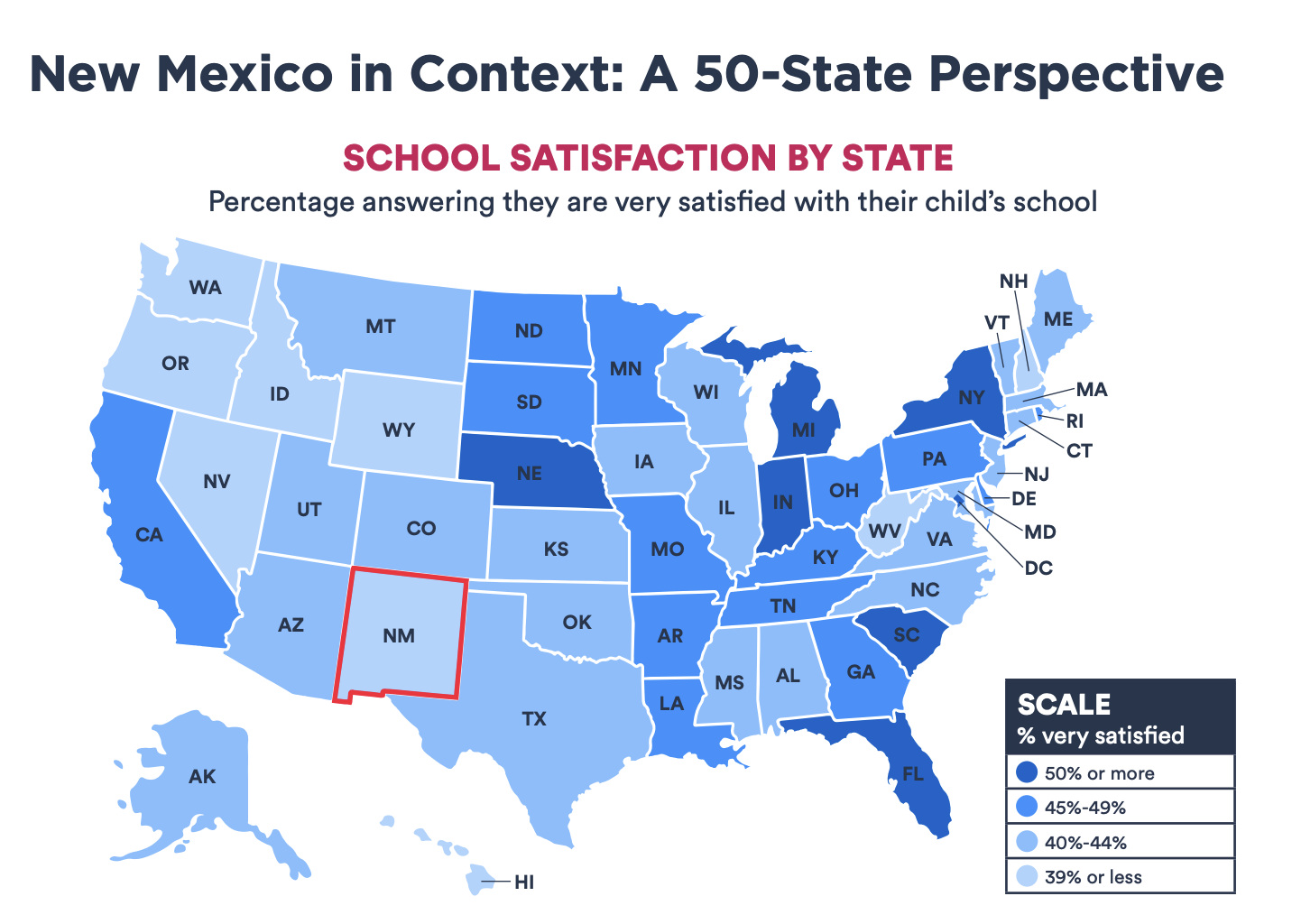
    • Parental dissatisfaction is widespread: Only about a third of New Mexico parents say they are “very satisfied” with their child’s school. Nationally, 45 percent of parents reported high satisfaction. New Mexico was one of the lower-ranked states in terms of parental satisfaction.
    • Communication Gaps Between Schools and Parents: Only 29% of New Mexico parents report feeling extremely confident in understanding their child’s academic progress ranking New Mexico second to last in the nation. 
    • Misperceptions about Student Achievement: 41% of New Mexico parents believe their child is above grade level in reading, yet state assessments show only 39% of students are reading at grade level. 
    • Afterschool Programs Show Promise: New Mexico ranks 22nd nationally in student participation in supervised afterschool programs, surpassing 28 other states. This success is likely attributed to increased state investments through the Extended Learning Time Program, which may have boosted overall participation rates.

    “This survey amplifies the voices of New Mexico parents,” said Amanda Aragon, Executive Director of NewMexicoKidsCAN. “The results reveal significant misperceptions about student performance, serious communication gaps between schools and parents, and widespread concerns about school satisfaction. 

    “It’s clear that many parents are not getting the information they need about their children’s academic progress. We must do more to close this communication gap and empower parents to be true partners in their child’s education.”

    “With such a large sample size, we are able to dig into the findings by state and across a range of important audiences. By making the findings publicly available, this is a gift of data that can inform conversations among communities and elected officials.” said Pam Loeb, Principal at Edge Research.

    Source link