Tag: Winners

  • Honoring Giving Day Excellence | The 2025 RNL Givey Winners

    Honoring Giving Day Excellence | The 2025 RNL Givey Winners

    Giving days have become a foundation for fundraising, helping institutions energize their donor base and create an incredible burst of philanthropic passion. As these days have evolved, so have the strategies institutions have used to amplify their efforts, rally donors around a theme, and gamify giving to take the results to the next level.

    To recognize the creativity and strategy of these programs, RNL created the Giveys, and annual award celebrating the most innovative and successful Giving Day campaigns. This year we are pleased to announce 28 winners among our ScaleFunder partners.

    The Giveys showcase a sampling of the outstanding work and unique approaches RNL’s many partners take to engage their communities and maximize their fundraising efforts. This year’s winners used pop culture-inspired themes and high-tech ambassador toolkits to bolster strategic support from the ScaleFunder and use of our easy-to-build platform to generate record-breaking fundraising events. Read about the winners and see their giving pages below, or watch our recent webinar where we unveiled the winning institutions.

    2025 RNL Giveys Winners & Highlights

    Category: Creative Giving Day Theme

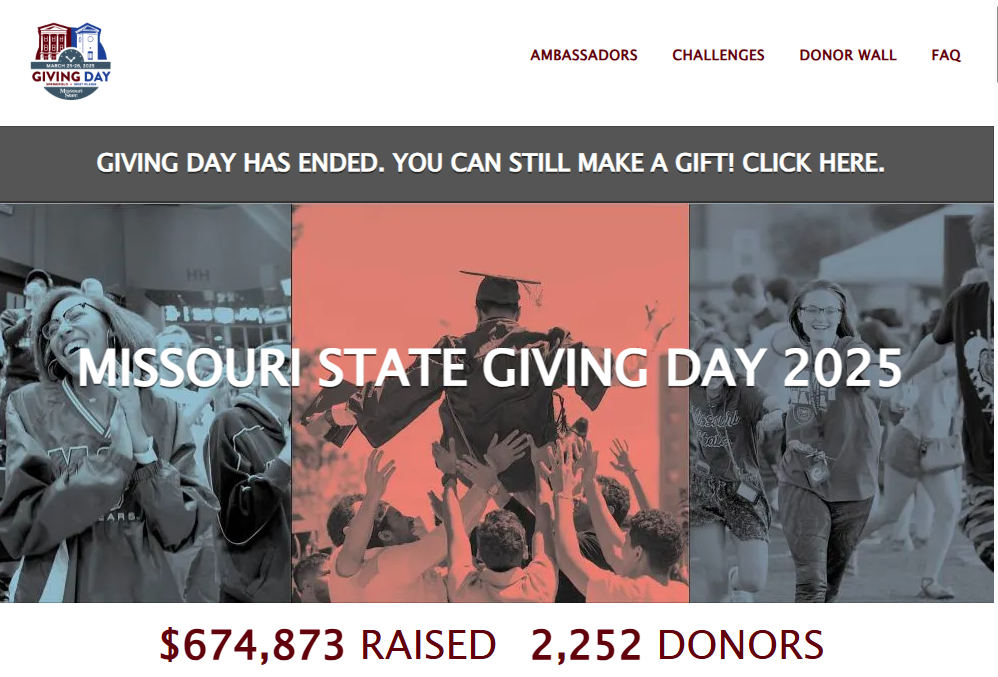
    Missouri State Giving Day
    • Winner: University of Texas at Dallas
      • University of Texas at Dallas launched a fully integrated Taylor Swift-inspired campaign that spanned their logo, site text, graphics, and ambassador toolkit. The theme culminated in a fun, on-campus concert featuring a Taylor Swift impersonator and a selfie station.
    • Winner: Missouri State University
      • Missouri State won for their Taylor Swift-inspired theme that carried across their site’s banner image and ambassador materials, demonstrating a high-energy approach that resonated with their community

    Category: Omnichannel Engagement

    • Winner: Michigan Tech University
      • Michigan Tech University was recognized for their professional and unified omnichannel strategy. They utilized high-quality branding, student photos, and front-and-center dates across postcards, digital ads, and email to ensure the campaign was seen everywhere.

    Category: Creative Social Media

    • Winner: West Virginia University (WVU)
      • West Virginia University was celebrated for its use of creative social media challenges and contests, leveraging the Walls.io social media aggregator. Our favorites included a “Day of Giving Social Prop Challenge” tied to their save-the-date postcard, a “Country Roads Challenge” asking people to sing the John Denver song, and a “Pet Photo Challenge.”

    Category: Gamification Excellence

    RPI Giving DayRPI Giving Day
    • Winner: The University of Mississippi
      • The University of Mississippi team was honored for leaning into what makes them unique! They tied their campaign to the hearts of their donors by offering unique and personalized rewards such as a manufacturing excellence fire pit and a signed, personalized print from artist Marshall Ramsey.
    • Winner: Indiana State University
      • Indiana State was recognized for an excellent display of matches and challenges on their site, particularly the “New Donor Challenge.” This challenge targeted first-time donors, successfully using a major gift to be unlocked once a specific number of new donors gave.
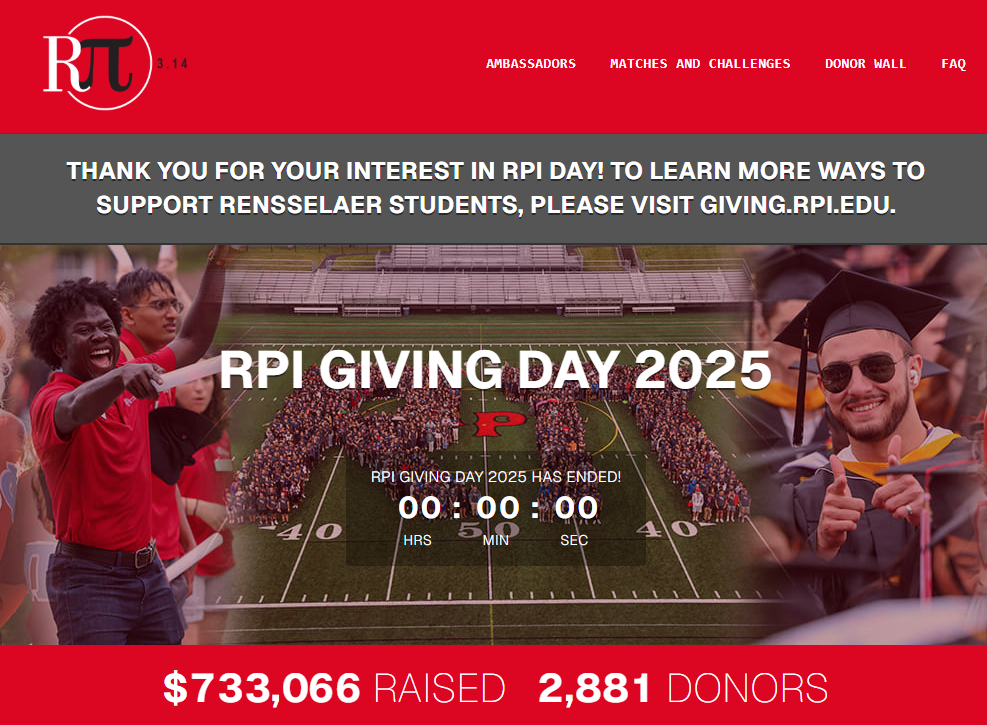
    • Winner: Rensselaer Polytechnic Institute (RPI)
      • We applaud RPI for tying their gamification directly into their giving day date, March 14th (Pi Day). Challenges included goals like 3,142 laps around the armory and gifts of $3.14 or $31.42, along with highlighting pet posts for their president’s dog’s birthday party.
    • Winner: Montclair State University
      • Montclair State University was highlighted for their fun, relatable challenge that asked young alumni to “give up a coffee” and make a modest gift, then rewarded them with a coupon for a free coffee, encouraging repeat engagement.

    Category: Ambassador + Donor Engagement

    University of Oregon Giving DayUniversity of Oregon Giving Day
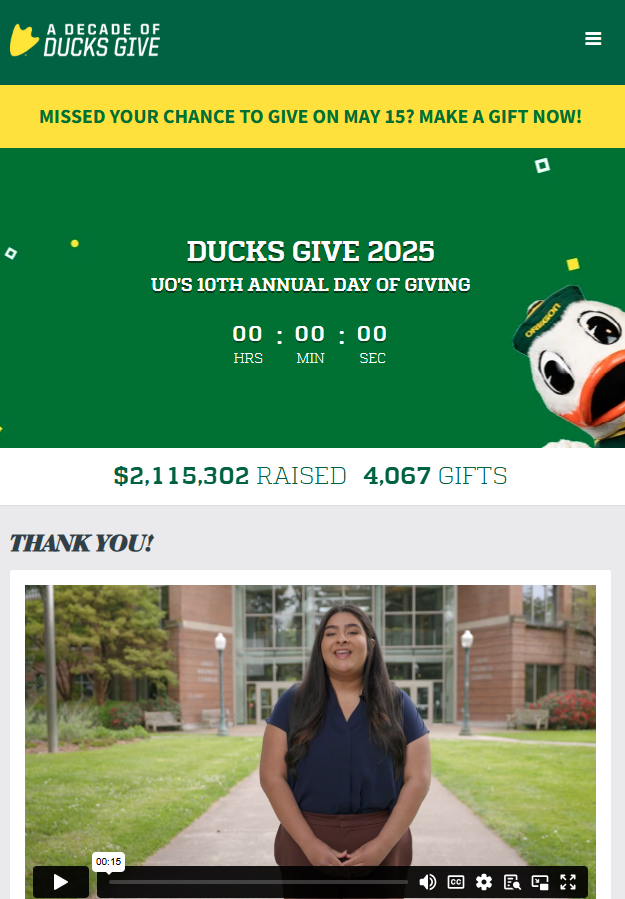
    • Winner: University of Oregon
      • The University of Oregon won for their “Ducks Give Day” campaign. They offered a free sticker pack for signing up as an ambassador and motivated participation in their “You+2” campaign, where ambassadors made a gift and secured two others to make a gift, then they earned an exclusive Oregon pin and pair of socks.
    • Winner: The University of Texas Health Science Center at Houston
      • UT Health Houston put together a Giving Day campaign toolkit to engage the ambassadors by providing professional, easy-to-use graphics and copy-and-paste sample messaging. The success of their campaign stemmed from understanding of their audience and a commitment to making it simple for people to spread the word and help them meet their goals.

    Category: On-Campus Engagement

    • Winner: University of Wisconsin-La Crosse
      • Celebrated for an excellent on-campus promotion strategy to generate awareness and engagement, which included free T-shirt giveaways, a kickoff pep rally, a voting contest for campus areas to receive funding, and a “Class Cab” golf cart.

    Category: Awesome Greek Organization

    • Winner: Kappa Alpha Theta
      • Kappa Alpha Theta was recognized for their well-designed and welcoming ScaleFunder site design, which featured animated graphics and powerful donor testimonials directly on the page, leaning into their core message of sisterhood and connection.

    Category: New Giving Day Partner

    University of DelawareUniversity of Delaware
    • Winner: University of Delaware
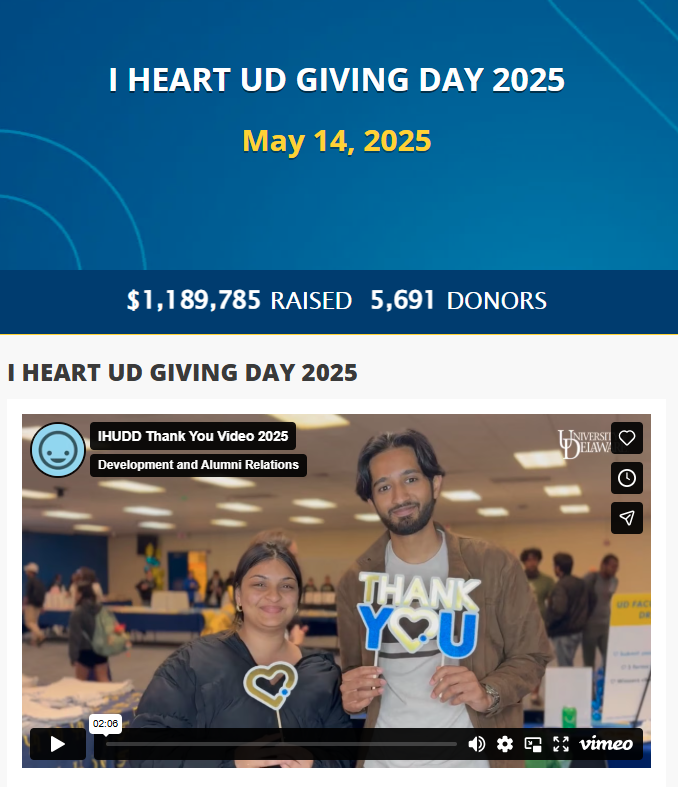
      • The University of Delaware was honored for their successful first “iHeartUD Giving Day,” demonstrating excellent branding and execution, especially after needing to change their Giving Day date. Their quick, professional communication and successful campaign showed great promise, and they were true experts at keeping their community in the loop about iHUD happenings.
    • Winner: California State University, Stanislaus
      • California State University, Stanislaus was recognized for a very strong entry, leveraging years of success with RNL’s crowdfunding platform for their first Giving Day. They created a unique theme, “1960 Minutes of Giving” (based on their founding year), and used a unique domain label: “stanforacause.”

    Category: Fall Giving Day

    • Winner: The University of Alabama
      • Featured for their recent “Clash of the Capstone” campaign, which pitted students against alumni in a competition to see who could bring in the greatest number of gifts, creating a fun, engaging way to host a second, focused giving day in the fall.
    • Winner: UC Berkeley
      • Recognized for the success of their second annual fall giving day, the “Oski’s Bearathon.” The campaign, which focuses on driving donations to student organizations, uses a fun, quirky theme and is a top example of how to successfully run multiple, distinct Giving Day campaigns in one year.

    Category: Frictionless Giving Experience

    • Winner: Butler University
      • Butler University was celebrated for proactively adding custom questions to their donation form to collect information vital for advancement services and athletics, streamlining the gift processing workflow for their campus partners.

    Category: Giving Day Video

    • Winner: University of Houston
      • The University of Houston created an engaging Giving Day campaign, which featured a video game theme. This included a fun, well-done video and the development of an actual playable game called “Shasta’s Birthday Dash,” accessible right on their Giving Day site. This gamified approach allowed participants to play, collect points by passing virtual campus landmarks, and track their scores on a visible leaderboard, making the celebration of their “years of excellence” a memorable and interactive experience.

    Category: Incentivized Giving

    • Winner: Northern Kentucky University
      • Northern Kentucky University developed highly effective donor incentives as part of their annual Giving Day campaign. These incentives included offering a choice of a long-sleeve T-shirt for any gift of $68 or more (honoring their founding year) and leveraging a partnership with AAA to enter all donors of any gift size into a drawing to win two round-trip Delta Airline ticket vouchers anywhere in the continental United States.

    Ready for a record-breaking giving day?

    RNL Giving Day Powered by ScaleFunder combines the most powerful giving day platform with strategic assessments, omnichannel marketing, and stewardship to make your giving day a major success and increase future giving.

    RNL Giving Day Powered by ScaleFunderRNL Giving Day Powered by ScaleFunder

    Category: Site Design

    • Winner: The University of Mary Washington
      • The University of Mary Washington earned recognition for their successful site refresh, which featured a custom-drawn campus wallpaper design for their Giving Day platform. Additionally, they leveraged a unique campus tradition, the “Devil Goat Challenge,” which pits even and odd class years against each other for additional challenge funds.
    • Winner: Ivy Tech Community College
      • Ivy Tech Community College Giving Day campaign prioritized team alignment across the entire organization and featured a visually fantastic site design. Their platform created a positive, celebratory atmosphere through its use of dynamic graphics and animation, including a banner with confetti dropping.
    • Winner: Tarleton State University
      • Tarleton State University created a professional and engaging Giving Day site that effectively showcased their branding, especially for the Texan Excellence Fund. Their use of vibrant giving area tiles that instantly captured attention and encouraged visitors to scroll and click through to learn about the different campus areas needing support.
    • Winner: Washington State University
      • Washington State University reached the outstanding milestone of their 10th annual Giving Day this year with their, “Cougs Give,” campaign. The university Giving Day site is well designed, featuring a “film noir” theme that used black and white imagery with a bold pop of red in their tile graphics, creating a memorable and visually sophisticated look that was carried throughout the entire campaign.

    Category: Multi-Campus Showcase

    • Winner: The University of Alaska
      • The University of Alaska leveraged an exceptional multi-campus showcase feature, which unified its various campus identities through the creative use of their mascots. Their campaign stood out with engaging features like mascots animating in and out of the banner images and a fun “hide and seek” challenge that visually highlighted each campus’s unique identity.

    Category: Athletics Giving Day

    • Winner: Virginia Tech University
      • Virginia Tech successfully hosted a second Giving Day specifically dedicated to their athletics, branded with the strong theme “Triumph Together.” This initiative united the university’s annual giving and athletics teams, serving as a powerful tool to generate engagement, secure great donor numbers, and cultivate loyal, all-around Virginia Tech fans.

    Category: Giving Tuesday

    • Winner: Northern Arizona University
      • Northern Arizona University was recognized for their cohesive and successful Giving Tuesday campaign that featured a fall theme and their “Lumberjacks” identity. Their strategy featured a beautiful site design and creative, engaging messaging, such as substituting “gifts” with “axe of kindness” and playful puns to reinforce the thematic branding and celebrate who they are.

    Category: Early Giving

    • Winner: Marshall University
      • Marshall University was recognized for their creative and effective use of early giving functionality on the ScaleFunder platform, which streamlined the donation process for both donors and staff. They simplified the experience by allowing gifts directly on the campaign site, customizing the donation button to say “Give Early,” and easily hiding the total aggregator and donor wall until the official launch to generate excitement.

    Category: Wild Card

    • Winner: Salem State University
      • Salem State University was recognized for enhancing their Giving Day with creative, multi-media engagement features promoted directly on their homepage, offering fun ways for their community to participate beyond just donating. These features included a high-energy “Viking Warrior Day hype up” Spotify playlist and a curated YouTube playlist offering various pre-recorded activities, such as an alumni-led morning yoga session and an evening meditation.

    Ready to have your award-winning Giving Day?

    These stories of record growth, community engagement, and frictionless giving celebrated at RNL’s 2025 Giveys highlights that with the right tools, consulting support, and strategic planning, any institution can host a successful and engaging digital fundraising campaign.

    Whether you’re looking to launch your first Giving Day, elevate your annual campaign, or start a new crowdfunding initiative, RNL’s ScaleFunder platform provides the technology, insights, and support to turn your vision into a fundraising victory.

    Contact us today to explore how RNL’s ScaleFunder can help you engage your donors, mobilize your ambassadors, and build a tradition of giving day excellence.

    Source link

  • Winners of the Best Personal Academic Websites Contest 2025

    Winners of the Best Personal Academic Websites Contest 2025

    Congratulations to the winners of the 2025 Best Personal Academic Websites Contest hosted by Jennifer van Alstyne, Brittany Trinh, and Ian Li. This contest celebrates great examples of academic websites from people in Higher Education.

    About the Awards

    Congratulations to this year’s award winning academic websites!

    Hi there, I’m Jennifer van Alstyne. This is our 3rd Best Personal Academic Websites Contest. This page celebrates the 2025 award winners. We hope their websites help inspire people around the world to create space for themselves online. Please share these award winning websites with a friend you think should have a website too.

    There are 12 award winners in this year’s contest. In a year we’ve had more entries than ever before, these academic website stood out. Each of the award winners in this year’s contest received a perfect score from the judges.

    While their websites may grow and change with them over time, these award winning academic websites deserve to be celebrated for the work they’re already doing to share their story. Thank you.

    Best wishes,
    Your Contest Co-Hosts

    Jennifer van Alstyne of The Social Academic
    Brittany Trinh of the Beyond Your Science Podcast
    Ian Li, PhD of Owlstown

    What you’ll find on this page

    Check out the award winning websites

    Read what inspired people to create their website

    Find what the judges thought

    Resources to help you create a website of your own

    Subscribe for when the contest re-opens in 2026

    To each person who entered their website into the Contest, thank you. Thank you for creating that space for yourself online. Thank you for being open to sharing it with people. I’m so glad your website is in the world.

    Would you like feedback from the judges on your website? We’re happy to share our thoughts with you if you’d find it helpful. Each person who entered the 2025 contest can request feedback from the judges. Email Jennifer van Alstyne at [email protected]

    The Best Personal Academic Websites Contest was open for entries from April 22, 2025 and closed on August 15, 2025. It will reopen for entries in 2026.

    Want to hear about next year’s contest? Subscribe to The Social Academic.

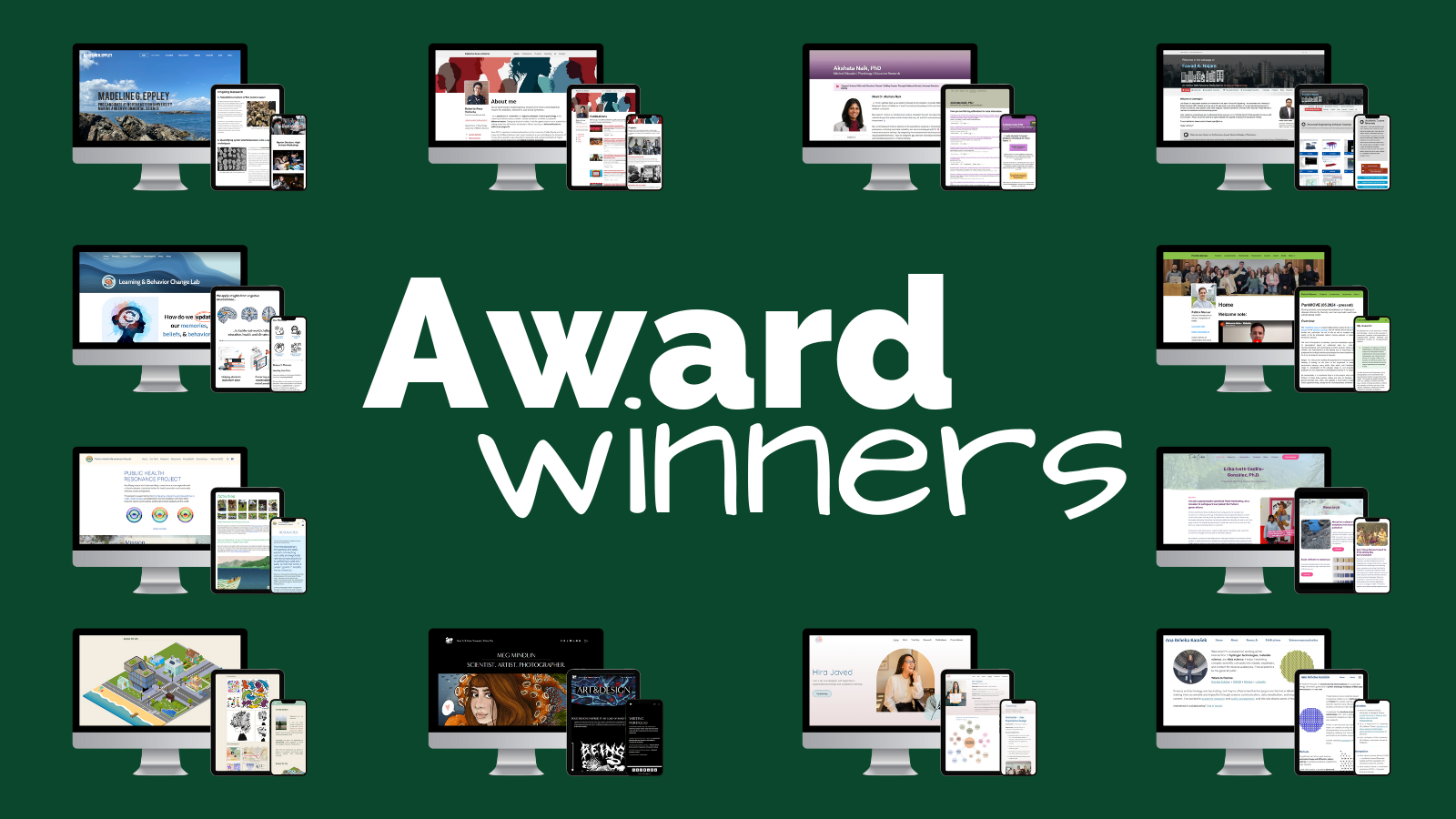
    2025 award winners of the personal academic websites contest hosted by Jennifer van Alstyne of The Social Academic. On this graphic are 12 award winning websites from this year's entries.

    Madeline Eppley and Dr. Roberta Rosa Valtorta (tied)

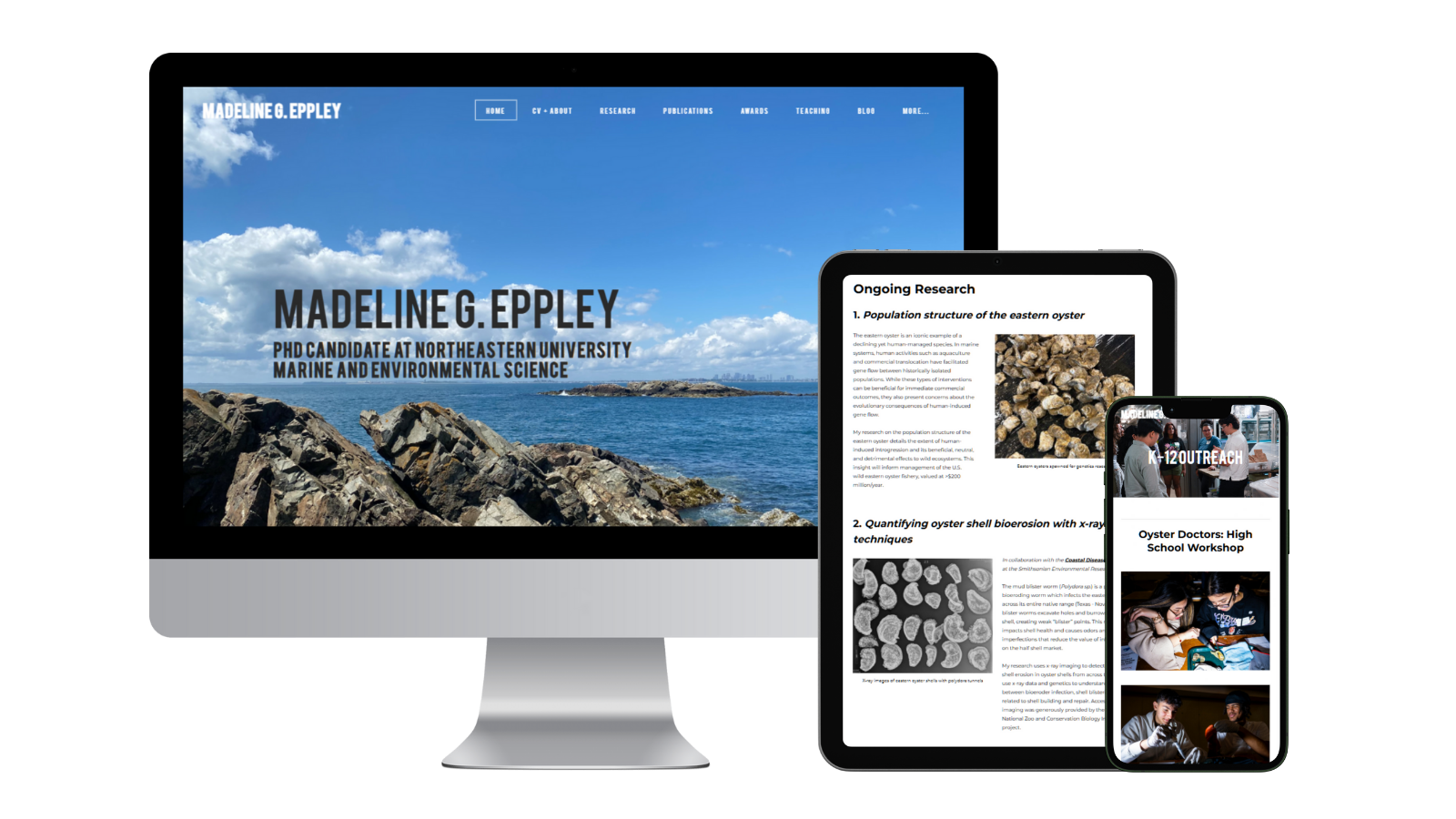
    Madeline Eppley Website on Desktop (homepage), Tablet (Research page), and Mobile (Outreach page) screens
    https://www.madeline-eppley.com/

    Madeline Eppley

    “I made my website because I feel there is a substantial gap in science communication training for graduate students and the broader field of biology. I graduated undergrad in 2020 when a lot of networking and resources went virtual. During this really pivotal stage in my career development, I needed to develop better digital presence and science communication skills to keep pace with the rising importance of networking in virtual academic spaces (e.g. virtual conferences and social media). Through this process, I ended up finding my current PhD position on social media, and also built a digital network that made me feel more connected to the science community online.”

    —Madeline Eppley

    Notes from the judges

    Jennifer van Alstyne: A visually engaging story-rich website. I hope Madeline’s website inspires people to take more photos because it makes such a difference. For instance, there’s a lot of content on this website, but it doesn’t feel overwhelming. While the top menu is initially hard to read, when I start scrolling there’s contrast. I like how Madeline’s research page shares ongoing research and completed research.

    Brittany Trinh: I love Eppley’s website, from the bio to all the photos of the field research. On the homepage, Eppley makes her passion for research and science communication clear, as well as her future goals. The research page explains the importance and impact for each research project and specifies which projects are ongoing or completed. Looking at her website, I am now inspired to go update my own website and incorporate more science in it! 

    Ian Li: Eppley’s website is well-organized and provides a lot of details on what inspires her work and the results of her research. She also describes her outreach to college and high school students. Her blog has lots of stories about her research and experience on the field.

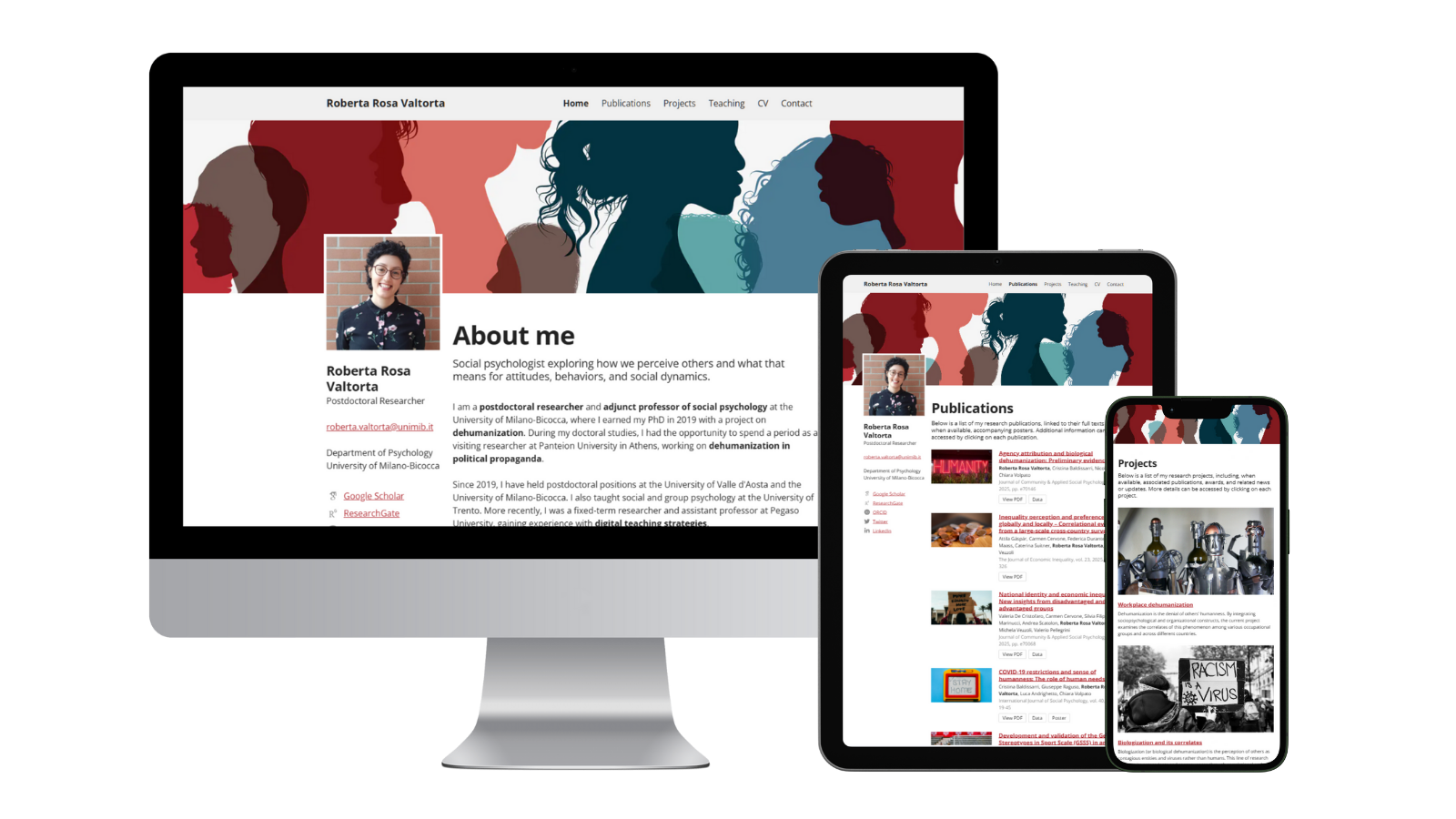
    Dr. Roberta Rosa Valtorta Website on Desktop (homepage), Tablet (Publications page), and Mobile (Projects page) screens
    https://robertavaltorta.research.st/

    Dr. Roberta Rosa Valtorta

    “I created my personal academic website for several reasons. First, to have one central place where all my work, publications, and projects are collected, making it easier for potential collaborators and anyone interested in my research to find accurate, up-to-date information. Second, to maintain control over my online presence, so that people searching for me don’t just find scattered pieces of information in different places. And finally, for a more personal reason: research can sometimes test self-esteem due to its competitiveness and constant pressure. Having a space where everything I have done is brought together helps me remember who I am, my roots, and the progress I have made.”

    —Dr. Roberta Rosa Valtorta

    Notes from the judges

    Jennifer van Alstyne: A thoughtful use of space on an Owlstown website. Dr. Valtorta has an expansive portfolio of publications, projects, and teaching. This website also shares teaching values, such as ways courses contribute to the United Nations Sustainable Development Goals (SDGs). From downloadable syllabi to accessible data, this is a great academic website example.

    Brittany Trinh: Valtorta’s website is great example of what you can do with an Owlstown website! The project pages include an overview, related awards, and related publications, which makes it easier to understand the impact of the research. The teaching pages provide a summary about the classes taught so we can understand the topics covered and importance of the course.

    Ian Li: This is such a great example of an academic website. It is well-organized. Projects are described with related publications, Publications and courses are summarized well. Her intro describes her passion for her research and points to the development of her work. She also shares a blog that is regularly updated. She also provides information in both English and Italian, which widens the reach of her work.

    Back to the list of award winners

    Owlstown Website Award

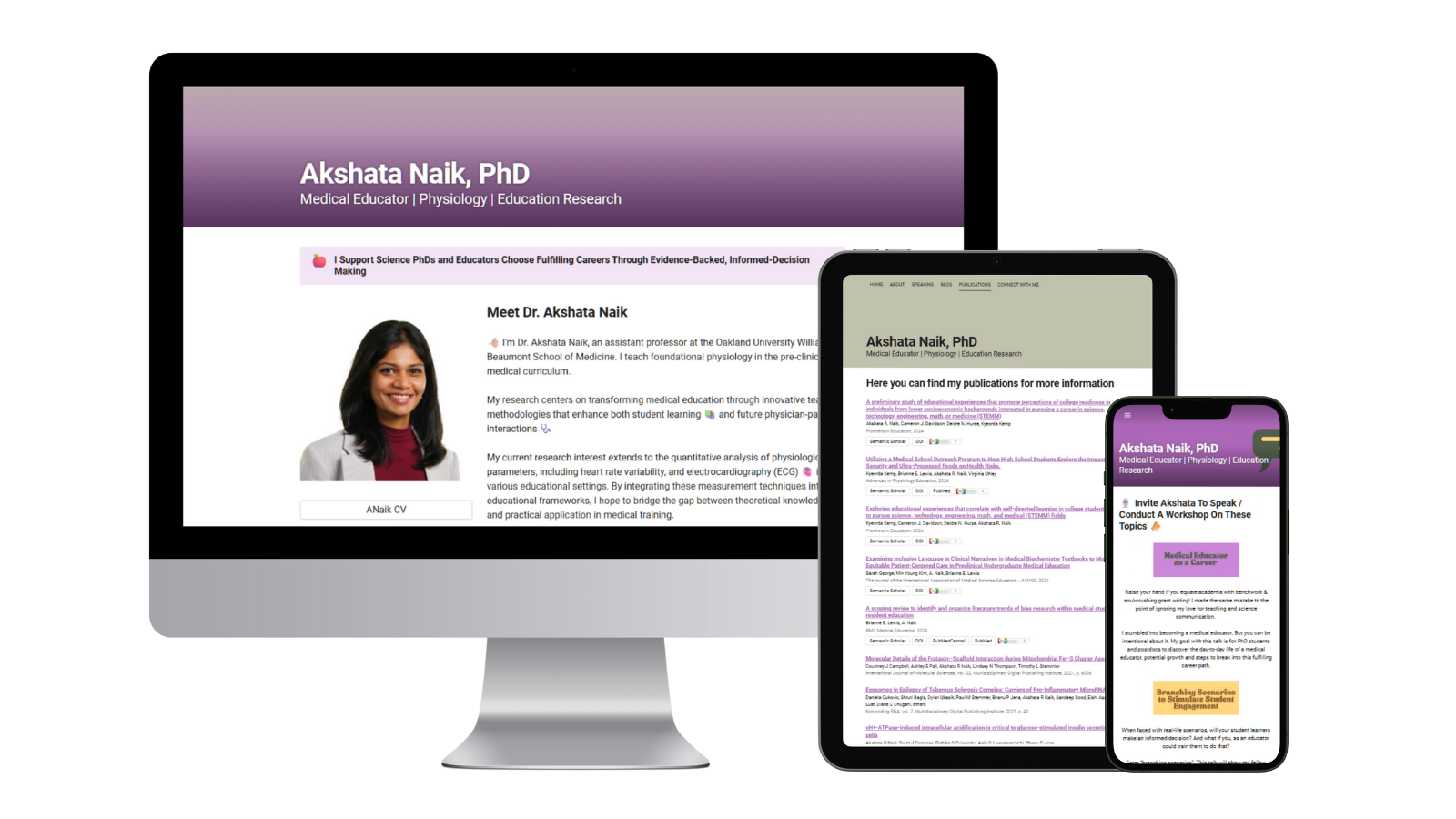
    Dr. Akshata Naik

    Akshata Naik Website on Desktop (homepage), tablet (publications page) and mobile (speaking page) screens
    https://www.anaikowl.com/

    Dr. Akshata Naik

    “I thrive on creativity! Science communication, teaching and new research ideas keep me going. So I wanted to create an online space to portray my work for networking with folks similar to my interests, and importantly serving the broader community via outreach. And being an academician is a good enough reason for building a digital presence as it strategically aligns with my tenure and promotion goals by amplifying the impact of my work beyond traditional boundaries.”

    —Dr. Akshata Naik

    Notes from the judges

    Jennifer van Alstyne: I get such a sense of personality from an Owlstown website. This is great. Publications with abstracts make a difference. The buttons, like ‘Get to know me’ stand out as a lovely way to be approachable. The ‘Generated using Canva AI’ disclosure on an image on the blog feels thoughtful (and like the kind of information people appreciate even if they don’t use AI art themselves). The use of emojis in the middle of sentences isn’t ideal for accessibility, and is something I’d recommend revising.

    Brittany Trinh: Naik does a great job on her Owlstown website sharing what she does and why she does it. My favorite page is her Speaking page because it highlights the different talks she has and shares more of her story.

    Ian Li: Naik’s website is a great example of an Owlstown website. It’s very organized with information about herself, her publications, and her speaking engagements. She also shares a blog.

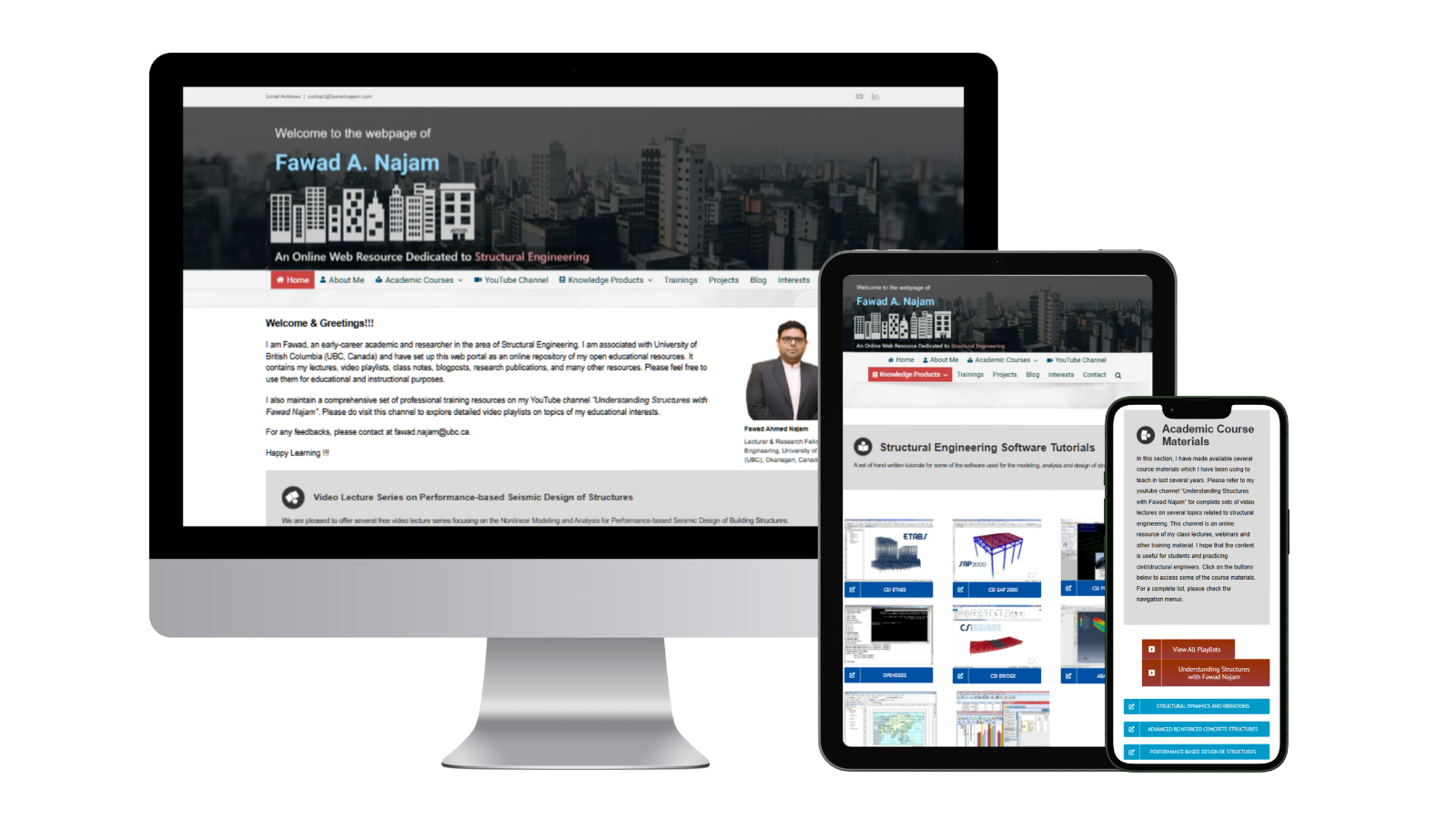
    Dr. Fawad Ahmed Najam

    Fawad Ahmed Najam Website on desktop (homepage), tablet (Tutorials page), and mobile (academic courses page) screens
    https://fawadnajam.com/

    Dr. Fawad Ahmed Najam

    “I am an educator in the field of structural and earthquake engineering. I originally created my website to make structural and earthquake engineering concepts more accessible to my students, fellow educators, and professionals. My goal was to share open educational resources, interactive tools, and practical examples (I use in classroom) with a wider audience. Knowing that it is making a difference and inspiring others means a lot to me.”

    —Dr. Fawad Ahmed Najam

    Notes from the judges

    Jennifer van Alstyne: A wealth of resources made accessible through this online space and good organization. While I don’t love the rotating icons for accessibility, every page of this website has videos, articles, blogs, and data to help people. I hope this website inspires people to consider: what do I already have that can help my students I’m open to sharing online?

    Brittany Trinh: Najam’s website is jam-packed with resources for his courses. His website is well organized and the content is probably super helpful to his students and others who are interested in structural engineering!

    Ian Li: If you want to learn about structural engineering, Najam’s website is the place to go. It is well-organized and has pages for course materials, YouTube videos, links to publications and resources.

    Back to the list of award winners

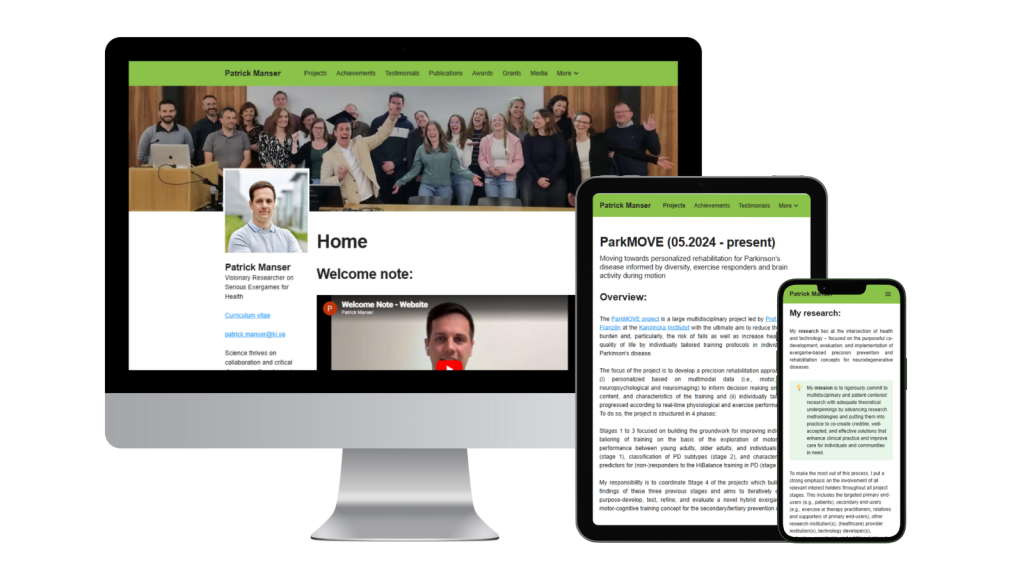
    Dr. Patrick Manser

    Patrick Manser website on Desktop (homepage), tablet (research project page), and mobile (homepage) screens
    https://www.patrick-manser.com/

    Dr. Patrick Manser

    “I created my personal academic website to make my collaborative research more accessible, with the aim of fostering transparency, promoting interdisciplinary dialogue, and broadening the dissemination of knowledge. By sharing my work openly, I hope to spark new connections and collaborative efforts that not only advance science but also translate research into meaningful improvements in healthcare and community-based health promotion.”

    —Dr. Patrick Manser

    Notes from the judges

    Jennifer van Alstyne: What a great welcome note video! I love it. That stood out because it was simple and invites folks to explore areas of the website. I felt like if I didn’t explore anywhere else, the video shared what, why and invited folks to get in touch. This website has far more on it than expected. While it’s mostly text-based with few visuals, it’s clear, easy to read, and well organized. I hope this website inspires people to consider video. Ooh, and requesting testimonials for their website too.

    Brittany Trinh: Manser’s website is very extensive regarding his research and how it has been highlighted in media. Additionally, he includes many stats regarding his academic contributions in many different areas such as awards, grants, peer review, and more. 

    Ian Li: Manser’s website is full of information on his research work: publications, courses taught, media, grants, etc. He also provides short descriptions for every item, so you have an introduction to the item. It’s a great example of how an academic website can serve as a portfolio.

    Back to the list of award winners

    Best Research Lab or Group Website

    Dr. Allie Sinclair and Dr. Tetine Sentell (tied)

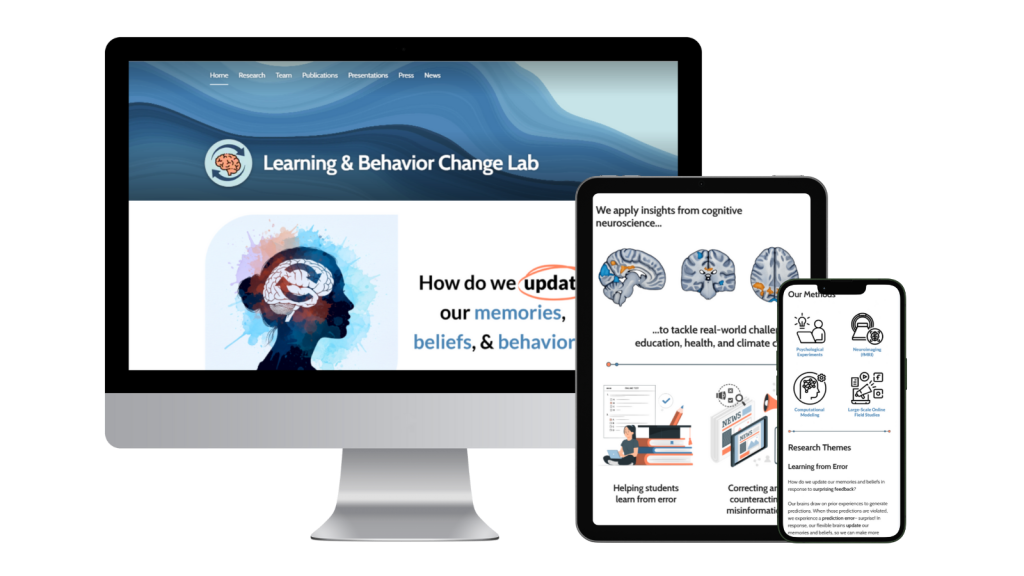
    Dr. Allie Sinclair | Learning & Behavior Change Lab website on desktop, tablet, and mobile screens
    https://www.sinclairlab-rice.com/

    Dr. Allie Sinclair | Learning & Behavior Change Lab

    “I was excited to make this website for my new lab, as I’ll be starting a faculty position at Rice University next year. I’ve spent many years dreaming of starting my own lab, although the exact vision has evolved over time. Now that the official website is ready, it finally feels real! I was motivated to create a fun and informative website this summer because I will be recruiting people to join my lab over the next year. I made the website with Owlstown, which made it easy to build and customize. I especially appreciated the features geared toward academics, like searching PubMed to find your publications and adding Altmetric badges.”

    —Dr. Allie Sinclair

    Notes from the judges

    Jennifer van Alstyne: Scroll down the homepage of this website and you have a great sense of what their research is about. Words, graphics, and illustration shares the story, and we’re then invited to explore the research and team. Folks are getting so creative with their Owlstown sites. I like the illustrations. There’s a lot of info for folks who are considering joining the lab which shares it’s recruiting for Fall 2026. Cats, Lara Croft and Moxie the cats have their own space on the team page. Yes. I’m so into this.

    Brittany Trinh: This is one of the best stylized Owlstown websites that I’ve seen. I love the cohesion of the color schemes in the visuals. I liked how they organized the research areas into three separate topics and had a link to the related publications. The publications page has the filter function so we can find papers related to a specific topic more easily.

    Ian Li: This is a great example of a lab website. You get a comprehensive understanding of what the lab does. Research projects are summarized and linked to relevant papers. There’s also links to media appearances and collaborators. Plus, the website is beautifully done with graphics and well-chosen colors.

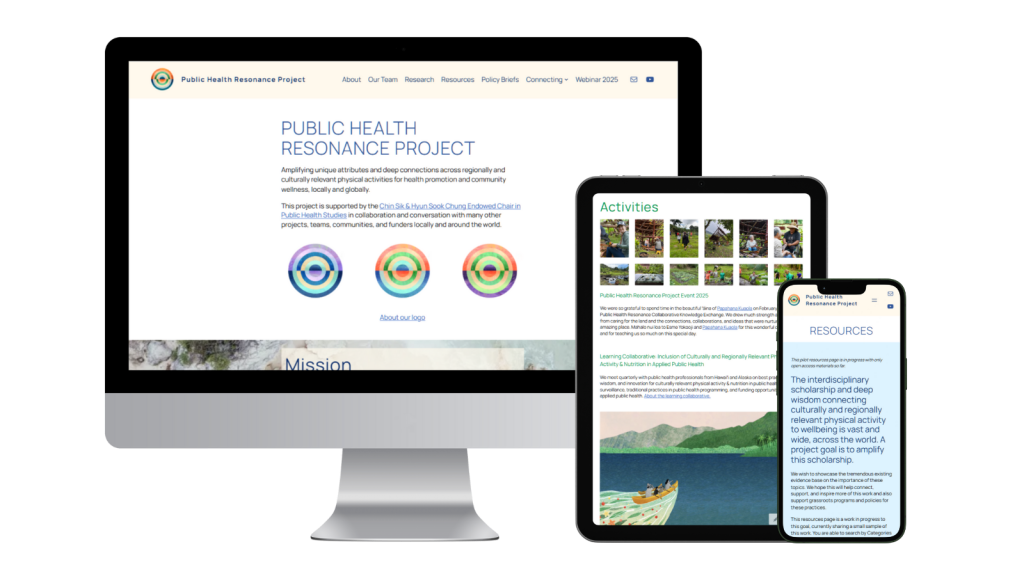
    Dr. Tetine Sentell Public Health Resonance Project Website on Desktop, Tablet, and mobile screens
    https://phresonance.com/

    Dr. Tetine Sentell | Public Health Resonance Project

    “Our interdisciplinary public health research collaboration is working together to help build the evidence base for regionally and culturally relevant physical activity for public health promotion. This work is designed to help connect and build this evidence base for public health promotion to produce actionable results for individuals, advocates, and communities to improve health outcomes and health equity. We wanted a beautiful and well-organized website to share information to support this goal. We plan to keep building on this website as the project continues and have been grateful to Jennifer van Alstyne for her support to make this possible!”

    —Dr. Tetine Sentell

    Notes from the judges

    Jennifer van Alstyne designed this website. She did not judge this entry.

    Brittany Trinh: This website is very well organized on their research page. Additionally, I love the use of real photos of the group in action in the field or at different events. It adds a personal flair to the website that makes it unique!

    Ian Li: This website is a great example of a lab website. It has full descriptions of lab members, research projects, lab activities, and outreach. It shares links to media and conference appearances. You get a detailed picture of what the lab does.

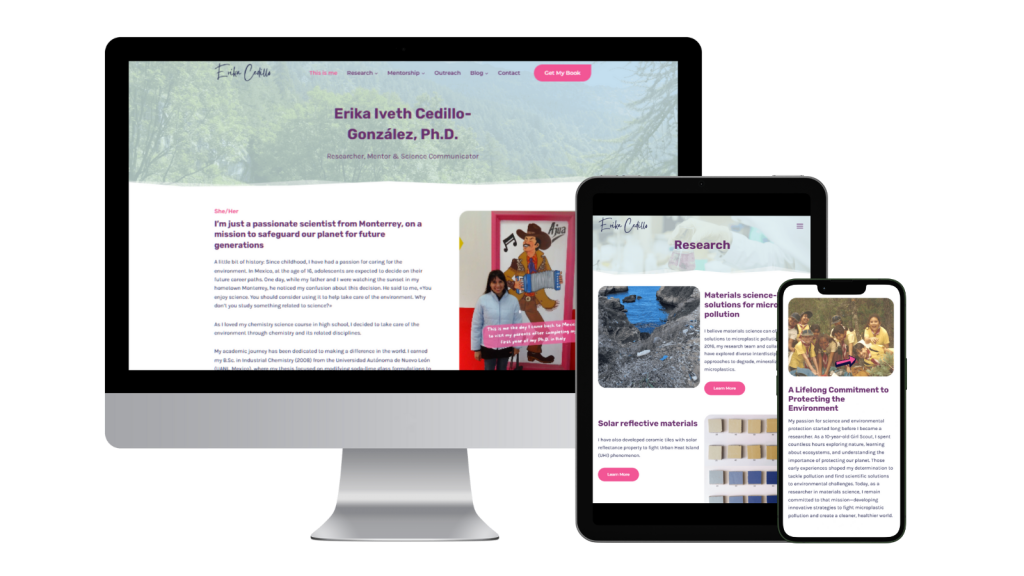
    Dr. Erika Iveth Cedillo-González

    https://erikacedillo.com/

    Dr. Erika Iveth Cedillo-González

    “I built my academic website to share what university profiles never did: my passion for research, my path as a mentor, and my dedication to protecting our planet. I believe each person in Academia carries a unique and inspiring journey that led them to science. A personal academic website offers the perfect space to share such story and remind others that research is also deeply human.”

    —Dr. Erika Iveth Cedillo-González

    Notes from the judges

    Jennifer van Alstyne: Personal and professional with pops of color. This website shares Dr. Erika Iveth Cedillo-González’ passion for science. It has science communication that invites the general public to learn and engage. There’s clarity not only on what the research is about, but how it impacts people. Accessible communication without sacrificing the science, in this website you get both.

    Brittany Trinh: I love how Cedillo tells her story of how she became a scientist and how it informs her research right from the start on her homepage. I also love that she has a blog for the Spanish-speaking ECR community, which serves as a resource and ties into her purpose and mission.

    Ian Li: The story of Cedillo’s work really comes together on this website. Her bio shows what inspires Cedillo, then her research shows how inspiration resulted in findings, then her outreach shows how she spreads her research to the broader community.

    Back to the list of award winners

    Dr. Cecilia Baldoni

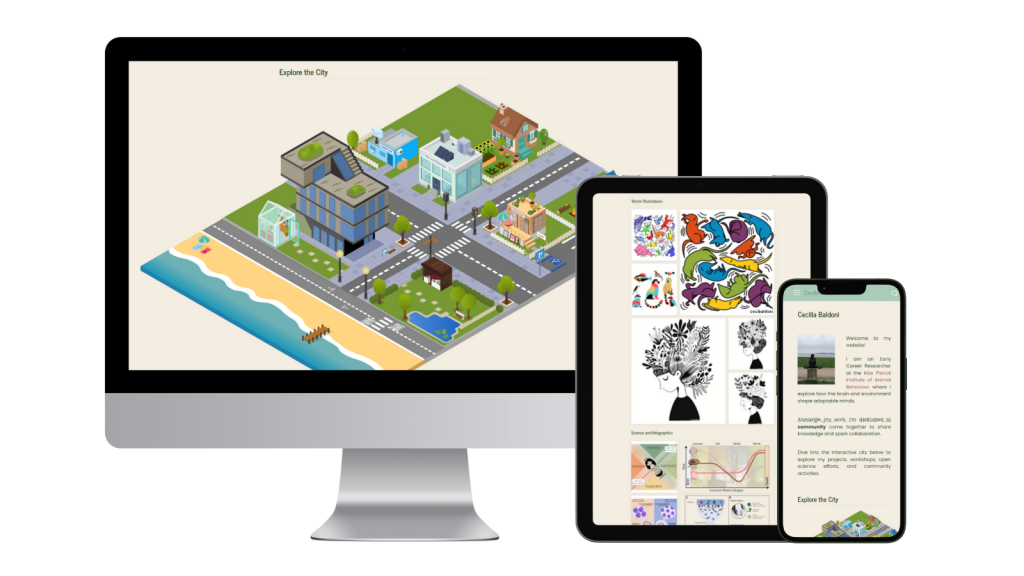
    Cecilia Baldoni GitHub website on desktop, tablet, and mobile screens
    https://cecibaldoni.github.io/

    Dr. Cecilia Baldoni

    “I was looking for a new fun way to express my creativity, and learn new ways to code and use version control!”

    —Dr. Cecilia Baldoni

    Notes from the judges

    Jennifer van Alstyne: Wow. I love the homepage interactivity. The blog post on Sketchnoting was great and the photos had captions. The Shrews page was visually engaging. I wish the text were a bit bigger (it felt like a lot of negative space on the text side). I’m obsessed with the Projects > Illustrations page. What a cute title page for their dissertation! Go explore this website. I hope it helps you imagine what’s possible for sharing your story too.

    Brittany Trinh: My favorite page is the Shrews webpage. As you scroll down the story and research unfold, and it’s a very unique way to share their research findings.

    Ian Li: The website has a bunch of interesting interactive elements. The Shrew’s page is a great example of how research can be presented in an interactive manner which elevates the understanding of the work. Baldoni also shares her slides which are viewable directly on the browser. Also, the city-like navigation on the front page.

    Back to the list of award winners

    Best Use of Art / Visuals

    Meg Mindlin

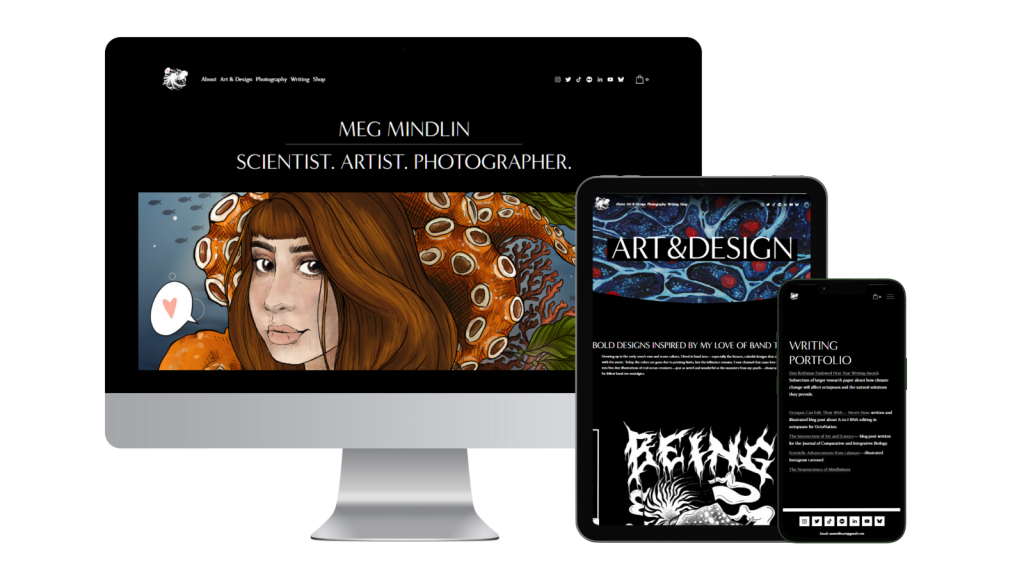
    Meg Mindlin graduate student website on desktop, tablet, and mobile screens
    https://www.megmindlin.com/

    Meg Mindlin

    “I’ve always had a website for my art portfolio, and as I was about to enter the real world, post graduate school, I saw no reason to not also utilize my website for my scientific endeavors. Especially with a budding career as a science communicator.”

    —Meg Mindlin

    Notes from the judges

    Jennifer van Alstyne did not judge Meg Mindlin’s website for this contest.

    Brittany Trinh: I love this website so much! It is a great example of how to incorporate your science and entrepreneurial ventures, while tying it together with your personal story! It is now my inspiration to update my own website.

    Ian Li: The illustrations and photography on this website are awesome. It’s a great example of visual communication of science.

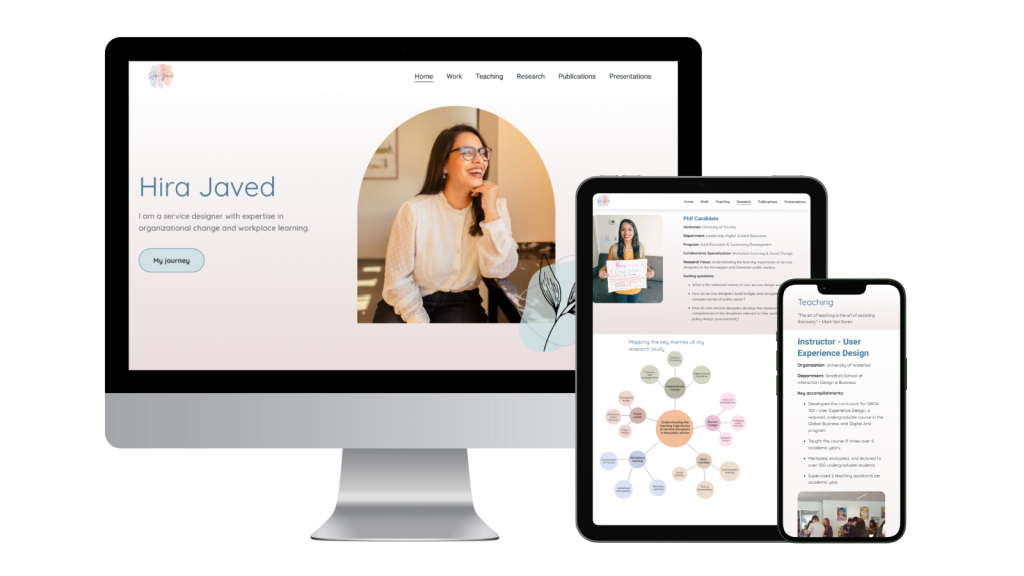
    Hira Javed

    Hira Javid phd student website on desktop, tablet, and mobile screens
    http://www.hirajaved.com

    Hira Javed

    “I made this website to tell the story of my non-linear, multidisciplinary career trajectory. It was an excellent reflective exercise for me.”

    —Hira Javed

    Notes from the judges

    Jennifer van Alstyne: This felt like a great portfolio website. A professional, resume-esque website without apology. I love that. The graphics are informative, visually engaging, and are thoughtful uses of color throughout the website. I wish that the My Journey section were built into the website rather than graphics. This section is beautiful, but the graphics make it less accessible. A favorite part of this website is the Presentations page where there’s a photo from each conference or event. That’s the dream.

    Brittany Trinh: I love the color palette and cohesion between the illustrations. I also like how Javed’s resume is color-coded and organized- it’s a creative way to showcase your experience, which you can only do on a website, and not in your resume.

    Ian Li: The coordination of the colors between the background, fonts, and graphical elements is really well done. The design serves the presentation of the Javed’s research projects, teaching, and presentations.

    Back to the list of award winners

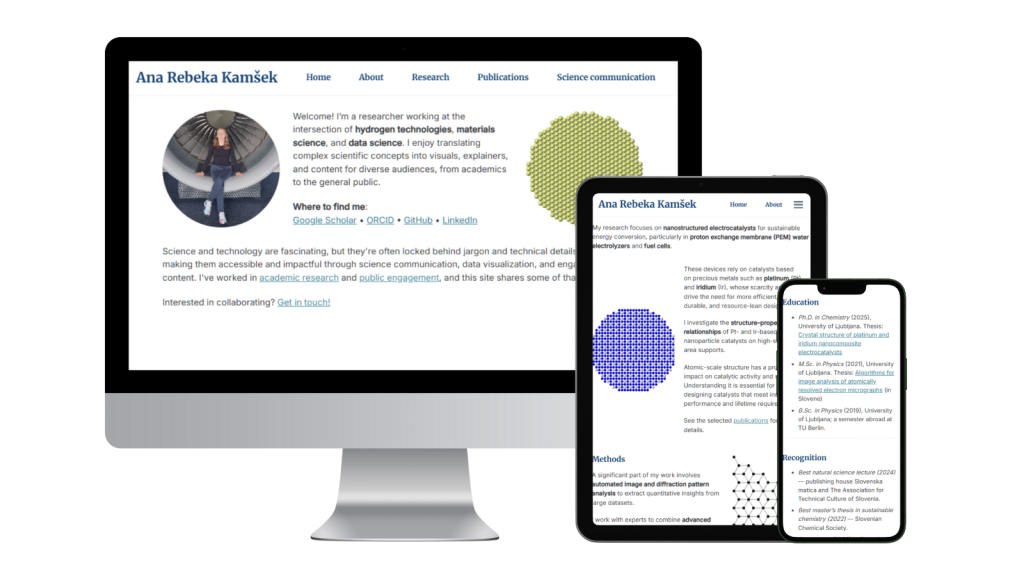
    Dr. Ana Rebeka Kamšek

    Ana Rebeka Kamšek science communication website on desktop, tablet, and mobile screens
    https://kamsekar.github.io/

    Dr. Ana Rebeka Kamšek

    “As a researcher interested in science outreach, I noticed my work was spread across platforms. People who searched for my scientific papers rarely saw what I wrote for the public, and the mix of English and Slovenian further split my audience. I wanted a home where visitors could find everything I’m proud of, regardless of language or format. A personal website felt right, and the Best Personal Academic Websites Contest nudged me to make it happen.”

    —Dr. Ana Rebeka Kamšek

    Notes from the judges

    Jennifer van Alstyne: Dr. Ana Rebeka Kamšek starts her website by sharing her value “I believe in making them accessible and impactful through science communication, data visualization, and engaging digital content.” This website does exactly that. You don’t need a huge website to share your story. A few figures, photos, with thoughtful text that considers what to say and how to share it.

    Brittany Trinh: I like that Kamsek’s publications page includes a short overview and takeaway from the papers, instead of relying just on the abstract. Additionally, the papers, related news highlights, and codes are linked for easy access.

    Ian Li: I really liked that Kamsek grouped her papers and described the relevance of each grouping. She also listed the related papers and linked to them. This made it easier to understand her work in context. She did something similar in the Science Communication page.

    Back to the list of award winners

    Thank you!

    Congratulations again to the award winners. We appreciate you.

    Don’t miss next year’s contest when it opens. Subscribe to The Social Academic blog.

    The form above subscribes you to new posts published on The Social Academic blog.
    Want emails from Jennifer on building your online presence? Subscribe to her email list.
    Looking for the podcast? Subscribe on Spotify.
    Prefer to watch videos? Subscribe on YouTube.

    The Best Personal Academic Websites Contest is brought to you by Jennifer van Alstyne, Brittany Trinh, and Ian Li.

    Source link

  • 2 U.S. Academics Among Winners of Nobel Prize in Economics

    2 U.S. Academics Among Winners of Nobel Prize in Economics

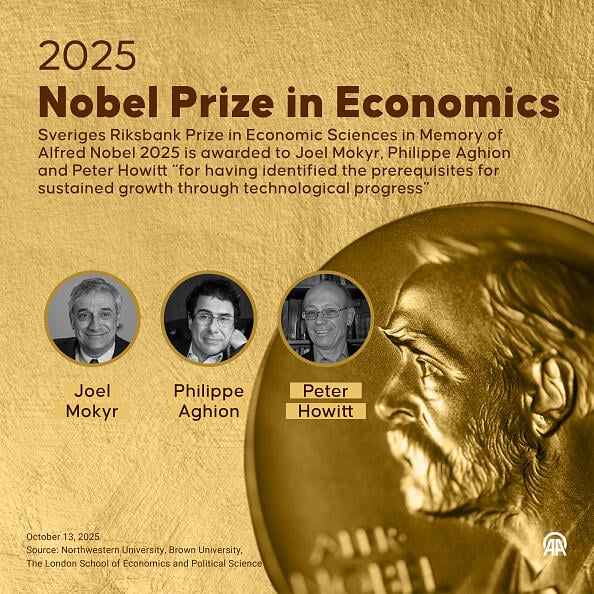
    Two American academics were among the three winners of this year’s Sveriges Riksbank Prize in Economic Sciences in Memory of Alfred Nobel. They were given the prestigious award “for having explained innovation-driven economic growth,” the Royal Swedish Academy of Sciences announced Monday morning.

    Joel Mokyr, the Robert H. Strotz Professor of Economics at Northwestern University, will receive half the roughly $1.6 million prize “for having identified the prerequisites for sustained growth through technological progress,” according to the announcement.

    Peter Howitt, a professor emeritus of economics at Brown University, will split the other half of the award money with Philippe Aghion of Collège de France and INSEAD and the London School of Economics and Political Science, “for the theory of sustained growth through creative destruction.”

    “The laureates’ work shows that economic growth cannot be taken for granted,” said John Hassler, chair of the committee for the Prize in Economic Sciences. “We must uphold the mechanisms that underlie creative destruction, so that we do not fall back into stagnation.”

    Source link

  • The PIEoneer Awards 2025: winners revealed

    The PIEoneer Awards 2025: winners revealed

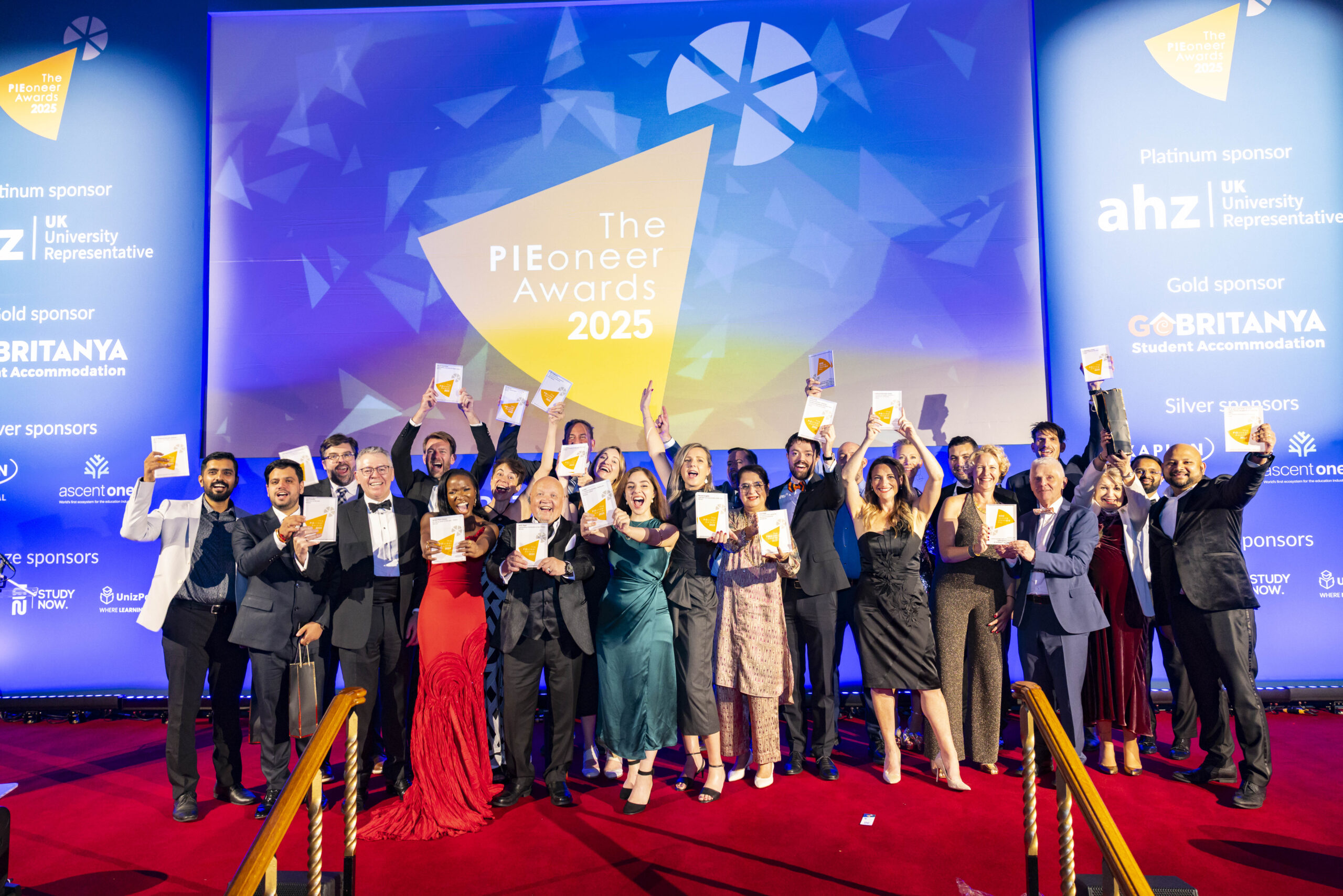
    Winners across 21 categories were announced at a glamorous gala hosted at the historic Guildhall in London, with many more entrants recognised as highly commended for their outstanding achievements and contributions to global education over the past year.

    “It feels as though the quality of The PIEoneer Award entries improves every year, and 2025 has been no exception,” commented The PIE’s editor, Beth Kennedy.

    A distinguished judging panel – representing a wide range of expertise and international backgrounds – sought out individuals and organisations redefining excellence and driving progress in global education.

    “We, and our panel of judges, were truly blown away by this year’s finalists. It’s been another challenging year for the international education sector, but their hard work, innovation and drive to make life better for international students has been truly inspiring – a sign that our community is set to thrive for many years to come,” continued Kennedy.

    In keeping with its commitment to sustainability, The PIE once again rolled out the green carpet, encouraging attendees to wear pre-loved outfits and showcase eco-friendly glamour.

    This year, the Sustainability international impact award went to the International Education Sustainability Group (IESG) with QS Quacquarelli Symonds and the University of Exeter highly commended for their Future17 SDG Challenge.

    The coveted PIEoneer of the year award recognised EasyTransfer for its efforts in simplifying global tuition payments for over 800,000 students in
    more than 170 countries.

    Each year, The PIE recognises an individual for their Outstanding contribution to the industry and this year Keith Segal, president and CEO at Guard.me, was recognised for his work in international education over the last three decades.

    It’s been another challenging year for the international education sector, but their hard work, innovation and drive to make life better for international students has been truly inspiring
    Beth Kennedy, The PIE

    The full list of winners and highly commended for the 2024 PIEoneer Awards are:

    • Business school of the year: UC Business School, New Zealand
      Highly commended: Leicester Castle Business School (LCBS), De Montfort University, United Kingdom
    • Championing diversity, equity and inclusion award: Jusoor, Global
      Highly commended: Edward Consulting, Nigeria
    • Digital innovation of the year – learning: Seenaryo, United Kingdom
      Highly commended: My Speaking Score – Real-Time TOEFL® Speaking Insights, Canada
    • Digital innovation of the year – student recruitment: VisaMonk – AI Powered Visa Interview Prep Platform, India
      Highly commended: Platty – Innovative Online Government Student Management Platform, Australia & Gyanberry – AI Powered Medical Admissions Platform, United Arab Emirates
    • Emerging leader of the year: Bimpe Femi-Oyewo, Nigeria
      Highly commended: Ricardo Tavares, United Kingdom
    • Employability international impact award: Virtual Internships, United Kingdom
      Highly commended: Wayble, Canada & PeopleCert / PeopleCert Accredited Academic Partner Program, United Kingdom
    • Excellence in data and insight: Beyond enrolment: Tracking international graduate outcome data, Netherlands
      Highly commended: Voyage’s Social Source, Australia
    • International alum of the year: Adityakumar Shrimali, India, London College of Fashion, University of the Arts, London and International Students House, London, United Kingdom
      Highly commended: Chenai Dunduru, Zimbabwe, Torrens University, Australia
    • International student recruitment organisation of the year: Keystone Education Group, Global
      Highly commended: NCUK, United Kingdom
    • Language training provider of the year: Discover English, Australia
      Highly commended: International House Yangon-Mandalay, Myanmar
    • Marketing campaign of the year: FPT University, Vietnam, STEM education in the age AI
      Highly commended: Queen’s University Belfast & PingPong Digital, United Kingdom, Bridging Research & Reputation: Queen’s Inspiring Experts Campaign in China
    • Membership organisation of the year: AIRC: The Association of International Enrollment Management, United States
      Highly commended: AIEA, United States
    • Outstanding contribution to the industry: Keith Segal, Guard.me, Canada
    • PIEoneer of the year: EasyTransfer, United Kingdom
      Highly commended: Global Seal of Biliteracy, United States
    • Progressive education delivery award: Kruu Edutech Private Limited, India & Global Cities, Inc., a Program of Bloomberg Philanthropies, United States
      Highly commended: Real Madrid Global Sports Management, Summer Discovery, United States
    • Public / Private partnership of the year: ISDC, Jain University, GOAL Guyana and SQA, ISDC, United Kingdom, GOAL – Guyana Online Academy of Learning, Guyana
      Highly commended: International student higher education recruitment, marketing and admissions support, Kaplan International, United Kingdom, Arizona State University, United States & University of Greenwich and Studiosity – A multi-year partnership, Studiosity, United Kingdom, University of Greenwich, United Kingdom
    • Secondary school international innovation: USAP Community School, Zimbabwe
      Highly commended: German European School Singapore (GESS), Singapore
    • Student support award: IES Abroad, United States
      Highly commended: KI Student Grief Network and Mindfulness-based Resilience, United Kingdom & Shorelight – The Shorelight Center for Academic Success (CAS), United States
    • Study abroad and exchange experience of the year: Coventry University Immersive Telepresence In Theatre (Romeo and Juliet Online), United Kingdom
      Highly commended: Think Pacific, United Kingdom
    • Sustainability international impact award: International Education Sustainability Group (IESG), Global
      Highly commended: Future17 SDG Challenge by QS Quacquarelli Symonds and the University of Exeter, Global
    • The Charlene Allen award for inspirational leadership: Kris Holloway, United States & Sonya Singh, India
      Highly commended: Miri Firth, United Kingdom

    The PIEoneer Awards will return to the Guildhall in September 2026 for its 10th anniversary.

    Source link

  • PBLWorks Announces its 2025 Award Winners

    PBLWorks Announces its 2025 Award Winners

    Novato, CA – The Buck Institute for Education (dba PBLWorks), a national provider of professional development and curriculum for high-quality Project Based Learning (PBL), has announced the recipients of its 2025 PBL Champions and John Larmer “JL” Lifelong Learning Awards.

    The recipients were honored during the organization’s 2025 PBL World conference in Napa Valley, California.

    The 2025 PBL Champions

    The PBL Champions program recognizes an individual, a school, and a school district that have demonstrated a commitment to PBL; have done quality, lasting work; and have shown evidence of impact on students. The 2025 recipients are:

    • District PBL Champion: Lynn Public Schools in Lynn, Massachusetts

    This 16,000-student district is transforming teaching and learning through its implementation of PBL. In a little over a year, the team at Lynn established high-functioning district and school leadership teams and trained a cadre of educators who have designed more than 70 projects for students. The district has implemented PBL at all seven of its secondary schools with a goal of having all students participate in two or more high-quality PBL experiences per year by the end of the 2029-30 school year.

    • School PBL Champion: University Prep Academy (UPA) High School in Detroit, Michigan

    University Prep Schools (UPrep) stands among Detroit’s earliest and longest-running charter school networks. Known for its unwavering commitment to student success, UPrep (UPA) has proudly upheld its signature “90/90 promise”—ensuring that at least 90% of students graduate from high school and 90% of those graduates go on to enroll in college. UPA teachers and leaders have leveraged PBL as a way that empowers students to be a part of the future of their city – from working on keeping their unhoused population warm in the winter through a physics project on heat transfer, to urban gardens that allowed students to provide farm-to-table food to local food pantries and shelters. PBL has opened their eyes to the challenges students face, encouraged them to see and explore those challenges through the lens of solutionists, and has brought UPA closer to the community it serves.

    • Individual PBL Champion: Kim Mishkin, Head of School at the Hudson Lab School (HLS) in Hastings, New York

    Kim Mishkin has been instrumental in embedding Project Based Learning as the foundation of the school’s curriculum. As both an educator and school leader, she has built structures, cultivated partnerships, and championed interdisciplinary, real-world learning experiences that empower students and educators alike. Through her leadership, HLS has become a model for how schools can integrate PBL at every level, ensuring that learning is not just about content, it is about empowering students to be problem-solvers, leaders, and changemakers.

    The John Larmer “JL” Lifelong Learning Award

    The John Larmer “JL” Lifelong Learning Award, named after PBLWorks’ Senior Fellow John “JL” Larmer, recognizes educators who are impacting and expanding the work of Project Based Learning. A significant advocate and thought leader in the field, JL has dedicated decades to advancing high-quality PBL and is the author of several foundational books that have shaped how educators design and facilitate high-quality PBL. This award celebrates those who carry forward that legacy with passion, purpose, and an unwavering commitment to deeper learning. The 2025 recipients are:

    • Rue Graham, Project Based Learning lead advisor and coach at the Pagosa Peak Open School, Archuleta County School District in Pagosa Springs, Colorado
    • Stephanie Tuttle, fourth grade teacher at Fairfield Elementary School, Rockbridge County Public Schools in Rockbridge, Virginia

    “Project Based Learning is an incredibly powerful way to engage students and ignite their passion for learning – and it all starts with having administrators and teachers who are committed to its success,” said PBLWorks CEO Bob Lenz. “Our awards programs recognize the incredible passion and hard work demonstrated by schools, districts, and individuals in implementing PBL. Congratulations to our 2025 award recipients!”

    About PBLWorks

    The Buck Institute for Education/ PBLWorks believes that all students, especially Black and Brown students, should have access to high-quality Project Based Learning to deepen their learning and achieve success in college, career, and life. Its focus is on building the capacity of teachers to design and facilitate high-quality Project Based Learning, and on supporting school and system leaders in creating the conditions for these teachers to succeed with all students.

    eSchool News Staff
    Latest posts by eSchool News Staff (see all)

    Source link

  • Project POTUS 2025 Middle School Winners Announced

    Project POTUS 2025 Middle School Winners Announced

    Indianapolis, IN — Project POTUS, a national middle school history initiative from the Benjamin Harrison Presidential Site, has named winners for this year’s competition. 

    Since the founding of our nation, there have been nearly half a billion American citizens. Of those, over 12,000 of us have served in Congress. Just 115 have become Supreme Court Justices. Only 45 citizens have become President of the United States. There’s something exceptional about each POTUS — good, bad, or otherwise. Project POTUS? challenges students in middle school to research an American president and create a video, 60 seconds or less, representing the POTUS chosen in a way that is creative, supported by good history research, and fun. A Citizen Jury made up of nearly 100 people reviewed all qualifying submissions and selected this year’s winners.

    Grand Jury’s Grand Prize and Spotlight Award Selections  

    Grand Prize Winner ($500 award) 

    • 6th grader Peter Gestwicki from Muncie, Indiana won grand prize for his video about Theodore Roosevelt. Watch his winning video  here.

    Spotlight Award  Winners ($400 award winners) 

    • 8th grader Grace Whitworth from St. Richard’s Episcopal School in Indianapolis, Indiana won for her video about President Thomas Jefferson. Watch her winning video  here.
    • 8th grader Izzy Abraham from Sycamore School in Indianapolis, Indiana for her video about President Calvin Coolidge. Watch his winning video  here.
    • 8th grader Clara Haley from St. Richards Episcopal School in Indianapolis, Indiana for her video about President George W. Bush. Watch his winning video  here
    • 8th graders Delaney Guy and Nora Steinhauser from Cooperative Middle School in Stratham, New Hampshire for their video about President James Polk. Watch their winning video  here.

    37 students throughout the country each won their Presidential Category and received $100 awards. Check out all of their videos  here.

    The 2026 Project POTUS competition begins Election Day, November 4, 2025 and all submissions must be entered by Presidents Day, February 16, 2026. Learn more  here.

    Project POTUS is made possible by the generous support from Russell & Penny Fortune. 

    About the Benjamin Harrison Presidential Site

    The Benjamin Harrison Presidential Site is the former home of the 23rd U.S. President. Now celebrating its 150th anniversary, it is a stunningly restored National Historic Landmark that shares the legacy of Indiana’s only President and First Lady with tens of thousands of people annually through guided tours, educational programs, special events and cultural programs. Rated “Top 5 Stately Presidential Homes You Can Visit” by Architectural Digest, the Harrison’s 10,000 square foot Italianate residence in downtown Indianapolis houses nearly 11,000 curated artifacts spanning more than two centuries of American and presidential history. Recently expanded and restored through a $6 million campaign, the Benjamin Harrison Presidential Site is also consistently ranked a Top 5 Thing To Do in Indianapolis by TripAdvisor. Signature programs and initiatives include: Future Presidents of America; Project POTUS, Candlelight Theatre; Juneteenth Foodways Festival; Wicket World of Croquet; and Off the Record. Founded in 1966 as a private 501c(3) that receives no direct federal support, the Benjamin Harrison Presidential Site is dedicated to increasing public participation in the American system of self-government through the life stories, arts and culture of an American President. Find out more at PresidentBenjaminHarrison.org

    eSchool News Staff
    Latest posts by eSchool News Staff (see all)

    Source link

  • LEO has a role to play in picking winners

    LEO has a role to play in picking winners

    Perhaps we have LEO all wrong?

    In the week of the industrial strategy, which brought confirmation as to how central higher level skills will be to our plans for national growth, the annual release of longitudinal education outcomes (LEO) data) hits a bit different.

    In the past, ministers and higher education obsessives, have seen the release as a chance to rank universities and subjects – and perhaps even a chance to spot the infamous “low quality courses” – based on median graduate earnings. As we’ve been through time and time again on Wonkhe, this doesn’t really work.

    But quietly, and at the instigation of the former Unit for Future Skills which now forms a part of Skills England, earnings have taken something of a back seat to more detailed information about subject areas, place, and industrial sectors. If you wanted to understand the way in which investment in particular subjects might translate to benefits to particular industries (to support changes to the allocation of the Office for Students Strategic Priorities Grant, for example), LEO is where you would look.

    Factory model

    And you can illustrate this with today’s release of LEO data on graduate outcomes and provider level data. (There’s even a new DfE dashboard.)

    Let’s take a worked example. Advanced manufacturing is one of the eight sectors named in the industrial strategy as a national priority. As a sector it is going to be receiving £4.3bn over the next five years, including £2.8bn in research and development, from the state. Of the “frontier industries” within the manufacturing sector battery technology and advanced materials feel like clear priorities – and exactly the kind of things that might need the higher level skills that a university education might bring – although manufacturing as a whole will be in a similar position.

    How do you develop these skill sets?

    First up, we can see what graduates that work in manufacturing industries have studied. Engineering is the main route (and the route to the kind of high earnings that suggest senior roles) – just over 1,900 people with a first degree in engineering are working in the sector.

    [Full screen]

    But it is clear that manufacturing also needs business expertise (there are 1,350 business graduates in the field) and design capability (890 creative arts and design graduates). Both these groups earn rather less than the engineers – the low level of pay for creative arts graduates suggests that these workers may have recently moved into the sector or are in non-graduate roles, or (whisper it) we might need to pay them better. This latter interpretation is backed up by the fact that similar proportions of graduates are in this sector a year after graduation, and designers are consistently paid less.

    There is a regional component to this too (using the purple filters at the bottom of the chart, note that you can only use one of these at once) as we can see that when we look at London we can see that salary differentials shrink between our top three.

    In terms of specific manufacturing specialisms giving design graduates good jobs ten years on, another plot of the same data suggests automotive, and aircraft/space craft, manufacturing are particularly positive destinations. That said, they are not the primary destinations for creative arts and design graduates ten years out: as with many subject areas teaching is well represented, as are retail and advertising.

    [Full screen]

    The regional dimension

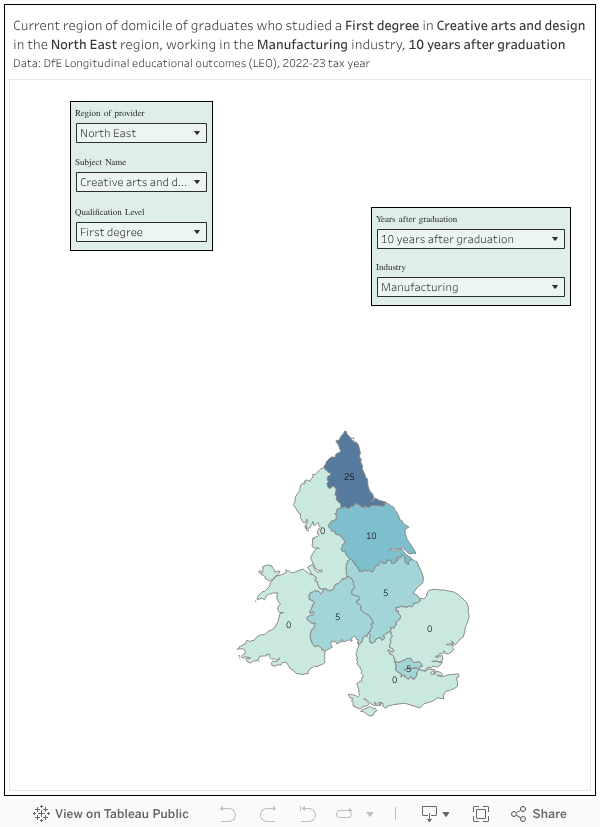
    Let’s say that we also want to use state investment in skills for manufacturing to have a regional benefit – and we wanted to focus on manufacturing in the north east. Would we need to specifically grow design provision in the north east of England in order to provide design graduates for firms there?

    Based on the data, the answer is yes. Most design graduates who studied in the north east working in manufacturing, are working in the north east ten years on. Though the numbers are small, the same appears to be true at other career points.

    [Full screen]

    Do we know if design students (rather than creative arts students) are the ones working in manufacturing? We don’t for certain but we can be reasonably sure. There are more design students than any other subjects in the creative arts and design area – and they tend to earn more ten years on than their peers in the arts. The median salaries also seem to match up – designers aren’t big earners, but they do earn more than some more traditional “skills priority” areas like ecology and mineral technology.

    [Full screen]

    Picking winners

    Seasoned LEO-watchers will be aware that there are issues when you look at specific sub-groups within the data. One of the drawbacks here is that we can’t track design specifically by provider – it would be helpful, if we decide we need more product designers in the north east, we knew which existing provider was landing them that well paid senior roles later in their careers. Best we can tell (and only five years out) it might be Newcastle and Northumbria – but we also need to factor in more granular effects (is Newcastle more likely to offer higher-paid design jobs than Sunderland or Middlesborough – I’d expect so, but we don’t get that data).

    [Full screen]

    It’s also likely that Teesside and Sunderland will be recruiting students with less traditional backgrounds, and we know that will have an impact on careers and salaries – but interestingly it appears to be Northumbria that are getting the best results for students from a domicile in a POLAR4 quintile one area.

    So there we have it: if we want to invest in advanced manufacturing in the north east of England in a way that gets the best results for local people, we need to support the design courses at Northumbria University. Which is something of a shame as we cut state support for design provision a couple of years ago.

    Source link

  • And the winners are…

    And the winners are…

    The judges in the 17th News Decoder Storytelling Competition chose as winners articles by students from The Hewitt School and The Tatnall School in the United States and Realgymnasium Rämibühl Zürich in Switzerland. 

    The entries tackled serious issues such as grade inflation, the local impacts of an international conference, demographic changes at universities, cell phones in classes, nepotism and the loss of languages to climate change.

    First Prize went to Stella Petersen of The Tatnall School in the U.S. state of Delaware for “Eliminating grade inflation isn’t as easy as ABC”, an article that considers whether letter or numerical grades on assignments are the best measure of student achievement. 

    One judge noted that the story was different from the others in the contest and well sourced. Another judge wrote: “This topic of grade inflation is an up-and-coming relevant conversation even across colleges around the country, and so many implications were considered here. The nuance in this article is marvellously impressive.”

    And for second place…

    Tying for Second Prize were Sophie De Lavendeyra of The Hewitt School in New York City and the team of Lennox Huisman and Maximilian Wunderli from Realgymnasium Rämibühl Zürich. 

    De Lavendeyra’s article, “Universities struggle with the speed of demographic change“, tackled the struggle of a university to meet the needs of a rapidly-changing student body. 

    In “When world leaders descend on your town”, Huisman and Wunderli looked at how the town and inhabitants of Davos, Switzerland are affected each year by the hordes of people who arrive for the World Economic Forum. Of the story, one judge wrote: “This was BY FAR my personal favorite in this storytelling contest. It grabbed at what really matters in journalism: How real-world, normal people are affected by big players attending the World Economic Forum.”

    The caliber of the entries as a whole was impressive. That can be seen in the fact that the judges had a particularly difficult time with the Third Prize winner — they ended with a four-way tie: Yi Le Low of Realgymasium Rämibühl won for “As fans flock to women’s football, pay stays out of play”; and from Tatnall, the third-place winners were Charles Norris for “Are smartphones at school all bad?”; Chloe Abel for “Should getting ahead depend on who you know?” and Simone Bessong for “Silencing voices by banning books“.

    The winners were selected by a three-person jury that included John West, a News Decoder correspondent based in Paris; ​Chloé Pété, a project officer for the international nonprofit organization Media & Learning Association; and ​Kaja Andrić, ​a former​ News Decoder intern and a journalism student at New York University.

    Judging student stories by professional standards

    The judges used the following criteria to rank the stories: whether the topic was fresh, different or timely; whether the student interviewed anyone for the story; whether the student reported the story without bias; whether the student considered different perspectives and finally the judge’s own subjective assessment. 

    Besides the winning entries, student Arya Sharma from VIBGYOR High NIBM in Pune, India won honorable mention for a story about how climate change can result in the extinction of human languages because of forced migration. One judge wrote: “This is my favourite story. I loved the topic, the style.”

    News Decoder Educational News Director Marcy Burstiner was particularly impressed by the challenging topics students took on. “There was such a great diversity of story topics,” she said. “It shows how curious students are about all kinds of things. They are questioning what they see around them and what they read.”

    It can’t be overstated how difficult a challenge the students were given, Burstiner said. Not only did they have to come up with an original topic to investigate, they need to find credible sources for their information and, at least for all the prize winners, they found experts to interview, and incorporated quotes from these people into their interviews.

    “Imagine, here you have a high school student asking a professional to set aside time to answer their questions for a story that will be published,” Burstiner said. “That is a difficult thing for professional journalists to do.”

    How the contest works

    The contest is held two times a year in honor of the late Arch Roberts Jr., who served with the International Atomic Energy Agency in Vienna after more than 12 years as a staff member with the U.S. House Foreign Affairs Committee. With the backing of an anonymous donor, News Decoder was able to award a total of $850 in cash prizes to this year’s winners.

    The entries came from students across News Decoder’s network of school partners. 

    To be considered for the contest, an entry must have been written by one or more students enrolled in a News Decoder partner institution. Students from nine schools in seven countries submitted articles to this iteration of the Storytelling Contest. Learn more about News Decoder’s school partnership program.

    Read the contest winners here:

    First Prize

    Eliminating grade inflation isn’t as easy as ABC

    Second Prize

    Universities struggle with the speed of demographic change

    When world leaders descend on your town

    Third Prize

    Are smartphones at schools all bad?

    Silencing voices by banning books

    Should getting ahead depend on who you know?

    As fans flock to women’s football, pay stays out of play

    Source link

  • Welcome, WINNERS, to Prosperity U (opinion/satire)

    Welcome, WINNERS, to Prosperity U (opinion/satire)

    Dear Excepted Student,

    Congratulations on your admission to Prosperity University’s class of 2026. We’re going to get you in and out of here faster and more efficiently than any of those LOSER Colleges that look like total DUMPS. You’re going to love it here. We’ve got the Best campus, the most beautiful Campus, the likes of which you’ve never seen. People are saying it’s the most Luxurious educational facility in the history of education, maybe ever.

    Our professors? Top-notch people, very Smart people. Some of the smartest people in the world, actually. They know things other professors don’t know. They teach things other universities are afraid to teach, believe me. And guess what? Our provost is None other than Neon Mush! That’s right, the greatest BUSINESS GENIUS OF OUR TIME is running our academic operations. He’s going to send our education to Mars, LITERALLY to Mars!!!

    And let me tell you, we don’t do this Ridiculous “tenure” thing here. No way. That’s for crooked lazy professors. At Prosperity U, you perform or you’re fired! Simple as that. “Academic freedom”? Just another excuse for Woke Liberal Indoctrination!!!! OUR PROFESSORS TEACH WHAT WE TELL THEM TO TEACH and it’s beautiful, believe me.

    The curriculum at Prosperity is unlike anything you’ve ever seen before. We don’t waste time with the Boring stuff, failing subjects like “science” or “medicine” or “math.” No one reads anymore, so you don’t even Need to buy books. Useless BS. We teach our students to make money. You want art? We do the Art of the Deal. WINNING!

    And let me tell you, you know, some very good people have been so discriminated against in this country. Very Good people. It’s terrible, just Terrible!! We just pick the best students, and if they happen to be the wealthy good-looking ones with great hair from the best Richest families with very big hands, which they Usually are, then that’s just how it is. That’s just how Winning works.

    We don’t have any failing students here. Zero. If you’re not WINNING, you’re not trying. Everyone at the U of P is a winner. That I can tell you. If students don’t fit in with our values? They’re fired! We don’t need whiners. You either get with the Program or you’re out, folks. We have no tolerance for losers or troublemakers.

    Let me tell you about our athletics program—it’s huge, just TREMENDOUS. We only play AMERICAN sports here, none of that soccer nonsense from shithole countries. Our football team? Undefeated. We’re winning bigly. Other schools are Terrified to play us, believe me. Nobody kneels during our national anthem, that I can Guarantee you. And we don’t have any of these women’s sports taking resources away from real sports. Title IX? Neon Mush is taking care of that. Our cheerleaders are the most Beautiful women you’ve ever seen, the most beautiful. Many people say they could be models. They love me. They’ll let you do anything to them!

    The tuition? It’s not Cheap, folks. Quality costs Money. But it’s worth every penny, every single penny. And when you graduate—which everyone does, because we fire them if they don’t show up, or sometimes, even if they do—we have a 100% graduation rate, huge crowds, biggest crowds you’ve ever seen, it’s amazing—you’ll be so successful. SO SUCCESSFUL! You’ll be tired of success.

    The other universities? Total Disasters. Sad! They’re Jealous of us, very jealous. But that’s OK. We’re making education great again, and they can’t stand it. The American people have lost faith in these liberal indoctrination camps they call “universities.” At Prosperity University, we teach Real skills for real Americans who want to stop this country from becoming a BUNCH of losers. NO SAFE SPACES HERE! No trigger warnings. We’re not afraid to pull triggers!

    Believe me, folks. Believe me.

    Sincerely,

    THE PRESIDENT

    Prosperity University

    Rachel Toor is a professor of creative writing at Eastern Washington University in Spokane and a contributing editor at Inside Higher Ed.

    Source link

  • CoSN2025 Takeaways: Meet the Winners

    CoSN2025 Takeaways: Meet the Winners

    Honors for edtech leaders across the country are always a highlight of one of edtech’s most influential events of the year. The innovations shared and insights delivered are what drive the best strategies for districts in the months and years to come. Below are some details:

    The CoSN Volunteer of the Year Award recognizes the achievements of one CoSN member who has provided exemplary support to the organization over the past year. Mike Daugherty of Chagrin Falls Exempted Village School District (OH) is this year’s winner. Mike has been a tireless volunteer and an invaluable leader in Ohio’s educational technology community. During the pandemic, he served as Chair of the Ohio CoSN chapter and extended his term an extra year to support the group during a critical time. One of his most impactful contributions has been the creation and leadership of a highly successful CETL study group. What began under his leadership during his time as Chair has grown into an annual fall cohort that meets weekly through the end of the year, guiding participants through the CETL framework. Thanks to Mike’s dedication, Ohio now has around 20 new CETLs each year — more than any other state.

    More News from eSchool News

    Teachers are superheroes. Every day, they rise to the challenge, pouring their hearts into shaping the future. They stay late to grade papers and show up early to tutor struggling students.

    We are again in uncertain times. We again find ourselves dealing with sudden changes and uncertainty. We seem to be in a state of constant change and ambiguity.

    In today’s evolving educational landscape, effective student assessment goes beyond multiple-choice tests and letter grades. According to a recent study, over 60 percent of educators believe traditional assessments fail to fully measure student understanding.

    Holden, my 21-month-old, has fallen in love.  His early morning snack and “couch time” includes a dose of “Tiger!”  This is toddler for, “Mom, turn on Daniel Tiger’s Neighborhood.”

    The COVID-19 pandemic left an indelible mark on K-12 education, placing immense pressure on teachers as they adapted, literally overnight, to new methods of instruction.

    Spring brings not only showers and flowers, but it also brings the opportunity to interview for new education positions. Preparing for an interview involves several key steps that can significantly impact the outcome.

    STEM careers are on the rise. According to the U.S. Bureau of Labor Statistics, employment in STEM occupations is expected to grow by 10.4 percent from 2023 to 2033, compared to just 3.6 percent for non-STEM occupations.

    The U.S. Department of Education is giving state education agencies 10 days to certify that their schools do not engage in any practices that the administration believes illegally promote diversity, equity, and inclusion.

    COVID had already killed thousands of people in other countries and was spreading in the United States when a top federal health official said schools should prepare to offer “internet-based teleschooling” in case they had to close for a period of time.

    More than half of educators (62 percent) are already making use of AI at school, with more than one-quarter using it daily for work purposes, according to a Twinkl survey of more than 3,500 U.S. teachers.

    Want to share a great resource? Let us know at [email protected].

    Source link