
Tag: Woes

  • Canada bears the brunt of ‘big four’ woes

    Canada bears the brunt of ‘big four’ woes

    The study, conducted by ApplyBoard, highlighted the absence of consistent communication around policy shifts in Canada, the US, UK and Australia last year – a persistent issue that it said would likely drive subdued demand across the four in 2026. 

    Although a slowdown in Canada was widely expected, ApplyBoard CEO Meti Basiri said the projected 54% decline in new study permits this year was “stark”, setting Canada on track to issue the lowest total international study visas of the big four in 2025.  

    As per ApplyBoard estimates, Canada will see the sharpest drop in new international students, granting just 80,000 postsecondary study visas this year, while the US and Australia are set to see less dramatic drops.

    The UK – the only ‘big four’ destination without a projected decline – is on track to maintain 2024 study visa issuance levels, in line new Home Office data showing a 7% increase in applications this year, though this could be slightly tempered by pending changes proposed by the immigration white paper.
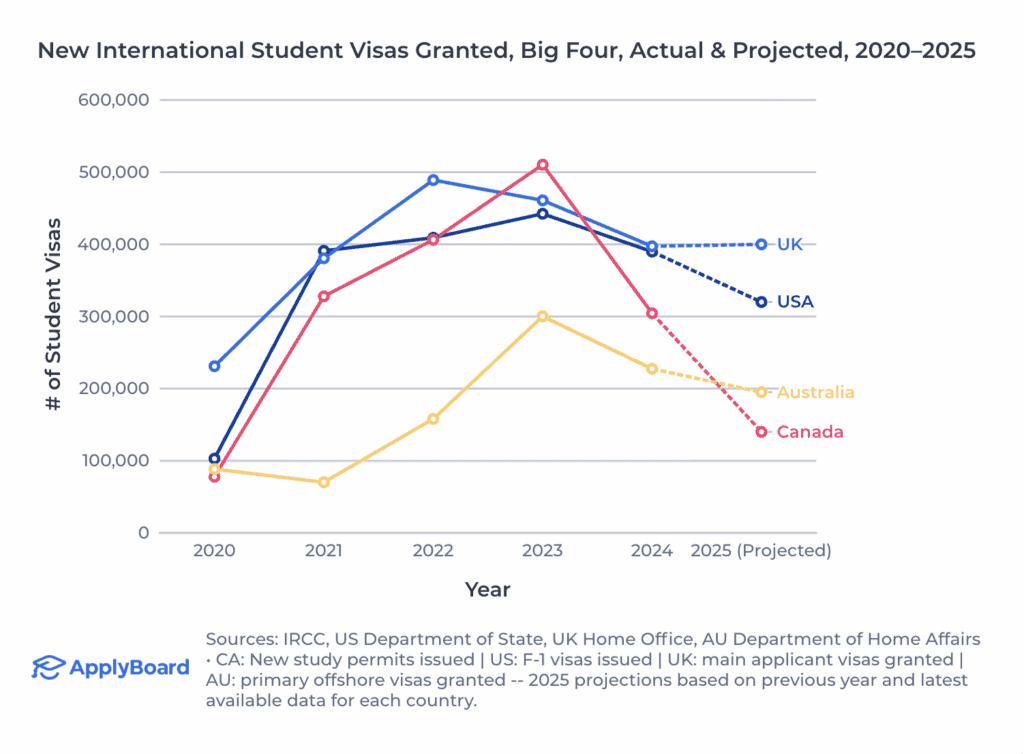
    Source: ApplyBoard.

    Basiri said Canada’s projected 80,000 new study permits would mark the lowest number of post-secondary approvals for the past decade, including during the pandemic. Elsewhere, stakeholders have raised concerns about the country’s plummeting study visa approval rate, which dropped below 40% this year.

    As the government pursues its goal of reducing Canada’s temporary resident population to below 5% by the end of 2027, the sector has been hit with two years of federal policy changes leading to lower application volumes, lower approval rates, and a higher proportion of onshore extensions.

    At the same time, in a recent student survey, Canada scored highly on welcomeness – with roughly 71% of students viewing it as open, safe and welcoming – but it also had one of the highest levels of disagreement for this metric. 

    “That polarisation suggests that international students are picking up on the tension between Canada’s long-standing reputation, and the current reality of caps, more limited work rights, and public debate that often links international students to housing and affordability pressures,” said Basiri.

    The report highlighted the impact of domestic political pressures around housing and net migration causing governments to tighten visa requirements, impose caps, reduce post-study work streams and raise compliance thresholds.  

    However, Basiri said the deciding factor for students increasingly came down to financial considerations, including the cost of study, cost of living and the ability to work during and after their studies.  

    “While political decisions set the rules of the game, affordability is often the filter through which students evaluate those rules – making it the more powerful force driving more students to consider more financially accessible destinations across Europe and the Asia-Pacific region,” he said.  

    “The speed at which alternative destinations are stepping up is remarkable,” Basiri added, highlighting the efforts of Germany, France, Spain, New Zealand, South Korea, and the UAE establishing clearer career pathways and expanding work rights, among other factors to boost internationalisation. 

    The speed at which alternative destinations are stepping up is remarkable

    Meti Basiri, ApplyBoard

    While traditional destinations are experiencing dips in demand, overall international student mobility continues to flourish, with more than 10 million students expected to study outside their home countries by the end of the decade, up from 6.9m in 2024.  

    The emergence of alternative destinations has not gone unnoticed, with another recent report tracking the rise of education “powerhouses” across Asia, fuelled by more English-taught programs, growing job opportunities and affordable study options.  

    Meanwhile, Europe is catching students’ attention, with European countries accounting for eight out of the top 10 destinations – outside the big four, Germany and Ireland – in ApplyBoard’s recent survey of student advisors.

    Basiri identified Germany and Spain as the destinations poised for the most growth next year: “Each offers a strong combination of affordability, workforce alignment, and clear post-study pathways that align with student priorities … Together, they are helping to shape the next wave of student mobility,” he said. 

    The rise of Germany in recent years has been widely reported on across the sector, with international enrolments on track to surpass 400,000 last year. What’s more, two-thirds of Germany’s international students say they intend to stay and work in the country after graduating.  

    Meanwhile, this summer the Spanish government authorised a policy to fast-track international students impacted by US visa restrictions, alongside authorising part-time work for students this academic year.  

    Coupled with previous measures relaxing visa requirements and new work and dependents rights, Spain is becoming “one of the most student-friendly destinations in Europe” said Basiri, noting its heightened appeal among Latin American students due to language and cultural affinities, as well as streamlined routes into the workforce.  
    Source link

  • University of Nebraska System offers buyouts to tenured faculty amid budget woes

    University of Nebraska System offers buyouts to tenured faculty amid budget woes

    This audio is auto-generated. Please let us know if you have feedback.

    Dive Brief: 

    • The University of Nebraska System is offering buyouts this fall to tenured faculty members eligible for retirement across its four campuses as the institution’s leaders look to shave $20 million from its budget.
    • Buyouts will be available to tenured faculty who will be at least age 62 at their date of separation and have worked at least 10 years in the system. More than 500 faculty members will qualify, according to reporting from Channel 8 News
    • In a Friday message to faculty and staff, system Chancellor Jeffrey Gold said the buyouts would position the institution “for long-term strength and financial sustainability.” The system has made several rounds of cuts in the past few years in the face of rising costs and limited state funding increases. 

    Dive Insight: 

    Like many other higher education institutions, the University of Nebraska System has sought to lower its expenses amid myriad financial headwinds, including rising labor costs and state and federal funding challenges. In June, system leaders approved plans to cut $20 million from its budget for the 2025-26 fiscal year and raise tuition by an average of 5%. 

    Those moves come after system leaders slashed $11.8 million from the most recent budget and $30 million from two years prior. The system has also offered several waves of buyouts over the past 15 years, though the payouts have decreased, according to the Lincoln Journal Star

    In this case, those taking the buyouts will receive 70% of their annual base salary in a lump sum payment. In 2019, eligible faculty who took buyouts got 80% of their annual salary and in 2014 they received 90%, the Journal Star reported. In 2010, eligible faculty received 100% of their salary. 

    Faculty members who take the latest buyouts will separate from the university next summer. 

    However, not all faculty members who apply will automatically be approved. While the system plans to allow as many interested employees to participate as possible, an FAQ said “each campus reserves the right to limit the total number of participants in order to preserve the viability of programs and services, as well as to remain fiscally responsible.”

    The news comes as the University of Nebraska-Lincoln, the system’s flagship campus, plans to slash $27.5 million from its own budget by the end of the year to remedy a structural deficit. The cuts could include eliminating or merging academic programs. 

    Earlier this month, UNL President Rodney Bennett said will review a planning committee’s recommendations for cuts and present final budget recommendations to Gold in October. 

    UNL officials also plan to grow extramural grants and contracts and boost revenue through higher enrollment and retention. They also hope to see increased revenue from the system’s tuition hike, which raised in-state undergraduate tuition from $277 to $291 per credit hour. 

    The other institutions in the Nebraska system are the University of Nebraska at Kearney, the University of Nebraska at Omaha and the University of Nebraska Medical Center.

    Source link

  • Federal Cuts Deepen Tennessee State U’s Budget Woes

    Federal Cuts Deepen Tennessee State U’s Budget Woes

    President Trump’s assault on federal grants is making Tennessee State University’s ongoing financial troubles even worse.

    The Tennessean reported last week that the chronically underfunded historically Black university in Nashville is preparing to lose $14.4 million, the remainder of an $18 million grant it received from the National Institute of Food and Agriculture. It’s one of hundreds of colleges and universities across the country facing financial uncertainty as the Trump administration moves to cut trillions of dollars from the federal budget.

    “This is going to impact our people,” Jim Grady, TSU’s chief financial officer, said at a finance committee meeting Wednesday evening. “We’ll continue to evaluate the volatility … and the potential impact to employees, students and university operations.”

    Grady said nothing would change for at least 90 days after receiving notice of the grant cancellation, and it’s not yet clear how many jobs will be eliminated as a result. And that’s not the only federal grant in question, according to The Tennessean.

    In February, the U.S. Department of Agriculture—which includes the National Institute of Food and Agriculture—canceled $45 million in federal grants to the cash-strapped university, which eliminated 114 positions last fall amid a looming budget shortfall.

    Earlier this month, the USDA restored about $23 million of those grants, though another $115 million could be suspended or frozen. TSU’s federal grants fully fund 62 employees and partially fund another 112.

    In the midst of the financial uncertainty, TSU has suspended its search for a permanent president, WKRN reported.

    Source link
