Tag: women

  • Reauthorization of Violence Against Women Act Signed Into Law – CUPA-HR

    Reauthorization of Violence Against Women Act Signed Into Law – CUPA-HR

    by CUPA-HR | April 12, 2022

    On March 15, President Biden signed into law the Violence Against Women Act (VAWA) Reauthorization Act of 2022. The legislation reauthorizes all current VAWA grant programs through 2027 and was included in the omnibus appropriations package, which provided $1.5 trillion to fund the federal government for fiscal year 2022.

    Several of the VAWA Reauthorization Act’s provisions will specifically impact higher education institutions. The bill:

    • requires colleges and universities to conduct campus climate surveys of students to track their experiences of sexual violence on campus;
    • expands and provides additional funding for the Rape Prevention and Education Grant Program and other existing campus grants designed to provide comprehensive prevention education for students;
    • establishes a pilot program that provides funding to colleges and universities (among other entities) to create programs on restorative practices to prevent and address sexual violence;
    • requires the Secretary of Health and Human Services to create a demonstration grant program for colleges and universities to provide comprehensive forensic training to train healthcare providers on forensic assessments and trauma-informed care to survivors of sexual violence; and
    • requires the Government Accountability Office to examine the relationships between victims of sexual violence and their ability to repay their student loans.

    Of particular concern for higher ed institutions is the survey to track student experiences of sexual violence on campus. Conducting the survey could create challenges for the institutions as well as for the Department of Education charged with developing it. Additionally, some institutions are already conducting similar surveys on their campuses, creating a risk of duplicated efforts. This will be a complex undertaking for both the department and higher ed institutions.

    CUPA-HR will update members on any additional information on the implementation of the VAWA Reauthorization Act as it is released.



    Source link

  • New Report on the Representation of Women and Racial/Ethnic Minorities in the Workforce of Minority-Serving Institutions – CUPA-HR

    New Report on the Representation of Women and Racial/Ethnic Minorities in the Workforce of Minority-Serving Institutions – CUPA-HR

    by CUPA-HR | February 23, 2022

    Minority-serving institutions (MSIs) play an important role in ensuring students from underrepresented races and ethnicities receive a quality education.

    While there is an abundance of research on students who attend MSIs, little research has examined the MSI workforce, specifically, how the racial/ethnic representation of faculty, administrator, professional and staff reflects the student populations being served.

    The latest CUPA-HR report, The Representation of Women and Racial/Ethnic Minorities in the Workforce of Minority-Serving Higher Education Institutions targets this gap by providing an overview of MSI representation among all U.S. higher ed institutions and showing their geographic spread across the country; providing a closer examination of racial/ethnic and gender composition of faculty, administrators, professionals and non-exempt staff; and assessing how well the racial/ethnic composition of the higher ed workforce at MSIs reflects their student populations and matches the minority-serving mission of the institutions.

    Key findings from the report:

    • MSIs have higher racial/ethnic minority representation among their workforce than non-MSIs.
    • HBCUs have the highest representation of racial/ethnic minority employees.
    • Overall, the representation of racial/ethnic minority faculty at MSIs does not match the representation in students.
    • Overall, administrators, professionals, and staff at MSIs have similar racial/ethnic minority representation when compared to students.

    For more findings on the representation of women and racial/ethnic minorities in the workforce at MSIs, read the full report.


    Source link

  • New Research Shows Women in the Leadership Pipeline in Higher Education Have Better Representation and Pay in Institutions With Female Presidents and Provosts – CUPA-HR

    New Research Shows Women in the Leadership Pipeline in Higher Education Have Better Representation and Pay in Institutions With Female Presidents and Provosts – CUPA-HR

    by CUPA-HR | January 24, 2022

    New research by CUPA-HR has found that U.S. colleges and universities with women presidents or provosts have higher representation of women in administrative, dean and faculty positions than institutions led by men. The study also found that colleges and universities with women presidents have higher pay for women in administrative positions than institutions led by men. These positions tend to be pipelines for the senior-most executive positions in higher ed, which underscores the significance of the findings.

    Women Administrators Pay and Representation in Institutions With Female Presidents

    Findings show that institutions with female presidents have a higher percentage of women in all administrative categories — senior institutional officers, institutional administrators and heads of divisions. Although female administrators are generally paid less than male administrators in the same positions regardless of the sex of the president, female senior institutional officers, institutional administrators, and heads of divisions are paid more equitably at institutions with a female president than at institutions with a male president.

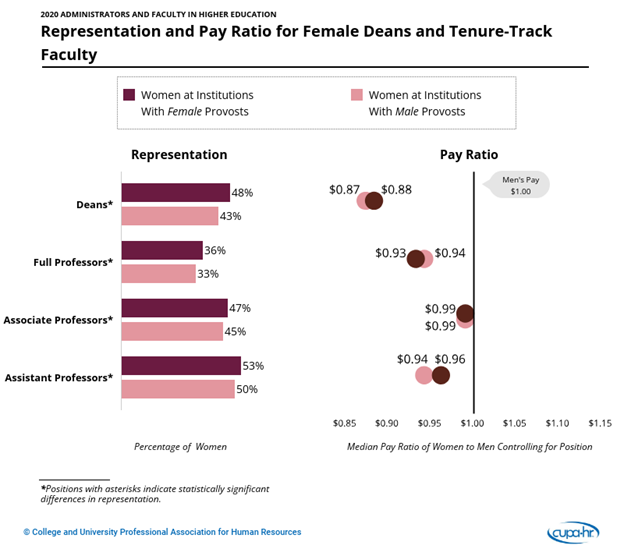
    Female Deans and Faculty Pay and Representation in Institutions With Female Provosts

    Institutions with female provosts have a significantly higher representation of women in dean positions and in all faculty ranks. Provost sex does not have a strong or consistent impact on pay equity for deans and faculty; however, it is worth noting that better representation at higher faculty ranks and in dean positions has an impact on pay, as these positions make higher salaries.

    The representation of women drops with successive faculty ranks (from assistant to associate to full professor). These promotions represent the few times in a faculty member’s career when appreciable salary increases are granted. If women are not being promoted, they are not receiving these pay raises. In addition, those in dean positions are generally promoted from senior faculty ranks. Therefore, if women are not adequately represented in senior faculty, they will not have the same likelihood as men of being considered for a higher-paying dean position.

    To sum up the findings, higher ed institutions with female executives have better representation of women throughout their institutions in positions that: a) are paid higher salaries and b) serve as key points in the executive leadership pipeline. Jackie Bichsel, CUPA-HR’s director of research and co-author of the new report, noted that, “In an era where institutions are adapting to shifting workforce expectations, adjusting to continuous decreases in budgets, contemplating changes in enrollment, addressing challenges of recruitment and retention, and rethinking their mission, more openness to change and less tolerance of risk may be just what is needed to navigate this new landscape. Providing more (and more equitable) opportunities for women to advance within higher education seems an obvious path forward in this navigation.”

    Read the full report, Women in the Leadership Pipeline in Higher Education Have Better Representation and Pay in Institutions With Female Presidents and Provosts.


    Source link