Tag: Wonkhe

  • Higher education postcard: statuary | Wonkhe

    Higher education postcard: statuary | Wonkhe

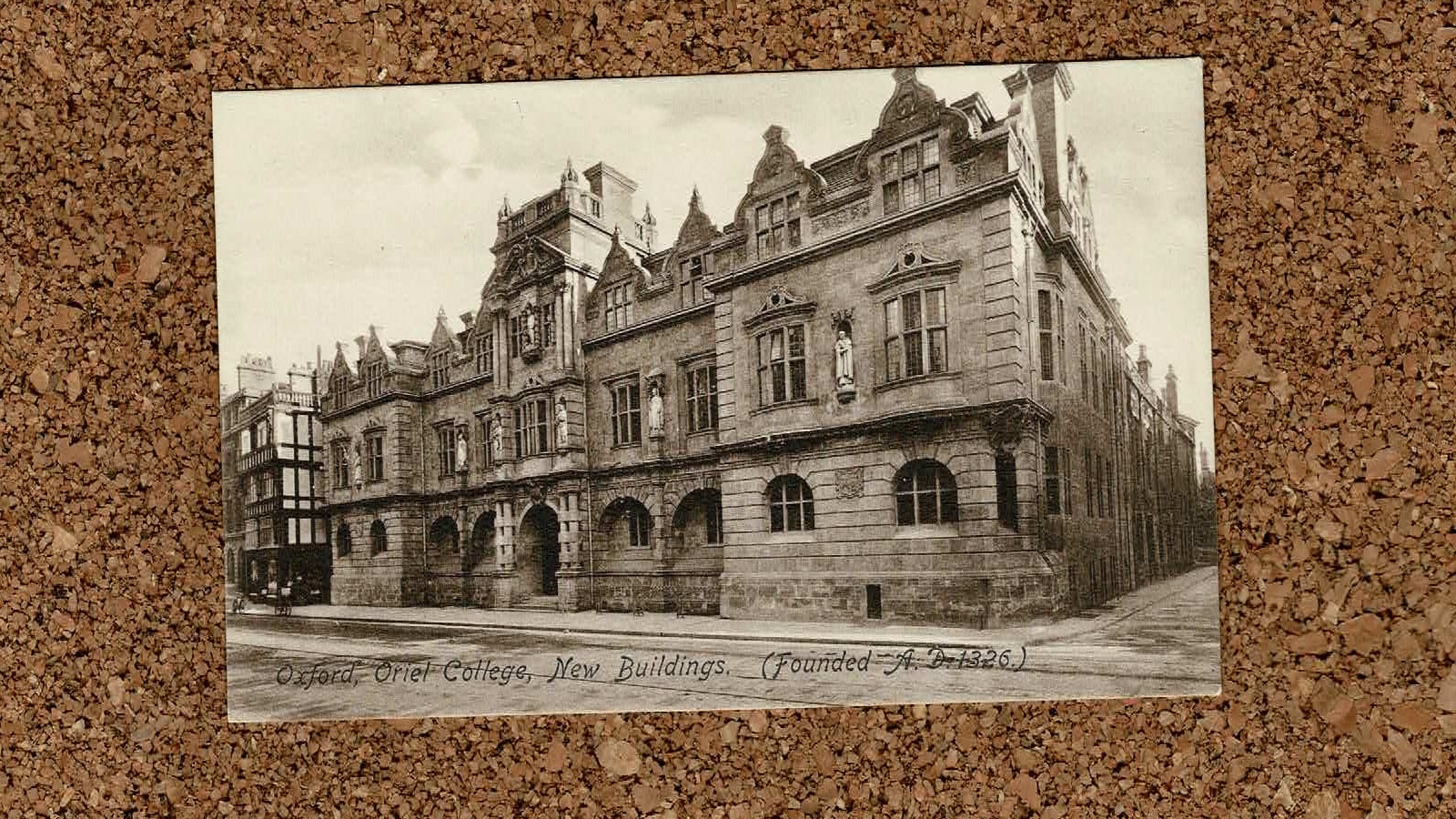
    Greetings from Oxford!

    Many – perhaps even most – universities have a statue or two. But few have a statute which is as troublesome as one of those belonging to Oriel College, Oxford. You can see the statue in question in the alcove directly above the door in the postcard – the one on its own at the top; not one of those along the first floor. And I bet by now you’ve guessed the statue. It’s of Cecil Rhodes: plutocrat, imperialist and, crucially for this post, alumnus of, and donor to, Oriel College, Oxford.

    You can see the statue a little better in this close-up from anther postcard. The Latin reads something like “from the generosity of Cecil Rhodes.” (It is also, apparently, a chronogram – the outsize capitals giving the date of construction, 1911, in Roman numerals. And it does, if you ignore the order and just add up all of the Ls, Ms, Is, Cs, Ds and Vs. There’s a really good site here to help.)

    Rhodes made money – a lot of it – from diamonds, and become politically powerful within the British southern African colonies. I’m not going to attempt a biography in this post; you can read here what Britannica has to say about him. He studied at Oxford between 1873 and 1881, the extended length of time not being explained by his gaining higher and higher degrees, but by his interrupting study to return regularly to South Africa.

    Rhodes became Prime Minister of the Cape Colony (as it was then known), and played critical roles in the British wars against the Zulu and against the Boer (he fomented the incident which led to the war against the Transvaal). He was an ardent imperialist: writing about the English, he said:

    I contend that we are the first race in the world, and that the more of the world we inhabit the better it is for the human race. I contend that every acre added to our territory means the birth of more of the English race who otherwise would not be brought into existence.

    Rhodes died young – aged 48 – and in his will left £100,000 to Oriel College (worth about £10.5 million today), a chunk of which was used for a new building on the High Street side of the college. Its the one in the postcard with the statutes. He also left money for other educational goals – for example, land in South Africa which became the campus for the University of Cape Town; and famously the Rhodes scholarships, which support students attending Oxford from the former British empire, and from Germany.

    In 2015, students at the University of Cape Town protested against a statue of Rhodes on campus. As this piece makes clear, the statue was the symbol, the protests had a broader target: the legacies of colonialism and racism within and beyond the university environment. The university’s council agreed with the protestors, and the statue was removed. Students 1, Rhodes 0. And a slogan – #RhodesMustFall – gained currency.

    In 2016, a focus of what had become a movement fell on Oxford. The Oxford Union debated and passed a motion in favour of the removal of the statue on Oriel college. In 2020 the matter surfaced again, with student protests in Oxford, and resolutions in favour of removing the statue from the undergraduate and postgraduate students of the college. Trickily for the college, the building – and hence the statues – were listed, so simply removing the statue was not possible. The college’s council agreed to hold an independent inquiry to make recommendations, and when the report was received in 2021, voted to seek to remove the statue. But, the environment was hostile, and it was clear that government, whose approval would be necessary, would not approve.

    The college has published a good explainer, which includes links to pieces by Professor William Beinart, Emeritus Rhodes Professor of Race Relations, outlining Rhodes’s legacy; and by Professor Nigel Biggar, Emeritus Regius Professor of Moral and Pastoral Theology, arguing that Beinart’s criticisms of Rhodes were overplayed.

    Now, the issue to me seems fairly simple. Did Rhodes’s actions lead to a state of affairs where if you have black or brown skin you were treated far worse than if you had white skin? The history of the twentieth century in southern Africa say clearly yes. Should we therefore be memorialising him? Reader, I invite you to answer this one for yourself.

    And that is how things currently sit. Whether under a different government permission to remove the statue might be given I do not know. Sculptor Antony Gormley suggested that the statue be turned to face the wall in shame – maybe that would be permitted? I do suspect, though, that we haven’t yet heard the last of this one.

    And here, as is customary, is a jigsaw of the postcard – enjoy!

    Source link

  • Podcast: Sussex fine, franchising | Wonkhe

    Podcast: Sussex fine, franchising | Wonkhe

    This week on the podcast we’re discussing the Office for Students fine of £585,000 levied against the University of Sussex for breaches of free speech conditions, as vice chancellor Sasha Roseneil calls the process “Kafka-esque” and plans a legal challenge.

    Plus we examine what Bridget Phillipson has called “one of the biggest financial scandals universities have faced” – franchising. Does the scandal point towards a shift towards a more “planned” system?

    With Vivienne Stern, Chief Executive at Universities UK, Jonathan Simons, Partner and Head of the Education Practice at Public First, Debbie McVitty, Editor at Wonkhe and presented by Mark Leach, Editor-in-Chief at Wonkhe.

    Sussex fined almost £600k over free speech

    So are universities allowed to chill misogyny or not?

    The franchise problem may not have a quick answer

    Welcome to the walk-in degree

    What is the franchising boom doing to drop-out?

    Source link

  • Reframing the commute | Wonkhe

    Reframing the commute | Wonkhe

    Way back in 2019, the Augar review stated that students living away from home for university was part of a “deep-seated culture.”

    By extension, it inferred that living at home – in whatever home looks like for an individual – was abnormal or uncommon.

    Six years on and it really feels like this narrative is changing. Whilst I’ve written on the site before about the sector being at cross purposes when talking about the student group, the acknowledgement and discussion of commuter students and their experiences is on the increase.

    As Wonkhe’s commuter student series has demonstrated, there are many students, scholars, policy makers and practitioners doing some excellent work to highlight the challenges faced by commuter students in higher education.

    Whilst the narrative might be changing, what is less discussed is some of the benefits of commuting for students.

    In my PhD research whilst students spoke of long and difficult journeys, struggling to park on campus or counterintuitive academic timetabling, they also spoke about the positives of their experiences. It’s these that I think are an important starting point for those looking to know more about this student group.

    Challenging the narrative

    Simply put, not all students want to live in student accommodation. Some prefer to live with family. Mature students don’t necessarily want to live with younger students or uproot their family units into family accommodation options.

    For those who have been in full-time employment to starting their studies, they saw the commute as just part of a working day.

    One of the students in my study specifically told me that they didn’t expect their institution to do anything special for them as a commuter because commuting was just “what you do” in order to get to class.

    For the wider student experience, a number of students in my research participated in multiple extra-curricular activities and had numerous friends they’d met through these, as well as on their commute or on their course. One commuter even elected to get a rail replacement bus at a weekend to participate in their sports club. Anyone who has ever taken a rail replacement bus will know that this isn’t a decision taken lightly.

    In all these instances, commuter students demonstrated either the positive benefits of commuting, or that they were able to participate in university life irrespective of their commute.

    I’m not trying to say that all commuter student experiences are positive. Unless you hold an amount of luck, you’re going to be late to class at some point due to some kind of transport issue. We’ve all been there, stood waiting for a bus that doesn’t turn up or a train that’s delayed. It’s frustrating and sometimes (read, often) it makes you late to class.

    What I am saying is that this deficit narrative of commuter students often does them a bit of a disservice and ends up homogenising their experiences in a way that isn’t always that useful if we’re trying to think about how to improve their experience.

    It’s not you, it’s me

    Instead of thinking about the commuter student, we might want to consider thinking about the institution itself.

    After all, when we’re framing commuter student experiences what we’re really doing is talking about how they fit in with the institutional structures that frame their university life.

    For one of the commuters I spent time with, delays to their journey were frequent even when allowing plenty of time for their journey. What is of interest though was what happened next.

    One of their class tutors routinely employed the institutions’ academic attendance policy. The policy stated that if a student arrived later than 15 minutes after the class had started, they’d be marked as absent. This meant that a couple of times, whilst they’d informed this staff member via email in advance that they’d be late and did physically make it to their class, they were still marked absent because they arrived 15 minutes late.

    In contrast another tutor, acknowledging that this student had emailed them warning of their late attendance, allowed them to sign the register when they arrived.

    Institutions can have one attendance policy but have staff enact it in different ways. If you’re a commuter student who’s had an awful journey to get to class, it’s not ideal when you’re not sure how your class tutor might respond.

    This particular student had been previously recommended by their tutor that they should factor more time into their journey to arrive on time. This student, along with many others in my study, were already factoring in extra time in their journeys.

    You can also see why there might be some disgruntlement between students here. If you’ve done the same journey as someone else on your course who has a different module tutor, you’d be annoyed to find out that they let them sign the register yet your tutor marked you as absent. Experiences like these then can lead to differing expectations between students and the institution which could develop into some pretty bad feeling.

    Great expectations

    I suggest it’s a question here around what the institution deems a reasonable expectation of its students, and by extension whether or not the institutional structures are suitably flexible enough to accommodate any fluctuations within these.

    If the above example here is anything to go by, it’s likely that what’s considered as a reasonable expectation of commuter students will differ between students, institutional policies and ultimately the staff that enact them.

    Where students spoke to me about commuting to university in more positive terms, it was often relating to how their expectations of university had matched their reality. This could be down to the individual themselves. For example, where students had researched their commute or done a commute to work prior to starting their degree they took things like disruptions to travel as simply part of life as a commuter student.

    But if the expectations that were being asked of students had changed. For example, being taught by different academic staff with different stances on attendance, or these experiences were not clear between the institution and the student to begin with, this negative narrative could often arise as a result.

    Being a commuter student is not mutually exclusive to having a poor student experience. But if we want to hear more about the positive experiences of commuter students, we need to think about why they’re positive and consider how our institutions can enhance these experiences further.

    Source link

  • Higher education postcard: Nalanda | Wonkhe

    Higher education postcard: Nalanda | Wonkhe

    A long time ago, in a land far, far away from where I sit in Swansea, King Kumaragupta I established a monastery as a centre for higher learning. The monastery was in Nalanda, in modern-day India, and the year was something like 427 CE.

    Nalanda was already a holy site: it had been visited by Siddhartha Gautama – who you might know better as Buddha – and was the birthplace of one of his disciples. By 427 CE there had for some 700 years been a stupa at the site, containing the remains of Sariputta, the disciple. Mahavira, a significant character in Jainism, had lived there. It was a place of pilgrimage.

    Roy Lowe and Yoshihito Yasuhara’s 2016 work, The origins of higher learning, contains a good discussion on Nalanda, on which this blog draws. The monastery was active between 427 and the twelfth century CE, so it had about 700 years of existence, and overlapped the creation of the first European universities and the Islamic centre of learning based upon mosques and libraries.

    Nalanda attracted scholars from many countries and regions – Lowe and Yasuhara report Persia, Tibet, Chia, Korea, Indonesia and Mongolia. (Their book highlights just how mobile scholars – and their ideas – were in the ancient world. It’s well worth a read.) From two of the Chinese scholars, Hiuen Tsang (who spent three years at Nalanda) and I Tsing (who, emulating Hiuen Tsang, spent ten years there), we can find out about life and learning at Nalanda.

    It seems that Nalanda was organised on a collegiate basis – that is, residential, with tutors supervising students’ learning. At its height there were about 1,500 tutors and 8,000 students, which is a very Oxbridge ratio.

    To gain admission, a student had to answers questions posed by the gatekeeper; apparently only one third of those who sought entry were successful. A high degree of literacy was expected of applicants: they must be familiar with core Buddhist texts and philosophical writings, although there was no religious belief bar to study.

    Kumara Gupta I and subsequent rules had granted Nalanda a substantial income, from the produce of over 200 villages. This income supported the tutors and scholars: there were no tuition fees, and no requirement for students to undertake any task other than learning, discussion and contemplation.

    The site was about the size of the City of London; there were ten temples, eight monastic buildings – which served as colleges – and over 600 individual study-bedrooms. But don’t think modern rooms with ensuite – this means space for a bed, and niches in the walls for a light and a bookshelf. The library was in three buildings, one of which was nine stories high; it is estimated that it held several hundred thousand texts; and copies were given to scholars who left for elsewhere.

    Nalanda was governed by an assembly which took all major decisions, including those relating to admission, allocation of study-bedrooms, and students discipline. (Nalanda’s authority over its members seems to have been like that of a medieval European university.) There was a clepsydra, which regulated the times for eating and bathing.

    The curriculum is known to have included study of Buddhist texts, and other subjects such as medicine and magic. Amartya Sen identified the subjects as including “medicine, public health, architecture, sculpture and astronomy… religion, literature, law and linguistics.” It is clear that Nalanda was a site for secular learning, not simply religious instruction. There was a tall tower for astronomy.

    And, wonderfully, it seems that Nalanda spawned other institutions of higher learning. Gopala, who came to power in the region in the 700s, after a century in which there had been a power vacuum and much strife, founded several institutions which formed, with Nalanda, a network. These were at Odantapura, Vikramshila, Somapura and Jaggadala. Lowe and Yasuhara speculate that this could be thought of as a federal organisation: tutors and scholars were able, and indeed were encouraged, to move freely between them; it was a single project to enhance learning.

    Nalanda is now simply ruins, although a modern university was established near the site in 2010, and in the 1960s there was what was regarded as a new university on the site. It says so on a postcard, which, as we know, never lie.

    Here’s a jigsaw of the postcard, which is from a 1960s tourist pack of several of the site and the temple. It is unsent, and the pack had been held together by a rusty staple whose disintegration enabled me to scan this one without damaging the others.

    Source link

  • The polycrisis needs you | Wonkhe

    The polycrisis needs you | Wonkhe

    Facing a climate and ecological polycrisis, human society needs to make a transition to restore life on earth to a sustainable footing.

    This is particularly true for those parts of the world sufficiently prosperous to have well-developed higher education systems, both because there is capacity and because the causes and effects of the crisis are uneven.

    Education for this purpose is variously called “education for sustainable development”, “teaching the crisis”, “climate and sustainability education” and other alternatives. There are good conversations to be had about the relative merits of these terms – what they invite, what they close off – but those are for a different piece. For this one we can go with EfS – education for sustainability.

    For those unconvinced

    In addressing the question of how higher education curricula can accelerate this transition, it helps to engage with the reservations. While many professionally oriented degrees already have some variant of sustainability in the criteria set by their accrediting body, it tends to be the harder, purer disciplines that pose the toughest questions about EfS.

    One position is that, as a matter of academic freedom, sustainability should not be imposed on higher education curricula. It’s true that coercion sits problematically with the kind of criticality and individual judgement higher learning demands. Yet students are already implicitly treated as prospective custodians of their discipline, and while on the surface this can look very diverse, there is a common basis of consistent reasoning, intellectual humility, collective endeavour, ethical practice, and academic integrity.

    It seems a small step to include the kind of integrative, future-oriented learning that characterises EfS – especially given that EfS exists to preserve and uphold the existing values. To underline this point, see the revised QAA Subject Benchmark statements, which begin to distinguish what EfS could be for different subject areas.

    Another concern is that there is no space for EfS in a given curriculum. It’s true that EfS needs thinking through to make it relevant to disciplinary teaching and learning. It’s also true that all curricula are all more or less time sensitive and are developed by module and programme leaders drawing on their evolving expertise and foresight. A case in point is the medical degree, perhaps the most pressured of all curricula.

    The General Medical Council takes a position that Education for Sustainable Healthcare and the concept of Planetary Health are key to addressing the greatest threats to health we face, and consequently medical curricula are integrating these.

    Somebody else’s problem

    The assumption that somebody else should do the EfS is common. It often comes from a place of humility and self-doubt – a belief that there are colleagues better qualified to lead this work, with better-suited modules. But in a modularised system this is a trap that needs to be sidestepped. EfS is most meaningful when integrated rather than adjunct, and strongest when it connects deeply with the disciplines students have signed up to study; it belongs in the core of a curriculum at each level. Viewed in this way, supporting core module leaders to develop themselves to teach the climate and environmental crisis through the lens of their discipline, along with ways students and graduates can contribute to addressing it, does not seem much different from any other continuous self-development a disciplinary expert and educator would undertake.

    Another reservation is that students of a given subject or discipline don’t need sustainability as part of that education. In response to that, an appeal: the polycrisis is existential and it needs you.

    This makes sense if we recognise climate breakdown, biodiversity collapse and all that follows from those as a “wicked” (nexus) problem that cannot be addressed by one discipline alone, but needs a plurality of perspectives within and beyond academia.

    For example, the modelling that informs the planetary boundaries framework depends on mathematicians, who in turn depend on scientific researchers collecting data out in the field, who in turn use bespoke equipment and software created by engineers with particular cases in mind. The modelling needs visualisation by scientific communication specialists, and it needs the kind of readiness abundant in arts and humanities to imagine and inculcate the social transformation implied. The transformation requires specialists in economics, law and policy, and the creativity of business and management. The impetus for all of this is health, and its dependency on our life support, a stable planet. So, education for sustainability doesn’t take students away from their discipline but draws deeply on it. This ability and intent to bring their disciplinary learning to the world beyond academia is what any academic hopes their students will do.

    Beyond the UN goals

    In some quarters there is a perception of EfS as teaching about the United Nations Sustainable Development Goals, and this is a misunderstanding which partly explains the reservations about disciplinary fit above. A simple explanation for why the SDGs on their own have not successfully averted the polycrisis is that they are in considerable tension with each other and require trade-offs. Education for Sustainability is an action-oriented education focused on empowering students to navigate these competing goods, cognisant that the basis for all of them is a habitable planet. It recognises that being able to mobilise knowledge does not necessarily follow from knowing alone.

    Hence the EfS emphasis on holistic thinking that recognises disciplinary boundaries and is curious beyond them, dialogue towards a shared, multifaceted understanding of the problem at hand, and the ability to contribute the most relevant of one’s own disciplinary perspectives and methods, in negotiation with others, to arrive at a collective plan of action which deals justly with conflicts of interests.

    This kind of education has always been valuable. In current times, where collective human behaviour is key to averting hunger, forced migration and conflict, it is not only valuable but urgent.

    Source link

  • Students on the Frontlines: The Ongoing Protests in Serbia with Jim Dickinson

    Students on the Frontlines: The Ongoing Protests in Serbia with Jim Dickinson

    If I say the word “Serbia”, chances are your mind goes to things like the NATO air attacks of 1999 and the associated Kosovo War, to the breakup of Yugoslavia and to Marshal Tito and maybe – if you’re more historically-minded – to the origins of World War I.  It probably doesn’t go to higher education or radical student politics.

    But that’s kind of unfortunate because in fact Serbia’s recent history has had plenty of instances where youth- or student-based movements have had an effect on politics, most notably with respect to the overthrow of Slobodan Milosevic in 2000.  And that’s very relevant today, because for the last 18 weeks, Serbia students have been on a campaign to rid the country of the governing Serbian Progressive Party on grounds of corruption.  They have formed some extraordinary alliances across civil society leading to regular marches involving tens of thousands of people as well as a series of rotating strikes.  The movement has not yet reached its ultimate objective, but it has claimed some notable victories along the way, most notably when the Prime Minister, Milos Vucevic, was forced to resign in January. 

    With me today to analyze all of this is Jim Dickinson.  He’s an associate editor at Wonkhe in London, one of the most remarkable Higher education sites in existence, and to my mind absolutely the best-informed person on the European student politics scene.  Jim wrote an excellent summary of the situation in Serbia around the time of the Vucevic resignation, and we thought it was high time to finally bring Jim on the show. 

    Jim talks about the origins of the protests, its growth and metastasis into a genuinely popular national protest movement and its prospects for future success.  Will Serbia end up being like Bangladesh, with students actually forcing regie change?  The future is never certain, of course.  But what I liked about Jim’s perspective is the way he takes account of the interplay between official student “unions” and an unofficial student “movement” and explains why you need to take account of both to understand the current situation in Serbia.

    But enough from me.  Let’s turn it over to Jim.


    The World of Higher Education Podcast
    Episode 3.21 | Students on the Frontlines: The Ongoing Protests in Serbia with Jim Dickinson 

    Transcript

    Alex Usher: Jim, before we get to current day events, tell me—what are student politics normally like in Serbia? Are student unions more about service delivery or activism? Is there just one national student union, or are there multiple ones? Are they organized on a party-political basis? Tell me how it all works in a normal year.

    Jim Dickinson: You know, we were there about 14 or 15 months ago, and we were quite impressed. We took a group of UK student unions on a little bus tour, as I do each year to different parts of Europe, and it was quite impressive. Student representation is guaranteed at both the faculty and university levels. Broadly speaking, what is also guaranteed is a student union, which has responsibility for extracurricular activities, as well as for student voice and representing students.

    These unions then feed into something called the Student Conference of the Universities of Serbia. What’s interesting—and a few countries in Europe have done this—is that they’ve put the national student union on a statutory footing. So, it’s actually mentioned in legislation. Essentially, they took the National Conference of Rectors, the university association, added an “S” at the front, and set it up as a statutory body that listens to students’ views on higher education.

    So, in theory, the legislation establishes representation at the faculty, university, and countrywide levels. Students have the opportunity to elect other students, organize student activities, and be the voice of students—which are broadly the two activities you would expect when you hear the phrase “student union.” Maybe not in the U.S., but certainly in most other parts of the world.

    Alex Usher: Is there party political involvement in student unions there?

    Jim Dickinson: I mean, this is really interesting. Some people would say there is. But one of the things that’s kind of, I guess, moderately characteristic of the former Yugoslavian and Eastern European countries is that there’s not much open talk of politics.

    Sometimes students will align with particular political views, but this isn’t like what we might see in Austria, Germany, or even Finland, where large factional or party political groups of students stand for election to student councils. In Serbia, student unions are framed as being independent from formal politics—pure, in a sense, and separate from direct political involvement.

    Now, of course, what actually happens—depending on who you listen to and believe—is that youth branches of political parties do stand in these elections. And depending on the perspective, the government—certainly the current government—is accused of pumping in money and candidates to ensure a level of control in these bodies, much like what might happen in other parts of civil society in the country.

    But officially, you don’t see that. In fact, in some of these countries, student unions will even sign documents declaring their complete independence from party politics as a way of signaling, “We’re not about that; we’re about the students.”

    Alex Usher: Tell me about the history of student unions getting involved in national politics. I know there’s a history going back to the 1960s in Bulgaria of student involvement in politics.

    After the fall of the Berlin Wall, there were two major instances in Serbia. In 1996–97, students led protests against what were seen as rigged elections in favor of Slobodan Milosevic. Then in 2000, there was a youth-led—but not student union-led—movement called Otpor, which was the central organizing group that ultimately helped remove Milosevic after the 2000 elections.

    Now, obviously, there’s a big mobilization happening today. What’s the connection between those events in the late 90s and early 2000s and what we’re seeing now?

    Jim Dickinson: So, ahead of putting student unions—both locally and nationally—on a statutory footing, there were always student groups and associations, often based around faculties or entire universities. Because these groups were relatively loose and voluntary, their level of political interest and influence would fluctuate.

    They often got caught up in the kind of events you described—first in the late 80s and then throughout the 90s. And that’s actually quite common. When student groups are loosely organized and not statutory, with many different associations and organizations floating around, they tend to get swept up in big political movements when those arise.

    Now, while you’re right that Otpor was technically a youth movement, in practice, it was largely dominated by students. That group of people was widely credited with the overthrow of Milosevic. We’ve actually visited some of the student accommodations where they were organizing, and you can really see how that must have worked—how students would have been talking to each other, coordinating, and mobilizing.

    Beyond that point, things get a bit more complicated.

    Alex Usher: So, Otpor was student-led, but not student union-led. That’s the distinction here?

    Jim Dickinson: Yeah.

    Alex Usher: Let’s get to current events. It’s November 1st, 2024. We’re at the railway station in Novi Sad, which is Serbia’s second-largest city. What happens next?

    Jim Dickinson: So, a canopy collapses, killing 15 people. By the time they’d completed their assessment about 24 hours later, the death toll had risen to 15. Pretty quickly, rumors started going around that this must be linked to corruption.

    There’s been a series of complex, controversial deals linked to some Chinese companies involving infrastructure projects across different parts of the country. So the view was that this was negligence, this was corruption, and that this was another example—right on their doorstep in this big student city—of the Serbian government’s corruption causing harm and death.

    Social media videos of the canopy collapsing on young people were pretty heartbreaking, and they went viral very quickly.

    What was interesting at that point was that this student group based in the Faculty of Philosophy, which had already been upset about the formal student union elections in their faculty and at the University of Novi Sad, then switched their attention from occupying the faculty building over student union election politics.

    They turned their focus to this incident, and quite quickly organized a blockade of the railway station, a blockade of the faculty, and then things kind of swept on from there.

    Alex Usher: I get that—it’s understandable why the collapse of a public building might make people upset about corruption. But why is it youth leading this charge? I mean, it’s not unnatural, but it’s also not a given that students would be the ones leading this.

    Why them and not some other group in society? Or even opposition parties? Why a small group of disaffected philosophy students?

    Jim Dickinson: Well, I mean, in many ways, that is the big question. I’m sure if the Serbian Progressive Party knew the answer, Alex, they’d have stopped it by now.

    I think the reality is that all of those involved in formal mechanisms of politics—to some extent—are discredited. And that’s something you see across many political systems, right? There’s a general distrust of politicians and of formal politics, both on the right and the left, in North America and across Europe.

    What’s interesting about this group of students is that, in many ways, you’ll find a similar type of group at almost every relatively elite, fairly academic, large university in the world. You’ve got the students who get elected to official positions, wear suits, and sit down with the rector, vice-chancellor, or president. And then there’s this other, rougher-looking group—the ones who like to think about bigger political issues. They’re the ones who will blockade a building, go on a protest, or join a demonstration.

    This particular group has probably always been there, usually complaining about student union elections. Then, suddenly, this huge tragedy happens in the city, and they find their big issue—something they can build their movement around.

    Often, they talk about building a social movement, but it’s hard to do when the issues they focus on don’t gain traction. This, however, was not a hard issue to mobilize around. It was a tragedy, it was clear-cut, and off the back of that, they took action.

    Alex Usher: That’s early November. The protests build and build, and by early December, they’ve secured the resignation of the minister of construction.

    So, at this point, what were the student movement’s aims? I get that they were upset about corruption, but what were they actually demanding in these demonstrations? And, given how informal the structure was, who was deciding what those demands were?

    Jim Dickinson: It’s really interesting because the demands haven’t really changed since then. Some were directly related to the tragedy, some were broader, and some were focused on higher education.

    Actually, if you look at some of the pro-Palestinian blockades and demonstrations in different countries over the past couple of years, they’ve also had a mix of demands like this.

    In this case, there were demands to publish all the documents related to the reconstruction of the station. There were calls to ensure that no criminal proceedings would be brought against protest participants. There was also a demand for the dismissal of all public officials who had assaulted students and professors—of which there were quite a few.

    Then there were demands related to higher education, like increasing the budget for higher education by 20%. And what’s fascinating is that this list of demands hasn’t really changed.

    Now, to answer your question about leadership—one of the defining characteristics of this kind of activism, which some people see as very old-fashioned, is that it’s highly decentralized. Decisions are made collectively, with lots of people sitting in circles discussing them. There’s no single figurehead. They’ve really tried to stick to those principles, even though, historically, that kind of approach sometimes falls apart depending on which allegorical novel you read.

    Despite the media’s efforts to identify particular ringleaders or intellectual figures behind the movement, it’s been difficult to pin down a single “bad guy” or figurehead. This stands in stark contrast to the formal student movement, which operates like a traditional hierarchy—a structured system where representatives elect other representatives, and so on.

    Alex Usher: So, it’s a little like the Occupy movement?

    Jim Dickinson: Yeah, very, very similar.

    Alex Usher: Over the course of December and January, the movement builds to the point where, eventually, the prime minister resigns on January 28th. That wasn’t even one of the demands, but it happened anyway. To make that happen, they had to build a coalition—not just within the student movement, which is one thing, but also by making links across civil society, with other groups like legal organizations, unions, teachers’ unions, and so on. How did a group of students manage that, especially given how decentralized their power structure was?

    Jim Dickinson: Part of it was about peaceful protest. If you look at historical examples like the Prague protests or the Velvet Revolution, they were always very deliberately peaceful, even though allegations are often thrown at them.

    So, good framing was key—absolutely sticking to those principles. And then, night after night, day after day, at each protest, they slowly built support from wider society. As time went on, they captured the imagination of more and more people. First, musicians got involved, then lawyers, then farmers, then taxi drivers.

    Each time a new group joined or more people expressed sympathy, the movement grew. And there’s historical precedent for this—going back to the late 80s and early 90s—where what started as a student movement began to voice deeper concerns about corruption, about the direction of the government, about how citizens are treated, and about the growing disconnect between the public and politicians. And they used powerful, simple, visually striking imagery. You might have seen the red hands in some of the protest photos—symbolizing “blood on their hands.” That really resonated with people.

    Because these countries have been through this kind of thing before—where students lead the charge and wider society gets behind them—there was this sense that both the students and the broader public felt the weight of history on their shoulders. And from there, it just kept growing.

    I was watching over Christmas—one night, there were 10,000 people in the streets, then 12,000 the next night, then 15,000. It just kept building. And every time the government tried to use traditional authoritarian tactics, the protesters held their nerve. They maintained their dignity, and in doing so, they were able to expose the government as authoritarian—cracking down on people who were making perfectly reasonable demands.

    Alex Usher: So that’s what’s happening in the streets. But what about the campuses? Are they shut down? Is there a strike? Is there a risk of losing the school year? And how are university administrations dealing with all of this?

    Jim Dickinson: That’s a really interesting question.

    Quite often—and this is probably true in the UK, certainly true in Canada and the U.S.—when there’s a blockade of a building, an occupation, or a major protest, you still get a form of teaching happening. There are efforts to ensure that education continues, though it might not be the same curriculum the university originally intended, and it often takes on a particular political edge.

    So, what they’ve been doing is blockading faculty buildings and university buildings, stopping some administrative functions from happening. But some teaching is still taking place.

    Now, whether that translates into exams happening or students receiving certificates at the end of the year varies widely. It depends on the campus, the faculty, and the university.

    A lot of that comes down to the level of support for the movement. So, it depends on what you mean by a “write-off.” There’s plenty of evidence that students are still getting an education, but if you’re the kind of student who isn’t interested in any of this and just wants your diploma at the end of the year, then it’s probably a disaster.

    Alex Usher: Just so listeners and viewers know, we’re recording this on February 11th—nine days before the air date. This is the 101st day of the protests. What do you think the endgame is here? What would it take at this point for students to achieve the aims you talked about earlier? Or are they going to have to settle for half a loaf?

    Jim Dickinson: Well, I mean, it’s really interesting.

    Just this week—or maybe it was right at the end of last week, I’ve lost track—they got the 20% budget increase, for example. Nobody expected that to happen two weeks ago. So, slowly, they’re managing to achieve pretty much everything except the dismissal of all the public officials they’ve been demanding.

    The problem, of course, is that even if they achieve all of those demands, they still won’t have reached their broader political goal—which is that they believe this is a deeply corrupt government. And while they don’t frame it in party political terms, they think this populist government needs to go. So, the endgame starts to get tricky for them.

    They’ve already achieved far more than most people expected. And historically, there’s precedent for this. There were plenty of student uprisings in Eastern Europe in the 1960s that captured the public’s imagination but ultimately didn’t lead to political change.

    So, once most of the demands are met and we get closer to the end of the academic year, will the movement start to fizzle out? Who knows?

    But for many of the people involved, they’re probably already thinking, “We’ve accomplished a hell of a lot more than we ever thought we would.” And certainly a lot more than the official student movement was ever going to achieve on these issues.

    Alex Usher: That brings me to my last question. This has been a success for the student movement—if you can call it that—but not necessarily a success for student unions. So, what do you think the impact will be on more official student organizations going forward? Are unions likely to be supplanted by something a little more anarchist? Or do they just go back to providing the same services they always have?

    Jim Dickinson: I mean, look—across the world, the bigger, more sophisticated, and more formally recognized student unions are, and the more access they have to decision-makers, the more mistrust tends to build.

    Both the textbooks and reality tell us that when student leaders start spending too much time with people who aren’t students, people begin to see them as too close to decision-makers. And that dynamic exists in every student movement around the world.

    The real question for a system like Serbia’s—which has student unions written into the constitution and structured to mirror the conference of rectors, university presidents, and vice-chancellors—is whether, in hindsight, that structure is simply too close to power.

    And that comes down to one of two concerns.

    If the official student movement hasn’t actually been controlled by the government but just appears too close to it, then there’s some broader reflection needed on the system’s credibility. But if it has been deliberately set up as a way for a corrupt national government to control it—to act as a puppet master—then that carries much bigger implications.

    Either way, you have to assume that where student energy is focused will shift. And that’s key because there’s only so much student energy available.

    Right now, the biggest problem for formal student unions is that student energy hasn’t gone into electing people to run the social committee or to be the faculty vice president and have a chat with the dean about curriculum.

    This year, the bulk of student energy has gone into something bigger—and they’ve won. That’s something a lot of people, both within the sector and seemingly within the country as a whole, will have to reckon with.

    Alex Usher: Jim, it’s been a pleasure. Thanks so much for joining us today. And I just want to take a moment to thank our excellent producers, Sam Pufek and Tiffany MacLennan, as well as you—our viewers, listeners, and readers—for joining us. If you have any questions about today’s episode, don’t hesitate to reach out at [email protected]. Never miss an episode of The World of Higher Education podcast—subscribe to our YouTube channel today. Next week, we’re off, but join us two weeks from today when our guest will be Israeli scholar Maya Wind. She’s a postdoctoral fellow at the University of California, Riverside, and the author of Towers of Ivory and Steel: How Israeli Universities Deny Palestinian Freedom. Bye for now.

    *This podcast transcript was generated using an AI transcription service with limited editing. Please forgive any errors made through this service.

    Source link

  • Predictably bad education | Wonkhe

    Predictably bad education | Wonkhe

    The game is up, people. Pack away your research, close the seminar rooms, forget your marking, cancel all your meetings – the higher education scam has been blown wide open.

    Just one man has done what generations of revolutionaries have failed at – through the simple power of speaking his lived experience he has named and thus destroyed the secrets and lies that have underpinned higher education’s decades-long conspiracy to take over the world.

    As Matt Goodwin puts it in his introduction to Bad Education:

    There’s a sort of secret code of silence among professors and academics on campus – what the Mafia call omertà. No matter how bad things get, no matter how glaringly obvious the crisis becomes, no matter how visibly these once great institutions are failing our young people, you just never, ever tell people on the outside.

    Well, to hell with that. I’m going to tell you everything. I’m going to pull back the curtain, lift the lid, and show you why our universities are falling apart, and how this crisis is now trickling out of the universities to weaken our wider society – our politics, culture, institutions and ways of life.

    It’s quite the arresting premise – and for anyone familiar with UK higher education (the book is ostensibly about UK higher education, even though most of the over-familiar examples and references are from the US) it prompts the reader to consider the roots of the polycrisis the sector currently faces: is it a poor underpinning funding settlement that privileges meeting market needs over socio-economic needs, a failure to deal with the legacy of an elite system of prestige in an era of mass higher education, an overreliance on the journal article as a measure of academic esteem, or the long-lasting impact of the 2017 decision to allow universities unfettered access to the financial markets?

    Tears in rain

    Alas, no. The problem, as diagnosed by a newly-minted visiting professor at the University of Buckingham’s Centre for Heterodox Social Sciences, is diversity initiatives.

    In one glorious passage in the first chapter, we are treated to a range of “I’ve watched…” statements that serve as a thesis for the entire (short) book. He’s seen things you people wouldn’t believe:

    I’ve watched this divisive, dogmatic and dangerous ideology not only infect every facet of university life but deliver, fundamentally, a bad education to our students… I’ve watched its most hardened and committed followers draw on obscure academic theories to crudely declare that all Western nations are ‘institutionally racist’… I’ve watched its followers ‘decolonize’ reading lists… I’ve watched universities betray their students, families and taxpayers by encouraging the next generation to view highly complex, multi-ethnic societies in crude, simplistic and divisive ways… I’ve watched them capture and politicize the large and expanding university bureaucracy… I’ve watched them dumb down intellectual standards on campus… I’ve watched them impose this dark and dystopian worldview on our students… And And I’ve watched this movement sacrifice free speech and academic freedom on the altar of what its followers call ‘social justice’, or ‘diversity, equality and inclusion’ (DEI).

    If you were taken aback by some of the Americanisms in that short excerpt I must reassure you that – somewhat surprisingly for a book about the UK – they appear to be a deliberate stylistic choice. We’ve seen the beginnings of attacks like these before – not least from an actual minister of state (Michelle Donelan) on diversity initiatives (or things that look like diversity initiatives from a distance) at UKRI, Advance HE, and – somehow – the QAA. In those cases, the charges felt disproportionate and somehow removed from the life of UK higher education. Almost as if there was a global playbook. And, gosh, doesn’t that stuff about DEI and dogma hit differently the month that NASA was forced by the US government to remove positive language about women and minorities from its website as a “drop everything” request?

    To be clear, Goodwin isn’t against diversity initiatives in all forms – he is very keen, for example on political diversity where it results in the protection of the ability of academics to promote views he (and a few high profile fellow travellers: Goodhart, Kaufmann, Stokes, Stock…) agrees with. He applauds, seemingly without irony, the establishment of the usual list of places (the University of Austin Texas, Ralston College, the Peterson Academy, the Centre for Heterodox Social Sciences at Buckingham) that openly profess only the new orthodoxy he cleaves to.

    Grift to the mill

    Because the sadness in all this is that he isn’t saying anything new. You can hardly open a newspaper without seeing some newly “free” academic (or opportunistic politician) claim you literally can’t speak your mind on campus any more, that students and their opinions are mollycoddled, and that there are too many administrators. It must be comforting for him to see such views widely and confidently shared, and to see politicians speak and governments legislate in response to those views, but it does rather damage his self-image as a John Galt-esque lone figure speaking truth to power.

    As an expression of this particular transatlantic groupthink, Bad Education is far from the worst. He makes some (selective) use of evidence, though as anyone familiar with his “polling” will note his use of statistics isn’t great and there are some telling misreads of the data: no Matt, one in three UK academics is not on an “unstable fixed-term and zero-hours” contract in 2024, the correct figure is 0.8 per cent although you can get close to your 80,000 if you look at all (FT or PT) fixed term contracts. But the vagary suits the point he is making. He’s happy to cite thinkpieces and substacks, less keen – despite a promise to – cite data and evidence. Many of the journal articles and books he reaches for are over-familiar, and closer to journalism than research.

    To give you one example, we’re given what feels like a stern rebuttal of the BBC’s “Reality Check” investigation that found only six occasions where campus speakers have been banned between 2010 and 2018. You are midway through the expected language on the chilling effect before you recall that statistics collected by the actual higher education regulator show similar numbers for later years – and while it is fair to say that free speech is a preoccupation of those who hold minority views, the fact that you have to fish very deep to find any evidence at all that anyone outside of the groupsicles perceives a problem with the way things currently are. Appeals to a silent majority – or the two people that email Matt Goodwin every time he is called out online – don’t really cut it, whatever murky underpinnings he may implore the reader to see.

    Lived experience

    So far – so much “silenced academic speaks out.” What is different is Matt Goodwin’s career trajectory. He started off his academic life as a researcher focusing on radical right-wing movements – his current era, which could be characterised as making him look more like an apologist for many of the same movements, has raised more than a few eyebrows among his colleagues and contemporaries. Has the noted chronicaller of radicalisation been radicalised?

    Clearly academia did not turn out the way he expected:

    “ can even remember imagining at the start of my academic career that my life as a university professor would look something like Russell Crowe’s character in A Beautiful Mind – the mathematician John Nash, who spent his days advancing the frontiers of knowledge while wandering around leafy campuses with books under his arm and students hanging on his every word (though, to be fair, Nash later went completely insane).

    It’s his experience at the University of Kent (an institution he waspishly describes as “non-elite” and “teetering on the bridge of bankruptcy”) that seems to have done the damage – in particular his experience following the Brexit vote after putting forward a position he characterises as:

    when a majority of my fellow citizens did vote to leave the EU I thought it important to respect their view, not least to safeguard representative democracy

    Goodwin’s research shortly after the vote was focused primarily on the reasons people voted for Brexit – he’d argued before the vote that an “enthusiasm gap” (drawing on the passion of Brexit supporters being greater than the passion of Remain supporters for EU affiliation) would drive the outcome, and afterwards he worked with other researchers (in Brexit: Why Britain voted to leave the European Union) to identify immigration and identity as key drivers of the popular movement.

    After a few articles along these lines in the national press, and some perhaps less measured thoughts on social media, he began to feel persecuted by fellow academics.

    In the weeks, months and years that followed I experienced what I can now only describe as a sustained campaign of abuse, intimidation and harassment, equivalent to how a religious cult treats a heretic. I was accused of being an ‘apologist’ for the ‘far right’. I was denounced as a Tory stooge. I was called an extremist. Even my own head of school liked a tweet insulting me. I experienced coordinated social media ‘pile-ons’, ironically led by academics who proclaim themselves to be among the most ‘liberal’ of all.

    Gatekeepers and dissent

    It’s worth unpicking the pile-on narrative.

    What happens is that one or two ‘gatekeepers’ let it be known to more junior academics that somebody has fallen out of favour, that somebody has violated the orthodoxy. The green light is then given for academics to pile in, usually on social media, and a coordinated campaign to try and assassinate somebody’s character and reputation begins

    There is (or was, social media pile-ons feel like a moment of their time as much as social media now does) no planning involved. If you say something people believe to be unpleasant online, people will tell you that the thing you said is unpleasant, and in doing so spread your original thought to others who will also tell you that it is unpleasant. Such is the attention economics of the industry.

    And early Matt wasn’t particularly unpleasant or even over-serious – this is a man who, lest we forget, ate his own (actually pretty good) Brexit book live on Sky News. An early draft of the “what happened to you?” chapter from Bad Education doesn’t even mention social media as he blames the “radicalisation of the elite class” for his growing disenchantment with scholarly life. While he’s made a conscious decision to move away from the mainstream opinions held by people with a similar set of life experiences, the early phases feel more like senior common room drama than the work of a shadowy cabal. He only really got into full scale pile ons when he published the similarly slight Values, Voice, and Virtue back in 2023.

    That’s not to say that others (including some of those he approvingly cites) have had worse experiences online and offline. Clearly nobody should be receiving death threats or risks to their health as a result of their terrible opinions – though it is also clear that our right to describe opinions as “terrible” when we feel they are terrible is inalienable. But if your entire story is hung around the way you were ostracised and vilified just for speaking the truth it probably needs a bit more than just a few whines about how nobody wants to write academic papers with you any more since you gave up on any pretence of dispassionate academic rigour.

    My interest in this phenomenon isn’t in the ostracisation itself (for further information on academics falling out with each other please see the entire history of academia from the School of Athens onwards) but in the way a “safe space” has emerged for former academics of a particular political stripe to band together and secure funding and media opportunities for ventures of a particular ideological bent. If Matt had left his career behind because his concern that universities weren’t doing enough for disadvantaged groups or were not active enough in bringing about social and economic changes went against a prevailing orthodoxy that we should just rub along with anyone that wants to fund us he would not be welcome in that particular gang. He wouldn’t get past the gatekeepers.

    And a half-hour spent in the world he creates in his Substack, books, media appearances, and mainstream news commentary broadcast suggests that you don’t have to do much more to be in this group than to cry persecution and recirculate the same tired old tropes about liberal extremism. There’s very little sadder than a group of free-thinking iconoclasts that all say the same thing – and something as craven as Bad Education is a long way from what the old, research-focused, evidence-led Matt Goodwin once did.

    Source link

  • Higher education postcard: Taxila | Wonkhe

    Higher education postcard: Taxila | Wonkhe

    We’re doing anther historical incursion today – looking at what was an internationally renowned centre of higher learning in the Indus valley.

    We have to wind the clock back a long way. In 535 BCE Persian emperor Cyrus the Great invaded the lands to the east, and by 540 BCE had taken all of the lands to the west of the Indus. A regional capital was established at Taxila, which by then had probably already been a city for about 500 years. It was the obvious choice, having been capital of the ancient kingdom of Gandhāra. We also need to note that in 326 BCE Taxila surrendered to Alexander the Great’s army; that a few years later it became part of the Mauryan empire for over 100 years; then part of the Yavana empire for another hundred years or so; then occupied by Indo-Scythians between 80-ish BCE and 30 CE; and the Kushan empire until about 375 CE.

    The following account draws strongly on Roy Lowe and Yoshihito Yasuhara’s 2016 work, The origins of higher learning. After the Persian conquest, Taxila became a centre for Vedic learning. By the time of Alexander and the early Mauryan emperors, there was a demand for scholars who could speak Greek.

    As well as the Vedic scriptures, medicine was taught at Taxila. Two eminent healers – Charaka and Jivaka – both studied at Taxila, perhaps under the teacher Disapamok Achariya. Other notable people associated with Taxila included Panini (who was neither the inventor of the sandwich nor the inventor of sticker albums, but was in fact a Sanskrit grammarian) and Chanakya, an early political economist.

    Lowe and Yasuhara tell us something about academic life at Taxila. Individual teachers shared a building with their students, and would enrol up to five hundred students. Senior students were used as assistant teachers, as clearly 500 is too many for one person (it’s easy to recognise the doctoral-students-as-teaching-assistants model here).

    The curriculum comprised “the three Vedas and the eighteen accomplishments”. The three Vedas – books of verses – were the Rigveda (knowledge of the verses), the Yajurveda (knowledge of the sacrifice) and the Samaveda (knowledge of the chants). The eighteen accomplishments are not so clearly specified. On the evidence seen by Lowe and Yasuhara they may have included “elephant lore, magic charms, spells for reincarnating the dead, hunting, the study of animals’ cries, archery, the art of prognostication, charms, divining from bodily symptoms, and medicine”; to which was later added “logic, the atomic theory of creation, arithmetic, law, accountancy, agriculture and astronomy.”

    This looks like a cracking degree programme to me. Particularly once I’d realised it was prognostication not procrastination, for which I’d want to submit a claim for accreditation of prior experiential learning. And, if you’re tempted to get sniffy about seriousness, it probably represented a good stab at the frontiers of knowledge at that time. Which is what first and second cycle qualifications of the UK higher education qualifications frameworks are about nowadays. So not so daft really.

    The Kusham empire, in the first century CE, destroyed the city of Taxila to make way for their own city, rebuilt a little to the north. And in the fifth century the Hunas destroyed the rebuilt city. (It is not clear if these Hunas were connected to the Huns who were busy invading Europe at about this time.

    And so there we have it; a very early institution of higher education. It is now a world heritage site, as suggested by the postcard, and a very popular tourist destination in Pakistan.

    A final cultural connection. A favourite of mine from the 1970s TV schedules was Monkey! This was a TV adaptation of an early Chinese novel, the Voyage to the West.

    The song played over the closing credits includes the lines “In Gandhāra, Gandhāra, they say it was in India…” – our heroes were escorting a Buddhist monk, Tripitaka, to being back some holy scrolls to help the emperor restore morality and order to China. It seems likely, I would suggest, that they were heading to Taxila.

    And really finally, here’s a jigsaw of the card, in case you feel the need of some pleasant distraction.

    Source link

  • HESA Spring 2025: staff | Wonkhe

    HESA Spring 2025: staff | Wonkhe

    HESA Spring 2025 kicks off in earnest with a full release of the staff data for 2023-24.

    Unlike in previous years, there’s been no early release of the headlines – the statistics release (which provides an overview at sector level) and the full data release (which offers detail at provider level) have both turned up on the same day.

    Staff data has, in previous years, generally been less volatile than student data. Whereas recruitment can and does lurch alarmingly around based on strategic priorities, government vacillation about student visas, and the vagaries of the student market – staff employment tends to be something with a merciful degree of permanency. Even if it isn’t the same staff working under the same terms and conditions, it does tend to need broadly the same number of people.

    With the increasing financial pressures felt by universities you would expect 2023-24 to be a deviation from this norm.

    Starters and leavers

    We’ll start by looking at the numbers of starters and leavers from each provider. This chart shows the change in academic staff numbers year on year between your chosen year and the year before (as the thick bars) and the total number of full and part time staff in the year of your choice (as the thin bars). Over on the other side of the visualisation under the controls you can see total staff numbers, broken down into full and part time as a time series – mouse over a provider on the main chart to change the provider focus here. You can filter by year, and (for the main chart) mode of employment.

    [Full screen]

    What’s apparent is that across quite a lot of the sector academic staff numbers didn’t change that much. There were some outliers at both end – Coventry University had 585 less academic staff in 2023-24 than 2022-23, while Cardiff University has 565 more (yes, the same Cardiff University that confirmed plans for 400 full time redundancies yesterday).

    If you’ve been following sector news this may surprise you – last year saw many providers announce voluntary or compulsory redundancies. The Queen Mary University of London UCU branch has been tracking these announcements over time.

    Schemes like this take time for a university to run – there is a mandatory consultation period, followed (hopefully) by some finessing of the scheme and then negotiations with individual staff members. It is not a way to make a quick, in year, saving. Oftentimes the original announcement is of a far higher number of staff redundancies than actually end up happening.

    Subject level

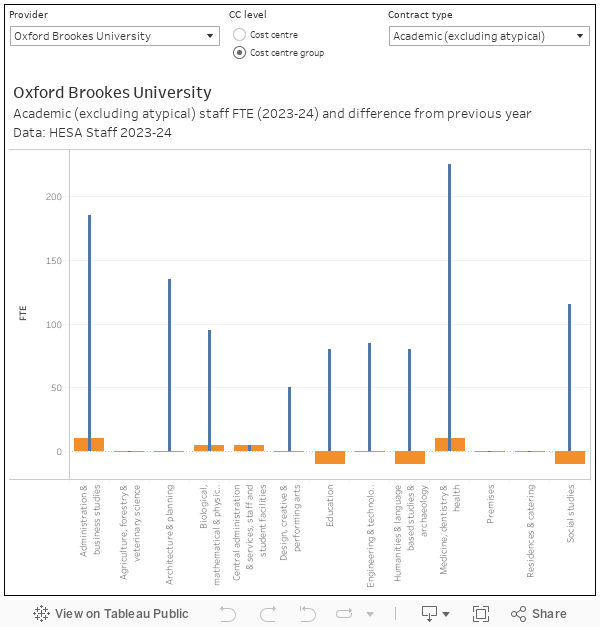
    If you work in a university or other higher education provider, you’ll know that stuff like this very often happens across particular departments and faculties rather than the whole university. I can’t offer you faculty level from public data, but there is data available by cost centre.

    [Full screen]

    Cost centres are usually used in financial data, and do not cleanly map to visible structures within universities. Here you can select a provider and choose between cost centre groups and cost centres as two levels of detail. I’ve added an option to select contract type – in the main I suggest you leave this as academic (excluding atypical).

    Zero hours

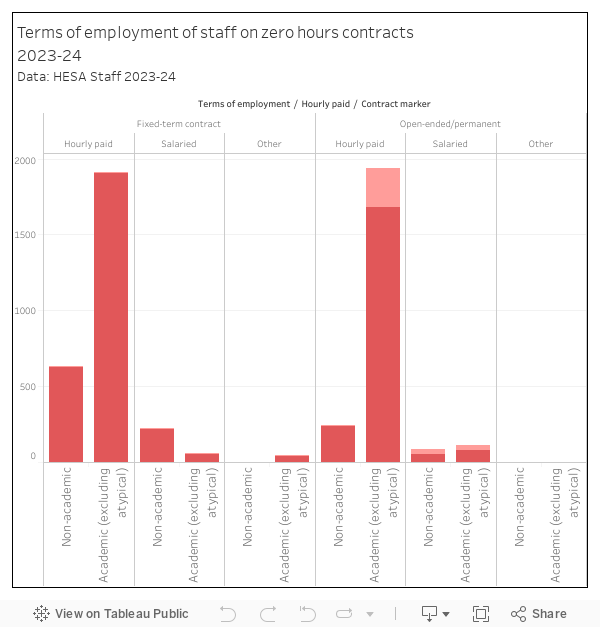
    I’m sure I say this every year, but not all providers return data for non-academic staff (in England they are not required to), and an “atypical” contract usually refers to a very short period of work (a single guest lecture or suchlike). There is a pervasive myth that these are “zero hours” contracts – even though HESA publishes data on these separately:

    Here’s a chart showing the terms of employment and pay arrangements related to zero hours contracts for 2023-24. You can see the majority of these are academic in nature, with a roughly even split between fixed term and open-ended terms. The majority (around 4,075) are paid by the hour.

    [Full screen]

    This represents a small year-on-year growth in the use of this kind of contract – in 2022-23, there were 3,915 academic staff on a zero hour contract

    Subject, age, and pay

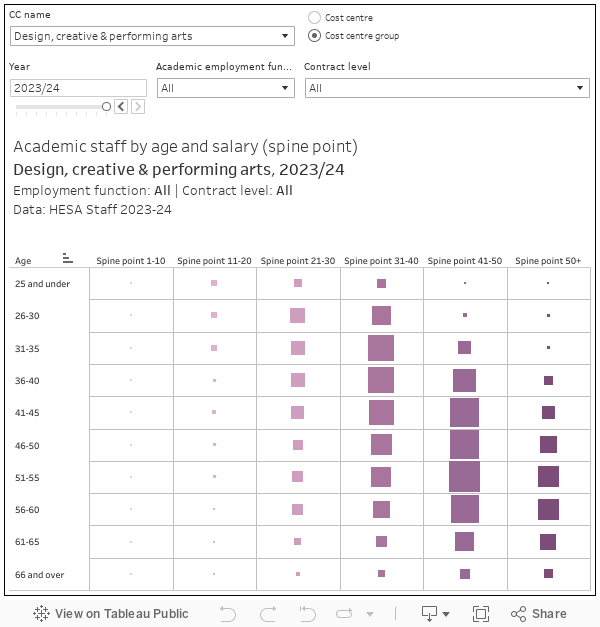
    I often wonder about the conditions of academic staff across subject areas, and how this pertains to the age of the academics involved and how much they are paid. This visualisation allows use to view age against salary (relating to groups of spine points on the standard New JNCHES pay scale used in most larger providers).

    [Full screen]

    As you’d expect, overall there is a positive correlation between age and salary – if you are an older academic you are likely to be paid more. This is particularly pronounced in design, creative, and performing arts: where staff are likely to be older and better paid on average. Compare the physical sciences, where more staff are younger and spine points are lower.

    This chart allows you to select a cost centre (either a group or individual cost centre), and filter by academic employment function (teaching, research, both…) and contract level (senior academics and professors, others…). There’s a range of years on offer as well.

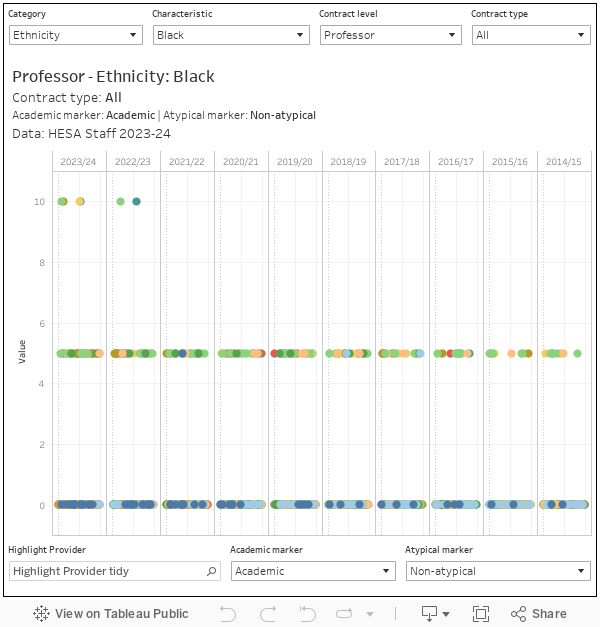
    Ethnicity

    The main news stories that tend to come out of this release relate to academic staff characteristics, and specifically the low number of Black professors. There is some positive movement on that front this year, though the sector at that level is in no way representative of staff as a whole, the student body, or wider society.

    [Full screen]

    Source link

  • Data futures, reviewed | Wonkhe

    Data futures, reviewed | Wonkhe

    As a sector, we should really have a handle on how many students we have and what they are like.

    Data Futures – the multi-year programme that was designed to modernise the collection of student data – has become, among higher education data professionals, a byword for delays, stress, and mixed messages.

    It was designed to deliver in year data (so 2024-25 data arriving within the 2024-25 academic year) three times a year, drive efficiency in data collection (by allowing for process streamlining and automation), and remove “data duplication” (becoming a single collection that could be used for multiple purposes by statutory customers and others). To date it has achieved none of these benefits, and has instead (for 2022-23 data) driven one of the sectors’ most fundamental pieces of data infrastructure into such chaos that all forward uses of data require heavy caveats.

    The problem with the future

    In short – after seven years of work (at the point the review was first mooted), and substantial investment, we are left with more problems than we started with. Most commentary has focused on four key difficulties:

    • The development of the data collection platform, starting with Civica in 2016 and later taken over by Jisc, has been fraught with difficulties, frequently delayed, and experienced numerous changes in scope
    • The documentation and user experience of the data collection platform has been lacking. Rapid changes have not resulted in updates for those who use the platform within providers, or those who support those providers (the HESA Liaison team). The error handling and automated quality rules have caused particular issues – indeed the current iteration of the platform still struggles with fields that require responses involving decimal fractions.
    • The behavior of some statutory customers – in frequently modifying requirements, changing deadlines, and putting unhelpful regulatory pressure on providers, has not helped matters.
    • The preparedness of the sector has been inconsistent between providers and between software vendors. This level of preparedness has not been fully understood – in part because of a nervousness among providers around regulatory consequences for late submissions.

    These four interlinked strands have been exacerbated by an underlying fifth issue:

    • The quality of programme management, programme delivery, and programme documentation has not been of the standards required for a major infrastructure project. Parts of this have been due to problems in staffing, and problems in programme governance – but there are also reasonable questions to be asked about the underlying programme management process.

    Decisions to be made

    An independent review was originally announced in November 2023, overlapping a parallel internal Jisc investigation. The results we have may not be timely – the review didn’t even appear to start until early 2024 – but even the final report merely represents a starting point for some of the fundamental discussions that need to happen about sector data.

    I say a “starting point” because many of the issues raised by the review concern decisions about the projected benefits of doing data futures. As none of the original benefits of the programme have been realised in any meaningful way, the future of the programme (if it has one) needs to be focused on what people actually want to see happen.

    The headline is in-year data collection. To the external observer, it is embarrassing that while other parts of the education sector can return data on a near-real time basis – universities update the records they hold on students on a regular basis so it should not be impossible to update external data too. It should not come as a surprise that when the review poses the question:

    As a priority, following completion of the 2023-24 data collection, the Statutory Customers (with the help of Jisc) should revisit the initial statement of benefits… in order to ascertain whether a move to in-year data collection is a critical dependent in order to deliver on the benefits of the data futures programme.

    This isn’t just an opportunity for regulators to consider their shopping list – a decision to continue needs to be swiftly followed by a cost-benefit analysis, reassessing the value of in-year collection and determining whether or when to pursue in-year collection. And the decision is that there will, one day, be in-year student data. In a joint statement the four statutory customers said:

    After careful consideration, we intend to take forward the collection of in-year student data

    highlighting the need for data to contribute to “robust and timely regulation”, and reminding institutions that they will need “adequate systems in place to record and submit student data on time”.

    The bit that interests me here is the implications for programme management.

    Managing successful programmes

    If you look at the government’s recent record in delivering large and complex programmes you may be surprised to learn of the existence of a Government Functional Standard covering portfolio, programme, and project management. What’s a programme? Well:

    A programme is a unique, temporary, flexible organisation created to co-ordinate, direct and oversee the implementation of a set of projects and other related work components to deliver outcomes and benefits related to a set of strategic objectives

    Language like this, and the concepts underpinning it come from what remains the gold standard programme management methodology, Managing Successful Programmes (MSP). If you are more familiar with the world of project management (project: “a unique temporary management environment, undertaken in stages, created for the purpose of delivering one or more business products or outcomes”) it bears a familial resemblance to PRINCE2.

    If you do manage projects for a living, you might be wondering where I have been for the last decade or so. The cool kids these days are into a suite of methodologies that come under the general description of “agile” – PRINCE2 these days is seen primarily as a cautionary tale: a “waterfall” (top down, documentation centered, deadline focused) management practice rather than an “iterative” (emergent, development centered, short term) one.

    Each approach has strengths and weaknesses. Waterfall methods are great if you want to develop something that meets a clearly defined need against clear milestones and a well understood specification. Agile methods are a nice way to avoid writing reports and updating documentation.

    Data futures as a case study

    In the real world, the distinction is less clear cut. Most large programmes in the public sector use elements of waterfall methods (regular project reports, milestones, risk and benefits management, senior responsible owners, formal governance) as a scaffold in which sit agile elements at a more junior level (short development cycle, regular “releases” of “product” prioritised above documentation). While this can be done well it is very easy for the two ideologically separate approaches to drift apart – and it doesn’t take much to read this into what the independent review of data futures reveals.

    Recommendation B1 calls, essentially, for clarity:

    • Clarity of roles and responsibilities
    • Clarity of purpose for the programme
    • Clarity on the timetable, and on how and when the scope of the programme can be changed

    This is amplified by recommendation C1, which looks for specific clarifications around “benefits realisation” – which itself underpins the central recommendation relating to in-year data.

    In classic programme management (like MSP) the business case will include a map of programme benefits: that is, all of the good things that will come about as a result of the hard work of the programme. Like the business case’s risk register (a list of all the bad things that might happen and what can be done if they did) it is supposed to be regularly updated and signed off by the Programme Board – which is made up of the most senior staff responsible for the work of the programme (the Senior Responsible Owners) in the lingo.

    The statement of benefits languished for some time without a full update (there was an incomplete attempt in February 2023, and a promise to make another one after the completed 2022-23 collection – we are not told whether the second had happened). In proper, grown-up, programme management this is supposed to be done in a systematic way: every programme board meeting you review the benefits and the risk register. It’s dull (most of the time!) but it is important. The board needs an eye on whether the programme still offers value overall (based on an analysis of projected benefits). And if the scope needed to change, the board would have final say on that.

    The issue with Data Futures was clarity over whether this level of governance actually had the power to do these things, and – if not – who was actually doing them. The Office for Students latterly put together quite a complex and unwieldy governance structure, with a quarterly review board having oversight of the main programme board. This QRB was made up of very senior staff at the statutory customers (OfS, HEFCW, SFC, DoE(NI)), Jisc, and HESA (plus one Margaret Monckton – now chair of this independent review! – as an external voice).

    The QRB oversaw the work of the programme board – meaning that decisions made by the senior staff nominally responsible for the direction of the programme were often second guessed by their direct line managers. The programme board was supposed to have its own assurance function and an independent observer – it did not (despite the budget being there for it).

    Stop and go

    Another role of the board is to make what are more generally called “stop-go” decisions, and are here described as “approval to proceed”. This is an important way of making sure the programme is still on track – you’d set (in advance) the criteria that needed to be fulfilled in terms of delivery (was the platform ready, had the testing been done) before you moved on to the next work package. Below this, incremental approvals are made by line managers or senior staff as required, but reported upwards to the board.

    What seems to have happened a lot in the Data Futures programme is what’s called conditional approvals – where some of these conditions were waived based on assurances that the remaining required work was completed. This is fine as it goes (not everything lines up all the time) but as the report notes:

    While the conditions of the approvals were tracked in subsequent increment approval documents, they were not given a deadline, assignee or accountable owner for the conditions. Furthermore, there were cases where conditions were not met by the time of the subsequent approval

    Why would you do that? Well, you’d be tempted if you had another board above you – comprising very senior staff and key statutory customers – concerned about the very public problems with Data Futures and looking for progress. The Quarterly Review Board (QRB) as it turned out, only actually ended up making five decisions (and in three of these cases it just punted the issue back down to the programme board – the other two, for completists, were to delay plans for in-year collection).

    What it was meant to be doing was “providing assurance on progress”, “acting as an escalation point” and “approving external assurance activities”. As we’ve already seen, it didn’t really bother with external assurance. And on the other points the review is damning:

    From the minutes provided, the extent to which the members of the QRG actively challenged the programme’s progress and performance in the forum appears to be limited. There was not a clear delegation of responsibilities between the QRG, Programme Board and other stakeholders. In practice, there was a lack of clarity also on the role of the Data Futures governance structure and the role of the Statutory Customers separately to the Data Futures governance structure; some decisions around the data specification were taken outside of the governance structure.

    Little wonder that the section concludes:

    Overall, the Programme Board and QRG were unable to gain an independent, unbiased view on the progress and success of the project. If independent project assurance had been in place throughout the Data Futures project, this would have supported members of the Programme Board in oversight of progress and issues may have been raised and resolved sooner

    Resourcing issues

    Jisc, as developer, took on responsibility for technical delivery in late 2019. Incredibly, Jisc was not provided with funding to do this work until March 2020.

    As luck would have it, March 2020 saw the onset of a series of lockdowns and a huge upswing in demand for the kind of technical and data skills needed to deliver a programme like data futures. Jisc struggled to fill key posts, most notably running for a substantive period of time without a testing lead in post.

    If you think back to the 2022-23 collection, the accepted explanation around the sector for what – at heart – had gone wrong was a failure to test “edge cases”. Students, it turns out, are complex and unpredictable things – with combinations of characteristics and registrations that you might not expect to find. A properly managed programme of testing would have focused on these edge cases – there would have been less issues faced when the collection went live.

    Underresourcing and understaffing are problems in their own right, but these were exacerbated by rapidly changing data model requirements, largely coming from statutory customers.

    To quote the detail from from the report:

    The expected model for data collection under the Data Futures Programme has changed repeatedly and extensively, with ongoing changes over several years on the detail of the data model as well as the nature of collection and the planned number of in-year collections. Prior to 2020, these changes were driven by challenges with the initial implementation. The initial data model developed was changed substantially due to technical challenges after a number of institutions had expended significant time and resource working to develop and implement it. Since 2020, these changes were made to reflect evolving requirements of the return from Statutory Customers, ongoing enhancements to the data model and data specification and significantly, the ongoing development of quality rules and necessary technical changes determined as a result of bugs identified after the return had ‘gone live’. These changes have caused substantial challenges to delivery of the Data Futures Programme – specifically reducing sector confidence and engagement as well as resulting in a compressed timeline for software development.

    Sector readiness

    It’s not enough to conjure up a new data specification and platform – it is hugely important to be sure that your key people (“operational contacts”) within the universities and colleges that would be submitting data are ready.

    On a high level, this did happen – there were numerous surveys of provider readiness, and the programme also worked with the small number of software vendors that supply student information systems to the sector. This formal programme communication came alongside the more established links between the sector and the HESA Liaison team.

    However, such was the level of mistrust between universities and the Office for Students (who could technically have found struggling providers in breach of condition of registration F4), that it is widely understood that answers to these surveys were less than honest. As the report says:

    Institutions did not feel like they could answer the surveys honestly, especially in instances where the institution was not on track to submit data in line with the reporting requirements, due to the outputs of the surveys being accessible to regulators/funders and concerns about additional regulatory burden as a result.

    The decision to scrap a planned mandatory trial of the platform, made in March 2022 by the Quarterly Review Group, was ostensibly made to reduce burden – but, coupled with the unreliable survey responses, this meant that HESA was unable to identify cases where support was needed.

    This is precisely the kind of risk that should have been escalated to programme board level – a lack of transparency between Jisc and the board about readiness made it harder to take strategic actions on the basis of evidence about where the sector really was. And the issue continued into live collection – because Liaison were not made aware of common problems (“known issues”, in fact) the team often struggled with out-of-date documentation: meaning that providers got conflicting messages from different parts of Jisc.

    Liaison, on their part, dealt with more than 39,000 messages between October and December 2023 (during the peak of issues raised during the collection process) – even given the problems noted above they resolved 61 per cent of queries on the first try. Given the level of stress in the sector (queries came in at all hours of the day) and the longstanding and special relationship that data professionals have with HESA Liasion, you could hardly criticise that team for making the best of a near-impossible situation.

    I am glad to see that the review notes:

    The need for additional staff, late working hours, and the pressure of user acceptance testing highlights the hidden costs and stress associated with the programme, both at institutions and at Jisc. Several institutions talked about teams not being able to take holidays over the summer period due to the volume of work to be delivered. Many of the institutions we spoke to indicated that members of their team had chosen to move into other roles at the institution, leave the sector altogether, experienced long term sickness absence or retired early as a result of their experiences, and whilst difficult to quantify, this will have a long-term impact on the sector’s capabilities in this complex and fairly niche area.

    Anyone who was even tangentially involved in the 2022-23 collection, or attended the “Data Futures Redux” session at the Festival of Higher Education last year, will find those words familiar.

    Moving forward

    The decision on in-year data has been made – it will not happen before the 2026-27 academic year, but it will happen. The programme delivery and governance will need to improve, and there are numerous detailed recommendations to that end: we should expect more detail and the timeline to follow.

    It does look as though there will be more changes to the data model to come – though the recommendation is that this should be frozen 18 months before the start of data collection which by my reckoning would mean a confirmed data model printed out and on the walls of SROC members in the spring of 2026. A subset of institutions would make an early in-year submission, which may not be published to “allow for lower than ideal data quality”.

    On arrangements for collections for 2024-25 and 2025-26 there are no firm recommendations – it is hoped that data model changes will be minimal and the time used to ensure that the sector and Jisc are genuinely ready for the advent of the data future.

    Source link