Tag: wont

  • Open-Admission Colleges Won’t Have to Report Disaggregated Data

    Open-Admission Colleges Won’t Have to Report Disaggregated Data

    In August, the Trump administration issued an executive action ordering colleges and universities to submit disaggregated data about their applicants and prove they are following the letter of the law when it comes to race in admissions. But a new notice, published to the Federal Register Wednesday, clarifies that the mandate only applies to four-year institutions.

    “We posed a directed question to the public to seek their feedback … [and] based both upon our initial thinking and public comment, we propose limit[ing] eligibility of [the new IPEDS Admissions and Consumer Transparency Supplement] to the four-year sector,” the notice stated.

    Colleges that are obligated to comply must still submit six years’ worth of application and admissions data, disaggregated by student race and sex, during the next survey cycle, it said. But any college that admits 100 percent of its applicants and does not award merit or identity-based aid will be exempt.

    Since the action was first published, institutions across the sector have warned the Trump administration that collecting and reporting such data would be a difficult task and place an undue burden on admissions offices. But with smaller staff sizes and limited resources, community colleges were particularly adamant about the challenge the requirement posed. 

    “It’s not just as easy as collecting data,” Paul Schroeder, the executive director of the Council of Professional Associations on Federal Statistics, told Inside Higher Ed in August. “It’s not just asking a couple questions about the race and ethnicity of those who were admitted versus those who applied. It’s a lot of work. It’s a lot of hours. It’s not going to be fast.”

    Source link

  • UNC Chapel Hill Won’t Sign Compact

    UNC Chapel Hill Won’t Sign Compact

    The University of North Carolina at Chapel Hill made clear Friday that it won’t sign the federal “Compact for Academic Excellence in Higher Education” that has been extended to all institutions after seven of the original nine universities invited rejected the offer, WRAL reported

    Last month the Trump administration floated a plan for preferential treatment on federal funding in exchange for universities overhauling admissions and hiring practices, freezing tuition for five years, capping international enrollment at 15 percent, and making various other concessions that many critics have warned will undermine academic freedom.

    UNC Chapel Hill chancellor Lee Roberts said Friday that while the university has not received a formal invitation from the Trump administration, he is not interested in the arrangement.

    “There are some parts of the compact that we are already doing and there are some parts that would be difficult or impossible,” Roberts said in a faculty council meeting, according to WRAL. “There’s no way we can sign the compact as written and we don’t plan to.”

    Invitations to the compact were initially sent to Brown University, Dartmouth College, the Massachusetts Institute of Technology, the University of Arizona, the University of Pennsylvania, the University of Southern California, the University of Texas at Austin, the University of Virginia and Vanderbilt University. All but two declined—Vanderbilt said it would provide feedback and Texas has yet to offer a public response.

    Multiple others also announced pre-emptive rejections after the initial invitation went out, including Emory University, Pennsylvania State University, Syracuse University and the University of Kansas. So far, only two institutions have announced intentions to sign the compact: New College of Florida and Valley Forge Military College in Pennsylvania.

    Source link

  • Regurgitative AI: Why ChatGPT Won’t Kill Original Thought – Faculty Focus

    Regurgitative AI: Why ChatGPT Won’t Kill Original Thought – Faculty Focus

    Source link

  • The white paper is wrong – changing research funding won’t change teaching

    The white paper is wrong – changing research funding won’t change teaching

    The Post-16 education and skills white paper might not have a lot of specifics in it but it does mostly make sense.

    The government’s diagnosis is that the homogeneity of sector outputs is a barrier to growth. Their view, emerging from the industrial strategy, is that it is an inefficient use of public resources to have organisations doing the same things in the same places. The ideal is specialisation where universities concentrate on the things they are best at.

    There are different kinds of nudges to achieve this goal. One is the suggestion that the REF could more closely align to the government missions. The detail is not there but it is possible to see how impact could be made to be about economic growth or funding could be shifted more toward applied work. There is a suggestion that research funding should consider the potential of places (maybe that could lead to some regional multipliers who knows). And there are already announced steps around the reform on HEIF and new support for spin-outs.

    Ecosystems

    All of these things might help but they will not be enough to fundamentally change the research ecosystem. If the incentives stay broadly the same researchers and universities will continue to do broadly the same things irrespective of how much the government wants more research aimed at growing the economy.

    The potentially biggest reform has the smallest amount of detail. The paper states

    We will incentivise this specialisation and collaboration through research funding reform. By incentivising a more strategic distribution of research activity across the sector, we can ensure that funding is used effectively and that institutions are empowered to build deep expertise in areas where they can lead. This may mean a more focused volume of research, delivered with higher-quality, better cost recovery, and stronger alignment to short- and long-term national priorities. Given the close link between research and teaching, we expect these changes to support more specialised and high quality teaching provision as well.

    The implication here is that if research funding is allocated differently then providers will choose to specialise their teaching because research and teaching are linked. Before we get to whether there is a link between research funding and teaching (spoiler there is not) it is worth unpacking two other implications here.

    The first is that the “strategic distribution” element will have entirely different impacts depending on what the strategy is and what the distribution mechanism is. The paper states that there could, broadly, be three kinds of providers. Teaching only, teaching with applied research, and research institutions (who presumably also do teaching.) The strategy is to allow providers to focus on their strengths but the problem is it is entirely unclear which strengths or how they will be measured. For example, there are some researchers that are doing research which is economically impactful but perhaps not the most academically ground breaking. Presumably this is not the activity which the government would wish to deprioritise but could be if measured by current metrics. It also doesn’t explain how providers with pockets of research excellence within an overall weaker research profile could maintain their research infrastructure.

    The white paper suggests that the sector should focus on fewer but better funded research projects. This makes sense if the aim is to improve the cost recovery on individual research projects but improving the unit of resource through concentrating the overall allocation won’t necessarily improve financial sustainability of research generally. A strategic decision to align research funding more with the industrial strategy would leave some providers exposed. A strategic decision to invest in research potential not research performance would harm others. A focus on regions, or London, or excellence wherever it may be, would have a different impact. The distribution mechanism is a second order question to the overall strategy which has not yet dealt with some difficult trade offs

    On its own terms it also seems research funding is not a good indicator of teaching specialism.

    Incentives

    When the White Paper suggests that the government can “incentivise specialisation and collaboration through research funding reform”, it is worth asking what – if any – links there currently are between research funding and teaching provision.

    There’s two ways we can look at this. The first version looks at current research income from the UK government to each provider(either directly, or via UKRI) by cost centre – and compares that to the students (FTE) associated with that cost centre within a provider.


    [Full screen]

    We’re at a low resolution – this split of students isn’t filterable by level or mode of study, and finances are sometimes corrected after the initial publication (we’ve looked at 2021-22 to remove this issue). You can look at each cost centre to see if there is a relationship between the volume of government research funding and student FTE – and in all honesty there isn’t much of one in most cases.

    If you think about it, that’s kind of a surprise – surely a larger department would have more of both? – but there are some providers who are clearly known for having high quality research as opposed to large numbers of students.

    So to build quality into our thinking we turn to the REF results (we know that there is generally a good correlation between REF outcomes and research income).

    Our problem here is that REF results are presented by unit of assessment – a subject grouping that maps cleanly neither to cost centres or to the CAH hierarchy used more commonly in student data (for more on the wild world of subject classifications, DK has you covered). This is by design of course – an academic with training in biosciences may well live in the biosciences department and the biosciences cost centre, but there is nothing to stop them researching how biosciences is taught (outputs of which might be returned to the Education cost centre).

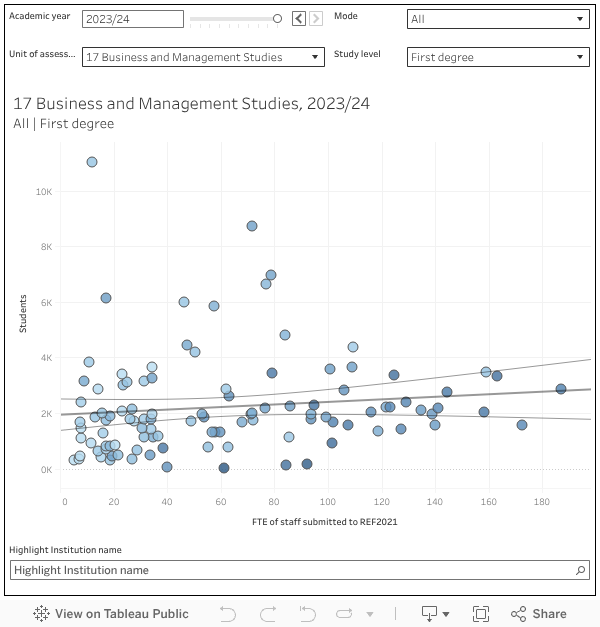
    What has been done here is a custom mapping at CAH3 level between subjects students are studying and REF2021 submissions – the axis are student headcount (you can filter by mode and level, and choose whichever academic year you fancy looking at) against the FTE of staff submitted to REF2021 – with a darker blue blob showing a greater proportion of the submission rated as 4* in the REF (there’s a filter at the bottom if you want to look at just high performing departments).

    [Full screen]

    Again, correlations are very hard to come by (if you want you can look at a chart for a single provider across all units of assessment). It’s almost as if research doesn’t bring in money that can cross-subsidise teaching, which will come as no surprise to anyone who has ever worked in higher education.

    Specialisation

    The government’s vision for higher education is clear. Universities should specialise and universities that focus on economic growth should be rewarded. The mechanisms to achieve it feel, frankly, like a mix of things that have already been announced and new measures that are divorced from the reality of the financial incentives universities work under.

    The white paper has assiduously ducked laying out some of the trade-offs and losers in the new system. Without this the government cannot set priorities and if it does not move some of the underlying incentives on student funding, regional funding distribution, greater devolution, supply-side spending like Freeports, staff reward and recognition, student number allocations, or the myriad of things that make up the basis of the university funding settlement, it has little hope of achieving its goals in specialisation or growth.

    Source link

  • Foreign Academics Won’t Give Up on the American Dream

    Foreign Academics Won’t Give Up on the American Dream

    Donald Trump’s defunding of scientific research and proposed new charges on migrant labor will not be enough to deter international academics from heading to America, given the country’s unparalleled willingness to reward academic talent, Radenka Maric has argued.

    Since February 2022, Maric has served as president of the University of Connecticut, a six-campus public research university with a $3.6 billion annual operating budget.

    The Bosnian-born engineer is arguably one of the world’s most well-traveled university leaders, having worked in seven countries in a 30-year career, including Japan (where she earned her Ph.D. at Kyoto University and worked at Toyota’s material science research division), Canada (where she led the Institute for Fuel Cell Innovation at the National Research Council Canada), and Italy (where she was a visiting professor at Polytechnic University of Milan on a Fulbright scholarship).

    Having joined Connecticut as a professor of sustainable energy in 2010, Maric was appointed vice president for research in 2017 and took the top job five years later—an achievement she believes would not have been possible in any other country.

    “As someone born in Bosnia without a U.S. college degree, I would never have been made a university president in Japan, Italy or even Canada,” argued Maric, who studied at Belgrade University in Serbia, where she later worked as a junior scientist.

    “I don’t have that traditional academic pedigree required by some countries. I didn’t study at Harvard—I have a ‘Japanese Harvard’ Ph.D., but who really cares about my Japanese degree—nor have I been a provost or dean at a big U.S. university,” she continued.

    “But American universities don’t care if you studied in Italy or Serbia—they are only focused on excellence in science and innovation, which means ‘what is your h-index?,’ ‘where have you published?’ and ‘how many people have you brought with you on your journey?’” Maric said.

    Despite uncertainty over federal science funding—with several national agencies facing cuts of about 50 percent to their budgets next year—the academic meritocracy promised by U.S. universities will continue to appeal to international researchers, Maric believes.

    “That is what is powerful about American academia. As long as the American dream is there—that people like me can make it on their own merits—then America will be a magnet for talent. Crises will come and go,” she said.

    The current uncertainty over funding has undoubtedly caused problems, Maric explained, while there are growing concerns over plans to charge a $100,000 fee for H-1B skilled worker visas, up from $7,000—a move that would make it much more difficult for U.S. universities to employ foreign Ph.D. students or postdocs.

    On the likely damage of Trump’s recent higher education policies, Maric said, “It depends how long this lasts, but America has a great capacity to resituate itself very quickly. If you compare how the U.S. pivoted after the 2008 financial crisis, it came back much quicker than any other nation.”

    Despite her evident enthusiasm for her adopted homeland, Maric said she was also inspired by her time in Japan. “This was the 1990s and I was the only woman doing a Ph.D. at Kyoto’s engineering school. I stayed for 12 years there, so it wasn’t just the language that I learned but the culture. There is an immense amount of care in how everything is done, so I applied this to my career by thinking, ‘how can I improve my skills?’ or ‘how can my research get better?’

    “When I was in Japan, it was constantly stressed that there was no great science if it didn’t lead to great technology. And there is no great technology without a product, and there is no product without a market,” Maric explained of her approach to applied science—she worked in the field of battery technology for Toyota and later Panasonic before leaving to join a start-up in Atlanta.

    “The most important thing about Japan is kata—a way of doing things in a particular way. There is a natural tendency to do things in a certain way and there is a desire to protect their culture, so eventually I knew I had to leave,” reflected Maric on her leap from Toyota to the U.S. start-up world.

    Recruited to lead a battery fuel research group in Vancouver, Maric eventually headed to Connecticut—a state with long-established defense and manufacturing industries, in which the university now plays a crucial research role.

    “Since 2010 the state has been recruiting faculty in renewable and environmental sustainability, including CO2 capture, so I’ve been part of this, but the history of manufacturing goes back to the mid-19th century when bicycle companies had their first factories in Connecticut,” Maric said.

    Her university’s willingness to recruit someone with an eclectic CV—including stints in corporate R&D, academia and start-ups covering three continents—then promote them to the top job is a good example of why American academia will continue to thrive, despite the current challenges, Maric said.

    “I am not a traditional person, but I was always a hard worker who sought to improve myself and bring people along with me whenever I could. Not many foreigners—whatever their expertise or experience—will become university presidents, but it is possible in America,” she said.

    Source link

  • Arkansas wants to jail librarians. The First Amendment won’t allow it.

    Arkansas wants to jail librarians. The First Amendment won’t allow it.

    Arkansas is trying to save one of the most extreme book censorship laws in recent memory, one that would allow jailing librarians and booksellers for keeping materials on their shelves that fall under the statute’s broad definition of “harmful to minors.” 

    The state’s Act 372 not only makes it possible for librarians to be jailed for providing teenagers with Romeo and Juliet, but also allows anyone to “challenge the appropriateness” of any book in a library.

    After the law passed, a coalition of booksellers, librarians, libraries, library patrons, and professional associations persuaded a federal judge to stop the law from taking effect in Fayetteville Public Library v. Crawford County. But the state appealed. FIRE in turn submitted a friend-of-the-court brief urging the U.S. Court of Appeals for the Eighth Circuit to affirm the permanent injunction against Act 372.

    How Act 372 operates

    Arkansas’s law compels public libraries to adopt policies allowing “any person affected” by a book to challenge its “appropriateness,” forcing libraries to remove or sequester the book in an area “not accessible to minors” if the challenge succeeds. The law provides no definitions for crucial terms like “appropriateness” or “accessible,” leaving librarians to guess how to comply and inviting challenges based on personal or political objections. 

    Worse still, the process creates a one-way ratchet in favor of censorship by granting challengers the right to appeal decisions to keep a book in place while having no appeal procedure when a book is removed or segregated. ​​FIRE advocates for a fair system — call it “due process for books” — where libraries use an impartial and objective process for reviewing challenged books’ educational value and age appropriateness. And a system that permits only one side to appeal a ruling while denying appeals by the other is inherently unfair, as we’ve noted in campus Title IX hearings. Act 372’s unbalanced system empowers hecklers to reshape public collections according to their tastes, undermining libraries’ historic role as repositories of diverse ideas and viewpoints.

    These issues are worsened by a broad and unconstitutional definition of “harmful to minors.” That section threatens librarians and booksellers with up to a year in jail if they furnish, present, provide, make available, give, lend, show, advertise, or distribute to a minor any material considered harmful—without distinguishing between materials inappropriate for young children and those suitable for older teens. By grouping all minors into one category and failing to define key terms, Act 372 effectively criminalizes access to classic and educational works that may include mature themes. 

    Why Act 372 is unconstitutional

    FIRE has consistently stated it’s entirely proper for public school libraries to consider whether books are age-appropriate for their collections based on various factors. But Act 372 falls far short of that commonsense standard by employing a broad definition that applies to all public libraries, as well as private bookstores, and by treating all minors the same, from first graders to high school seniors. 

    To understand why Act 372’s “harmful to minors” definition does not meet constitutional standards, one must consider the Supreme Court’s precedents in this area. For decades, the Court has been cautious to ensure that merely labeling sexually suggestive materials as obscene does not give the government blanket authority to censor speech. That’s because works that are obscene are considered unprotected speech—for both adults and minors—and essentially freely regulable or sanctionable. But what about sexually explicit material that is not obscene and thus protected?

    In Ginsberg v. New York, the Court recognized the state’s limited power to restrict minors’ access to sexually explicit content, while emphasizing it remains constitutionally protected for adultsIn Miller v. California, the Court formulated a rigorous test for obscenity that ensured works with serious literary, artistic, political, or scientific value would not meet the test simply because they involve sex. Taken together, GinsbergMiller, and cases flowing from them acknowledge that states may use a variable obscenity test based on the viewer’s age, while ensuring that adults can access non-obscene materials. 

    The Supreme Court further clarified the issue in Virginia v. American Booksellers Association, where it cautioned against laws that aim to protect minors but could potentially limit free speech. The law in question survived only after the Virginia Supreme Court narrowed its definition of “harmful to juveniles” to cover works judged as harmful to older teens, and only when someone knowingly put that material where kids could easily see it. Without this clarification, the law would have been unconstitutionally overbroad and vague.

    The standard for obscene-for-minors or “harmful to minors” material has thus generally coalesced around a version of the Miller obscenity test tailored to the underaged to require that: the material taken as a whole must appeal primarily to a prurient interest in sex as to minors; it must portray hardcore sexual conduct in a manner patently offensive to the average adult under contemporary community standards for minors; and it must lack serious literary, artistic, political or scientific value for minors.

    Unlike the Virginia Supreme Court, the Arkansas Supreme Court adopted a much broader interpretation of “harmful to minors” that treats all minors under 18 the same. As a result, libraries and local bookstores could be penalized simply for providing older minors with access to books that would be objectionable only to the youngest children. In other words, books older minors have a right to read under the First Amendment.

    This would require librarians to put classics like Romeo and Juliet or Catcher in the Rye behind adults-only walls. Further, Act 372’s challenge system also subjects the availability of library books to a “heckler’s veto” by anyone who objects to the material. But the very purpose of public libraries is to provide everyone access to a broad marketplace of ideas. If Act 372 stands, librarians will be forced to choose between their professional duty to provide the community with a wide range of books and the threat of imprisonment if any of those books might be inappropriate for a 5-year-old.

    What’s at stake

    FIRE is asking the Eighth Circuit to affirm the district court’s ruling striking down Arkansas’s Act 372, because if the state can jail librarians for letting kids read books, it won’t stop at Arkansas. The First Amendment doesn’t allow governments to censor ideas under the guise of “protecting children,” and we’re fighting to make sure it never does.

    Source link

  • Good Marketing Won’t Fix Unpopular Programs

    Good Marketing Won’t Fix Unpopular Programs

    In full disclosure, I work in higher education marketing. But I’m here to say: Marketing can’t fix a bad program. OK, maybe “bad” is too strong of a word, but degree programs that aren’t aligned to the modern learner’s needs and expectations — or the job market — can be challenging. Let’s discuss.

    For this article, we’ll primarily focus on adult online learners. And these prospective students are very different from those coming right out of high school. According to Common App, first-time college students apply to about six different colleges, on average. The online learner typically inquires with only two institutions, according to an EducationDynamics report, and 45% apply to just one.

    What does this mean for schools with online programs? You have to get in front of your target audience quickly and make your case clearly. But if you don’t have the right mix of features or programs for these students, it doesn’t matter if your marketing is excellent.

    Give Online Learners What They Need 

    Online learners typically work at least part time and often full time. They have different needs and expectations for their higher education experience. They need flexibility. They also don’t want to be in school longer than necessary. Most are earning a degree to improve their career options. 

    Below are a few things to consider when formatting your programs and processes for online students.

    Efficiency 

    Once online learners have decided to take the step of applying, they’re committed and want to get started quickly. According to the EducationDynamics report, 80% enroll in the school that admits them first, and more than 50% expect to begin courses within a month of being admitted. 

    That means admissions teams have to move quickly and the programs must offer multiple start dates per year. If you make prospective students wait, you lose out. Delays can make an otherwise good program fall into the “bad” category.

    This one can be challenging. You need enough students to merit multiple start dates. That’s where that good marketing comes in!

    Relevant Skills

    Online learners choose online because they’re working and need a flexible school schedule to accommodate their work and personal commitments. But let’s focus on the work part here. These students need skills and credentials that will boost their earnings and opportunities. That’s one of the most cited reasons for returning to school.

    So, again, the degree must match the skills students need to find work. If the only online programs you offer are in computer science, you may find that you’re wasting your marketing dollars. Yes! Computer science! In the age of artificial intelligence (AI), computer science and engineering graduates are struggling to find work. 

    Personal opinion: Liberal arts and studies will become more important if they can teach students the durable skills needed in the AI era — communication, critical thinking, and research skills.

    Clear Information

    Degree program pages and websites sometimes obscure information users need to make decisions. And we saw above how quickly online learners are making decisions and want to get started. If your program page hides costs, financial aid information, credit hours, and requirements, you’re going to drop out of their consideration set. 

    Online learners want to weigh available information and make informed decisions. Some will certainly have price sensitivity, but it’s not the only consideration, so don’t hide tuition rates and fees. The EducationDynamics report notes that “flexibility can even overcome cost, with 30% of respondents indicating they would enroll at a more expensive institution if the available format, schedule, or location were ideal.” Show your cards. Let the students make their decisions with the information available.

    If your program doesn’t meet student requirements in this area, marketing won’t make a significant impact on your enrollments.

    Be Discriminating in Your Marketing Spend

    Sometimes there are politics at play or other reasons to market or support certain programs, but when possible, be thoughtful and intentional about where you spend your marketing dollars. Because marketing can’t solve for a challenging program, you must put your budget toward programs that meet student needs, including those that meet the criteria above.

    It’s tempting to give equal shares to all programs, but unless you have an unlimited budget, that’s not the best use of your funds. 

    If you must give some marketing love to all programs, even the “bad” ones, try a brand-focused approach that connects to an all-programs page. For example, send some limited traffic to a dedicated landing page that briefly covers all available programs. That way, you’ve covered the challenged programs without dedicated resources.

    Use the remainder of your budget on programs that align with students’ needs, so you can enjoy a lower cost per enrollment. Who doesn’t love a “chase the winners” strategy?

    Need More Help?

    Archer Education has deep expertise in both of these areas: marketing and program assessments. Our Strategy and Development team can help you take an unfiltered view of your programs and processes to create a plan for future success, even as the market shifts. If you have good programs and need marketing support, we’re here for that, too.

    Source link

  • DOJ Deems Definition of HSIs Unconstitutional, Won’t Defend

    DOJ Deems Definition of HSIs Unconstitutional, Won’t Defend

    Photo illustration by Justin Morrison/Inside Higher Ed | InnaPoka and yongyuan/iStock/Getty Images

    The country’s roughly 600 Hispanic-serving institutions are in peril of losing hundreds of millions of dollars annually from the federal government, after the Department of Justice said it won’t defend the program against a lawsuit alleging the way HSIs are currently defined is unconstitutional. The suit challenges the requirement that a college or university’s undergraduate population must be at least a quarter Hispanic to receive HSI funding.

    U.S. solicitor general D. John Sauer wrote to House Speaker Mike Johnson July 25 that the DOJ “has determined that those provisions violate the equal-protection component of the Fifth Amendment’s Due Process Clause.” Federal law requires DOJ officers to notify Congress when they decide to refrain from defending a law on the grounds that it’s unconstitutional.

    Citing the 2023 U.S. Supreme Court ruling that banned affirmative action in student admissions, Sauer wrote that “the Supreme Court has explained that ‘[o]utright racial balancing’ is ‘patently unconstitutional’” and said “its precedents make clear that the government lacks any legitimate interest in differentiating among universities based on whether ‘a specified number of seats in each class’ are occupied by ‘individuals from the preferred ethnic groups.’” 

    The Washington Free Beacon, a conservative outlet, first reported on the letter Friday. The DOJ subsequently provided Inside Higher Ed with the letter but gave no further comment or interviews.

    The Free Beacon wrote that “the letter likely spells the end for the HSI grants, which the Trump administration is now taking steps to wind down.” The Education Department wrote in an email, “We can confirm the Free Beacon’s reporting,” but didn’t provide Inside Higher Ed an interview or answer further written questions. 

    Just because the executive branch has given up defending the program doesn’t necessarily mean it’s over—or that the group Students for Fair Admissions and the state of Tennessee have won the lawsuit they filed in June. The Hispanic Association of Colleges and Universities moved to intervene in the case late last month, asking U.S. District Court judge Katherine A. Crytzer to add the group as a defendant. She has yet to rule, but the Education Department and education secretary Linda McMahon, the current defendants, didn’t oppose this intervention. 

    The legal complaint from Students for Fair Admissions and Tennessee  asks Crytzer to declare the program’s ethnicity-based requirements unconstitutional, but not necessarily to end the program altogether. Students for Fair Admissions is the group whose suits against Harvard University and the University of North Carolina at Chapel Hill yielded the 2023 Supreme Court decision banning affirmative action in admissions. In the suit over the HSI program, that group and Tennessee’s attorney general, Jonathan Skrmetti, now argue that the admissions ruling means Tennessee colleges and universities can’t use affirmative action to increase Hispanic student enrollments in order to qualify for HSI funding. 

    Deborah Santiago, co-founder and chief executive officer of Excelencia in Education, which promotes Latino student success, said Friday that the Education Department in June “opened a competition to award grants for this fiscal year for HSIs.”

    “There are proposals to the Department of Education right now that they said they were going to allocate,” Santiago said, noting that the program was set to dole out more than $350 million this fiscal year—money that institutions use for faculty development, facilities and other purposes. 

    “The program doesn’t require that any of the money go to Hispanics at all,” she said. For a college or university to qualify for the program, at least half of the student body must be low-income, in addition to the requirement that a quarter be Hispanic. 

    “The value of a program like this has really been investing in institutions that have a high concentration of low-income, first generation students,” Santiago said. 

    Source link

  • Florida district won’t rehire teacher in LGBTQ+ controversy over student’s preferred name

    Florida district won’t rehire teacher in LGBTQ+ controversy over student’s preferred name

    This audio is auto-generated. Please let us know if you have feedback.

    Brevard Country Public Schools will not rehire the veteran Florida English teacher at the center of an LGBTQ+ controversy over using a student’s preferred name, according to local news reports. 

    Melissa Calhoun, who taught at Satellite High School and had worked in Brevard County schools for over a decade, was initially reprimanded by the district in April for calling the student by the name they wanted to use.

    Her case marked one of the first high-profile incidents of a teacher being disciplined for such a reason in a state that has led the charge for strictly applying anti-LGBTQ+ laws to K-12 classrooms. The rebuke led to her contract not being renewed and her professional certificate being placed under state review. Calhoun ultimately got to keep her teacher’s license under a recent settlement.

    The situation arose from Florida’s 2023 law restricting the use in public schools of names and pronouns that don’t align with a student or employee’s sex assigned at birth.

    However, by the end of July, the Florida Department of Education’s Education Practices Commission reached a settlement with Calhoun that allowed her to teach on probation for one year, fined her $750, and required her to complete an ethics and education course.

    Nonetheless, Brevard County will not rehire Calhoun, according to a statement Superintendent Mark Rendell shared with local media outlets.

    “Teachers hold a powerful position of influence, and that influence must never override the rights of parents to be involved in critical decisions affecting their children,” said Rendell. “This was not a mistake. This was a conscious and deliberate decision to engage in gender affirmation without parental knowledge.” 

    Calhoun, who taught the student before and after the 2023 law, told News 6 that using the student’s preferred name was a mistake. “There wasn’t any intention to subvert this parent’s wishes,” she said. “This happened out of habit and frankly was an unfortunate oversight on my part.” 

    Rendell said he expects Calhoun to complete the state’s one-year probation requirement “before any consideration of employment.” 

    Four months prior, Calhoun posted on LinkedIn that she was looking for work elsewhere, primarily in corporate training roles.

    Calhoun’s situation comes as “Don’t Say Gay” and other anti-LGBTQ+ state laws raise questions for teachers on how to navigate relationships with students and parents while staying within legal bounds.

    According to a survey conducted by RAND Corp. between April and May 2022, when some of the earlier laws were passed and implemented, about 1 in 4 teachers reported that local and state restrictions on race and gender topics had influenced their choices of curriculum materials or instructional practices. 

    Even outside of states with restrictions, teachers have reported feeling spillover impacts, according to the research.

    Teachers told RAND that teaching students under the new laws made the job more difficult, including making it more challenging to engage students in learning, support their critical thinking skills, and develop their ability to engage in different perspectives and build empathy. 

    Source link

  • ED Won’t Fund CTE, Dual Enrollment for “Illegal” Students

    ED Won’t Fund CTE, Dual Enrollment for “Illegal” Students

    The Education Department said Thursday that federal money shouldn’t fund dual enrollment, adult education and certain career and technical education for “illegal alien” students, whether they’re adults or K–12 pupils who are accessing postsecondary education.

    Department officials said in a news release that they are rescinding parts of a 1997 Dear Colleague letter that had allowed undocumented students to access those programs.

    In the interpretative rule published on the Federal Register, the department declared that “non-qualified alien adults are not permitted to receive education benefits (postsecondary education benefits or otherwise) and non-qualified alien children are not eligible to receive postsecondary education benefits and certain other education benefits, so long as such benefits are not basic public education benefits. Postsecondary education benefits include dual enrollment and other similar early college programs.”

    Education Secretary Linda McMahon said in the release that “under President Trump’s leadership, hardworking American taxpayers will no longer foot the bill for illegal aliens to participate in our career, technical, or adult education programs or activities. The department will ensure that taxpayer funds are reserved for citizens and individuals who have entered our country through legal means who meet federal eligibility criteria.”

    Augustus Mays, vice president of partnerships and engagement at EdTrust, an education equity group, said in a statement that the change “derails individual aspirations and undercuts workforce development at a time when our nation is facing labor shortages in critical fields like healthcare, education, and skilled trades. This decision raises barriers even higher for undocumented students who are already barred from accessing federal financial aid like Pell Grants and student loans.

    “Across the country, we’re seeing migrant communities targeted with sweeping raids, amplified surveillance, and fear-based rhetoric designed to divide and dehumanize,” Mays said. “Policies like this don’t exist in a vacuum. They are rooted in a political agenda that scapegoats immigrants and uses fear to strip rights and resources from the most vulnerable among us.”

    Source link