Tag: wont

  • DOJ Deems Definition of HSIs Unconstitutional, Won’t Defend

    DOJ Deems Definition of HSIs Unconstitutional, Won’t Defend

    Photo illustration by Justin Morrison/Inside Higher Ed | InnaPoka and yongyuan/iStock/Getty Images

    The country’s roughly 600 Hispanic-serving institutions are in peril of losing hundreds of millions of dollars annually from the federal government, after the Department of Justice said it won’t defend the program against a lawsuit alleging the way HSIs are currently defined is unconstitutional. The suit challenges the requirement that a college or university’s undergraduate population must be at least a quarter Hispanic to receive HSI funding.

    U.S. solicitor general D. John Sauer wrote to House Speaker Mike Johnson July 25 that the DOJ “has determined that those provisions violate the equal-protection component of the Fifth Amendment’s Due Process Clause.” Federal law requires DOJ officers to notify Congress when they decide to refrain from defending a law on the grounds that it’s unconstitutional.

    Citing the 2023 U.S. Supreme Court ruling that banned affirmative action in student admissions, Sauer wrote that “the Supreme Court has explained that ‘[o]utright racial balancing’ is ‘patently unconstitutional’” and said “its precedents make clear that the government lacks any legitimate interest in differentiating among universities based on whether ‘a specified number of seats in each class’ are occupied by ‘individuals from the preferred ethnic groups.’” 

    The Washington Free Beacon, a conservative outlet, first reported on the letter Friday. The DOJ subsequently provided Inside Higher Ed with the letter but gave no further comment or interviews.

    The Free Beacon wrote that “the letter likely spells the end for the HSI grants, which the Trump administration is now taking steps to wind down.” The Education Department wrote in an email, “We can confirm the Free Beacon’s reporting,” but didn’t provide Inside Higher Ed an interview or answer further written questions. 

    Just because the executive branch has given up defending the program doesn’t necessarily mean it’s over—or that the group Students for Fair Admissions and the state of Tennessee have won the lawsuit they filed in June. The Hispanic Association of Colleges and Universities moved to intervene in the case late last month, asking U.S. District Court judge Katherine A. Crytzer to add the group as a defendant. She has yet to rule, but the Education Department and education secretary Linda McMahon, the current defendants, didn’t oppose this intervention. 

    The legal complaint from Students for Fair Admissions and Tennessee  asks Crytzer to declare the program’s ethnicity-based requirements unconstitutional, but not necessarily to end the program altogether. Students for Fair Admissions is the group whose suits against Harvard University and the University of North Carolina at Chapel Hill yielded the 2023 Supreme Court decision banning affirmative action in admissions. In the suit over the HSI program, that group and Tennessee’s attorney general, Jonathan Skrmetti, now argue that the admissions ruling means Tennessee colleges and universities can’t use affirmative action to increase Hispanic student enrollments in order to qualify for HSI funding. 

    Deborah Santiago, co-founder and chief executive officer of Excelencia in Education, which promotes Latino student success, said Friday that the Education Department in June “opened a competition to award grants for this fiscal year for HSIs.”

    “There are proposals to the Department of Education right now that they said they were going to allocate,” Santiago said, noting that the program was set to dole out more than $350 million this fiscal year—money that institutions use for faculty development, facilities and other purposes. 

    “The program doesn’t require that any of the money go to Hispanics at all,” she said. For a college or university to qualify for the program, at least half of the student body must be low-income, in addition to the requirement that a quarter be Hispanic. 

    “The value of a program like this has really been investing in institutions that have a high concentration of low-income, first generation students,” Santiago said. 

    Source link

  • Florida district won’t rehire teacher in LGBTQ+ controversy over student’s preferred name

    Florida district won’t rehire teacher in LGBTQ+ controversy over student’s preferred name

    This audio is auto-generated. Please let us know if you have feedback.

    Brevard Country Public Schools will not rehire the veteran Florida English teacher at the center of an LGBTQ+ controversy over using a student’s preferred name, according to local news reports. 

    Melissa Calhoun, who taught at Satellite High School and had worked in Brevard County schools for over a decade, was initially reprimanded by the district in April for calling the student by the name they wanted to use.

    Her case marked one of the first high-profile incidents of a teacher being disciplined for such a reason in a state that has led the charge for strictly applying anti-LGBTQ+ laws to K-12 classrooms. The rebuke led to her contract not being renewed and her professional certificate being placed under state review. Calhoun ultimately got to keep her teacher’s license under a recent settlement.

    The situation arose from Florida’s 2023 law restricting the use in public schools of names and pronouns that don’t align with a student or employee’s sex assigned at birth.

    However, by the end of July, the Florida Department of Education’s Education Practices Commission reached a settlement with Calhoun that allowed her to teach on probation for one year, fined her $750, and required her to complete an ethics and education course.

    Nonetheless, Brevard County will not rehire Calhoun, according to a statement Superintendent Mark Rendell shared with local media outlets.

    “Teachers hold a powerful position of influence, and that influence must never override the rights of parents to be involved in critical decisions affecting their children,” said Rendell. “This was not a mistake. This was a conscious and deliberate decision to engage in gender affirmation without parental knowledge.” 

    Calhoun, who taught the student before and after the 2023 law, told News 6 that using the student’s preferred name was a mistake. “There wasn’t any intention to subvert this parent’s wishes,” she said. “This happened out of habit and frankly was an unfortunate oversight on my part.” 

    Rendell said he expects Calhoun to complete the state’s one-year probation requirement “before any consideration of employment.” 

    Four months prior, Calhoun posted on LinkedIn that she was looking for work elsewhere, primarily in corporate training roles.

    Calhoun’s situation comes as “Don’t Say Gay” and other anti-LGBTQ+ state laws raise questions for teachers on how to navigate relationships with students and parents while staying within legal bounds.

    According to a survey conducted by RAND Corp. between April and May 2022, when some of the earlier laws were passed and implemented, about 1 in 4 teachers reported that local and state restrictions on race and gender topics had influenced their choices of curriculum materials or instructional practices. 

    Even outside of states with restrictions, teachers have reported feeling spillover impacts, according to the research.

    Teachers told RAND that teaching students under the new laws made the job more difficult, including making it more challenging to engage students in learning, support their critical thinking skills, and develop their ability to engage in different perspectives and build empathy. 

    Source link

  • ED Won’t Fund CTE, Dual Enrollment for “Illegal” Students

    ED Won’t Fund CTE, Dual Enrollment for “Illegal” Students

    The Education Department said Thursday that federal money shouldn’t fund dual enrollment, adult education and certain career and technical education for “illegal alien” students, whether they’re adults or K–12 pupils who are accessing postsecondary education.

    Department officials said in a news release that they are rescinding parts of a 1997 Dear Colleague letter that had allowed undocumented students to access those programs.

    In the interpretative rule published on the Federal Register, the department declared that “non-qualified alien adults are not permitted to receive education benefits (postsecondary education benefits or otherwise) and non-qualified alien children are not eligible to receive postsecondary education benefits and certain other education benefits, so long as such benefits are not basic public education benefits. Postsecondary education benefits include dual enrollment and other similar early college programs.”

    Education Secretary Linda McMahon said in the release that “under President Trump’s leadership, hardworking American taxpayers will no longer foot the bill for illegal aliens to participate in our career, technical, or adult education programs or activities. The department will ensure that taxpayer funds are reserved for citizens and individuals who have entered our country through legal means who meet federal eligibility criteria.”

    Augustus Mays, vice president of partnerships and engagement at EdTrust, an education equity group, said in a statement that the change “derails individual aspirations and undercuts workforce development at a time when our nation is facing labor shortages in critical fields like healthcare, education, and skilled trades. This decision raises barriers even higher for undocumented students who are already barred from accessing federal financial aid like Pell Grants and student loans.

    “Across the country, we’re seeing migrant communities targeted with sweeping raids, amplified surveillance, and fear-based rhetoric designed to divide and dehumanize,” Mays said. “Policies like this don’t exist in a vacuum. They are rooted in a political agenda that scapegoats immigrants and uses fear to strip rights and resources from the most vulnerable among us.”

    Source link

  • What Legacy Vendors Won’t Tell You

    What Legacy Vendors Won’t Tell You

    30% of Institutions Are Not Accreditation Ready — Is Yours Falling Behind?

    Nearly 1 in 3 higher education institutions struggle to meet accreditation standards — not because of academic shortcomings, but because they lack true accreditation readiness.

    The pressure on QA Directors and Accreditation Heads has never been higher. Regulatory expectations are rising. Documentation demands are expanding. And legacy systems? They’re making it worse — with scattered data, manual tracking, and zero real-time visibility.

    Readiness is no longer optional. It’s a year-round necessity. In this blog, we expose what legacy vendors won’t tell you — and what forward-thinking institutions are doing to stay compliant, connected, and confidently audit-ready.


    Key Takeaways

    • Accreditation readiness means real-time, year-round preparedness — not last-minute chaos.
    • Legacy tools create silos, delays, and compliance risks.
    • Modern systems support:
      • Workflow automation
      • Curriculum mapping
      • Faculty credential tracking
    • Institutions that modernize stay audit-ready and aligned with accreditors.


    Why Accreditation Readiness Matters More Than Ever


    What is accreditation readiness, and why is it important?

    Accreditation readiness refers to an institution’s ability to maintain full, ongoing compliance with accreditor standards — not just during evaluation windows, but all year round. It means that your documentation, outcomes, faculty credentials, and curriculum alignment are always audit-ready, accessible, and defensible.


    Why this matters now:

    • Accreditors want more reports, greater proof, and clearer learning outcomes on a regular basis.
    • There is more pressure from regulators. Each group, from CHED and PAASCU to ABET and AUN-QA, has its own set of changing standards.
    • The faculty are quite busy. Keeping track of credentials, exams, and program goals by hand makes people more tired.
    • Old systems can’t keep up. Tools and spreadsheets that are kept in separate places don’t have visibility, automation, or built-in support for compliance.

    Institutions that treat accreditation as an “every few years” project are exposed to delays, rejections, and lost funding. But those with modern systems in place for accreditation workflow automation, curriculum mapping, and faculty credential tracking are equipped to respond instantly, with confidence.

    Looking to align outcomes with accreditation standards? Explore our Outcome-Based Education Software.


    The Hidden Flaws in Legacy Accreditation Systems


    What are the limitations of legacy accreditation systems?

    Most traditional accreditation systems were built for a different era — one with fewer programs, simpler standards, and slower timelines. Today, those same systems are liabilities. Here’s what QA Directors and Accreditation Heads face when relying on outdated tech:


    What legacy systems don’t tell you:

    • No real-time visibility. You chase files instead of monitoring readiness on a dashboard.
    • Faculty data, outcomes, and evidence are scattered in error-prone spreadsheets.
    • No automation—workflows, reminders, audit logs? Your work is manual.
    • Evidence is scattered in inboxes, shared folders, and obsolete systems.
    • Compliance guesswork—No standards mapping or role-based controls implies memory, not process.

    Legacy tools make you work harder to keep up, not ready.

    Modern institutions need more than storage — they need a college accreditation system that actively supports continuous readiness, not just static compliance.


    How Accreditation Gets Delayed — And Why 

    Even well-run institutions miss deadlines — not because of lack of quality, but because their systems fail them.


    What causes delays or failures in accreditation audits?

    Most accreditation delays don’t happen at the last mile — they happen months before, in the day-to-day workflows that no one’s watching. Here’s how it breaks down:

    Key reasons accreditation gets delayed:

    • Evidence is incomplete or outdated. Faculty credential tracking, course assessments, and program reviews aren’t updated regularly — so you scramble when auditors request proof.
    • Stakeholders aren’t aligned. QA teams, deans, and faculty operate in silos. Without a unified accreditation management system, responsibilities fall through the cracks.
    • Curriculum data doesn’t align with outcomes. When you don’t have built-in curriculum mapping for accreditation, proving outcome achievement becomes a manual and inconsistent task.
    • No audit trail. Legacy systems don’t offer version control, timestamped approvals, or centralized workflows — which leads to missing context during audits.
    • Everything is reactive. Institutions focus on audit prep only when the review date is near — not realizing that accreditation readiness requires year-round activity and automation.
    • Delays aren’t just inconvenient — they damage institutional credibility and burden your QA teams with avoidable stress. An intelligent, automated accreditation software helps you stay one step ahead, not one step behind.
       

    What Modern Vendors Offer That Legacy Vendors Don’t 

    To be honest, most old systems weren’t made to work with today’s accrediting needs.

    They can’t keep up with changing standards, more paperwork, and the stress that QA teams are under from many campuses and accrediting authorities.

    Accreditation management systems today are not the same. They are made to be improved all the time, not just once. They don’t only keep data; they also let you keep track of it in real time.


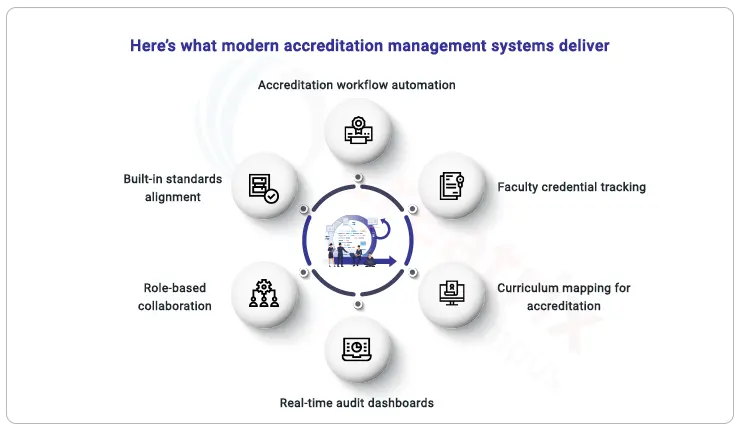
    Here’s what modern accreditation management systems deliver:


    • Automate accreditation workflow by triggering activities, approvals, and deadline alerts to avoid mistakes.
    • Centralize qualifications, certifications, and teaching assignments to ensure teachers satisfy program standards across cycles.
    • Curriculum mapping for accreditation shows compliance by seamlessly linking learning outcomes to courses, assessments, and standards.
    • Live audit dashboards for program, department, and standard accreditation preparation with fast evidence.
    • Managed access and verifiable updates help QA teams, deans, and faculty collaborate.
    • Built-in standards alignment—CHED, PAASCU, ABET, AUN-QA—mapped and monitored.

    Modern platforms are strategic pieces for compliance, quality assurance, and institutional growth, not just upgrades.


    Accreditation Readiness strategic


    Want consistent curriculum, outcomes, and standards? Visit our Curriculum Mapping Tools.

    Simplify faculty evaluations and credential tracking? Explore our Faculty Management System.


    How to Future-Proof Your Accreditation Process 


    How can institutions upgrade from legacy to modern accreditation systems?


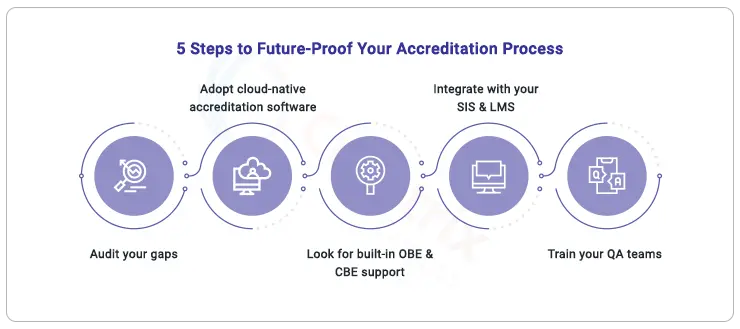
    • Audit your gaps—Find old systems that delay or require manual work in your accreditation process.
    • Use cloud-native accreditation software Choose a safe, scalable higher education accrediting solution.
    • Built-in OBE/CBE support Align with CHED, ABET, PAASCU outcomes and standards.
    • Integrate SIS/LMS – Make accreditation automation seamless and avoid redundancy.
    • Train QA teams Give staff tools for faculty credential tracking, task management, and real-time insights.


    Final Thoughts — Don’t Let Legacy Hold You Back


    What’s the risk of continuing with legacy systems for accreditation?

    Using old tools is not only a waste of time, it’s also dangerous. Missed deadlines, failed audits, not following the rules, and QA teams that are too busy are only the beginning.

    Legacy systems were made for reporting that doesn’t change. But to be ready for accreditation today, every program, campus, and accreditor needs to be flexible, visible, and always in sync.

    Modern universities are going forward with integrated, automated, and standards-aligned accreditation management systems because they have to, not because they want to.

    Don’t wait till the next audit to find the holes. Get Creatrix Campus’s AI rich accreditation system before your old one slows you down

    Source link

  • What Legacy Vendors Won’t Tell You About Accreditation Readiness

    What Legacy Vendors Won’t Tell You About Accreditation Readiness

    30% of Institutions Are Not Accreditation Ready — Is Yours Falling Behind?

    Nearly 1 in 3 higher education institutions struggle to meet accreditation standards — not because of academic shortcomings, but because they lack true accreditation readiness.

    The pressure on QA Directors and Accreditation Heads has never been higher. Regulatory expectations are rising. Documentation demands are expanding. And legacy systems? They’re making it worse — with scattered data, manual tracking, and zero real-time visibility.

    Readiness is no longer optional. It’s a year-round necessity. In this blog, we expose what legacy vendors won’t tell you — and what forward-thinking institutions are doing to stay compliant, connected, and confidently audit-ready.


    Key Takeaways

    • Accreditation readiness means real-time, year-round preparedness — not last-minute chaos.
    • Legacy tools create silos, delays, and compliance risks.
    • Modern systems support:
      • Workflow automation
      • Curriculum mapping
      • Faculty credential tracking
    • Institutions that modernize stay audit-ready and aligned with accreditors.


    Why Accreditation Readiness Matters More Than Ever


    What is accreditation readiness, and why is it important?

    Accreditation readiness refers to an institution’s ability to maintain full, ongoing compliance with accreditor standards — not just during evaluation windows, but all year round. It means that your documentation, outcomes, faculty credentials, and curriculum alignment are always audit-ready, accessible, and defensible.


    Why this matters now:

    • Accreditors want more reports, greater proof, and clearer learning outcomes on a regular basis.
    • There is more pressure from regulators. Each group, from CHED and PAASCU to ABET and AUN-QA, has its own set of changing standards.
    • The faculty are quite busy. Keeping track of credentials, exams, and program goals by hand makes people more tired.
    • Old systems can’t keep up. Tools and spreadsheets that are kept in separate places don’t have visibility, automation, or built-in support for compliance.

    Institutions that treat accreditation as an “every few years” project are exposed to delays, rejections, and lost funding. But those with modern systems in place for accreditation workflow automation, curriculum mapping, and faculty credential tracking are equipped to respond instantly, with confidence.

    Looking to align outcomes with accreditation standards? Explore our Outcome-Based Education Software.


    The Hidden Flaws in Legacy Accreditation Systems


    What are the limitations of legacy accreditation systems?

    Most traditional accreditation systems were built for a different era — one with fewer programs, simpler standards, and slower timelines. Today, those same systems are liabilities. Here’s what QA Directors and Accreditation Heads face when relying on outdated tech:


    What legacy systems don’t tell you:

    • No real-time visibility. You chase files instead of monitoring readiness on a dashboard.
    • Faculty data, outcomes, and evidence are scattered in error-prone spreadsheets.
    • No automation—workflows, reminders, audit logs? Your work is manual.
    • Evidence is scattered in inboxes, shared folders, and obsolete systems.
    • Compliance guesswork—No standards mapping or role-based controls implies memory, not process.

    Legacy tools make you work harder to keep up, not ready.

    Modern institutions need more than storage — they need a college accreditation system that actively supports continuous readiness, not just static compliance.


    How Accreditation Gets Delayed — And Why 

    Even well-run institutions miss deadlines — not because of lack of quality, but because their systems fail them.


    What causes delays or failures in accreditation audits?

    Most accreditation delays don’t happen at the last mile — they happen months before, in the day-to-day workflows that no one’s watching. Here’s how it breaks down:

    Key reasons accreditation gets delayed:

    • Evidence is incomplete or outdated. Faculty credential tracking, course assessments, and program reviews aren’t updated regularly — so you scramble when auditors request proof.
    • Stakeholders aren’t aligned. QA teams, deans, and faculty operate in silos. Without a unified accreditation management system, responsibilities fall through the cracks.
    • Curriculum data doesn’t align with outcomes. When you don’t have built-in curriculum mapping for accreditation, proving outcome achievement becomes a manual and inconsistent task.
    • No audit trail. Legacy systems don’t offer version control, timestamped approvals, or centralized workflows — which leads to missing context during audits.
    • Everything is reactive. Institutions focus on audit prep only when the review date is near — not realizing that accreditation readiness requires year-round activity and automation.
    • Delays aren’t just inconvenient — they damage institutional credibility and burden your QA teams with avoidable stress. An intelligent, automated accreditation software helps you stay one step ahead, not one step behind.
       

    What Modern Vendors Offer That Legacy Vendors Don’t 

    To be honest, most old systems weren’t made to work with today’s accrediting needs.

    They can’t keep up with changing standards, more paperwork, and the stress that QA teams are under from many campuses and accrediting authorities.

    Accreditation management systems today are not the same. They are made to be improved all the time, not just once. They don’t only keep data; they also let you keep track of it in real time.


    Here’s what modern accreditation management systems deliver:


    • Automate accreditation workflow by triggering activities, approvals, and deadline alerts to avoid mistakes.
    • Centralize qualifications, certifications, and teaching assignments to ensure teachers satisfy program standards across cycles.
    • Curriculum mapping for accreditation shows compliance by seamlessly linking learning outcomes to courses, assessments, and standards.
    • Live audit dashboards for program, department, and standard accreditation preparation with fast evidence.
    • Managed access and verifiable updates help QA teams, deans, and faculty collaborate.
    • Built-in standards alignment—CHED, PAASCU, ABET, AUN-QA—mapped and monitored.

    Modern platforms are strategic pieces for compliance, quality assurance, and institutional growth, not just upgrades.


    Want consistent curriculum, outcomes, and standards? Visit our Curriculum Mapping Tools.

    Simplify faculty evaluations and credential tracking? Explore our Faculty Management System.


    How to Future-Proof Your Accreditation Process 


    How can institutions upgrade from legacy to modern accreditation systems?


    • Audit your gaps—Find old systems that delay or require manual work in your accreditation process.
    • Use cloud-native accreditation software Choose a safe, scalable higher education accrediting solution.
    • Built-in OBE/CBE support Align with CHED, ABET, PAASCU outcomes and standards.
    • Integrate SIS/LMS – Make accreditation automation seamless and avoid redundancy.
    • Train QA teams Give staff tools for faculty credential tracking, task management, and real-time insights.


    Final Thoughts — Don’t Let Legacy Hold You Back


    What’s the risk of continuing with legacy systems for accreditation?

    Using old tools is not only a waste of time, it’s also dangerous. Missed deadlines, failed audits, not following the rules, and QA teams that are too busy are only the beginning.

    Legacy systems were made for reporting that doesn’t change. But to be ready for accreditation today, every program, campus, and accreditor needs to be flexible, visible, and always in sync.

    Modern universities are going forward with integrated, automated, and standards-aligned accreditation management systems because they have to, not because they want to.

    Don’t wait till the next audit to find the holes. Get Creatrix Campus’s AI rich accreditation system before your old one slows you down

    Source link

  • Federal Judge Won’t Block Trump’s Cuts to IES

    Federal Judge Won’t Block Trump’s Cuts to IES

    A federal district judge declined to issue an injunction that would block the Trump administration’s recent cuts to staff and contracts at the Institute of Education Sciences—an agency charged with collecting and analyzing data about both K–12 and higher education.

    In an opinion released last week, Maryland judge Stephanie A. Gallagher acknowledged that the new administration has terminated 90 percent of the agency’s staff and therefore IES “is not doing a number of tasks Congress requires of it.” Gallagher, a Trump appointee, also empathized with the two education research associations that filed the lawsuit—the American Educational Research Association and the Society for Research on Educational Effectiveness—saying she trusts that not receiving the data they expected from IES “will harm them.” 

    But that does not mean the plaintiffs have a strong enough case to stop the Trump administration from continuing to dismantle the agency. Gallagher said that the associations’ arguments are at times too broad or too narrow, that they lump together numerous cuts—some of which may be justified—and that they include “factual discrepancies” and improper interpretations of “no fewer than a dozen statutes.” 

    Over all, she said, “They have not shown they are entitled to this sort of extraordinary relief.”

    “These Plaintiffs have alleged, and have provided some evidence to support, a troubling pattern of conduct at IES,” Gallagher wrote. “But because they cannot make the requisite showings on the preliminary injunction factors, and in particular have not shown they have standing to seek the relief they are asking for, their motion for a preliminary injunction must be denied.”

    This ruling is not final, however, and “should not be taken as predictive of this Court’s ultimate decision,” Gallagher added.

    But the Education Department is already walking back some of the IES cuts, according to court filings in the lawsuit that The Hechinger Report first reported on. Department officials disclosed earlier this month that they are reinstating at least 20 out of the 101 contracts that were terminated. The restored contracts include one that requires the National Center for Education Statistics to participate in the Program for International Student Assessment. (According to Hechinger, Congress mandates that the department take part in international assessments.)

    SREE president Elizabeth Tipton told Hechinger that the limited reversal was “upsetting” and not enough to fix the problem.

    “They’re trying to make IES as small as they possibly can,” she said.

    Source link

  • If it’s top down it won’t work

    If it’s top down it won’t work

    Higher education institutions are complex ecosystems where policies shape the experiences of students, academics, and administrative staff.

    However, the process of policy creation and implementation often lacks inclusivity, flexibility, and responsiveness to the rapidly evolving educational landscape.

    If institutions are to thrive in an era of digital transformation, shifting student expectations, and increasing socio-economic challenges, they must rethink how policies are designed and enacted.

    A more participatory, adaptive, and evidence-based approach is essential to creating institutional policies that truly serve the needs of all stakeholders.

    Top down without engagement

    Institutional policies often emerge from a centralised, top-down approach, where senior leadership teams develop policies without adequate engagement with those directly affected (students, faculty, and professional service staff).

    This results in policies that may be well-intended but are disconnected from on-the-ground realities. For instance, policies surrounding Technology-Enhanced Learning (TEL) frequently fail because they do not account for academic workload constraints, staff and students’ digital literacy levels, or disparities in institutional infrastructure.

    The gap between policy intentions and practical implementation then leads to confusion, resistance, and limited adoption.

    Policies should not be dictated from the top – but rather co-created with those who will implement and be impacted by them. This requires institutions to foster genuine dialogue with diverse stakeholders, ensuring that different perspectives and experiences shape decision-making.

    Adopting participatory approaches such as Change Laboratories, a method that engages stakeholders in problem-solving workshops, can provide a structured way for institutions to address contradictions and inefficiencies in their current policy frameworks.

    A recent Change Laboratory intervention at a UK research-intensive university demonstrated the benefits of participatory policy development. The initiative brought together academics, administrators, and digital learning specialists to collaboratively identify barriers to effective blended learning adoption.

    Through iterative discussions and problem-solving exercises, the group developed a Culturally Advanced Activity System (CAAS), aligning institutional policies with pedagogical realities. The process not only resulted in a more practical and effective policy framework but also increased staff engagement and willingness to adopt blended learning practices.

    The success of participatory policy-making in blended learning highlights its potential application across other areas of policy. Institutions could apply similar methodologies to enhance policies related to assessment frameworks, student support services, diversity and inclusion, and faculty development. By institutionalising collaborative problem-solving approaches, HE governance structures can become more responsive to evolving educational needs.

    Rigid policies that fail to account for evolving challenges and opportunities quickly become obsolete. HE institutions must adopt a more dynamic approach, treating policies as living documents that are regularly reviewed and updated based on data-driven insights.

    For example, instead of prescribing a one-size-fits-all approaches, institutions should allow for staff-led experimentation, followed by structured evaluations to refine policies based on what works best in different disciplines.

    An evidence-based policy culture?

    Stakeholder-led policy development is crucial to ensuring that policies are not only relevant but also widely accepted and effectively implemented. By actively involving students, faculty, and administrative staff in the policy-making process, HE institutions can create frameworks that reflect the lived experiences of their communities.

    This participatory approach fosters greater trust, encourages meaningful engagement, and enhances the practicality of policies. When stakeholders have ownership over policy development, they are more likely to support its implementation, leading to smoother transitions and sustainable institutional improvements.

    Additionally, fostering a culture of continuous professional development ensures that policy decisions align with the latest pedagogical and technological advancements.

    For HE institutions to remain relevant and responsive in the 21st century, they must overhaul how they create and implement policies. Moving away from rigid, top-down structures and embracing participatory, flexible, and evidence-driven approaches will ensure that policies are both effective and widely supported.

    Institutional leaders must prioritise stakeholder engagement, foster a culture of continuous learning, and create policies that genuinely enhance teaching, learning, and student success.

    Without these changes, HE risks stagnation in an era that demands adaptability and innovation. By embedding participatory mechanisms and evidence-based strategies in governance, HE institutions can pave the way for a more inclusive and forward-thinking educational environment.

    Source link

  • Research funding won’t redistribute itself

    Research funding won’t redistribute itself

    On the whole research funding is not configured to be sensitive to place.

    Redistribution

    It does good things in regions but this is different to funding being configured to do so. For example, universities in the North East performed strongly in the REF and as a consequence they received an uplift in QR funding. This will allow them to invest in their research capacity, this will bring agglomerate benefits in the North East, and go some small way to rebalancing the UK’s research ecosystem away from London.

    REF isn’t designed to do that. It has absolutely no interest where research takes place, just that the research that takes place is excellent. The UK isn’t a very big place and it has a large number of universities. Eventually, if you fund enough things in enough places you will eventually help support regional clusters of excellence.

    There are of course some specific place based funds but this doesn’t mean they are redistributive as well as being regionally focussed. The Higher Education Innovation Fund (HEIF) is focussed on regional capacity but it is £260m of a total annual Research England funding distribution of £2.8bn. HEIF is calculated using provider knowledge exchange work on businesses, public and third sector engagement, and the wider public. A large portion of the data is gathered through the HE-BCI Survey.

    The result of this is that there is place based funding but inevitably institutions with larger research capacities receive larger amounts of funding. Of the providers that received the maximum HEIF funding in 2024/25 five were within the golden triangle, one was in the West Midlands, one was in the East Midlands, two were in Yorkshire and the Humber, one was in the North West, and one was in the South East but not the golden triangle. It is regional but it is not redistributive.

    Strength of feeling/strength in places

    RAND Europe has released a process evaluation of wave two of the Strength in Places Fund (SIPF). As RAND Europe describe the fund is

    The Strength in Places Fund (SIPF) is a £312.5 million competitive funding scheme that takes a place-based approach to research and innovation (R&I) funding. SIPF is a UK Research and Innovation (UKRI) strategic fund managed by the SIPF delivery team based at Innovate UK and Research England. The aim of the Fund is to help areas of the UK build on existing strengths in R&I to deliver benefits for their local economy

    This fund has been more successful in achieving a more regionally distributed spread of funding. For example, the fund has delivered £47m to Wales compared to only £18m in South East England. Although quality was a key factor, and there are some challenges to how aligned projects are to wider regional priorities, it seems that a focus on a balanced portfolio made a difference. As RAND Europe note

    […]steps were taken to ensure a balanced portfolio in terms of geographical spread and sectors; however, quality was the primary factor influencing panel recommendations (INTXX). Panel members considered the projects that had been funded in Wave 1 and the bids submitted in Wave 2, and were keen on ensuring no one region was overrepresented. One interviewee mentioned that geographical variation of awards contributed to the credibility of a place-based funding system[…].

    The Regional Innovation Fund which aimed to support local innovation capacity was allocated with a specific modifier to account for where there had historically been less research investment. SPIF has been a different approach to solving the same conundrum of how best support research potential in every region of the UK.

    It’s within this context that it is interesting to arrive at UKRI’s most recent analysis of the geographical distribution of its funding in 2022/23 and 2023/24. There are two key messages the first is that

    All regions and nations received an increase in UKRI investment between the financial years 2021 to 2022 and 2023 to 2024. The greatest absolute increases in investment were seen in the North West, West Midlands and East Midlands. The greatest proportional increases were seen in Northern Ireland, the East Midlands and North West.

    And the second is that

    The percentage of UKRI funding invested outside London, the South East and East of England, collectively known as the ‘Greater South East’, rose to 50% in 2023 to 2024. This is up from 49% in the 2022 to 2023 financial year and 47% in the 2021 to 2022 financial year. This represents a cumulative additional £1.4 billion invested outside the Greater South East since the 2021 to 2022 financial year.

    Waterloo sunset?

    In the most literal sense the funding between the Greater South East and the rest of the country could not be more finely balanced. In flat cash terms the rest of the UK outside of the Greater South East has overtaken the Greater South East for the first time while investment per capita in the Greater South East still outstrips the rest of the country by a significant amount.

    The reasons for this shift is because of greater investments in the North West, West Midlands, and East Midlands who cumulatively saw an increase of £550m worth of funding over the past three years. The regions with the highest absolute levels of funding saw some of the smallest proportions of increases in investment.

    The evaluations and UKRI’s dataset present an interesting picture. There is nothing unusual about the way funding is distributed as it follows where the highest numbers of researchers, providers, and economic activity is located. It would be an entirely arbitrary mechanism which penalised the South East for having research strengths.

    Simultaneously, with constrained resources there are lots of latent assets outside of the golden triangle that will not get funding. The UK is unusually reliant on its capital as an economic contributor and research funding follows this. The only way to rebalance this is to make deliberate efforts, like with SIPF, to lean toward a more balanced portfolio of funding.

    This isn’t a plea to completely rip up the rule book, and a plea for more money in an era of fiscal constraint will not be listened to, but it does bring into sharp relief a choice. Either research policy is about bolstering the UK’s economic centre or it is about strengthening the potential of research where it receives less funding. There simply is not enough money to do both.

    Source link

  • Nassau Community College punishes students, but won’t tell them why

    Nassau Community College punishes students, but won’t tell them why

    Email Nassau Community College now and tell them due process is not optional

    If actions speak louder than words, then Nassau Community College has made its stance crystal clear: it is not a fan of the First Amendment. This New York institution has an astounding track record of disregarding the rights of students and faculty, but even FIRE was shocked by the brazen lawlessness of NCC’s recent actions against two student leaders.

    The students, NCC Board of Trustees student member Jordon Groom and Academic Senate student chair Grant Peterson, were punished for alleged discrimination and harassment. While these are serious charges, the college fatally undermined the credibility of its sanctions by violating the most basic tenets of due process in doling out its discipline. 

    Groom and Peterson both found themselves embroiled in NCC’s broken disciplinary system late last year. NCC administrators initially told them that other students filed complaints against them for “discrimination” and “harassment,” but did not provide any further information. Now both students are left with no recourse, as they wonder how their due process rights could have been so badly violated by their local community college. 

    Last November, Peterson received formal notification of two complaints against him from NCC. But “formal” doesn’t mean it gave him any idea of what he allegedly did wrong — NCC just told him that complaints existed.

    Peterson was left to use his imagination about the substance of the allegations until Dec. 2, when he met with an NCC administrator, who finally allowed him to see the complaints. The complaints cited a number of instances of Peterson using strong language — like telling another student, “You have no idea what you’re talking about, once again,” or calling an administrator an “idiot.” Doing so was alleged to have been discrimination and harassment.

    Importantly, however, the college forbade Peterson from obtaining a copy of the complaint. NCC expected him to review the complaint — one that cited numerous alleged instances and charged him with high-stakes policy violations — and provide a substantive response to those allegations in the same meeting. There was no opportunity to provide a written defense or conduct a substantial review of the complaint. This was the sum total of Peterson’s “hearing.”

    Due process protections, when properly followed, ensure fairness in proceedings and outcomes that can be trusted by all participants in the justice system. 

    Groom never received formal notification of any complaints. He got an inkling that something was amiss only when he was asked to leave a meeting of the Nassau Board of Trustees in December because of an active investigation—which was news to him.

    Days later, he met with the same administrator as Peterson. Only this time, the administrator told Groom the complaint against him had been found meritless and had been closed, without offering any specifics. Great news, right? Wrong.

    On Jan. 22, NCC informed both Peterson and Groom they had both been found responsible for discrimination and harassment. The college suspended Peterson from all club and organizational leadership roles for the remainder of the academic year — including from his role as student chair of the NCC Academic Senate. Whatever it was Groom did, he was required to complete a training module. There was no mention of an appeals process.

    Obvious and basic principles of due process include:

    • Timely and adequate written notice of charges
    • A hearing process that includes the right to present evidence in your defense
    • A right to appeal

    NCC’s failure to provide even these basic requirements doesn’t even pass the “laugh test.” Sitting Peterson down for the first time with a stack of allegations and demanding he defend himself, now, is manifestly unjust. Groom didn’t even get to see the allegations against him before being found guilty, and was given outright misleading information to boot.

    FIRE wrote NCC on Feb. 7, explaining how badly the college compromised its disciplinary process by neglecting the basic tenets of due process: 

    Simply put, NCC’s procedural abuses have now muddied the waters so severely that they have adversely affected everyone even peripherally involved in the case except NCC administrators. NCC subjected the complainants’ concerns to a broken process. It subjected Peterson and Groom to disciplinary measures without any chance to properly respond to the substance of the complaints — without any due process.

    Accusations of discrimination and harassment are supposed to be taken seriously. This kind of total neglect of basic standards screams that it’s not being taken seriously at NCC.

    The college responded to us two weeks later, effectively declining to substantively engage with our concerns. With no appeals process available, Peterson and Groom have no internal recourse for this discipline. 

    Due process protections, when properly followed, ensure fairness in proceedings and outcomes that can be trusted by all participants in the justice system. Someone needs to tell that to NCC. As we told the college in our letter, “NCC’s failure is comprehensive and total.” The damage this will do to the college and its students down the road still remains to be seen.

    Source link

  • 12% of college students won’t participate in an internship

    12% of college students won’t participate in an internship

    The value of internships for students’ career navigation and future employment opportunities is clear for colleges and many employers. But what do students think of internship experiences, and how do they benefit them in their future planning?

    A new report from Handshake, published Feb. 20, highlights trends across students who have and have not participated in internships, the impact on their goals beyond college, and the barriers that hinder engagement.

    Among the trends present: More interns are participating in paid internships and earning above minimum wage while doing so, and company culture can influence students’ willingness to return for a full-time position.

    Methodology

    Handshake’s Internship Index was assembled with data from a November 2024 survey of more than 5,605 students and 834 recent graduates, as well as job posting and application data from the platform. Recent graduates are those who completed their degree in 2022, 2023 or 2024.

    Why intern? A majority of students said they pursue internships to build valuable skills (87 percent), to identify possible career opportunities (72 percent), to make professional connections (70 percent) or to get a leg up in their future job hunt (70 percent). About 59 percent say participating in an internship is an essential step toward clarifying their career goals.

    Only one-third of students identified fulfilling a degree requirement as a primary factor for pursuing an internship, and just over half indicated financial motivation for interning.

    Among students who have completed an internship, more than 80 percent say the experience shaped their preferences for industries and job roles. Around 54 percent of students said their internship made them more confident in their career goals, and 56 percent said it was essential for making progress toward career goals. One-quarter said it inspired them to set new career goals, which can be similarly valuable.

    A winter 2023 Student Voice survey by Inside Higher Ed and College Pulse found 10 percent of students identified an internship as a top influence on their career decisions for after college.

    What hinders internships: Around 12 percent of students in the Handshake study have not participated in an internship and do not expect to do so prior to finishing their degree. The greatest share of these students say they’re limited by time (33 percent)—overwhelmed by coursework and other commitments—or they’ve applied for roles and haven’t been selected (33 percent).

    “Students may feel shut out of internships for a variety of reasons, ranging from packed schedules to financial and geographic constraints,” the report says. “Even for students who have ample time and resources, landing an opportunity has become more difficult as hiring contracts and competition increases, and the application process may feel overwhelming given the variation in hiring timelines across employers and industries.”

    Internal data shows demand for opportunities among students that is outpacing the supply. The number of internship postings on Handshake declined 15 percent from January 2023 to January 2025, but applications surged, with 41 percent of the Class of 2025 having applied to at least one internship through Handshake, compared to 34 percent of the Class of 2023.

    Only half of recent college graduates participated in an internship while enrolled in an undergraduate program. Even among students who do land an internship, time continues to be limited, with 56 percent of interns simultaneously taking classes and 36 percent working a part-time job. Around one in eight students said that their internship required them to work 40 hours a week or more.

    First-generation students were more likely to say they completed an internship while taking classes or working (80 percent) compared to their continuing-generation peers (70 percent).

    Pay day: As colleges and employers consider the importance of experiential learning for student career outcomes, more attention has been placed on the value of fair compensation to reduce equity gaps in who is able to participate in internships. Some colleges will provide stipends or scholarships for learners who take on an unpaid or underpaid internship, allowing them to still receive financial support for their work.

    Almost all internships (95 percent) posted on Handshake in the past year were paid, which students say is important to them in selecting an internship role.

    A majority of students who participated in an internship had an hourly wage (57 percent) or a fixed salary or stipend (24 percent). The highest average rate was for student interns working in professional services ($35 an hour) or financial services ($31 per hour). Students working in hospitality or education received the lowest average rate of $17.50 an hour.

    A talent pipeline: Internships can be a great way for a student to get a foot in the door of a company and for the employer to offer training and a career pathway for early talent. Handshake’s data shows that the interpersonal experiences students have while in their internships can influence their desire to hold a full-time role in that company.

    Three in five interns said the mentorship they received or didn’t receive had a major impact on their level of interest in working full-time for their internship employer. About 89 percent of students said team culture at least somewhat impacted on their interest in working full-time for their internship employer, and 90 percent said the same of their interactions with colleagues.

    Similarly, pay was a factor that impacted students’ consideration of a full-time role at their employer. Eighty-two percent of interns who had a fairly compensated role would likely accept a full-time offer from their internship employer, compared to 63 percent of those who didn’t feel their pay was fair.

    After finishing their internship, 59 percent of students said their experience impacted their interest in working for their employer at least moderately, but only 30 percent said they would definitely accept a full-time offer from their employer.

    Get more content like this directly to your inbox every weekday morning. Subscribe here.

    Source link