Tag: workforce

  • Setting learners up for success in the global workforce

    Setting learners up for success in the global workforce

    • By Sidharth Oberoi, VP of Global Strategy at Instructure.

    Imagine a world where anyone who wants to work in a different city or country can simply share all their skills and learning achievements – including those obtained through formal and informal settings – in a unified, digital format with a prospective employer. Imagine employers having an easy way to verify a candidate’s diverse skills and clearly being able to identify the applicable competencies across international boundaries.

    For anyone who has ever tried to work abroad and navigated all the paperwork and certification processes, this could sound like a very futuristic idea. However, this is precisely what digital learning portfolios are making possible – fostering student mobility and facilitating cross-institutional collaboration among universities worldwide to dynamise the global workforce.

    A digital learning portfolio is an online collection of a student’s verified skills, qualifications and learning experiences, often captured across various formal and informal settings. By functioning as a form of digital credentialling, this portfolio allows students to document and present their learning achievements in a unified, digital format. Students can seamlessly showcase a combination of academic degrees, microcredentials, short courses and experiential learning, giving domestic or international prospective employers a more comprehensive view of their capabilities.

    As more educational institutions look to expand their international reach, digital credentials present a transformational opportunity to track learning experiences and position students more competitively in the global job markets. With a structured, verifiable digital portfolio, students can demonstrate their formal and informal learning experiences in real time and highlight an array of microcredentials, skills and qualifications.

    Enabling cross-institution collaboration

    Global collaboration in higher education is growing steadily, marking a crucial step for universities – even as countries like the UK, Canada, and Australia impose tighter restrictions on international students. This trend highlights the increasing importance of cross-border partnerships in advancing research, innovation, and academic excellence.

    Students continue to seek study-abroad opportunities and universities are increasingly partnering across borders to offer joint programmes and exchange initiatives. This has been highlighted in Europe with programmes like the European Universities Initiative. However, differing approaches to credentialling can often pose challenges. These challenges are further compounded by the fact that some institutions still rely on traditional methods—such as print and paper—to manage and distribute official transcripts and certificates. This not only slows down the process but also hinders the seamless exchange of academic records across borders.

    Digital credentials and badges can help address these issues by offering a consistent and verifiable way for students to record their achievements. This consistency simplifies joint programmes, exchange students and curriculum alignment across countries. With a universal standard, students can more easily navigate international educational pathways and access opportunities that may have been limited by varying credentialing systems.

    For institutions, investing in technology to leverage digital credentials and badges will streamline the process of building and strengthening global partnerships. They can provide a reliable way to attract international students, create robust pathways to global learning opportunities and ensure smooth credit transfers between institutions in different countries. This can significantly prevent credential fraud and enhance an institution’s global appeal, as students can trust that their academic achievements and skills will be recognised no matter where they go.

    Transforming the global workforce

    Today’s employers are gradually favouring skills over traditional degrees and looking for agility and flexibility in their hiring processes. Digital credentialling supports a skills-driven hiring process that’s more responsive to the needs of a global, fast-evolving workforce.

    Digital credentials and badges will become essential for documenting and validating shorter, targeted learning experiences such as microcredentials, apprenticeships and other skill-focused learning experiences that may not necessarily fit within traditional degree frameworks. This transparency helps employers better assess candidates based on relevant, demonstrated competencies.

    Supporting global workforce readiness

    One of the key benefits of digital credentials is their ability to support lifelong career mobility. As people change roles, industries, and even countries throughout their careers, having the opportunity to access 24/7 digital credentials will provide them with an adaptable, portable record of qualifications. This flexibility empowers students to carry their skills and experiences with them, regardless of where their careers take them.

    For these students, a digital portfolio that evolves with them throughout their lives opens doors to greater global mobility and ensures that achievements from one part of the world are recognised and respected in another, strengthening graduates’ ability to apply to job opportunities abroad, or pursue additional international degrees, short courses or microcredentials and thrive in diverse job markets.

    While AI is reshaping industries by automating routine tasks, leading to the evolution of existing roles and the creation of new ones, higher education institutions must focus on the importance of lifelong learning, as continuous skill development becomes essential in an AI-driven economy.

    More than ever, universities need to invest in modern cloud-based virtual learning environments that can support and scale a lifelong learning strategy, including microcredentials and digital credentials. By offering students the tools to maintain dynamic portfolios throughout their careers, institutions can better prepare graduates to succeed in an interconnected and global workforce and stay relevant.

    Lifelong recognition

    Education is no longer confined to traditional phases of life; it’s a continual journey of growth and adaptation. By enabling seamless transitions between learning opportunities and career stages, universities can empower individuals to thrive in a world where constant upskilling is essential, and skill recognition should go beyond the boundaries of traditional learning.

    In today’s interconnected world, digital credentials and learning portfolios provide a structured way to document and share skills, supporting both students’ career ambitions and employers’ workforce needs across the globe. Institutions and employers must collaborate to integrate digital credentials into the skills journey, ensuring a seamless link between education and workforce readiness to dynamically prepare students for a global economy, paving the way for a more adaptable, skilled and mobile workforce.

    Source link

  • Higher Ed’s Troubles Are Affecting Its Workforce: The Key

    Higher Ed’s Troubles Are Affecting Its Workforce: The Key

    As colleges across the country cut staff, implement hiring freezes and slash budgets, fewer people could see higher education as a long-term career path, according to Kevin McClure, a professor of higher education and chair of the Department of Educational Leadership at the University of North Carolina at Wilmington.

    In a recent episode of The Key, Inside Higher Ed’s news and analysis podcast, McClure told IHE editor in chief Sara Custer that in the current environment, demoralization is high among faculty and staff. “It’s just really difficult to do good work. There’s a significant amount of uncertainty, there is stress, there is trauma that people are still living through from COVID and the great resignation … and there is no doubt that the workforce in higher education is struggling,” he said.

    “It’s not the case that across the board every institution is in this scenario …but every single institution is being cautious right now, and there is enough uncertainty and enough question about multiple revenue streams coming into institutions that there are cascading effects for working conditions.”

    McClure said he’s concerned institutions are not doing a good enough job of articulating their values. This, he said, is what colleges should “double down” on to combat the demoralization he’s observed in current employees and to show future talent “what they’re all about.”

    “In the current environment, I think we have seen some backsliding, some backtracking, some revisions of our websites—all of these signposts suggesting to people who work here that the things we stand for are actually maybe flexible and can be modified as the political winds blow.”

    Listen to the full episode of The Key.

    Source link

  • The economic cost of an unequal R&D workforce

    The economic cost of an unequal R&D workforce

    The argument for investment in R&D goes as follows.

    The more innovative an economy is the greater level of economic output it will produce. The more output an economy produces the wealthier a country will be and by extension its citizens will enjoy higher wages, better public services, and a greater quality of life.

    Innovation is dependent on two things. The first is the infrastructure to make innovation happen. The great universities, laboratories, equipment, and less prosaically the roads, broadband, and public transport, that facilitate the physical transfer of ideas. The second is human capital. The educated workforce that can turn the raw materials of our collective knowledge into new products and services which make the economy strong and society better.

    The ideal scenario has two major assumptions. The first is that the products of innovation will be widely felt in the economy to spur economic growth and these benefits will be felt by the workers who are not taking part in R&D intensive activities. In other words, private activities have a spill over benefit to the public at large. The second is that human capital will be allocated efficiently where the best people to do R&D will be placed in the best roles and the market will reward them for their time.

    This means that work in R&D should return higher wages through the input (people’s labour) and through its output (a more productive economy.) A new independent report for DSIT has raised questions on whether the benefits of R&D are felt evenly either by its producers or the population at large.

    Skill issue

    As the report highlights there is little empirical evidence on the kind of R&D workforce the UK needs. The evidence of which kinds of people in which kinds of roles will spur which kinds of R&D activity is poorly understood across geographies, it is poorly understood which specific skills are needed, and it is poorly understood which skills are needed to meet the R&D challenges of the future.

    This is surprising when we learn that 56 per cent of all business R&D spend is spent on staff and the number of people working in roles essential for R&D activity has grown by over a million in the past eleven years. Owing to changes in R&D accounting methodology it’s hard to suggest whether R&D activity or spending intensity has increased at the same rate. It is however true that there are regional imbalances in R&D spending, R&D intensive roles generally pay more, and despite an increase in the R&D workforce the UK’s overall productivity levels remains frustrating low.

    Successive government industrial strategies, incentives, and supply-side reforms, aimed at any kind of redistribution of the proceeds of R&D activity may not have been an effective counterweight to the incentives of business to simply invest where they will see the largest private returns.

    Imbalances

    There is a distinct problem that the R&D workforce is imbalanced. Some parts of the R&D economy, particularly roles like software, have an underrepresentation of women, a significant number of people with level four and above qualifications, and growth is rapid in London and the South East. There is both a demographic and geographic equality issue which means the benefits of R&D investment are not broadly felt across the UK population.

    This is bad on its own terms. It is not a good outcome for society that the public investment in R&D through subsidies, tax credits, capital investment, infrastructure, and the myriad of kinds of corporate welfare, is producing a workforce which has gendered earning inequalities amongst even the highest paid R&D workers (albeit this less than some parts of the labour market), where growing investment is concentrated in the most economically prosperous part of the country, and where there is significantly more instability for the least qualified workers.

    As the report points out, academic literature demonstrates that a more diverse workforce is good for economic growth, productivity, innovation, and entrepreneurship. The inequality of inputs limits the UK’s innovation potential, which in turn impacts how widely the benefits of R&D are felt. Compounding this innovation trap is the UK’s poor record at in work training, geographic inequalities in access to jobs, challenges with university pipelines into specific skills, and geographic imbalances in hard to fill vacancies.

    Universities

    The solution to a more dynamic R&D workforce does not fall exclusively at the door of universities. As the report highlights, universities are churning out large numbers of graduates in subjects aligned to the R&D intensive roles. However, there is a significant undermatching in those graduates then being able to deploy their skills in the labour market. There is also a significant gender imbalance in university recruitment into STEM programmes which then leads into the imbalances in the workforce.

    Interviewees for the report also suggested that university CPD for R&D industries could help close skills gaps and redefining their commercial approaches with SMEs could help with the workforce challenges. Yes, but it also doesn’t feel like universities should be responsible for the permanent reskilling of their graduates. Again, in work training in the UK is low.

    The labour market in R&D is the product of every step up to someone entering the workforce and then the conditions once they are in it. At the current trajectory the UK will have an ever large R&D workforce but the expansion in its size will not occur conterminously with a geographic or demographic expansion of its impacts.

    Universities are not factories that churn out graduates with neatly aligned skills to the ever changing demands of the labour market. However, this report does convincingly point out that the UK’s economy benefits from diverse firms and more diverse firms will only happen with more diverse graduates.

    Source link

  • Future of STEM Workforce in Jeopardy Amid NSF Overhaul

    Future of STEM Workforce in Jeopardy Amid NSF Overhaul

    Erik Jacobsen, an associate professor of mathematics education at Indiana University, was nearing the end of a years-long project designed to address teacher biases with the goal of helping more students excel in math and pursue STEM careers. But that all stopped several weeks ago, when the National Science Foundation notified him that it had terminated the grant because it was “not in alignment with current agency priorities.”

    Jacobsen’s grant, which was funding multiple graduate students and a postdoc, who are all now in limbo, is far from the only STEM education–focused grant the NSF recently canceled.

    Of the approximately 1,500 grants the agency recently terminated, at least 750 came from the NSF’s education directorate, according to Grant Watch, an independent website that tracks terminated NSF grants. And that’s not the only shake-up happening at the NSF, which Congress created in 1950 to “promote the progress of science; advance the national health, prosperity and welfare; and secure the national defense.” The Trump administration has also laid off staff and proposed slashing the agency’s budget.

    Additionally, NSF announced new priorities that include not funding projects aimed at recruiting more Americans from underrepresented backgrounds to the STEM workforce—a key focus for the agency historically.

    The Trump administration says all these changes are part of its plan to reform the NSF, correct an alleged “scientific slowdown,” build a “a robust domestic STEM workforce” and “rapidly accelerate its investment in critical and advanced technologies such as artificial intelligence, quantum computing and biotechnology.” The NSF sends billions to colleges and universities to support STEM education and nonmedical scientific research.

    Researchers and policy experts are worried that the major cuts to STEM education programs will jeopardize the long-term future of the STEM workforce and leave the nation with a deficit of scientists and other skilled workers who are capable of carrying out Trump’s vision of winning “the technological race with our geopolitical adversaries.”

    “There may be enough scientists to do the projects that are left. But for how long? They’re eventually going to retire and there won’t be this robust pipeline,” Jacobsen said. “There’s so many kids in our country that learn math and science every day. And the reason they learn it as well as they do is because of NSF’s historic investment in education.”

    ‘Nearsighted’ Changes

    Since Trump started his second term in January, the NSF has upended its operations and spurred chaos and uncertainty within the research community. In February, the agency fired 10 percent of its staff—many who help university researchers navigate the grant application and funding process—though a federal judge later ordered the NSF to reinstate some of those employees.

    “Their absence means that even if the budget is sufficient to fund new projects, distributing that money fairly and appropriately is going to be delayed if not made impossible,” Suzanne Ortega, president of the Council of Graduate Schools, said. While those and other changes are already “having immediate effects on graduate students, postdocs and early-career scientists,” she said there will also be “major downstream consequences” that won’t come home to roost for at least five years.

    According to the Bureau of Labor Statistics, employment in STEM occupations is expected to grow 10.4 percent between 2023 and 2033, more than double the projections for non-STEM careers. But decimating the NSF’s education directorate—which funds many projects focused on researching how to improve STEM education outcomes starting in K-12—will make it harder to cultivate the robust STEM workforce Trump says he wants, Ortega said.

    “This kind of research tells us how we can develop curricula that makes the pathway from a Ph.D. program into industry more seamless. Or how we can create mentoring networks or other kinds of connections that foster more rapid degree completion,” she said. “To forget that education research itself is vital to improving the system that our research enterprise depends on is very nearsighted.”

    Adding to the challenges is the Trump administration’s crackdown on international student visa holders—who make up a sizable portion of STEM graduate students—which could make strengthening the STEM career pipeline increasingly difficult, said Holden Thorp, editor in chief of the Science family of journals.

    “We desperately need more effort to produce scientists who are U.S. citizens,” he said. “Regardless of whether those programs are devoted to marginalized groups or anyone else, there’s people we need to encourage to go into science. Even if you don’t accept the reason why some of these programs were set up. It’s a disastrous economic strategy to get rid of programs—especially when they were in midstream—that would be growing the supply of scientists in the American workforce.”

    As these changes keep coming, the NSF remains without permanent leadership. Sethuraman Panchanathan—the Trump appointee who had run the agency since 2020—resigned in late April, stating that he’d done all he could “to advance the critical mission of the agency.”

    Earlier this month, the NSF announced a plan to cap indirect cost rates—which fund laboratory space and other research supports that can be used for multiple projects—for universities at 15 percent. At the same time, Trump’s budget bill proposed cutting the NSF’s 2026 budget by 55 percent, which includes cutting $3.5 billion from the agency’s general education and research budget, $1.1 billion from the Broadening Participation programs and $93 million for agency operations and awards management.

    A coalition of former NSF directors and National Science Board chairs blasted the proposal, saying it “would thwart scientific progress, decimate the research workforce and take a decade or more to recover” and “fast-track China’s plans for technological dominance.”

    Although Congress will have to approve Trump’s budget proposal later this year for it to become law, the NSF is already preparing for a future with less funding.

    According to Science, NSF has eliminated 37 divisions across its eight directorates and is also creating a new oversight body of unknown membership that will have the final say in reviewing a proposal to ensure it doesn’t violate the agency’s new anti-DEI priorities. Additionally, the NSF announced earlier this month that it plans to cut more than half of its senior administrations and slash the number of “rotators”—academic scientists who serve two- to four-year terms to help the NSF choose which research to fund—as part of its cost-saving strategies.

    That has big implications for NSF-funded initiatives like the Advanced Technological Education (ATE), which is a congressionally mandated effort led by community colleges designed to improve and expand educational programs for technicians to work in high-tech STEM fields that drive the U.S. economy.

    “ATE is heavily influenced by rotators from community colleges,” said Ellen Hause, associate vice president for academic and student affairs at American Association of Community Colleges. “With the rotators on the chopping block, we would lose some of this expertise not only in STEM technician education, but in the community college space, which is a unique piece of the STEM workforce and STEM education.”

    Many of the future community college students who may want to participate in a program like ATE in the coming years are just now getting exposure to STEM fields in their K-12 classrooms. And projects like Jacobsen’s (the math education researcher at IU) were supposed to help more of those students get comfortable with the academic material required to pursue such careers. But canceling his and other STEM education research grants midstream is already undermining decades of federal investment in STEM education, he and others said.

    “We’d already done most of the work and spent most of the money,” he said. “By not having the final amount, we can’t complete our work, which means the public doesn’t get the benefit of the knowledge we would have learned. We still don’t know if the tool we were developing works. And now we’ll never know. It’s just wasting that investment.”

    Source link

  • Clean energy workforce training hub a ‘gamechanger’ in this struggling factor town

    Clean energy workforce training hub a ‘gamechanger’ in this struggling factor town

    Decatur, Illinois, has been losing factory jobs for years. A training program at a local community college promises renewal and provides training for students from disenfranchised communities

    This story is part of a collaboration between the Institute for Nonprofit News’ Rural News Network and Canary Media, South Dakota News WatchCardinal News, The Mendocino Voice and The Maine Monitor, with support from Ascendium Education Group. It is reprinted with permission. 

    DECATUR, IL. — A fistfight at a high school football game nearly defined Shawn Honorable’s life.

    It was 1999 when he and a group of teen boys were expelled and faced criminal charges over the incident. The story of the “Decatur Seven” drew national headlines and protests led by the Rev. Jesse Jackson, who framed their harsh treatment as blatant racism. The governor eventually intervened, and the students were allowed to attend alternative schools.

    Honorable, now 41, was encouraged by support “from around the world,” but he said the incident was traumatizing and he continued to struggle academically and socially. Over the years, he dabbled in illegal activity and was incarcerated, most recently after a 2017 conviction for accepting a large amount of marijuana sent through the mail.

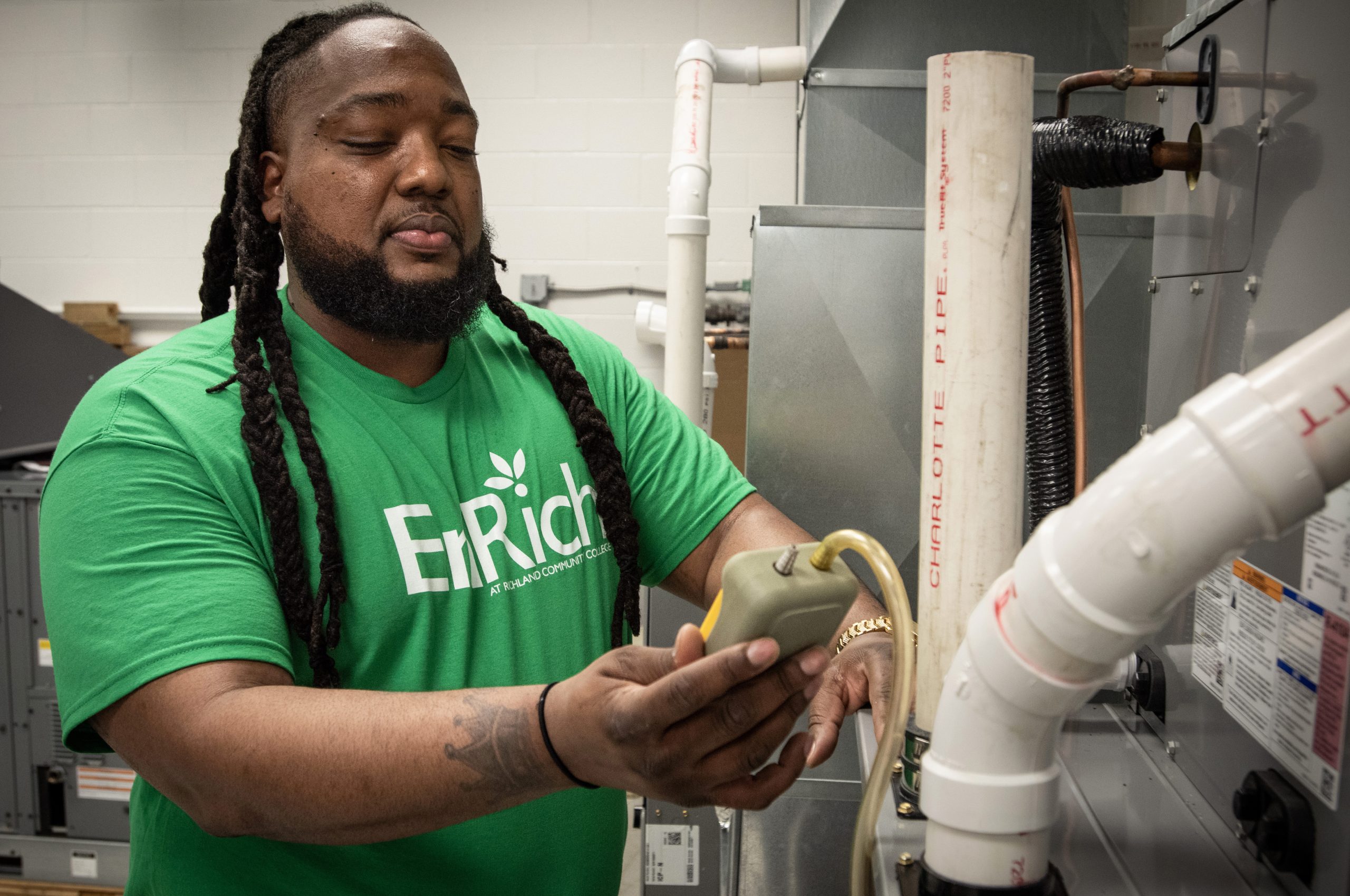
    Today, Honorable is ready to start a new chapter, having graduated with honors last week from a clean energy workforce training program at Richland Community College, located in the Central Illinois city of Decatur. He would eventually like to own or manage a solar company, but he has more immediate plans to start a solar-powered mobile hot dog stand. He’s already chosen the name: Buns on the Run.

    “By me going back to school and doing this, it shows my nephews and my little cousins and nieces that it is good to have education,” Honorable said. “I know this is going to be the new way of life with solar panels. So I’ll have a step up on everyone. When it comes, I will already be aware of what’s going on with this clean energy thing.”

    Shawn Honorable graduated with honors last week from Richland Community College’s clean energy workforce training program in Decatur, Illinois, part of a network of hubs funded by the state’s 2021 Climate and Equitable Jobs Act. Credit: Lloyd DeGrane/Canary Media

    After decades of layoffs and factory closings, the community of Decatur is also looking to clean energy as a potential springboard.

    Located amid soybean fields a three-hour drive from Chicago, the city was long known for its Caterpillar, Firestone Tire, and massive corn-syrup factories. Industrial jobs have been in decline for decades, though, and high rates of gun violence, child poverty, unemployment, and incarceration were among the reasons the city was named a clean energy workforce hub funded under Illinois’ 2021 Climate and Equitable Jobs Act (CEJA).

    Decatur’s hub, based at Richland Community College, is arguably the most developed and successful of the dozen or so established statewide. That’s thanks in part to TCCI Manufacturing, a local, family-owned factory that makes electric vehicle compressors. TCCI is expanding its operations with a state-of-the-art testing facility and an on-site campus where Richland students will take classes adjacent to the manufacturing floor. The electric truck company Rivian also has a factory 50 miles away.

    “The pieces are all coming together,” Kara Demirjian, senior vice president of TCCI Manufacturing, said by email. “What makes this region unique is that it’s not just about one company or one product line. It’s about building an entire clean energy ecosystem. The future of EV manufacturing leadership won’t just be on the coasts — it’s being built right here in the Midwest.”

    Powering Rural Futures: Clean energy is creating new jobs in rural America, generating opportunities for people who install solar panels, build wind turbines, weatherize homes and more. This five-part series from the Rural News Network explores how industry, state governments and education systems are training this growing workforce.

    Related: Want to read more about how climate change is shaping education? Subscribe to our free newsletter.

    The Decatur CEJA program has also flourished because it was grafted onto a preexisting initiative, EnRich, that helps formerly incarcerated or otherwise disenfranchised people gain new skills and employment. The program is overseen by the Rev. Courtney Carson, a childhood friend of Honorable and another member of the Decatur Seven.

    “So many of us suffer significantly from our unmet needs, our unhealed traumas,” said Carson, who was jailed as a young man for gun possession and later drag racing. With the help of mentors including Rev. Jackson and a college basketball coach, he parlayed his past into leadership, becoming associate pastor at a renowned church, leading a highway construction class at Richland, and in 2017 being elected to the same school board that had expelled him.

    Carson, now vice president of external relations at the community college, tapped his own experience to shape EnRich as a trauma-informed approach, with wraparound services to help students overcome barriers — from lack of childcare to PTSD to a criminal record. Carson has faith that students can overcome such challenges to build more promising futures, like Decatur itself has done.

    “We have all these new opportunities coming in, and there’s a lot of excitement in the city,” Carson said. “That’s magnificent. So what has to happen is these individuals who suffered from closures, they have to be reminded that there is hope.”

    Richland Community College’s clean energy jobs training starts with an eight-week life skills course that has long been central to the larger EnRich program. The course uses a Circle of Courage practice inspired by Indigenous communities and helps students prepare to handle stressful workplace situations like being disrespected or even called a racial slur.

    “Being called the N-word, couldn’t that make you want to fight somebody? But now you lose your job,” said Carson. “We really dive deep into what’s motivating their attitude and those traumas that have significantly impacted their body to make them respond to situations either the right way or the wrong way.”

    The training addresses other dynamics that might be unfamiliar to some students — for example, some male students might not be prepared to be supervised by a woman, Carson noted, or others might not be comfortable with LGBTQ+ coworkers.

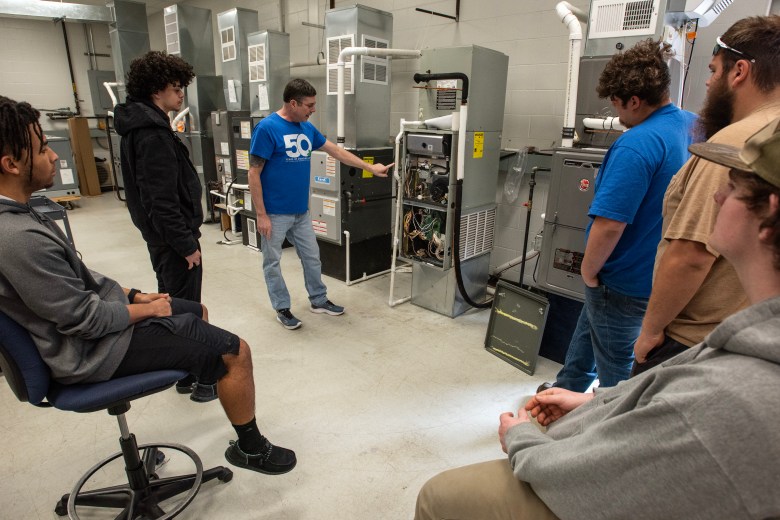
    Karl Evans instructs Richland Community College students on the inner workings of a gas furnace. Credit: Lloyd DeGrane/Canary Media

    Life skills are followed by a construction math course crucial to many clean energy and other trades jobs. During a recent class, 24-year-old Brylan Hodges joked with the teacher while converting fractions to decimals and percentages on the whiteboard. He explained that he moved from St. Louis to Decatur in search of opportunity, and he hopes to become a property manager overseeing solar panel installation and energy-efficiency upgrades on buildings.

    Students take an eight-hour primer in clean energy fields including electric vehicles, solar, HVAC, and home energy auditing. Then they choose a clean energy track to pursue, leading to professional certifications as well as a chance to continue at Richland for an associate degree. Under the state-funded program, students are paid for their time attending classes.

    Related: Students partnered with an EV battery factory to train students and ignite the economy. Trump’s clean energy war complicates their plans

    Marcus James was part of the first cohort to start the program last October, just days after his release from prison.

    He was an 18-year-old living in Memphis, Tennessee, when someone shot at him, as he describes it, and he fired back, with fatal consequences. He was convicted of murder and spent 12 years behind bars. After his release he made his way to Decatur, looking for a safer place to raise his kids. Adjusting to life on the outside wasn’t easy, and he ended up back in prison for a year and a half on DUI and drug possession charges.

    Following his release, he was determined to turn his life around.

    “After I brought my kids up here, I end up going back to prison. But at that moment, I realized, man, I had to change,” James told a crowd at an event celebrating the clean jobs program in March.

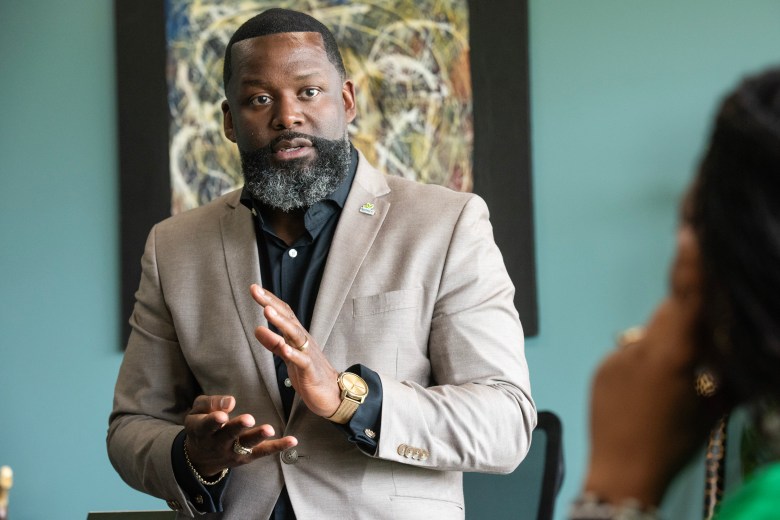
    The Rev. Courtney Carson, vice president of external relations at the community college. Credit: Lloyd DeGrane/Canary Media

    James said that at first, he showed up late to every class. But soon the lessons sank in, and he was never late again. He always paid attention when people talked, and he gained new confidence.

    “As long as I put my mind to it, I can do it,” said James, who would like to work as a home energy auditor. Richland partners with the energy utility Ameren to place trainees in such positions.

    “I like being out in the field, learning new stuff, dealing with homes, helping people,” James said, noting he made energy-efficiency improvements to his own home after the course.

    Related: To fill ‘education deserts,’ more states want community colleges to offer bachelor’s degrees

    Illinois’ 2017 Future Energy Jobs Act (FEJA) launched the state’s clean energy transition, baking in equity goals that prioritize opportunities for people who benefited least and were harmed most by the fossil fuel economy. It created programs to deploy solar arrays and provide job training in marginalized and environmental justice communities.

    FEJA’s rollout was rocky. Funding for equity-focused solar installations went unspent while workforce programs struggled to recruit trainees and connect them with jobs. The pandemic didn’t help. The follow-up legislation, CEJA, expanded workforce training programs and remedied snafus in the original law.

    Melissa Gombar is principal director of workforce development programs for Elevate, a Chicago-based national nonprofit organization that oversaw FEJA job training and subcontracts for a Chicago-area CEJA hub. Gombar said many community organizations tasked with running FEJA training programs were relatively small and grassroots, so they had to scramble to build new financial and human resources infrastructure.

    “They have to have certain policies in place for hiring and procurement. The influx of grant money might have doubled their budget,” Gombar said. Meanwhile, the state employees tasked with helping the groups “are really talented and skilled, trying their best, but they’re overburdened because of the large lift.”

    CEJA, by contrast, tapped community colleges like Richland, which already had robust infrastructure and staffing. CEJA also funds community organizations to serve as “navigators,” using the trust and credibility they’ve developed in communities to recruit trainees.

    Richland Community College received $2.6 million from April 2024 through June 2025, and the Community Foundation of Macon County, the hub’s navigator, received $440,000 for the same time period. The other hubs similarly received between $1 million and $3.3 million for the past year, and state officials have said the same level of funding will be allocated for each of the next two years, according to the Illinois Clean Jobs Coalition.

    CEJA hubs also include social service providers that connect trainees with wraparound support; businesses like TCCI that offer jobs; and affiliated entrepreneur incubators that help people start their own clean energy businesses. CEJA also funded apprenticeship and pre-apprenticeship programs with labor unions, which are often a prerequisite for employment in utility-scale solar and wind.

    “The sum of the parts is greater than the whole,” said Drew Keiser, TCCI vice president of global human resources. “The navigator is saying, ‘Hey, I’ve connected with this portion of the population that’s been overlooked or underserved.’ OK, once you get them trained, send their resumes to me, and I’ll get them interviewed. We’re seeing a real pipeline into careers.”

    The hub partners go to great lengths to aid students — for example, coordinating and often paying for transportation, childcare, or even car repairs.

    “If you need some help, they always there for you,” James said.

    Related: Losing faith: Rural, religious colleges are among the most endangered

    In 1984, TCCI began making vehicle compressors in a Decatur plant formerly used to build Sherman tanks during World War II. A few decades later, the company began producing compressors for electric vehicles, which are much more elaborate and sensitive than those for internal combustion engines.

    In August 2023, Gov. JB Pritzker joined TCCI President Richard Demirjian, the Decatur mayor, and college officials for the groundbreaking of an Electric Vehicle Innovation Hub, which will include a climatic research facility — basically a high-tech wind tunnel where companies and researchers from across the world can send EV chargers, batteries, compressors, and other components for testing in extreme temperatures, rain, and wind.

    A $21.3 million capital grant and a $2.2 million electric vehicle incentive from the state are funding the wind tunnel and the new facilities where Richland classes will be held. In 2022, Pritzker announced these investments as furthering the state goal of 1 million EVs on the road by 2030.

    Far from the gritty industrial environs that likely characterized Decatur workplaces of the past, the classrooms at TCCI feature colorful decor, comfortable armchairs, and bright, airy spaces adjacent to pristine high-tech manufacturing floors lined with machines.

    “This hub is a game changer,” said Keiser, noting the need for trained tradespeople. “As a country, we place a lot of emphasis on kids going to college, and maybe we’ve kind of overlooked getting tangible skills in the hands of folks.”

    A marketing firm founded by Kara Demirjian – Richard Demirjian’s sister – and located on-site with TCCI also received clean energy hub funds to promote the training program. This has been crucial to the hub’s success, according to Ariana Bennick, account executive at the firm, DCC Marketing. Its team has developed, tested, and deployed digital billboards, mailers, ads, Facebook events, and other approaches to attract trainees and business partners.

    “Being a part of something here in Decatur that’s really leading the nation in this clean energy initiative is exciting,” Bennick said. “It can be done here in the middle of the cornfields. We want to show people a framework that they can take and scale in other places.”

    With graduation behind him, Honorable is planning the types of hot dogs and sausages he’ll sell at Buns on the Run. He said Tamika Thomas, director of the CEJA program at Richland, has also encouraged him to consider teaching so he can share the clean energy skills he’s learned with others. The world seems wide open with possibilities.

    “A little at a time — I’m going to focus on the tasks in front of me that I’m passionate about, and then see what’s next,” Honorable said. He invoked a favorite scene from the cartoon TV series “The Flintstones,” in which the characters’ leg power, rather than wheels and batteries, propelled vehicles: “Like Fred and Barney, I’ll be up and running.”

    The Hechinger Report provides in-depth, fact-based, unbiased reporting on education that is free to all readers. But that doesn’t mean it’s free to produce. Our work keeps educators and the public informed about pressing issues at schools and on campuses throughout the country. We tell the whole story, even when the details are inconvenient. Help us keep doing that.

    Join us today.

    Source link

  • Trends in Hiring, 2025 Graduate Readiness for the Workforce

    Trends in Hiring, 2025 Graduate Readiness for the Workforce

    SDI Productions/E+/Getty Images 

    Commencement season brings excitement to college campuses as community members look to celebrate the accomplishments of the graduating class and usher them into their next chapter of life.

    The Class of 2025, however, is gearing up to enter a challenging environment, whether that’s a competitive application cycle for gaining admission to graduate school or a tighter job market compared to previous years.

    Inside Higher Ed compiled 25 data points regarding the Class of 2025 and the workforce they will enter, including levels of career preparedness, challenges in the workplace and the value of higher education in reaching career goals.

    1. Over half of seniors feel pessimistic about starting their careers because they worry about a competitive job market and a lack of job security.
    2. Seventy-eight percent of students rank job stability as a “very important” attribute in potential employers, followed by a healthy workplace culture.
    3. Eighty-eight percent of college juniors and seniors believe their coursework is adequately preparing them for entry-level roles in their chosen fields.
    4. Eight out of 10 soon-to-be graduates plan to start work within three months of graduating.
    5. Hiring for college graduates is down 16 percent compared to last year, and 44 percent below 2022 levels.
    1. Starting salaries are up 3.8 percent year over year, outpacing inflation’s growth of 2.4 percent, as of March.
    2. Seventy-nine percent of young adults say health benefits are a “high” or “very high” priority for them when considering a job opportunity.
    3. Desired location is a top priority for 73 percent of 2025 graduates in deciding which jobs to apply for, followed by job stability (70 percent). Over two-thirds said they’re looking for a job near their family.
    4. If they choose to relocate for work, cost of living is the most pressing issue for new graduates (90 percent), followed by a diverse and tolerant community (64 percent). Ninety-eight percent of young adults say cost of living is their No. 1 money stressor, as well.
    5. Flexibility remains key for graduates, with 43 percent looking for hybrid work, defined as being on-site for two or three days a week. Forty-four percent cited the ability to work from home as an important benefit, and over half want more than two weeks of vacation or paid time off in their first year of work.
    1. Roughly half of entry-level job postings employers plan to create will be hybrid, and about 45 percent will be for fully in-person roles.
    2. Engineering students are expected to be the highest paid of all the majors pursued by the class of 2025, earning an average of $78,731 this year.
    3. Recent college graduates who participated in experiential learning while in college earn on average $59,059, compared to their peers without internships, who earn an average of $44,048.
    4. As of last fall, only half of first-generation students in the Class of 2025 had completed an internship, compared to 66 percent of their peers.
    5. About 12 percent of students have not participated in an internship and do not expect to do so before finishing their degree—lower than the average of 35 percent of workers who enter the workforce without an internship or other relevant work experience.
    1. Ninety-eight percent of employers say their organization is struggling to find talent, but nearly 90 percent say they avoid hiring recent grads—in part, as 60 percent noted, because they lack real-world experience.
    2. One-third of hiring managers say recent graduates lack a strong work ethic, and one in four say graduates are underprepared for interviews.
    3. Over half (57 percent) of HR departments expect to increase spending on training and development in the year ahead.
    4. As of March, nearly 6 percent of recent graduates (ages 22 to 27 who hold a bachelor’s degree or higher) were unemployed, compared with 2.7 percent of all college graduates. The unemployment rate for all young workers (ages 22 to 27) is approximately 7 percent.
    5. Twenty-five percent of young adults are struggling to find jobs in their intended career fields; 62 percent aren’t employed in the career they intended to pursue after graduation.
    6. Nearly 90 percent of students chose their major with a specific job or career path in mind.
    7. Finding purposeful work is critical to Gen Z’s job satisfaction, and more than half say meaningful work is important when evaluating a potential employer.
    8. One-quarter of young adults already have a side hustle, and 37 percent of Gen Z want to start a side hustle.
    9. Ninety-seven percent of human resources leaders say it’s important that new hires have a foundational understanding of business and technology, including in such areas as artificial intelligence, data analytics and IT.
    10. Gen Y and Gen Z workers are more likely than their older peers to worry they will lose their job or their job will be eliminated by generative AI.

    We bet your colleague would like this article, too. Send them this link to subscribe to our newsletter on Student Success.

    Source link

  • Workforce Planning Meets AI: A Blueprint for Smarter Surveys – CUPA-HR

    Workforce Planning Meets AI: A Blueprint for Smarter Surveys – CUPA-HR

    by Christy Williams | May 21, 2025

    For HR professionals in higher education, workforce planning has evolved into a strategic discipline. Filling positions is no longer enough — leaders must anticipate talent needs, support professional growth and align development opportunities with institutional goals. A well-designed needs assessment gives HR teams the insight to take action with confidence and create lasting impact.

    In the CUPA-HR webinar, Survey Says! Using HR Data and AI to Maximize Analysis of Needs, presenters from Harvard University’s Center for Workplace Development shared how their team designed and executed a large-scale, data-informed, AI-supported needs assessment. The goal? To better understand learning needs and create targeted strategies for professional growth across a decentralized institution.

    Here are the key takeaways from their process.

    Start With a Strategic Why

    Before sending a single survey question, clarify what you’re hoping to learn — and why it matters.

    At Harvard, the team began their needs assessment with a clear objective to understand learning and development needs across various employee groups as part of a larger workforce strategy. This meant designing a survey aimed at uncovering more than surface-level training needs, asking instead: What do our employees really need to grow and thrive in their roles?

    Their advice to other HR teams is to anchor your assessment in your institution’s strategic goals and organizational context. Let that “why” guide your survey design from the start.

    Design a Survey That Reflects Your Workforce

    A successful needs assessment is tailored to the specific population it serves rather than one-size-fits-all.

    Harvard’s workforce includes individual contributors, supervisors and executives across many schools and units. Their team created targeted questions for each group and pre-populated some responses using data from their HRIS system to reduce survey fatigue and improve accuracy.

    Make sure your questions are relevant to different audience segments, and use the data you already have to streamline the experience for respondents.

    Boost Participation Through Targeted Communications

    Even the best survey won’t produce results without strong participation. Driving engagement was one of the biggest challenges for Harvard, as it is for many institutions. Their team addressed this by securing leadership support, crafting targeted communications and clearly communicating the value of the survey to employees.

    To boost response rates on your own campus, consider using champions across departments, timing your outreach thoughtfully and explaining how the data will be used to benefit staff.

    Use AI Thoughtfully to Analyze Large Data Sets

    If your survey includes open-ended responses, you’ll likely end up with more data than you can quickly process — especially if your institution is large. This is where AI can help.

    Harvard’s team used a combination of AI tools to analyze thousands of comments and identify themes. But they stressed that the human element remained critical. They invested time in crafting the right prompts, testing outputs and verifying results before presenting them to stakeholders.

    Their approach to AI offers an important lesson: AI can accelerate analysis and bring fresh insights, but it’s not a shortcut. You need to build a process that includes human judgment, data verification and transparency.

    Integrate HR Data for Deeper Insights

    One of the most impactful decisions the Harvard team made was linking survey responses to existing HR data. This allowed them to connect learning needs to specific job roles, departments and demographics — enabling more targeted follow-up and planning.

    By incorporating HRIS data, they were also able to personalize survey questions and reduce respondent burden. That integration enhanced both the quality of their data and their ability to act on it.

    If you’re planning a survey, consider how existing HRIS data can be used to sharpen your questions and deepen your analysis.

    Turn Results Into Action

    The final — and perhaps most critical — step is using what you’ve learned.

    At the time of the webinar, the Harvard team was in what they described as the “where are we now” stage and had begun implementing some of the recommendations from their survey analysis. They emphasized the importance of translating results into practical strategies that support learning and development, talent mobility and organizational effectiveness.

    To do the same on your campus, be sure to:

    • Share key findings transparently with stakeholders.
    • Identify priority areas for development or investment.
    • Use insights to shape programming, leadership development or change management strategies.

    Embrace Experimentation and Continuous Learning

    The Harvard team acknowledged that this process wasn’t perfect — and that was okay. They embraced experimentation, learned from trial and error, and remained open to improving their approach as they went.

    Their experience is a reminder that innovation in higher ed HR — especially when integrating AI — is a journey. Don’t be afraid to pilot new tools and adjust your process.

    Watch the Webinar Recording

    Interested in learning more about Harvard’s process? The full webinar recording and slide deck are available here.

    More CUPA-HR Resources

    Harnessing the Power of Big Data for Sound HR Decision Making — This article examines using workforce data to make good business decisions with confidence.

    Data Visualization and Storytelling Tips and Tools for HR — This on-demand CUPA-HR webinar covers practical tips and tools you can use to share compelling data stories and data visualizations.

    AI in Higher Education HR Toolkit — Best practices and tools for using AI technologies thoughtfully and safely.


    Source link

  • Canceling AmeriCorps grants threatens the future of education and workforce pipelines that power our nation’s progress

    Canceling AmeriCorps grants threatens the future of education and workforce pipelines that power our nation’s progress

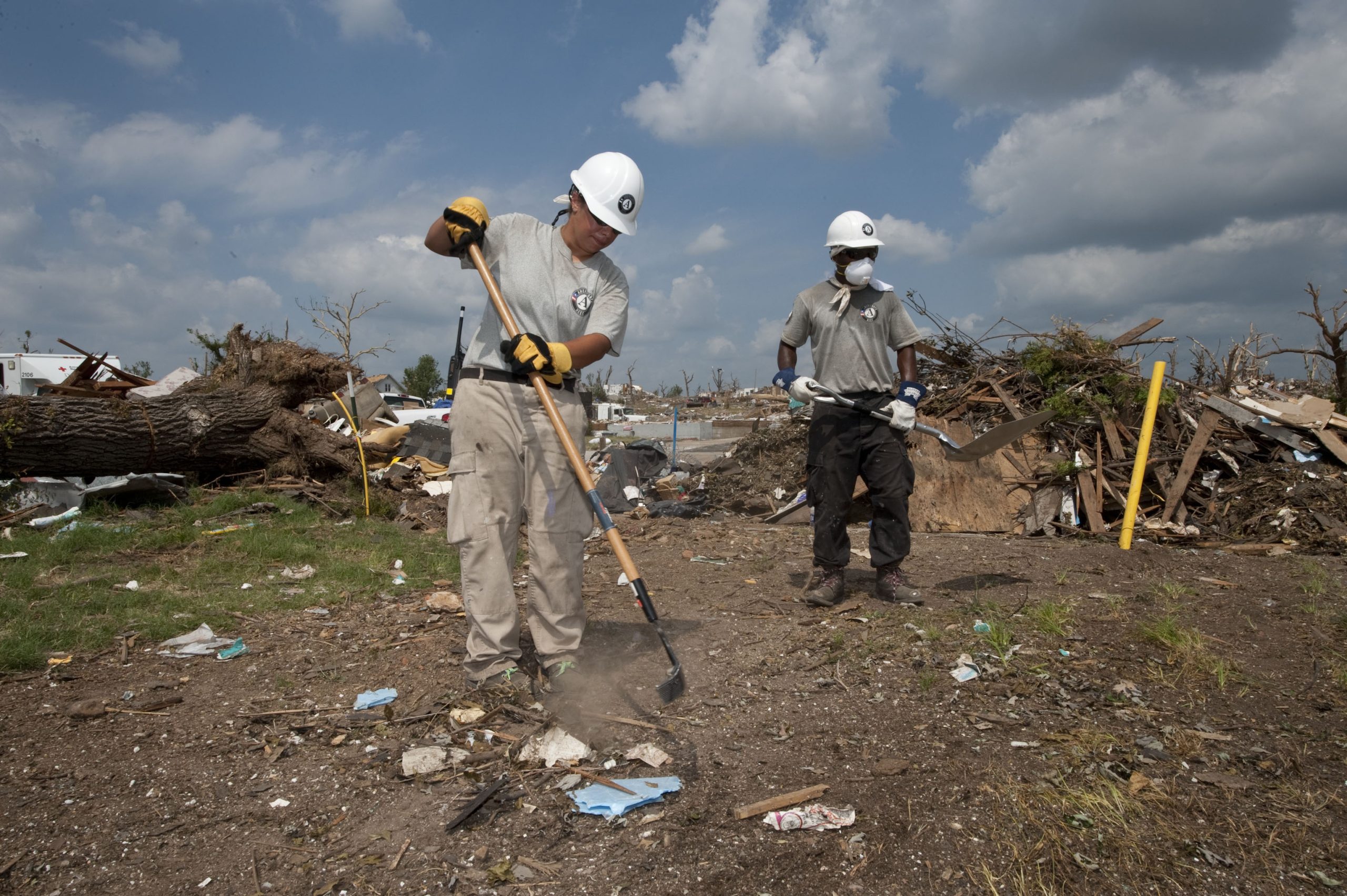
    The recent decision to cancel $400 million in AmeriCorps grants is nothing short of a crisis. With over 1,000 programs affected and 32,000 AmeriCorps and Senior Corps members pulled from their posts, this move will leave communities across the country without critical services.

    The cuts will dismantle disaster recovery efforts, disrupt educational support for vulnerable students and undermine a powerful workforce development strategy that provides AmeriCorps members with in-demand skills across sectors including education.

    AmeriCorps provides a service-to-workforce pipeline that gives young Americans and returning veterans hands-on training in high-demand industries, such as education, public safety, disaster response and health care. Its nominal front-end investment in human capital fosters economic mobility, enabling those who engage in a national service experience to successfully transition to gainful employment.

    As leaders of Teach For America and City Year, two organizations that are part of the AmeriCorps national service network and whose members receive education stipends that go toward certification costs, student loans or future education pursuits, we are alarmed by how this crisis threatens the future of the education and workforce pipelines that power our nation’s progress, and it is deeply personal. We both started our careers as corps members in the programs we now lead.

    Related: A lot goes on in classrooms from kindergarten to high school. Keep up with our free weekly newsletter on K-12 education.

    Aneesh began his journey as a Teach For America corps member teaching high school English in Minnesota. Jim’s path began with City Year, serving at a Head Start program in Boston. We know firsthand that AmeriCorps programs are transformative and empower young people to drive meaningful change — for themselves and their communities.

    At Teach For America, AmeriCorps grants are essential to recruiting thousands of new teachers every year to effectively lead high-need classrooms across the country. These teachers, who have a consistent and significant positive impact on students’ learning, rely on the AmeriCorps education awards they earn through their two years of service to pay for their own education and professional development, including new teacher certification fees, costs that in some communities exceed $20,000.

    Termination of these grants threatens the pipeline of an estimated 2,500 new teachers preparing to enter classrooms over the summer. At a time when rural and urban communities alike are facing critical teacher shortages, cutting AmeriCorps support risks leaving students without the educators they need and deserve.

    City Year, similarly, relies on AmeriCorps to recruit more than 2,200 young adults annually to serve as student success coaches in K-12 schools across 21 states, 29 cities and 60 school districts.

    These AmeriCorps members serving as City Year student success coaches provide tutoring and mentoring that support students’ academic progress and interpersonal skill development and growth; they partner closely with teachers to boost student achievement, improve attendance and help keep kids on track to graduate. Research shows that schools partnering with City Year are two times more likely to improve their scores on English assessments, and two to three times more likely to improve their scores on math assessments.

    Corps members gain critical workforce skills such as leadership, problem-solving and creative thinking, which align directly with the top skills employers seek; the value of their experience has been reaffirmed through third-party research conducted with our alumni. The City Year experience prepares corps members for success in varied careers, with many going into education.

    AmeriCorps-funded programs like Breakthrough Collaborative and Jumpstart further strengthen this national service-to-workforce pathway, expanding the number of trained tutors and teacher trainees while also preparing corps members for careers that make a difference in all of our lives.

    Those programs’ trained educators ensure all students gain access to excellent educational opportunities that put them on the path to learn, lead and thrive in communities across the country. And the leaders of both organizations, like us, are AmeriCorps alumni, proof of the lasting effect of national service.

    Collectively, our four organizations have hundreds of thousands of alumni whose work as AmeriCorps members has impacted millions of children while shaping their own lives’ work, just as it did ours. Our alumni continue to lead classrooms, schools, districts, communities and organizations in neighborhoods across the country.

    Related: Tracking Trump: His actions to dismantle the Education Department, and more

    The termination of AmeriCorps grants is a direct blow to educators, schools and students. And, at a time when Gen Z is seeking work that aligns with their values and desire for impact, AmeriCorps is an essential on-ramp to public service and civic leadership that benefits not just individuals but entire communities and our country at large.

    For every dollar invested in AmeriCorps, $17 in economic value is generated, proving that national service is not only efficient but also a powerhouse for economic growth. Rather than draining resources, AmeriCorps drives real, measurable results that benefit individual communities and the national economy.

    Moreover, two-thirds of AmeriCorps funding is distributed by governor-appointed state service commissions to community- and faith-based organizations that leverage that funding to meet local needs. By working directly with state and local partners, AmeriCorps provides a more effective solution than top-down government intervention.

    On behalf of the more than 6,500 current AmeriCorps members serving with Teach For America and City Year, and the tens of thousands of alumni who have gone on to become educators, civic leaders and changemakers, we call on Congress to protect AmeriCorps and vital national service opportunities.

    Investing in AmeriCorps is an investment in America’s future, empowering communities, strengthening families and revitalizing economies. Let’s preserve the fabric of our national service infrastructure and ensure that the next generation of leaders, educators and community advocates who want to serve our nation have the ability to do so.

    Aneesh Sohoni is Teach For America’s new CEO. Previously, he was CEO of One Million Degrees and executive director of Teach For America Greater Chicago-Northwest Indiana. He is a proud alum of Teach For America.

    Jim Balfanz, a recognized leader and innovator in the field of education and national service, is CEO and a proud alum of City Year.

    Contact the opinion editor at [email protected].

    This story about AmeriCorps, Teach For America and City Year was produced by The Hechinger Report, a nonprofit, independent news organization focused on inequality and innovation in education. Sign up for Hechinger’s weekly newsletter.

    The Hechinger Report provides in-depth, fact-based, unbiased reporting on education that is free to all readers. But that doesn’t mean it’s free to produce. Our work keeps educators and the public informed about pressing issues at schools and on campuses throughout the country. We tell the whole story, even when the details are inconvenient. Help us keep doing that.

    Join us today.

    Source link

  • What does our future workforce look like – and how are universities responding?

    What does our future workforce look like – and how are universities responding?

    • By Jamie Roberts, Policy Manager, and Aiste Viduolyte, PhD student intern at the Russell Group.

    To achieve the government’s ambitious aims of increasing growth and productivity, the UK will need a skilled workforce to match.

    All eight high-potential growth sectors identified by the government’s Industrial Strategy green paper will heavily rely on graduate skills – in particular the creative, digital and life sciences sectors, where over 70% of the workforce is made up of graduates. The government’s own forecasts show that the UK will need an additional 11 million graduates across the country by 2035, with 88% of new jobs being graduate-level.

    To meet these needs on both national and local levels, Russell Group universities are building on their existing partnerships with colleges, businesses and local authorities to make sure education remains as relevant and responsive as possible for graduates and employers alike. Our latest briefing paper, Local Partnerships to Deliver Skills, looks in more detail at the ways in which our universities collaborate with industry, local government and education providers.

    Here we explore three key characteristics of the UK future workforce – and how our universities are responding.

    1. Workers’ skills must keep pace with employers’ rapidly evolving needs

    The government is determined to get British business back to full health and has identified several growth-leading sectors in the Industrial Strategy green paper. These are likely to attract the most investment, but to generate productivity and deliver innovation, they will also need a workforce with the right set of skills – and these needs are evolving at speed.

    Not only will we need new graduates with the latest skills and knowledge, but also existing workers who can be upskilled and reskilled to make sure the workforce’s capabilities keep pace with rapidly changing technological developments and industry practices. This is why Russell Group universities partner with industry to shape course content, ensuring education and training are agile and responsive to each sector.

    Increasingly – now at 17 of our 24 universities – this includes degree apprenticeships, which give people opportunities to pivot or upskill at any stage of their career. Apprenticeships have become an essential pathway for delivering skills directly to industry at all levels, and almost 8,000 students enrolled on apprenticeships at Russell Group universities in 2023/24. At Queen’s University Belfast, for example, business partners such as PwC and construction firm Farrans are directly influencing apprenticeship course content and building talent streams in the areas where skills are most urgently needed, from digital software technology to civil engineering and building.

    More and more, this also means partnering with Small and Medium Enterprises (SMEs) which form the bedrock of the UK economy. At the University of Liverpool, the careers and employment service works with a network of local SMEs to support graduate recruitment and ensure that the university’s graduates are equipped not only with the specialist and technical know-how, but also essential soft skills to enhance what they can bring to local small businesses.

    2. Local workforces must meet each region’s specific needs, strengths and skills gaps

    Whether it’s fixing cold spots or supporting existing industry clusters, we can’t take a one-size-fits-all approach across the country. Local growth plans will be vital in shaping each region’s workforce needs.

    That’s why universities, as important anchor institutions in their towns, cities and regions, must be at the heart of these plans. Our members are already in active collaboration with local and combined authorities to research, understand and address local workforce needs – as part of City Deals, Civic University Agreements, or university involvement in local skills networks.

    In Manchester, the University has teamed up with Greater Manchester Combined Authority and four other regional university partners to develop the first ever city-region Civic University Agreement (GMCUA) in the UK. This model is transforming the relationship between the university sector and local government, allowing them to work together on mapping skills and opportunities, particularly in green skills, the creative sector, health and social care. Meanwhile in London, UCL’s partnership with the councils of Camden, Islington and Newham enables students to contribute to local research and policy, while granting residents access to data skills and literacy training to improve their employability and career prospects.

    3. Every workforce benefits from multiple educational pathways to build the best combination of skills and experience

    While growing the UK’s graduate workforce, it is important we remain cognisant of the wide variety of educational backgrounds and pathways in our communities, and maximise the strengths that different providers bring. We need to move toward a skills and education system that incentivises true collaboration. Partnerships between higher education and further education are invaluable and should acknowledge that further education colleges are not just feeder institutions. Building on existing collaboration will allow students the best of both worlds, while creating cohesive educational pathways that complement, rather than compete with each other.

    Through a mixture of academic and vocational training, our universities’ partnerships with our further education colleagues offer a broad range of expertise, which can support a variety of career options and cover the multitude of skills needed in each region.

    Working together makes sure we not only fulfil a broader range of skills and sectors but also support greater access to education for all. A co-ordinated system, where further and higher education are aligned, creates clearer pathways for people of all backgrounds and educational experiences to access higher-level qualifications. This generates more mechanisms by which we can upskill our workforce.

    A sustainable, highly skilled workforce is of course reliant on a stable, well-funded university system. which is one of the reasons the sector has been so keen to make government understand the scale and urgency of the financial challenges we’re facing. Simply put, the UK won’t have the right workforce to achieve its growth ambitions without considering the role of its universities.

    Source link

  • Overskilled and Underused? What PIAAC Reveals About the Canadian Workforce

    Overskilled and Underused? What PIAAC Reveals About the Canadian Workforce

    Before our show starts today, I just wanna take a minute to note the passing of Professor Claire Callender, OBE. For the last two and a half decades, she’s been one of the most important figures in UK higher education studies, in particular with respect to student loans and student finance. Holder of a joint professorship at UCL Institute of Education and Birkbeck University of London, she was also instrumental in setting up the ESRC Centre for Global Higher Education, of which she later became deputy director. I just want to quote the short obituary that her colleague Simon Marginson wrote for her last week after her passing from lung cancer. He said, “What we’ll remember about Claire is the way she focused her formidable capacity for rational thought on matters to which she was committed, her gravitas that held the room when speaking, and the warmth that she evoked without fail in old and new acquaintances.”

    My thoughts and condolences to her partner Annette, and to her children. We’ll all miss Claire. 


    I suspect most of you are familiar with the OECD’s Program for International Student Assessment, or PISA. That’s a triannual test of 15 year olds around the world. It tries to compare how teenagers fare in real world tests of literacy and numeracy. But you might not be as familiar with PISA’s cousin, the Program for International Assessment of Adult Competencies or PIAAC. To simplify enormously, it’s PISA, but for adults, and it only comes out once a decade with the latest edition having appeared on December 10th of last year. Now, if you’re like most people, you’re probably asking yourself, what does PIAAC measure exactly?

    PISA pretty clearly is telling us something about school systems. Adults, the subject of the PIAAC test, they’ve been out of school for a long time. What do test results mean for people who’ve been out of school for, in some cases, decades? And what kinds of meaningful policies might be made on the basis of this data?

    Today my guest is the CEO of Canada’s Future Skills Centre, Noel Baldwin. Over the past decade, both in his roles at FSC, his previous ones at the Council Minister of Education Canada, he’s arguably been one of the country’s most dedicated users of PIAAC data. As part of Canada’s delegation to the OECD committee in charge of PIAAC, he also had a front row seat to the development of these tests and the machinery behind these big international surveys. 

    Over the course of the next 20 or so minutes, you’ll hear Noel and I, both fellow members of the Canada Millennium Scholarship Foundation Mafia, discuss such issues as how the wording of international surveys gets negotiated, why we seem to be witnessing planet wide declines in adult literacy, what research questions PIAAC is best suited to answer, and maybe most intriguingly what PIAAC 3 might look like a decade from now.

    I really enjoyed this conversation and I hope you do too. Anyway, over to Noel.


    The World of Higher Education Podcast
    Episode 3.28 | Overskilled and Underused? What PIAAC Reveals About the Canadian Workforce

    Transcript

    Alex Usher (AU): Noel, some of our listeners might be familiar with big international testing programs like PISA—the Program for International Student Assessment. But what is the Program for the International Assessment of Adult Competencies? What does it aim to measure, and why?

    Noel Baldwin (NB): It’s somewhat analogous to PISA, but it’s primarily focused on working-age adults. Like PISA, it’s a large-scale international assessment organized by the OECD—specifically by both the education and labor secretariats. It’s administered on the ground by national statistical agencies or other government agencies in participating countries.

    PIAAC is mainly focused on measuring skills like literacy and numeracy. Over time, though, the OECD has added other skill areas relevant to the intersection of education and labor markets—things like digital skills, technology use, problem solving, and social-emotional skills.

    In addition to the assessment itself, there’s a large battery of background questions that gather a lot of demographic information—details about respondents’ work life, and other factors like health and wellbeing. This allows researchers to draw correlations between the core skills being measured and how those skills are used, or what kind of impact they have on people’s lives.

    AU: How do they know that what’s being measured is actually useful in the workplace? I mean, the literacy section is reading comprehension, and the math is sort of like, you know, “If two trains are moving toward each other, one from Chicago and one from Pittsburgh…” It’s a bit more sophisticated than that, but that kind of thing. How do they know that actually measures anything meaningful for workplace competencies?

    NB: That’s a good question. One thing to start with is that the questions build from fairly easy and simple tasks to much more complex ones. That allows the OECD to create these scales, and they talk a lot about proficiency levels—level one up to five, and even below level one in some cases, for people with the weakest skill levels.

    And while PIAAC itself is relatively new, the assessment of these competencies isn’t. It actually dates back to the early 1990s. There’s been a lot of research—by the OECD and by psychometricians and other researchers—on the connections between these skills and broader outcomes.

    The key thing to understand is that, over time, there’s been strong evidence linking higher literacy and numeracy skills to a range of life outcomes, especially labor market outcomes. It’s a bit like educational attainment—these things often act as proxies for one another. But the stronger your skills, the more likely you are to be employed, to earn higher wages, to avoid unemployment, and to be adaptable and resilient.

    And it’s not just about work. It extends to other areas too—life satisfaction, for instance. There are even some interesting findings about democratic participation and people’s perceptions of how their society is doing. So there are pretty strong correlations between higher-level skills and a variety of positive outcomes.

    AU: But, I can imagine that the nature of an economy—whether it’s more manufacturing-based or service-based—might affect what kinds of skills are relevant. So different countries might actually want to measure slightly different things. How do you get 50—or however many, dozens of countries—to agree on what skills to assess and how to measure them?

    NB: The point at which OECD countries agreed to focus on literacy and numeracy actually predates me—and it also predates a lot of today’s focus on more digitally oriented skills. It was a much more analog world when this started, and so literacy and numeracy made a lot of sense. At the time, most of the information people consumed came in some form of media that required reading comprehension and the ability to navigate text. And then, on the numeracy side, the ability to do anything from basic to fairly advanced problem solving with numbers was highly relevant. So I suspect that when this was being developed—through the 1980s and into the early 1990s—there was a high degree of consensus around focusing on those core skills.

    The development of the instruments themselves is also an international effort. It’s led by the OECD, but they work with experts from a range of countries to test and validate the items used in the assessment. Educational Testing Service (ETS) in the U.S. is quite involved, and there are also experts from Australia and Canada. In fact, Canada was very involved in the early stages—both through Statistics Canada and other experts—particularly in developing some of the initial tools for measuring literacy. So, the consensus-building process includes not just agreeing on what to measure and how to administer it, but also developing the actual assessment items and ensuring they’re effective. They do field testing before rolling out the main assessment to make sure the tools are as valid as possible.

    AU: Once the results are in and published, what happens next? How do governments typically use this information to inform policy?

    NB: I’ll admit—even having been on the inside of some of this—it can still feel like a bit of a black box. In fact, I’d say it’s increasingly becoming one, and I think we’ll probably get into that more as the conversation goes on.

    That said, different countries—and even different provinces and territories within Canada—use the information in different ways. It definitely gets integrated into various internal briefings. I spent some time, as you know, at the Council of Ministers of Education, and we saw that both in our own work and in the work of officials across the provinces and territories.

    After the last cycle of PIAAC, for instance, Quebec produced some fairly detailed reports analyzing how Quebecers performed on the PIAAC scales—comparing them to other provinces and to other countries. That analysis helped spark conversations about what the results meant and what to do with them. New Brunswick, for example, launched a literacy strategy shortly after the last PIAAC cycle, which suggests a direct link between the data and policy action.

    So there are examples like that, but it’s also fair to say that a lot of the data ends up being used internally—to support conversations within governments. Even since the most recent PIAAC cycle was released in December, I’ve seen some of that happening. But there’s definitely less in the public domain than you might expect—and less than there used to be, frankly.

    AU: Some of the findings in this latest PIAAC cycle—the headline that got the most traction, I think—was the fact that we’re seeing declines in literacy and numeracy scores across much of the OECD. A few countries bucked the trend—Canada saw a small decline, and parts of Northern Europe did okay—but most countries were down. What are the possible explanations for this trend? And should we be concerned?

    NB: I think we should be really aware. When it comes to concern, though, I’m always a bit hesitant to declare a crisis. There’s a lot of work still to be done to unpack what’s going on in this PIAAC cycle.

    One thing to keep in mind is that most of the responses were collected during a time of ongoing global turmoil. The data was gathered in 2022, so we were still in the middle of the pandemic. Just getting the sample collected was a major challenge—and a much bigger one than usual.

    With that caveat in mind, the OECD has started to speculate a bit, especially about the literacy side. One of the things they’re pointing to is how radically the way people consume information has changed over the past 10 years.

    People are reading much shorter bits of text now, and they’re getting information in a much wider variety of formats. There are still items in the literacy assessment that resemble reading a paragraph in a printed newspaper—something that just doesn’t reflect how most people engage with information anymore. These days, we get a lot more of it through video and audio content.

    So I think those shifts in how we consume information are part of the story. But until we see more analysis, it’s hard to say for sure. There are some signals—differences in gender performance across countries, for example—that we need to unpack. And until we do that, we’re not going to have a great sense of why outcomes look the way they do.

    AU: Let’s focus on Canada for a second. As with most international education comparisons, we end up in the top—but at the bottom of the top third, basically. It doesn’t seem to matter what we do or when—it’s always that pattern. Looking at global trends, do you think Canada stands out in any way, positively or negatively? Are there things we’re doing right? Or things we’re getting wrong?

    NB: Well, I’d say we continue to see something that the OECD points out almost every time we do one of these assessments: the gap between our top performers and our lowest performers is smaller than in many other countries. That’s often taken as a sign of equity, and I’d say that’s definitely a good news story.

    In the global comparison, we held pretty much steady on literacy, while many countries saw declines. Holding steady when others are slipping isn’t a bad outcome. And in numeracy, we actually improved.

    The distribution of results across provinces was also more even than in the last cycle. Last time, there was much more variation, with several provinces falling below the OECD or Canadian average. This time around, we’re more tightly clustered, which I think is another positive.

    If you dig a little deeper, there are other encouraging signs. For example, while the OECD doesn’t have a perfect measure of immigration status, it can identify people who were born outside a country or whose parents were. Given how different Canada’s demographic profile is from nearly every other participating country—especially those in Northern Europe—I think we’re doing quite well in that regard.

    And in light of the conversations over the past few years about immigration policy and its impacts across our society, I think it’s a pretty good news story that we’re seeing strong performance among those populations as well.

    AU: I know we’ll disagree about this next question. My impression is that, in Canada, the way PIAAC gets used has really changed over the last decade. The first round of PIAAC results got a lot of attention—StatsCan and the Council of Ministers of Education both published lengthy analyses.

    And maybe “crickets” is too strong a word to describe the reaction this time, but it’s definitely quieter. My sense is that governments just don’t care anymore. When they talk about skills, the narrative seems focused solely on nursing and the skilled trades—because those are seen as bottlenecks on the social side and the private sector side.

    But there’s very little interest in improving transversal skills, and even less knowledge or strategy about how to do so. Make me less cynical.

    NB: Well, it’s funny—this question is actually what kicked off the conversation that led to this podcast. And I’ll confess, you’ve had me thinking about it for several weeks now.

    One thing I want to distinguish is caring about the skills themselves versus how the data is being released and used publicly. There’s no denying that we’re seeing less coming out publicly from the governments that funded the study. That’s just true—and I’m not sure that’s going to change.

    I think that reflects a few things. Partly, it’s the changed fiscal environment and what governments are willing to pay for. But it’s also about the broader information environment we’re in today compared to 2013.

    As I’ve been reflecting on this, I wonder if 2012 and 2013 were actually the tail end of the era of evidence-based policymaking—and that now we’re in the era of vibes-based policymaking. And if that’s the case, why would you write up detailed reports about something you’re mostly going to approach from the gut?

    On the skills side, though, I still think there’s an interesting question. A few weeks ago, I felt more strongly about this, but I still believe it’s not that governments don’t care about these foundational skills. Rather, I think the conversation about skills has shifted.

    We may have lost sight of how different types of skills build on one another—starting from foundational literacy and numeracy, then layering on problem-solving, and eventually reaching digital competencies. That understanding might be missing in the current conversation.

    Take the current moment around AI, for example. Maybe “craze” is too strong a word, but there’s a belief that people will become great at prompt engineering without any formal education. Mark Cuban—on BlueSky or wherever, I’m not sure what they call posts there—made a point recently that you won’t need formal education with generative AI. If you can get the right answers out of a large language model, you’ll outperform someone with an advanced degree.

    But that completely overlooks how much you need to understand in order to ask good questions—and to assess whether the answers you get are worth anything. So we may start to see that shift back.

    That said, you’re right—there has definitely been a move in recent years toward thinking about workforce issues rather than broader skill development. And that may be a big part of what’s going on.

    AU: What do you think is the most interesting or under-explored question that PIAAC data could help answer, but that we haven’t fully investigated yet? This dataset allows for a lot of interesting analysis. So if you could wave a magic wand and get some top researchers working on it—whether in Canada or internationally—where would you want them to focus?

    NB: First, I’ll just make a small plug. We’ve been working on what we hope will become a PIAAC research agenda—something that responds to the things we care about at the Future Skills Centre, but that we hope to advance more broadly in the coming weeks and months. So we are actively thinking about this.

    There are a bunch of areas that I think are really promising. One is the renewed conversation about productivity in Canada. I think PIAAC could shed light on the role that skills play in that. The Conference Board of Canada did a piece a while back looking at how much of the productivity gap between Canada and the U.S. is due to skill or labor factors. Their conclusion was that it wasn’t a huge part—but I think PIAAC gives us tools to continue digging into that question.

    Another area the OECD often highlights when talking about Canada is the extent to which workers are overqualified or overskilled for the jobs they’re in. That’s a narrative that’s been around for a while, but one where I think PIAAC could offer deeper insights.

    It becomes even more interesting when you try to link it to broader labor supply questions—like the role of immigration. Some people have suggested that one reason Canada lags in things like technology integration or capital investment is that we’ve substituted skilled labor for that kind of investment.

    With PIAAC, we might be able to explore whether overqualification or overskilling is connected to the way we’ve managed immigration over the last couple of decades.

    So, there are a few areas there that I think are both relevant and under-explored. And of course, on the international side, you’re right—we should be looking for examples of countries that have had success, and thinking about what we can emulate, borrow from, or be inspired by.

    AU: I don’t know if either of us wants to still be doing this in 10 years, but if we were to have this conversation again a decade from now, what do you think—or hope—will have changed? What will the long-term impact of PIAAC Cycle 2 have been, and how do you think PIAAC 3 might be different?

    NB: Well, I think I need to say this out loud: I’m actually worried there won’t be a PIAAC 3.

    We’re recording this in early 2025, which is a pretty turbulent time globally. One of the things that seems clear is that the new U.S. administration isn’t interested in the Department of Education—which likely means they won’t be interested in continuing the National Center for Education Statistics.

    And like with many international initiatives, the U.S. plays a big role in driving and valuing efforts like PIAAC. So I do worry about whether there will be a third cycle. If it happens without U.S. participation, it would be a very different kind of study.

    But I hope that in 10 years, we are talking about a robust PIAAC 3—with strong participation from across OECD countries.

    I also hope there’s continued investment in using PIAAC data to answer key research questions. It’s just one tool, of course, but it’s a big one. It’s the only direct assessment of adult skills we have—where someone is actually assessed on a defined set of competencies—so it’s really valuable.

    For an organization like ours, which is focused on adult skills in the workforce, it’s up to us to push forward and try to get answers to some of these questions. And I hope the research we and others are doing will find its way into policy conversations—especially as we think about how workforce needs, skills, and the broader economy are going to change over the next decade.

    It would be a wasted opportunity if it didn’t.

    AU: Noel, thanks so much for being with us today.

    NB: Thanks Alex.

    *This podcast transcript was generated using an AI transcription service with limited editing. Please forgive any errors made through this service. Please note, the views and opinions expressed in each episode are those of the individual contributors, and do not necessarily reflect those of the podcast host and team, or our sponsors.

    This episode is sponsored by Studiosity. Student success, at scale – with an evidence-based ROI of 4.4x return for universities and colleges. Because Studiosity is AI for Learning — not corrections – to develop critical thinking, agency, and retention — empowering educators with learning insight. For future-ready graduates — and for future-ready institutions. Learn more at studiosity.com.

    Source link