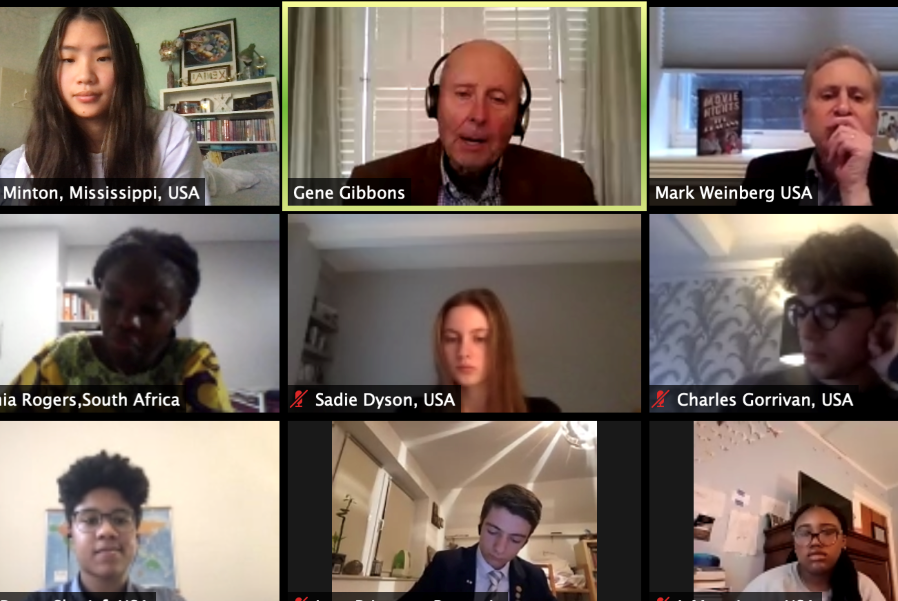
Back in 2019, students at La Jolla Country Day School in California interviewed a citizen of Beirut who had spent years imprisoned in the Guantanamo Bay Detention Center in Cuba, through a live zoom webinar arranged by News Decoder.
In 2022, News Decoder brought war correspondent Bernd Debusmann into a classroom, through a live feed to the Tatnall School in the U.S. state of Delaware where students were able to ask him what it was like getting shot in the back while covering Beirut.
My memory of high school is the challenge I had keeping my eyes open and my head vertical. I can describe falling in love with a metallic blue Mercedes in the parking lot below the window in my trigonometry class but I can’t tell you what a cotangent is.
The students in math and history and language classes today will inherit not just the world we live in but the power to shape it. And the years they spend in school are supposed to prepare them for that awesome responsibility.
But can we keep them awake and aware after they’ve stayed up half the night binging Apple TV or playing PUBG, fueled by orange Fanta and Hot Cheetos?
Feeding curiosity
It is News Decoder’s deep belief that most students are curious and want to learn but that they need to connect to the material they are supposed to study.
For 10 years we’ve helped teachers and schools engage teens through experiential learning and by connecting them with people who have been eyewitnesses to world events. At News Decoder, we bring the world into the classroom and take students out into the world around them.
We do this through storytelling. We don’t tell them stories, we have them tell stories to us and the world and interview people who have stories to tell. We show them the power of telling other people’s stories through journalism and in the process exploring other people’s perspectives and learning about their experiences.
Two ways we do this is through cross border webinars and through our signature Pitch, Report, Draft and Revise process that we call PRDR. In cross border webinars we put students from different countries and across different time zones together in live video sessions to share problems in their communities and compare the conclusions they reached after researching the same important topic.
This past year we did that through our monthly “Decoder Dialogues.” Students from countries including Colombia, India, Belgium, France, Rwanda and the United States shared their research and views about topics as important as the role of the press in journalism, what good and bad leadership looks like, and where responsibility for climate change lies.
Through the PRDR process, we encourage students to identify a problem in their community, research it, and find and interview an expert — someone who had directly experienced the problem, or someone working to solve it and then see whether and how that same problem exists in other countries and how people in those countries tackle it.
Building human connections across borders
Ultimately, we guide them through the process of turning their findings into engaging stories — articles or podcasts or videos and publishing those stories to the world.
In a world where so many of us spend so much time looking at screens, we want students to realize that knowledge can begin online, but the most powerful information comes from finding and interviewing people who are knowledgeable and that conversation with an interesting person is so much more engaging than words on a screen.
Interviews are transformative. In conducting them, students find themselves at the same level as the people they interview no matter how important that person is. An insightful question asked by a 16-year-old to say, famed U.S. constitutional lawyer Floyd Abrahms, which Lucy Jaffee did back in 2020, commands respect.
“I just loved being able to talk to people and hear their stories,” Jaffee said at the time.
It is that love for human connection in an increasingly robotic world that News Decoder is committed to fostering. We’ve done it for 10 years and we plan to do it for another decade.
Seventeen years after Suzanne Collins first introduced us to The Hunger Games, the world is still captivated by Panem. The latest installment, Sunrise on the Reaping, dives into Haymitch’s backstory and has been called a “propulsive and heart-wrenching addition” to the series by The New York Times. For many of us, books like these aren’t just stories–they’re cultural moments.
I remember reading the original trilogy on my iPad while training for a half-marathon. Katniss’ fight against the Capitol powered me through some of my longest runs. That’s the magic of books: They meet us where we are and carry us somewhere else entirely. They become part of our personal history, woven into our memories and milestones.
But the power of books goes far beyond personal nostalgia. When a major title drops, it’s not just a release date–it’s a shared experience. Readers rush to get their hands on it. Social media lights up with reactions. Libraries field waitlists. These moments remind us why books matter. They connect us, challenge us, and inspire us.
This fall, we’re about to experience two more of these moments. On October 21, Diary of a Wimpy Kid: Partypooper hits shelves. Jeff Kinney’s beloved series has become a rite of passage for young readers, and this latest installment–centered around Greg Heffley’s attempt to throw himself the ultimate birthday bash–is already generating buzz. It’s funny, relatable, and perfectly timed for a generation that’s grown up with Greg’s awkward, hilarious adventures.
Just a few weeks later, on November 11, Dog Man: Big Jim Believes arrives. Dav Pilkey’s Dog Man series has redefined what it means to be a children’s book phenomenon. With its blend of humor, heart, and comic-style storytelling, Dog Man has helped countless kids fall in love with reading. This new title promises to be no different, offering a story about belief, friendship, and finding strength within.
These books aren’t just for kids–they’re cultural touchstones. They bring generations together. Parents read them with their children. Teachers use them to spark classroom discussions. Librarians build displays around them. And kids? They devour them and talk about them with the kind of passion usually reserved for blockbuster movies or viral games.
And yes, there’s a business side to books. Pricing, distribution, marketing strategies–they all matter. Behind every book on a shelf is a network of people working to make that moment possible. Publishers, authors, illustrators, binders, warehouse teams, sales reps, marketers, and more. It’s easy to forget that when you’re holding a finished book, but every title is the result of countless decisions, collaborations, and passions.
In a world dominated by screens, short-form content, and constant notifications, books offer something different. They ask us to slow down. To focus. To imagine. To empathize. And that’s more important than ever.
Literacy isn’t just about reading words on a page–it’s about understanding the world. It’s about critical thinking, emotional intelligence, and the ability to engage with complex ideas. Books help build those skills. They give kids the tools to navigate life, not just school.
Because in a world that’s constantly changing, books remain one of our most powerful tools for understanding it–and each other. The world needs stories. And stories need us.
A fifth-generation family member, Britten Follett is CEO at Follett Content Solutions, which has long been the No. 1 provider of content and technology solutions to school libraries at more than 70,000 schools and school districts. She has led Follett’s PreK-12 business since September 2019 and is responsible for providing leadership, strategic direction, and business development. In September 2020, Publishers Weekly named her a “PW Star Watch” honoree, one of 40 professionals singled out from the North American publishing industry.
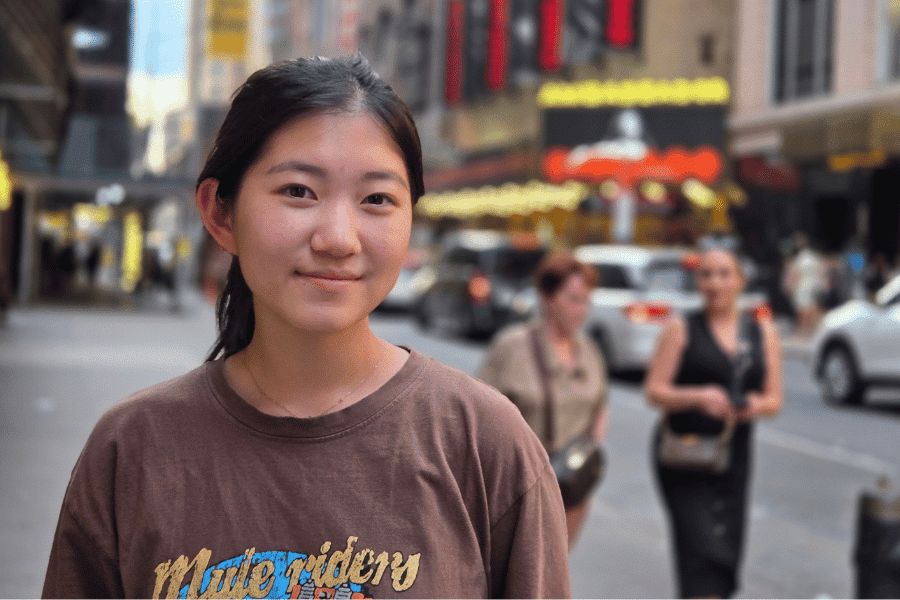
At the age of 9, Hannah Choo found herself shuttled across the Pacific Ocean from California to Seongnam, South Korea. She found herself living in a city, about an hour from Seoul, where everything from language to climate was different.
She’d grown up in sunny, suburban, slow-paced Pasadena in Southern California and wasn’t happy at first about the move.
“When I first arrived, the honking of cars at night was so loud that I couldn’t fall asleep,” Choo said.
But now, seven years later, she realizes that the experience of living in two starkly different cities has given her a better understanding of people. And this is important because Choo wants to be a journalist.
She has joined News Decoder as a summer intern, bringing with her an interest in communities and how they collectivize and support themselves.
“Korea has made me look deeper into how people differ experientially, not just in terms of surface factors like race or ethnicity or where they’re from,” she said. “I think there’s a lot of diversity in Korea with what people go through in their lives.”
Appreciating cultural differences
The homogenous culture of South Korea gives Choo a strong sense of community and has helped her realise that people’s differences are not defined by where they come from.
For News Decoder, Choo brings the perspective of a young person, which is valuable to an organization devoted to helping youth process global events and the confusing digital world that consumes them.
“Hannah has been helping me critique News Decoder’s climate journalism educational materials,” McCauley said. “As the EYES project enters its phase of dissemination, Hannah’s curiosity and understanding of depth is helping the curriculum to become stronger and more relevant for the young people of today.”
McCauley said that Choo is thoughtful and critical, but that it is her way of interacting with others that is her best asset.
“She brings me trust in future generations,” McCauley said.
Working with News Decoder
Choo said she wanted to work with News Decoder because of the way it spotlights the human side of news, and how lives are impacted by everyday events.
“I feel like News Decoder aims to really empower students to not just write a story in general, but also how to incorporate their own voice into that while sticking with the rules of journalism,” Choo said.
Choo will also help News Decoder bolster its social media. In the coming weeks, she will be working with News Decoder’s Program and Communication Manager Cathal O’Luanaigh on her own series of posts on News Decoder’s social media pages and working with its Educational News Director Marcy Burstiner on articles related to climate change, people and culture.
Burstiner said that when Choo first came to News Decoder it was as if she knew exactly what was wanted of her. “She has a great instinct for news, for seeing the story that hasn’t been told and that needs to be told,” Burstiner said. “For News Decoder, South Korea is a country that has been underreported. I’m really looking forward to her stories.”
Ultimately, Choo hopes to tell stories about people in many different places.
“I see myself travelling the world and visiting different communities and really hearing their stories, and being able to present it in a way that’s authentic to them,” she said. “And showing that to the rest of the world and allowing other people to also see all of these unique parts of a global culture that you never really get a spotlight on.”
Telling global stories
What she has learned so far in her travels from California to South Korea is that there is great satisfaction in adapting to a new culture.
While there was no language barrier for Choo when she moved to Seongnam, having spoken Korean with her parents since she was a child, the noise and way of living there needed some getting used to. But what she at first found so different, she now finds comfort in.
Everything she needs outside of her apartment complex, which is wrapped by four different roads, is just a short subway, drive or walk away. And with community comes safety.
“I always tell people that you could leave your laptop on top of a coffee shop table and expect to find it there again an hour later,” Choo said.
There are still challenges.
Korean schools are hyper competitive and getting into a prestigious university is important. This means that in high school, students are so focused on getting good grades that their mental health often suffers.
Young people prioritise studying for tests over sleep and a social life. They compare themselves to each other and base their self worth on academic performance.
“That creates pretty toxic dynamics between people,” she said. “Beating out the competition, I think, is a huge narrative here.”
This also means that school and learning is centred on grades, so that critical thinking and interest is of much lower importance.
“Studying in any school in Korea, even if international, means you’re still affected by the culture,” Choo said.
To understand the chaos that is the world today it helps to look back a decade.
This past year, world representatives met at COP29 to fight climate change in a place led by an authoritarian regime dependent on fossil fuels. The Israeli government under Prime Minister Benjamin Netanyahu has been massacring Palestinians in Gaza. The United States bombed Iran in an attempt to eliminate its nuclear capability. And U.S. President Donald Trump and an increasing number of European leaders have closed their doors to immigrants and refugees.
In great contrast, when News Decoder launched 10 years ago, 196 nations signed onto the landmark agreement known as the Paris Accords, ushering in the hope that together we could cool down the planet. The administration of then-U.S. President Barack Obama signed a historic agreement with Iran, in which Iran would get rid of 97% of its supply of enriched uranium. A million refugees flooded into Europe from conflicts in Syria and elsewhere.
In the years in between, the world locked down during the Covid-19 pandemic, Great Britain exited the European Union, the #MeToo movement erupted across the world, nations across the globe began legalizing same sex marriage, Russia invaded Ukraine, Trump got elected, tossed out and re-elected and we began ceding everything to artificial intelligence.
Can you imagine coming of age in that world?
Decoding world events
When Nelson Graves founded News Decoder to help young people “decode” the world through news, it seemed that we lived in an age of optimism. Now young people feel helpless and disconnected. In April 2024, the World Economic Forum reported that young people worldwide are increasingly unhappy and this trend would have real consequences for the future.
“We live in a world where teenagers grapple with a sense of crisis before adulthood; a time when young people, historically beacons of optimism, report lower happiness than their elders,” the report said.
But even back in 2015, Nelson knew things would change. He’d spent years as a foreign correspondent covering world events.
“Anyone with a sense of history and someone with experience in following current events — especially a foreign correspondent — would have known that the world is most likely to change when you’re least expecting it,” he said. “Nothing is immutable — except the truism that the political pendulum is always swinging.”
The roots of Brexit, the Make America Great Again movement in the United States and antipathy towards immigrants were already deep in 2015, even if they were largely underground and out of sight, he said.
A decade later, News Decoder’s mission of connecting young people to the world around them seems more relevant than ever.
For 10 years, the high school students News Decoder has worked with have explored — through articles, podcasts, videos and photo essays and in live, cross-border dialogues — how problems in their communities connect to things happening elsewhere in the world. In 2016, for instance, a student studying abroad in China worked with News Decoder to explore how growing consumerism was leading to mountains of trash and created an army of people who mined that trash building up around them.
That same year in an online roundtable, News Decoder brought together students from the Greens Farms Academy in the United States with students from Kings Academy in Jordan, Aristotle University in Greece and School Year Abroad in France to discuss the ongoing war in Syria and the worldwide crisis of Syrian refugees.
Kindling curiosity
One of the Greens Farms Academy students who participated, Samyukt Kumar, further explored the topic in an article News Decoder published that year. Looking back, he now tells, the practical experience it gave him was valuable.
“Less for the substance but more for the practical experience,” he said. “My views on these topics evolved significantly as I received greater education and real-world exposure. But I still reap the benefits from gaining more confidence in my writing, learning to embrace the editing process and engaging my curiosity about the world.”
In 2017, a News Decoder student at Haverford College in the United States explored the problem of migrants flooding into her home country of Italy. She came to this conclusion:
“The roots of the problem lie outside of Italy, which nonetheless bears a heavy burden as the first EU destination for thousands of Africans crossing the Mediterranean,” she wrote. “A solution to the migration crisis depends not only on Italy’s good will — now being stretched to the limits — but also on the willingness of the rest of Europe and the international community to tackle the armed conflicts, poverty and human rights abuses that stir so many Africans to attempt the perilous Mediterranean crossing.”
Fast forward to 2025. News Decoder worked with high school students in the British Section at the Lycée International Saint-Germain-en-Laye outside of Paris to take what they learned about the United Nations Sustainable Development Goals and find and tell narrative stories through podcasts. They explored such things as the problem of poverty in resource-rich areas of Africa and the connection between actions of multinational corporations and climate change.
Crossing borders
In Switzerland, News Decoder worked with students at Realgymnasium Rämibühl Zürich on a series of articles that explored gender inequity in sports, the connection between social media and the decline of democracy, how a local community is affected when it hosts a world conference and the connection between the quality of life in a country and the people’s willingness to pay for that through high prices and high taxes.
And in monthly “Decoder Dialogues” News Decoder put together students from countries such as the United States, Colombia, France, India, Belgium and Rwanda in online roundtables to discuss such topics as the future of journalism, climate action, censorship, leadership and artificial intelligence.
Through the exploration of a problem in the world, by seeking out experts who can put it into context and by seeking out different perspectives from other places, students make sense out of chaos. They begin to see that there are people out there thinking about these problems in different ways and seeking solutions to them.
Ultimately, the message News Decoder wants students to take away is that you don’t need to run from complicated problems. You don’t need to disengage from the news and the events happening around you. By delving more into a topic or issue or controversy, you can begin to understand it and see the path forward.
At News Decoder, we believe people should be able to listen to each other and exchange viewpoints to work through problems across differences and borders. Back in 2015, Graves posed this challenge: How to tap into the intellectual energy of the generation that will soon assume leadership in business, government, academia and social enterprise?
For the past 10 years we have worked to empower young people by giving them the information they need, connecting them to the world around them and providing them a forum for expression. For a decade we have helped them find coherence out of the chaos around them — and we intend to continue doing that for the next 10 years.
One thing we know: 10 years from now the world will be a lot different from what it is now.
“While no one has a perfect crystal ball, you can be sure that nothing remains unchanged for long,” Graves said. “Yesterday’s mortal enemy can become a fast friend — think of U.S. relations with Vietnam since the 1950s. Lesson: Always expect change, even if you can’t anticipate the precise contours, and don’t project linearly into the future. As ever, keep an open mind and beware confirmation bias.”
That’s the message News Decoder tries to instill in the young people we work with. After all, a decade from now, they will be the ones making that change happen.
If you believe – as many do – that English higher education is among the best in the world, it can come as an unwelcome surprise to learn that in many ways it is not.
As a nation that likes to promote the idea that our universities are globally excellent, it feels very odd to realise that the rest of the world is doing things rather better when it comes to quality assurance.
And what’s particularly alarming about this is that the new state of the art is based on the systems and processes set up in England around two decades ago.
Further afield
The main bone of contention between OfS and the rest of the quality assurance world – and the reason why England is coloured in yellow rather than green on the infamous EQAR map – and the reason why QAA had to demit from England’s statutory Designated Quality Body role – is that the European Standards and Guidance (ESG) require a cyclical review of institutional quality processes and involve the opinions of students, while OfS wants things to be more vibes risk-based and feels quality assurance is far too important to get actual students involved.
Harsh? Perhaps. In the design of its regulatory framework the OfS was aiming to reduce burden by focusing mainly on where there were clear issues with quality – with the enhancement end handled by the TEF and the student aspect handled by actual data on how they get on academically (the B3 measures of continuation, completion, and progression) and more generally (the National Student Survey). It has even been argued (unsuccessfully) in the past that as TEF is kind of cyclical if you squint a bit, and it does sort of involve students, that England is in fact ESG compliant.
It’s not like OfS were deliberately setting out to ignore international norms, it was more that it was trying to address English HE’s historic dislike for lengthy external reviews of quality as it established a radically new system of regulation – and cyclical reviews with detailed requirements on student involvement were getting in the way of this. Obviously this was completely successful, as now nobody complains about regulatory burden and there are no concerns about the quality of education in any part of English higher education among students or other stakeholders.
Those ESG international standards were first published in 2005,with the (most recent) 2015 revision adopted by ministers from 47 countries (including the UK). There is a revision underway led by the E4 group: the European Association for Quality Assurance in Higher Education (ENQA), ESU, EUA and EURASHE – fascinatingly, the directors of three out of four of these organisations are British. The ESG are the agreed official standards for higher education quality assurance within the Bologna process (remember that?) but are also influential further afield (as a reference point for similar standards in Africa, South East Asia, and Latin America. The pandemic knocked the process off kilter a bit, but a new ESG is coming in 2027, with a final text likely to be available in 2026.
A lot of the work has already been done, not least via the ENQA-led and EU-funded QA-FIT project. The final report, from 2024, set out key considerations for a new ESG – it’s very much going to be a minor review of the standards themselves, but there is some interesting thinking about flexibility in quality assurance methodologies.
The UK is not England
International standards are reflected more clearly in other parts of the UK.
Britain’s newest higher education regulator, Medr, continues to base higher education quality assurance on independent cyclical reviews involving peer review and student input, which reads across to widely accepted international standards (such as the ESG). Every registered provider will be assessed at least every five years, and new entrants will be assessed on entry. This sits alongside a parallel focus on teaching enhancement and a focus on student needs and student outcomes – plus a programme of triennial visits and annual returns to examine the state of provider governance.
Over at the Scottish Funding Council the Tertiary Quality Enhancement Framework (TQEF) builds on the success of the enhancement themes that have underpinned Scottish higher education quality for the past 20 years. The TQEF again involves ESG-compliant cyclical independent review alongside annual quality assurance engagements with the regulator and an intelligent use of data. As in Wales, there are links across to the assessment of the quality of governance – but what sets TQEF apart is the continued focus on enhancement, looking not just for evidence of quality but evidence of a culture of improvement.
Teaching quality and governance are also currently assessed by cyclical engagements in Northern Ireland. The (primarily desk-based) Annual Performance Review draws on existing data and peer review, alongside a governance return and engagement throughout the year, to give a single rating to each provider in the system. Where there are serious concerns an independent investigation (including a visit) is put in place. A consultation process to develop a new quality model for Northern Ireland is underway – the current approach simply continues the 2016 HEFCE approach (which was, ironically, originally hoped to cover England, Wales, and Northern Ireland while aligning to ESG).
The case of TNE
You could see this as a dull, doctrinal, dispute of the sort that higher education is riven with – you could, indeed, respond in the traditional way that English universities do in these kinds of discussions by putting your fingers in your ears and repeating the word “autonomy” in a silly voice. But the ESG is a big deal: it is near essential to demonstrate compliance if you want to get stuck into any transnational education or set up an international academic partnership.
As more parts of the world are now demanding access to high quality higher education, it seems fair to assume that much of this will be delivered – in the country or online – by providers elsewhere. In England, we still have no meaningful way of assuring the quality of transnational education (something that we appear to be among the best in the world at expanding)? Indeed, we can’t even collect individualised student data about TNE.
Almost by definition, regulation of TNE requires international cooperation and international knowledge – the quasi-colonial idea that if the originating university is in good standing then everything it does overseas is going to be fine is simply not an option. National systems of quality need to be receptive to collaboration and co-regulation as more and more cross-border provision is developed, in terms of rigor, comparability (to avoid unnecessary burden) and flexibility to meet local needs and concerns.
Of course, concerns about the quality of transnational education are not unique to England. ENQA has been discussing the issue as a part of conversations around ESG – and there are plans to develop an international framework, with a specific project to develop this already underway (which involves our very own QAA). Beyond Europe, the International Network for Quality Assurance Agencies in Higher Education (INQAAHE – readers may recall that at great expense OfS is an associated member, and that the current chair is none other than the QAA’s Vicki Stott) works in partnership with UNESCO on cross-border provision.
And it will be well worth keeping an eye on the forthcoming UNESCO second intergovernmental conference of state parties to the Global Convention on Higher Education later this month in Paris, which looks set to adopt provisions and guidance on TNE with a mind to developing a draft subsidiary text for adoptions. The UK government ratified the original convention, which at heart deals with the global recognition of qualifications, in 2022. That seems to be the limit of UK involvement – there’s been no signs that the UK government will even attend this meeting.
TNE, of course, is just one example. There’s ongoing work about credit transfer, microcredentials, online learning, and all the other stuff that is on the English to-do pile. They’re all global problems and they will all need global (or at the very least, cross system) solutions.
Plucky little England going it alone
The mood music at OfS – as per some questions to Susan Lapworth at a recent conference – is that the quality regime is “nicely up and running”, with the various arms of activity (threshold assessment for degree awarding powers, registration, and university titles; the B conditions and associated investigations; and the Teaching Excellence Framework) finally and smoothly “coming together”.
A blog post earlier this month from Head of Student Outcomes Graeme Rosenberg outlined more general thinking about bringing these strands into better alignment, while taking the opportunity to fix a few glaring issues (yes, our system of quality assurance probably should cover taught postgraduate provision – yes, we might need to think about actually visiting providers a bit more as the B3 investigations have demonstrated). On the inclusion of transnational education within this system, the regulator has “heard reservations” – which does not sound like the issue will be top of the list of priorities.
To be clear, any movement at all on quality assurance is encouraging – the Industry and Regulators Committee report was scathing on the then-current state of affairs, and even though the Behan review solidified the sense that OfS would do this work itself it was not at all happy with the current fragmentary, poorly understood, and internationally isolated system.
But this still keeps England a long way off the international pace. The ESG standards and the TNE guidance UNESCO eventually adopts won’t be perfect, but they will be the state of the art. And England – despite historic strengths – doesn’t even really have a seat at the table.
Renowned economist Jeffrey Sachs has launched a scathing critique of U.S. foreign policy in the Middle East, placing the blame squarely on Washington’s alliance with Israel’s far-right leadership. Speaking at the Antalya Diplomacy Forum, Sachs claimed that American interference—encouraged by Israeli Prime Minister Benjamin Netanyahu—has devastated the region. He cited covert operations like the CIA’s Timber Sycamore as catalysts behind the Syrian civil war and accused Israel of pushing for armed conflict with Iran after having allegedly promoted six previous wars.
This audio is auto-generated. Please let us know if you have feedback.
With diversity, equity and inclusion efforts facing scrutiny under the Trump administration, school districts and states looking to diversify their teacher workforces are in a precarious situation.
Nearly a month into President Donald Trump’s second term, for instance, the U.S. Department of Education slashed $600 million in “divisive” teacher training grants — specifically through the Teacher Quality Partnership Program and the Supporting Effective Educator Development Grant Program. The department said in February that those cuts were made to grants that “included teacher and staff recruiting strategies implicitly and explicitly based on race.” Advocates for the federal grants said the decision particularly impacted funding for programs aiming to improve teacher diversity in classrooms.
For years, there’s been a push for more policies to support the recruitment and retention of teachers of color as the nation’s K-12 public school student population grows more racially diverse and as teacher shortages persist. Advocates often point to research that shows when schools hire teachers who look like their students — particularly students of color — student achievement improves and disciplinary rates go down.
While research from the National Council on Teacher Quality found that teacher diversity slowly grew between 2014 and 2022, those findings also suggested that teachers of color are opting out of careers in education as teacher diversity lags behind the rate of the broader workforce.
But with the U.S. Supreme Court’s 2023 ruling that repealed race-conscious admissions in higher education and the Trump administration’s ongoing push against DEI, some experts advise districts and states to be cautious when approaching teacher diversity efforts moving forward. On the flip side, advocates say the need for these initiatives remain.
A ‘scary’ time for teacher diversity initiatives
Before Modesto City Schools began its teacher workforce diversity partnership with California State University, Stanislaus, there was a “mismatch” in representation between students of color and teachers of color in its elementary schools, said Shannon Panfilio-Padden, an associate professor at the university’s college of education.
During the 2021-22 school year, elementary enrollment for students of color in Modesto City Schools could range from 60% in some buildings to as much as 98% in others. That’s compared to the range of 13% to 66% among elementary teachers of color in the district, said Panfilio-Padden, who helped oversee the partnership between the district and university. “What Modesto had been working on for years was diversifying their teacher workforce, but no matter what they tried, it wasn’t working.”
By improving collaboration and identifying workforce barriers with Modesto City Schools, CalState Stanislaus — which has a majority Hispanic student population — was able to double the number of candidates who are teachers of color, from 6 to 16, who entered the district’s classrooms between the 2021-22 and 2023-24 school years, said Panfilio-Padden.
At a time when such initiatives are being targeted at the federal level, Panfilio-Padden said “it can be scary.” But, she said, she’s dedicated to supporting her students, who are aspiring teachers from diverse backgrounds.
“We need teachers so desperately in California, and we need highly qualified teachers,” she said. Panfilio-Padden said the university can’t predict the amount of federal aid or state grant money that will be available to aspiring teachers, but “at the same time, when they continue to come to us with an enthusiasm to teach elementary kids, it just puts everything into perspective.”
Meanwhile, on the other side of the country, Massachusetts enacted the Educator Diversity Act in November 2024 as part of the state’s economic development package. The legislation looks to address barriers to recruiting and retaining educators of color by allowing multiple pathways for teacher certification, creating a statewide dashboard for tracking educator workforce diversity at the district level, and increasing uniformity in hiring practices to support candidates from underrepresented backgrounds.
Students of color make up more than 45% of public school enrollment in Massachusetts, while only 10% of teachers in the state are people of color, according to Latinos for Education, a nonprofit advocacy group that supported the Educator Diversity Act.
The Educator Diversity Act is “going to help all communities” and not just aspiring educators of color, because the legislation creates more equitable opportunities to enter the teaching profession — and that ultimately benefits everyone, said Jorge Fanjul, executive director for the Massachusetts chapter of Latinos for Education. If the law included a quota based on race, that would be discriminatory, he said, but that’s not the case here.
While Fanjul said he’s hopeful about the efforts to improve teacher diversity in Massachusetts, parts of the broader movement in the U.S. “may be wounded” because of the Trump administration’s anti-DEI policies.
Elsewhere, a 33-year-old Illinois state law aiming to boost teacher diversity, known as the Minority Teachers of Illinois Scholarship Program, is being challenged in court by public interest law firm Pacific Legal Foundation, which claims the program discriminates against nonminorities. A motion to dismiss the case is still pending in the U.S. District Court for the Central District of Illinois.
Since the program’s beginnings in 1992, 13,000 scholarships have been awarded to aspiring teachers through the Minority Teachers of Illinois Scholarship Program, said Bravetta Hassell, director of communications for Advance Illinois, an organization that supports the state’s scholarship program.
Applicants must be a minority student to receive the scholarships, which are “intended to help diversify the teaching pool and provide a supply of well-qualified and diverse teachers for hard-to-staff schools,” according to the program’s website.
Over the last decade, teaching candidates of color have jumped from 20% to 36% in Illinois, Hassell said. That’s not enough, considering over half of all K-12 public school students in the state are students of color compared to just 18% of the state’s teachers being educators of color, she added.
‘Tread carefully’
The lawsuit challenging MTI alleges that not allowing nonminority students to receive a scholarship on the basis of race is a violation of the equal protection clause of the 14th Amendment. For Erin Wilcox, senior attorney at Pacific Legal Foundation, MTI is a pretty clear example of a government program that gives out a benefit based on race.
Since the Supreme Court’s ruling against race-based admissions practices in 2023, Wilcox said, courts are starting to implement a stricter standard for when the government can discriminate on the basis of race for many different programs.
The latest challenge against the MTI program “is one more example of how states have really got to take a hard look at their laws and start cleaning up their act” as they approach similar programs that promote teacher diversity, Wilcox said.
“The race-based programs, ones that specifically admit or exclude applicants based on their race, I think those are on a collision course with the U.S. Constitution. I think it’s unavoidable,” Wilcox said.
While schools “desperately” need teachers nationwide, Wilcox said, districts and states need to continue encouraging people to become teachers — but “you can’t do it based on the race of the person who’s applying for your program.”
Though there’s promising research on the importance of having a diverse teaching staff, districts should “tread carefully,” on teacher diversity initiatives, which are now increasingly at risk of potential legal scrutiny, said Mike Petrilli, president of the Thomas B. Fordham Institute, a nonprofit education policy think tank.
Districts have to make sure their policies and practices don’t discriminate against Black or Hispanic teachers, Petrilli said. While they seek to expand their pipeline to include those candidates, districts must also avoid discriminating against White or Asian teachers. Rather, he said, the district workforce strategy should be “opening the door to everybody.”
The point, Petrilli said, should be, “How can we get as close to a non-discriminatory approach and a non-biased approach as possible, and can that help us improve our diversity?”
Imperial College London, University of Oxford, University of Cambridge and UCL all maintain their places in the global top 10 and 17 of the total 90 UK universities ranked this year are in the top 100, two more than last year.
The University of Sheffield and The University of Nottingham have returned to the global top 100 for the first time since 2023 and 2024 respectively.
But despite improvements at the top end of the QS ranking, some 61% of ranked UK universities have dropped this year.
Overall, the 2026 ranking paints a picture of heightening global competition. A number of markets have been emerging as higher education hubs in recent decades – and the increased investment, attention and ambition in various places is apparent in this year’s iteration.
Saudi Arabia – whose government had set a target to have five institutions in the top 200 by 2030 – has seen its first entry into to top 100, with King Fahd University of Petroleum & Minerals soaring 34 places to rank 67th globally.
Vietnam, a country that is aiming for five of its universities to feature in the top 500 by the end of the decade, has seen its representation in the rankings leap from six last year to 10 in 2026.
China is still the third most represented location in the world in the QS World University Rankings with 72 institutions, behind only the US with 192 and the UK with 90. And yet, close to 80 institutions that are part of the Chinese Double First Class Universities initiative to build world-class universities still do not feature in the overall WUR.
Saudi Arabia currently has three institutions in the top 200, while Vietnam has one in the top 500. If these countries succeed in their ambitions, which universities will lose out among the globe’s top in five years’ time?
The financial pressure the UK higher education is facing is well documented. Universities UK (UUK) recently calculated that government policy decisions will result in a £1.4 billion reduction in funding to higher education providers in England in 2025/26. The Office for Students’s warning that 43% of England’s higher education institutions will be in deficit this academic year is often cited.
Some 19% UK university leaders say they have cut back on investment in research given the current financial climate, and an additional 79% are considering future reductions.
On a global scale, cuts like this will more than likely have a detrimental impact on the UK’s performance in the QS World University Ranking – the world’s most-consulted international university ranking and leading higher education benchmarking tool.
The 2026 QS World University Rankings already identify areas where UK universities are behind global competitors.
With a 39.2 average score in the Citations per Faculty area, measuring the intensity of research at universities, the UK is already far behind places such as Singapore, the Netherlands, Hong Kong, Australia and Mainland China, all of which have average scores of at least 70.
In Faculty Student Ratio, analysing the number of lecturers compared to students, the UK (average score of 26.7) is behind the best performing locations such as Norway (73.7), Switzerland (63.8) and Sweden (61.8).
While Oxford, Cambridge and LSE all feature in the global top 15 in Employment Outcomes and 13 UK universities feature in the top 100 for reputation among employers, other universities across the world are improving at a faster rate than many UK universities.
While 74% of UK universities improved in the international student ratio indicator in 2022, the last few years have identified a weakening among UK institutions. In 2023, 54% of UK universities fell in this area, in 2024, 56% dropped and in 2025, 74% declined. And in 2026, 73% dropped.
The government in Westminster is already aware that every £1 it spends on R&D delivers £7 of economic benefits in the long term and, for that reason, it prioritised spending to rise to £22.6bn in 2029-30 from £20.4bn in 2025-26.
But without the financial stability at higher education institutions in question, universities will need more support going ahead beyond support for their research capabilities. Their role in developing graduates with the skills to propel the UK forward is being overlooked. The QS 2026 World University Ranking is already showing that global peers are forging ahead. UK universities will need the right backing to maintain their world-leading position.