Tag: World

  • Leading (again) in uncertainty

    Leading (again) in uncertainty

    Key points:

    • Change has become the norm in our high-speed world
    • How school leaders can manage and control emotions
    • Em-pathy, not un-pathy, in school leadership
    • For more news on navigating change, visit eSN’s Educational Leadership hub

    We are again in uncertain times. We again find ourselves dealing with sudden changes and uncertainty. We seem to be in a state of constant change and ambiguity. The causes are different, but the feelings–and often our immediate reactions to these events–are the same.

    More News from eSchool News

    Teachers are superheroes. Every day, they rise to the challenge, pouring their hearts into shaping the future. They stay late to grade papers and show up early to tutor struggling students.

    In today’s evolving educational landscape, effective student assessment goes beyond multiple-choice tests and letter grades. According to a recent study, over 60 percent of educators believe traditional assessments fail to fully measure student understanding.

    Holden, my 21-month-old, has fallen in love.  His early morning snack and “couch time” includes a dose of “Tiger!”  This is toddler for, “Mom, turn on Daniel Tiger’s Neighborhood.”

    The COVID-19 pandemic left an indelible mark on K-12 education, placing immense pressure on teachers as they adapted, literally overnight, to new methods of instruction.

    Spring brings not only showers and flowers, but it also brings the opportunity to interview for new education positions. Preparing for an interview involves several key steps that can significantly impact the outcome.

    STEM careers are on the rise. According to the U.S. Bureau of Labor Statistics, employment in STEM occupations is expected to grow by 10.4 percent from 2023 to 2033, compared to just 3.6 percent for non-STEM occupations.

    The U.S. Department of Education is giving state education agencies 10 days to certify that their schools do not engage in any practices that the administration believes illegally promote diversity, equity, and inclusion.

    COVID had already killed thousands of people in other countries and was spreading in the United States when a top federal health official said schools should prepare to offer “internet-based teleschooling” in case they had to close for a period of time.

    More than half of educators (62 percent) are already making use of AI at school, with more than one-quarter using it daily for work purposes, according to a Twinkl survey of more than 3,500 U.S. teachers.

    Many math tasks involve reading, writing, speaking, and listening. These language demands can be particularly challenging for students whose primary language is not English.

    Want to share a great resource? Let us know at [email protected].

    Source link

  • In a world of tech, human-led efforts may be the best school safety tool

    In a world of tech, human-led efforts may be the best school safety tool

    The Education Reporting Collaborative, a coalition of eight newsrooms, is investigating the unintended consequences of AI-powered surveillance at schools. Members of the Collaborative are AL.com, The Associated Press, The Christian Science Monitor, The Dallas Morning News, The Hechinger Report, Idaho Education News, The Post and Courier in South Carolina, and The Seattle Times.

    RIGBY, Idaho — Four years ago, a sixth grader in Rigby, Idaho, shot and injured two peers and a custodian at a middle school. The tragedy prompted school officials to reimagine what threat prevention looks like in the approximately 6,500-student district.

    Now, student-run Hope Squads in Rigby schools uplift peers with homemade cards and assemblies. Volunteer fathers patrol hallways as part of Dads on Duty. A team of district staff, counselors, social workers and probation officers gathers to discuss and support struggling students. Thanks to a new cellphone ban, students are off screens and talking to each other. The positive results of these combined efforts have been measurable.

    “We’ve helped change … lives,”said Brianna Vasquez, a senior at Rigby Highand member of her school’s Hope Squad. “I’ve had friends who have been pulled out of the hole of depression and suicidal thoughts because of [the Hope Squad].”

    School shootings like Rigby’s have driven America’s educatorstotry to prevent similar harm. Many districts in the U.S. have turned to technology — especially digital surveillance — as the antidote. Not everyone is sold on that approach, as there can be issues, including with privacy and security.Without broad agreement on which strategies do work best, some districts are trying a braided approach — using a combination of technology, on-the-ground threat assessment teams, and other mental health supports.

    “If you’re sitting in the shoes of a district leader, taking a multi-pronged approach is probably very sensible,” said Jennifer DePaoli, a senior researcher at the Learning Policy Institute, who has studied school safety.

    Related: Schools are surveilling students to prevent gun violence or suicide. The lack of privacy comes at a cost

    In Rigby, educators lean toward human interaction. Artificial intelligence and digital surveillance systems are perhapsless likely to identify who is eating alone at lunch or withdrawing from friends.

    “It’s all about culture,” said Chad Martin, the superintendent of Jefferson County School District in Rigby. “It starts with that — just having a friend, having a group of friends, having a connection somewhere.”

    Rigby school leaders use technology to detect threats, including an app, STOPit, which allows students to anonymously report safety concerns, and surveillance software that monitors students’ keystrokes and looks out for troubling terms. Martin said those are helpful, but must be used in concert with human-led initiatives.

    The district’s version of a threat assessment team, which meets monthly, has been one of the most useful tools, Martin said. In those group conversations, school staff may realize that a student who’s been missing class has a parent who was recently arrested, for example.

    “Everybody has a little piece of information,” Martin said. “So the goal is to put those people in the same room and be able to paint a picture that can help us support kids.”

    Chad Martin, superintendent of Jefferson County School District, said student relationships remain the most powerful tool in keeping school safe. Credit: John Roark

    Although Idaho does not mandate the use of in-school threat assessment teams, 11 states in the U.S. do. In 2024, the National Center for Education Statistics reported that 71 percent of U.S. public schools have a threat assessment team in place.

    A leading model,used by thousands of school districts, is the Comprehensive School Threat Assessment Guidelines (CSTAG). These were developed by forensic clinical psychologist Dewey Cornell after he spent years studying homicides committed by children or teens, including school shootings. He said digital surveillance technology can offer school districts “an illusion of safety and security.”

    With CSTAG, school-based teams use a five-step process when threats emerge. The team includes a school administrator, a counselor or psychologist, a social worker, a staff member focused on special education, and a school resource officer. In serious situations, the group might suspend or move a student elsewhere while conducting mental health screenings,a law enforcement investigation, and development of a safety plan. Ultimately, that plan would be put into effect.

    If implemented correctly, Cornell says, this type of approach is less punitive and more rooted in intervention. Instead of relying only on technology, Cornell and his threat assessment guidelines recommend adding humans who can make decisions with schools as situations emerge. He points to a recent study in Florida, one of the states where threat assessment teams are mandatory. Threats investigated by those teams “resulted in low rates of school removal and very low rates of law enforcement actions,” according to the report authored by Cornell and fellow University of Virginia researchers.

    “If you’re a school counselor and you can work with a troubled kid and help get them on the right track, you’re not just preventing a school shooting, but you’re more likely to be preventing a shooting that would occur somewhere else and maybe years in the future,” he said.

    Threat assessment teams — whether using the CSTAG model or another form — haven’t been immune from scrutiny. Complaints have emerged about them operating without student or parent knowledge, or without staff members to represent children with special needs. Criticism has also included concern about discrimination against Black and Hispanic students.

    DePaoli, from the Learning Policy Institute, says more research is needed to determine whether they successfully identify threats and provide students with appropriate support. She suspects it boils down to implementation.

     “If you are being required to do these, you need to be doing them with so much training and so much support,” she said.

    Related: Do protocols for school safety infringe on disability rights?

    The Jordan School District in Utah uses the CSTAG model. Travis Hamblin, director of student services, credits the “human connection” with strengthening the district’s approach to handling threats and, as a result, boosting student safety and well-being.

    Earlier this school year, the district received an alert through Bark, a digital monitoring tool that scans students’ school-issued Google suite accounts. It flagged a middle schooler’s account, which contained a hand drawn picture of a gun that had been uploaded.

    The notification mobilized the school’s threat assessment team. By using the CSTAG decision-making process, the team determined the student did not intend any harm, Hamblin says.

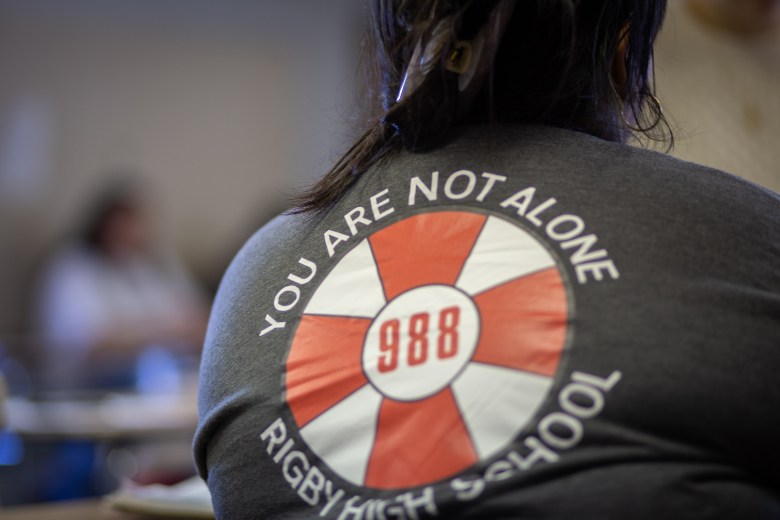
    Rigby High’s Hope Squad — and those like it nationwide — aim to foster connection and reduce the risk of suicide. Credit: John Roark

    The school leaders didn’t unnecessarily escalate the situation, he says. After their assessment, they chalked it up to middle school immaturity and asked the student to avoid such drawings in the future.

    “When you say, ‘Why did you do that?’ And they say, ‘I don’t know.’ That’s the truth, right? That’s the gospel truth,” Hamblin said.

    He shares this example to illustrate how the district marries technology-related monitoring with human-led threat assessment. The district employs someone — a former school administrator and counselor — to field the Bark alerts and communicate with school staff. And administrators from every school in the district have undergone threat assessment training, along with select members of their staff.

    “A digital tool for us is a tool. It’s not the solution,”  Hamblin said. “We believe that people are the solution.”

    Related: Schools are sending more kids to psychiatrists out of fears of campus violence, prompting concern from clinicians

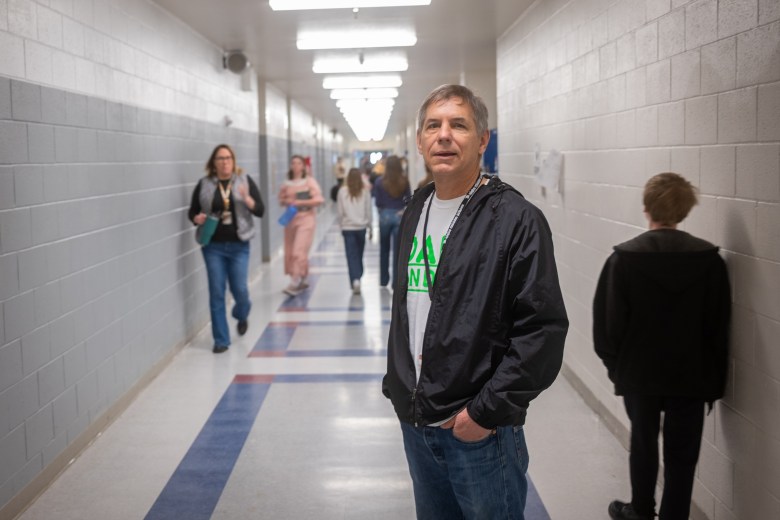
    In Rigby, one of those solution people is Ernie Chavez, whose height makes him stick out in a hallway streaming with middle schoolers. He’s part of Dads on Duty, a program that brings in parents to help monitor and interact with students during passing periods and lunch.

    Throughout the school, students reach out to Chavez for high-fives. On one February afternoon, he was greeted with applause and cheers. “I don’t know what that was about,” he said with a smile.

    Similarly, the district’s Hope Squads, in place since 2021, have become an active presence inside the school.

    The student-led coalitions aim to foster connection and reduce the risk of suicide. Thousands of schools across the United States and in Canada have implemented Hope Squads, but in Rigby, the mission of violence prevention has become personal.

    Ernie Chavez monitors the hallways at Rigby Middle School on Feb. 5 for the Dads on Duty program. Credit: John Roark

    “We refer … students every year to counselors, and those students go from some of the worst moments in their life (to getting help),” Vasquez said. “We build the connection between adults and faculty to the student.”

    Members of the Hope Squad notice peers who seem down or isolated and reach out with a greeting, or sometimes a handmade card.

    “We just reach out and let them know that people in the community are there for them, just to show them that we care and they’re not alone,” said Dallas Waldron, a Rigby High senior and Hope Squad member.

    The groups also plan assemblies and special events, including, for example, a week of activities themed around mental health awareness.

    Emilie Raymond, a sophomore at Rigby High, said the shooting made it clear “that people need to feel included and they need to find that hope.”

    Another change at Rigby schools is a cell phone ban that was put in place this school year.

    Before the ban,students were “sitting in the corners, isolated, staring at a screen,” said Ryan Erikson, Principal at Rigby Middle School. Now, “they’re playing games, they’re goofing off … they’re actually conversing.”

    While Jefferson County School District’s approach to stemming violence is robust, “it’s not perfect,” Martin, the superintendent, said. “It’s still life. That’s just the reality of it, we’re still going to have things come up that we haven’t prepared for or weren’t on our radar. But we address them and just try to do whatever we can to support kids.”

    Carly Flandro is a reporter with Idaho Education News. Jackie Valley is a reporter with The Christian Science Monitor.

    Contact Hechinger managing editor Caroline Preston at 212-870-8965, on Signal at CarolineP.83 or via email at [email protected].

    This story about school threat assessments was produced by the Education Reporting Collaborative, a coalition of eight newsrooms that includes AL.com, The Associated Press, The Christian Science Monitor, The Dallas Morning News, The Hechinger Report, Idaho Education News, The Post and Courier in South Carolina, and The Seattle Times.

    The Hechinger Report provides in-depth, fact-based, unbiased reporting on education that is free to all readers. But that doesn’t mean it’s free to produce. Our work keeps educators and the public informed about pressing issues at schools and on campuses throughout the country. We tell the whole story, even when the details are inconvenient. Help us keep doing that.

    Join us today.

    Source link

  • How to incorporate real-world connections into any subject area

    How to incorporate real-world connections into any subject area

    Key points:

    In my classroom, I frequently encounter students expressing their opinions: “How is this relevant to the real world?” or “Why should I care? I will never use this.” This highlights the need for educators to emphasize real-world applications across all subjects.

    As an educator, I consistently strive to illustrate the practical applications of geography beyond the classroom walls. By incorporating real-world experiences and addressing problems, I aim to engage students and encourage them to devise solutions to these challenges. For instance, when discussing natural resources in geography, I pose a thought-provoking question: “What is something you cannot live without?” As students investigate everyday items, I emphasize that most of these products originate from nature at some point, prompting a discussion on the “true cost” of these goods.

    Throughout the unit, I invite a guest speaker who shares insights about their job duties and provides information related to environmental issues. This interaction helps students connect the dots, understanding that the products they use have origins in distant places, such as the Amazon rainforest. Despite it being thousands of miles away, I challenge students to consider why they should care.

    As students engage in a simulation of the rainforest, they begin to comprehend the alarming reality of its destruction, driven by the increasing demand for precious resources such as medicines, fruits, and beef. By the conclusion of the unit, students will participate in a debate, utilizing their research skills to argue for or against deforestation, exploring its implications for resources and products in relation to their daily lives. This approach not only enhances their understanding of geography but also creates a real-world connection that fosters a sense of responsibility toward the environment.

    Creating a foundation to build upon

    Engaging in academic discussions and navigating through academic content is essential for fostering a critical thinking mentality among students. However, it is often observed that this learning does not progress to deeper levels of thought. Establishing a solid foundation is crucial before advancing toward more meaningful and complex ideas.

    For instance, in our geography unit on urban sprawl, we start by understanding the various components related to urban sprawl. As we delve into the topic, I emphasize the importance of connecting our lessons to the local community. I pose the question: How can we identify an issue within the town of Lexington and address it while ensuring we do not contribute to urban sprawl?  Without a comprehensive foundation, students struggle to elevate their thinking to more sophisticated levels. Therefore, it is imperative to build this groundwork to enable students to engage in higher-order thinking effectively.

    Interdisciplinary approaches

    Incorporating an interdisciplinary approach can significantly enrich the learning process for students. When students recognize the connections between different subjects, they gain a deeper appreciation for the relevance of their education. According to Moser et. al (2019), “Integrative teaching benefits middle-level learners as it potentially increases student engagement, motivation, and achievement. It provides learners with the opportunity to synthesize knowledge by exploring topics and ideas through multiple lenses.” This method emphasizes the importance of making meaningful connections that deepen students’ comprehension. As they engage with the content from different perspectives, students will apply their learning in real-world contexts.

    For instance, principles from science can be linked to literature they are studying in English class. Similarly, concepts from physics can be applied to understand advancements in medical studies. By fostering these connections, students are encouraged to think critically and appreciate the interrelated nature of knowledge.

    Incorporating technology within classrooms

    In today’s digital world, where technology is readily accessible, it is crucial for classroom learning to align with current technological trends and innovations. Educators who do not incorporate technology into their teaching practices are missing an opportunity to enhance student learning experiences. In my class, I have students explore their designated area using Google Earth, which we previously outlined. Each student selected a specific region to concentrate on during their analysis. This process involves identifying areas that require improvement and discussing how it can benefit the community. Additionally, we examine how these changes can help limit urban sprawl and reduce traffic congestion.

    We have moved beyond the era of relying solely on paper copies and worksheets; the focus now is on adapting to change and providing the best opportunities for students to express themselves and expand their knowledge. As Levin & Wadmany (2014) observe, “some teachers find that technology encourages greater student-centeredness, greater openness toward multiple perspectives on problems, and greater willingness to experiment in their teaching.” This highlights the necessity for teachers to evolve into facilitators of learning, acting as guides who support students taking ownership of their learning.

    Strategies for implementation

    1. Start with the “why”: Teachers should critically consider the significance of their instructional approaches: Why is this method or content essential for students’ learning? Having a clear vision of the desired learning outcomes enables educators plan effectively and what instructional strategies to use. This intentionality is crucial.

    2. Use authentic materials: Incorporating meaningful text that involves real-world concepts can significantly enhance students’ engagement. For instance, in social studies class discussing renewable energy can lead to academic discussion or projects where students research about local initiatives in their community.

    3. Promote critical thinking: Encourage students to engage in critical thinking by asking open-ended questions, creating opportunities for debates to challenge their ideas, and urging them to articulate and defend their viewpoints.

    4. Encourage collaboration: Students excel in collaborative learning environment, such as group projects and peer reviews where they can engage with their classmates. These activities allow them to learn from each other and view different perspectives.

    5. Provide ongoing feedback: Providing constructive feedback is essential for helping students identify their strengths and areas for improvements. By having planned check-ins, teachers can tailor their instruction to ensure that they are meeting the academic needs of individual students.

    References

    Levin, T., & Wadmany, R. (2006). Teachers’ Beliefs and Practices in Technology-based Classrooms: A Developmental View. Journal of Research on Technology in Education, 39(2), 157–181. https://doi.org/10.1080/15391523.2006.10782478

    Moser, K. M., Ivy, J., & Hopper, P. F. (2019). Rethinking content teaching at the middle level: An interdisciplinary approach. Middle School Journal, 50(2), 17–27. https://doi.org/10.1080/00940771.2019.1576579

    Latest posts by eSchool Media Contributors (see all)

    Source link

  • Humans in an AI world

    Humans in an AI world

    Key points:

    Like it or not, AI is evolving, and it is cementing its place in education. And the CoSN 2025 Conference is preparing attendees to meet the AI challenge head-on, focusing this year’s conference theme on human leadership in an AI world.

    Register here to attend this year’s conference in Seattle.

    Ken Shelton, an independent consultant, speaker, advisor, and strategist, opens the conference on Monday, March 31 with his keynote, Reimagining Learning with AI: A Path to Empowerment. Shelton will explore the promises and perils of leveraging AI in education and will delve into strategies for maximizing AI’s benefits while addressing its risks, ensuring that AI becomes a tool for true empowerment in education.

    On Tuesday, April 1, panelists Lindsay E. Jones, CEO of CAST, Lindsay Kruse, CEO of All Means All, and Rachell Johnson, director of assistant technology at SCATP, will participate in a general session, Leadership, Not Bystanders, moderated by Sarah Radcliffe, director of Future Ready Learning in the School District of Altoona. Panelists will discuss how can to ensure that no student is overlooked as AI continues to reshape education.

    The closing keynote on Wednesday, April 2, Beyond the Algorithm–Building Trust, Access, and Purpose in AI-Enhanced Education, features Richard Culatta of ISTE + ASCD, Victor Lee of the Graduate School of Education at Stanford University, Pati Ruiz, EdD, of Digital Promise, and Kris J. Hagel of the Peninsula School District. The discussion will focus on ensuring AI enhances, rather than diminishes, human potential in education.

    Workshops include:

    • Student data privacy
    • Generative AI implementation
    • Education leadership in the digital age
    • AI and leadership
    • Organizational change management for digital transformation

    Spotlight sessions cover cybersecurity and physical security, tackling cell phones in classrooms, top edtech trends in 2025, edtech and AI quality indicators, and FERPA.

    Wondering what the CoSN conference has for you?

    Chief Technology Officers 

    • Learn proven strategies for getting the dollars you need to build the infrastructure for today and tomorrow
    • Connect with your peers and build your community of practice
    • Discover how to stretch scarce resources to make the greatest impact on teaching and learning Instructional Technology Directors

    Instructional Technology Directors 

    • Hear about new tools and models for engaging students and personalizing instruction
    • Strategize about how to bridge the gap between the technical and instructional silos
    • Improve your leadership skills and how to scale technology beyond islands of innovation

    Superintendents, District Teams, and Education Service Agencies 

    • Hear from thought leaders on how to create a vision for digital conversion and continuously improving innovative culture in your district
    • Learn tips for breaking down the silos and leveraging technology to enable a 21stcentury school system
    • Share creative and strategic solutions about how to create robust learning environments at school and at home 

    Industry, Government, and Nonprofit Representatives 

    • Understand what is keeping school system technology leaders up at night 
    • Share information on emerging tools and services for learning
    • Learn about better strategies and models for implementing, maintaining, and evaluating technology for learning
    Laura Ascione
    Latest posts by Laura Ascione (see all)

    Source link

  • What stories can teach us about the world

    What stories can teach us about the world

    In a time of widespread misinformation, disinformation, fake news and outright lies throughout the world, many people are wondering what the truth really is and how to find it.

    In Africa, it is embedded in the power of story.

    “The oral tradition has always been a hallmark of West African culture for generations long before colonization, and so storytellers have been the truth tellers,” said Dr. Geremie Sawadogo, a World Bank talent manager and storyteller, who, as a child growing up in Burkina Faso, would gather with his family to listen to story hour on national radio every Tuesday evening.

    David Thuku, an executive coach and storyteller in Nairobi, Kenya, agreed. “Stories are a very structured system of managing life and giving knowledge about such things as governance, values, laws, social sciences and medicine. Medicine men, for example, would tell people which plants to use for different illnesses,” Thuku said.

    “They also taught us morals and our code of acceptable behaviours,” Sawadago added. For many, they are a form of timeless, universal truth.

    African stories can come in many different forms: two- to three-hour speeches, long monologues, oral renditions, poems, sayings, proverbs, fables, folklore tales, visual language, songs and even dance.

    Source link

  • The Old World Is Dying and the New One Is Struggling to Be Born

    The Old World Is Dying and the New One Is Struggling to Be Born

    Antonio Gramsci, the Italian Marxist philosopher and political theorist, famously wrote in his Prison Notebooks, “The old world is dying, and the new world struggles to be born: Now is the time of monsters.”

    This phrase speaks not only to Gramsci’s time, but to our own: when older sociopolitical and economic structures are collapsing, but no new stable order has yet emerged.

    In such transitional moments, Gramsci argued, uncertainty, instability and reactionary forces dominate, creating a breeding ground for extremism, authoritarianism and political “monsters”—figures or movements that thrive in times of disorder.

    For Gramsci, an interregnum refers to a period when the ruling class can no longer maintain its dominance, but the emerging class or system has not yet fully consolidated power. This results in a vacuum of authority, where competing forces—both progressive and regressive—struggle for control.

    In these moments the legitimacy of the old order erodes, but its institutions continue to function in a dysfunctional, decaying manner. New movements and ideologies arise, but they lack coherence, structure or the ability to fully replace the old system. Meanwhile, monstrous forces emerge—authoritarian leaders, reactionary movements and political opportunists who capitalize on the instability.

    Gramsci saw this dynamic playing out in early-20th-century Europe, where the decline of traditional aristocratic and capitalist structures, coupled with the failures of liberal democracy, gave rise to fascism and Stalinism. He viewed these as monsters—political mutations that emerged from the chaos of transition.

    Gramsci’s framework remains highly relevant today. The post–Cold War order—characterized by U.S. hegemony, economic globalization and liberal democracy—is unraveling, but a new, stable global system has not yet taken shape. In this vacuum, we are seeing:

    • The rise of authoritarian leaders (Putin, Xi, Erdoğan, Orbán, Trump) who exploit the failures of liberal democracy.
    • Resurgent nationalist and populist movements, fueled by economic stagnation, inequality and disillusionment with global institutions.
    • Economic disorder, as global supply chains, financial systems and labor markets undergo rapid disruption.
    • Technological and social transformations, including artificial intelligence–driven job displacement, misinformation and surveillance states.

    In short, we are in another Gramscian interregnum, where the old world is collapsing but the new one remains undefined. The critical question remains: What kind of order will emerge from this instability, and at what cost?

    The End of the Old Order and the Rise of an Interregnum of Monsters

    The post–World War II geopolitical order, defined by American-led capitalism and Soviet-led state socialism, effectively collapsed with the dissolution of the Soviet Union in 1991. Yet, nearly four decades later, a stable new order has failed to materialize. The world remains in a state of flux—an era of competing powers, ideological uncertainty, economic fragmentation and political instability.

    Slavoj Žižek’s characterization of our era as a time of “monsters” perfectly captures this interregnum, a period in which the old system has lost legitimacy but a new one has yet to take shape.

    The “monsters” in Žižek’s vision are not just metaphorical; they include:

    • The resurgence of authoritarianism manifest in Chinese assertiveness, Russian revisionism and democratic backsliding in many countries.
    • Economic disruptions evident in supply chain crises, inflation and the decline of global economic integration.
    • Technological transformations, including drones, AI, cyberwarfare and social media–driven political instability.
    • Unstable alliances and shifting power centers resulting from the U.S.-China rivalry, the decline of U.S. hegemony and the European Union’s internal struggles.

    This chaotic transition recalls other historical moments when an old international or regional order collapsed without an immediate replacement, creating instability, war and uncertainty.

    Historical Parallels: When an Old Order Dies, but No New Order Has Yet Emerged

    History is not a linear progression but a series of cycles, punctuated by moments of collapse and renewal. When dominant political, economic and ideological structures break down, they rarely give way immediately to a new, stable order.

    Instead, the period between the death of the old system and the emergence of the new is often chaotic, violent and unpredictable. When great empires, ruling ideologies or geopolitical structures collapse, they leave behind a vacuum. This vacuum is rarely filled by a single force but instead becomes a battleground of competing factions, ideologies and power struggles. Only through conflict, negotiation and time does a new order finally emerge. Let me briefly describe several historical examples of such moments of transition, each marked by political fragmentation, war and economic collapse before a more stable system eventually took hold.

    • The Fall of the Roman Empire and the Dark Ages (Fifth–Eighth centuries CE): The fall of the Western Roman Empire, traditionally dated to 476 CE, was one of the most profound civilizational collapses in history. For centuries, Rome had maintained political unity, trade networks, infrastructure and a legal system that stretched across Europe, North Africa and the Middle East. But as Rome’s central authority weakened, it became vulnerable to external invasions and internal decay. The final blow came when the Germanic chieftain Odoacer deposed the last Western Roman emperor, Romulus Augustulus, in 476 CE.

    However, the fall of Rome did not immediately give rise to a new political order. Instead, Europe entered a long period of fragmentation, instability and decline. The vast Roman infrastructure—roads, aqueducts, cities—began to deteriorate, trade networks collapsed and literacy declined. Warlords, petty kings and shifting barbarian kingdoms—Visigoths, Vandals, Ostrogoths and Franks—fought for dominance, carving up the former Roman provinces into competing territories.

    The Eastern Roman Empire (Byzantium) continued to exist, but it could not restore unity to the West. It took centuries before Europe stabilized under the feudal order, where landowning lords, bound by obligations of service and protection, became the dominant power structure. Meanwhile, the Catholic Church filled part of the power vacuum left by Rome, gradually emerging as a unifying institution across medieval Europe.

    The monsters of the era include warlords and barbarian kingdoms: Visigoths, Vandals and Ostrogoths carved up Roman territory through conquest and shifting alliances. And without a central government, Europe descended into a patchwork of feudal kingdoms, often engaged in constant warfare.

    • The Thirty Years’ War and the Birth of the Modern State (1618–1648): The Thirty Years’ War was one of the bloodiest and most devastating conflicts in European history, a war that erupted after the collapse of the Catholic-Protestant balance in the Holy Roman Empire. What began as a religious conflict between Catholic and Protestant states soon spiraled into a broader struggle for power involving nearly every major European state.

    For three decades, mercenary armies ravaged the continent, plundering cities and decimating populations. Entire regions of Germany were depopulated, with famine and disease killing millions. The political and economic devastation was so extreme that some regions took over a century to recover.

    Eventually, the Peace of Westphalia in 1648 ended the war and established a new political order based on sovereign states, setting the foundation for the modern nation-state system. The idea that rulers had the right to control their own territories without external interference—the principle of sovereignty—became the new international norm.

    The monsters of the era included:

    • Mercenary armies: Private military forces, loyal only to the highest bidder, wreaked havoc across Europe.
    • Militant religious factions: Fanatical Catholic and Protestant forces carried out massacres in the name of faith.
    • Warlords and opportunists: The war allowed ambitious nobles and military leaders to seize power in the chaos.
    • The French Revolution and the Napoleonic Wars (1789–1815): The French Revolution (1789–1799) shattered the old European order by overthrowing the monarchy, aristocracy and feudal privileges. However, rather than leading to a stable democratic government, France descended into a decade of internal purges, political terror and war.

    The Reign of Terror (1793–1794), led by Maximilien Robespierre and the Jacobins, saw thousands executed by the guillotine as the revolutionary government turned against itself. Meanwhile, the monarchies of Europe waged war to crush the revolution, fearing that its ideals would spread beyond France.

    Out of this chaos rose Napoleon Bonaparte, a military leader who transformed revolutionary France into a new empire that briefly dominated Europe. His conquests spread the principles of nationalism and legal reform but also brought bloody war. Only with the Congress of Vienna (1815) did Europe regain a measure of stability, restoring monarchies and attempting to balance power between nations.

    The monsters of the era included:

    • Revolutionary factions: Competing groups (Jacobins, Girondins) executed thousands in ideological purges.
    • Napoleon’s imperial vision: A charismatic leader who promised order, only to launch wars of conquest across Europe.
    • Mercenary armies: Warfare became a permanent state of existence, with shifting alliances.
    • The Aftermath of World War I and the Rise of Fascism (1919–1939): World War I (1914–1918) marked the beginning of the end of the age of empires, leading to the collapse of the Austro-Hungarian, Ottoman, German and Russian Empires. However, the war did not create a stable new order. Instead, the 1920s and 1930s saw economic depression, political instability and the rise of radical ideologies.

    The Treaty of Versailles (1919) imposed harsh economic reparations on Germany, fueling resentment, hyperinflation and nationalist extremism. Meanwhile, the Great Depression (1929) devastated economies worldwide, discrediting democratic governments and strengthening totalitarian movements. By the 1930s, fascist regimes had emerged in Italy, Germany, Spain and Japan, ultimately leading to World War II.

    The monsters of the era included:

    • Adolf Hitler and Benito Mussolini: Fascist leaders who exploited economic despair and nationalism to seize power.
    • Stalin’s purges: The Soviet Union’s totalitarian regime carried out mass executions and forced labor camps.
    • Militarist Japan: Japanese imperialists invaded China and Southeast Asia, committing atrocities on a massive scale.
    • The Post–Cold War Era and the War on Terror (1991–Present): The end of the Cold War in 1991 did not lead to universal peace. While the United States emerged as the dominant superpower, the global landscape became more unstable, with failed states, terrorism and regional wars filling the vacuum.

    Yugoslavia’s violent breakup led to genocide and ethnic cleansing. The Sept. 11 attacks triggered the U.S.-led War on Terror (2001–), which destabilized the Middle East. ISIS emerged from the ruins of Iraq and Syria, proving that power vacuums create new threats.

    The monsters of that era included extremist groups like Al-Qaeda, ISIS and other militant factions that thrived in collapsed states, and insurgencies and rogue states as failed governments allowed warlords and factions to seize power.

    Every historical interregnum has followed a pattern: collapse, chaos, monsters and eventually, stability. Today, we stand in another such moment—what emerges next remains uncertain.

    Our Present Moment: A New Interregnum, a New Time of Monsters

    History does not move in a straight line. It is instead marked by periods of stability, where dominant powers enforce a relatively predictable order and periods of transition, where old systems collapse but no new framework has yet taken hold. These interregnums—moments between the death of one order and the birth of another—are often the most dangerous and unpredictable in human history.

    Antonio Gramsci’s invocation of a “time of monsters” refers to the forces—political extremism, authoritarianism, war, economic collapse, technological upheaval—that emerge to fill the uncertainty and chaos left by the collapse of the old order.

    Like past historical interregnums, our world today is trapped in an unstable and dangerous limbo.

    The post–World War II order, which was largely defined by the Cold War’s bipolar structure, has now been gone for over three decades, but a stable replacement has yet to emerge. The unipolar world dominated by the United States after 1991 has weakened.

    We are witnessing the decline of U.S. hegemony, the rise of new powers like China and the fragmentation of global politics into multiple competing spheres of influence. In the midst of this transition, we are already seeing conflict, chaos and the resurgence of political forces that many had assumed had been relegated to the past.

    A new world order will eventually arise, but the crucial question remains: At what cost? If history is any guide, the period before the emergence of a new stable order is likely to be marked by war, social upheaval, economic instability and political extremism. The world we recognize today may be unrecognizable within a generation.

    A Fractured World: The Breakdown of Global Stability

    One of the defining features of interregnum periods is the dissolution of previous structures of power and authority. The last 30 years have seen:

    • The weakening of U.S. global leadership: After decades of post–Cold War dominance, the United States faces internal political instability, economic stagnation and diminishing global influence.
    • The rise of China as an alternative power: While not yet a global hegemon, China’s economic, military and technological rise directly challenges U.S. influence, particularly in Asia and Africa.
    • The return of revisionist states: Countries like Russia, Turkey and Iran seek to challenge, alter or overturn the international order and reshape their regional environments through military force and coercion, testing the limits of international norms.
    • The decline of global institutions: The United Nations, the World Trade Organization and other international bodies have been weakened, sidelined or ignored as major powers act unilaterally.

    Instead of one dominant global system, the world is now fragmenting into competing blocs, including:

    • A China-led economic and technological sphere, including much of Asia, parts of Africa and South America.
    • A U.S.-led bloc, still influential in Europe and parts of the Pacific but facing internal and external challenges.
    • A growing zone of instability, including much of the Middle East, sub-Saharan Africa and Central Asia, where states are collapsing and nonstate actors (militias, terrorist groups, warlords) are gaining power.

    These fractured realities mean that global cooperation—on everything from climate change to economic stability—has become harder than ever before.

    The Return of Nationalism, Populism and Authoritarianism

    When old orders collapse, people often turn to strongmen, radical ideologies and reactionary forces for answers. This is not new—the 1920s and 1930s saw the collapse of post–World War I democratic governments and the rise of fascism, communism and militarism. The same dynamic is unfolding today.

    • Right-wing nationalism is rising across the world, from Europe to India to the United States, driven by fears of economic decline, cultural change and political dysfunction.
    • Populist movements are destabilizing democracies, as leaders use rhetoric against elites, immigrants and globalization to build political power.
    • Authoritarian regimes are emboldened, seeing liberal democracies as weak and in decline. Russia’s invasion of Ukraine is the most striking example of this trend.
    • Polarization and political violence are increasing, as societies turn against themselves, fueled by disinformation and deep ideological divisions.

    Rather than a world moving toward greater democracy and cooperation, we are witnessing a reversal of the democratic gains of the 20th century, with more countries turning toward illiberalism, autocracy and repression.

    Economic Uncertainty and the Decline of Globalization

    Another feature of historical interregnums is economic instability, as old economic systems break down and new ones struggle to take shape. Today, we are seeing:

    • A shift away from globalization: Many nations are moving toward economic nationalism, erecting trade barriers and focusing on domestic production.
    • Massive debt crises and inflation: Governments across the world are struggling with unsustainable debt, leading to potential financial crises and the erosion of the middle class.
    • Technological displacement: Automation and technology-driven foreign competition are rapidly replacing traditional jobs, with millions of workers facing economic uncertainty.
    • The rise of alternative currencies and financial systems, including digital currencies that could further destabilize traditional financial institutions.

    The predictable economic order of the late 20th century—characterized by free trade, global markets and stable growth—is unraveling, creating opportunities for economic monsters like black-market economies, corporate monopolies and financial manipulation.

    The Role of Technology: AI, Misinformation and Surveillance States

    One of the most unprecedented factors of our modern interregnum is the power of technology to both stabilize and destabilize societies.

    AI-driven disinformation is undermining trust. Social media algorithms and AI-generated content make it easier than ever to spread propaganda, conspiracy theories and false information, eroding the shared reality necessary for democratic governance.

    Surveillance technology is empowering authoritarian states. Countries like China are perfecting digital authoritarianism, using facial recognition, AI and big data to monitor and control their populations.

    Cyberwarfare is replacing conventional warfare—Future conflicts may not be fought with tanks and missiles but with hacked infrastructure, financial system disruptions and AI-driven attacks.

    While technology has the potential to create solutions, it is currently being weaponized in ways that amplify chaos rather than order.

    A New Order Will Emerge—but at What Cost?

    Every historical interregnum has eventually given way to a new order, whether it was the birth of the nation-state system after the Thirty Years’ War, the formation of modern democracy after World War II or the collapse of communism leading to the globalized 1990s. But the transitions have rarely been peaceful.

    What will it take for a new world order to emerge? Three possibilities stand out:

    • A negotiated, stable transition: Major powers could collaborate to reshape international institutions, preventing catastrophic conflict. This is the most hopeful outcome.
    • A prolonged period of instability and fragmentation: The world could remain in political, economic and military chaos for decades before a new dominant system arises.
    • A major global conflict or crisis forces a new order: As in the aftermath of World Wars I and II, only after widespread destruction will nations work together to build something new.

    The ultimate question is: Will today’s leaders and institutions manage to shape a new order without the suffering and bloodshed that usually accompanies such transitions? Or are we doomed to repeat the violent cycles of history?

    Until that question is answered, we remain in a dangerous interregnum—a time of uncertainty, instability and monsters.

    Steven Mintz is professor of history at the University of Texas at Austin and recipient of the AAC&U’s 2025 President’s Award for Outstanding Contributions to Liberal Education.

    Source link

  • Real World Support

    Real World Support

    As students navigate an increasingly complex world defined by artificial intelligence, social media, and rapid technological change, the need for essential life skills has never been greater. A new curriculum called The Edge immerses students in real-life, complex scenarios that challenge them to think critically, collaborate effectively, and apply social-emotional learning (SEL) to everyday situations. Hear how educators are using these next-generation strategies in classrooms today.

    The computer-generated transcript is below:

    Kevin Hogan,
    Content Director, eSchool News
    This episode is brought to you by ascend now. Ascend now is an online education platform focused on providing personalized, academic and beyond academic coaching and mentoring to students aged 7 to 17. With a particular emphasis on fostering entrepreneurial skills and mindset by integrating entrepreneurship education into their curriculum. Aiming to normalize kid entrepreneurs through tailored programs and personalized learning paths. OK. Hello and welcome to this special edition of Innovations in Education, the podcast that explores how tech can enable districts to improve teaching and learning in their classrooms. I’m Kevin Hogan, content director for eSchool News. And I’m glad you found us. Believe it or not, it’s been five years this month that the world and schools shut down due to the COVID pandemic. Since then, so much has changed from student behavior to the way that schools respond to that behavior. Many through the use of social emotional learning, or SEL techniques. I had the pleasure to speak with Jesse Bushman. Jesse is the senior director of SEL at. Fayette Valley Community School District in Iowa about their efforts by using a new program called the. We also spoke with the creator of that curriculum, Devi Sahny. She’s the CEO and founder of Ascend now, now designed in collaboration with educators and aligned with the Castle Framework. The. The first curriculum to meet educators demands for high quality instructional materials for SEL and life skills readiness. The curriculum helps students cultivate communication, problem solving and self-awareness, as well as essential life skills like entrepreneurs. Negotiation, financial literacy and networking to boost their academic abilities. I think you’ll find their insights valuable. Have a listen. OK. Devi, Jesse, thanks so much for joining me today. Really appreciate it.

    Devi Sahny
    CEO and Founder, Ascend Now & The Edge
    I’m happy to be here. Thanks for having us.

    Kevin Hogan
    And as I was mentioning right before we started the recording here, I guess it’s hard to believe, but it’s five years ago to this month, it was actually Friday the 13th. Believe it or not that Jesse, I mean I know a lot of school districts, that’s when we. Into this great. Beta test in education with remote learning and COVID. Years. So tired of talking about it. However, it is still really kind of with us in the way that it has changed education and especially with the work that Jesse you do and Devi that you do that really took one of those acronyms I’ve always heard in education SEL, which was kind of like a nice to have probably for districts who might be kind of more well off than others. That would introduce that to where social emotional learning became front and Center for everybody in this. Group trauma together districts have spread apart. If they had the luxuries or the privileges to be able to set up remote right away. Most of the, if I recall correctly, in my conversations, most of those conversations involved around social emotional learning. You OK at home? How are you doing at home? People those first few months. No more worried about standardized testing, right? Everybody was worried. Just kind of keeping it all together. Jesse, we can get. Let me talk about that time for you in. In your district, in what you were doing in what SEL mean back then. And what does it mean? And Devi, I promise we’ll get into the news of the edge and how this all comes part and parcel.

    Jessie Bushman
    Senior Director SEL,
    North Fayette Valley Community School District,
    Yeah. You’re totally correct. At that time it was like scary. We’re all learning to adjust. The kids were learning to adjust to and as educators. That was our most important thing was to tune in with the kids. Sure, they were safe. Check in on how they were doing and as staff we did that together as well, so we would check in on each other. A lot of our first meetings were just talking about how everybody was doing. So coming back, it did change a lot of things kids were. And teachers were. So as a school, we had to change things.

    Kevin Hogan
    Yeah. And Devi, let’s get into the news a little. I mean, just here in January, now you’ve announced this new curriculum called The Edge. How have the past few years informed the work and the ultimate release of this new service? You’re providing.

    Devi Sahny
    Yeah. And and just to answer that first part of the question about COVID, I think COVID certainly transformed education for K12. In a lot of ways, I think in one way teachers overnight had to have this accelerated adoption of technology, some that was super helpful and integrated really easily and others that may have perhaps even. Slow down learning. I think teachers out of all stakeholders during Covic with the heroes, because overnight they had to change their delivery and immediately adapt. And I think that’s in a very entrepreneurial thing. One of the other big changes we saw through Covic was this increased emphasis on social emotional learning. Think there was a report. Brookings stating that nearly 40% of teachers report students struggling more with depression and anxiety than before. COVID and over 80% of those teachers still have students that are struggling with depression and anxiety. So I think the overemphasis of technology combined with an entirely new world landscape reframed this focus of, hey, we should maybe turn back the pendulum and focus on the important skills. And with AI and technology, everything is advancing. But certain skills like networking and grit and resilience and communication, they still remain incredibly important. And one of the reasons we decided to create the edge is we felt that students in their middle and high school years did not really feel those skills were learnable. They thought I’m either born with strong public speaking skills or I’m not. I’m either born. With a learning mentality and a strong mentality or I’m not and we wanted to break that belief and provide them with student friendly resources, but I think yeah, COVID certainly changed a lot and I think now more than ever SEL is critical the amount of times we hear. Teacher saying we don’t have time for essay and I always. Well, that’s actually going to reframe and support your your students to be ready for. But even the teachers need SEL. I mean, Jesse and I were just talking about one of her students who I think Jesse was saying, like, found purpose through essay.

    Jessie Bushman
    Yeah, we had a great conversation when we were working on a lesson. It would just like the light bulb went off, he and he said. Now have a purpose like. There’s a reason, like I understand why I need to learn this, because this is my future. And so it wasn’t just another thing to teach. At that moment, for him, this was like I need to learn this. Is life.

    Kevin Hogan
    Yeah, it seems to me with both you’re talking about two is the change in student behavior right? Of the experiences of the of the past couple years. One of the net positives, if you can call it that or a silver lining, whatever cliche you you wanna use. You’re describing a self-awareness that I still don’t think I have for myself. That said, students of that age and having gone through this experience, are aware of their learning journeys. Aware of where they might need to improve and also don’t kind of shrug it off as. This sort of like, well, that’s just for people with depression. Or that’s just for certain part of the kids in class, maybe who aren’t succeeding like, this really is beneficial for everybody, right?

    Devi Sahny
    Absolutely. And I think that when we talk about soft skills and we talk about Sela, lot of the resources that currently exist remain a bit outdated and they’re not student friendly and a lot of the teachers we’ve spoken to have said we’re using the same curriculum, that’s 50. Older. 30 years old to teach, you know, stress and anxiety, and it’s not as simple as just a deep breath. There’s more to it, and there’s more conversation involved. So one of the things we did when we created this program, the edge is we try to identify what the future skills are. How do we actually figure out what are those skills? And how are they learnt? Are they acquired? So we went on this crazy research experiment where we interviewed different stakeholders. We interviewed 500 educators from different demographics and socio economic backgrounds to ask them what are the scales you wish you could teach in your classroom but don’t have the resources for. Then we interviewed 500 students different ages in middle and high school to understand what skills they wish they could learn, and some really interesting responses. Like networking, which is one of our more. Skill. And then we interviewed about 200 chief learning officers from different Fortune 500 companies to ask them when you teach your employees in these higher Ed programs whether the skills you focus on. Then we cross reference that with HR and recruitment industry to understand what they hire for across sectors, whether that be education, technology, human resources, fin. We came up with a list of about 6000 schools. We then took that. We spoke with OECD World Economic. We’re actually one of the partners and I was at Davos recently in January speaking about this and we looked at the future of jobs report and we took all that data and all that research. To create our own framework which is called the Life readiness playbook by. Edge and this playbook is not necessarily, as you pointed out, Kevin, for students to get ready for an outcome like good grades or a university outcome or a good job, it’s actually just to have them ready for life. And these are skills that are lifelong. You know, I’m constantly working on my listing skills, my stress management skills. And the way that students can consume this content is pretty exciting. Like if a student wants to. Consume the content, grit the skill, grit they can learn from Michael Jordan. Not making his high school basketball team and the cool thing is the video format. It’s funny. Quirky. It’s engaging. But it still has all those learning outcomes tied to it, which is something, frankly, I wish I had when I was in middle high school.

    Kevin Hogan
    Yeah. Jesse, talk a little bit about what that means on a day-to-day basis for our listeners, our readers who are either running districts themselves or their principal of a school or even at the classroom level, I mean. These are great theoretical topics, but what? About science class between 10:30 and 12:30 on a Tuesday. How do these curricula? Do these topics kind of show themselves in the day-to-day of educating students?

    Jessie Bushman
    Well, I’m gonna step. Just one step and kind of explain how we. There. I think that’ll make a little bit more sense looking for something. We just know that we needed something to add for our students and looking for a curriculum we couldn’t find what we needed. They were not rigorous enough. Wasn’t the correct content. Not engaging for our students or didn’t have enough depth as as far as lessons to make it through a school year or to do a 612 model so. Once I saw the edge, the skies parted and I was like, this is exactly what we need. And so once we started teaching those things, we noticed that the students confidence changed. They became more confident in themselves in what they can do, looking forward to their futures. And so we had a lot less behaviors. So those started decreasing because. There was. We’ve also seen absentee change. Kids want to be at school, they want to be engaged. It’s great with our staff as well. Like you said, adults need this too. This is stuff for all of us. It’s been great teaching it because it’s a reminder myself as well on a lot of these skills that you don’t think. Every day.

    Kevin Hogan
    Yeah, especially when you look at again. I hate to go back to COVID, but there really was a significant chasm there in, I would say the soft skills versus the hard skills. But we we kind of focus on the on the reading and and the math scores that go down. I see it from my own kind of COVID kids here to see. Of having a person to person in person conversation with someone if they weren’t in school for 18 months between the time they were an eighth grader up to sophomore, they’re still struggling to recover on how to. Behave in person for for a lot of stuff, right? But maybe Devi, you could talk a little bit. I know that you you had this integrated school framework, you had this educator friendly design that you put these things together. What is your hope terms of turning those soft skilled potentials into real world accomplishments?

    Devi Sahny
    Yeah, I think that in the digital age and like you said, the students that were were most impacted during COVID. Many of them have lost what’s called human skills. Actually hate the term soft skills because I think soft and hard skills, but all human skills, right? Portions of soft skills have pieces of hard scales, etc. We actually focus on both soft and hard. But I would. That turning the pendulum back and saying how can we help these students develop self-confidence, self-awareness, resilience, grit through stories of themselves through activities, through gamified examples that will really take them forward into the real life. It’s funny that you say this because I gave a talk at one of the leading international schools and recently and I asked the students, I think it was about 200. I asked them who here is confident with the skill networking and is confident speaking to people they have never met before in person. And I have 200 students, maybe 3 raise their hands. Then I reframe that question. Said. Who here in this classroom is confident speaking to someone they haven’t met before online? Maybe 30 raised their hand. So there’s this confidence and this comfort with online communication that is so easy for students to accept. It’s interesting. I I I will say that sometimes I’m like that too, right? When I’m in person, meeting changes into zoom, I’m like, yeah. Like I don’t have to like wear anything. Know too too fancy. I can do it in my hoodie. There is a bit of that right and I think there there’s an honesty to that and I think that’s important. But I think the. The fear with this new generation is that the human skills are not getting practised at all. Again, very weird example which I’ll put in quotations. You may want to cut out, but some of our students, one of our students I’m speaking to recently, she’s 19 years old, she said to me, I have a boyfriend. I said, oh, great. Where did you meet him? She said no. We’ve been dating for a year, but I never met him in person.

    Kevin Hogan
    It’s amazing, yeah.

    Devi Sahny
    So it’s like is the world changing that way or is it, you know, the skills or what’s happening, right? But I think you know, Jesse’s been Jesse’s such an inspiring educator for this reason. Jesse’s smart enough to know that teachers themselves also need to work on their SEL. All do. Adults, professors, everyone and so in parallel. If teachers working on their SEL, they’re teaching students SEL. The students are teaching the teachers. And that’s such a beautiful process because. Learning can happen in any sort of. But that’s really our. My hope is to help students to fundamentally figure out who they are, their purpose, like Jesse’s student who figured out what made himself tick. The Edge is designed for students to figure out who they are, what their strengths are, what skills they’d like to work on and for. Kevin, I’ll be honest that the edge is designed as a one stop shop, easy to use resource that helps them use these skills in their classroom with no prep that gives them maybe 10 minutes extra with their, with their kids or their partner. That they don’t have to write a whole Lesson plan or learning sequence, right? And that’s important to us too, because they’re the heroes.

    Jessie Bushman
    That was a huge. Point that I fell in love with when I saw it is these are lessons that I can just pick up. I can pick it up, I can read it, and I can teach it, and it’s not something that’s going to be another thing on. Plate right now I have a lot of things on my plate, so when I’m able to pick it up, the slides are ready for a whole group. Very little needed. It also has the online component. It has all the pieces to it prepped and ready, so it’s not one more thing for me to have to do.

    Kevin Hogan
    Yeah, another aspect I know which is important for districts. Again, when it came to social emotional learning techniques in the past, you might have had that guy, usually a guy on the school board saying. Show me the results. Show me the data. Show me how this is actually been effective and don’t give me the squishy anecdotes. Me the the hard numbers. And I know that with the eggs, there are some real time analytic techniques that are connected with it.

    Devi Sahny
    Absolutely. So you as a teacher or a district can see how your students are performing across every. Personal development, communication, employability, skills, active citizenship and learning, and you can actually get a score to see how your students are progressing on a grade level. Age level. Student level. You can compare that data geographically so you can see what kids. In China or in Asia or Europe are doing compared to your students, at least those of our school partners that are working with us, we work with quite a few international schools too, like International School partnerships, Dulwich College, Xcl Cognita School, some of the American schools and so. Interesting to compare that data with some of the data in the US and to see how students. But overall, we’re seeing that a lot of students are like, wow, I didn’t know I could learn financial literacy. Didn’t know I could learn about. I didn’t know I could learn about entrepreneurship in such a friendly way, so that’s really important to us, but also to feed the schools with unique data to see where the holes and the gaps are, because as schools. Ton of things you have to, you know, kind of take care of chronic absenteeism, teacher retention, you know, school leadership. So many things involved. I mean this is really just designed to see how can we. And we also have a mental health teacher track coming up too, which I’m really excited about because that’s something that can really support the teachers.

    Kevin Hogan
    Yeah. And Jesse, to kind of to go back a little bit, give us a little bit of a day in the. I mean, are these seen as extracurricular activities that happen after the Bell ring in the afternoon or they are they tied into actual classes? Kind of give us the specifics there.

    Jessie Bushman
    Well, the one thing that I love about this curriculum is it’s super. So according to your school, you can adapt it and switch it to. However, it’s going to work best for you. We as a district started off with it in the special Ed program. Actually, and we needed a curriculum there 1st and looking at that then we saw the need like the rest of the kids need this information as well. Looking into putting it into advisory, that portion of time. A lot of times teachers are trying to fill that time with lessons themselves or create these types of lessons. So using it as universal gives the kids the the vocabulary, the information, and then we can use it all the way into special Ed. So it’s an intensive program as well. It’s very. That was huge for me that my students are going to have the same vocabulary from 6:00 to 12:00. In. Ed and special Ed.

    Kevin Hogan
    And it says to me that it’s pretty much teacher driven or educated driven. That fair to say.

    Jessie Bushman
    Yeah, it’s very engaging. All the material is very. And it’s very relevant to the kids. The kids can relate to it. Stuff that’s happening in their lives. The discussions. It’s not just role. It’s great discussions on actual problems in the world and tools that they can actually use right there in the classroom as well, so. They’re discussing things that are happening right around us.

    Kevin Hogan
    Excellent. Now I think we’ve gotten a really good sense of the state of play of where we are with social emotional learning. Now, if you are up in progressive schools or districts like Jesse’s, let’s talk about. Next steps, Devi, where do you see? This is just the edges that’s been launched here in January. What are your hopes to see your services as they continue to evolve over the next several months and and years?

    Devi Sahny
    Yeah. What we’re doing in parallel supporting districts now, 200 schools and total. So we just enter the US, but we already work with seven districts here as well as Georgetown University Summer School and two other summer schools in the process. But my hope really is that as we have all these amazing districts using us to take as much feedback and see how we can make this product as easy to use and helpful for teachers. One of the feedbacks we’ve gotten is we love this so much. You include a teacher mental health track. And mental health videos for teachers to help us do what we’re doing every single day. We have tracks that include entrepreneurship and internships. A lot of employability skills in college and career readiness, but we have two more tracks. Is called AI interpretation and another is graphic design in the making. So what happens in these tracks is the students can reapply the skills they were learning. But through an experience through something a different context where they can basically trans context, apply that skill again. So that’s really cool because at the end of the entrepreneurship track, there’s a Shark Tank for kids where they can compete, and the best business gets funding. Actually, that funding is funded by Ascend. Now, over the past seven years, actually we’ve. We funded student businesses as prize money essentially, and the internship track they can, you know, apply to different companies to apply for internships. So there’s a bit of that, but overall my hope is. Is that we have this next generation of future ready, SCL, smart skill, savvy students across the world that know themselves that find their own edge through essay. Because essay everywhere and to have 30 minutes a week in SEL. I don’t think that’s enough. You know, I really Don. So it’s a. It’s a good start, but we need to do better, so I think valuing the Selma as a society would be something that I would be very interested to see what happens in the next few years.

    Kevin Hogan
    Yeah. And Jesse will leave the last word with you about where your hopes to see this sort of work and how we can kind of continue to evolve and benefit your students.

    Jessie Bushman
    I’m just excited to see what they can do with their futures as we’re learning these skills and you see the light in their eyes and they’re able to you do the challenges and apply the skills that they’re learning in real life. Talking about networking, the challenges to go. And network and come back with three business cards. So we’re putting it right in their. And so when they’re learning, it guided with us, I mean, just excited to see what they’re going to be able to do in the future.

    Kevin Hogan
    Yeah. Well, once again, it’s a difficult topic and you add in COVID. It’s just always a tough conversation, but at the end of it I come out feeling better. Congratulations on your launch. Congratulations on on the work that you’re doing. Jesse at your district glass always seems half full. When I when I sit. With a few educators for 15 or 20 minutes this way, and here the the real work and the real successes you’re having. Thanks again for your time and for your insights.

    Devi Sahny
    Thanks so much Kevin for having us. We really appreciate it and love talking to you.

    Jessie Bushman
    Thank you.

    Kevin Hogan
    And that wraps up the special edition of Innovations in Education, which was brought to you by ascend. Now a US based education startup committed to increasing both college and career readiness for all students. For more information, you can find them on the web at buildmyedge.com.

    Kevin Hogan
    Latest posts by Kevin Hogan (see all)

    Source link

  • Connecting Universities in a Divided World: International Association of Universities’ Mission

    Connecting Universities in a Divided World: International Association of Universities’ Mission

    There are a lot of transnational associations of universities out there. Some are meant to advance specific political goals, like the European Universities Association. Others exist simply to support their members without engaging in lobbying or political work, such as the African Association of Universities, whose former president, Ernest Aryeetey, was a guest on the show last year.

    But the oldest of all these associations is the International Association of Universities (IAU), based in Paris and created by UNESCO in 1950. I had the pleasure of attending their annual meeting in Tokyo last November—a unique opportunity to see global higher education, in all its glorious diversity, reflected in a single room.

    While I was there, I asked their Secretary-General, Hilligje Van’t Land, to join us on the show. Graciously, she agreed, leading to today’s podcast.

    My chat with Hilligje revolved mainly around two issues. First, the state of global higher education—spoiler: it’s been better. And second, the challenges of maintaining an association across a membership spanning over 100 countries.

    How do you keep an organization relevant across institutions with such different capacity levels, facing such different problems in vastly different external environments? And at the global level, can universities even be considered a single community?

    Hilligje, who has one of the most interesting vantage points in global higher education, brings sharp insights to these big questions. And so, without further ado, let’s turn it over to Hilligje.


    The World of Higher Education Podcast
    Episode 3.23 | Connecting Universities in a Divided World: International Association of Universities’ Mission 

    Transcript

    Alex Usher (AU): Hilligje, I’m not sure all our viewers, listeners, or readers are familiar with the history of the International Association of Universities. I know it was founded in 1950, but how has it evolved since then? And what does your membership look like geographically?

    Hilligje Van’t Land (HVL): Yes, well, my name is indeed HVL, and I’m the Secretary-General of this wonderful organization, the International Association of Universities.

    As you mentioned, it was founded in 1950 under the auspices of UNESCO, and its secretariat is based in Paris. I point that out because it’s one of the most common questions I get—where are you based?

    At the same time, we represent a truly global higher education community, with universities from 130 countries across five continents.

    How has it evolved over time? In the beginning, the association was largely led by universities from the Global North, working to rebuild the world after World War II on a foundation of shared values—values that would help create peace among people through higher education. And today, that vision still underpins much of what we do. Our goal is to bring together voices from around the world to collaboratively shape a collective vision of what universities can stand for, ultimately helping societies develop toward something better.

    So what does our membership look like? We have 600 engaged members who contribute financially to the association, and it’s an incredibly diverse group of universities spanning all five continents. That diversity is central to our mission—not just representing one group, but bringing together many perspectives.

    AU: We often think of university associations in terms of rectors’ conferences, where their primary job is to lobby—whether at a national level or through organizations like the European Universities Association. The International Association of Universities (IAU) obviously doesn’t have that kind of function. So is it more about universities speaking to each other? What exactly is its role in the global higher education ecosystem? Who is it speaking to beyond just its membership?

    HVL: That’s a very good question—sorry if my English stumbles sometimes!

    Indeed, we are a truly global association of universities, but without a specific regional or local resonance. For example, the European Universities Association engages with the European Commission, the Arab Association of Universities works closely with ministries across the Arab world, and American universities are involved in national-level associations that influence policy, like the Association of American Universities (AAU). In Africa, university associations work closely with the African Union.

    Our role is to bring these voices together, encouraging universities to collaborate globally in ways that contribute to transforming the world. From where we sit, we advocate to the United Nations and UNESCO, influencing policy decisions within global agenda-setting bodies affiliated with UNESCO.

    Right now, we are approaching the end of the UN Agenda 2030. A new global agenda will have to be developed because we are far from achieving the current goals. Yet, those goals have played a crucial role in bringing universities together around essential topics. As we look ahead, universities worldwide will help shape this next agenda, ensuring higher education continues to be a key driver of global progress.

    AU: One thing that struck me when I attended your meeting in Tokyo last November—an amazing gathering, by the way—was how difficult it must be to create an institutional agenda that speaks to universities from such different parts of the world. How can I put it? Institutions in Australia, Indonesia, and Somalia—where I think you even had a delegate from Somaliland—are all dealing with vastly different domestic challenges. Given that universities are so deeply embedded in their national contexts, how do you find themes that resonate across all of them? How do you create a common agenda that works for everyone?

    HVL: It’s both a challenge and an opportunity, Alex.

    When institutions are deeply embedded in their national dynamics, it can be difficult to see beyond them. But without looking outward, how can they truly make the case for what they do? Staying in an echo chamber or only engaging in national-level discussions limits the ability to develop informed policies. That’s why bringing in diverse voices from the global higher education community is so important—it enriches conversations at institutional, national, and regional levels.

    The agenda we co-develop with our board is then put to the IAU membership every four years for discussion at the global level. Are these the right topics to focus on? Yes or no? From there, a strategy is developed, and universities engage by seizing opportunities for responsible and meaningful internationalization.

    For example, universities rally around themes like fair and inclusive leadership, the role of higher education in sustainable development, and, since COVID, the global conversation on digital transformation in higher education. A major focus now is open science and AI—how do these shape the future of universities?

    And while institutions may come from Somaliland, Ghana, Colombia, Reykjavik, or Paris, they often grapple with similar questions. University rectors and policymakers worldwide are asking themselves the same things. By facilitating global leadership meetings, we create spaces where these shared concerns resonate and where new perspectives can emerge.

    AU: You’ve mentioned the three big areas that IAU works in—sustainability, internationalization, and digital transformation. You also have those large surveys and studies that go out every couple of years. How do you engage institutions in these areas? What are universities doing in each of these three areas with IAU, and what are they getting out of it?

    HVL: Fair and inclusive internationalization—one of the key topics that resonates strongly, even within the name International Association of Universities—translates into at least 10 different ways for universities to engage.

    For example, just yesterday, we hosted a webinar on what responsible internationalization means today. Does it mean closing borders and fencing off countries that are perceived as threats to our intellectual work? Or, on the contrary, is responsible internationalization an opportunity to connect universities globally around key topics and foster international research collaborations? These collaborations are critical for addressing global challenges like climate change and crises in their many forms.

    So, these discussions are one way we engage institutions. We also offer a service called HEIAS (Higher Education Internationalization Strategies Advisory Service), which helps universities refine their internationalization approaches.

    Additionally, we maintain a network of internationalization associations, including NAFSA in the U.S., EAIE in Europe, and the African Association for Internationalization. By bringing these voices together, we co-develop statements that universities can adopt, ensuring that key topics remain at the forefront of global discussions.

    On sustainability, we created the Global Cluster on Higher Education and Research for Sustainable Development. This initiative invites universities worldwide to champion specific Sustainable Development Goals (SDGs) while ensuring their projects remain interconnected. The goal is not to work in silos but to collaborate and co-create solutions to pressing challenges—whether water issues, gender inequality, or unsustainable urban development.

    These efforts lead to research projects, joint initiatives, and meaningful impact across the global higher education community.

    AU: Hilligje, you held that meeting in Tokyo last November, which I mentioned earlier. What do you think were some of the main takeaways from that event? What did you learn about how universities are coping with the challenges of the 2020s?

    HVL: The 2020s—universities are coping with everything that comes their way, I would say.

    One of the major takeaways was something you might not expect: the theme itself—University Values for the Future in a Changing World. When planning the conference, we had many discussions with the program committee. People said, We need to talk about AI. We need to talk about sustainability. We have to discuss the financial sustainability of universities because that’s what institutions are struggling with.

    And I said—many organizations are already tackling these topics specifically. Let’s focus on values. Where do values stand today? What values do we need to cultivate to build a meaningful, impactful higher education system for the future?

    As you saw at the conference, we had an unusually large group of university leaders attending—more than in previous years. We brought together leadership from universities worldwide to discuss the values they stand for, each from their own unique perspectives.

    What this told me is that IAU has a unique opportunity to rally around topics that other organizations aren’t addressing. And these conversations are essential.

    We received a lot of feedback—messages and even letters—from participants saying these discussions were eye-opening. They allowed universities to develop new collaborations, whether by inviting each other to campuses or by looking at institutional challenges through a different lens.

    So the key takeaway? These conversations are crucial if we want to shape the future of higher education differently. Of course, IAU will continue to address the pressing issues on universities’ daily agendas, but leaders are also craving more space for these deeper discussions—discussions that are vital yet often overlooked.

    AU: At the meeting, one session in particular stood out to me—the one led by Fanta Aw from NAFSA in the United States. A lot of participants from North America, Australia, and other OECD countries came in very concerned about university values, feeling that they were under threat. This was just a week or two after the U.S. elections, so people were thinking about issues like that, as well as the rise of movements like Alternative für Deutschland in Germany and what these political shifts could mean for universities.

    What struck me, though, was the response from universities in other parts of the world—particularly in Asia and Africa. It wasn’t outright pushback, but more of a gentle chiding. Their message was, We live with these challenges all the time. From IAU’s perspective, that’s just another example of how institutions come from vastly different contexts. How do you bridge these experiences within IAU? How do you ensure that both perspectives are heard?

    HVL: Well, those perspectives were very much present on that panel, and the discussion continued long after the session ended.

    It’s important to recognize that these challenges aren’t confined to a single region or a divide between so-called “developed” and “developing” countries. In fact, I’d like to discard that terminology altogether—many of the countries we traditionally label as developing have advanced in ways that often surpass others.

    The key takeaway is that these conversations are essential. Just because one university or country is newly experiencing pressures from policymakers, threats to academic freedom, or restrictions on institutional autonomy doesn’t mean these issues are new globally. For some institutions, this is an everyday reality.

    But these challenges must be debated openly. If the future of higher education is one without institutional autonomy and academic freedom, what kind of education system are we building? What happens if governments dictate which topics can be discussed on campus, replace rectors at will, or shut down academic departments based on political agendas?

    These issues need to be confronted head-on. From these discussions, the conversation must be taken further—to the United Nations, to UNESCO policymaking forums, and to global decision-makers. If we don’t address them now, the future could be even bleaker than it already appears in many parts of the world.

    AU: A couple of weeks ago, we had American author Ben Wildavsky on the show. Of course, he wrote The Great Brain Race 15 years ago, and we invited him to discuss that book because it presented such an optimistic view of higher education—one where globalization would bring everyone closer together.

    But looking around the world today, I find myself questioning the future of globalization and internationalization. IAU is deeply tied to a version of internationalization—maybe not the one Ben was promoting, but still a vision of global academic collaboration. If globalization really does roll back over the next four or five years, what do you see as IAU’s role?

    HVL: Globalization is a complex phenomenon, with many facets—and it’s often questioned because it brings challenges alongside opportunities. Increasingly, it also comes with fear.

    What IAU fosters, however, is global cooperation. Cooperation starts at the institutional level, extends to national and regional levels, and then reaches the global stage. But cooperation is never a given—it must be nurtured carefully, strategically, and consistently.

    Just yesterday, during our Futures of Higher Education webinar series—which now includes 75 recorded sessions available on our website—we hosted Ayesha Maikundi, the new Vice Chancellor of the University of Abuja. She was asked about responsible internationalization and what globalization means today.

    She raised an important point: We send the best and brightest into the world, but they rarely come back. Some return as expats, contributing to higher education in their home countries occasionally, but not in a sustained way. The challenge of brain drain remains significant.

    While brain gain and brain circulation are often discussed—though, of course, brains don’t literally circulate on their own—the real issue is ensuring meaningful global academic connections. Different models have been used over time, but we need to continuously rethink how we facilitate these exchanges.

    For example, not every system is easy to engage with—Nigeria, as Ayesha noted, presents logistical challenges. But beyond that, there are many places around the world that remain overlooked, not because they lack value, but because we fail to recognize them as worthy academic destinations.

    That’s why global collaboration and mobility must be continuously worked on—strategically, deliberately, and persistently—to strengthen the international higher education ecosystem.

    AU: Beyond issues like globalization and state intrusion into university decision-making, from your vantage point, what are the other major trends shaping higher education globally today? Are we seeing a convergence of concerns at the university level? In other words, are institutions becoming more similar—more isomorphic, so to speak? Or, at a global level, are we seeing more diversification among institutions?

    HVL: Universities are institutions with many, many faces.

    There are certainly harmonization processes underway in different parts of the world. In Europe, for instance, you have the European Higher Education Area and the Bologna Process, along with ministerial meetings aimed at creating greater alignment among institutions.

    But the goal isn’t to make every university the same. In Europe, the aim is to embrace diversity while fostering better dialogue and collaboration across institutions. A similar trend is slowly emerging in Asia as well.

    Now, if you look at the United States—it’s technically one country, but in reality, it has so many states, so many systems, and so many different kinds of universities within those systems. That diversity is significant.

    This is why, right from IAU’s founding in 1950, we began developing the World Higher Education Database. At the time, it included just 50 universities. Today, we track and document over 21,000 institutions worldwide, mapping entire higher education systems in order to foster better understanding and appreciation of their differences.

    In the end, this work also feeds into UNESCO’s Global Convention on the Recognition of Higher Education Qualifications, which aims to improve system compatibility. Harmonization is important in the sense that it allows students and scholars to navigate different systems more easily and become true global citizens.

    If systems are entirely disconnected—with different academic calendars, study periods, and structures—it creates barriers. So yes, harmonization is happening, but there is no one-size-fits-all model. Universities will remain distinct, and that’s the beauty of it.

    AU: So, maintaining harmonization while preserving diversity—that could be one of the major global trends over the next 15 to 20 years. How do you see IAU evolving over the next 10 to 15 years as sustainability, internationalization, and digital transformation continue to accelerate? Will you stick with these three focus areas, or do you anticipate new priorities emerging? And will new ways for institutions to collaborate globally develop as well?

    HVL: I’m convinced that this will remain a movable feast, to borrow a phrase—because universities are never static. Their interests and priorities evolve over time.

    We host International Conferences annually, but every four years, we hold a General Conference where we elect a new board and bring together the global higher education community to define our next strategic plan.

    Right now, we have four priority areas—though leadership is a major focus as well. These priorities may shift over time, as they have in the past. While the core mission remains, new challenges continue to emerge.

    For instance, we need to address the massification of higher education, as more people around the world seek university degrees. We must also consider the commodification of higher education, which is becoming an increasing concern. At the same time, there is a strong push for skills-based education, which we try to balance by advocating for the continued importance of the humanities.

    Another tension that remains unresolved is collaboration versus competition—how universities navigate national interests while engaging in global partnerships. The rise of digital education also raises new questions about what it means to be a university in a rapidly changing world.

    In terms of IAU’s membership, we currently have 600 institutions that financially support our vision and mission. But many more universities align with our values and participate in our initiatives.

    Looking ahead 10 years, where do I see IAU? Well, in an ideal world, I’d love to see 21,000 universities as members—creating a truly global dialogue, not just about the future of higher education, but about how universities shape society itself.

    Because ultimately, we’re not just looking inward—we’re asking what universities contribute to the world.

    AU: Hilligje, thank you so much for joining us today.

    HVL: You’re welcome.AU: And before we wrap up, I’d like to thank our excellent producers, Tiffany MacLennan and Sam Pufek, as well as you—our viewers, readers, and listeners—for tuning in. If you have any questions or comments about today’s episode, please reach out to us at [email protected]. And don’t forget to subscribe to our YouTube channel so you never miss an episode of The World of Higher Education. Join us next week when our guest will be Dendev Badarch, a professor at the Mongolian University of Science and Technology. He’ll be with us to discuss the future of higher education in Mongolia. Bye for now.

    *This podcast transcript was generated using an AI transcription service with limited editing. Please forgive any errors made through this service. Please note, the views and opinions expressed in each episode are those of the individual contributors, and do not necessarily reflect those of the podcast host and team, or our sponsors.

    This episode is sponsored by Studiosity. Student success, at scale – with an evidence-based ROI of 4.4x return for universities and colleges. Because Studiosity is AI for Learning — not corrections – to develop critical thinking, agency, and retention — empowering educators with learning insight. For future-ready graduates — and for future-ready institutions. Learn more at studiosity.com.

    Source link

  • When world leaders descend on your town

    When world leaders descend on your town

    When Linda Zaugg’s baby caught a high fever in January, it took an hour and a half to walk him to the hospital — a journey that usually takes 10 minutes. But this was Davos, Switzerland during the week of the World Economic Forum (WEF). Some 3,000 politicians and business leaders from all around the world had descended on the city to discuss important political and economic issues. 

    Zaugg is a member of the local parliament in Davos, a town in the Swiss Alps with a permanent population of about 11,000 people. She has been spearheading a campaign to raise awareness of the local impacts the conference has and find ways to mitigate them. 

    During the forum, traffic becomes so bad, she said, that ambulances have trouble finding their way through the streets of Davos, causing response times to increase significantly. 

    Traffic isn’t the only problem. During this time Davos experiences a massive influx of people, causing rent prices to explode by up to 10 times.

    “This is the real problem with the WEF,” she said. “Not the conference itself, but all the people and companies that come along with it to make money and advertise.”

    Economic effects of an economic forum

    Albert Kruker, the tourism director of Davos, warned that these price increases may cause a price spiral which would affect the town year-round.

    During the forum, local businesses go into overdrive trying to supply the politicians, journalists and other attendees with everything they require. When asked about it, the owner of a local bakery, Bäckerei Weber, said that it is one of the most profitable but also intense weeks of the year.

    “During the conference you get all these catering companies coming in and the hotels are full, so we have a lot more orders,” he told us. “During the conference we work 24 hours a day. Because of the security, we usually start delivering at two o’clock in the morning.”

    Many other business and house owners during this time either stock up on their goods or rent out their buildings for exorbitant prices. A banker living in Zurich with an apartment in Davos said that he can rent out his apartment for a single week during the conference for approximately three months’ rent.

    In an apartment block right next to the conference hall, many inhabitants move out during the week. These apartments are then rented by journalists, attendees and large companies.

    Disruption in Davos

    One resident of an apartment block told us that he is never home during the WEF. “I rent out my apartment and go on holiday during this time,” he said.

    The housing crunch during the forum is so intense that to accommodate attendees, some renters and families are forced out of their homes for the duration of the conference.

    Zaugg said that some landlords even include a clause in the renter’s agreement dictating that the renters must leave during this period. A side effect of this is that many children must live temporarily outside the city and cannot attend school.

    This problem is worsened by the fact that the streets are constantly congested and filled with drivers that aren’t used to Davos.

    These drivers often do not respect speed limits or pedestrian only zones, requiring even more attention by commuters, which is especially difficult and dangerous for children and the elderly as they aren’t used to this amount of traffic.

    Additionally, the public transportation system is bogged down during this time, once again causing confusion among society’s most vulnerable.

    Crowds and congestion

    Stephan Büchli, a local bus driver, said that there are no fixed schedules during this time as the traffic is simply too unpredictable. Additionally, they must use smaller buses, as the streets are too congested to allow the manoeuvring of the traditional ones.

    Furthermore, the new drivers often also park in restricted zones, further impacting public transport.

    “Last year I saw an old man at the local bus station during the conference. He was crying very heavily and was confused. It really made me angry,” Zaugg told us.

    The level of congestion also brings other problems with it.

    All this traffic creates substantial emissions. In 2023, the private jets attending the Forum alone generated 7,500 tons of CO2, roughly equivalent to the yearly emissions of 5,000 cars.

    Minimising the carbon footprint

    Part of the problem, Büchli said, is that limousines, trucks and taxis often leave their engines on while standing still, sometimes for upwards of half an hour. He himself has frequently witnessed cars idling with the engine running while stuck in traffic.

    As a high-profile event, the WEF requires a lot of temporary structures, internal furnishings and food to function. Every year these temporary structures are erected in late December and then taken down again afterwards. Some of them only get used once and thrown away after only one week’s use.

    The same is true for internal furniture such as carpets, shelves, computers and TV screens, as well as any leftover food. Several residents told us that after the WEF there are heaps of electronic equipment that gets thrown away. 

    Still, while many residents feel the effects, many keep their irritation to themselves out of fear of being labelled a WEF hater.

    While there are several key problems with the Forum in its current form, the organisers aren’t sitting idle. Over the past few years, several steps have been taken to lessen the impact of these problems.

    The road ahead

    The most obvious of these steps is the reduction in waste. The organisers of the conference and the government of Davos have issued regulations on the number of temporary structures and their reusability. This has caused their number to noticeably decrease over the last few editions.

    Old furniture and electronic devices are sold to the local inhabitants at reduced prices and spare food is offered to the residents for free, further contributing to making the WEF more sustainable.

    To ensure that people can travel around in a manageable timeframe, the municipality has also set up extra trains that commute from one end of the town to the other. Entry into Davos by car was also restricted this year for visitors and tourists.

    One of the most impactful changes was the installation of temporary ambulance stations. These stations are scattered across Davos, allowing them to respond quickly to emergencies and save lives.

    Over the last few years, both the WEF organisation and Davos itself have taken several different measures to lessen the negative impacts of the conference. However, these issues still persist and require solutions.

    Only time will tell if the people who organize a conference meant to bring people together to improve the state of the world can improve the lives of the people who live in this small town in the Alps, for one week of the year. 

    “You truly notice how the ideological part of the WEF, the bringing together of people, gets pushed into the background in favour of economic reasons,” Zaugg said.


    Questions to consider:

    • What is the World Economic Forum?

    • In what ways is the town of Davos negatively affected by the WEF?

    • Is there an event that disrupts life near where you live? How do people deal with it?


    Source link

  • The importance of Ukraine to the world

    The importance of Ukraine to the world

    A radical violation of international law

    Daniel Warner: Since the end of World War Two in 1945, the relations between countries have been more or less governed by certain norms. The United Nations and international law have been the foundations for over 70 years of relative peace. While there have been small outbreaks of violence, there have been no major violent confrontations. The Cold War was not a hot war.

    The Russian attacks on Ukraine violate numerous parts of that established order. While the Russian president claims that Ukraine is not a real state and is part of Russia, Ukraine, since the end of the Soviet Union in 1991, is a country recognized by the international community. A country bombing another country is a radical violation of international law.

    How to respond? While the government of Ukraine will attempt to respond militarily, other countries will try to impose sanctions on Russia in order to stop the fighting while not engaging in a major conflict.

    The implications around the world will vary. But the most damaging implication for everyone will be the lack of respect for international norms that have been the bedrock of peace for over 70 years.

    Inconsistent champions of international norms

    Alistair Lyon: Putin’s invasion of Ukraine is an unconscionable violation of international law, the integrity of national borders and any respect for the rules of the United Nations, where Russia sits as a veto-wielding member of the Security Council.

    Anglo-Saxon outrage at the Russian leader’s use of military power would carry more weight if the United States and Britain had themselves proved consistent champions of international norms since the Cold War ended with the collapse of the Soviet Union in 1991.

    The U.S.-British invasion of Iraq in 2003 punched a huge hole in the post-Cold War security system. The war, launched on spurious grounds and without U.N. authorisation, was opposed not only by Russia and China, but also by France and other NATO allies such as Germany.

    The assault on Ukraine might seem more shocking to some because it threatens peace in Europe, but the Iraqi debacle helped destabilise the Middle East, spurred Islamic militancy and crippled U.S. influence in the region, leaving a vacuum filled by others, including Turkey, Iran and Russia.

    The commitment of the United States to international law also came into question when former President Donald Trump endorsed Israel’s 1981 annexation of Syria’s Golan Heights and recognised Jerusalem as the Jewish state’s capital, including the city’s occupied eastern sector, which Palestinians see as their future capital. President Joe Biden has not reversed those moves.

    A fear of democracy

    Julian Nundy: What if the reason for invading Ukraine was nothing to do with NATO after all? What if it was just a fear that the functioning democracy that has developed in Russia’s southwestern neighbor could be contagious?

    Amid all the media attention given to Moscow’s calls for NATO to renounce any idea of admitting Ukraine into the western military alliance, there have been commentaries, stirring less debate, that it is President Vladimir Putin’s obsession with “color” revolutions in former Soviet republics — especially the 2004 Orange Revolution in Ukraine that led to a re-run of a presidential election and the final inauguration of a westward-looking government — that prompted his decision to use force to bring Ukraine into line.

    “On the whole, strategic stability is maintained … NATO forces are not building up, and they are not showing threatening activity,” wrote one commentator at the end of January. And not just any commentator. It was retired Colonel General Leonid Ivashov, chairman of the All-Russian Officers’ Assembly, who as a serving general occupied several of the most senior command posts in the Soviet and Russian armies.

    The statement was given prominent coverage on Ekho Moskvy (Moscow Echo) radio, which is owned by the Gazprom gas giant’s media arm, suggesting that Putin had less than total backing for his policy in very high places. Ivashov said Putin threatened to make “Russians and Ukrainians mortal enemies” and turn Russia “into a pariah of the world community.”

    If the invasion really was motivated by a fear of democracy, then Russia itself — where there are now reported to be more political prisoners than in the Soviet Union 40 years ago and where free speech and other rights are being reined in on a regular basis — can expect yet more erosion of basic freedoms. And if Putin succeeds in bringing Ukraine under control, who will be next? The former communist states of eastern Europe, most probably, and then, perhaps, the rest of Europe.

    Climate change will go on the back burner.

    Helen Womack: Quite apart from the suffering of Ukraine, this war may go well beyond its borders. If Putin attacks the Baltic States or Poland, NATO will be obliged to come in militarily.

    NATO member Hungary, which under Prime Minister Viktor Orbán has in the past sought friendly relations with Putin, will be forced to make clear where it really stands.

    War between Russia and NATO would amount to a third world war, and let us not forget that Russia has nuclear weapons. But Putin is NOT Russia, and his war is not likely to be popular with ordinary Russians. The only hope is that internal opposition will grow.

    Ultimately, this war will bring Putin down but at what cost? The world has better things to be thinking about than war, but again climate change will go on the back burner while we focus on this.

    Ukraine does matter.

    Alex Nicoll: Does Ukraine matter to the wider world? Well, if armed gangsters took over your neighbour’s house, what would you do?

    Would you, like Donald Trump, say “genius move,” shrug your shoulders and go back to your golf game? Or might you think that your house, and your friends’ houses, could be next?

    This is the situation facing all western governments today as they watch the invasion of a democratic European country. We live in a sophisticated, digitised world. But we can see plainly that our comforts can be undone by old-style tanks, missiles and bombs. The atrocities of war have not been consigned to history.

    If you are American, your reaction might be that this is happening a long way away, so why should I care? Someone else’s problem! But remember that the United States too was attacked in 1941 and 2001, resulting each time in American involvement in long global conflicts and the loss of many American lives. Because of past traumas, the U.S. is party to numerous alliances, agreements and friendships. These benefit Americans just as much as other people around the world. Thanks to strong alliances, a third world war has been averted.

    So far. It is for mutual self-preservation — leaving aside moral outrage at Russia’s attack on Ukraine — that Western countries now need to unite to starve Putin of money and support, so that the venture in Ukraine fails and global conflict is averted. It does matter.

    None of this bodes well economically.

    Bryson Hull: The conflict in Ukraine is already raising energy prices and that in turn will make climate change policies, which entail higher costs or wholesale energy system changes such as eliminating oil and natural gas, less palatable to voters. Politicians will correspondingly find it less attractive to support aggressive steps to mitigate climate risks until energy prices trend lower.

    The realities of war in Ukraine and the global economic spillover will necessarily put more aggressive carbon-zero efforts to the wayside because of cost concerns. The tradeoff there is that practical, achievable energy and climate policies will fall back into vogue with politicians — who fear high energy costs as the election risk they are — instead of activist/pressure group-driven policies like those that are faring disastrously in the UK and Europe. Good sense and appropriate urgency may now be able to coexist in the sphere of energy prices versus climate ambitions.

    There are already about 20 U.S. liquified natural gas cargoes diverted to Europe from Asia on a pure arbitrage market play because of Ukraine. Already they’re running up against offloading capacity issues. High crude prices fund the war, and you can already see the Biden Administration greens doing everything they can to avoid the U.S. stepping into the gas supply breach with Democratic Senators urging a liquefied natural gas export ban.

    With the highest inflation in 40 years and gasoline (petrol) back at seven-year highs, none of this bodes well economically unless Biden goes Keynesian and cranks up the war machine.

    Europe needs Russian gas.

    Jeremy Lovell: Putin has very openly been using energy as an economic and political lever on Europe for some time. I reckon Europe needs Russian gas on balance rather more than Russia needs Europe’s gas market. It has VAST resources of untapped gas such as the Shtokman field and can always supply elsewhere given time. China is a good option there.

    But both Putin and Xi appear to have megalomaniac tendencies — although one is rather more thuggish than the other, at least on the surface — and an alliance between the two might be a bit fragile in much more than the immediate term.

    Given that the Ukraine venture seems rather unlikely to have been a spur-of-the-moment thing, I assume Putin calculates Europe will fold quietly in a relatively short time, giving him carte blanche to act at will and isolating the U.S. even further.

    The Brits may crow about the fact the UK does not import much if any Russian gas. But gas is a pure commodity. Supplies of floating liquefied natural gas (LNG) frequently change destination several times on any given voyage. So if Russia fiddles with gas supplies — or Ukraine taps off even more than it usually does — then Qatari LNG heading for South Wales or London will simply divert to Belgium or France, and the UK, which has minuscule storage facilities, will be left hanging.

    No legal standing

    Robert Holloway: Putin’s legal justification for the invasion is very flimsy, to say the least. He said he acted “in accordance with Article 51 of the United Nations Charter” after two provinces in eastern Ukraine sought Russia’s help.

    The UN Charter recognises the right of a member state to self-defence in case of armed attack. Even allowing Putin’s breath-taking claim that Ukraine was the aggressor, the breakaway provinces are not UN member states and have no legal standing under the Charter. And Russia, which is a member, is not under attack.

    The Charter goes on to say that an attack on a member state must be reported to the UN Security Council so it can take measures to maintain international peace and security.

    But even if Ukraine reports the invasion to the UN, Russia is one of the five permanent members of the Security Council with the power to veto any of its decisions.

    A carnivore among herbivores

    Tom Heneghan: Before leaving Paris last week, I heard the French philosopher Luc Ferry say on French radio: “Putin is a carnivore in a world of herbivores.” That goes to the heart of what is happening now. Since the fall of the Soviet Union, it seemed that most countries were playing by the post-World War Two rules that say borders are inviolable and problems between countries should be solved peacefully. That has not always been the case, of course, but all knew the rules and mostly kept by them. The speech by the Kenyan ambassador to the U.N. the other day was a good example of that.

    Biden keeps on saying we will not send U.S. troops to Ukraine, and that’s both a recognition of reality in U.S. politics and admission that Russia should not be unduly provoked. But the U.S. has been willing to send U.S. troops to a lot of countries in recent decades, like Kuwait, Iraq, former Yugoslavia and Afghanistan. They were smaller and the wars were theoretically winnable. The wars did not always turn out as planned. Both the U.S. and its adversaries in those countries were carnivores — think Saddam Hussain or Slobodan Milosovic — but the forces were unequal and politics messy.

    Russia has been a carnivore in recent years — Georgia, Crimea, in a lesser way Belarus — and continues now. NATO now shows admirable resolve in standing up for the rules-based world order. But how long will that last? Putin is thinking of history and ready to play a long game here. The West — for lack of a better term — has to adjust to the long term too. This doesn’t mean the West has to become a carnivore as well, but it has to think far more strategically about Russia than it has so far. Ukraine is bigger and more central than those smaller wars. That Putin opted for a full invasion rather than more green-man salami tactics tells us that his goal is to turn the clock back to bloc-style divisions.

    A lot of commentators have been saying this crisis is like the Cuban Missile Crisis of 1962, and in many ways that’s true. But I think another important comparison is with the 1948 Berlin Blockade, when the USSR blocked Allied rights to ship goods through East Germany to West Berlin. The Cuban Missile Crisis was a perilous standoff that ended quickly. The Berlin Blockade lasted about a year and a half and required sustained Allied solidarity and the famous airlift to West Berlin. We’re going to need that kind of sustained solidarity to ensure we can hold the line on the rules-based world order.

    One of the elements in any sustained strategy is weeding the Russian oligarchs out of the Western economic system. Suspending Nordstream 2 was a good start. How about stopping all the money laundering the oligarchs get away with in Western countries? All the property they’ve bought up in London, New York and elsewhere to squirrel their money abroad? And what about their relatives, like the children who get to study in the best universities we have? Part of Putin’s power lies in the way he has allowed oligarchs make money as long as they do not play politics and contribute to soft-power causes he likes, such as the “Russkii Mir” (Russian World) projects promoting Russian culture and the massive church-building of the Russian Orthodox Church? These non-governmental organizations are not non-political.

    A carnivore among herbivores. Not all carnivores have won against smart herbivores, but Moscow has a far more crafty carnivore in power this time around. We need sustained solidarity now to deal with this challenge, probably more than we seem to be capable of these days. Let’s hope we can do it.

    A major blow to Pax Americana

    Jim Wolf: Russia’s armed thrust into Ukraine marks a major blow to the so-called Pax Americana, the state of relative peace since the end of World War Two. That’s when the United States became the world’s top economic and military power.

    The land, air and sea attack on an increasingly pro-Western Ukraine supercharges a Great Power rivalry as U.S. clout has been slipping and China-Russia solidarity is growing.

    The old Soviet Union dissolved in 1991 after a 40-year “Cold War” with the U.S. — a geopolitical struggle that also dominated the world view of both powers’ respective allies and blocs. With the Soviet Union’s collapse, its 15 former Communist-controlled republics gained independence, leaving the U.S. the sole remaining superpower.

    Russian leader Vladimir Putin has called that fall “the greatest geopolitical catastrophe” of a 20th century that was also wracked by two world wars. In launching the biggest attack by one state against another since the end of World War Two, Putin said he was protecting Russian citizens among others subjected to “genocide” in Ukraine, which has infuriated Moscow by aiming to join the U.S-led NATO military alliance.

    Putin warned against outside interference, saying Russia is “a powerful nuclear state.

    Off the Earth, for the Earth

    Tira Shubart: At the moment onboard the International Space Station is a crew of seven: two Russians, four Americans and a German. Other than the German and one American – who is a doctor – they are bred and trained in the military.

    The crew all speak English and Russian.

    In fact, one of the Americans, Kayla Barron, is a Submarine Warfare officer. The doctor has been working with Russians — and on joint missions with the Russians since 1997. His Russian is particularly good.

    The United States and Russia — NASA and Roscosmos — were in the process of negotiating more crew exchanges. And at the moment there are three Russian cosmonauts — who are certainly military as all cosmonauts are — training at the Johnson Space Center in Houston.

    Finally, on March 30, one of the Americans, Mark Vande Hei — also a professor at West Point — will be landing in Kazakhstan with the two Russians. Traditionally, a NASA team flies in through Russia and joins their recovery team, then bounces back through Russia to the United States. It will be interesting to see what happens.

    Twitter posts today from the international space community were saddened and alarmed by the Ukraine crisis but agreed that solidarity in space, which one called “the pinnacle of human cooperation” would not be threatened. After all, the U.S. Astronauts and the Russian Cosmonauts of the Cold War era held each other in high regard and the crew members onboard “have trained together for years and are personal friends.”

    There is a club of Space Explorers which are all the astronauts and cosmonauts who have flown. They say they simply regard themselves as earthlings after looking down and seeing no borders on our planet. But surely the ISS motto of “Off the Earth, For the Earth” will be in their minds now.

    Embers of dead empires

    Jeremy Solomons: An immediate African perspective on the Ukraine invasion was shared by Kenyan U.N. Ambassador Martin Kimani, who used a speech at the UN Security Council on Tuesday to warn Russia to respect its border with Ukraine, using Africa’s colonial past to highlight the dangers of stoking the “embers of dead empires.”

    More controversially, he went on to say: “At independence, had we chosen to pursue states on the basis of ethnic, racial or religious homogeneity, we would still be waging bloody wars these many decades later. Instead, we agreed that we would settle for the borders that we inherited. But we would still pursue continental political, economic and legal integration. Rather than form nations that looked ever backwards into history with a dangerous nostalgia, we chose to look forward to a greatness none of our many nations and peoples had ever known … not because our borders satisfied us, but because we wanted something greater, forged in peace.”

    For some commentators, who are concerned about neo-colonialism on the African continent, this invoked the somewhat cynical conclusion of the late Tanzanian leader, Julius Nyerere, who said: “You multiply national anthems, national flags and national passports, seats at the UN and individuals entitled to 21 guns salute, not to speak of a host of ministers, prime ministers and envoys, you have a whole army of powerful people with vested interests in keeping Africa balkanised.”

    Floods, COVID-19, Ukraine

    Robert Hart: Obviously the UK government, as a committed member of NATO and a devoted ally of the United States, has joined the international clamour denouncing Russia’s attack.

    Prime Minister Boris Johnson has labelled the Russian offensive as “a tidal wave of violence” and declared that a “massive package” of sanctions will be introduced against Moscow.

    No doubt many young UK graduates and university students will see the Russian attack with alarm and deep concern about where this will all lead and how it may affect their future. But many others, young and older, will be reaching for an atlas to check where Ukraine is and wondering how much this matters.

    The UK itself has just come through a period of three consecutive typhoon strength storms which have caused major damage and severe flooding in many parts and given millions of people, young and old, plenty to worry about in their own lives.

    And those who follow national politics at all will have been hooked by the still ongoing saga of the prime minister’s involvement in a string of illicit drinks parties held in No.10 Downing Street during the peak months of COVID-19 lockdown. Smart young people don’t have to be super-cynical to see how the floods and now the Ukraine drama could divert public attention from Boris Johnson’s role in the lockdown parties scandal.

    Russian nuclear missiles feel very close to home.

    Tiziana Barghini: News of Russia’s invasion of Ukraine is an awful awakening. Putin has shown total disdain for international borders, agreements and customs. I wonder what his real motivations are – a way to build domestic consensus? I do not understand who is benefitting from this.

    This morning at a bakery in Milan, someone attached a sign – “Putin = Hitler”. World War Two — a story often told by my parents and grandparents. I feel relieved that I am burying my Mom today. My parents are not here anymore to see the world going on that path again. They were sincerely convinced that wars were something of the past.

    I feel thrown back into the Cold War years. Russian nuclear missiles feel very close to home in Milan and even closer to Germany, where my son lives. First the pandemic and now the war. I can’t believe we are really living this.


    Questions to consider:

    1. What reasons did Russian President Vladimir Putin give for invading Ukraine?
    2. How has the West and its allies reacted to the Russian aggression?
    3. Does the conflict in Ukraine matter to you, and if so, why?


    Source link