Tag: Worse

  • How Educated Neoliberals Built the Homelessness Crisis—and Why HUD’s New Cuts Will Make It Worse

    How Educated Neoliberals Built the Homelessness Crisis—and Why HUD’s New Cuts Will Make It Worse

    The US Department of Housing and Urban Development has quietly announced one of the most drastic federal rollbacks in homelessness policy in decades: a massive cut to permanent housing under the Continuum of Care (CoC) program, with more than half of its 2026 funding diverted to transitional housing and compliance-based services. HUD’s own internal estimates warn that up to 170,000 people could lose housing as a result of the shift. For millions of Americans, especially those on the margins, this is not a policy adjustment; it is the beginning of a humanitarian disaster.

    To understand how we arrived here, it is not enough to point at the Trump administration, the ideological crusade against “Housing First,” or the White House Faith Office now shaping federal grantmaking. One must also examine the educated neoliberals who built and normalized the system that made this possible.

    HUD’s policy change overturns decades of federal commitment to permanent supportive housing, an evidence-backed model that dramatically reduces chronic homelessness. The new Notice of Funding Opportunity caps permanent housing at just 30 percent of CoC dollars, down from 87 percent in prior years, while the remainder is funneled toward transitional housing, work or service requirements, mandatory treatment, and faith-based compliance programs. The total funding for 2026 is roughly $3.9 billion across 7,000 grants. That amount, spread across hundreds of thousands of people experiencing homelessness, is barely sufficient to provide minimal assistance, let alone stable housing or the comprehensive services this population needs. One-third of existing programs will run out of funds before the new awards are issued in May, leaving vulnerable individuals exposed to eviction during the harshest months of winter. Ann Oliva, CEO of the National Alliance to End Homelessness and a former HUD official, described the rollout as deeply irresponsible, warning that the administration is setting communities up for failure.

    For decades, U.S. policy has been shaped not just by conservatives but also by a sprawling class of highly educated managers: MBAs, MPPs, JDs, think-tank fellows, foundation executives, nonprofit administrators, and “innovation” consultants. They came from America’s elite universities, fluent in market logic, managerialism, and austerity politics. They preached efficiency, accountability, metrics, and self-sufficiency. Many also personally accumulated wealth, often owning multiple homes, benefiting from investment income, and exploiting loopholes to minimize or avoid taxes. Meanwhile, the programs they manage shrink support for the poor and vulnerable.

    Through their influence, housing became a program, not a public good. Public housing construction largely disappeared, replaced by a grant-driven, nonprofit marketplace controlled by elite professionals. Even the funding allocated for CoC programs, though nominally in the billions, is deliberately minimal. This scarcity forces competition, instability, and suffering among poor people. Nonprofit executives, most of whom depend on federal contracts and foundation dollars, rarely challenge the economic and political structures that produce homelessness. Accountability rhetoric replaced structural change, reframing homelessness as an issue of individual behavior rather than a systemic failure. The academy normalized the idea that poor people should suffer, teaching a generation of managers to prioritize markets, metrics, and “innovation” over human need. This bipartisan, university-trained professional class laid the foundation for the HUD cuts now threatening hundreds of thousands of lives.

    HUD argues that the new model “restores accountability” and reduces the purported waste of Housing First, but decades of research contradict that claim. Permanent supportive housing reduces chronic homelessness, lowers emergency and policing costs, stabilizes people with disabilities, and is cheaper than institutionalization or shelters. Transitional housing with mandatory compliance, on the other hand, repeatedly pushes people back to the streets, disproportionately harms people with disabilities, increases mortality, inflates administrative costs, and creates churn rather than stability. The policy is not a mistake; it reflects the calculated priorities of an elite managerial class whose worldview demands austerity for the poor while allowing them to flourish materially.

    The response in Washington has been striking. Forty-two Senate Democrats warned HUD that the shift violates the McKinney-Vento Act, undermines local decision-making, and rejects decades of federally funded research. Even twenty House Republicans urged careful implementation to avoid destabilizing services for seniors and disabled people. Yet decades of neoliberal policymaking—funded and legitimized by universities, foundations, and think tanks—have already created a system in which poverty and suffering are baked into federal policy. This latest HUD action simply codifies that worldview.

    The crisis unfolding now is not just the product of Trump’s ideological war on Housing First. It is the logical endpoint of decades of privatization, the erosion of public housing, elite consensus around austerity, credentialed managerialism, the nonprofit-industrial complex, the foundation-university revolving door, and the belief—deeply embedded in higher education—that markets and metrics should govern everything. Many of these policymakers and nonprofit executives own multiple homes, refuse to pay taxes, and structure federal policy to ensure the poor remain dependent, unstable, and suffering. The people most directly harmed are those with the least political power: disabled people, elderly tenants, veterans, people with serious mental illness, women fleeing violence, and families trying to survive an economy that no longer works for them. Behind them stands a class of educated neoliberals who built the systems that made this outcome possible, often congratulating themselves for “innovation” while allowing misery to proliferate. This is not failure. This is design.


    Sources:

    • Politico, “HUD to Cut Permanent Housing Funding for Homeless Programs,” 2025.

    • National Alliance to End Homelessness, internal HUD funding documents, 2025.

    • Ann Oliva, National Alliance to End Homelessness, statements to POLITICO, 2025.

    • McKinney-Vento Homeless Assistance Act, 1987.

    • HUD Notice of Funding Opportunity, 2026 Continuum of Care Program.

    • Executive Order: “Ending Crime and Disorder on America’s Streets,” White House, 2025.

    Source link

  • Rural teacher shortages could get worse thanks to Trump’s visa fee

    Rural teacher shortages could get worse thanks to Trump’s visa fee

    by Ariel Gilreath, The Hechinger Report
    November 7, 2025

    HALIFAX COUNTY, N.C.When Ivy McFarland first traveled from her native Honduras to teach elementary Spanish in North Carolina, she spent a week in Chapel Hill for orientation. By the end of that week, McFarland realized the college town on the outskirts of Raleigh was nowhere near where she’d actually be teaching.

    On the car ride to her school district, the city faded into the suburbs. Those suburbs turned into farmland. The farmland stretched into more farmland, until, two hours later, she made it to her new home in rural Halifax County.

    “I was like, ‘Oh my God, this is far,’” McFarland said. “It was shocking when I got here, and then I felt like I wanted to go back home.”

    Nine years later, she’s come to think of Halifax County as home.

    In this stretch of rural North Carolina, teachers hail from around the globe: Jamaica, the Philippines, Honduras, Guyana. Of the 17 teachers who work at Everetts Elementary School in the Halifax County school district, two are from the United States. 

    In this rural school district surrounded by rural school districts, recruiting teachers has become a nearly impossible task. With few educators applying for jobs, schools like Everetts Elementary have relied on international teachers to fill the void. Districtwide, 101 of 156 educators are international. 

    “We’ve tried recruiting locally, and it just has not worked for us,” said Carolyn Mitchell, executive director of human resources in the eastern North Carolina district of about 2,100 students. “Halifax is a rural area, and a lot of people just don’t want to work in rural areas. If they’re not people who are from here and want to return, it’s challenging.” 

    Around the country, many rural schools are contending with a shortage of teacher applicants that has ballooned into a crisis in recent years. Fewer students are enrolling in teacher training programs, leading to a shrinking pipeline that’s made filling vacancies one of the most challenging problems for school leaders to solve in districts with smaller tax bases and fewer resources than their suburban and urban peers. In certain grade levels and subject areas — like math and special education positions — the challenge is particularly acute. Now, some of the levers rural schools have used to boost their teacher recruitment efforts are also disappearing.

    This spring, the federal Department of Education eliminated teacher residency and training grants for rural schools. In September, President Donald Trump announced a $100,000 fee on new H-1B visa applications — visas hundreds of schools like Everetts Elementary use to hire international teachers for hard-to-staff positions — saying industries were using the visas to replace American workers with “lower-paid, lower-skilled labor.” A lawsuit filed by a coalition of education, union, nonprofit and other groups is challenging the fee, citing teacher shortages. Rural schools are also bracing for more cuts to federal funding next year.

    “We’re not only talking about a recruitment and retention problem. We’re talking about the collapse of the rural teacher workforce,” said Melissa Sadorf, executive director of the National Rural Education Association.

    Related: Become a lifelong learner. Subscribe to our free weekly newsletter featuring the most important stories in education. 

    Most of Halifax’s international teachers arrive on H-1B visas, which allow them to work in the U.S. for about five years with the possibility of a green card at the end of that period. About one-third of the district’s international teachers have J-1 visas, which let them work in the country for three years with the possibility of renewing it for two more. At the end of those five years, educators on J-1 visas are required to return to their home countries.

    A few years ago, Halifax County Schools decided to shift from hiring teachers on J-1 visas in favor of H-1B, hoping it would reduce teacher turnover and keep educators in their classrooms for longer. The results have been mixed, Mitchell said, because within a few years, some of their teachers ended up transferring to bigger, higher-paying districts anyway. 

    There are trade-offs for the teachers, too. Mishcah Knight came to the U.S. from Jamaica both to expand her skills and increase her pay as an educator. In the rural North Carolina county, finding transportation has been the biggest challenge for Knight, who teaches second grade. 

    She lacks a credit history needed to buy a car, leaving her reliant on carpooling to work. A single taxi driver serves the area, which doesn’t have public transit, Uber or Lyft. “Sometimes, he’s in Virginia,” Knight said. “It’s lucky when we actually get him to take us somewhere.”

    Being away from family also takes its toll on teachers. Nar Bell Dizon, who has taught music at Everetts Elementary since 2023, had to leave his wife and son back home in the Philippines. He visits in the summer, but during the school year, he sees them only through video calls. 

    “This is what life is — not everything is smooth,” Dizon said. “There will always be struggles and sacrifices.”

    Dizon’s first year in Everetts Elementary School was hard — it took time adapting to a different teaching style and classroom management. Now that he’s in his third year, he feels like he’s gotten his feet beneath him. 

    “When you can build a rapport with your students, things become easier,” Dizon said.

    When her international teachers are able to stay for longer, the students perform better, said Chastity Kinsey, principal of Everetts Elementary. “I know the benefit the teachers bring to the classroom,” Kinsey said. “After the first year or two, they normally take off like rock stars.” 

    Related: Trump’s cuts to teacher training leave rural school districts, aspiring educators in the lurch 

    Trump’s new fee does not address any of the challenges the Halifax district had with the H-1B visa, and it effectively slams the door on future hires. Now, the district will have to rely on J-1 visas to recruit new international teachers, meaning the educators will have to leave just as they’ve acclimated to their classrooms.

    “We just can’t afford to,” Mitchell said of paying the $100,000 fee. Other districts, she said, might turn to waivers allowing them to increase class sizes and hire fewer teachers, among other strategies.

    Since the applicant pool began drying up about a decade ago, the make-up of the district’s teaching staff has slowly shifted to international teachers. 

    At the heart of the problem is that when a position opens up, few, if any, citizens apply, said Katina Lynch, principal of Aurelian Springs Institute of Global Learning, an elementary school in Halifax County. 

    When Lynch had to hire a new fourth grade teacher this summer, she received three applications: Only one was a licensed teacher from the U.S.

    Nationally, about 1 in 8 teaching positions are either vacant or filled by teachers who are not certified for the position, according to data from the nonprofit Learning Policy Institute, published in July. In addition to fewer college students graduating with degrees in education, diminished public perception of the teaching profession and political polarization of schools are to blame, school leaders said. In some states, the growth of charter and private school options has made competing for teachers even harder. On top of a widening pay gap between rural and urban districts, it’s a perfect storm for schools in more remote parts of the country, said Sadorf.

    In rural Bunker Hill, Illinois, where more than 500 students attend two schools, some positions have gone unfilled for years. “We’ve posted for a school psychologist for years, never had anybody apply. We posted for a special ed teacher — have not had anybody apply. We’ve posted for a high school math teacher two years in a row,” said Superintendent Todd Dugan. “No applicants.”

    As a result, students often end up with a long-term substitute or an unlicensed student teacher. 

    When teachers do arrive in the district, Dugan works hard to try to get them to stick around. He pairs new teachers with experienced mentors, and uses federal funding to help those who want master’s degrees to afford them. 

    He also formed a calendar committee to give teachers input on which days they get off during the year. “More than pay, having at least a little bit of involvement, control and say in your work environment will cause people to stay,” said Dugan. It seems to be working: Bunker Hill’s teacher retention rate is more than 92 percent. 

    Related: Schools confront a new reality: They can’t count on federal money 

    Schools across the country face the same challenges to varying degrees. Several years ago, the Everett Area School District in southern Pennsylvania would receive 30 to 50 applications for a given position at its elementary schools, Superintendent Dave Burkett said. Now, they’re lucky if they get three or four.

    Last year, the district learned that a middle school science teacher would retire that summer. Just three people applied for the opening, and only one was certified for the role.

    “We offered the job before that person even left the building,” Burkett said. The candidate accepted it, but when it was time to fill out paperwork that summer, the teacher had taken a different job in a bigger district.

    One way Burkett has tried to address the shortage is to hire a permanent, full-time substitute teacher in each of its buildings. If a vacancy opens up that they haven’t been able to fill, the full-time substitute can step in until a permanent replacement is found. The permanent substitute makes more than a traditional sub and also receives health insurance. 

    Sadorf, with the National Rural Education Association, says other ways to help include introducing students to teacher training pathways starting in high school, building “grow-your-own” programs to train local people for teaching jobs, and offering loan forgiveness and housing support.

    Sadorf’s organization is in favor of creating an educator-specific visa track that would allow international teachers to be in communities for longer. The group is also in favor of exempting schools from the $100,000 H-1B fee. “Stabilizing federal support is something that really needs to be focused on at the federal level,” Sadorf said.

    At Everetts Elementary in Halifax County, McFarland, the educator from Honduras, is among the most senior teachers in the school. She has adapted to the rural community, where she met and fell in love with her now-husband. She gets asked sometimes why she hasn’t moved to a bigger city.

    “Education has taken me places I’ve never expected,” McFarland said. “For me, being here, there’s a reason for it. I see the difference I can make.”

    Contact staff writer Ariel Gilreath on Signal at arielgilreath.46 or at [email protected].

    This story about the visa fee was produced by The Hechinger Report, a nonprofit, independent news organization focused on inequality and innovation in education. Sign up for the Hechinger newsletter.

    This <a target=”_blank” href=”https://hechingerreport.org/federal-policies-risk-worsening-an-already-dire-rural-teacher-shortage/”>article</a> first appeared on <a target=”_blank” href=”https://hechingerreport.org”>The Hechinger Report</a> and is republished here under a <a target=”_blank” href=”https://creativecommons.org/licenses/by-nc-nd/4.0/”>Creative Commons Attribution-NonCommercial-NoDerivatives 4.0 International License</a>.<img src=”https://i0.wp.com/hechingerreport.org/wp-content/uploads/2018/06/cropped-favicon.jpg?fit=150%2C150&amp;ssl=1″ style=”width:1em;height:1em;margin-left:10px;”>

    <img id=”republication-tracker-tool-source” src=”https://hechingerreport.org/?republication-pixel=true&post=113282&amp;ga4=G-03KPHXDF3H” style=”width:1px;height:1px;”><script> PARSELY = { autotrack: false, onload: function() { PARSELY.beacon.trackPageView({ url: “https://hechingerreport.org/federal-policies-risk-worsening-an-already-dire-rural-teacher-shortage/”, urlref: window.location.href }); } } </script> <script id=”parsely-cfg” src=”//cdn.parsely.com/keys/hechingerreport.org/p.js”></script>

    Source link

  • Gen Z’s Career Apocalypse Just Got Worse (Vincent Chan)

    Gen Z’s Career Apocalypse Just Got Worse (Vincent Chan)


    The job market is the worst it’s been in over a decade, specifically for the younger generation. Gen Z’s unemployment rate is nearly double the national average and nearly 60% of recent college grads are still looking for their first job, compared to just 25% of recent college graduates in previous generations. but this all Gen Z’s fault or is there something else going on?

    Source link

  • The incentives don’t work they just make growth worse

    The incentives don’t work they just make growth worse

    The UK’s economy looks particularly bad at the moment.

    There is a Jeremy Hunt view of the world that while the UK is in a muddle with its money the foundations are strong. After all, the UK is still one of the world’s largest economies. There is the City AM view that the UK is in many ways fundamentally broken. And, there is the Resolution Foundation that predicts that many households will endure another decade of lost earnings.

    The UK’s particular malaise is manifold. The IFS talks about it as a result of “Low investment, policy mistakes, political instability, and Brexit,” (Covid didn’t help either). The result is what former LSE president and now advisor to Keir Starmer Minouche Shafik and founder of the Resolution Foundation Clive Cowdery have called a “toxic combination of low growth and high inequality.” Their view is stagnation is because of low records of investment in staff by business, regional inequalities, and the overplaying of the UK’s manufacturing strengths at the expense of its actual strengths in services.

    New advisor old problems

    As the country has ambled through its decade and more of low growth the university sector has expanded rapidly. As I wrote about in a paper for the Post-18 Project this presents a fundamental problem for people like me that believe in the economic utility of universities.

    The best version of the story is that universities have genuinely transformed the economic fortunes of some parts of the country, if not the entire country. A recent Centre for Cities report suggests there are some places that have become more prosperous through all the economic goods a university attracts to their place including students, knowledge workers, and some kinds of innovation.

    The second sunniest version is that the country would be in an even greater mess were it not for its universities. The gloomiest picture is that despite the enormous amount of additional public funding, increases in turnover, new research schemes, capital builds, and other fiscal levers, universities have not been able to get the country out of its fiscal funk.

    The rejoinder to this is that universities don’t just exist for reasons of economic utility. The problem is, as Jane Robinson has pointed out for Wonkhe, university’s social contract and the funding that flows to them is increasingly about how they choose to invest, the partnerships they build, the ways in which they grow their economies, and their role in regional development. Their ability to meet the challenges Shafik and Cowdery have set out is the bargain for further funding.

    This is fair enough. It is unreasonable for universities to expect more public funding in a tight economy without offering something in return. The problem is the things that universities are doing are often going under the radar and the things they might do better are often beyond their control.

    It’s not that universities don’t want to contribute to economic growth, it is that it is hard and government policy often makes it harder. To demonstrate, let’s consider Shafik’sand Cowdery’s triangle of growth; skills (as a key part of productivity), regions, and maximising the UK’s strengths.

    Start, stop, go

    Universities generally produce people with the skills the economy needs. They do not produce as many people with the skills the economy needs at pre-degree level, because the curriculum is usually built around undergraduate degree level qualification, but there is no other game in town when it comes to producing the graduate workers an economy requires.

    Universities will probably never provide all the sheet metal workers the country requires or fill the massive gaps in the care system but they will provide a good number of the nuclear physicists, programmers, engineers, lawyers, accountants, and managers the industrial strategy requires.

    The problem is that universities have almost no incentive to teach the things that the industrial strategy says the country needs. They may do so for academic reasons, civic good, inertia, research profile, specialism, or something else, but teaching the future home students in high-cost programmes is the exact opposite way any sensible university financial planner would arrange their portfolio of programmes. Programmes at pre-degree level have students for less time on them, with a less obvious market, and comparable individual unit costs. An even worse deal.

    To look at this another way the university which aimed solely to meet the needs of their local and national labour markets would have to ignore the financial reality they exist within. My own view is that on narrow economic terms it’s a good thing universities teach broad based curricula because the labour market is unpredictable and benefits from a range of skilled people to draw upon. The government view is that it’s not only necessary to entirely reform the skills pipeline but to provide more specific skills in AI, engineering, cyber, and other STEM related fields.

    The government has therefore created a misalignment between financial incentives and the labour market outcomes they are trying to achieve. To address this the government could increase university funding generally through strategic grants (probably not going to happen), boost other forms of income through relaxing visa regulations (absolutely not going to happen,) or improve incentives to teach home students in high cost programmes (we might get some inflationary fee increases).

    The alternative is to recognise that an entirely student demand led model is going to lead to some skills gaps. Various attempts to nudge students into certain qualifications (remember the adverts on cyber?) don’t seem to have made an awful lot of difference. Through the Post-18 project my co-authors and I argued that some HE provision could be commissioned:

    The Devolution Bill should make provision for mayoral combined authorities to convene a post-18 education and skills provision group with a diversity of provider and industry representation that can draw on the insight from regional growth insight centres to develop post-18 pathways, provision and partnerships. These groups could initially propose business cases for reprofiling of funding but over time could be given direct commissioning powers and/or direct injections of public funding to catalyse new provision aligned to national or regional economic growth priorities.

    The government can find ways of boosting or redirecting teaching resources or the country, in the long term, can have fewer graduates in high-cost degrees. There is no path to more students studying more expensive things in line with government priorities without resources to do so.

    Regions

    Regional growth is another area where the incentives make absolutely no sense. The UK is unusually imbalanced where second cities are comparably unproductive to many other large economies. One way in which to rebalance economies is to increase investment and the supply of skilled human capital.

    The single most important measure of skilled human capital in the university sector is Graduate Outcomes. Graduate Outcomes measure whether a student is in highly-skilled employment fifteen months after they graduate. Universities are regulated and placed in league tables based on this metric. The incentive for universities is to place their graduates where there are the highest number of available highly skilled jobs which is London. Even building a spin-out outside of London only gives a 6/10 chance the spin-out won’t migrate to the capital anyway.

    Universities do not have golden handcuffs to their places and the economic geography of London can too easily pull their economic goods away. Research excellence and impact is not measured on a regional footprint. Infrastructure investment does not follow where there is the greatest latent potential. There is astoundingly little policy that is place sensitive.

    In supporting the UK’s strengths universities are not often the primary beneficiaries of the economic growth they support. There is lots of stick for them to do good economic things but the carrots for supporting growth, particularly in local economies, tend to be the odd grant and bit of underspend like the Regional Innovation Fund. The government cannot be surprised about investment and talent flight where regional educational incentives are non-existent.

    Leave alone

    It can feel like the role of universities in the economy is both over- and understated. On the one hand they are not designed to, never will, and should not be expected to solve every problem with the economy.

    They will not bring back manufacturing, they will not rebalance regions on their own, and they will not fill all of the gaps in the labour market. At the same time they do a lot of good stuff as employers, innovators, anchors, coalition builders, contributing to clusters, attracting knowledge workers, and through educating students.

    The bit where the incentives do work is producing students for the knowledge economy. The part of the UK’s economy that has grown as manufacturing has declined. Universities have a reliable (if not predictable) income, their graduate outcomes are regulated (how well is a different question), and parts of the economy make good use of their graduate skills. If university marketing departments are to be believed this good employment is also one of their major selling points which through student recruitment then puts more funding back into the system. The incentives just line up a bit better.

    The problem is that universities are not only not always supported to get on with the job but they aren’t left alone to do so. It would perhaps be too much to hope for but welcome that the reshuffle leads to clear direction on what universities are expected (or maybe even regulated or incentivised to do) in the local economy, recognition for their national role and how they will continue to be supported to do so, and a clear sense of where they will be given a little boost but mostly left alone to keep doing the good things they are doing.

    Refiring the economy does not have to be about doing new things. It might be about doing old things in a more joined up, properly funded, and regionally focussed way. As growth goes to the top of the agenda, let’s not forget the work universities are already doing.

    Source link

  • Censorship at Northwestern Worse After Dreger’s Resignation

    Censorship at Northwestern Worse After Dreger’s Resignation

    Ten years ago, on Aug. 24, 2015, Alice Dreger submitted her resignation as a tenured professor at Northwestern University’s Feinberg School of Medicine. Dreger was protesting the censorship of an academic journal at Northwestern called Atrium, for which she had served as guest editor of the 2014 issue with the theme “Bad Girls.” That edition included a controversial essay by disability rights advocate William Peace, who wrote about receiving oral sex from a nurse in the 1970s. Northwestern officials removed Atrium’s online issues for 14 months, restoring access to it only after Dreger announced she was going public about the censorship.

    Dreger wasn’t even the first professor to quit in protest over the censorship of Atrium. Kristi Kirschner, a clinical professor of medical humanities and bioethics, resigned in December 2014 because of the repression.

    But Northwestern demanded a new editorial board (including a public relations official) to oversee the journal in the future, which Dreger called a “censorship committee.” The faculty editors of Atrium refused to accept administrative control over its content, and it has never published another issue.

    Dreger recently wrote about her “disappointment (and that tablespoon of regret) at having accidentally caused the end of Atrium. For the magazine was such a gem.” But, of course, she didn’t cause the end of the journal—Northwestern administrators did by making unacceptable demands for control. The blame for censorship always must belong to the censor for suppressing controversy, and not the censored for causing controversy.

    Dreger’s resignation, and the censorship that prompted it, received much less attention than it deserved. This year is also the 10th anniversary of another case at Northwestern that was far more publicized: The Title IX investigation of Laura Kipnis over her essay “Sexual Paranoia Strikes Academe” that examined the case of a Northwestern professor accused of sexually assaulting a graduate student. Two students filed a complaint of retaliation against Kipnis over her writing, and the university cleared her after a lengthy investigation. While Kipnis obviously should never have been investigated for expressing her opinions on a case of campus sexual misconduct, she never suffered any official penalty or censorship.

    By contrast, the censorship of Atrium actually did lead to the demise of a respected academic journal (and the loss of the two professors who protested it). But while the Kipnis case fit a very popular narrative of politically correct leftists demanding suppression, the Atrium case exposed the reality on campus: Conservative censorship was more repressive but much less publicized than the trendy complaints about the PC police.

    Another example of this at Northwestern occurred in 2016, when political science professor Jackie Stevens was suspended and banned from campus after she complained that an administrator had yelled at her and slammed a door. Without any evidence and in violation of its due process policies, Northwestern officials contended that Stevens posed an immediate violent threat to the campus and forced her to undergo a psychological evaluation (which found no danger) before lifting the suspension and banishment. Stevens had been a harsh critic of the administration and was a leader of the successful faculty effort to prevent a retired general without a Ph.D. from being appointed head of an international studies program.

    Looking back at the Dreger resignation a decade ago, it’s hard to feel optimistic, because censorship on campus is even worse today. In the past year, Northwestern University’s actions have been some of the most repressive in the entire history of the institution. In February, Northwestern’s administration adopted the International Holocaust Remembrance Alliance definition of antisemitism, which the Foundation for Individual Rights and Expression has condemned because it “will chill campus speech.”

    One little-known example of Northwestern’s censorship is shockingly reminiscent of what happened to Atrium, except that it’s much worse. In February, Northwestern officials took down the entire website of the Gender and Sexuality Resource Center in response to President Donald Trump’s executive order “Ending Illegal Discrimination and Restoring Merit-Based Opportunity.” GSRC director Matt Abtahi didn’t go public about the censorship, but wrote an April 14 email to his staff to explain the removal of the website: “This last month working with the lawyers and senior leadership at NU has been particularly gutting.”

    He added, “The use of civil rights law and discrimination policy to advance these kinds of changes is alarming.” When Northwestern officials learned about the email, they immediately suspended Abtahi on April 18 and then fired him on April 29 and banned him from campus. Northwestern finally restored the GSRC website in May but censored all of the LGBTQ+ content. The censorship today is far worse than what happened to Atrium, which was finally restored online without censorship and no one was fired for questioning the repression.

    But even more appalling has been Northwestern’s violation of the rights of journalism professor Steven Thrasher. After Thrasher defended a student encampment in spring 2024 to prevent police from arresting protesters, Northwestern’s administration retaliated several months later in the wake of Northwestern president Michael Schill’s testimony before members of Congress who called Thrasher a “goon” and demanded his firing.

    Northwestern used its police powers to order Thrasher’s arrest, although the charges were immediately dismissed. In the fall of 2024, Northwestern suspended Thrasher from teaching for two quarters in violation of campus rules and claimed that he had violated professional norms by questioning the concept of “objectivity” in journalism. After a faculty committee cleared Thrasher of any wrongdoing, Northwestern was forced to reinstate him.

    However, Thrasher was up for tenure in 2025, and Northwestern denied him tenure. When Thrasher publicly criticized that decision and blamed it on retaliation for his criticism of Israel, Northwestern’s administration promptly banned Thrasher from teaching in the spring quarter and the entire 2025–26 academic year, declaring, “Your public lobbying, mischaracterizations and efforts to encourage pressure from groups complicate and compromise the process of tenure review, decision making, and appeal. Therefore, we are concerned about your presence with students in our community.”

    Obviously, criticizing the administration can never be grounds for banning a professor from the classroom for years without due process. Because tenure decisions are secretive, we don’t know if illegitimate, nonacademic judgments affected Thrasher’s case. But we do know that Northwestern’s excuses for twice suspending Thrasher are entirely illegitimate and violate basic norms of academic freedom.

    (Full disclosure: I’m a member of the Illinois AAUP’s Committee A on Academic Freedom and Tenure, and we wrote two letters to Northwestern, condemning its initial suspension of Thrasher and its second suspension of Thrasher that denied him the right to teach during his terminal year after being denied tenure.)

    Despite the extraordinary repression at Northwestern, where merely speaking out against the administration’s censorship can get you immediately banished, faculty and students are resisting efforts to silence dissent. On April 21, 2025, the entire faculty assembly at Northwestern voted 338 to 83 to support a resolution sponsored by the Northwestern AAUP (led by Jackie Stevens) that called upon the university to defend academic freedom, protect free speech and follow due process. But so far Northwestern refuses to back down from its embrace of censorship.

    As Dreger wrote 10 years ago, “An institution in which the faculty are afraid to offend the dean is not an institution where I can in good conscience do my work. Such an institution is not a ‘university,’ in the truest sense of that word.”

    Sadly, Dreger’s warning is going unheeded by Northwestern (and many other “universities”) that are part of a growing wave of repression on campus.

    John K. Wilson was a 2019–20 fellow with the University of California National Center for Free Speech and Civic Engagement and is the author of eight books, including Patriotic Correctness: Academic Freedom and Its Enemies (Routledge, 2008), and his forthcoming book The Attack on Academia. He can be reached at [email protected], or letters to the editor can be sent to [email protected].

    Source link

  • Higher Education Inquirer : Community College Meltdown: Can It Get Worse?

    Higher Education Inquirer : Community College Meltdown: Can It Get Worse?

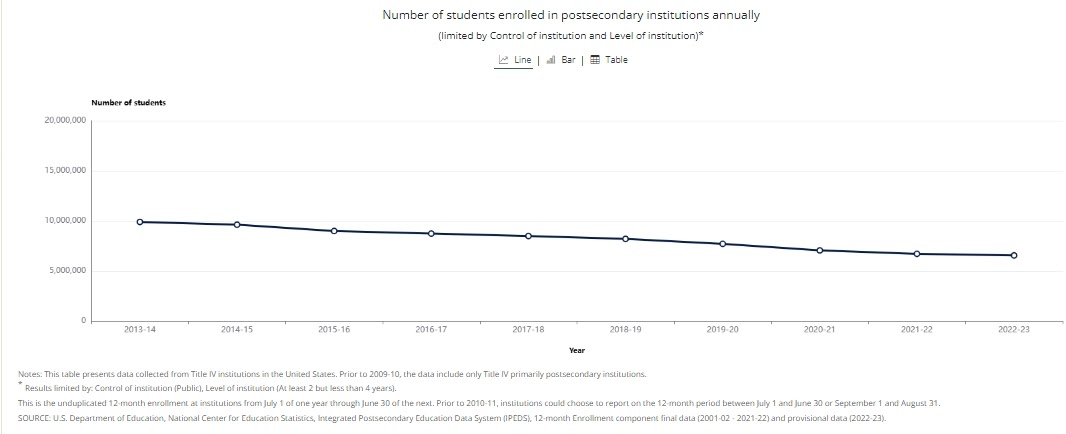
    The National Center for Education Statistics (NCES) has documented the decline in community college enrollment for more than a decade.  And the Higher Education Inquirer has been reporting on the decline for much of that time.  

    The question we are asking now is, where is the floor for the community college meltdown?  The answer, from what we gather, is not clear. Folks should not assume the bottom has already been felt, even if there are signs of a rebound

    The downward path for community colleges is likely the result of several factors related to economics (including the economics of individual states and counties), demographics, and consumer choices.  And we do not see these variables, in general, improving in the near future. Especially in states with declining youth and young adult populations. 

    If state-level austerity lies ahead for many states, the floor could be lowered, even though these community colleges provide job training at a fraction of the cost of state universities.  Working class folks, in particular, would have to change the way they think about themselves and their perceptions of community colleges. And community colleges would need to provide stronger returns on investment for those who attend. 

    There are some bright spots, including the use of College Promise (low-cost college) in many states and proposed increases in funding in California.  Community colleges have also shored up these declines with dual enrollment (high school students taking courses).  

    (Source: US Department of Education, IPEDS)

    Source link