Tag: write

  • Educators Can Teach Students to Write Well—and to Hope

    Educators Can Teach Students to Write Well—and to Hope

    To the editor:

    I was absolutely appalled at the anonymous AP Literature and Composition reader’s summary of his time in Salt Lake City. I was even more appalled by his tone, which was condescending, arrogant and unapologetic, and by his sense of superiority. Far be it from me to evaluate how he might be as a teacher (especially if he had a bad night’s sleep, poor lamb), but his emphatic victimhood at the circumstances that accompanied the reading, which he signed up for, was more than off-putting; it was flat out reprehensible.

    His attitude, that this whole event is beneath him, is hard to understand. Again, he chose to be there. He blatantly ignored his table leaders, skimmed rather than read essays and, behind the shield of anonymity, celebrated only giving a handful of 5s. He took it as a personal affront when he was asked to follow the rules. I feel especially bad for any AP student who suffered because of the negligence of this dismissive and self-pitying reader. 

    Worse, he used his entire experience as a microcosm for What’s Wrong With Education Today. The other readers are a part of this excoriation: While he gets up to give himself additional breaks, his colleagues “seem well adapted to the AP regimen, and to regimentation.” He, though, has escaped from Plato’s cave and has come back to tell us all … that the free coffee wasn’t very good. 

    This, while there are actual problems plaguing the state of college writing, from students uncritically using AI to assignments and essays that aren’t accurately evaluating student learning. With these legitimate concerns, it seems myopic to worry only that he encountered too few essays that contained “something insightful or fluent.” From that small sample, he concludes, “Is this how we’re educating the best and brightest, these college students of the near future? Are the vaunted humanities—assailed for years from without—rotting from within?”

    A sharp reader might resist stooping to make such generalizations. A sharp reader might conclude that work written hastily on an unseen topic while myriad other concerns are influencing its writer will rarely be sufficiently fluent. But the author’s preoccupation with these flawed essays reveals something worse: an attitude more concerned with signifying his august tastes than celebrating some of the essays’ successes—which AP readers are explicitly tasked with doing. As many happiness scholars have noted, expressing gratitude is an often-effective way to combat negativity. 

    If I were the sort of writer who uses few examples to draw overconfident conclusions, I might argue that the anonymous author represents the worst sort of virtue signaler: one who simultaneously laments that the “army of food service workers, mostly Hispanic or Asian,” must serve all the readers, but who also overindulges on the free food (“my waistline expands”). He likewise points out the inequality women professors face (“That fits with the service-heavy load female professors typically shoulder at most universities”) while demeaning his own female table assistant-leader (ignoring her when she asked him to put away his phone). Dare one conclude that he is staring at the mere shadows of true virtue down in his cave of concrete convention center floors and thick black curtains? 

    Maybe I am overreacting. I have a visceral dislike for the sort of persona he displays here, and it was part of the reason I left higher education after finishing my Ph.D. At most academic conferences, especially in the humanities, where our findings aren’t as obviously helpful to the field as, say, the sciences, postering and self-aggrandizement were pervasive. Seven years ago, I became a high school teacher and now an AP Literature reader, and I’m happy to report that I find myself surrounded more by the optimism of youth than the performative jadedness of some of those in higher education. 

    I’m sorry the author wears his ennui and disillusionment as a signifier of his superiority. I’m sorry he celebrates his misanthropy alongside his impractically high standards. And it’s a shame that he was so disheartened by this experience, he felt the need to trash it publicly. To what end? 

    I was not at the author’s table this year. I’m sure my sunny disposition would have made me fodder for his future displeasure. (When he got to his table and saw so many people excited to start reading, he responded, “The enthusiastic vibe can’t help, either.”) But perhaps instead of focusing our energies complaining about the task of wading through essays or the state of writing today, we can embrace the role we have as educators. Few other positions offer that sort of direct influence on such a large number of people. 

    Hopefully, as we teach our students to write well and insightfully analyze texts, we can also teach them to see the hope that comes with possibility—to see that they can always find something to celebrate, as long as they try to have the right attitude. 

    Andrew J. Calis is an English teacher at Archbishop Spalding High School in Maryland.

    Source link

  • Why Write About Grad, Postdoc Career Development? (opinion)

    Why Write About Grad, Postdoc Career Development? (opinion)

    As a higher education professional with a background in writing and rhetoric, I frame my work in career and professional development in terms of communication, such as helping trainees translate their skills to the language of employers, convey complex research to audiences beyond their fields and forge professional selves through the written and digital texts they produce. By training, I often think about how texts produce effects on readers and the design choices writers make to engage those audiences.

    At a time when higher education faces great adversity, I find myself reflecting on the value of writing about career and professional development work in a venue such as “Carpe Careers”: Why write about graduate and postdoc career and professional development? How does this writing translate the impact of our work to different audiences? In this piece, I outline what we do when we write about graduate and postdoc career and professional development and why we should keep writing about this work.

    Writing to Empower Graduate and Postdoctoral Scholars

    As career and professional development leaders, we sometimes feel frustrated that the impact of our work seems limited to one institution or program. For example, we might be the office of one at our institution and concerned about the scalability of advising appointments or low attendance at workshops. Writing about best practices for career and professional development can expand the reach of our advice to online audiences worldwide.

    For example, “Carpe Careers” writers have penned more than 400 pieces that address key career exploration skills like job search strategies, building an authentic personal brand and identifying transferable skills. In addition to equipping graduate and postdoctoral trainees with strategies for landing fulfilling jobs, we present essential advice for navigating academia, such as how to communicate with faculty mentors, deliver effective presentations and cultivate professional references.

    These essential topics continue to be necessary and relevant to new generations of graduate and postdoctoral readers because they make visible the hidden curriculum of academia and the world of work. Our work gives learners the tools to navigate these spaces with confidence, supplementing the efforts of mentors, coaches and instructional workshops. Likewise, when we write about professional development, we attend to the holistic flourishing of graduate and postdoctoral scholars by centering topics such as mental well-being on the job search, coping with the culture shock of career transitions or the power of rest. We not only give learners practical advice for the next steps in their careers but also cultivate virtual community and belonging for graduate and postdoctoral trainees facing common challenges and pursuing similar goals.

    Writing to Support Fellow Practitioners

    When we write about career and professional development, we put our own spin on old chestnut topics by drawing on our backgrounds, identities and experiences. For example, this recent piece reframes professional networking as a form of evidence-gathering and scientific research, leveraging the authors’ training in science. Putting our own spins on standard topics of career transitions and exploration can help us create a distinct personal professional brand as practitioners: How have we synthesized our own stories and the wisdom of others to support current graduate and postdoc trainees? What do we want to be known for as graduate and postdoc career development leaders?

    Beyond enriching individual professional identities, when we write about graduate and postdoc career and professional development, we also reflect on how our work with graduate and postdoctoral trainees is changing and identify opportunities for innovation, from the pros and cons of using generative AI tools for career-related activities to advice for supporting international job seekers. We likewise showcase innovative approaches to implementing career and professional development for graduate and postdoctoral learners, such as how to tailor experiential learning, alumni mentoring and badging programs to these populations.

    By reflecting on our practice and how we have adapted to challenges, this writing becomes a form of professional development for us, as it enriches the dynamic fields of graduate and postdoc career and professional development and extends our conversations from professional organizations and conferences to wider, virtual communities of practitioners. For instance, recent “Carpe Careers” pieces have highlighted administrative postdoc and “meta” postdoc roles as entry points to career development and related academic administrative work, defining new positions through the perspectives of those who hold these inaugural roles and shaping the futures of work in our fields. When we address practitioners as an audience, writing about career and professional development creates a virtual community of practice where we highlight emerging trends and offer support for one another’s professional growth.

    Writing to Engage Stakeholders

    Writing for fellow graduate and postdoc career practitioners elevates our work and sets the stage to convey its value to stakeholders, such as faculty and senior administrators whose support is crucial for campus career and professional development initiatives. The external recognition from a piece in a venue such as “Carpe Careers” can lead to greater internal recognition for our programs and offices. For example, when I wrote a “Carpe Careers” post on professional thank-you notes for Thanksgiving week 2024, a University of Pittsburgh newswire service highlighted it in a newsletter, and a vice provost invited me to present on writing thank-yous at a faculty retreat.

    Beyond our campuses, when we write about graduate and postdoctoral career development, we communicate the value of our efforts to stakeholders outside higher education, such as employers, policymakers and the public. As Celia Whitchurch observed, graduate and postdoc career and professional development work occupies a third space in higher education amid academic, student affairs and administrative functions, so it is often overlooked and less understood than more conventional academic or student life initiatives.

    Writing about our work situates it—and by extension the experiences of graduate and postdoctoral scholars—in the wider ecosystems of higher education and the workforce. This writing can educate stakeholders who are less familiar with the work of career and professional development, highlighting our contributions to graduate and postdoctoral learners’ success, and thereby helping us advocate for greater visibility and resources. When we write about graduate and postdoc career and professional development, we underscore the value of our work and its impacts on trainees, higher education and the wider society.

    Writing for and as Change

    Writing about graduate and postdoc career and professional development positions us as change agents, championing trainees’ holistic success and envisioning what our field could be. In this writing, we hold space for courageous conversations in difficult times, such as supporting learners through recent disruptions, reflecting on activism as a form of professional development and highlighting the entrepreneurial potential of our trainees amid economic uncertainty. Whether we address learners, fellow practitioners or broader stakeholders, when we write about career and professional development, we let ourselves dream about our careers and those of trainees, not only advocating for change but also modeling what change looks like through our advice, our programmatic innovations and our support for the broader enterprise of higher education.

    In short, writing about graduate and postdoc career and professional development is an affirmation of advanced degrees, higher education and the work of practitioners who support these learners’ long-term professional flourishing. This writing can be rewarding, as it scales up the impact of our advice, enriches professional communities and elevates the profile of career and professional development work. It can be bold, as it envisions and embodies positive change in our areas of practice. For “Carpe Careers” readers who are writers, why do you write about graduate and postdoc career and professional development? For “Carpe” readers who are considering writing about their work, when will you start?

    Katie Homar is the assistant director of the Office of Academic Career Development, Health Sciences, at the University of Pittsburgh. She is a member of the Graduate Career Consortium—an organization providing an international voice for graduate-level career and professional development leaders.

    Source link

  • Don’t Wait for Permission to Write for the Public

    Don’t Wait for Permission to Write for the Public

    Welcome to the first installment of my monthly column, “The Public Scholar,” in which I invite academics and other experts to step forward—thoughtfully, clearly and with purpose—to help shape public conversations that matter. In this space, I’ll offer practical, field-tested strategies for turning academic expertise into public impact, including how to know if an idea is op-ed–worthy, how to turn a classroom anecdote into publishable prose, how to know when it’s time to query a literary agent about your book idea and more.

    I’m Susan D’Agostino, a mathematician whose stories have been published in The Atlantic, the BBC, Scientific American, The Washington Post, The Financial Times, Wired, Quanta and other leading publications. (You may recall that I wrote with some frequency about math and technology for Inside Higher Ed a couple of years ago.) My last book, How to Free Your Inner Mathematician (Oxford University Press, 2020), won the Mathematical Association of America’s Euler Book Prize for an exceptionally well-written book with a positive impact on the public’s view of math. My next book, How Math Will Save Your Life, to be published by W. W. Norton, makes the case for harnessing mathematical thinking in the face of personal and global crises.

    But none of that came easily or automatically. A decade ago, I was a tenured mathematics professor who had spent years honing proofs and lectures. Yet amid lagging public math literacy, I felt an unshakable urge to reach beyond the walls of academia and write for the public. Still, I hesitated. Was my voice or expertise welcome outside of peer-reviewed journals? Did I have the authority to write for readers I could not picture in a seminar room? Did I even know how?

    That transition—from academic to public scholar—was bumpy. I made mistakes. I received more rejections than I care to count. (Stay tuned for a future column about all those rejections!) I had to unlearn some academic habits and relearn how to communicate with clarity for broad audiences. But step by step, I found my way.

    You don’t need to leave higher ed to write for the public. And you certainly don’t need permission. Academia often trains scholars to seek approval—through grants, press offices and peer-reviewed publications. But the reality is that institutional support often follows after a scholar gains visibility. You already have the credentials to write for the public in your area of expertise. Now you need the courage and practical tips for doing so.

    Maybe you’re a historian who sees how your field illuminates today’s political divides. Or a scientist concerned about climate change, misinformation or public health. Or an artist reflecting on what the arts can—and do—offer society. Or a literary scholar exploring how stories shape our moral imaginations. Or an educator with hard-won insights into what learning looks like in today’s classrooms. If you feel the tug to engage beyond campus gates, this column is for you.

    Many academics assume that public writing takes time away from scholarship. But making your work accessible to a wide audience forces you to think harder, not less. How can you distill the central argument of your research so that an intelligent friend with no training in your field can understand? Why should they care? Honing translation skills is an art. Your goal is to show up with clarity and generosity.

    As a bonus, crafting the occasional op-ed can energize your research and teaching—not distract from it. You can clarify your ideas and receive real-time feedback on your argument and may even attract collaborators. Public writing can also be personally restorative. It reconnects you with the real-world questions that made you fall for your field. Your op-ed may even catch the eye of a literary agent or editor who’s interested in discussing book ideas. Also, your willingness to be a novice again may offer credibility among students, as that’s what many are wrestling with in your classroom.

    When I began writing in public-facing newspapers and magazines, I felt newly connected to issues that mattered beyond academia. While campus conversations are vital and intellectually rich, I found that engaging the broader public offered a different kind of clarity and urgency—to respond to a moment unfolding in real time and to make research relevant to people’s lives.

    Scholars across disciplines have watched with rising unease as the Trump administration has terminated research grants, dismissed government scientists without cause and wielded funding as a cudgel against universities. In this atmosphere, it can be tempting to self-censor or to wait for more hospitable times.

    But the cost of silence must be weighed against the consequences of inaction. Public conversations—about health care, history, science, democracy, libraries, public art and education—unfold every day, with or without scholars who can offer nuance, evidence and context.

    “Opinions are most malleable before they are fully formed,” wrote Lisa Fazio, a psychology professor at Vanderbilt whose federal grant for misinformation research was terminated. “We must not shy away from the spotlight.”

    Fazio’s warning is especially resonant now, as academics face mounting pressure from funding threats to political scrutiny. These pressures are real, and they are unevenly distributed. As University of Washington computer scientist Kate Starbird, also a target for her work on misinformation, told Science magazine, “I never had the option of keeping my head down.”

    And yet: Sharing knowledge, humanizing data and contextualizing history are profound acts of public service in consequential times. The OpEd Project puts it plainly: “If you say things of consequence, there may be consequences. The alternative is to be inconsequential.”

    Here’s some good news: Editors at newspapers and magazines want academic voices in the mix, and they’re often willing collaborators in helping your ideas rise above the noise. Editors want assurance that you are trained in your area of expertise, but they are less concerned with titles or tenure than your academic colleagues. Whether you’re a graduate student, an adjunct, new on the tenure track or a full professor, what matters is your voice, your argument and your ability to meet the moment.

    Ready to begin? Here are a few prompts to spark your first (or next) op-ed:

    • What’s one thing people misunderstand about your field, and why does it matter?
    • What recent news headline made you think, “If only they understood this about my field …?”
    • What conversation is already happening in the news, online or in your community that your research can help reframe, complicate or clarify?
    • What’s one counterintuitive idea from your work that could shift how people think?
    • Has your research or teaching ever changed how you see the world, and could it do the same for others?
    • Where is your field falling short in meeting a public need, and what would it take to change that?

    You don’t need to have all the answers. Often, a strong op-ed starts with one sharp insight, thoughtfully delivered and timed to the news cycle.

    Try drafting a few notes in your phone during your commute, between classes or even while multitasking in that faculty meeting (I won’t tell). Write as if you’re talking to a smart, curious friend. Make it clear, specific and real. Proofread like your reputation depends on it, because for the editor you’re pitching, it does. Make it short, too! Aim for 800 words max.

    And if you’d like more help along the way, sign up for my monthly newsletter. You’ll get notice of each new article in “The Public Scholar,” practical writing tips, behind-the-scenes insights from my work and inspiration from other academics finding their voice in public spaces. Your expertise is hard-won. What might happen if you shared what you know more broadly?

    Susan D’Agostino is a mathematician whose stories have been published in The Atlantic, the BBC, Scientific American, The Washington Post, Wired, The Financial Times, Quanta and other leading publications. Her last book, How to Free Your Inner Mathematician (Oxford University Press, 2020) won the Mathematical Association of America’s Euler Book Prize for an exceptionally well-written book with a positive impact on the public’s view of math. Her next book, How Math Will Save Your Life, will be published by W. W. Norton. She has been a journalism fellow at Oxford University’s Reuters Institute, Columbia University’s Graduate School of Journalism and the Mila-Quebec AI Institute. For notice of each new article in Susan’s Inside Higher Ed column, “The Public Scholar,” practical writing tips, behind-the-scenes insights from her work and inspiration from other academics finding their voice in public spaces, sign up for her free, monthly newsletter here.

    Source link

  • How To Write A Media Pitch Examples

    How To Write A Media Pitch Examples

    How to Write a Media Pitch

    Pitching compelling storylines and sources are the crux of any public relations strategy. In the higher education digital marketing space, we at Archer Education leverage the expertise of professors from our partner institutions to help increase the school’s visibility, student enrollment, thought leadership, and brand awareness. 

    Professors make excellent sources for stories through unmatched expertise and experience in their respective fields, but without the correct messaging and communication strategy, this opportunity could be missed. 

    In this article, we’ll go over how to write a media pitch in higher education and review the most common types of media pitches.

    What Is a Media Pitch?

    Media pitches in higher education are strategic communications sent to journalists, editors, or media outlets to promote faculty expertise, research, or institutional initiatives. These pitches typically highlight faculty insights on current events, groundbreaking studies, or thought leadership in their field.

    These pitches are particularly key to faculty promotion because they enhance visibility, establish credibility, and position faculty as subject matter experts. Media coverage can lead to invitations for speaking engagements, collaborative research opportunities, and increased citations — all of which contribute to professional advancement for the faculty member and enhanced institutional reputation.

    How to Create Your Media Pitch 

    Before we dive into best practices, tips, and examples of PR pitching, let’s go over some of the basics of how to structure a media pitch. Creating a set standard for yourself and your team will not only streamline the process and allow you to be as efficient as possible, but it will also ensure consistency amongst your team and allow for smooth training programs.

    Select the Right Type of Journalism Lead

    Before you even start writing a pitch, you want to make sure you find a lead that will entice whoever you are reaching out to. The lead is the angle into your story that makes everything relevant. You can look for two types of leads that are applicable throughout journalism:

    1. A news peg is a trending story or topic in the news that relates to what you’re pitching. For example, leveraging a political debate or a new medical study that was just released. This allows you to hook the reader with a relevant and widespread story.
    2. A time peg represents an upcoming date or event. For example, anniversaries of days like 9/11 or Hurricane Katrina, days or weeks dedicated to specific causes like “Health IT Week” or “Mental Health Awareness Day,” or even months like “Breast Cancer Awareness Month.”

    These types of dates and events can be easily leveraged for PR purposes as media outlets will often shape content around significant or relevant time pegs. In order to keep track and take advantage of these dates, it’s helpful to create and consistently update an internal editorial calendar with your team.

    Develop Your Pitch Structure

    Below is the basic outline/structure you should consider when writing a media pitch: 

    • As mentioned above, start with the lead. This should be the first thing the reporter or editor reads. An enticing lead that is relevant to their beat will ensure they continue through your pitch.
    • The second part is your call-to-action. This is the action you want your audience to take. Whether it is writing a product review, publishing a piece of content, or conducting an interview, it’s important to make your intention here as clear as possible.
    • Next comes your value proposition. This is a key piece of the puzzle as it will be the meat of the pitch; this is where you can showcase the value of what you are offering and why they should be interested in it. It is essential in differentiating yourself from the hundreds of other pitches they receive.
    • The last piece of the pitch is your conclusion. This is a straightforward recap that includes a  recap of the call-to-action and a thank you. 

    Use the Right Subject Line for Your Pitch Email

    Subject lines are the first and sometimes only thing that a media contact will see — often determining whether they will even bother to open your email or not. Ensuring that your subject line is clear, concise, and enticing is critical. According to Omeda, subject lines with 20 characters or fewer achieve the highest open rates, averaging 29.9%. Open rates decline to 17.3% for subject lines between 20 and 124 characters. 

    Interestingly, subject lines exceeding 174 characters see a slight recovery in open rates, averaging around 23%. However, due to potential display issues and the risk of being cut off, it’s generally recommended to keep subject lines concise. Prioritizing brevity ensures better visibility across various devices and enhances the likelihood of engagement.

    While creating a subject line that produces an “open” should always be the goal, you should make sure to avoid using “click-bait” phrasing as a tactic to draw in the recipient, as this is considered unprofessional. The last thing you want to do is mislead your audience or appear spammy.

    How to Pitch the Media: Communication Strategies

    Now that you understand the basics on how to write and structure a media pitch, let’s cover some media pitching strategies that can lead to greater success. 

    Use Timely Stories and Research               

    Don’t deprive yourself of using relevant news pegs or research as your hook for your pitch. It’s no secret that the media lives off of news pegs, trending topics, and new research to tell their stories. To increase the chances of someone showing interest in your pitch, it’s important to make their job as easy as possible. It’s a good idea to spell out the story for them so that your source or story fits in seamlessly with trending news topics and their target audience’s interests.

    Reporters and editors receive hundreds of pitches every day, so providing them with a story that their readers will be interested in and offering sources to help supplement that story will make them more compelled to move forward with the conversation. 

    Along these same lines, always try to include hyperlinks to any research or statistics that you reference in your pitch. You don’t want them to shy away from expressing interest or continuing the conversation simply because they don’t have time to do the legwork to track down the sources themselves.

    Know the Reporter’s Beat 

    You can have the best pitch in the world, but if it doesn’t align with the reporter’s beat (the types of stories they cover), then it will provide no use or value to them. In fact, it will only blatantly show that you are sending out mass email distributions and aren’t doing the appropriate research and legwork before pitching them. While it’s not always realistic or feasible, personalize pitches whenever possible and mention any related articles that they recently wrote.

    Keep it Concise and Know Your Story

    As previously mentioned, media contacts receive hundreds of pitches a day. If you’re lucky enough to get yours opened, the worst thing that someone with very little time can be confronted with is an unnecessarily long pitch. Find out how to say everything that you need to say in a paragraph or less (with rare exceptions). The more specific and focused you can be, the better. It’s also crucial to understand and communicate the story you’re trying to tell and how it aligns with the larger media trends yet provides a unique angle to the storyline. 

    Follow Up Is Key to Media Pitching

    Following up on initial email pitches is one of the most crucial elements of the pitching process. This is where most of your interest and responses will come from, so ensure that you schedule reminders to follow up. 

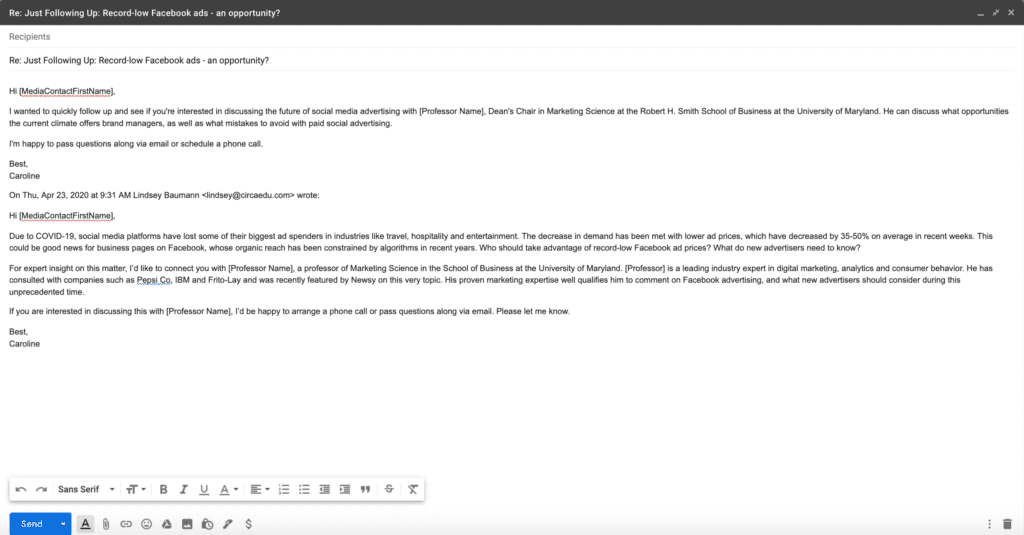
    Generally, it’s appropriate to wait about one week until you send follow-ups out; this will ensure that the media contact has sufficient time to get through their emails and respond if they are planning to. If the story is incredibly time-sensitive, you can follow-up a bit sooner. Similarly, if it is not a time-sensitive story at all, then waiting a little longer than a week can be a good strategy.  Just be sure to include your original pitch at the bottom of your follow-up email to help jog the recipient’s memory and provide more context. 

    Media Pitch Examples

    Now that you have the information that you need to be successful with your pitch writing, here are some real-life examples of media pitches and pitch letters that our team sent to the media. 

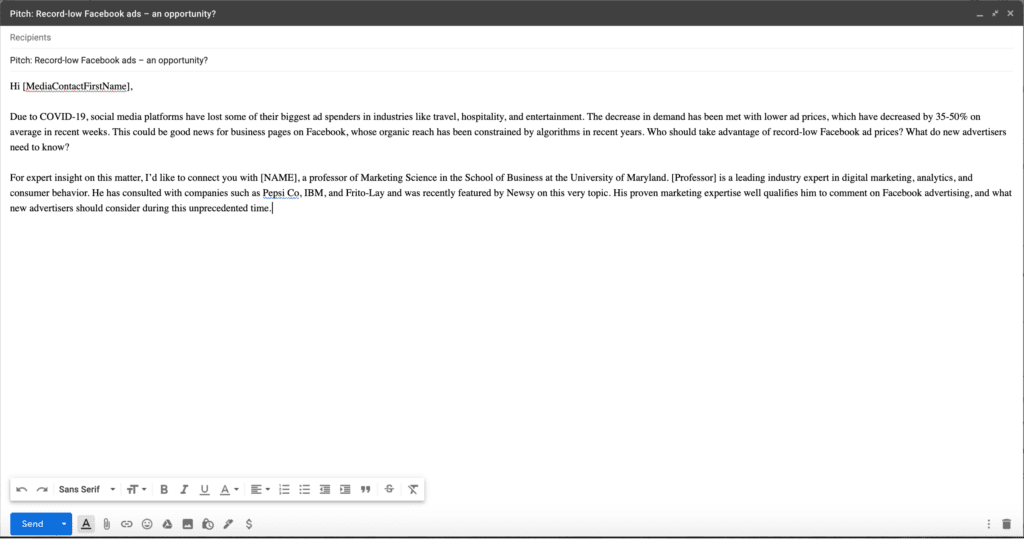
    1. Cold Pitch

    A cold pitch is an unsolicited email or message sent to a journalist or media outlet with whom there is no prior relationship. It typically introduces a faculty member’s expertise or research in hopes of securing media coverage.

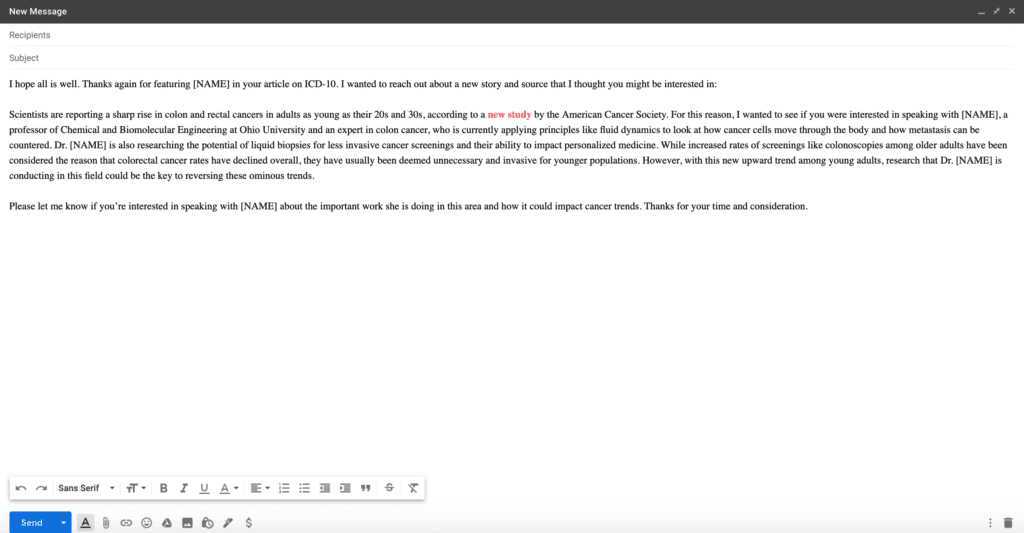
    2. Pitch for Established Contact/Relationship

    This type of pitch is sent to a journalist or media contact with whom a relationship already exists. It builds on past interactions, making it more likely to be well received and result in coverage.

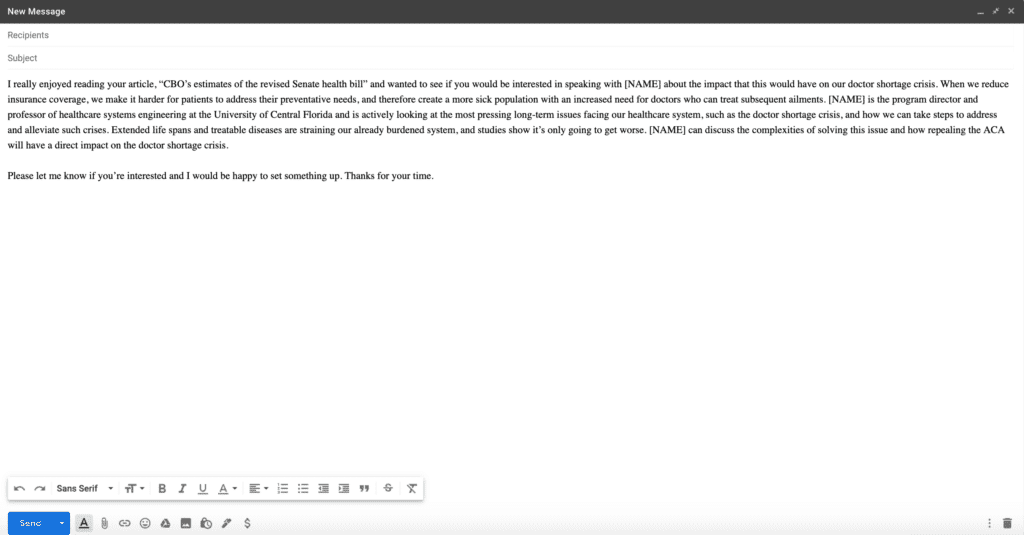
    3. Personalized Pitch

    A personalized pitch is tailored specifically to a journalist’s interests, past work, or the needs of their publication. It demonstrates a clear understanding of their audience and increases the chances of engagement.

    4. Follow-Up Pitch

    A follow-up pitch is sent after an initial pitch to reinforce interest, provide additional details, or remind the recipient about the story idea. It’s essential for maintaining momentum and increasing response rates.

    How to Write Media Pitches That Consistently Convert

    In today’s media landscape, consistent PR exposure is essential for faculty members looking to establish themselves as thought leaders and elevate their institution’s brand. At Archer Education, we specialize in crafting strategic media pitches that align with timely news cycles, ensuring professors and researchers receive the visibility they deserve. Whether through cold outreach, leveraging existing media relationships, or personalized pitches, we help faculty secure media placements that enhance their credibility, attract prospective students, and showcase their expertise to a broader audience.

    Our experience in higher education marketing allows us to effectively position faculty members in conversations that matter, increasing opportunities for interviews, guest articles, and thought leadership features. Don’t let valuable media opportunities go untapped — connect with us today to develop a custom PR strategy that amplifies your faculty’s impact and strengthens your institution’s reputation.

    Source link

  • To write about what’s new, look to the past

    To write about what’s new, look to the past

    To help explain what’s happening out there now, it helps to delve into the past. 

    That’s because, for one thing, something similar probably happened before and how that ended might help you anticipate what will happen next.

    News story after news story about U.S. President Donald Trump, for instance, talks about things being unprecedented. But did you know that in the 1850s in the United States there was a political party called the Know Nothing party. It was xenophobic and a spreader of conspiracy theories. According to the writer Lorraine Boissoneault, it was anti-immigration and called for mandatory Bible readings in schools. 

    “At its height in the 1850s, the Know Nothing party, originally called the American Party, included more than 100 elected congressmen, eight governors, a controlling share of half-a-dozen state legislatures from Massachusetts to California and thousands of local politicians,” Boissoneault wrote. 

    It is important to delve into history when doing a news story because things don’t just happen. Stuff led up to what is happening now. There are causes, and causes of causes. There might be a whole link of events that led up to the calamity that is now, or the explosion that happened or the political turmoil you find yourself in. 

    Put events into context.

    A little history in a story brings depth and context. It makes the whole story more interesting and helps people better understand what is happening now. News Decoder correspondent Gene Gibbons helped us understand the constitutional crisis the United States finds itself under Trump by looking back at a previous crisis in the 1970s under President Richard Nixon. 

    Correspondent Bernd Debusmann knew he couldn’t really explain the significance of the antipathy Trump now has for the European Union without explaining why the EU was formed in the first place. That meant going back to the aftermath of World War Two. 

    Correspondent Barry Moody helped us appreciate the triumphant win in a rugby game in South Africa by delving into the long history of apartheid and showing how rugby fit into that. 

    But how do you add some history? Well, you find yourself a historian. Every town has one, whether that person carries a title or not. A historian is simply someone who keeps track of past events and often documents them by collecting news stories or photographs, or by keeping journals. They might be the caretaker of archives of one kind or another. 

    You can also seek out professional historians. They can be found in university history departments, libraries and historical societies. Some are super specialized. I once saw a great documentary about a portrait of a woman believed to be painted by Leonardo de Vinci, and to prove it, the owner found a hair historian who found that the hairstyle of the woman was specific to a short time in history in a very small geographical area of Italy. 

    If you were doing a story about technology and wanted to include a bit of history you could contact the Society for the History of Technology. There are historians of politics, war, fashion, movies, food and architecture. 

    You can also just ask about the history of a place or event when you interview experts on what is happening now. You can’t really call yourself an expert on any topic if you don’t know its history. 

    So when you ask about what just happened, ask about what happened a decade or two ago, or more. Ask how things came to be the way they are. Maybe if we all understood the history of our times, history wouldn’t have to repeat itself. 


    Questions to consider:

    1. How can history add context to a news story?

    2. Where might you find a historian?

    3. If you were doing a story about your town, where would you find someone knowledgeable about its history?


    Source link

  • How to write MBA Student Resume with Keywords

    How to write MBA Student Resume with Keywords

    Creating a resume for a mba fresher student can be a crucial step in launching your career or getting your first job.

    Rememder that HR Recruiter have only 3-5 seconds to review your resume on job portals. So you should start your resume with 

    • Name –
    • Email –
    • Phone Number –
    • Linkedin ID – Create a Impressive Portfolio that highlights your internship experience or github projects. If you have recommendations from past employer or friends from same domain experience is a bonus. Todays most HR recruiters try to find your extra carricular activity like NGO or charity work you have done during your college days or activity on linkedin post. 

    A strong cover page details or job objective for 4 lines is a must. This is the section recruiters read before downloading your resume from portal. You should change this section every 7 days to keep it fresh and up-to-date. 

    For experienced candidates, write a summary that highlights your professional identity and major achievements in your present job or intership that increased companies profitability will help you get job interview calls faster.

    A well-structured resume template format in word format highlights your education, skills, and any relevant experience, even if it’s limited. Below is a guide to help you craft an effective resume that can help you to get inverview calls faster.

    Do not discuss your salary expectation in direct figure. Give a salary range depending upon job responsibility.

     Just change the following details on the releveant field and upload on job sites like naukri, indeed or linkedin. 

    Source link

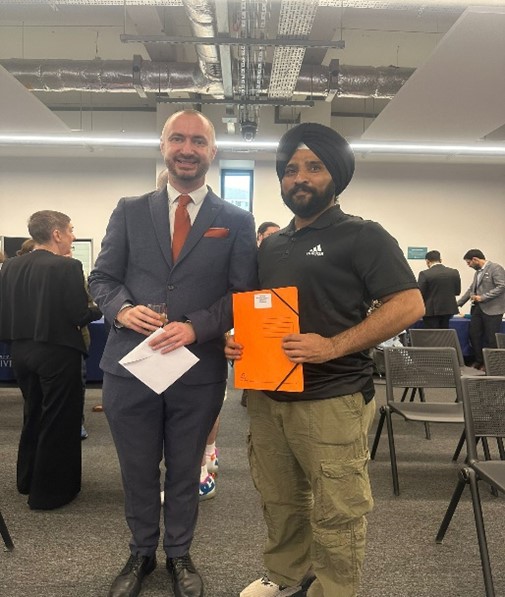
  • Thank you to the Go Higher team for allowing me to write a blog and share my amazing experience on the Go Higher programme! By Gary Singh – ALL @ Liverpool Blog

    Thank you to the Go Higher team for allowing me to write a blog and share my amazing experience on the Go Higher programme! By Gary Singh – ALL @ Liverpool Blog

    I am thrilled to share my heartfelt gratitude to the University of Liverpool for offering the Diploma for Go Higher Programme – a remarkable initiative designed to open doors and beacon of hope for those who, due to various reasons, have been unable to pursue their educational goals and have had to suppress their ambitions.

    My name is Gary Singh, and I want to share my journey with you, a journey that has been filled with challenges, resilience, and hope. In 2004, my plans to become a solicitor were shattered by the sudden passing of my father. I had to start working, and unfortunately, I faced exploitation by corrupt politicians in India, making it nearly impossible to chase my dreams. Every attempt to resume my education was met with rejection due to the gap in my studies. After seeking asylum in the UK, I reached out to the University of Liverpool, hoping to enroll in a degree program because of the plenty of time available to me. Unfortunately, again, I was told that the gap in my education prevented direct entry into a degree course. However, Go Higher Team introduced me to the Go Higher Diploma program, a pathway that would enable me to pursue a degree. This news reignited my optimism and belief that I could achieve my dream of becoming a solicitor to serve society, just as I had hoped for as a teenager.

    I was fortunate enough to receive scholarships from the University of Liverpool, which were specifically designed for destitute students like myself, as I am not permitted to work as an asylum seeker. Even as a mature student, I found the friendly, multicultural atmosphere at the University of Liverpool very welcoming. My classmates, both younger and older, were incredibly supportive. Despite English being my second language and the initial challenge of understanding new accents, I can comprehend about 80% of my tutor’s lectures and make up the rest by utilizing lecture slides and class recordings available on the Canvas site. I started my first assignment with marks well above passing, and with unimaginable support from my tutors, I received an A grade on my last assignment. The dedication of my mentors—James Bainbridge, David Ellis, Barbara Milne, Julia, Sharon Connor, Darryn Nyatanga, Claire Jones, Stephen Kearns, Debbie Hart, and Matthew—along with additional English classes by Will, has been invaluable.

    I have encountered challenges on the path to success, but determination and hard work have allowed me to conquer every obstacle. On the day of the Go Higher celebration, something incredible occurred. I was honored with a personal achievement award, which came as a pleasant surprise. Furthermore, I was accepted into the Law with Business program at the University of Liverpool. This achievement has filled me with excitement and hope as I strive to complete my degree and make a positive impact on society. My aspiration is to become so capable and competent that I can assist those in need.

    Go Higher education means more to me than just personal advancement; it’s a way to think critically for the betterment of society and individuals. Through my Go higher studies, I learned to see society from a different perspective and took the first step toward progress in civilized society. My message to everyone is this: Don’t let your ambitions die in your heart. Give it a try! If your intentions are good, you will find many opportunities, mentors, and friends who are ready to help you. Believe in yourself and take the first step. The journey may be challenging, but the rewards are immeasurable.

    Thank you,

    Gary

    Source link