Tag: years

  • College Student Satisfaction: Reflecting on 30 Years

    College Student Satisfaction: Reflecting on 30 Years

    College students have changed greatly in 30 years, but how has student satisfaction changed?

    Think back 30 years ago to 1995. What is different for you now? Where were you and what were you doing in the mid 1990s? Perhaps you were still in school and living at home, or not even born yet. Perhaps you were in your early years of working in higher education. Take a moment to reflect on what has (and has not) changed for you in that span of time. 

    Thirty years ago, I was just starting my position at what was then Noel-Levitz. What stands out for me was that I was about to become a mom for the first time. Now my baby is grown and will be a new mom herself later this year. And I find myself being on one of the “seasoned professionals” in the company, working alongside members of my team who were still in elementary school back in 1995. 

    Thirty years ago, we were just beginning to utilize email and the internet. Now they have become the primary way we do business, communicate professionally, and discover information.  Artificial intelligence (AI) is the new technology that we are learning to embrace to improve our professional and personal lives.   

    Thirty years ago, students were arriving on our campuses, seeking an education, guidance, growth, belonging, value for their investment and ultimately a better life.  That’s still the case today.  Plus, students are navigating more technology options, they are more openly seeking mental health support, and they are living in a world full of distractions. Online learning is a reality now and continues to become more accepted as a modality, especially after the experiences of 2020. As the demographic cliff looms, colleges are expanding their focus to include lifelong learners. 

    Thirty years ago is also when the Student Satisfaction Inventory (SSI) was launched to provide four-year and two-year institutions with a tool to better understand the priorities of their students. (In the early 2000s, we added survey instruments specifically for adult and online populations.) The data identified where the college was performing well and where it mattered for them to do better in order to retain their students to graduation. The concept of looking at satisfaction within the context of the level of importance was new back then, but in the past three decades, it has become the standard for capturing student perceptions. Since 1995, we have worked with thousands of institutions and collected data from millions of individuals, documenting what is important and where students are satisfied or dissatisfied with their experience. As we reach this 30-year milestone for the SSI, I took some time to reflect on what has changed in students’ perceptions and what has stayed the same.

    Consistent priorities

    What stood out to me as I reviewed the national data sets over the past 30 years is that what matters to students has largely stayed the same. Students continue to care about good advising, quality instruction and getting access to classes. The academic experience is highly valued by students and is the primary reason they are enrolled, now and then. 

    Another observation is that there are two areas that have been consistent priorities for improvement, especially at four-year private and public institutions:

    • Tuition paid is a worthwhile investment.
    • Adequate financial aid is available for most students. 

    These two items have routinely appeared as national challenges (areas of high importance and low satisfaction) over the decades, which shows that institutions continue to have opportunities to communicate value and address the financial pain points of students to make higher education accessible and affordable. 

    Campus climate is key

    One thing we have learned over the past thirty years is how students feel on campus is key to student success and retention. The research reflects the strongest links between students’ sense of belonging, feeling welcome, and enjoying their campus experience to their overall levels of satisfaction. High levels of satisfaction are linked to individual student retention and institutional graduation rates. Campuses that want to best influence students remaining enrolled are being intentional with efforts to show concern for students individually, building connections between students from day one, and continuing those activities as students progress each year. It is important for institutions to recognize that students have lots of options to receive a quality education, but the environment and the potential student “fit” is more likely to vary from location to location. What happens while a student is at the college they have selected is more impactful on them than which institution they ultimately chose. Creating welcoming environments and supporting students’ sense of belonging in the chosen college is a way for institutions to stand out and succeed in serving students. Colleges often ask, “Why do students leave?” when they could be asking, “Why do students stay?” Building positive campus cultures and expanding the “good stuff” being done for students is a way to critical way to improve student and institutional success.

    One sector where the data reflect high satisfaction scores and good consistency, especially in the past five years since the pandemic, is community colleges. Students attending their (often local) two-year institutions want to be there, with high percentages of students indicating the school is their first choice.  Community college students nationally indicate areas such as the campus staff being caring/helpful, students being made to feel welcome, and people on the campus respecting each other, as strengths (high importance and high satisfaction). These positive perceptions are also reflected with overall high levels of satisfaction and indications of a likelihood to re-enroll if the student had it to do over again. The data indicate that two-year institutions are doing a nice job of building a sense of community among primarily commuter student populations. 

    Systemic issues and pockets of improvement

    Everyone talks about “kids today,” but in reality, they have been doing that for generations. It can’t be a reason not to change and respond appropriately to the needs of current students. When we consider the priorities for improvement in higher education that have remained at the forefront, we may need to recognize that some of these areas are systemic to higher education, along with recognizing that higher education generally has not done enough to respond. There are certainly pockets of improvement at schools that have prioritized being responsive and, as a result, are seeing positive movement in student satisfaction and student retention, but that is not happening everywhere. Taking action based on student feedback is a powerful way to influence student success. The campuses that have bought into that concept are seeing the results. 

    Current student satisfaction national results

    Want to learn more about the current trends in student satisfaction?  I invite you to download the 2024 National Student Satisfaction and Priorities Report

    This year’s analysis takes a closer look at the national results by demographic subpopulations, primarily by class level, to get a clearer view on how to improve the student experience. Institutions have found that targeting initiatives for particular student populations can be an effective way to have the biggest impact on student satisfaction. Download your free copy today.

    Source link

  • Moving Beyond New Year’s Resolutions to Embrace a Multi-Year Enrollment Strategy 

    Moving Beyond New Year’s Resolutions to Embrace a Multi-Year Enrollment Strategy 


    Developing New Year’s resolutions for personal growth is something many of us do. Unfortunately, it is often a set-it and forget-it process that is simply reupped the following year. When done correctly, however, creating a resolution that is developed as a sustained, long-term strategy—and that is regularly returned to and adjusted as needed—seems to be the best way to meet our personal goals.  
     
    As enrollment managers, we all have pursued the first approach in our professional lives by evaluating last year’s successes and failures annually, making a few tweaks, and then seeing how it all works out again the following year. The truth of the matter is that this approach was relatively sustainable for a time. Simply buying more names, adjusting the aid-leveraging model annually, or a developing a wider marketing plan often could drive greater enrollments—mostly because those tactics generally were designed to “add more fuel to the fire.” As long as the applications continued to grow, annual tweaks could help to maintain the core enrollments as well as improve on the margins for many institutions.  


    The Need for More Effective Strategic Enrollment Strategies

    Unfortunately, outside of key private and public flagship institutions, headwinds have developed over the past decade that are affecting higher education enrollments in significant ways. Ultimately, they may lead to campus closures for some, and to campus financial distress for many. As outlined in a paper from the Federal Reserve Bank of Philadelphia, “Predicting College Closures and Financial Distress,” those pressures include:

    • Post-pandemic enrollment challenges from traditional students (decreasing 15% from 2010-2021).


    • Changes among adult learners (“The number of adult students over the age of 25 has fallen by nearly half since the Great Recession”).


    • Growing competition.


    • A lack of public support for higher education nationally. 

    The combination of all these factors has brought about the need for enrollment managers to develop a wider multi-year strategy that includes tools with the ability to enable deeper, more highly data-informed fine tuning throughout any given cycle. A one-size-fits-all approach to creating a nuanced strategy can no longer work in an environment of shrinking applications and increased competition. 


    Liaison’s Partnership Philosophy

    Liaison is uniquely positioned to assist with higher education institutions in a true partnership. With the technology, services, and consultative approach that we provide our partners throughout the nation, we can assist in developing a comprehensive enrollment approach unique to your campus—ranging from single-point to full-enrollment planning solutions that are uniquely tailored to your unique needs. Liaison’s partnership philosophy, technology solutions, and industry knowledge and insights can not only help strengthen your enrollment planning and goals for this year but also set you up for long-term enrollment success.  


    Craig Cornell is the Vice President for Enrollment Strategy at Liaison. In that capacity, he oversees a team of enrollment strategists and brings best practices, consultation, and data trends to campuses across the country in all things enrollment management. Craig also serves as the dedicated resource to NASH (National Association of Higher Education Systems) and works closely with the higher education system that Liaison supports. Before joining Liaison in 2023, Craig served for over 30 years in multiple higher education executive enrollment management positions. During his tenure, the campuses he served often received national recognition for enrollment growth, effective financial aid leveraging, marketing enhancements, and innovative enrollment strategies.

    Source link

  • New policy gives Cornell head start on New Year’s gains

    New policy gives Cornell head start on New Year’s gains

    Cornell got a jump on its New Year’s resolutions this winter, unveiling an updated version of its proposed Expressive Activity Policy just before the holiday season. On Dec. 18, the Cornell Committee on Expressive Activity released a much-improved revision of the proposed policy. This comes after FIRE and nearly 500 other organizations and individuals weighed in on an earlier draft from Oct. 30. The final say belongs to university leadership, but this update marks a significant step in the right direction. 

    One of the most notable changes from the Oct. 30 version is that the policy no longer requires students to schedule expressive activities through the 25Live reservation system. The October draft also limited spontaneous protests to Ho Plaza — a tiny patch of campus measuring merely one acre out of the sprawling 745-acre Ithaca campus. We criticized this provision as well as the scheduling requirement, and thankfully, the new proposal contains neither. 

    That’s not the only laudable change. The new policy also preserves the right to put up flyers, posters, and other expressive materials without having to identify oneself on the material. That is a critical win for students who may only feel comfortable expressing their views anonymously. 

    Cornell deserves praise for demonstrating its willingness to engage critics, make changes, and to honor the principle of free expression as enshrined in our Constitution. 

    Nor is outreach to the university required to put up material in designated posting areas. While the initial March 11 interim policy stated that approval was not required to post in designated areas, it instructed community members to “[c]ontact the applicable building coordinator or campus facilities director to find out the locations of” said areas. This effectively created a prior restraint that required students, faculty, and staff to reach out to administrators before expressing themselves. In contrast, the latest proposed policy puts the onus on personnel to “communicat[e] transparently” on where they place posting areas. 

    The committee rejected suggestions from several commenters to require pre-approval or notification before posting, choosing instead to uphold the principle of free speech and honor the school’s own noble legacy of political activism and public debate.

    Unfortunately, the new proposal is not without its flaws. It maintains a broad definition of hostile environment harassment, reflecting and even exceeding the overbroad definition set forth by the controversial Title IX regulations enacted in 2024. These federal rules require colleges to adopt a standard for harassment that includes protected speech, and as a result of deep-seated constitutional concerns, courts have blocked their implementation in 26 states. Any further federal changes to Title IX regulations would necessitate another round of changes at Cornell.

    Despite this, Cornell deserves praise for demonstrating its willingness to engage critics, make changes, and to honor the principle of free expression as enshrined in our Constitution. 

    FIRE will continue to call for the reform of Title IX regulations and for universities to adopt a definition of hostile environment harassment that better reflects First Amendment principles. We’ve been writing to the Cornell Committee on Expressive Activity every step of the way during the revision process, and we will continue to nudge Cornell toward making further progress. But for now, good on Big Red for locking in some solid gains before the new year even started. 

    If you have questions about your school’s new or existing policies, reach out to FIRE’s Policy Reform team at [email protected], and we’ll make sure you get answers. And if your school adopted policies you’re concerned about, we’re here to help you push back. You can also check out our FAQ on protests and our political speech FAQ if you’re interested in activism this spring.

    Source link

  • Twenty six years of enrollment at Public Research 1 Universities

    Twenty six years of enrollment at Public Research 1 Universities

    A while ago, I made the claim that Oregon State University has the longest streak of consecutive years of fall-over-fall enrollment growth of any public, Research 1 university in America.  A few people have asked me, not exactly doubting the claim, but thinking maybe I had made a mistake, for the source of it.

    This started as a curiosity: I knew from our own internal documentation that the last time OSU (the oldest OSU…not the one in Ohio or Oklahoma) had a fall-to-fall enrollment drop was 1996, and I was curious to see if any other institution could make that claim. So I went to the IPEDS Data Center and downloaded the data. 

    It’s below.  First, a few points: My comparison group is 108 Public, four-year, Research 1 Universities as designated by the Carnegie Commission on Higher Education as of Fall, 2022, the latest IPEDS data available. The R1 designation is actually called “Doctoral Institutions: Very High Research Activity” but the nickname R1 is a holdover from prior years. The category contains those institutions who produce the highest research activity and output among American universities.

    What you can’t see here is that 2023 showed an increase (it’s not yet in IPEDS, but trust me), and that 2024 will also show an increase once our census is final.  So OSU’s record is the 26 shown, plus last year, plus this coming year, for a total of 28 years.

    There are a couple of small anomalies with the data, as there always seems to be.  First, some institutions missed a year or two in their reporting.  Even if those years had shown an increase, they were already nullified by other decreases. And Penn State has bounced around from being one institution to being several to being one again; this too does not seem to make a difference in the tally.

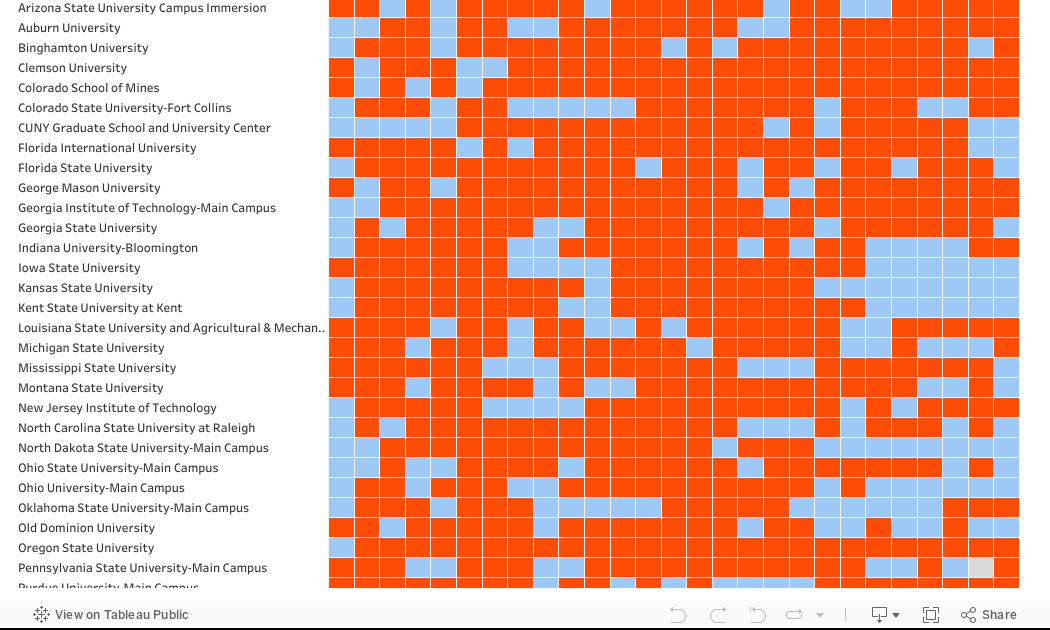
    The first chart here shows all years and all institutions (you’ll have to scroll down to see them all using the bar on the right.)  You’ll notice that every institution shown (other than OSU) has at least two years with a blue box after 1997, meaning a decrease.  Hover over the box for details.  Orange shows an increase from the prior year.

    The second chart shows individual enrollment data for any institution you select, using the filter at the top.  The bars are colored similarly: Orange for increase, and blue for decrease.

    If I’ve missed something or you think these data points are wrong, let me know.  If a university decided intentionally to shrink, for whatever reason, that’s interesting, but not the point of this visualization. If you want to look at just graduates or undergraduates or men or women or students of color or some other variable, I encourage you to read my posts here and here about how to download IPEDS data for yourself. 

    And as always, leave a comment below if you find something interesting.

    Source link

  • When is an extracurricular good enough? Part 2 – Four Years Later!

    When is an extracurricular good enough? Part 2 – Four Years Later!

    By Tim Parros

    I wrote an article four years ago about the importance of extracurriculars in the college admission process (read it here)

    Interestingly enough, it still rings true and is even more critical going into the 2023/2024 admission cycle. As a result, we see our students reaching for many colleges that take a deep look into the extracurriculars; after all, colleges want students to better their communities, and students with experience in this are very attractive to them.

    The admissions landscape continues to evolve, and schools seek students with more than perfect test scores and top grades. There are so many students with perfect scores and outstanding academics, which is still essential, but most schools take a holistic approach to the admissions process. They want students with diverse interests and backgrounds who will be a good fit for the school outside of academics. Your extracurriculars help them determine if you will be equipped to make your mark at their college in a positive and influential way.

    So why is this important again?

    Because it tells admissions more about you as a person. By looking at your activities in your free time, they learn about your interests and the key qualities you possess.

    Essentially, your extracurriculars are one of the application components (along with your college essays and letters of recommendation) that they feel determines the characteristics that you will add to their student body. Different schools may value different traits, but they all value leadership, social responsibility, commitment, drive, and determination. Many other traits will be apparent to them as they review your application. It is also true that extracurriculars make for some great essays when it comes time to apply to college.

    Generally speaking, the quality and the duration of your commitment to your extracurricular activity seem more important than how many you have on your list. The commitment you show in your extracurriculars for college over a more extended period is more impactful than being a member of many clubs for a short period. Even more important in this category is showing them what you learned, how you’ve grown, and how you will interact with their student body.

    When we have students considering some of the top colleges in the US, we start early in helping them identify extracurriculars that they are passionate about. This is critical. I will end with the same advice from 4 years ago.

    Here are some questions to ask yourself about your activities:

    1. Does it benefit your community?

    2. Could it lead to any awards?

    3. Is it possible to write about it and have it published?

    As we discuss extracurricular activities with our students, we try to get them to think outside the box and go beyond with their peers are doing. We’re not encouraging students to give up activities they enjoy, but we hope that asking these questions will spark something and stretch the student in what activities they spend their time on. 

    We want to discuss this and explore how we can help you in your college planning journey.

    Source link

  • 5 Ways For Instructional Coaches to Recharge after 3 LONG Years

    5 Ways For Instructional Coaches to Recharge after 3 LONG Years

    Welcome to “Ask the Tech Coach,” a podcast for Instructional Coaches and Technology Integration Specialists.

    In this episode of “Ask the Tech Coach,” Jeff and Susan welcome Danielle McGee as we have a conversation about recharging as a coach after a challenging year.

    If you would like to be a part of future podcasts and share your thoughts, please contact the podcast.  We would love to have you join the show.

    Join the TeacherCast Tech Coaches Network!

    • Are you a Tech Coach or looking to become one this year?
    • Are you searching for support in your position?
    • The TeacherCast Tech Coaches Network, is a dynamic Professional Learning Network designed specifically for Tech Coaches and designed to provide weekly support for all Instructional Coaches.

    Our favorite part of recording a live podcast each week is participating in the great conversations that happen on our live chat, on social media, and in our comments section.

    This week’s question is:

    It’s been a long 3 years for many Instructional Coaches … what is the best way to relax and recharge for a new and challenging school year?

    Weekly Topic

    • SEL – What is it?
    • How do we become self-aware of our own wellbeing?
    • Allow yourself to take the time to be aware of yourself and your own wellbeing
    • Self-reflection – How are feeling about____?
    • Goals for yourself as a coach/educator
    • How do we manage our own stress levels and emotions while on the job?
    • In what ways can we use this summer to recharge?
    • Downtime
    • Conferences
    • Podcasts
    • Family Time
    • Cleaning the Inbox
    • Coaching Activities in the Summer
    • ISTE
    • Instructional Coaches Network

    About our Guests

    Danielle has almost 20 years in the technology and education field, with focuses geared towards information technology, education, security, and data management. She’s served several K12 school districts, Higher Ed, and corporate organizations as a professional development trainer and consultant. She currently serves as a Learning Technologies Administrator for the Education Technology Services team at Harvard and is the founder of Scared Sheetless, where they’re taking the fear out of EdTech.

    Links of Interest

    Contact the Podcast!

    Subscribe to “Ask the Tech Coach”

    Follow our Podcast on Social Media

    Follow our Hosts

    Join our PLN

    Are you enjoying the TeacherCast Network, please share your thoughts with the world by commenting on iTunes today? I enjoy reading and sharing your comments on the podcast each week.


    Source link