From the day he retook office, President Donald Trump’s campaign to disrupt higher education has been unrelenting. He’s targeted diversity, equity and inclusion. His administration slashed more than a billion dollars in federal grants and contracts for universities, and it plans to cut more. It’s also attempted to deport pro-Palestinian international scholars, accusing them of sympathizing with terrorism.
Prominent—or infamous—among the administration’s escalating actions was its decision last month to cut $400 million from Columbia University for allegedly failing to address on-campus antisemitism. Trump officials followed this by demanding that the university, among other things, place its Middle Eastern, South Asian and African Studies Department in academic receivership.
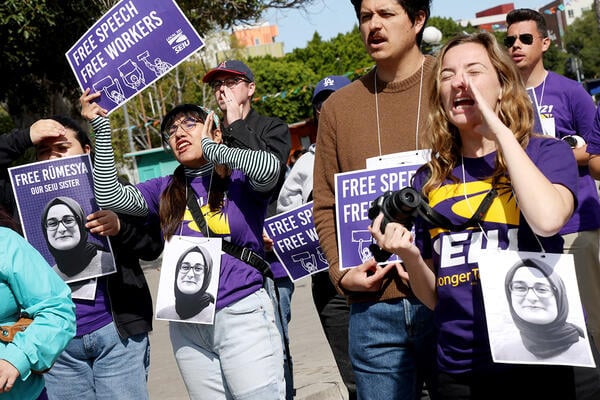
As the disruption has mounted, many college and university presidents have kept silent. But unions representing higher ed employees have stepped up to the plate. They’ve protested in Washington, D.C., and on their campuses, organized open letters and filed a flurry of lawsuits against the Trump administration. Union leaders say they are filling a void in an existential fight for higher ed’s future. They wish others would join their resistance, but their unified strength in numbers may protect their members from federal retaliation in ways that higher ed officials aren’t.
Concerns about higher ed’s future under Trump and calls for a forceful response to his actions pervaded a recent gathering on collective bargaining in higher ed. The conference—held in Manhattan just two days after Columbia announced it would capitulate to multiple demands the administration made—offered a snapshot into a large pocket of resistance.
We couldn’t actually be better positioned to fight back against the kind of authoritarian attacks that we’re seeing.”
—Ian Gavigan, national director of Higher Ed Labor United
William A. Herbert, executive director of the National Center for the Study of Collective Bargaining in Higher Education and the Professions, kicked off the event addressing what he has called the Trump administration’s “assault on higher education.”
“We gather today during a very perilous time. To paraphrase Tom Paine, these are the times that try our souls,” Herbert said, adding that “in this crisis, we must care for ourselves and others—particularly our students, our immigrants and others most vulnerable in this time of danger.”
He spoke to roughly 150 people gathered in the historic home of Franklin Delano Roosevelt. Invoking the wartime president’s Four Freedoms speech, Herbert said FDR’s listed freedoms—of speech and worship, and from want and fear—“are threatened more today than ever before. So it is our obligation to those who came before us to fight for freedom and to fight against tyranny.”
Rejecting nonintervention, Herbert said, “Neutrality in defense of higher education’s mission and the principles of collective bargaining is not an option. We must reject appeasement. We must reject capitulation to the enemies of higher education and collective negotiations.”
As the conference progressed last week, unions showed they weren’t capitulating. The American Association of University Professors, an organization of scholars that also represents many of them as a union, alongside the American Federation of Teachers, with which the AAUP is affiliated, filed together or individually three lawsuits against the Trump administration’s moves. These suits seek to stop the dismantling of the Education Department, end deportations of noncitizen students and faculty who demonstrated for Palestinians, and restore Columbia’s lost $400 million.
Even before last week, the AFT had sued the Education Department to stop it from enforcing a sweeping Dear Colleague letter targeting DEI, and together with the AAUP sued the department and Trump to overturn his anti-DEI executive orders. The AAUP and its partners did secure a temporary injunction blocking parts of the anti-DEI orders—an early victory—but an appeals court overturned that court order. (Other higher ed groups and unions have sued, but the AAUP and AFT are involved in multiple lawsuits that Inside Higher Ed is tracking.)
Atop the litigation, presidents and members of those unions and others—such as the United Autoworkers, a major organizer of graduate student workers—have rallied in Washington, D.C., against cuts to universities and federal research agencies. This week, the UAW joined other, nonunion organizations in suing to overturn the administration’s cancellations of National Institutes of Health grants.
Attempts at more national shows of force are coming. Across dozens of campuses, multiple unions are sponsoring a “Kill the Cuts” day of action on April 8, focused on reversing the NIH cuts and other federal funding reductions, followed by a more general protest April 17. It all adds up to campus unions taking a public stand where administrators largely haven’t.
“I think that labor needs to fill the vacuum of leadership we’re seeing in the sector,” said Todd Wolfson, national president of the AAUP. “I don’t see another way forward.”
A Large Presence
Expecting powerful resistance from labor organizations might seem irrational in the U.S., where union membership among workers over all dropped to 10 percent in 2024—a record low since data collection began in 1983. But the picture is starkly different when you look at faculty and grad student workers alone.
Bucking the national trend, grad workers’ unionized ranks increased 133 percent from 2012 to the start of 2024. Roughly 38 percent of them are now unionized. That’s according to a report released last year by Herbert’s collective bargaining study center at Hunter College; Herbert said the share of unionized grad workers is even greater today, but he didn’t have an updated figure.
The number of unionized faculty also increased over that 12-year period, from roughly 374,000 in 2012 to 402,000 in January 2024. Roughly 27 percent of faculty are now unionized. And the Biden years saw a growing phenomenon of postdoctoral and undergraduate student workers unionizing. Trump has shaken up the National Labor Relations Board and experts predict a rollback in rights for union workers, but higher ed strikes are continuing into his administration in Massachusetts and California.
“We have more power now on our campuses than we’ve had in recent memory,” said Ian Gavigan, national director of Higher Ed Labor United, or HELU, and formerly a unionized grad worker himself. “And we couldn’t actually be better positioned to fight back against the kind of authoritarian attacks that we’re seeing.”
“I’m scared,” Gavigan said, but “that power gives me hope.”
The White House didn’t return Inside Higher Ed’s requests for comment.
HELU seeks to unify all types of higher ed workers—including nonacademic workers, and regardless of whether they’re unionized or not—into a single, national coalition. Gavigan spoke during a late-addition panel to the conference. (The whole conference was renamed, after Trump’s election, “Unity in Defense of Higher Education and Collective Bargaining.”)
Panelists and the audience discussed the Trump administration’s ongoing targeting of higher ed and how to respond.
“We are under absolutely relentless assault,” said Rebecca Givan, general vice president of the Rutgers University AAUP-AFT and a HELU steering committee member. “It’s constant, it’s everywhere, it’s in every direction, but it would be so much worse if we didn’t have our unions. And so we have these structures and we need to use them to fight back.”
Givan said that “none of us have been sleeping,” but “if we can’t organize within our unions to fight back, we have nothing.” She said unions have to work within state and federal politics and agencies, fighting for changes such as higher taxes on the rich to fund higher ed.
“We also have to give our university administrators a strong invitation to do the right thing,” Givan said. “And if they do not, we have to fill that leadership vacuum. We cannot let them back down. We cannot let them do a Columbia and capitulate.”
Some other higher ed groups beyond unions are resisting as well. The American Council on Education, which represents colleges and universities, has sued to stop the NIH from capping reimbursements for costs indirectly related to research. As for why many presidents aren’t publicly speaking up, Jon Fansmith, ACE’s senior vice president for government relations, told Inside Higher Ed that they have an “incredible tightrope to walk.”
“They are responsible for the jobs and livelihood of thousands—tens of thousands—of people in some cases,” Fansmith said.
They’re also responsible for the continuation of university work that includes treating patients and other important concerns. Speaking up could come at a price. Fansmith noted that the Trump administration froze about half of Princeton University’s federal grants after President Christopher Eisgruber wrote in The Atlantic that the “Trump administration’s recent attack on Columbia” represented “the greatest threat to American universities since the Red Scare of the 1950s.”
Wolfson, the AAUP president, told Inside Higher Ed that individual university presidents might not speak out because that puts targets on their backs. But there’s “no reason why we haven’t seen a letter signed by 1,000 presidents” speaking out against what the administration did to Columbia, Wolfson said.
“It’s a real disappointment,” he said, adding that “labor has to step in and be the main focal point of a strong, powerful and vigorous response to the federal government.”