Tag: Young

  • When young girls pay the cost of climate change

    When young girls pay the cost of climate change

    Jaffarabad, Balochistan: When floodwaters swept through Shaista’s village in 2022, they didn’t just take her family’s home and farmland, they also took away her childhood. Just 14 years old, Shaista was married off to a man twice her age in exchange for a small dowry. 

    Her father, a daily wage laborer, said it was the most painful decision he has ever made.

    “I didn’t want to do it,” he said, his eyes fixed on the cracked earth where his fields used to be. “But I have four other children to feed and no land to farm. We lost everything.”

    Stories like Shaista’s are becoming increasingly common across Balochistan, Pakistan’s poorest province. In 2022, devastating floods there driven by record-breaking monsoon rains and accelerated glacial melt linked to climate change, displaced over 1.5 million people.

    There is worldwide recognition that extreme weather events — not just floods, but drought, heatwaves, tornados and hurricanes — are becoming more frequent and less predictable as the planet warms. These events have devastating and long-term consequences for people in poor regions. 

    Young girls as assets 

    In districts like Jaffarabad and Chowki Jamali, the aftermath of the disaster has left families grappling with deepening poverty, food insecurity and crushing debt. For many, marrying off their young daughters is no longer just a tradition, it’s a form of survival.

    A 2023 survey by the Provincial Disaster Management Authority reported a 15% spike in underage marriages in flood-affected regions. Child rights activists warn that these numbers likely underestimate the scale of the crisis, as most cases go unreported.

    “In flood-hit areas, families are exchanging their daughters to repay loans, buy food or simply reduce the number of mouths to feed,” said Maryam Jamali, a social worker with the Madad Community organization. “We’ve documented girls as young as 12 being married to men in their forties or fifties. This isn’t about tradition anymore, it’s desperation.”

    Bride prices, once a source of negotiation and family prestige, have plummeted due to the economic collapse. Activists report instances where girls are married for as little as 100,000 Pakistani rupees (roughly US$360), or in some cases, simply traded for livestock or debt forgiveness.

    “There are villages where girls are married off like assets being liquidated,” said Sikander Bizenjo, a co-founder of the Balochistan Youth Action Committee. “It’s not just a violation of rights, it’s a systemic failure rooted in climate vulnerability, poverty and legal gaps.”

    Marriage as debt payment

    In Usta Muhammad, another flood-ravaged district, 13-year-old Sumaira (name changed) was married off just weeks after her family’s mud house collapsed. Her parents received 300,000 rupees (a little over $1,000) from the groom’s family, which they used to rebuild their shelter and repay moneylenders. 

    Now pregnant, Sumaira, has dropped out of school and rarely leaves her husband’s house.

    “I miss my friends and school,” she told us softly. “I wanted to become a teacher. But my parents said there was no other way.”

    Child marriages like Shaista’s and Sumaira’s carry lasting consequences: early pregnancies that endanger both mother and child, disrupted education, psychological trauma and lifetime economic dependence. 

    A study following the 2010 floods found maternal mortality rates in some affected regions were as high as 381 per 100,000 live births, one of the highest in the world.

    “These girls are thrust into adult roles before they’re ready,” said Dr. Sameena Khan, a gynecologist in Quetta. “They face dangerous pregnancies, and many have no access to medical care. Their childhood ends the moment they say ‘yes’ or are forced to.”

    Giving girls an alternative to marriage

    The crisis unfolding in Balochistan is not unique. Across the world, climate shocks and civil strife are causing displacement that intensifies the risk of child marriage. 

    In 2024, News Decoder correspondent Katherine Lake Berz interviewed 14-year-old Ola, who nearly became a child bride after her Syrian family, displaced by war and facing severe poverty, began arranging her marriage to an older man. But before that coil happen, Ola was able to enroll in Alsama, a non-governmental organization that provides secondary education to refugee girls. In less than a year, she was reading English at A2 level.

    Alsama, which has more than 900 students across four schools and a waiting list of hundreds, has been able to show girls and their parents that education can offer an alternative path to security and dignity.

    In Balochistan, the absence of legal safeguards compounds the crisis. The Sindh province banned child marriage in 2013 under the Sindh Child Marriage Restraint Act which set the legal age at 18 for both girls and boys. But Balochistan has yet to enact a comparable law. 

    Nationally, Pakistan remains bound by the UN Convention on the Rights of the Child, which requires nations to end child marriage but enforcement remains patchy. And Pakistan is not one of the 16 countries that have also signed onto the Convention on Consent to Marriage, Minimum Age for Marriage and Registration of Marriages, which forbids marriage before a girl reaches puberty and requires complete freedom in the choice of a spouse. 

    Pakistan needs to reform its laws, said human rights lawyer Ali Dayan Hasan. “Without a clear provincial law and mechanisms to enforce it, girls are at the mercy of social pressure and economic collapse,” Hasan said. “We need legal reform that matches the urgency of the climate and humanitarian crises we are facing.”

    Attempts to introduce child marriage laws in Balochistan have repeatedly stalled amid political resistance and lack of awareness. Religious and tribal leaders argue that such laws interfere with cultural norms, while government officials cite limited administrative capacity in rural areas.

    Bringing an end to child marriages

    The solution, experts agree, is multi-pronged: legal reform, economic recovery and access to education.

    “We can’t end child marriage without rebuilding livelihoods,” said Bizenjo. “Families need food, land, healthcare and hope. If they can’t survive, they’ll continue to sacrifice their daughters.”

    Grassroots organizations like Madad and Sujag Sansar provide vocational training, safe shelters and legal awareness sessions in flood-affected areas. In one case, Sujag Sansar intervened to stop the marriage of 10-year-old Mehtab in Sindh, enrolling her in a sewing workshop instead.

    UNICEF estimates that child marriages could increase by 18% in Pakistan due to the 2022 floods, potentially reversing years of progress. The agency is urging governments to integrate child protection into climate adaptation and disaster relief programs.

    “Girls must not be forgotten in climate response plans,” said UNICEF Pakistan’s representative Abdullah Fadil. “Their future cannot be the cost of every flood, every drought, every crisis.”

    Back in Jaffarabad, Shaista now lives with her husband’s family in a two-room house. Her dreams of becoming a doctor have faded, replaced by household chores and looming motherhood. “I wanted to study more,” she said. “But now I have to take care of others.”


    Questions to consider:

    1. How does the marriage of young girls connect to climate change?

    2. How can societies end the practice of child marriage?

    3. Why do you think only 16 countries have signed the UN treaty that requires consent for marriages?
     

    Source link

  • Where are our young leaders?

    Where are our young leaders?

    Why is it that young leaders are in such short supply? 

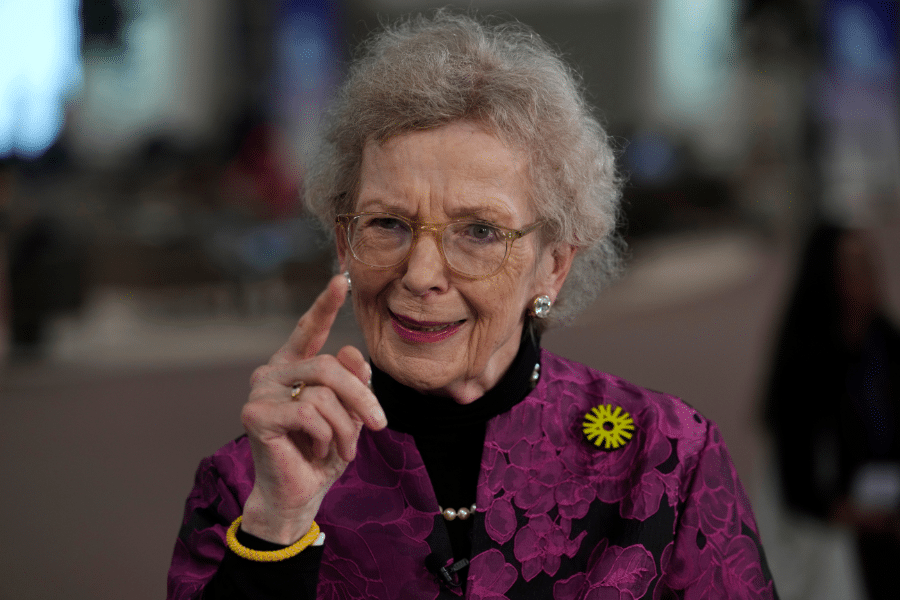
    Former Irish President Mary Robinson recently gave one of the most forceful condemnations of Israel’s war on Gaza. Now the UN High Commissioner for Human Rights, Robinson visited Egypt and the Rafah border and called on states to implement “decisive measures” to halt the genocide and famine in Gaza

    “Governments that are not using all the tools at their disposal to halt the unfolding genocide in Gaza are increasingly complicit,” she said.  

    Robinson is a member of an organization that calls itself “The Elders.” Founded in 2007 by Nelson Mandela, the South African political prisoner turned president, the group advocates peace, human rights and environmental sustainability. 

    In her comments, Robinson chided today’s leaders for not fulfilling their legal obligations. “Political leaders have the power and the legal obligation to apply measures to pressure this Israeli government to end its atrocity crimes,” she said. 

    Robinson is 81 years old. Where are the young leaders making such statements? Where are they organizing groups like The Elders? 

    Youth power

    The media’s attention to Robinson was impressive. Her August press conference was followed by several lengthy interviews on major networks. An independent group like The Elders — whose members include former presidents, UN officials and civil society activists — deserves recognition. It also invites reflection on the role of age in today’s accelerated time. 

    Being elderly and having once held an important position was not always politically positive. “Don’t trust anyone over 30,” was a popular expression in the 1960s. Dr. Martin Luther King Jr. was just 26 when he led the 1955 Montgomery bus boycott and 34 when he delivered his  “I Have a Dream” speech during the 1963 Washington rally in front of the Lincoln Memorial. John F. Kennedy was 30 when he was elected to the U.S. Congress and 43 when he was elected president. Student leaders made their marks on U.S. politics in the 1960s. 

    Mario Savio was 21 when he led the Berkeley Free Speech Movement in California, which demonstrated the political power of student protests. 

    Mark Rudd was a 20-year-old junior when he led strikes and student sit-ins at Columbia University to push for student involvement in university decision making.  

    Tom Hayden was 20 when he cofounded Students for a Democratic Society (SDS), a national student movement that opposed the Vietnam War and pushed for a complete reform of the political system. At age 22, he wrote the Port Huron Statement, a political manifesto that called for non-violent student activism and widespread civil disobedience achieve the international peace and economic equality that government leaders had failed to achieve. 

    Savio, Rudd and Hayden were more than just campus activists; they were front page national news. 

    Age politics

    Where are the student leaders opposing Trump’s attack on universities and freedom of expression now? College presidents, professors and boards of trustees are shouldering the burden. There is a generational vacuum. 

    Youth and youthful dynamism are no longer viewed as political positives. Today, no one could imagine the 79-year-old Donald Trump playing touch football on a beach in Florida as John F. Kennedy and family did at Hyannis Port on Cape Cod when he was president.

    In reality, Kennedy suffered from many serious medical conditions but they were largely hidden from the public; it was crucial that he maintain his youthful image. Trump swinging a golf club and riding in a golf cart is not a youthful image; even his awkward swing shows his age. 

    Nor are the pictures of the members of his Mar-a-Lago crowd youthful; they look like a meeting of grandparents. As slogans reflecting their times, Make America Great Again is far from the New Frontier which called for an end to poverty and investing in technology and science to send humans to the moon.

    Robinson visited the Rafah crossing with another member of The Elders, Helen Clark. Clark is 75 years old, the former Prime Minister of New Zealand and United Nations Development Program administrator. 

    Generational change

    Of her visit Clark said that she was horrified to learn from United Nations Sexual and Reproductive Health Agency that the birth rate in Gaza had dropped by over 40% in the first half of 2025, compared to the same period three years ago. “Many new mothers are unable to feed themselves or their newborn babies adequately, and the health system is collapsing,” Clark said. “All of this threatens the very survival of an entire generation.”

    Based on her years of experience, Clark wisely talked of generational change.

    Age benefits people who, like Robinson and Clark, have held important positions. Because of that experience, members of The Elders take no political risks by speaking out. 

    The 83-year-old U.S. Senator Bernie Sanders is a notable exception of an elder speaking out in the United States while still in office. For whatever reasons, the elderly members of the Senate — there are currently seven senators who are in their 80s and 17 are in their 70s — have been particularly silent on issues like Gaza. 

    In fact, they have been particularly silent on most issues. 

    Where are the Savio/Rudd/Haydens today? A comparable young leader is Greta Thunberg. Greta was only 15 when she initiated the climate strike movement Fridays for Future. But while Greta initiated the movement, she did not organize it as Tom Hayden did with the formation of the SDS. Thunberg is an important symbol and example of courage — the drone attack on her Gaza-bound “Freedom Flotilla” is beyond reprehensible and consistent with Israel’s total war — but she is not a movement organizer on a national or global level. 

    What makes statements by people like Robinson and Clark so impressive is that they stand out in a realm of stunning silence. 

    The New Frontier

    The Democratic Party in the United States, for example, has no serious leadership. (The same might be said for Socialists in Europe and the Labour Party in Great Britain.) The Democrats inability to rally around 33-year-old Zohran Mamdani who is running for mayor of New York City is an example of the Party’s cowardice and/or lack of vision. 

    While the older, established Democrats are quick to criticize Trump, they offer no new strategies or actions.

    We are desperately waiting for something new. JFK’s motto The New Frontier touched a foundational American embrace of the frontier, the space between the known and new. Back in 1893, historian Frederick Jackson Turner came up with a theory that the continual expansion of the American frontier westward allowed for continual reinvention and rebirth, and that shaped the character of the American people. This frontier theory is essential to an America’s identity built on always moving forward. In contrast, Trump’s return to the past is anti-frontier. MAGA is nostalgia and passé. 

    Where are today’s young progressives presenting new political possibilities as Hayden and his cohorts did with Port Huron and SDS? Or does asking that question show that I am being too nostalgic about the past as well?   

    A version of this article was published previously in the magazine Counterpunch.


    Questions to consider:

    1. Who are “The Elders” and what are they trying to achieve?

    2. What was “The New Frontier” and what did it say about the American character?

    3. Do you think you would be more likely to vote for some very old over someone very young for political office? Why?


    Source link

  • Fewer Young People See Math Skills as Very Important in Work

    Fewer Young People See Math Skills as Very Important in Work

    Higher education stakeholders have noted that math anxiety can hold students back from pursuing some disciplines or major programs, but a new analysis from Gallup finds that young Americans over all place less importance on math skills compared to the general population.

    While over half of all Americans rate math skills as “very important” in their work (55 percent) and personal (63 percent) lives, only 38 percent of young people (ages 18 to 24) said math skills are very important in their work life and 37 percent in their personal life, according to a December survey of 5,100 U.S. adults.

    The survey highlights generational divisions in how math skills are perceived, with adults older than 55 most likely to see math as very important compared to younger adults, and Gen Z least likely to attribute value to math skills.

    To Sheila Tabanli, a mathematics professor at Rutgers University, the low ratings point to a lack of perceived connection between math skills and career development, despite the clear correlation she sees.

    Tabanli said it can be hard to convince many Gen Z and Alpha students that math content is necessary for their daily lives, in part because access to information is so convenient and they can perform calculations on their phones or online.

    “We need to transition from focusing too much on the concept, the domain, the content—which we do love as math people, otherwise we wouldn’t be doing it for a living—but students don’t see that connection [to employable skills],” Tabanli said.

    When asked how important math skills were for the majority of the U.S. workforce, 40 percent of young adults rated having math skills as very important—the lowest rating of nine skills evaluated, including reading, language, technology and leadership, according to Gallup.

    Young people also rated the importance of math skills for the general workforce, as compared to their own lives, the lowest of all age cohorts. Adults ages 55 to 64 (71 percent) and 65 and older (68 percent) were most likely to say math is a very important skill for the general workforce.

    Most career competencies that colleges and universities teach, such as those by the National Association for Colleges and Employers, focus on broader skills—including critical thinking, leadership, communication and teamwork—as essential for workplace success. Math can teach students how to solve problems and engage with difficult content, which Tabanli argues are just as important for an early-career professional.

    One reason a young adult might not rate math skills highly is because many students face undue math anxiety or a skepticism about their own ability to do math, falling into the belief that they’re not “math people,” Tabanli said.

    In response, Tabanli believes professors should help students apply computational skills to their daily lives or link content to other classes to encourage students to invest in their math learning. While this may be an additional step for a faculty member to take, Tabanli considers it a disservice to neglect this connection.

    Professors can also strive to make themselves and the content more human and approachable by sharing information about their lives, their careers and why they’re passionate about the subject, Tabanli said.

    Source link

  • NCCU Receives $500K Grant to Study Career Barriers Facing Young Men in Research Triangle

    NCCU Receives $500K Grant to Study Career Barriers Facing Young Men in Research Triangle

    NDr. Tryan McMickensorth Carolina Central University has received a $500,000 grant from the Walton Family Foundation to launch a  research initiative addressing the systemic barriers that prevent young men in the Research Triangle region from accessing career pathways and educational opportunities.

    The two-year study, titled “Understanding Education as a Career Choice for NC Research Triangle Youth,” will focus on what researchers term “opportunity youth” – young men between ages 18 and 24 who have become disconnected from both education and employment systems. Despite broader national gains in educational access, this demographic continues to face significant obstacles that contribute to high dropout rates and limited postsecondary success.

    Dr. Tryan McMickens, professor of higher education and coordinator of NCCU’s higher education administration program, will lead the initiative alongside Dr. Jim Harper II, professor of history and associate dean of the School of Graduate Studies. Their research team will include faculty members, six graduate students from the higher education administration and history programs, and a dedicated project manager.Dr. Jim Harper II Dr. Jim Harper II

    “I am thrilled that the Walton Foundation has chosen to invest in NCCU faculty to advance research on postsecondary attainment among boys and young men,” said Dr. Ontario Wooden, NCCU provost and vice chancellor for academic affairs. “This support highlights the importance of this critical area and empowers our faculty to deliver meaningful, evidence-based results. I eagerly anticipate the insights and impact this work will bring.”

    The research aims to move beyond simply identifying problems to developing concrete solutions through research-based interventions, community engagement, and policy recommendations. The project will culminate in a two-day conference planned for 2026, where findings and potential interventions will be shared with stakeholders across the region.

    McMickens brings extensive expertise in higher education access and the experiences of Black male students to the project. His research centers on college mental health and historically Black colleges and universities, and he authored Black Male College Students’ Mental Health: Providing Holistic Support in Higher Education. Harper’s scholarship focuses on African and African American education and innovative uses of technology for public engagement with history. He co-authored With Faith in God and Heart in Mind: A History of Omega Psi Phi Fraternity, Inc.

    The Research Triangle region, encompassing Raleigh, Durham, and Chapel Hill, represents one of the nation’s most concentrated areas of higher education institutions and technology companies. However, the economic opportunities created by this educational and technological hub have not been equally accessible to all young people in the region, particularly young men from underserved communities.

    The Walton Family Foundation, established by descendants of Walmart founders Sam and Helen Walton, focuses its philanthropic efforts on three primary areas: improving K-12 education, protecting rivers and oceans along with their communities, and investing in Northwest Arkansas and the Arkansas-Mississippi Delta. The foundation also supports projects reflecting individual family members’ personal interests.

    The timing of this research initiative comes as higher education institutions nationwide are examining their role in addressing broader social and economic inequities, particularly those affecting young men of color who face disproportionate barriers to educational and career advancement.

    Source link

  • A decade connecting young people to the world they live in

    A decade connecting young people to the world they live in

    To understand the chaos that is the world today it helps to look back a decade.

    This past year, world representatives met at COP29 to fight climate change in a place led by an authoritarian regime dependent on fossil fuels. The Israeli government under Prime Minister Benjamin Netanyahu has been massacring Palestinians in Gaza. The United States bombed Iran in an attempt to eliminate its nuclear capability. And U.S. President Donald Trump and an increasing number of European leaders have closed their doors to immigrants and refugees.

    In great contrast, when News Decoder launched 10 years ago, 196 nations signed onto the landmark agreement known as the Paris Accords, ushering in the hope that together we could cool down the planet. The administration of then-U.S. President Barack Obama signed a historic agreement with Iran, in which Iran would get rid of 97% of its supply of enriched uranium. A million refugees flooded into Europe from conflicts in Syria and elsewhere.

    In the years in between, the world locked down during the Covid-19 pandemic, Great Britain exited the European Union, the #MeToo movement erupted across the world, nations across the globe began legalizing same sex marriage, Russia invaded Ukraine, Trump got elected, tossed out and re-elected and we began ceding everything to artificial intelligence.

    Can you imagine coming of age in that world?

    Decoding world events

    When Nelson Graves founded News Decoder to help young people “decode” the world through news, it seemed that we lived in an age of optimism. Now young people feel helpless and disconnected. In April 2024, the World Economic Forum reported that young people worldwide are increasingly unhappy and this trend would have real consequences for the future.

    “We live in a world where teenagers grapple with a sense of crisis before adulthood; a time when young people, historically beacons of optimism, report lower happiness than their elders,” the report said.

    But even back in 2015, Nelson knew things would change. He’d spent years as a foreign correspondent covering world events. 

    “Anyone with a sense of history and someone with experience in following current events — especially a foreign correspondent — would have known that the world is most likely to change when you’re least expecting it,” he said. “Nothing is immutable — except the truism that the political pendulum is always swinging.”

    The roots of Brexit, the Make America Great Again movement in the United States and antipathy towards immigrants were already deep in 2015, even if they were largely underground and out of sight, he said. 

    A decade later, News Decoder’s mission of connecting young people to the world around them seems more relevant than ever.

    For 10 years, the high school students News Decoder has worked with have explored — through articles, podcasts, videos and photo essays and in live, cross-border dialogues — how problems in their communities connect to things happening elsewhere in the world. In 2016, for instance, a student studying abroad in China worked with News Decoder to explore how growing consumerism was leading to mountains of trash and created an army of people who mined that trash building up around them.

    That same year in an online roundtable, News Decoder brought together students from the Greens Farms Academy in the United States with students from Kings Academy in Jordan, Aristotle University in Greece and School Year Abroad in France to discuss the ongoing war in Syria and the worldwide crisis of Syrian refugees.

    Kindling curiosity

    One of the Greens Farms Academy students who participated, Samyukt Kumar, further explored the topic in an article News Decoder published that year. Looking back, he now tells, the practical experience it gave him was valuable.

    “Less for the substance but more for the practical experience,” he said. “My views on these topics evolved significantly as I received greater education and real-world exposure. But I still reap the benefits from gaining more confidence in my writing, learning to embrace the editing process and engaging my curiosity about the world.”

    In 2017, a News Decoder student at Haverford College in the United States explored the problem of migrants flooding into her home country of Italy. She came to this conclusion:

    “The roots of the problem lie outside of Italy, which nonetheless bears a heavy burden as the first EU destination for thousands of Africans crossing the Mediterranean,” she wrote. “A solution to the migration crisis depends not only on Italy’s good will — now being stretched to the limits — but also on the willingness of the rest of Europe and the international community to tackle the armed conflicts, poverty and human rights abuses that stir so many Africans to attempt the perilous Mediterranean crossing.”

    Fast forward to 2025. News Decoder worked with high school students in the British Section at the Lycée International Saint-Germain-en-Laye outside of Paris to take what they learned about the United Nations Sustainable Development Goals and find and tell narrative stories through podcasts. They explored such things as the problem of poverty in resource-rich areas of Africa and the connection between actions of multinational corporations and climate change.

    Crossing borders

    In Switzerland, News Decoder worked with students at Realgymnasium Rämibühl Zürich on a series of articles that explored gender inequity in sports, the connection between social media and the decline of democracy, how a local community is affected when it hosts a world conference and the connection between the quality of life in a country and the people’s willingness to pay for that through high prices and high taxes.

    And in monthly “Decoder Dialogues” News Decoder put together students from countries such as the United States, Colombia, France, India, Belgium and Rwanda in online roundtables to discuss such topics as the future of journalism, climate action, censorship, leadership and artificial intelligence.

    Through the exploration of a problem in the world, by seeking out experts who can put it into context and by seeking out different perspectives from other places, students make sense out of chaos. They begin to see that there are people out there thinking about these problems in different ways and seeking solutions to them.

    Ultimately, the message News Decoder wants students to take away is that you don’t need to run from complicated problems. You don’t need to disengage from the news and the events happening around you. By delving more into a topic or issue or controversy, you can begin to understand it and see the path forward.

    At News Decoder, we believe people should be able to listen to each other and exchange viewpoints to work through problems across differences and borders. Back in 2015, Graves posed this challenge: How to tap into the intellectual energy of the generation that will soon assume leadership in business, government, academia and social enterprise? 

    For the past 10 years we have worked to empower young people by giving them the information they need, connecting them to the world around them and providing them a forum for expression. For a decade we have helped them find coherence out of the chaos around them — and we intend to continue doing that for the next 10 years. 

    One thing we know: 10 years from now the world will be a lot different from what it is now. 

    “While no one has a perfect crystal ball, you can be sure that nothing remains unchanged for long,” Graves said. “Yesterday’s mortal enemy can become a fast friend — think of U.S. relations with Vietnam since the 1950s. Lesson: Always expect change, even if you can’t anticipate the precise contours, and don’t project linearly into the future. As ever, keep an open mind and beware confirmation bias.”

    That’s the message News Decoder tries to instill in the young people we work with. After all, a decade from now, they will be the ones making that change happen. 

    Source link

  • Can young people help save local newsrooms?

    Can young people help save local newsrooms?

    Can youth doing journalism help save local news media? 

    Unfortunately, this isn’t a rhetorical question. The crisis around the world for local news outlets is so dire, people who understand the importance of unbiased news at the local level are looking for any and all solutions to save the industry. 

    This is a worldwide phenomenon. Data collected by researcher Amy Watson in August 2023, for example, found that more news outlets in the UK closed than were launched. Between 2008 and 1 April 2025, a total of 566 local news outlets closed in 372 communities across Canada, according to the Local News Map crowd-sourcing data initiative. And a report from the Brookings Institution found that in the United States in 2023, some 2.5 local news outlets folded every week.  

    That’s why Global Youth & News Media, a French nonprofit affiliated with News Decoder, is offering an award for youth collaborations that support struggling local news outlets by providing content produced in their schools and helping to expand the outlet’s audience. Entry deadline is 16 June and details are here.

    “We and the partners in this award around the world want to find and spread the word about the lessons from the best cases of success as well as cautions about inevitable problems and challenges,” said Aralynn McMane, executive director of Global Youth & News Media.

    “At the very minimum, ‘success‘ means a discernible audience for the work that youth reporters — up through university age — produce in news media that serve a wider local community than their classmates,” McMane said “It’s even better if their efforts can be linked to financial sustainability.” 

    Supporting local news efforts

    The main goal of the award is to highlight successful collaborations between youth and local outlets so that other organizations around the world can adopt those strategies. McMane said that she has seen this happen many times — smart news media innovators will come up with a solution to a problem, and those solutions can help news producers even very far away adapt that idea to solve a similar issue. 

    Award partners that support local news efforts internationally as well as from Africa, North America, Europe and Asia have stepped up to help make sure the search for such cases is as wide as possible and to distribute the intelligence gained from this search to as many news organizations in as many places as possible. 

    First to sign up to help was the University of Southern California’s Communication Center on Leadership and Policy (CCLP), located within the USC Annenberg School for Journalism and Communication.

    In 2024, CCLP launched the Local News and Student Journalism Initiative to study the role of student journalists across America and issued this first report on their work.

    “We are delighted to partner with Global Youth & News Media to celebrate impactful local news stories produced by young journalists around the world, as well as to share and amplify their efforts with the goal of inspiring more young people to cover the news of their communities who are already providing first-rate local news coverage,” said Geoffry Cowan, center director. 

    Inspiring young people to tell important stories

    Another national academic partner, the Medill School at Northwestern University, released a report earlier this month about collaborations between local news outlets and student journalists in the United States as part of its Local News Initiative.

    The report found a trend for such collaborations in the United States. “Instead of news organizations giving boosts to students, students are supporting often-short-staffed outlets by providing coverage as part of their curricula,” the report said. 

    Senior Associate Dean Tim Franklin, the project’s director, said Medill started the initiative seven years ago to see how they could leverage the school’s resources to help local news outlets, journalism organizations, scholars and scholastic media at a time of crisis in the industry.

    “Our research provides insights about trends and issues in local news in this fast-changing landscape,” Franklin said. “And through our programs, we’re helping news organizations with things like business strategy and product development at a time when many can’t do R&D themselves. We’re also creating opportunities to inspire young people to pursue careers in journalism.”

    The quest to help local news is global. The Austria-based International Press Institute, for example, has run two editions of an “accelerator” program to support digital innovation in local journalism’s editorial and business models around the world. It also runs a related network.

    Other partners include the International Center for Journalists and the Media Diversity Institute, both of which have extensive local news programs, Youth Community Journalism Institute founded by the Strong Mind Strong Body Foundation, a U.S. nonprofit, Europe Youth Press, a consortium of outlets in 34 countries, Africa Media Perspectives, The Media Lab in Jordan, Asia division of the Asian-American Journalists Association, the Panhellenic Federation of Journalists’ Unions of Greece and Toronto Metropolitan University’s Local News Research Project

    Empowering youth through journalism

    Stefano Zamparo, an executive board member for Europe Youth Press said that the award aligns with the group’s work empowering youth voices through journalism, ensuring their stories resonate within their local communities and beyond. 

    “Celebrating successful collaborations between young journalists and local media helps foster greater press freedom and media literacy across Europe,” Zamparo said. 

    Ivor Price, founder of Africa Media Perspectives, sees young people as the driving force behind a rebirth of local news. “For local news to survive and thrive, it must become a true reflection of the communities it serves, which means opening our newsrooms and our storytelling platforms to new voices,” Price said. 

    Since 2018, the Global Youth & News Media Prize has honored the important work that sees news media meaningfully engage the young with notable results that benefit both parties. 

    Its first award recognized a cooperation between the United States digital edition of the The Guardian news organization and reporters from the Eagle Eye, a student news operation at Marjory Stoneman Douglas High School in Parkland, Florida, which was the site of a 2018 school shooting in which 17 people were killed. Through the journalism collaboration, the Parkland students contributed live digital coverage of an anti-gun violence demonstration in Washington, D.C. 

    News Decoder has been a partner in these competitions from the start.

    “This particular award theme resonates particularly strongly with us,” said News Decoder managing director Maria Krasinski. “All around the globe, student journalists are telling important stories, but often those stories aren’t heard outside their schools. This competition will rightfully recognize the important work youth are doing to help inform local communities.”

    Source link

  • PSHE education can improve young people’s preparedness for higher education and beyond

    PSHE education can improve young people’s preparedness for higher education and beyond

    Personal, social, health and economic (PSHE) education is the school curriculum subject in England dedicated to supporting children’s safety, health, wellbeing and preparation for life and work. When timetabled and taught effectively, it can play a key role in improving young people’s preparedness for life beyond school, including for higher education and the graduate labour market. For instance, PSHE education can provide a safe and dedicated space for young people to learn about sex and relationships, budgeting and time management, among other things that most students will need to navigate more independently – and sometimes for the first time – during higher education.

    As the official subject association for PSHE education, and a charity and membership body supporting over 50,000 teachers and schools nationally with resources, training and guidance, the PSHE Association was especially interested in the Higher Education Policy Institute’s (HEPI) recent report, One Step Beyond, which investigated how well the curriculum as a whole prepares young people for life beyond school.

    The report, which is based on an analysis of data from a survey of 1,105 undergraduates in England, found that over half of participants wanted to have received more education on personal finances and budgeting (59%) and to have had more opportunities to learn ‘life skills’ (51%) prior to entering higher education. A large minority also wanted to have received more careers education (44%), a topic that PSHE education covers and which, when delivered well, can make a positive difference to young people’s confidence, sense of direction and career trajectories.

    Importantly, the report also found that over half (58%) of participants wanted PSHE education to be compulsory until 18. At present, while relationships, sex and health education (RSHE) is compulsory for 16- to 18-year-olds in schools with sixth forms – and our own PSHE education planning guidance runs up to post-16 / key stage 5 – this requirement is not applicable to other settings, including sixth form and further education colleges. Furthermore, existing PSHE education content on economic wellbeing, personal financial education and careers education is optional in all but independent schools. As there is evidence to suggest that these are topics that young people from more affluent backgrounds are more likely to be taught about and discuss with their parents, all of PSHE education, including economic wellbeing, personal finance and careers education, has the potential to contribute towards narrowing social inequalities. And this is what we argue strongly for in our response to the Curriculum and Assessment Review, alongside strengthening the expectation that all young people should benefit from PSHE education up to the age of 18.

    The good news is that since statutory RSHE requirements were introduced in 2020, these appear to have made a positive impact. And the findings from the One Step Beyond report support this idea, with half of the participants reporting feeling well prepared for sex and relationships in higher education in 2024 (47%) – almost double the percentage that reported feeling this way three years earlier (27%).

    Another aspect of life which PSHE education can help young people to navigate during school, college and higher education is mental health. The One Step Beyond report found that most participants believed that their schools or colleges had done a ‘good’ or ‘excellent’ job of preparing them to plan and manage their workloads (61%); take care of their mental health and wellbeing (56%); and use healthy coping strategies (55%). However, a substantial minority of participants did not feel this way, suggesting that there is room to improve the quality of education that students receive on these topics – and PSHE education can play a crucial role in making this happen.

    PSHE education provides opportunities for young people to learn about mental health and develop skills that can support them in taking care of it. For example, through PSHE education, young people can be taught about how to prevent and manage stress, which can aggravate or contribute towards the development of mental health difficulties. This is achieved in a variety of ways. For instance, by providing opportunities for young people to be taught about how to problem solve, develop greater emotional awareness, use healthy coping strategies, maintain good sleep routines and recognise when and how to access support for themselves or others.

    After leaving school, such teaching could help young people to navigate further and higher education, which both demand greater independence and present unique opportunities and challenges. Illustrating this, when 136 A-level students were asked to describe their experience of sixth form using three words or phrases, the majority (79%) used at least one term to describe it as challenging and almost half (43%) described it as intense, stressful or overwhelming. Furthermore, across several interview studies, students have consistently described studying A-levels as a ‘massive step up’, a ‘jump’ and ‘a completely different ballgame’, which demands far more self-directed learning and can be an emotionally turbulent experience. It has also been found that experiencing education-related problems is among the main reasons why 16- to 18-year-olds contact Childline. So, PSHE education during school and post-16 education has the potential to support young people and contribute to improving higher education students’ mental health by equipping them with knowledge, understanding and skills that can help them to navigate this stage of education prior to entering it.

    To conclude, high-quality PSHE education has the potential to improve young people’s preparedness for many aspects of higher education – social, academic and economic – as well as for life beyond its walls. And it is for this reason that the PSHE Association has argued in response to the Curriculum Review and Assessment Group consultation that personal finance education and careers education should be placed on the same statutory footing as RSHE and for PSHE education, comprising all these elements, to be scheduled as a school curriculum subject in all schools, with at least one timetabled lesson per week.

    Findings from the One Step Beyond report indicate that PSHE education has had a positive impact on preparing young people for life beyond school, but that there is significant potential and need to build on improvements since elements of RSHE became statutory. This includes more emphasis on economic wellbeing, careers and mental health, as well as a guarantee that young people in all post-16 education settings can benefit from PSHE education until the age of 18 – not just those in specific settings.

    Source link

  • Young people from deprived areas can’t afford to consider university

    Young people from deprived areas can’t afford to consider university

    Should the economic fortunes area you grew up in have an impact on your chances of attending university?

    There has always been a stubborn connection between 18 year old participation rates and your (UK) region of residence.

    Currently UCAS data tells us that 18 year olds living in London are more likely than not to go on to attend university, whereas in the North East just 29.9 per cent will get there.

    Can’t get there from here

    And in many parts of the UK the proportion of 18 year olds getting to university has stagnated (or even dropped over recent years), as the population of 18 year olds has expanded.

    [Full screen]

    If you are concerned about left-behind parts of the UK, this is something that should concern you. It’s widely acknowledged that graduates are key to levelling up a region, and a surprisingly large number of graduates return to their home area (at least in the short term) after graduation.

    Costs not culture?

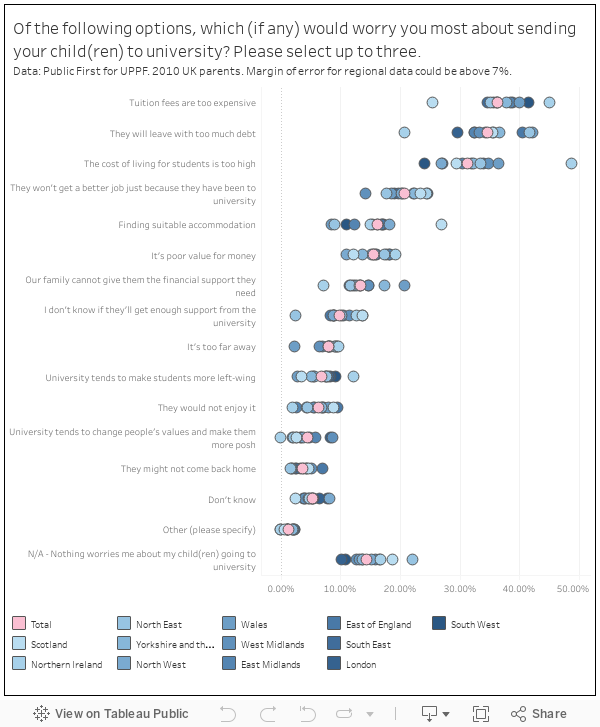
    The counter argument to that is very often cultural – the idea that going to university changes a person, and dilutes the essence of what makes (frankly) a deprived area a deprived area. Polling from Public First for the UPP Foundation (which is kicking off an inquiry into the state of widening participation in higher education) happily suggests that this is not an attitude prevalent among UK parents.

    [Full screen]

    What does worry parents is the sheer cost of study – both in terms of tuition fees (36 per cent cite this as a top three reason to be concerned about their children attending university) and living costs (31 per cent). The overall level of debt on graduation is the other big one (35 per cent).

    But that’s not to say that there are not other reasons – number four in the list is the idea that “they won’t get a better job just because they have been to university” (particularly prevalent in London), number six is “poor value for money” (an East Midlands, North East, and Northern Ireland prevalence). The size of the sample makes the regional splits difficult to draw accurate conclusions from, but the trends are interesting.

    What teachers said

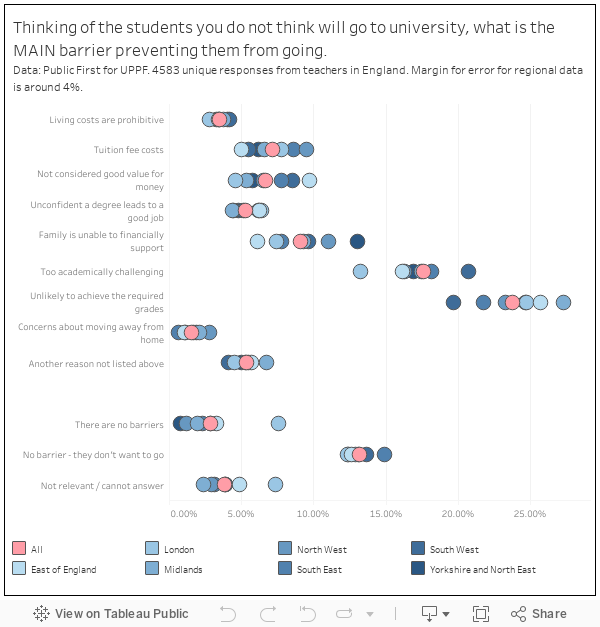
    Teachers are a primary source of information about higher education – happily UPPF also commissioned Public First to look at what teachers felt were the barriers to participation, and there are (some) regional splits.

    [Full screen]

    The question here focuses on why teachers don’t expect some pupils to go to university – we are looking across all types of schools at the top of secondary education. Here we see that the big barriers are academic – teachers tend to feel that students are unlikely to get the required grades (24 per cent) or to rise to the academic challenge (18 per cent). And this is true across all English regions.

    Notably prevalent in the North East and Yorkshire (combining two standard, ILTS1, regions) is the idea that the family will be unable to support a student. In that region this was cited by 13 per cent of teachers – enough to feel concerning, but similar to the proportion that simply don’t want to go to university (again note that the margin of error will be high with small subsamples).

    Your chances are variable

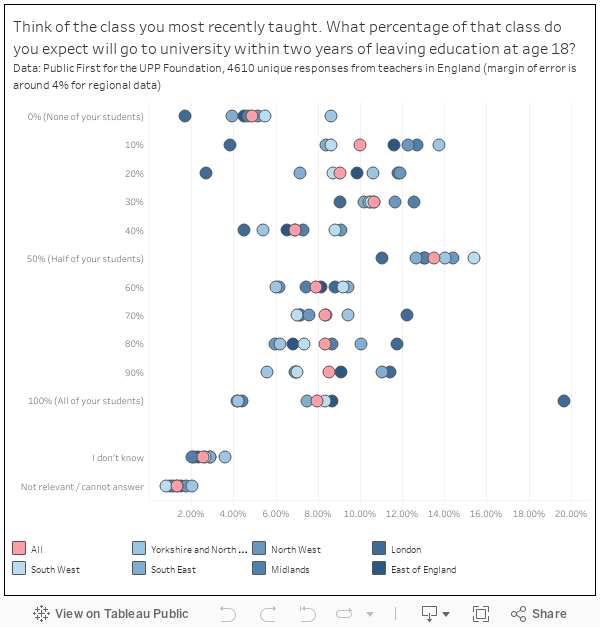
    Twenty per cent of teachers in London feel like all of the last class they taught will go on to university – just four per cent of teachers in the North West, North East, and Yorkshire had similar confidence. Indeed 14 per cent of teachers in the North East and Yorkshire felt that only 10 per cent of their class would go on to university. As you might expect, the modal answer for most regions was “about half” of pupils – the North East and Yorkshire is the only exception.

    [Full screen]

    This, then, is what access and participation in the north is up against. Attainment and capacity is an issue everywhere, and one that the access and participation regime in England attempts to address via collaboration between universities and schools – something that also contributes to aspiration.

    But aspiration and attainment count for little when parents and teachers are agreeing that for many in the UK’s most deprived areas university study simply is not affordable. And though participation among disadvantaged groups is improving – disadvantaged areas continue to struggle.

    Source link

  • Whitney Brothers® elevatED™ CollectionReceives Design Journal BEST of 2024 Award

    Whitney Brothers® elevatED™ CollectionReceives Design Journal BEST of 2024 Award

    Keene, NH – Acclaimed furniture brand Whitney Brothers® today announced its new elevatED™ Collection of furniture for young learners received a BEST of 2024 award from Design Journal, a leading global trade resource for interior designers, architects and facility managers.

    A Design Journal panel of 2,400 internationally renowned interior designers, architects and facility managers cited the elevatED™ Collection’s distinct contemporary style and its inventive adaptation across 46 individual pieces in the collection. Each piece is constructed in textured white oak and white melamine structural elements that form crisp, pleasing lines with refined contrasting color accents. Brushed nickel legs add design counterpoint and rich visual interest.

    The elevatED™ Collection comprises 46 individual and modular pieces for young learner activities including art, STEM / sensory, literacy development, play, tables, seating, lockers and storage. Each piece is flexible, mobile or modular to enable furnishing a dynamic learning environment for young learners completely within the elevated™ Collection.

    Technical attributes of the collection include FSC certified wood material and Eco-Certified Composite (ECC) certification, an exemplary commitment to sustainability and environmental stewardship. The finish on each piece includes proven antimicrobial properties, an important attribute that contributes to the health and well-being of young children.

    “The Design Journal BEST of 2024 award recognizes how a fresh, modern expression of furniture can play a central role in creating a dynamic learning environment for our youngest learners,” said Mike Jablonski, president of Whitney Brothers®. “The elevatED™ Collection is another great example of our brand’s innovation and commitment to furnish learning environments that inspire and engage young children.”

    About Design Journal
    Design Journal is a leading international trade resource for interior designers, architects and facility managers since 1988. The Design Journal awards program is one of the most prominent design recognition platforms in the world for the fields of architecture and design. Each year, a global advisory board of 2,400 internationally renowned industry professionals preside over a rigorous evaluation process to select projects and products that represent the highest standards of design excellence.

    About Whitney Brothers®
    Founded in 1904, Whitney Brothers® is a 100% employee-owned producer of furniture for Early Learning and institutional childcare environments sold through educational distributors and dealers to schools, childcare centers, Head Start facilities, churches, libraries, museums and residential homes throughout North America and around the world. The brand’s rich 121-year history reflects old world craftsmanship blended with state of the art manufacturing technology to create products of uncompromising quality, design, innovation, safety, durability and value. Each product is UL GREENGUARD® Gold and antimicrobial certified, qualifies for LEED credits, meets or exceeds applicable CPSIA, ASTM and BIFMA requirements, supported by a Limited Lifetime Warranty and proudly made in America.

    eSchool News Staff
    Latest posts by eSchool News Staff (see all)

    Source link

  • Stranger than fiction: The Young Warrior saga at the Institute for American Indian Arts

    Stranger than fiction: The Young Warrior saga at the Institute for American Indian Arts

    TAKE ACTION

    David John Baer McNicholas’s first novella is inspired by a darkly comedic poem he once wrote about a town that outlawed canned food and built a massive trebuchet, or catapult, to hurl the cans into the distance — only to receive thank-you notes tied to bricks hurled back at them.

    Lately, McNicholas has been entangled in a real-life plot eerily similar to his writing. At the Institute of American Indian Arts in Santa Fe, New Mexico, food pantries were empty despite a $50,000 grant meant to support them. When student publication The Young Warrior printed criticisms of school officials for these failures and the Associated Student Government began investigating, administrators swiftly retaliated — kicking students out of housing, putting them on probation, and even threatening them with lawsuits.

    This may sound like the plot of a neo-noir film bleak enough to rival “Chinatown,” but for McNicholas, a creative writing student at IAIA and the founder and editor of The Young Warrior, it’s reality.

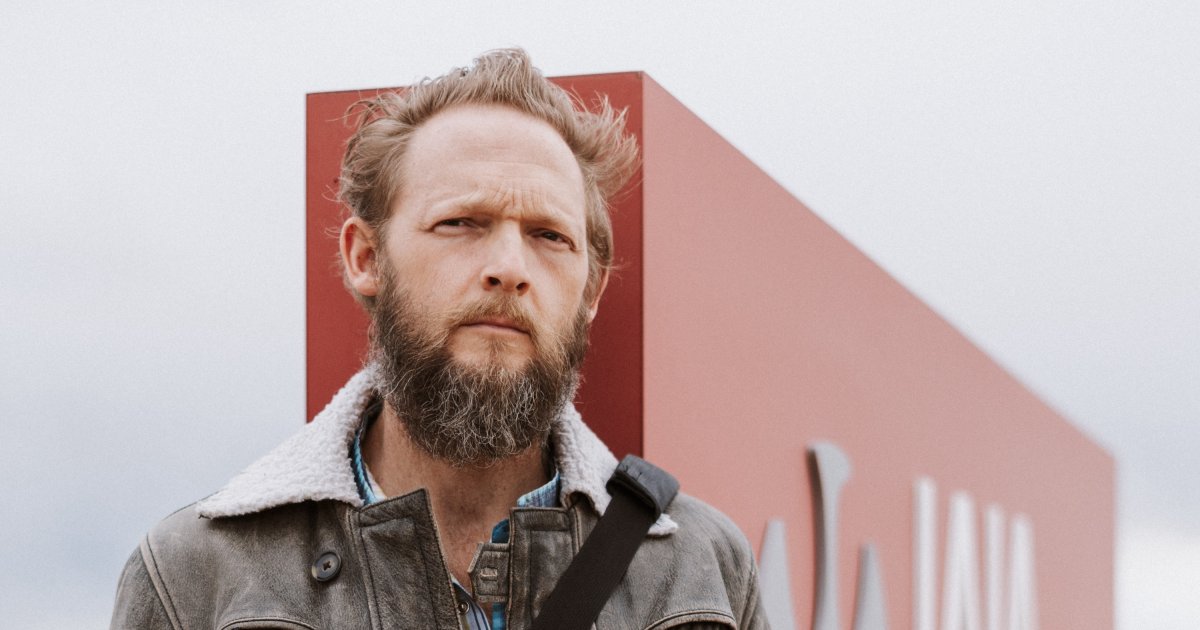
    Young Warrior editor David McNicholas recalls, “Oh shit, they’re going to throw everything at me” for exposing the administration. (Ponic Photography)

    McNicholas connects IAIA’s pattern of silencing dissent to broader institutional failures. He recounts how during a faculty meeting with the Board of Trustees, a sculpture professor once dared to mention an academic paper written by a former IAIA department head. The paper showed that even conservative estimates put IAIA’s staff turnover rate at about 30%. McNicholas says when the professor brought it up, “everyone in the meeting clammed up, and later they came down on him hard. They told him he embarrassed the dean of students and demanded he write a public apology and retraction. He wrote a coerced apology and quit the next day.”

    The Young Warrior published the academic paper before quickly being told to retract it.

    “We want better,” says McNicholas. “Student retention is 50%. Graduation is 25% . . . The faculty, staff, and students here are top-notch people, but the administration just supports the rising stars and lets everyone else evaporate.”

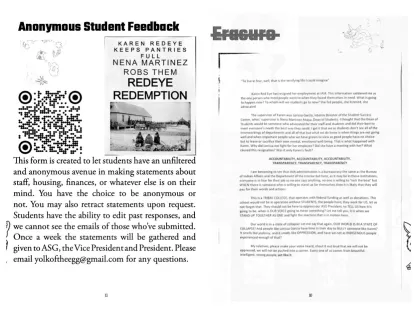
    McNicholas’s own showdown with the administration began when he published an anonymous student letter and flyer accusing the dean of students of bullying and suggesting food-pantry funds had been misappropriated. The letter and flyer resonated with the student body, according to McNicholas, and many came forward to thank him and to offer support. 

    I love this school. I love the community. I love the students and the faculty. I struggle with the administration after this, but I think that that struggle was there long before I came along. I just kind of exposed it.

    When McNicholas published the anonymous letter and flyer, he says students were being forced to buy meal plans they couldn’t always use while the dean of students, McNicholas says, dismissed the need for food pantries altogether, claiming, “Students have meal plans; they don’t need food pantries.” 

    This explanation rang hollow for McNicholas who, like many of his peers, falls below the poverty line and relies on food pantries to survive. 

    Collage of advertisements in the Young Warrior student magazine

    After the letter and flyer came out, the administration promptly accused McNicholas of “bullying” staff with his publication, and IAIA Provost Felipe Colón put him under investigation. 

    “They came down on me primarily, but also on a peer who had made an Instagram post, of all things,” he recalls. “I said, ‘Oh shit, they’re going to throw everything at me.’” 

    Anticipating housing sanctions, McNicholas preemptively left campus and lived out of his van. 

    “It sucked, because I wasn’t prepared for it. I had to go sleep in a friend’s driveway,” he remembers. The forcefulness of the school’s response only made McNicholas more suspicious, bringing to mind Shakespeare’s famous line, “The lady doth protest too much.” 

    Institute of American Indian Arts Can’t Ignore the First Amendment

    Page (Two-Column)

    Tell the Institute of American Indian Arts to lift sanctions against David McNicholas and revise its anti-bullying policy.


    Read More

    The situation escalated when the administration denied that the grant even existed during a meeting with McNicholas and other members of the Associated Student Government who had taken an interest in the matter. Despite the administration’s denials, an anonymous source provided McNicholas with a photocopy of a grant award letter for the rumored $50,000. Armed with this evidence, McNicholas and the ASG president confronted the administration, only to face threats of legal action. 

    The administration’s behavior took an emotional toll on students, according to McNicholas. One day, the ASG called a meeting to discuss the situation — just ASG members, since advisors employed by the college couldn’t be trusted — and the ASG president showed up in tears. She had just come from a meeting with IAIA President Robert Martin, who delivered a shocking ultimatum. 

    “She said that he told her the school was seriously considering suing ASG — and her — because of the bad publicity,” McNicholas says. “She came to us and said, ‘They told me to fix it.’ She was in tears, you know, and that made me mad.” 

    When they confronted the provost with the grant award letter, he changed his tune. 

    “He showed up at the next meeting and said, ‘Oh, you know what? I did some looking, I researched it, and I think I found the grant that you guys were talking about, and I’d like to come and explain how it was spent,’” McNicholas recalls. “I was like, yeah, I bet you do.”

    Meanwhile, Provost Colón’s investigation of McNicholas for publishing the student critiques found him responsible for violating the school’s unconstitutional anti-bullying policy. Exhausted and beaten down, he was unable to attend the meeting where the provost attempted to explain the grant’s expenditures. McNicholas says, “I got the sheet he handed out, which showed budget-to-actual figures, but when pressed to release the ledger, he claimed bank statements might not go back that far. We’re talking a year, maybe two at most. I think he thought you could say that because he was with a room full of like 19, 20 year olds. But if I had been in that room, I would have pushed back.”

    Though McNicholas later successfully appealed the housing sanctions and recovered about $2,000 in lost fees, he remains outraged at how other students were treated. 

    McNicholas never did accept IAIA’s “as little as possible” philosophy, in which truth had no place, power thrived on silence, and the ones who dared to ask questions were the first to pay the price.

    “What I really can’t stand is that they did the same thing to a 19-year-old freshman for making an Instagram post. That person didn’t move out on their own accord. They lost all their housing and meal plan money. They lost $2,000,” McNicholas says. “They kicked that person out, kept their money, and made a 19-year-old student homeless. As far as I’m concerned, that’s unconscionable.”

    Not only did the sanctions against McNicholas affect his ability to participate in campus life, they also threatened his employment opportunities, including a federal work-study opportunity that should have been protected from administrative interference. 

    “I was hired to be an orientation mentor at the end of last summer,” he says “And the day before I was going to start, I got a call from the director of that program who said, ‘Yeah, you can’t participate because you’re on institutional probation.’”

    Finding himself ruthlessly targeted by the administration, McNicholas turned to the press. Teaming up with a few peers, they went to the Santa Fe Reporter, and the article that followed — which detailed the administration’s retaliatory actions against him — made an immediate impact. 

    “When that article came out, both the interim director and dean of students were gone within days,” he says. “Like, they were gone.” 

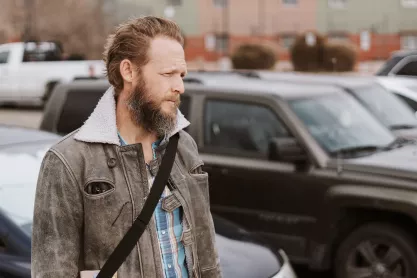
    David McNicholas at the Institute of American Indian Arts in Santa Fe, New Mexico

    Anticipating housing sanctions, Young Warrior editor David McNicholas preemptively left campus and lived out of his van. “It sucked, because I wasn’t prepared for it. I had to go sleep in a friend’s driveway.” (Ponic Photography)

    After the Santa Fe Reporter exposé and leadership shakeup, the food pantry miraculously transformed. A 20-foot-long conference table in the Student Success Center, once filled with nothing but cans of tomatoes that no one was using, suddenly became a bounty of groceries. 

    Last semester, McNicholas delved into the intersection of journalism and free speech through an independent study. His research included works like Dean Spade’s “Mutual Aid” and FIRE’s “Guide to Free Speech on Campus,” laying the groundwork for his evolving understanding of rights and responsibilities. 

    This semester, McNicholas has already published a new issue of The Young Warrior, which reflects his growing interest in matters of free expression. The issue includes a letter from FIRE written on his behalf and a personal acknowledgment of his own rights and responsibilities as a journalist. 

    “Yes, the school violated my rights and they need to be held accountable, but also, I could have been a better journalist. And there’s room to talk about that,” he says with characteristic humility. The issue also strikes a lighter tone with a comic poking fun at the provost — because, as McNicholas says with a grin, “why not?”

    The intersection of art, politics, and personal freedom is a driving force for McNicholas. “My work is very personal,” he explains. “I live in a political morass metaphorically surrounded by people on both sides of a binary who think censorship is fine as long as it’s censoring the other guy. I’m a non-binary thinker. I’m an anarchist. For an artist like me to make art, I can’t be worried about who I will offend. I can’t tailor my work to thread between all these idiots who can’t think for themselves, who can’t be critical without taking sides. If I worried about that, I couldn’t get up in the morning. I couldn’t be an artist.”

    McNicholas never did accept IAIA’s “as little as possible” philosophy, in which truth had no place, power thrived on silence, and the ones who dared to ask questions were the first to pay the price. Nevertheless, he speaks with deep affection about IAIA. 

    “I love this school. I love the community. I love the students and the faculty. I struggle with the administration after this, but I think that that struggle was there long before I came along. I just kind of exposed it.”

    Source link