For years, YouTube sat at the edge of higher education recruitment strategies. Institutions uploaded campus tours, student testimonials, and program overviews, but often without a measurable link to enrolment performance.
In 2026, that approach is no longer sufficient.
YouTube is now the second-largest search engine, a dominant short-form discovery platform, and a powerful recommendation engine. For enrolment marketers, YouTube for student recruitment is a full-funnel channel, not a branding add-on. Prospective students discover institutions through Shorts, research programs via YouTube search, and evaluate credibility through long-form video. The algorithm continues guiding them long after the first view.
If your content is not structured intentionally, YouTube will still sequence it. The difference is whether that sequencing supports your recruitment goals. This article outlines how to use Shorts for reach, search for intent, and video sequencing to move prospects from awareness to application.
Refine your school’s YouTube student recruitment strategy?
Contact HEM for more information.

How Big Is the Student Recruitment Market?
The global student recruitment market spans billions annually, including digital advertising, agency partnerships, CRM systems, and marketing services. With international mobility rebounding and domestic competition intensifying, institutions are increasing investment in digital channels such as search, social, and video to secure qualified applicants in an increasingly competitive environment.
What kind of marketing works best with students on college campuses? Authentic, peer-led, and mobile-first content performs best. Students respond to relatable voices, clear outcomes, and practical information. Video, short-form content, and search-driven resources outperform static promotional messaging. Campaigns that combine social proof, transparency about cost and outcomes, and clear next steps tend to drive stronger engagement and action.
How to create a YouTube channel for college recruiting? Start with structure, not volume. Define your recruitment goals first. Build channel sections around Tours, Programs, Student Life, and How to Apply. Create 3–5 core playlists that reflect enrolment journeys. Publish Shorts for reach and search-optimized long-form for intent. Use consistent CTAs, end screens, and descriptions that link directly to admissions pages.
Why YouTube Matters More in 2026, and Why “Posting Videos” Is Not a Strategy
In 2026, YouTube is no longer a secondary distribution channel. It is part of the core infrastructure for digital recruitment. For higher education institutions competing for fragmented attention, YouTube for student recruitment offers something few platforms can: sustained visibility across awareness, consideration, and decision stages.
Today, YouTube functions as:
- A discovery engine driven by search-led intent
- A daily habit channel powered by Shorts-led reach
- A conversion-assist channel enabled by sequenced viewing and retargeting
That combination is precisely what enrolment marketers need. It delivers qualified attention at scale, tighter control over institutional messaging, and a measurable pathway from curiosity to inquiry.
What has changed is not only audience behaviour. The platform itself has evolved. Shorts’ recommendation mechanics continue to refine how short-form content is surfaced. According to TechCrunch, YouTube search increasingly mirrors traditional SEO dynamics, rewarding structured titles, descriptive metadata, and topical consistency.
On the paid side, Google’s shift toward Demand Gen formats is reshaping how institutions build video sequencing and retargeting strategies across devices.
The implication is clear: publishing isolated videos is not a strategy. A disconnected campus tour, a standalone testimonial, and an occasional program overview do not create momentum. Without intentional sequencing, search framing, and next-step design, views rarely translate into measurable recruitment outcomes.
HEM perspective: Most schools do not have a YouTube volume problem. They have a sequencing problem. Content exists, but it is not architected to guide prospects from discovery to deeper engagement.
Example: Harvard University: Harvard organizes content into clearly defined playlists spanning student life, faculty research, campus features, and admissions-related material. Thumbnails are consistent and institutional. Titles are descriptive rather than abstract. This supports sequencing and discoverability. Thematic grouping allows viewers to move laterally across related content, increasing session depth. Harvard treats YouTube as an always-on institutional library, not a campaign archive.
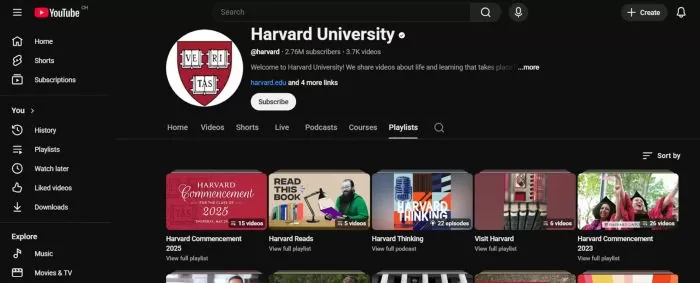
Source: YouTube
These institutions are not outperforming because they publish more. They treat YouTube as an always-on recruitment environment, not a campaign landing zone.
The 2026 Framework: Shorts + Search + Sequencing
If you take one model into planning, make it this:
- Shorts = Reach and familiarity
- Search = Intent capture
- Sequencing = Momentum to conversion
Shorts introduce your institution to new audiences and build repeated exposure through habitual viewing. Search-optimized long-form videos surface when prospects actively research programs, career outcomes, or admissions requirements. Sequencing, through playlists, retargeting, and structured next steps, moves viewers from passive interest to measurable action.
You can deploy this framework organically, through paid media, or with a hybrid approach. The key is strategic design. Each format should perform one primary function within a coordinated recruitment video strategy, rather than competing for the same objective.
Part 1: Shorts for Student Recruitment, Top-of-Funnel That Does Not Feel Like Marketing
Shorts are where students decide whether your institution feels relevant. In 2026, attention is earned in seconds. If your content feels scripted or overly institutional, it is skipped.
Shorts perform for recruitment when they:
- Put the student experience into motion, showing campus, community, and daily routines
- Answer one micro-question clearly and directly
- Feel native to the feed, with a fast hook, simple structure, and low friction
This is not about production polish. It is about authenticity and clarity.
Important platform note for 2026 reporting: Shorts view counting methodologies and search integrations have evolved. Benchmarking performance requires updated internal expectations around reach, retention, and discovery attribution. Marketing teams must recalibrate reporting frameworks accordingly.
A Practical Short-Content Menu for Higher Ed
Instead of asking, “What should we post?”, build repeatable categories that align with enrolment questions.
Belonging and fit
- “What surprised you most about your first year?”
- “What I wish I knew before moving into residence.”
- “One thing people misunderstand about our campus.”
These build emotional resonance and social proof.
Program clarity
- “What you actually do in this major.”
- “Three career graduates don’t realise this program leads to”
- “A day in the lab, studio, or clinic”
These address confusion and surface outcomes early.
Affordability and outcomes
- “How scholarships actually work here, in 20 seconds.”
- “Co-op, placements, and what support looks like.”
- “How students balance work and study.”
These reduce perceived barriers.
Process confidence
- “Application mistakes to avoid.”
- “Portfolio tips in 30 seconds”
- “How to book a campus tour or virtual session.”
These lower friction and encourage the next steps.
Example: MIT frequently uses concise, concept-driven videos that demonstrate research and student work in action. Many videos open with outcome-forward framing rather than institutional introductions. This reflects the “show, do, explain” pattern effective for Shorts and short-form discovery. Complex topics are broken into focused, digestible units aligned to curiosity-led viewing.
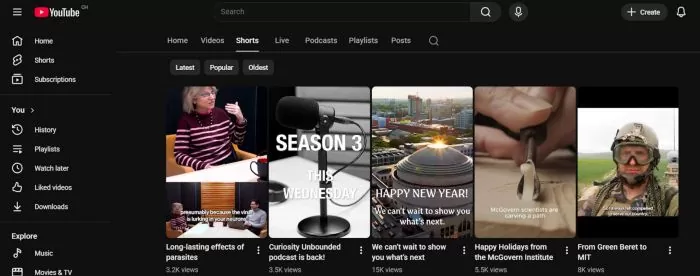
Source: YouTube
The lesson is structural. One idea. One outcome. One next step.
Shorts Production That Is Realistic for Higher Ed Teams
A sustainable workflow typically includes:
- One filming block per month, capturing 20 to 40 short clips
- One standardized editing template for captions, opening text, and end card
- A weekly publishing cadence of two to four Shorts
To maintain quality without overproduction:
- Use on-screen captions by default
- Open with the outcome, not the introduction
- Prioritize student voice, with staff as contextual authority
Shorts succeed when they feel human, immediate, and purposeful.
Part 2: YouTube Search as the Recruitment Middle Funnel
Shorts create familiarity. Search creates action.
When a prospect searches YouTube, they are often further along in the decision process than when they passively scroll through Shorts. Search behaviour typically centres on high-intent queries such as:
- “campus tour [school]”
- “residence tour [school]”
- “Is [program] worth it?”
- “How to apply to [school].”
- “Scholarships [school]”
- “International students [school]”
- “Co-op [school]”
- “Student life [city] university.”
These are not curiosity clicks. They signal evaluation. YouTube search, in this context, functions as a middle-funnel conversion driver.
Why YouTube Search Is More Important in 2026
Recent platform changes have given users greater control over filtering Shorts versus long-form content in search results. That shift directly affects discoverability and influences how institutions should title, label, and package videos.
In practical terms:
- Shorts can dominate quick-answer queries and surface in “how to” or FAQ-style searches
- Long-form videos win depth queries such as tours, admissions walkthroughs, and program explainers
A strong recruitment strategy deliberately produces both formats with different search roles.
The YouTube SEO Checklist for Higher Ed That Actually Matters
Titles: Clarity First
- Mirror the language prospects use
- Avoid internal terminology and acronyms
- Use year signals when relevant, such as “2026 admissions” or “2026 scholarships”
If students search “How to Apply to [School],” your title should match that phrasing directly.
Descriptions: Structure for Search and Action
- First two lines: state who the video is for and what question it answers
- Follow with direct links to relevant pages, including program pages, admissions, and tour booking
- Then include timestamps, related resources, and additional video links
Descriptions are not filler. They are structural metadata and conversion infrastructure.
Chapters and Timestamps
Chapters improve navigation and strengthen topical clarity, especially for longer admissions or financial aid videos. They also reinforce keyword associations within YouTube’s indexing system.
Captions
Accurate captions improve accessibility and retention. They also support comprehension for viewers watching without sound and contribute to search relevance.
Thumbnail and First 10 Seconds
Winning search visibility is only the first step. Click-through rate and early retention determine whether YouTube continues recommending the video. The opening must confirm relevance immediately.
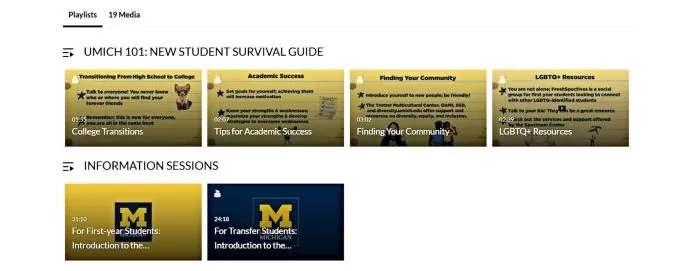
Example: University of Michigan’s Prospective Students portal is not YouTube proper, but it is a highly relevant reference model because it demonstrates what a recruitment-first channel should look like: explicit segmentation, clear titles, and playlist-style browsing. The hub has top-level navigation for “Prospective Students,” “Admitted Students,” and “Video Tours,” mirroring the sequencing logic recommended in the article.
Within “Prospective Students,” the hub includes canonical, search-matching assets like “Campus Tour” and gives duration context (18 minutes) that signals “depth content for evaluators,” which in the YouTube framework corresponds to Search = intent capture.
Source: University of Michigan
The objective is not imitation. It is recognition through tour intent, application intent, and scholarship intent that live on YouTube. Institutions that optimize for search capture prospects at the moment of evaluation.
Part 3: Sequencing, the Strategy Most Schools Are Missing
Sequencing is how you turn YouTube from isolated content into recruitment momentum.
Most institutions produce individual videos. Few design intentional pathways. Without sequencing, every video must perform independently. With sequencing, each video advances the viewer toward a clearer next step.
A basic recruitment sequence looks like this:
- Video A creates curiosity
- Video B answers the next question
- Video C reduces risk
- Video D prompts the action
This mirrors the enrolment journey. Awareness leads to evaluation. Evaluation leads to reassurance. Reassurance leads to action.
You build sequences using:
- Playlists
- End screens and cards
- Pinned comments
- Channel sections
- Retargeting, where paid media is available
- Consistent creative cues such as recurring hosts, naming conventions, and thumbnail systems
The objective is continuity. When a student watches one video, the next logical step should be obvious and frictionless.
The Simplest Organic Sequence to Implement
Sequence: From first view to campus tour booking
- Short: “One thing students wish they knew.”
- Long-form: “Campus tour, what to expect”
- Long-form: “Residence, affordability, student support.”
- Short: “How to book a tour or apply, link in description.”
- Community post or follow-up Short: “FAQ from comments.”
This sequence moves from emotional connection to practical detail to conversion instruction. Each step anticipates the next question rather than waiting for the viewer to search again.
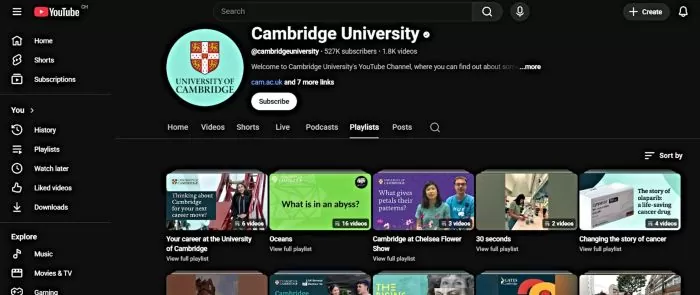
Example: University of Cambridge is a strong exemplar of series-style recruitment packaging that supports all three framework layers. On the channel playlists index, Cambridge pairs short-form-friendly collections (“30 seconds,” “30 seconds of Cambridge Colleges”) with application-oriented sequences (“Get In Cambridge,” “Cambridge Open Days,” “Vlogbridge”). This is exactly what “Shorts + Search + Sequencing” looks like when operationalized as a channel system.
Cambridge also provides visible conversion CTAs inside video descriptions that tie YouTube viewing to an enrolment action. In “Top 10 Cambridge University myths – busted!,” the description includes an explicit next step: “See for yourself, sign up for an Open Day…”—a direct example of moving from consideration content into a real-world conversion event.
For search, the “myths busted,” “top tips,” and “day in the life” patterns map cleanly to common applicant queries (“is Cambridge really like…,” “how to apply to Cambridge,” “Cambridge myths”), increasing the likelihood that Cambridge’s own videos win the search result instead of third-party explainers.
Source: University of Cambridge
Even when content is broad, grouping videos into clear thematic arcs improves session duration and reinforces institutional positioning. Sequencing is not about producing more content. It is about connecting what already exists into a coherent recruitment pathway.
Sequencing with paid media in 2026 (what has changed)
Higher ed paid teams often treat YouTube as a reach buy, then wonder why results look soft.
In 2026, paid sequencing works best when it is designed like a progression, not a single ad.
Key platform shift: Google Ads has been moving advertisers from Video Action Campaigns toward Demand Gen, with defined migration milestones and new controls. This matters for schools using YouTube to drive inquiries and applications through paid video.
A practical paid sequencing model for higher ed
Layer 1: Prospecting
- Use short creative variants (15s, 6s, vertical)
- Optimize for reach and view-based engagement
- Target by intent clusters (fields of study, career interests), plus geo where relevant
Layer 2: Consideration
- Retarget video viewers with longer content
- Serve “program clarity” and “student experience” assets
- Drive to high-intent pages (program pages, tours, webinars)
Layer 3: Conversion assist
- Retarget site visitors and engaged viewers
- Use clear CTAs: book a tour, attend an info session, start an application
- Match landing pages to the promise of the video
If your institution is in Canada and recruiting nationally or internationally, sequencing also helps you segment by region and readiness, without fragmenting your channel into chaos.
What “Shorts + Search + Sequencing” looks like in a real editorial plan
Here is a sample 6-week plan that a small team can execute.
Weeks 1 to 2: Build the discovery base
- 6 Shorts (belonging, affordability, program outcomes)
- 1 search-led long-form video (campus tour, program explainer, admissions walkthrough)
- Create a playlist: “Start Here: [Institution] in 2026.”
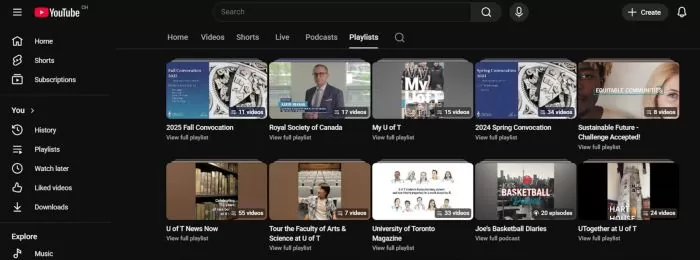
Example: University of Toronto U of T’s playlists index shows segmentation that maps cleanly to recruitment audiences and intents, including “International Students,” “Welcome to the University of Toronto,” and a tour-focused set (“Tour the Faculty of Arts & Science at U of T”). This is the structural prerequisite for sequencing: viewers can enter at a high-level “welcome” playlist and then self-route into specific need states (tour, international).
U of T also maintains Shorts as a format layer (Shorts tab is explicitly present), supporting the “Shorts = reach” side of the framework. Cadence is not explicitly quantified in the excerpt, but the Shorts index includes recent campus-life items like “#MyUofT: Clubs Fair 2025,” indicating recurring short-form presence.
Source: University of Toronto
Weeks 3 to 4: Add the next-question layer
- 6 Shorts (FAQs from comments, myth-busting, student tips)
- 1 long-form: “How to apply, key dates, what matters.”
- 1 long-form: “Scholarships, affordability, support.”
Weeks 5 to 6: Drive action without feeling pushy
- 6 Shorts (deadline prompts, “how to book a tour”, “who to contact”)
- 1 long-form: “Student panel: what I chose and why.”
- Retargeting flight (if paid is available): viewers of 50%+ of long-form
Measurement: what to report (and what not to over-index on)
If YouTube Shorts’ definitions and search filtering are shifting, your reporting needs to be stable enough to remain credible across changes.
For recruitment teams, focus on:
YouTube-native engagement quality
- Returning viewers growth
- Watch time and average view duration (especially on search-led long-form)
- Audience retention curves (where do they drop, where do they rewatch)
Traffic and conversion assist
- Clicks to site (from descriptions, end screens)
- Branded search lift (in Google Search Console)
- Tour bookings, info session registrations, inquiry form completions
Sequence health
- Playlist starts and completions
- End screen click-through rate
- Viewer paths (what they watched next)
Avoid overreacting to:
- Raw view counts alone (especially on Shorts, where counting approaches have changed)
- One-off viral spikes that do not lead to deeper viewing
Common Mistakes HEM Sees with YouTube in Higher Education
Many institutions post polished highlight reels that have no search utility. The video may look strong, but without query-based titles, structured descriptions, chapters, or a clear CTA, it does not capture intent or drive action.
Shorts are often treated as random content rather than strategic entry points. Effective Shorts should ladder into a longer answer, playlist, or defined next step. Without that bridge, attention dissipates.
Another common issue is the absence of a series architecture. If prospects cannot easily binge related content, they leave the channel and continue research elsewhere.
Overproduction is also a frequent trap. Cinematic quality does not compensate for inconsistency. In recruitment, regular publishing and clarity build more trust than occasional flagship videos.
Finally, one-size-fits-all messaging weakens impact. International students, domestic commuters, graduate applicants, and career switchers each evaluate different risks and priorities. Sequencing and content design should reflect those distinctions.
The Operational Checklist So Teams Can Execute
Channel foundations
- Clear channel trailer for prospective students
- Channel sections: Tours, Programs, Student Life, How to Apply, International
- 3 to 5 pinned playlists
Content system
- 4 Shorts categories you can repeat every month
- 2 search-led long-form videos per month (minimum)
- 1 student-led recurring series (simple format)
Conversion pathways
- Description templates with consistent CTAs
- End screens: next video + “Apply / Book a tour”
- Pinned comment linking to the next step
Paid (optional)
- Viewers retargeting pools
- Sequence creative mapped to funnel stages
- Landing pages matched to video promises
Where HEM Fits
YouTube marketing is not separate from your enrolment marketing system. It should connect to your inbound strategy, your content planning, and your conversion pathways across the site.
If you want HEM support with:
- YouTube strategy and sequencing architecture
- Search-led video content planning for recruitment
- Paid YouTube and Demand Gen sequencing tied to enrolment actions
- Measurement frameworks that leadership can trust
You can start here:
Refine your school’s YouTube student recruitment strategy?
Contact HEM for more information.
FAQs
How to create a YouTube channel for college recruiting?
Start with structure, not volume. Define your recruitment goals first. Build channel sections around Tours, Programs, Student Life, and How to Apply. Create 3–5 core playlists that reflect enrolment journeys. Publish Shorts for reach and search-optimized long-form for intent. Use consistent CTAs, end screens, and descriptions that link directly to admissions pages.
What kind of marketing works best with students on college campuses?
Authentic, peer-led, and mobile-first content performs best. Students respond to relatable voices, clear outcomes, and practical information. Video, short-form content, and search-driven resources outperform static promotional messaging. Campaigns that combine social proof, transparency about cost and outcomes, and clear next steps tend to drive stronger engagement and action.
How big is the student recruitment market?
The global student recruitment market spans billions annually, including digital advertising, agency partnerships, CRM systems, and marketing services. With international mobility rebounding and domestic competition intensifying, institutions are increasing investment in digital channels such as search, social, and video to secure qualified applicants in an increasingly competitive environment.