
This post is one of many, related to my participation in Harold Jarche’s Personal Knowledge Mastery workshop.
I’ve been thinking a lot about the elements that prevent us from most deeply practicing Personal Knowledge Mastery (PKM) in our lives. A big piece involves fear, the worries that we couldn’t possibly know enough, or being talented enough, to contribute anything to the discourse. I’m at the POD Conference this week in San Diego and have been thinking about my own, long-term desire to get better at sketchnotes, while realizing that the only way you do something like that is to start out not-so-good, and establish a regular practice that could contribute to you getting better.
People often use the metaphor of a gap existing between where we are and where we want to be… We forget the value we might possess along the way. Daniel Sax starts out his video called THE GAP by Ira Glass with text that appears on the screen, in the form of a dedication of sorts. The words initially say:
For everyone in doubt
After a few seconds, an additional line of text appears:
Especially for myself
How many of us can relate to those feelings of doubt?
How often do we ponder what they prevent us from achieving?
After that compelling two-line introduction, Sax shows what I think is a printing press in action, though I’m not entirely sure what I’m looking at, during the first part of the video. Ironically, I wrote in my last post about how Bryan Alexander embodied PKM at a dinner, recently, but I didn’t write much about the other people who were there. However, I realize now that one of the people is working on her doctoral research and it is on Black women who were printmakers in the 1930s, I believe it was. My mind flashed, as I revisited watching Sax’s video, thinking that this doctoral researcher would surely know if what I think I’m seeing here is actually that.
Before now, I hadn’t really paid much attention to Sax’s video description on Vimeo. However, my curiosity was rewarded, by getting to discover that Sax made this video, because he was inspired by another one and wanted to experiment with his own creation. He writes:
I made it for myself and for anybody who is in doubt about his/her creative career. I also think that Ira Glass’ message isn’t only limited to the creative industry. It can be applied to everyone who starts out in a new environment and is willing to improve.
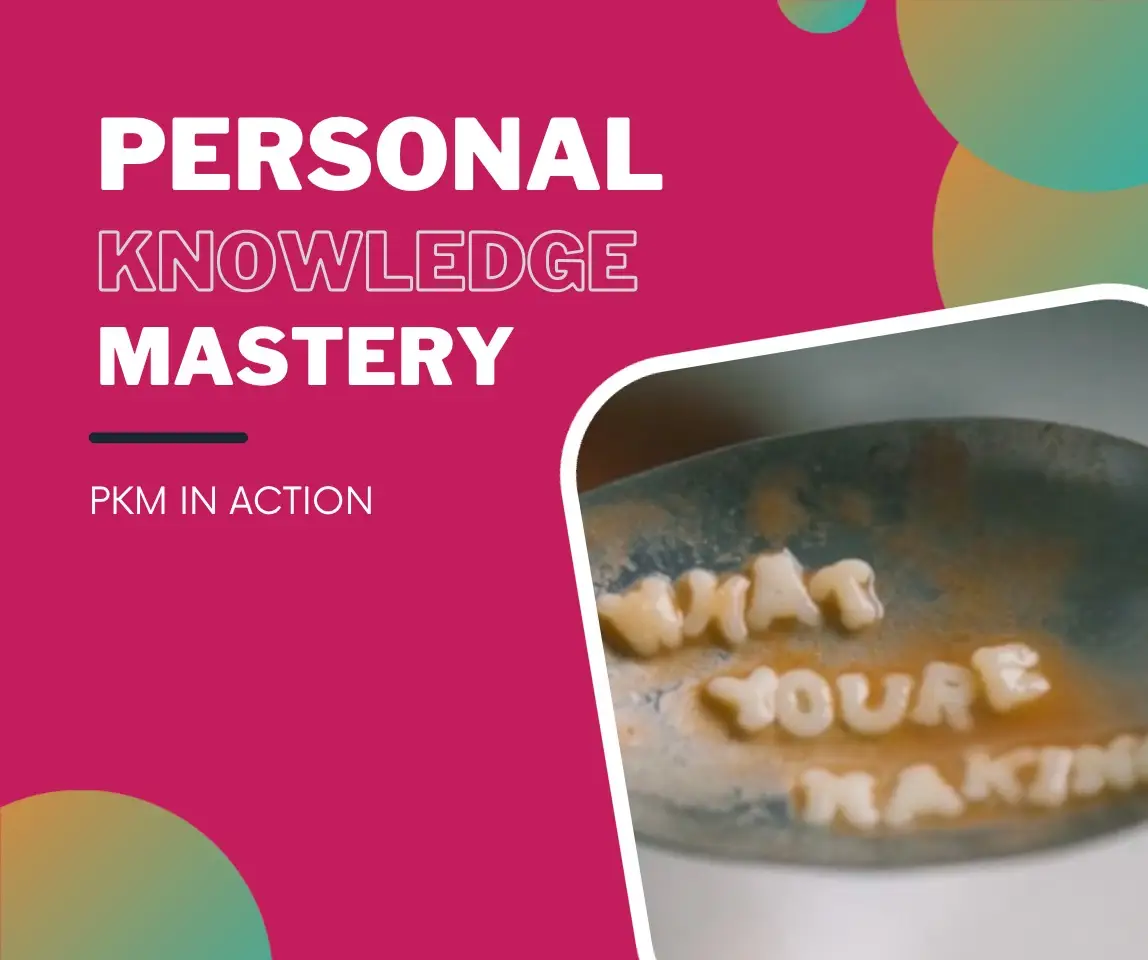
I encourage you to stop and watch Sax’s video: THE GAP by Ira Glass and reflect on the different ways he conveys his messages and ideas, throughout. I wonder how long it took him to do the spoon full of noodle letters, spelling out his thoughts for that 2-3 second part.
Back to Sax’s video description, he ends with a series of expressions of gratitude, to all of those who got him to the point of creating his piece. He thanks David Shiyang Liu, who has a graphical, text-based depiction of Ira’s words about storytelling (which really could be about any new pursuit). Sax continues to thank the people who made his video possible (I suggest going to the video description and witness a wonderful example of giving credit where credit is due).
As Jarche begins to wind down the PKMastery Workshop and invites us to start our PKM practice (if we haven’t, already), he quotes Tim Kastelle:
The biggest gap is between those doing nothing and those doing something.
Jarche uses his book reviews and Friday’s Finds as examples of his PKM practice lived out. He’s been at that for such a long time now, I look forward to each post, as they get released and show up in my RSS feeds. Despite having learned so much over the 10+ years I’ve been following his work, taking this PKM workshop has accelerated my learning exponentially. There’s nothing like doing all the sensemaking and sharing that I set myself up to do when I committed to blogging publicly throughout the six weeks of the workshop.
My PKM
While I’ve got a ways to go and it is still quite early in my practice, I’m enjoying revisiting books from authors I have interviewed for Teaching in Higher Ed via a new video series I’m calling Between the Lines. This series is helping me experiment more with video as a medium, as well as supporting my ongoing learning about teaching and learning. I also have a playlist of me practicing Mike Caulfield’s SIFT framework for fact checking. I’m realizing I probably need to do some more thinking about the playlists as categories of different types of videos, but I also have this playlist of technology for teaching and learning.
Of course producing and hosting the Teaching in Higher Ed podcast is a huge part of PKM for me. Here are some unpolished thoughts about how seek-sense-share shows up through this 11-year adventure.
Seek
I get new guest ideas from past podcast guests, conferences I attend, books I read, PR people I now know from book publishers, and from things that show up on my RSS feeds. The point I’m at in my seeking process is actually more so that I need to find ways to filter out the vast number of ideas for possible interviews that come my way and be more disciplined and discerning about saying no (either to myself, or to others).
Sense
In preparing for interviews, I do a ton of sensemaking, thinking through the themes that are narrow enough to not be all over the place, but also not overly prescriptive, lest I miss what is emerging in the moment. I read digitally and typically highlight way too much of the book. Sometimes I mindmap my ideas, or just type up themes and reorder ideas. Creating the show notes for each episode also helps me extend the learning opportunities from each conversation.
Share
The podcast gets shared on all the major podcast directories and services. YouTube recently revised their policies to now allow for RSS feeds from audio-only shows to come through on their site (Teaching in Higher Ed podcast on YouTube). Spotify represents a growing Teaching in Higher Ed audience and has some nice features for more engagement than on other platforms, such as being able to ask listeners a question about what they took away from listening.
Hope
My hope is that I’ll forever continue to live in the gap and experience the positive benefits of being willing to be fueled by the vulnerability required to learn out loud.