
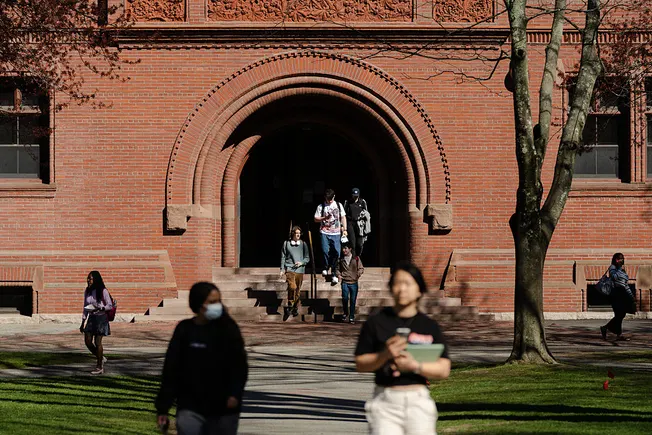
The September ruling in Harvard University’s favor restoring roughly $2.2 billion in federal funding struck a short-term blow against the Trump administration’s use of civil rights investigations against universities.
The administration pulled the funding in April after Harvard rejected a series of sweeping demands, claiming it was suspending the funds because the university hadn’t adequately protected students from antisemitism.
In June, the U.S. Department of Health and Human Services’ civil rights office formally accused the university of violating Title VI, which bars discrimination on the basis of race, color or national origin in programs or activities receiving federal funding.
Yet in her 84-page order, U.S. District Judge Allison Burroughs found that none of the federal government’s grant termination letters specified how Harvard failed to respond to any acts of antisemitism in violation of Title VI.
“A review of the administrative record makes it difficult to conclude anything other than that Defendants used antisemitism as a smokescreen for a targeted, ideologically-motivated assault on this country’s premier universities,” Burroughs wrote. “Further, their actions have jeopardized decades of research.”
Harvard isn’t the only university facing Title VI accusations. The Trump administration is seeking $1.2 billion from the University of California, Los Angeles — plus an overhaul of its campus practices — after the U.S. Department of Justice accused the institution of violating Title VI. In both UCLA and Harvard’s cases, the Trump administration cited pro-Palestinian campus demonstrations and claims of antisemitism in its notices of violations.
The Justice Department didn’t make an official available for an interview.
These types of developments have set off a high stakes debate among legal experts about whether the Trump administration is weaponizing Title VI.
They trouble Jodie Ferise, a partner in the higher education practice at the Indiana law firm of Church Church Hittle and Antrim, who previously served as vice president and general counsel for the Independent Colleges of Indiana.
“Discrimination was always a disqualifier for federal funds, but when it’s just a pretext to bend higher education to the federal government’s will, that’s a problem,” Ferise said. “To sweep every single grant off the table seems more like extortion. Nothing about it is designed to make higher education better.”
In the Harvard ruling, Burroughs wrote that the administration failed to take the proper steps before pulling federal funding.
Title VI requires the federal government to notify an institution of its alleged violation and determine that it can’t come into compliance voluntarily before ending financial assistance to the university, the judge explained. Even then, the agency may terminate the funding only after the university has been given the opportunity for a hearing.
Burroughs concluded, “It is undisputed that Defendants did not comply with these requirements before issuing the Freeze Orders or Termination Letters.”
However, experts who spoke with Higher Ed Dive agree that Burroughs’ ruling is far from the last word on the issue. That case could eventually be headed to the U.S. Supreme Court, as the Trump administration vowed to appeal, though a settlement is not impossible.
Is the Trump administration using Title VI legitimately?
The Trump administration has warned dozens of colleges of potential Title VI violations. In March, the U.S. Department of Education’s Office for Civil Rights sent letters to 60 institutions of higher education warning them of potential enforcement actions if they failed to comply with Title VI to protect Jewish students.
“What’s been happening is not so much expanding Title VI as implementing it properly so there’s no double standard. For many years, Jewish students’ rights were not being protected,” said Kenneth Marcus, the founder and CEO of the Louis D. Brandeis Center for Human Rights Under Law, a research and legal advocacy group aiming to combat antisemitism.
As an official in the George W. Bush administration and the first Trump administration, Marcus also strongly advocated for the use of Title VI to protect students who were harassed because of their ancestry, such as ethnic and religious characteristics.
“When Congress passed the Civil Rights Act of 1964, Title VI was an ingenious mechanism to ensure federal funds are not misused,” said Marcus in noting this was crucial to ensure institutions racially desegregated.
He added that Title VI can have a broad impact because it ensures students don’t face a hostile environment and have equal access to learning opportunities at their institutions.
But Harvard law professor Benjamin Eidelson takes a decidedly different view about the Trump administration’s use of Title VI. Eidelson, who co-authored a June Harvard Law Review article about Title VI and antisemitism, said in an email to Higher Ed Dive that “the recent enforcement actions and lawsuits have gone far, far beyond anything Title VI was meant to do.”
He added that Title VI was never meant to require imposing content-based speech restrictions in the name of curing a hostile environment.
“Nobody has a right under Title VI to have a campus free of protests that offend their moral or political convictions,” Eidelson said. “It’s so clear that fighting antisemitism is just the administration’s pretext for imposing ideological reform and demanding submission across the board. And Judge Burroughs rightly held that the First Amendment doesn’t allow that.”
Marcus, however, takes issue with the judge’s view that the Trump administration’s position is a smokescreen. Speaking of his conversations with administration officials, Marcus said, “There is no question in my mind that they’re furious with what’s happened to too many Jewish students and faculty members.”
The Brandeis Center was not a party to the case before Burroughs, but it had settled a separate Title VI federal lawsuit against Harvard earlier this year on behalf of several students.
Under the settlement, Harvard agreed to incorporate the International Holocaust Remembrance Alliance’s definition of antisemitism to assess complaints of harassment. While some have praised the adoption of the IHRA’s definition — which lists different examples of potential antisemitism — critics argue it can be used to target protected forms of speech and criticism against Israel.
But Gerard Filitti, senior counsel at The Lawfare Project, a nonprofit organization that has filed Title VI antisemitism lawsuits against colleges such as Columbia University, Carnegie Mellon University and The Cooper Union, said the cases he has seen involve legitimate antisemitic incidents and that there has been a double standard.
He said, for instance, that it would be unthinkable to have lecturers speak about white power on college campuses, but suggested the equivalent is happening with hate speech against Jews. “The 64,000-foot view is it’s always good when the government is doing what it can to combat antisemitism.”
Columbia’s $221 million settlement with the federal government this summer, after the administration formally accused it of violating Title VI, will deter future bad conduct, according to Filitti. But he added that the deal could have included more policies to address the root cause of antisemitism.
‘No one wants to send out invitations to their own funeral’
In Harvard’s case, the university established two task forces in January 2024 — one to combat antisemitism and anti-Israeli bias and another to fight anti-Muslim and anti-Arab bias. The university also began making policy changes aimed at ensuring that its campus is safe and welcoming for those students. Other universities have similarly set up task forces to combat antisemitism and taken actions such as hiring Title VI coordinators in recent months.
But the Trump administration is citing the findings of these task force reports when accusing universities of violating Title VI. And that doesn’t sit well with attorney Ferise, who suggested this tactic is already leading to a chilling effect among university administrators.
“If we are only inviting candid disclosure of their weak spots so as to prove our preexisting notion that they were evil actors with discriminatory intentions, that’s a real disincentive to lay bare any unpleasant truth,” she said. “No one wants to send out invitations to their own funeral.”
“Discrimination was always a disqualifier for federal funds, but when it’s just a pretext to bend higher education to the federal government’s will, that’s a problem.”
Jodie Ferise
Partner, Church Church Hittle and Antrim
The Brandeis Center’s Marcus acknowledged that university administrators at many institutions have taken actions to deter antisemitism, but said few have done enough. And, he added, “Sophisticated people in universities have known for some time that these task force reports can be used as evidence.”
Along similar lines, Filitti said the task force report contents are “precisely what plaintiffs are seeking in discovery anyway, so it saves six months of time and expense” to seek the findings out earlier.
But Harvard’s Eidelson noted in an email to Higher Ed Dive that these reports, including Harvard’s, often focus on how the university can better promote a sense of belonging for students who might feel marginalized.
“That is a fundamentally different question than the one that matters under Title VI, namely how the university has responded if and when students experience harassment that is ‘so severe, pervasive, and objectively offensive’ that it effectively bars the victim’s access to an educational opportunity or benefit,” Eidelson said, citing a 1999 Supreme Court ruling in Davis v. Monroe County Board of Education.
While these task force reports could theoretically be used to surface information relevant to a federal investigation, they “pose special risks of misuse, especially in the hands of unserious investigators,” Eidelson said. That’s because these task force reports are usually seeking to answer different questions than what matters under the law, he added.
What’s next?
The potential loss of federal funding is a real pressure point, lawyers on all sides point out.
“The power of the purse has always been an important tool in the government’s arsenal,” the Lawfare Project’s Filitti said. “The flip side is it’s meant to address discrimination and not be used for political purposes.”
But Ferise lamented that that ’s exactly what’s happening.
At Harvard, she pointed to the Trump administration sending “overbroad” demand letters seeking information about international students, including whether they have conduct violations or if they have obstructed “the school’s learning environment.”
“That’s not calculated to reveal who engaged in a bias incident,” Ferise said.
“What’s been happening is not so much expanding Title VI as implementing it properly so there’s no double standard.”

Kenneth Marcus
Founder and CEO, Louis D. Brandeis Center for Human Rights Under Law
Ferise added that it’s not just elite institutions that should fear these government investigations and enforcement actions.
“Every college and university should be concerned, but smaller schools don’t have the bandwidth” to fight these investigations in court, she said.
And that has led her to change the advice she now gives to her higher education clients.
“We represent several small, private institutions with large endowments for their size and a great deal of intentionality about inclusion. Not in a million years could any of them afford to litigate as Harvard has,” Ferise said.
“You never want to say ‘Lay low,’ but that is my advice now because you don’t want to end up on the administration’s radar. No one wants to be the first non-elite school that goes out of business.”