
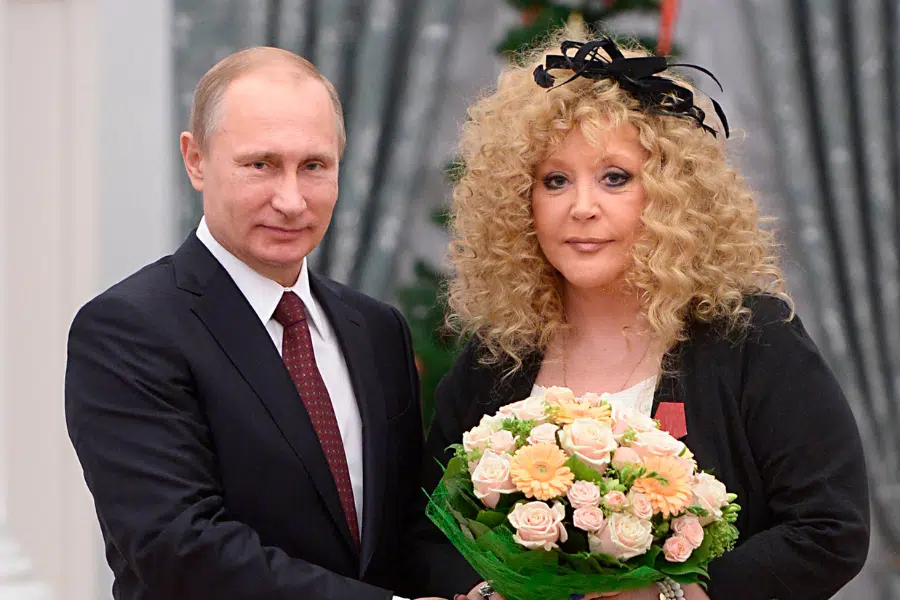
The reaction to Alla’s interview contrasted with the pro-Ukraine demonstrations that met Russian soprano Anna Netrebko when she appeared on the opening night of Puccini’s “Tosca” at the Royal Opera House in London earlier this month.
In contrast, the appearance of Netrebko, who has said in an understated way that she is against the war, sparked a debate in the British press about whether politics and art should be mixed.
But Alla was clear. She said she felt she had to tell the truth for the sake of her children.
Repercussions of speaking out
Her interview, lasting more than three-and-a-half hours, ranged over many topics, from her musical memories to her five husbands. But it was when she grasped the nettle of politics — and how politics affected her family — that it became gripping.
Alla is married to the Russian-Israeli stand-up comedian Maxim Galkin, who at 49 is 27 years her junior (their 12-year-old twins Liza and Harry were born via a surrogate mother).
Straight-talking and irreverent, Galkin shared a stage with Ukraine’s comedian-turned-president Volodymyr Zelensky for Russia’s iconic New Year’s Eve show in 2013. He opposed the war with Ukraine, when it broke out in 2022.
After Galkin spoke out, Alla said she was summoned to the Kremlin for a “talk” with Sergei Kiriyenko, the first deputy chief of staff of the presidential administration. The conversation seemed to be friendly enough. But a few days later, Galkin was declared a “foreign agent”.
Alla said that when their children went to school after that, they were mocked as the children of spies and told that their father was a foreign agent and their parents were enemies. The family packed up and left — first to Israel and then to Cyprus. They spend their summer holidays in Latvia.
“They call me a traitor,” Alla said in the interview. “And what exactly did I betray? I have said that I could leave my homeland, which I love very much, only in one case — if my homeland betrayed me. And it has betrayed me.”
Strong words from a woman who has been a celebrity in Russia for decades.
A performer for the people
Classically trained to conduct choirs, Alla shot to stardom in 1975 when she won the grand prix at the Golden Orpheus international song contest in Bulgaria with the song “Arlekino” (Harlequin).
Banned by the Communist Party from collaborating with ABBA, she became huge in her own right — as big as Tina Turner, say, in the United States — and always sang for the people. In 1986, for example, she appeared in a special concert for the firemen who risked their lives in the aftermath of a devastating explosion at the Chernobyl nuclear plant in northern Ukraine, when it was part of the Soviet Union.
Because Alla never projected herself as a diva but rather as “the woman who sings”, she won the hearts of millions and was loved by everyone, from housewives to mafia bosses. In the 1990s, there was even a petition calling for her to stand as Russian president, which she modestly laughed off.
Russian journalist and writer Mikhail Zygar, who now lives in Berlin, wrote that Alla’s statements against Putin are important because she had never been a political activist.
“Millions of Russians always considered her ‘one of their own’ — because through her songs she expressed the pain and suffering of ordinary Russians,” he said. “The fact that she has stopped keeping silent and spoken out openly against the war is a very important signal. She has always been the voice of millions of mute, wordless, unhappy Russians. Now they will think the way she put it — that’s how her interview is being described on social media.”
Perhaps the biggest indication of the strength of the interview was the speed and viciousness with which the Russian authorities reacted.
Foreign Ministry spokeswoman Maria Zakharova called it a “bazaar of hypocrisy” while parliamentary deputy Vitaly Milonov said: “I believe that in her interview, Pugacheva said enough not only to warrant the status of ‘foreign agent’ but also to fall under several criminal articles, including the justification of terrorism.” The pro-Kremlin ruler of Chechnya, Ramzan Kadyrov, went so far as to call Alla an “enemy of the people”.
Questions to consider:
1. In what ways could it be “patriotic” to criticise your own country?
2. Should art and politics be mixed?
3. Can you think of other artists or musicians who have risked their popularity by standing out against their government’s policies?