
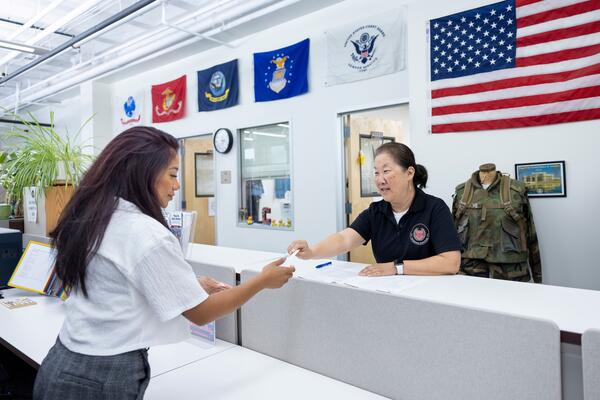
An estimated 820,000 students in higher education are military-affiliated, including current and former active-duty service members and their families. These students are more likely to be first-generation or parenting students and often hold competing priorities while pursuing a degree, which can put them at risk of stopping out.
A Nov. 4 webinar by the American Council on Education solicited insights from former and current service members on their experiences navigating higher education and how campuses can improve supports.
“Veterans are not a monolith; they don’t want pity or lower bars,” said Roman Ortega, chief executive officer and founder of Global Integrity Consulting and a member of the Army Reserve. “They want colleges to treat them like they’re mission-driven adults and to remove the friction that keeps them from showing what they already know how to do.”
Veterans shared four key themes that could enhance military-affiliated students’ college experience.
- College Navigation
About two-thirds of student veterans are first-generation college students, according to data from Student Veterans of America. First-generation students, in general, often lack cultural capital and insight into the bureaucracy of higher education; for former service members, college can be even more mystifying. Effective advising can make a difference, veterans said during the webinar.
“I was enrolled at Northern Illinois University. I didn’t know what to do or where to go,” Ortega said. “I saw a sign for Army ROTC; I walked right into the office and I said, ‘Hey, I really don’t know what I’m doing here, I don’t know where any of my classes are, I don’t know how to be advised on any of this. They said, ‘Hey, we’ll help you out.’”
Bringing in other military-affiliated students can be one way to boost engagement; several veterans mentioned they enrolled in higher education because of positive peer pressure from other service members.
“I didn’t even know what questions to ask. I just knew my peers were going and I wanted to be a part of that,” said Lola Howard, an Air Force veteran and doctoral student at Columbia Southern University.
Not every branch of the military looks at continuing education in the same way, which can have an impact on participation, veterans noted. “The Air Force, the Navy very much culturally encourage continued education in the service,” noted Lukas Simianer, an Army veteran and chief executive officer and founder of VetClaims.ai. “If you would have told the commander of Fort Bragg that you were going to go to college, they would have laughed.”
The University of Texas, San Antonio, has a dedicated first-year seminar for student veterans, which helps them establish a sense of belonging early in their college career and provides them with personalized assistance in obtaining credit for military service.
- Credit for Prior Learning
Military-affiliated students often enroll in higher education with a wealth of experiences that can translate directly into course learning outcomes. ACE and other organizations have worked to streamline credit for prior learning offerings through the joint service transcript, which can help make college more accessible and affordable for veterans.
“It was very clear what the equivalent courses were that were off of my degree plan,” said Jonny Coreson, a Navy veteran and director of workforce strategy at the Learning Economy Foundation. “It was an opportunity to see that I had few courses [left] to attain an associate’s degree, but I literally had to see it.”
However, not every student veteran is eligible for or benefits from CPL in the same way, Simianer said.
“Be prepared that some of your veterans who have arguably had some of the hardest deployments, hardest service life, most wear and tear on their bodies, they may have the most courses to fulfill,” Simianer said. “Being really good at handling a machine gun does not really translate [to degree programs].”
- Flexibility
Active-duty service members can experience frequent change as part of their service, including deployment or relocation. Student veterans are also often more likely to be parenting students or working, and these competing priorities can make pursuing a degree more challenging.
Creating a safe space for students to share their obstacles to success can mitigate disruptions to learning.
“As a student, it was important for me to communicate up front what was going on with my life, with my counselor, with my faculty, staff,” Howard said. “There were times that my house is being packed up and I’m trying to finish an eight-page paper and I just had to let my professor know, ‘I’m going from this time zone to that time zone—I’m just asking for a little flexibility.’”
- Resource Hubs
Some colleges have created dedicated spaces on campus to centralize resources and connect military students with one another. Simianer, an older student who had won a Purple Heart and was diagnosed with post-traumatic stress disorder, remembers looking at his peers and feeling like he couldn’t relate to traditional students. But getting connected to his college’s student veteran hub changed that.
“Having a place where I could be, where the humor we had would fly or the conversations you needed to have could happen, is the most powerful thing that I am grateful for,” Simianer said. “I would not have continued an education, probably, if I would not have had that at the beginning.”
Javier Marin, a Marine Corps veteran and consultant at Vantage Point Consulting, said his college’s student veteran hub was particularly impactful because it connected him to staff.
“I found that the hardest part wasn’t the academics; it was having a good support system,” Marin said. “You’re working, you’re going to school, you’re being a parent, you have a mortgage—everything that goes along with transitioning and navigating that space without your old support system, which was the military.”
How does your campus seek to improve the college experience for military affiliated students? Tell us more.