
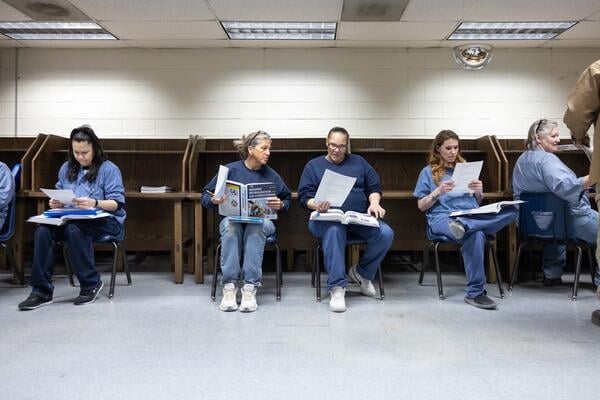
In 2023, Congress reinstated use of Pell Grants for students in prison, expanding their access to higher education.
One of the stipulations was that colleges would provide them with the same access to resources that on-campus students have, including academic supports, career advising, tutoring, mental health resources and study halls. However, a recently published report from the University of Puget Sound finds that this provision has been difficult to fulfill, in part because of prison systems, but also because of the overly bureaucratic processes at higher ed institutions themselves.
The report identifies existing barriers, as well as opportunities to better serve incarcerated students.
What’s the need: Higher education programs in prisons can help incarcerated individuals improve their educational attainment and career opportunities upon release, as well as increase socioeconomic mobility for affected individuals and their families.
Providing education to incarcerated individuals, however, can be a challenge due to their lack of access to technology and learning materials, restrictions on when they can participate and policies like lockdowns that impede learning opportunities.
“Prison rules and staff often limit the ability to study, work together, possess books and supplies in cells, and meet outside the classroom,” according to the report. Students can also lack access to faculty outside of the classroom.
Students often are unaware of or unable to access traditional campus resources such as research databases, learning management systems, disability and mental health resources, and tutoring.
The findings: Puget Sound’s report includes survey data from alumni of higher education in prison (HEP) programs and faculty. Researchers also relied on in-depth interviews with 25 stakeholders involved in such programs, as well as any affiliated teaching and learning center staff members. Interviews were conducted between August and November 2024.
In conversations with faculty, researchers learned that silos often exist between teaching and learning centers and HEP programs, which can leave professors without sufficient resources or supports to be effective instructors. Even at the national level, pedagogical or student success–oriented conversations often don’t take into account incarcerated students.
For instructors, working with incarcerated students can be demanding because it’s not part of their regular teaching load, they have long commutes or they have to adapt their materials and syllabi to a low- or no-tech teaching environment, according to the report. Some professors reported feeling isolated from peers or unable to share or receive feedback about their teaching.
Keep Reading
The University of Puget Sound compiled resources from higher education in prison programs to improve teaching and learning, including trainings, sample faculty and student handbooks, models for mental health support, and more.
What can help: The researchers identified a variety of innovative programs to enhance incarcerated students’ learning and educational outcomes.
Some HEP programs, including those at Rutgers University and Scripps College, established peer tutoring opportunities among incarcerated students, in which graduates provide feedback on writing, research, time management and study skills.
“The implementation of peer-to-peer tutoring does not just help the students receiving support. It builds professional development skills, volunteer or employment histories, and confidence for the tutors themselves as they continue their learning journeys,” the report says.
The University of Utah Prison Education Program pays incarcerated students about $600 per month to provide peer support in a one-stop location. Student employees offer homework assistance, help organize events and educate their peers on health and wellness topics.
The report also advocates for developing college prep and student success courses for incoming incarcerated students to help them get familiar with resources and technology that they may not know about. Tufts University Prison Initiative of Tisch College offers a two-semester foundation of academic success course, for example.
Incarcerated students may also have mental health needs or disabilities that require extra intervention from the institution. Loyola University in Chicago’s HEP program employs a social worker who meets with students individually to understand their needs and connect them with support.
Administrators can also institutionalize support for instructors of these programs by counting teaching in prison settings as a part of a regular course load or providing training for such programs during new faculty orientations. Learning communities, course development stipends and certifications can also incentivize effective teaching practices among instructors who teach in prisons.
Connecting campus staff, particularly those in teaching and learning centers, with HEP faculty and students can also break down silos between campus and incarcerated students and ensure learners are being best served, according to the report.
In the future, researchers hope to establish a national learning community for pedagogy in prison and a convening of stakeholders in this space to share resources.