
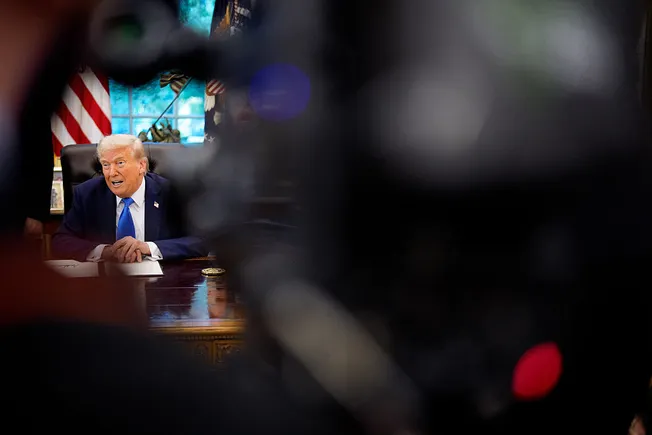
President Donald Trump caught the higher education world by surprise on Sept. 19, when he signed a proclamation announcing a new $100,000 fee for H-1B visas. Before the new policy, employers paid between $2,000 and $5,000 for new H-1B petitions, according to the American Immigration Council.
Colleges, especially large research universities, rely on H-1B visas to recruit foreign faculty, scholars and researchers. Stanford University, the University of Michigan and Columbia University all employed over 200 workers through H-1B visas in fiscal 2025.
The new fee could impede colleges’ ability to recruit those workers — potentially curtailing research, slowing scientific innovation and even leading to reduced course offerings for students, according to higher education experts.
“There’s no doubt that it will deter global talent that is not in the U.S.,” Miriam Feldblum, president and CEO of the Presidents’ Alliance on Higher Education and Immigration. “We lose the benefit of their skills, expertise and talent. It is not only a loss for them, it is just clearly a loss for campuses and other employers.”
Higher education and legal experts are still trying to understand some elements of the new policy, such as if colleges and other employers can secure exemptions to the $100,000 fee for workers they’d like to sponsor. However, they shared insights about who the policy impacts, what could change in the future and how colleges can navigate this moment.
Which workers are impacted by the $100,000 fee?
When the Trump administration first rolled out the policy, confusion abounded about which types of workers would trigger the fee. That’s in part because U.S. Commerce Secretary Howard Lutnick initially said the fee would be paid annually, according to Reuters.
But a day after the policy’s rollout, White House Press Secretary Karoline Leavitt walked back Lutnick’s remarks and said on social media that it would be a one-time free for new petitions only. Since then, the Trump administration has provided guidance further narrowing the policy’s impact.
U.S. Citizenship and Immigration and Services said in October that the fee would not apply to someone already in the U.S. that is requesting a change of status. According to Joshua Wildes, associate attorney at immigration law firm Wildes & Weinberg, that means that students on F-1 and J-1 visas may not be subject to the fee if they are in the U.S. and are seeking to switch to H-1B status.
However, they would have to stay within the U.S. until they secure H-1B status to avoid incurring the fee.
“They’re going to have to decide whether or not they are willing to stay put in the U.S.,” Wildes said. That could include forgoing traveling to see their families or taking vacation outside of the country, Wildes said.
Those who already have H-1B visas, however, can travel outside the U.S. and return without triggering the fee.
Even with the latest guidance, colleges are still reeling from the new policy, as it still applies to new petitions for workers who are outside of the U.S.
No institution wants to pay the fee, “regardless of how small or big you are,” Wildes said. “The smaller ones that don’t have the funds, they simply cannot afford it. The bigger ones that do have the funds, they don’t want to do it because it’s a lot of money.”
The guidance said the U.S. secretary for the Department of Homeland Security could grant exemptions to the fee for certain workers, though it added they will be “extraordinarily rare.”
To qualify, the secretary would have to determine a worker “is in the national interest,” doesn’t pose a security risk to the U.S. and that no American citizen is able to perform the role they would be brought in to fill. The secretary would also have to determine if requiring the new H-1B fee from the sponsoring employer would “significantly undermine” the nation’s interest.
USCIS on Thursday referred Higher Ed Dive to the proclamation and existing guidance when asked for details about which workers would qualify for these exceptions. It added that those requests are handled by DHS and not USCIS.
Will the $100,000 fee stay in place for the higher education sector?
Nearly three dozen higher education organizations, led by the American Council on Education, urged DHS Secretary Kristi Noem in an Oct. 23 letter to carve out a sectorwide exemption to the $100,000 fee for colleges and universities.
In the letter, ACE President Ted Mitchell argued that the H-1B workers do work “crucial to the U.S. economy and national security.” He pointed to their work contributing to research, providing medical care and educating the nation’s students.
“We know that the Trump administration does consider high-skilled immigration to be very important,” said Sarah Spreitzer, ACE’s vice president and chief of staff for government relations. “We are hiring high-skilled faculty, staff and researchers.”
Neither DHS nor the White House answered whether Noem would grant a sectorwide exemption to the fee for colleges and universities.
A White House official contended that foreign workers undercut wages in academia and that the change protects Americans seeking careers in the field.
Even if the sector can’t win a standing exception, the policy could be disrupted by two recent legal challenges.
The first was filed in early October by groups representing the healthcare, K-12, religious and higher education sectors, including the American Association of University Professors. They warned that the new policy could lead to “catastrophic setbacks” to U.S. research and urged a federal judge to declare the $100,000 fee unlawful.
Later that month, the U.S. Chamber of Commerce likewise sued over the policy, arguing it was a “plainful unlawful” expansion of executive authority. The Chamber asked an appeals court to block the fee and vacate any agency actions taken so far to implement it.
What can colleges do now?
Spreitzer noted that the new policy is yet another challenge for colleges attempting to respond to shifting federal policies and predicted the higher education sector’s overall hiring will fall.
“I think that this is just going to be one piece of it,” Spreitzer said.
But higher education and legal experts noted that colleges can take several steps to navigate the new $100,000 fee.
For one, colleges should be proactive if they plan to about seeking exemptions for individuals they want’d like to sponsor for H-1B visas. “Universities need to plan ahead to make those arguments to show that the people that they want to hire are eligible for that exception,” Wildes said.
Legal expertise is required to make those arguments, Wildes added.
“You might only get one bite at the apple,” Wildes said. “Putting together an argument that a foreign worker’s presence in the U.S. is deemed in the national interest is difficult.” Wildes added that colleges need to “give themselves time” to work on those arguments.
Some colleges are also looking at alternatives to the H-1B visa program such as the O visa, which Spreitzer noted is often referred to as the “Einstein visa.”
The O-1A visa is reserved for those with “an extraordinary ability in the sciences, education, business, or athletics,” while the O-1B is reserved for those “with an extraordinary ability in the arts” or achievement in the film industry, according to USCISC. Although the O visa is another pathway to bring a worker to the U.S., it has limitations.
“That’s a visa that’s granted for someone that has unique skills that are recognized on a global stage, and they usually have a very high bar to demonstrate that,” Spreitzer said. “You’re not going to be able to hire an early career faculty or researcher under an O visa.”
Meanwhile, Feldblum recommended that colleges engage with their policymakers both at the local and federal level and educate them about the “adverse impact” the fee has on the sector.
“Because if the goal is to spur American economic growth and to support American workers, this doesn’t do it,” Feldblum said.