
A significant book in political science is Pressman and Wildavsky’s wonderfully titled Implementation: how great expectations in Washington are dashed in Oakland; or, why it’s amazing that federal programs work at all, this being a saga of the economic development administration as told by two sympathetic observers who seek to build morals on a foundation of ruined hopes.
Let’s see how different things were in County Durham.
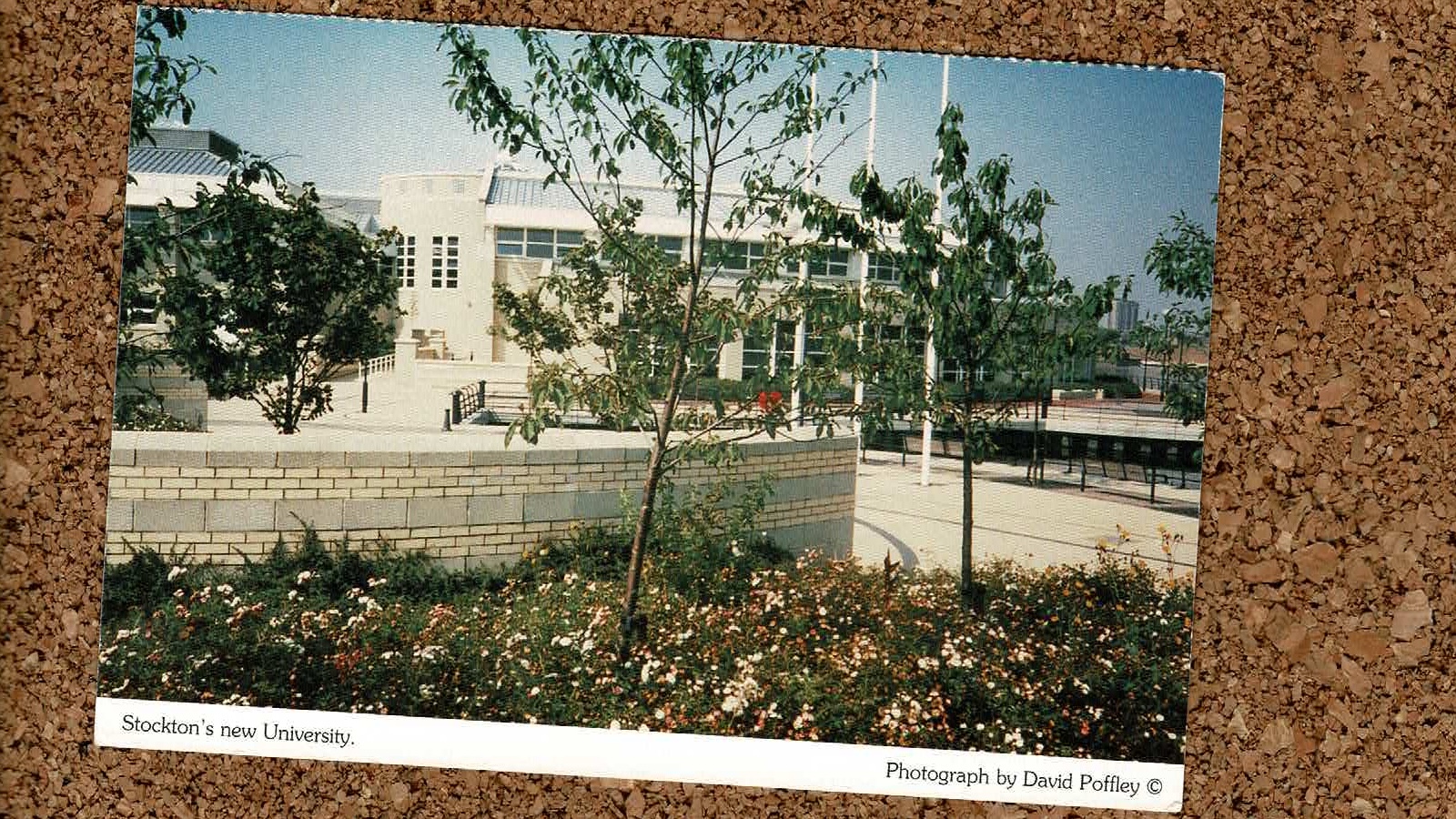
The Middlesbrough Herald and Post, 14 October 1992, could hardly have been more excited. Hailing the opening of the University College Stockton, a joint venture between Durham and Teesside universities, it noted that it was “the most important higher education development in Britain for 25 years” (the transmogrification of polytechnics to universities was clearly just a footnote).
The principal, Professor Bob Parfitt, who had joined from the University of Western Australia, expressed the view that the college would have a bright future in 20 years’ time:
I would hope that we are an international institution which is a clear part of the local community. We will be meeting the needs of the local market in our degrees and short courses, but I also hope we shall play a leading role in the industrial and urban regeneration of the area.
Fast forward to 1995 and the first students were graduating. The Stockton and District Herald and Post on 28 June 1995 reports that Catherine Barker was the first to receive a joint degree from Durham and Teesside, gaining a first in European Studies (French). Environmentalist David Bellamy and local environmental activist Angela Cooper received honorary degrees at the same ceremony.
But it wasn’t to last. John Hayward’s account of the first ten years of the college tells a tale of insufficient capital, changing government policy which slowed expansion of student numbers, and the complexities of operating a college jointly between two universities. It had been only by the skin of its teeth that the new college had got off the ground at all; and in 1994 the two universities agreed that it would continue under the tutelage of just one of them – Durham University.
Over the next few years the university college fought to establish a sustainable basis for operations, trying different subjects and seeking funding from many sources for buildings and equipment. By the late 1990s it was no longer operating in deficit, and in the early 2000s, in order to bring it more into line with norms elsewhere in Durham University, two colleges were created at the Stockton Campus – Stephenson College and John Snow College.
The colleges have since moved, physically, to Durham, and the campus is now known as the Queen’s Campus, Stockton. It hosts the university’s International Study Centre, so in this respect Professor Parfitt’s hope that it would be an international institution has been borne out. But not in a way he would ever have imagined.
John Hayward’s account is worth a read. There’s a story – hidden behind the institutional politics and the minutiae of council and senate meetings – of the practical difficulties in getting something new off the ground. And of the difficulties in multi-institutional working. Which in these days of radical new governance models is a lesson worth remembering.
Here’s a jigsaw of the postcard – it wasn’t posted, but must date from the early 1990s. It was sold in aid of the Butterwick Hospice, and slight perforation marks at the top suggest that it was one of a concertina strip of cards.