
Dropping the appeal ends a yearlong legal battle over the guidance that declared race-based programming illegal.
Celal Gunes/Anadolu/Getty Images
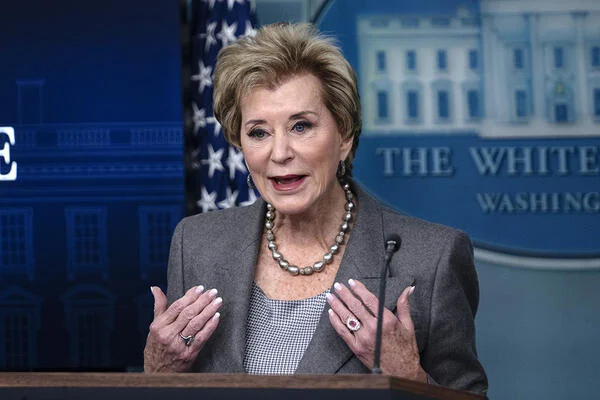
Education Secretary Linda McMahon and her legal team have dropped their appeal of a federal court ruling that blocked the department from requiring colleges to eradicate all race-based curriculum, financial aid and student services or lose federal funding.
The motion to dismiss was jointly approved by both parties in the case Wednesday, ending a nearly yearlong court battle over the department’s Feb. 14 Dear Colleague letter that declared race-based programming and policies illegal. If institutions didn’t comply within two weeks, department officials threatened to open investigations and rescind federal funding.
In response, colleges closed offices related to diversity, equity and inclusion; scrubbed websites; and cut other programming.
First Amendment advocacy groups and the DEI leaders who remain in higher ed declared it a major victory for public education. Democracy Forward, the legal group that represented educators in the case, went as far as to say that it marks the “final defeat” of Trump’s effort to censor lessons and scrub student support programs.
Skye Perryman, president of Democracy Forward, said it should encourage those affected by the Trump administration’s “unlawful crusade against civil rights” to keep fighting back.
“Today’s dismissal confirms what the data shows: government attorneys are having an increasingly difficult time defending the lawlessness of the president and his cabinet,” she said in a news release about the court filing. “When people show up and resist, they win.”
The court filing did not explain why the department chose to abandon the case, and Ellen Keast, a department spokesperson, declined to provide any further comment.
Trump officials had argued that they were merely enforcing existing federal civil rights laws and the 2023 Supreme Court ruling that struck down affirmative action. They claimed race-based programming constitutes discrimination.
But 10 days later, a coalition of education unions, a national association and a public school district challenged the letter in court, arguing it violated administrative procedure law and institutions’ First Amendment rights. Then, in August, federal district Judge Stephanie Gallagher struck down the department’s guidance, arguing it “ran afoul” of procedural requirements and that “the regulation of speech cannot be done casually.”
Colleges and universities aren’t entirely in the clear, though. Just days before the Maryland District Court issued its ruling on the ED letter, the Department of Justice released its own nine-page memo on DEI.
That guidance, which went even further than ED’s guidance, said that basing services on stand-ins for race—like “lived experience,” “cultural competence” and living in a minority-heavy geographic area—could also violate federal civil rights laws. In response, colleges have closed campus centers and publications cater to certain racial or ethnic groups.
Still, many educators see this as a significant step forward.
“When you fight you don’t always win, but you never win without a fight,” said Randi Weingarten, president of the American Federation of Teachers, one of the cases’ plaintiffs, in a news release. “We are proud that this case has once again halted the administration’s pattern of using executive fiat to undermine America’s laws that enshrine justice and opportunity for all.”