Author: admin

  • This is what greater collaboration between further and higher education in England should look like

    This is what greater collaboration between further and higher education in England should look like

    With the UK government’s focus on opportunity as part of its mission-led approach, ensuring equitable access to higher-level skills development and training must be prioritised across all education sectors.

    To address skills shortages and support social mobility, high-quality, place-based solutions must be embedded within a cohesive tertiary landscape. College-based higher education plays a pivotal role in this system, not as a second-tier option, but as an essential component of the HE ecosystem.

    For the many people who cannot (or choose not) to leave their local area due to financial constraints, work or family commitments, higher education must remain a viable and accessible option. This means providing alternative, innovative pathways that allow individuals to develop higher level skills within their communities.

    Many institutions are committed to social justice, but existing policy structures, funding mechanisms and an emphasis on market competition between higher education institutions and further education colleges weakens local partnerships and impedes the development of inclusive pathways into higher education. Further education and higher education share a civic mission to deliver skills and education which drives social mobility and economic growth. To fulfil this mission, institutions must shift from competing for students and funding, to collaborating meaningfully to widen participation and create an inclusive HE system.

    Sharing knowledge

    Collaboration must extend beyond student recruitment strategies to include shared resources, further co-developed curricula and the integration of expertise between institutions. An example of this is the partnership between Loughborough University and Loughborough College, where both institutions work together to enhance provision rather than compete. This collaboration includes the sharing of facilities and staff expertise, ensuring delivery of high-quality education with clear progression routes, while successfully addressing regional skills needs.

    However, to be sustainable and effective partnerships must be structured equitably. Each institution must be valued and respected for its unique strengths and share a clearly defined ambition for learners. True partnership requires trust, ensuring that both HE and FE partners collaborate as equals, aligned to their strengths.

    Government policies must actively incentivise collaboration rather than perpetuate competition. This requires:

    • Revised funding models; rewarding collaboration instead of duplication of provision
    • Integrated quality assurance frameworks; streamlining oversight to prevent excessive bureaucracy and misaligned standards
    • Regional skills planning; aligning provision with workforce needs through engagement with combined authorities, local enterprise partnerships and other education providers including schools and multi-academy trusts.

    Further education colleges and higher education institutions have different but complementary knowledge and expertise. The government’s recent announcement to invest £600 million into construction training underscores its recognition that FE colleges are well placed to deliver high-quality technical education at scale. The plan to establish ten new technical excellence colleges builds on the success of institutes of technology, where FE institutions take the lead in delivering skills training, supported by higher education institutions and employers.By reinforcing the central role of FE colleges, the government is acknowledging their deep-rooted connections to local economies and their ability to respond flexibly to employer needs.

    It is this strong employer engagement that is crucial to a responsive tertiary system. FECs excel in building industry connections and adapting swiftly to workforce demands. Integrating HE institutions into these partnerships expands progression routes, ensuring access to technical training and advanced/professional qualifications. This is particularly critical in sectors facing acute skills shortages, such as digital technology, green industries and STEM. Joint curriculum development between FE and HE, informed by employer needs, ensures that students acquire both theoretical knowledge and the practical skills required in their chosen fields.

    Flexible pathways

    Ensuring accessible education also requires more flexible, modular learning pathways, particularly for adult learners balancing study with work and family. Colleges and universities alike are seeing an increase in students struggling with mental health challenges, which can impact attendance and academic performance. More comprehensive wrap-around student support, together with flexible and locally delivered learning plus adaptable timetables, are already helping to improve student retention and achievement in many further education colleges.

    However, rigid funding structures often restrict more flexible modular approaches to delivery. Effective funding adjustments are needed to support lifelong learning, allowing students to build qualifications, including sub degree provision progressively rather than committing learners to long-term study upfront.

    While collaboration is the logical and necessary path forward, inequitable funding remains a real barrier. Universities receive significantly higher per-student funding than colleges, despite the crucial role colleges play in delivering higher-level skills. Addressing this financial imbalance is essential if colleges are to deliver, sustain and expand high-quality Level 4 and 5 provision, particularly in sectors critical to economic growth.

    A more integrated tertiary system is needed, one that values the contributions of colleges, universities and other providers without unnecessary division. If done right, this will result in win/win for all students, employers and providers. This is not about merging the sectors but making collaboration the norm, underpinned by policy that prioritises partnership over competition and facilitates local, equitable access to high level skills and development.

    Debbie McVitty’s recent article on evolution vs. transformation in higher education is highly relevant to thinking through the future for place-based partnerships. While some advocate radical change, others prefer an evolutionary approach that builds on existing strengths. In FE and HE collaboration, enhancing partnerships, refining policies and expanding successful local models is more practical. This would enable more cost-effective delivery of skills and knowledge, while ensuring resources are not wasted on competition for students. Given the financial strain so many providers are currently under, this would be hugely beneficial.

    With genuine collaboration and more equitable funding, we can build a better-integrated, place-based higher education system that widens access and drives economic growth – advancing social mobility and regional prosperity.
    Source link

  • CUPA-HR Joins Higher Education Letter Seeking Additional Information on International Students

    CUPA-HR Joins Higher Education Letter Seeking Additional Information on International Students

    by CUPA-HR | April 8, 2025

    On April 4, CUPA-HR joined the American Council on Education and 14 other higher education associations on a letter to Department of State (DoS) Secretary Marco Rubio and Department of Homeland Security (DHS) Secretary Kristi Noem seeking additional information on the agencies’ policy and planned actions for international students and scholars.

    The letter states that additional clarity is sought after reports that student visas are being revoked without additional information being shared with institutions where those students attend. According to the letter, such reports include messages to international students about their visas being revoked and requesting that they self-deport without providing additional information about the process to appeal such decisions. The letter argues that these actions hinder institutions’ ability to best advise their international students and scholars on what is happening.

    In order to provide more clarity to institutions, the higher education associations request that DoS and DHS schedule a briefing with the impacted community to better understand the actions being taken by the agencies. The briefings could provide the opportunity to understand the administration’s actions in this space and to allow the higher education community to better understand how they can best help address issues of national security.

    CUPA-HR will share any updates from these agencies related to the international student and scholar news and requests set forth in this letter.


    Source link

  • CUPA-HR Joins Amicus Brief in Case Regarding NCAA Eligibility Rules

    CUPA-HR Joins Amicus Brief in Case Regarding NCAA Eligibility Rules

    by CUPA-HR | April 8, 2025

    On March 28, CUPA-HR joined the American Council on Education and other higher education associations in filing an amicus brief in Pavia v. NCAA, which challenges the association’s eligibility rules with respect to the five-year time limits for student-athletes. The brief was filed with the United States Court of Appeals for the 6th Circuit.

    Background

    Pavia filed the lawsuit against the NCAA in November 2024, claiming that the NCAA’s ability to limit eligibility for previous junior college transfers by counting their competition years in junior college towards the number of years they are eligible to compete in NCAA sports restrains labor market forces and thus violates antitrust laws. A federal district court judge agreed on the merits of Pavia’s arguments and issued a preliminary injunction blocking the NCAA from enforcing its eligibility rules and allowing Pavia only to play an additional season. The judge argued that the ability for student-athletes to earn money through name, image and likeness (NIL) deals thus makes the NCAA’s eligibility rules “commercial,” meaning the rules themselves would not survive antitrust scrutiny. The NCAA appealed this ruling to the 6th Circuit Court of Appeals, where the case awaits further litigation.

    Amicus Brief

    The brief, filed by ACE, CUPA-HR, and five other higher education associations, argues that all eligibility rules set by the NCAA, including the five-year time limitations challenged in this case, aim to ensure “the primacy of the educational context for the student-athlete experience.” The brief argues that the preliminary injunction placed by the district court threatens to “shift the formulation and enforcement of the NCAA’s eligibility rules from educators and athletics administrators to federal courts” as any student-athlete disqualified by an eligibility rule could request a court to file an injunction and argue that the eligibility rule restricts their ability to pursue NIL deals. This would ultimately result in a patchwork of waivers granted by judges nationwide, undermining the national system of enforcement already in place through athletic associations like the NCAA and cementing federal judges as the unofficial court of appeals for the NCAA.

    CUPA-HR will continue to monitor for updates related to this court case.


    Source link

  • AI Detection Tools Are Powerful When Instructors Know How to Use Them

    AI Detection Tools Are Powerful When Instructors Know How to Use Them

    To the editor:

    I’m sympathetic to the overall thrust of Steven Mintz’s argument in Inside Higher Ed, “Writing in the Age of AI Suspicion” (April 2, 2025). AI-detection programs are unreliable. To the degree that instructors rely on AI detection, they contribute to the erosion of trust between instructors and students—not a good thing. And because AI “detection” works by assessing things like the smoothness or “fluency” in writing, they implicitly invert our values: We are tempted to have higher regard for less structured or coherent writing, since it strikes us as more authentic.

    Mintz’s article is potentially misleading, however. He repeatedly testifies that in testing the detection software, his and other non-AI-produced writing yielded certain scores as “percent AI generated.” For instance, he writes, “27.5 percent of a January 2019 piece … was deemed likely to contain AI-generated text.” Although the software Mintz used for this exercise (ZeroGPT) does claim to identify “how much” of the writing it flags as AI-generated, many other AI detectors (e.g., chatgptzero) indicate rather the degree of probability that the writing as a whole was written by AI. Both types of data are imperfect and problematic, but they communicate different things.

    Again, Mintz’s argument is useful. But if conscientious instructors are going to take a stand against technologies on empirical or principled grounds, they will do well to demonstrate appreciation for the nuances of the various tools. 

    Christopher Richmann is the associate director of the Academy for Teaching and Learning and affiliate faculty in the Department of Religion at Baylor University.

    Source link

  • University of Wisconsin academic freedom panel back on after effort to disinvite speaker

    University of Wisconsin academic freedom panel back on after effort to disinvite speaker

    Disinviting a professor from a panel on academic freedom for exercising her academic freedom is, to put it mildly, a bad look. That’s why FIRE is glad to report the Universities of Wisconsin system backed off such an ill-advised course of action. 

    The Wisconsin Institute for Citizenship and Civil Dialogue will host a discussion on academic freedom at a faculty retreat next month with UW-Milwaukee professor Rachel Buff, the former head of the UW-Milwaukee chapter of the American Association of University Professors, and FIRE’s Director of Campus Rights Advocacy Lindsie Rank. 

    But last week, UW officials privately demanded that Buff be disinvited. Their reason? Buff’s criticisms of Israel and advocacy for the Palestinian cause, as well as her involvement in the encampment protest on campus last May. 

    On Friday, FIRE wrote UW system President Jay O. Rothman to demand that the UW system reverse its decision. As we told the university: 

    While the University of Wisconsin system does exercise some authority over WICCD’s activities, it should wield that authority in ways that maximize the atmosphere for academic freedom for its faculty and may not do so in ways that compromise that freedom. By demanding Buff’s disinvitation because of her political speech, UW sends a deeply chilling message to WICCD’s leadership and to UW faculty as a whole.

    On Monday, UW responded by affirming its commitment to academic freedom and confirming that the retreat will proceed as originally planned, clearing the way for Buff to speak at the panel. 

    “It is appropriate to review an individual’s adherence to both the First Amendment and time, place and manner restrictions when determining who to contract and pay to speak at a private professional development conference,” wrote UW Vice President for University Relations Chris Patton. “It was this type of review that I requested be performed.”

    WICCD is a subunit of the Universities of Wisconsin system intended to promote viewpoint diversity, free inquiry, and academic freedom, both within UW schools and society at large. In its public releases, UW has crowed that WICCD “seeks to enhance democracy through civil dialogue in a robust marketplace of ideas.”

    We give the system credit for backing off and getting its priorities straight, allowing WICCD to fulfill its commendable mission. 

    Source link

  • Why Timing Matters: Enhancing Graduate Recruitment Strategies with Prompt Communication

    Why Timing Matters: Enhancing Graduate Recruitment Strategies with Prompt Communication

    Graduate enrollment is more competitive than ever. As an admissions leader, you’re not just striving to hit enrollment targets––you’re also navigating the complex needs of prospects who are balancing careers, families, and other responsibilities. It’s no small task. 

    Our recent collaboration with UPCEA confirmed something many of us already suspected: Timely, meaningful communication is the key to standing out in a crowded market. 

    To dig deeper, we enlisted Kate Monteiro, associate director of communication strategy at Collegis Education, to share her perspective on why prompt, responsive interactions matter. Her insights reveal how intentional communication builds trust and drives results. 

    3 key benefits of effective, early communication 

    “Plans and interests can change as quickly as they develop,” Monteiro explains. “Capitalizing on a prospective student’s excitement early can help you keep their momentum going — and dramatically improve their likelihood of enrolling.” 

    From that very first touchpoint, graduate students are evaluating your institution. Are you responsive? Are you supportive? These early interactions set the tone for how they perceive your school will engage with them once they are enrolled – and this can make or break their decision. Here’s why they matter so much: 

    1. Making a strong first impression 

    Your first interaction says a lot. A quick, thoughtful response shows students that their time and interest matter. “Quick responses instill confidence,” Monteiro shares. “They signal that your institution is organized, efficient, and genuinely cares—all of which are qualities students associate with the experience they’ll have if they enroll.” 

    2. Alleviating anxiety and uncertainty 

    Navigating graduate admissions can be overwhelming, especially for students juggling applications to multiple institutions. A delayed response could be viewed as a red flag by students who feel overlooked or unworthy of attention. 

    On the flip side, timely and helpful communication reassures students that they’re a priority. That sense of trust could be the difference between a completed application and a missed opportunity. 

    3. Setting the tone for future interactions 

    “Students notice when there’s a lack of responsiveness,” Monteiro cautions. “If their early experiences are stressful or unclear, they’ll assume that’s what they can expect moving forward.” 

    Consistency is key. A reliable, nurturing communication strategy not only establishes trust but encourages forward momentum toward enrollment. 

    The data on communication preferences 

    If you’re wondering just how much communication matters, numbers tell the story. A 2023 Ruffalo Noel Levitz study found that 65% of enrolled students identified personalized attention as a critical factor in choosing their school. 

    And when it comes to how students want to connect, the data from our survey with UPCEA confirms that email is the clear favorite for all stages. Email was reported as preferred by 47% of students for initial inquiries, 67% for follow-ups, 74% when approaching application, and 69% for application decision notifications.  

    “Email provides a professional yet low-pressure way to engage,” Monteiro adds. “It’s also something students can reference later, which helps minimize miscommunication or misunderstanding.” 

    This data emphasizes a key takeaway: Schools that respond quickly and deliberately, particularly through the channels students prefer, are the most likely to earn trust and secure enrollments. 

    5 strategies to master timely communication 

    A thoughtful approach to communication doesn’t just make a good impression—it sets your team up for long-term success. Here are five strategies to help you get there: 

    1. Develop a structured outreach plan 

    Without a clear communication plan, students can easily fall through the cracks. Monteiro often sees institutions struggle here: “A lot of schools don’t have an outlined communication plan or fail to hold their staff accountable to it. By having a clear and structured plan, you ensure students receive the outreach they need at the right time.” 

    Your outreach plan should have a strategic mix of emails, calls, and texts, with pre-written templates, clear timelines, and designated responsibilities outlined for your team. This ensures consistent, proactive communication with prospective students throughout the funnel. 

    2. Leverage technology 

    Technology is your ally in timely communication, but its effectiveness depends on the strength of your data foundation. CRM systems, AI chatbots, and automated workflows streamline outreach while keeping things personal—provided your data is accurate and well-organized. 

    Automated emails can deliver the communication students prefer, and chatbots can address frequently asked questions 24/7, ensuring students get quick answers—even outside standard business hours. However, without a solid data infrastructure, these tools may fall short. While not a replacement for human connection, they can provide efficient support when and where students need it most—if your data house is in order. 

    3. Foster collaboration across teams 

    Admissions, marketing, and academic teams all play a role in student outreach. Monteiro highlights the disconnect she often sees: “Each team assumes the other is responsible. But ultimately, prospective students are everyone’s responsibility.” 

    Breaking down silos between teams ensures consistent messaging and a seamless student experience. 

    4. Use data to inform strategies 

    Data can reveal what’s working in your current graduate recruitment strategies—and what isn’t. For example, if students are engaging more with email than phone calls, it might be time to shift your focus toward crafting compelling email campaigns. Data can also provide insights into how long students typically take to move through the admissions funnel, allowing teams to optimize communication frequency, timing, and format. 

    5. Balance speed with personalization 

    Quick responses powered by automation are essential, but it’s the personal touch that leaves a lasting impression. Pairing automated emails with personalized follow-ups—whether by phone, text, or email—ensures your outreach feels both efficient and authentic. 

    Level up your graduate recruitment strategies 

    Improving communication isn’t just a nice-to-have—it’s a need-to-have for institutions looking to thrive in today’s competitive graduate market. With a structured plan, the right tools, and data-driven insights, you can build trust and guide more students to enrollment. 

    “Our Collegis Enrollment Specialists hear it all the time from the students at our partner institutions: The level of support and responsiveness is what ultimately compels them to move forward.” 

    – Kate Monteiro, Associate Director of Communication Strategy

    To learn more about how Collegis Education can help enhance your graduate recruitment strategies, explore our Enrollment and Recruitment Services page. For more actionable insights on engaging and enrolling graduate students, request your copy of the report below.

    Optimize Your Enrollment Funnel

    Get the latest on graduate student enrollment trends. Download the full report now.

    Source link

  • The Non-Exempt Staff Workforce in Colleges and Universities Is Shrinking

    The Non-Exempt Staff Workforce in Colleges and Universities Is Shrinking

    by CUPA-HR | April 8, 2025

    New research from CUPA-HR shows that the number of non-exempt* staff employees in higher education has been on a steady decline for the past several years. In the newest workforce trends report, The Non-Exempt Higher Education Staff Workforce: Trends in Composition, Size, and Equity, CUPA-HR examines the makeup of and trends in the higher ed non-exempt staff workforce from 2016-17 to 2023-24.

    One of the more notable findings: Since 2017, there has been a 9 percent decrease overall in the full-time non-exempt staff higher ed workforce. Part-time staff employee numbers have also fallen — down 8 percent in that same time period. The most significant downward trend began in 2020 (the onset of the COVID-19 pandemic), with decreases for both full-time (-3.3 percent) and part-time (-17.2 percent) staff.

    Some of the other key findings highlighted in the report:

    • Fewer non-exempt staff are age 55+. Non-exempt staff are slightly younger than they were pre-pandemic, and the proportion that is age 55+ has steadily declined from a high of 34% in 2019-20 to 31% in 2023-24.
    • Women make up 59% of the non-exempt staff workforce. They are best represented among office and clerical staff. Women in non-exempt positions are paid $.96 for every dollar White men are paid. Pay equity is lowest for Black ($0.92) and Hispanic ($0.94) women.
    • People of color make up 33% of the non-exempt workforce. This representation is much higher than in any other segment of the workforce, including administrators, faculty and professionals.
    • Women and Black staff experience multiple layers of inequity among non-exempt staff. They are better represented in the lowest-paying positions (e.g., dishwasher, custodian) than among the highest-paying positions (e.g., metalworker, electrician lead). They also have lower representation in lead positions than in non-lead positions.

    Read the report and explore this data with interactive graphics.


    *A non-exempt employee is one that is covered by (not exempt from) the Fair Labor Standards Act. As such, they are required to be paid overtime for every hour worked over 40 hours per week. Non-exempt staff must track their hours and be paid at least the federal minimum hourly wage. Examples of non-exempt staff in higher education include electricians, police officers, photographers, custodians, office assistants and food service workers.


    Source link

  • Most Higher Ed Employees Received Raises This Year, but Salaries Still Fall Short of Pre-Pandemic Pay

    Most Higher Ed Employees Received Raises This Year, but Salaries Still Fall Short of Pre-Pandemic Pay

    by CUPA-HR | April 8, 2025

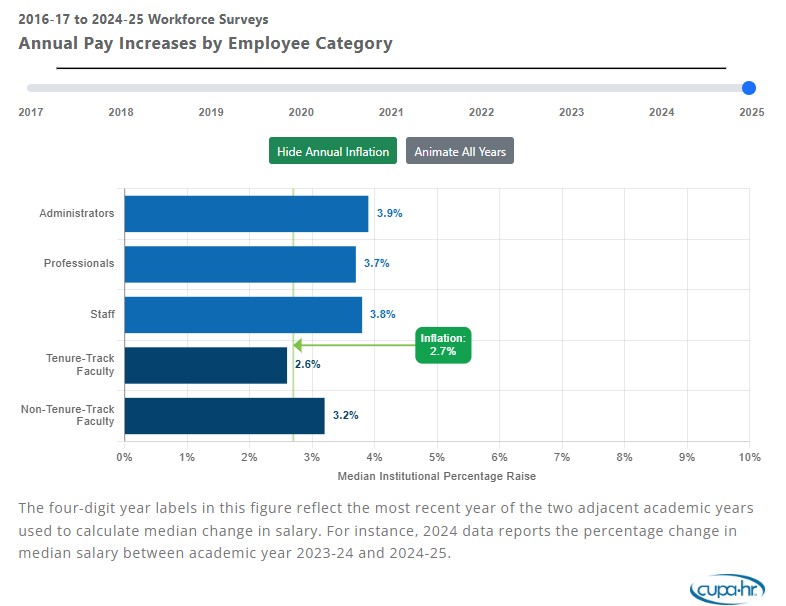
    New research from CUPA-HR shows that median pay increases for most higher education employees in 2024-25 remained strong, although they have dropped from the historically high increases seen in the previous two years. And although raises this past year for most employees outpaced inflation, they are still being paid less than they were in 2019-20 in inflation-adjusted dollars.

    The largest gap between pre-pandemic inflation-adjusted salaries and current salaries is for tenure-track faculty (who are paid 10.2% less), followed by non-tenure-track teaching faculty (paid 7.6% less). The smallest gap is for staff (paid 2.8% less).

    Some of the other key findings from an analysis of CUPA-HR’s higher ed workforce salary survey data from 2016-17 to 2024-25:

    • Staff employees continued to receive some of the highest pay increases compared to other workforce areas.
    • Non-tenure-track teaching faculty received a 3.2% salary increase, which is lower than last year’s high but still among the largest increases seen in recent years.
    • For the third consecutive year, tenure-track faculty received the lowest salary increase of all employee categories (2.6%). Across the nine years of data analyzed, tenure-track faculty salaries have not once exceeded the rate of inflation. This essentially means that — in real dollars — they have received salary decreases for the past decade.

    Explore this data and more in CUPA-HR’s newest interactive graphic.


    Source link

  • USCIS Updates Form I-9 Language

    USCIS Updates Form I-9 Language

    by CUPA-HR | April 8, 2025

    On April 2, the U.S. Citizenship and Immigration Services (USCIS) announced minor changes to the Form I-9 to align with statutory language. The changes update language in the document that was included in previous editions of the Form I-9 released under the Biden administration.

    The new Form I-9 changes the language in Section 1, checkbox 4 from “A noncitizen authorized to work” to “an alien authorized to work” (italicized for emphasis). Additionally, USCIS announced that E-Verify and E-Verify+ have updated the Citizenship Status selection during case creation. Specifically, the selection “a noncitizen authorized to work” is updated to “an alien authorized to work.” In previous editions of the Form I-9 and in the E-Verify case creation process, the Biden administration’s USCIS changed the language from “alien” to “noncitizen” in this checkbox to align with an internal memo issued by the administration in April 2021 aiming to change the language used by agencies when talking about immigrants.

    The new Form I-9 from the Trump administration also updates the descriptions of the documents accepted under List B to say “sex” instead of “gender.” This change aligns with another April 2 announcement from USCIS about updates to its Policy Manual to clarify that the agency will only recognize two biological sexes, male and female, consistent with the Trump administration’s executive order, “Defending Women From Gender Ideology Extremism and Restoring Biological Truth to the Federal Government.” In the USCIS announcement on sex, the agency states that it would not deny benefits “solely because the benefit requestor did not properly indicate his or her sex” but that the agency would not issue documents with a blank sex field or with a sex different from the sex assigned at birth.

    The new Form I-9 from the Trump administration, known as the January 20, 2025, edition, is valid through May 31, 2027. Previous editions of the Form I-9 that include language from the Biden administration are still valid as well, including two editions from August 1, 2023, that have expiration dates on July 31, 2026, and May 31, 2027. Employers may continue to use the previous Form I-9 editions through their expiration dates; however, employers using the August 1, 2023, edition with the July 2026 expiration date in an electronic system are required to update their system with the Form I-9 expiring in May 2027 by July 31, 2026.

    CUPA-HR will continue to monitor for updates related to the Form I-9 and E-Verify.


    Source link

  • student-assistant-new-genai-capabilities – The Cengage Blog

    student-assistant-new-genai-capabilities – The Cengage Blog

    Reading Time: 2 minutes

    Since launching the Student Assistant in beta last year, we’ve been working with thousands of faculty and students to train it and bring a personalized learning experience to more students. So, what’s next for this GenAI-powered tool? 

    We’re taking it to the next level. Starting this fall 2025, the Student Assistant will become available to over 1 million students with new capabilities, including integration throughout the learning experience, course offerings across 100+ products and our new AI-powered insights dashboard.  

     Let’s jump in. 

    A quick refresher: Let us reintroduce you to the Student Assistant 

    Leveraging intelligent language models and Cengage-trusted content, the Student Assistant guides students through the learning process within their specific products. Currently, embedded in our online learning platform, MindTap, it provides tailored feedback to help students reach their own solutions, without giving away the answers. We want to support students to not only understand what they’re learning, but apply course concepts with confidence. That’s why this tool was purposefully trained by students and instructors, to ensure academic integrity is at the forefront.  

    Personalized support across learning activities 

    We’ve told you how the Student Assistant personalizes learning. Soon, students can experience that level of comprehensive, personalized support throughout their entire learning experience. The Student Assistant is expanding across various learning activities and can support more difficult question types. Plus, its responses will link to actual textbook chapters, images, videos and other resources. This allows students to instantly connect with their course content and understand exactly what they’re learning.  

    More course options equal more opportunities for students 

    Spanning 100+ products, the Student Assistant will be available to over 1 million students, each with their own set of unique learning needs. We’ve expanded access across our best-selling products, including “Principles of Economics” by N. Gregory Mankiw, “Anatomy & Physiology” by Dr. Liz Co, “Precalculus” by James Stewart and more. With more product offerings and platforms available, we can reach a wider range of students from a variety of key disciplines.

    Allows instructors to look beyond grades with AI-powered insights dashboard  

    The most desired AI use case for 52% of instructors we surveyed is AI that personalizes learning and instruction.  

    Built on real-time interactions from the Student Assistant, our new AI-powered insights dashboard is a tool instructors can utilize to support and meet students right where they’re at in the learning process. Instructors can track students’ learning patterns and increase engagement with personalized, actionable insights on everything from study habits to learning challenges and concept gaps – all before it impacts their grades.  

    The future of learning is looking bright 

    Overall, this expansion will help us create better learning experiences for more students and allow instructors like you to meet their individual needs — so you can support them in their academic journeys and create futures full of opportunity.   

    Want to stay posted on updates about our fall 2025 expansion and learn more about the Student Assistant for your course?  

    Source link