Author: admin

  • 15 Green Flags in a Relationship (2024)

    15 Green Flags in a Relationship (2024)

    Finding a meaningful and lasting relationship can be challenging, but there are positive signs that show you’ve found someone special. While red flags often get the most attention, green flags are just as important in recognizing a healthy, fulfilling relationship.

    These are the reassuring traits and behaviors that indicate your partner is a great fit for you. In this article, we’ll explore 15 green flags that suggest you’ve found “The One.”

    Green Flags you’ve Found the One

    15. They Communicate Openly and Honestly

    Example: “They always tell me how they feel, even when it’s difficult.”

    Explanation: Open and honest communication is a key foundation for a strong relationship. It ensures that both partners are able to express themselves freely and work through challenges together. When someone communicates openly, it builds trust and creates a safe space for vulnerability, preventing misunderstandings and fostering deeper emotional connection.

    14. They Respect Your Boundaries

    Example: “When I say I need alone time, they understand and don’t pressure me.”

    Explanation: Respecting boundaries shows that your partner values your personal space and autonomy. It indicates that they are attentive to your needs and willing to honor them without making you feel guilty. Healthy boundaries are essential for maintaining individuality and fostering mutual respect in a relationship.

    13. They Support Your Personal Growth

    Example: “They encourage me to pursue new opportunities and support my ambitions.”

    Explanation: A partner who supports your personal growth shows that they want you to succeed and flourish as an individual. This means they aren’t threatened by your success, but instead celebrate it. When both partners are encouraged to grow, it strengthens the relationship by fostering a sense of mutual development and fulfillment.

    12. They Share Similar Values

    Example: “We both believe in honesty, family, and hard work.”

    Explanation: Having shared values is a strong indicator of long-term compatibility. While differences in personality and interests can add variety to a relationship, shared core values ensure that both partners are aligned on the important things in life. This alignment creates a strong foundation for navigating life’s challenges together.

    11. They Make You Feel Appreciated

    Example: “They regularly thank me for the little things I do.”

    Explanation: Feeling appreciated in a relationship is crucial for maintaining a positive dynamic. When your partner shows gratitude, it reinforces that they notice your efforts and value your presence. This consistent acknowledgment helps strengthen emotional bonds and fosters a sense of mutual respect and care.

    10. They Listen Actively

    Example: “When I talk, they really pay attention and engage with what I’m saying.”

    Explanation: Active listening shows that your partner is genuinely interested in your thoughts, feelings, and experiences. It goes beyond hearing words; they ask questions, offer feedback, and validate your emotions. This level of engagement is a clear sign of emotional investment and care in the relationship.

    9. They Are Dependable and Reliable

    Example: “I know I can count on them to be there when I need them.”

    Explanation: Being able to depend on your partner is key to building trust. When someone is reliable, they follow through on their promises and consistently show up for you in meaningful ways. This dependability provides emotional security and reinforces that you can rely on them during both good times and bad.

    8. They Respect Your Opinions

    Example: “Even when we disagree, they take the time to understand my point of view.”

    Explanation: Respecting your opinions, even when they differ, is a sign of a mature and balanced relationship. It shows that your partner values you as an individual and is open to seeing things from different perspectives. This mutual respect helps maintain harmony and ensures that both partners feel heard and validated.

    7. They Share Responsibilities Equally

    Example: “We both contribute to household chores and decision-making.”

    Explanation: Sharing responsibilities equally demonstrates that your partner sees you as an equal and values fairness in the relationship. Whether it’s household duties, emotional labor, or decision-making, a balanced distribution of responsibilities ensures that neither partner feels overburdened or taken for granted. This creates a sense of teamwork and mutual respect.

    6. They Make You Laugh

    Example: “We can joke around together, and they always know how to lighten my mood.”

    Explanation: Laughter is a powerful tool for building connection and reducing stress. A partner who can make you laugh not only adds joy to your life but also strengthens the emotional bond between you. Sharing moments of humor creates a lighthearted atmosphere in the relationship, helping to navigate challenges with positivity.

    5. They Prioritize Time with You

    Example: “Even with their busy schedule, they make sure we spend quality time together.”

    Explanation: When your partner makes time for you, it shows that they value the relationship and are committed to nurturing it. Prioritizing quality time, whether it’s through shared activities or simple moments together, reinforces the emotional connection and ensures that the relationship remains a top priority amidst other life demands.

    4. They Are Emotionally Available

    Example: “They’re always open to talking about feelings and don’t shy away from tough conversations.”

    Explanation: Emotional availability is a crucial element in a healthy relationship. A partner who is willing to share their feelings and listen to yours fosters an environment of trust and intimacy. This openness strengthens the emotional bond, ensuring that both partners feel supported and understood during both good and challenging times.

    3. They Have Healthy Relationships with Others

    Example: “They maintain strong, positive relationships with their friends and family.”

    Explanation: Observing how your partner interacts with others can be a good indicator of their relationship skills. If they maintain healthy, respectful relationships with friends, family, or colleagues, it often reflects their ability to nurture a positive dynamic with you as well. These strong connections suggest that they understand the value of trust, respect, and communication in all relationships.

    2. They Accept You for Who You Are

    Example: “I never feel like I have to pretend or change myself around them.”

    Explanation: Feeling accepted for who you are is one of the most important green flags in a relationship. When your partner embraces your authentic self, including your quirks, flaws, and strengths, it builds a foundation of unconditional love and acceptance. This sense of security allows you to be vulnerable and fosters a deeper emotional connection.

    1. They Envision a Future with You

    Example: “We talk about our future plans together, and they include me in their long-term goals.”

    Explanation: A partner who talks about the future with you in mind is clearly invested in the relationship. Whether it’s discussing career goals, living arrangements, or starting a family, including you in their plans shows that they see you as a long-term partner. This commitment is a strong indicator that they are serious about building a life together.

    What about Red Flags?

    Okay, so those are our green flags. But what are the red flags you need to look out for early in a relationship? Well, I show you the red flags in this article next.


    Chris

    Dr. Chris Drew is the founder of the Helpful Professor. He holds a PhD in education and has published over 20 articles in scholarly journals. He is the former editor of the Journal of Learning Development in Higher Education. [Image Descriptor: Photo of Chris]
    Source link

  • 15 Signs you’re Burnt Out, Not Lazy (2024)

    15 Signs you’re Burnt Out, Not Lazy (2024)

    Burnout and laziness can often feel similar, but they are very different experiences.

    • Burnout stems from prolonged stress and exhaustion, leaving you feeling emotionally, mentally, and physically drained.
    • Laziness is more about a lack of motivation or desire to engage in tasks.

    In this article, we’ll explore key signs that indicate you’re experiencing burnout, not laziness, and why recognizing the difference is important for your well-being.

    Signs you’re Burnt Out, Not Lazy

    1. Constant Fatigue

    Example: “No matter how much sleep I get, I always wake up feeling exhausted.”

    Explanation: Burnout often manifests as a deep, persistent fatigue that doesn’t go away, even after resting. This isn’t the same as being tired from a busy day; it’s a physical and emotional exhaustion that lingers, making it difficult to engage in daily tasks. Unlike laziness, where motivation might be lacking, this fatigue feels more like an inability to regain energy, no matter how hard you try.

    2. Difficulty Concentrating

    Example: “I can’t focus on anything for more than a few minutes, even when I want to.”

    Explanation: Burnout impacts cognitive function, making it hard to focus or stay on task. Unlike laziness, which is often a lack of desire to start something, burnout leads to an inability to concentrate even when there’s a strong desire to complete a task. This mental fog can make even simple activities feel overwhelming and lead to frustration over not being able to perform at your usual level.

    3. Lack of Motivation for Tasks You Once Enjoyed

    Example: “I used to love drawing, but now it just feels like another chore.”

    Explanation: Burnout saps joy from activities you once found fulfilling, leaving you feeling disconnected from your passions. This is different from laziness, where there’s a temporary lack of interest; burnout makes once-enjoyable tasks feel exhausting or even pointless. This loss of enthusiasm is often a sign that emotional and mental resources are depleted, not a reflection of laziness.

    4. Increased Irritability

    Example: “Little things that never used to bother me are making me snap at everyone.”

    Explanation: When burnt out, small irritations that you would normally brush off suddenly feel overwhelming. This heightened sensitivity to stress is not laziness, but a sign that you’re emotionally and mentally overtaxed. The inability to manage these emotions can lead to frustration and anger, which can further perpetuate feelings of burnout and guilt.

    5. Emotional Numbness

    Example: “I just don’t feel anything anymore. Even things that used to excite me feel flat.”

    Explanation: Emotional numbness is a common sign of burnout, where you become detached from your feelings and experiences. This is different from laziness, which is more about avoiding tasks due to a lack of motivation. Emotional numbness indicates a deep sense of exhaustion and a defense mechanism against overwhelming stress, leaving you unable to connect with others or even yourself.

    6. Feeling Overwhelmed by Simple Tasks

    Example: “Filling out a simple form feels like climbing a mountain.”

    Explanation: Burnout can make even the smallest tasks seem insurmountable. This is different from laziness, where you might just avoid tasks because they feel like a hassle. When you’re burnt out, the emotional and mental resources needed to complete even routine tasks are depleted, making everything feel overwhelming and anxiety-inducing.

    7. Physical Symptoms

    Example: “I keep getting headaches and stomachaches, but I’m not sick.”

    Explanation: Burnout doesn’t just affect your mental and emotional health; it can also manifest in physical symptoms like headaches, stomachaches, or muscle tension. These aren’t excuses to avoid tasks (as laziness might be perceived), but genuine physical reactions to prolonged stress and emotional strain. Ignoring these symptoms can worsen the burnout and lead to more serious health issues.

    8. Decreased Productivity

    Example: “I sit at my desk for hours, but I get nothing done.”

    Explanation: Burnout often leads to a noticeable drop in productivity, where you spend hours trying to work but can’t seem to make any progress. This is different from laziness, which is more about not wanting to start; burnout is about wanting to work but feeling incapable of actually getting things done. This inability to be productive despite your efforts can lead to frustration, guilt, and further exhaustion.

    9. Avoiding Social Interactions

    Example: “I just don’t have the energy to hang out with my friends anymore.”

    Explanation: Burnout can make you withdraw from social activities that you used to enjoy, not because you don’t want to see people, but because you simply don’t have the emotional or physical energy for it. Unlike laziness, where avoidance might be due to a lack of interest, this withdrawal stems from feeling drained and overwhelmed. Over time, this can lead to isolation and further feelings of burnout.

    10. Feeling Cynical or Negative

    Example: “What’s the point of trying? Nothing ever works out anyway.”

    Explanation: Burnout often brings a sense of cynicism and negativity, where everything feels pointless and you struggle to see the value in what you’re doing. This isn’t a sign of laziness, but a sign that your mental and emotional reserves are tapped out, leading to pessimism. The persistent negative outlook can further perpetuate burnout, making it harder to find motivation and hope for the future.

    11. Sleep Problems

    Example: “I’m either sleeping way too much or can’t sleep at all.”

    Explanation: Sleep disturbances are a common symptom of burnout, whether you find yourself sleeping excessively but still feeling tired, or struggling with insomnia. This differs from laziness, where sleep might be used as an escape; with burnout, sleep is disrupted due to stress, anxiety, or an inability to recharge properly. These sleep issues can create a vicious cycle, worsening the feelings of exhaustion and burnout.

    12. Feeling Detached from Your Work

    Example: “I used to care about my job, but now I’m just going through the motions.”

    Explanation: Burnout often makes you feel disconnected from your work or responsibilities, as though you’re just doing the bare minimum to get by without any sense of fulfillment. This isn’t laziness, but rather a response to prolonged stress and emotional depletion, where you no longer feel engaged or passionate about what you’re doing. This detachment can make it difficult to find meaning in your work and further contribute to burnout.

    13. Inability to Recharge

    Example: “Even after a day off or a vacation, I still feel just as exhausted.”

    Explanation: Burnout often leaves you feeling unable to recover, no matter how much rest or relaxation you get. Unlike laziness, which might improve with rest, burnout keeps you feeling depleted even after taking breaks. This inability to recharge indicates that the emotional and mental exhaustion runs deeper, requiring more than just physical rest to heal.

    14. Loss of Self-Confidence

    Example: “I used to be good at my job, but now I doubt every decision I make.”

    Explanation: Burnout erodes your self-confidence, making you question your abilities and feel incompetent, even in areas where you used to excel. This isn’t laziness, where the issue is a lack of effort; it’s a deep-seated sense of inadequacy that comes from prolonged stress. As burnout progresses, it becomes harder to trust yourself, which only compounds feelings of failure and exhaustion.

    15. Emotional Exhaustion

    Example: “I don’t have the energy to care about anything anymore.”

    Explanation: Emotional exhaustion is a key indicator of burnout, where you feel completely drained and incapable of dealing with any more stress or emotional demands. This goes beyond laziness, which is more about a lack of motivation. Emotional exhaustion reflects a deeper level of depletion, where you’ve given all you have and have nothing left to give, affecting all areas of your life.


    Chris

    Dr. Chris Drew is the founder of the Helpful Professor. He holds a PhD in education and has published over 20 articles in scholarly journals. He is the former editor of the Journal of Learning Development in Higher Education. [Image Descriptor: Photo of Chris]

    Source link

  • 15 Toxic Things Parents Say to their Children (2024)

    15 Toxic Things Parents Say to their Children (2024)

    Parents play a crucial role in shaping their children’s self-esteem and emotional well-being. However, certain words and behaviors can unintentionally cause harm, leading to long-lasting emotional damage.

    Toxic remarks or actions, whether intentional or not, can make children feel unworthy, insecure, or neglected.

    In this article, we’ll explore specific examples of harmful things parents might say or do and how these behaviors can negatively impact a child’s development.

    Toxic Things Parents Say to their Children

    1. Dismissing Accomplishments

    Example: “Oh, you got a B? That’s not impressive, anyone can do that.”

    Explanation: Dismissing a child’s achievements, no matter how small, invalidates their efforts and can make them feel like nothing they do is ever good enough. This constant dismissal leads to a lack of motivation and self-confidence, as the child internalizes that their hard work or success will never be acknowledged or appreciated by those they seek validation from the most.

    2. Playing Favorites

    Example: “Your sister is my favorite because she never gives me trouble like you do.”

    Explanation: Playing favorites creates rivalry and animosity between siblings and fosters resentment in the child who feels less loved. This favoritism can lead to long-lasting emotional scars, causing the unfavored child to constantly seek approval or attention in unhealthy ways. It erodes trust and connection in the parent-child relationship, as the child feels unworthy of their parent’s affection.

    3. Undermining Confidence

    Example: “You’ll never be able to do that. Why even try?”

    Explanation: Telling a child they aren’t capable of something kills their confidence and discourages them from trying new things. This type of remark plants seeds of self-doubt, making the child feel incompetent or inferior. Over time, the child may start to believe that they aren’t capable of success, leading to low self-esteem and a fear of failure.

    4. Public Shaming

    Example: “Why can’t you act right? You’re embarrassing me in front of everyone!”

    Explanation: Publicly shaming a child humiliates them and damages their sense of self-worth. It turns the focus from correcting behavior to making the child feel ashamed of who they are, especially when it happens in front of others. This approach not only harms their self-esteem but also teaches them that mistakes are something to hide, rather than opportunities to learn and grow.

    5. Threatening Abandonment

    Example: “If you don’t behave, I’ll just leave you here.”

    Explanation: Threatening to abandon a child, even in jest, can create deep fears of abandonment and insecurity. It undermines the child’s trust in their parents and can cause long-lasting emotional trauma. Children rely on their parents for safety and security, and threatening to remove that support can lead to anxiety and a fear of being unloved or unwanted.

    6. Silent Treatment

    Example: Ignoring the child for days after they’ve done something wrong.

    Explanation: The silent treatment is a form of emotional manipulation and punishment that isolates the child, leaving them to feel abandoned and confused. Instead of resolving conflict in a healthy way, this behavior teaches the child that love and attention are conditional. It can create anxiety, a fear of confrontation, and a deep sense of insecurity in their relationship with their parents.

    7. Critiquing everyday Actions

    Example: “Why are you always so lazy? Don’t you care about anything?”

    Explanation: This type of question is designed to provoke shame rather than address the behavior. It paints the child as inherently flawed instead of focusing on the specific issue. This can lead to feelings of guilt, frustration, and confusion about their identity, as the child is made to feel their actions are linked to their worth as a person.

    8. Commenting Negatively about Their Appearance

    Example: “You’d be so much prettier if you lost some weight.”

    Explanation: Comments like this damage a child’s self-esteem and body image, making them feel inadequate. Constant criticism of appearance can lead to long-term issues like body dysmorphia, eating disorders, and self-worth problems. Children begin to internalize that their value is tied to their looks, rather than who they are.

    9. Unhealthy Comparisons

    Example: “Why can’t you be more like your brother? He always gets good grades.”

    Explanation: Comparing a child to a sibling or peer can cause resentment, insecurity, and a constant feeling of inadequacy. This type of remark fosters competition rather than support, leaving the child feeling that no matter what they do, they will never measure up. Over time, it can damage self-esteem and create unnecessary tension within the family dynamic.

    10. Overreacting to Mistakes

    Example: “I can’t believe you did that! You’ve ruined everything!”

    Explanation: Overreacting to a child’s mistake makes them feel like their errors define them and are unforgivable. This kind of extreme response can cause the child to fear failure or mistakes, leading them to become overly cautious or anxious. It also discourages them from taking risks or trying new things, as they begin to associate making mistakes with extreme disappointment and anger from their parents.

    11. Empty Promises

    Example: “I’ll take you to the park this weekend, I promise,” but it never happens.

    Explanation: When parents repeatedly make promises they don’t keep, it breaks trust and makes the child feel unimportant. This can lead to disillusionment, where the child stops believing in what their parent says. Over time, the child might become less emotionally attached or stop relying on the parent, leading to feelings of betrayal and disappointment.

    12. Refusing to Apologize

    Example: “I’m the parent, I don’t have to say sorry to you.”

    Explanation: When parents refuse to apologize, they teach children that accountability and taking responsibility for mistakes is unnecessary, especially if you’re in a position of power. This can erode trust and respect between the parent and child, as the child may feel that their feelings are invalid. Apologizing models humility and empathy, and without it, children may grow up with a distorted view of conflict resolution and respect.

    13. Making Jokes at the Child’s Expense

    Example: “You’re such a klutz, no wonder you can’t do anything right.”

    Explanation: Joking at a child’s expense under the guise of humor can feel like betrayal, especially if the parent downplays their emotions by saying, “It’s just a joke.” These remarks hurt because they often highlight insecurities or flaws the child is already self-conscious about. Over time, this behavior can cause deep emotional wounds and lead the child to doubt their abilities, even when meant in a lighthearted way.

    14. Selfish Commentary

    Example: “I wish I never had kids. My life would’ve been so much better.”

    Explanation: This statement makes the child feel like an unwanted burden and deeply impacts their emotional security. When a parent expresses regret over having children, it communicates that the child is the root cause of their unhappiness. This can lead to feelings of rejection, unworthiness, and emotional neglect.

    15. Making the Child Feel Like a Burden

    Example: “You’re such a hassle. I can’t do anything because of you.”

    Explanation: Statements like this frame the child as an obstacle to their parent’s happiness or freedom. It fosters guilt and self-blame, making the child feel like they are in the way or a nuisance. Over time, this can erode their sense of belonging and make them believe they are undeserving of love and care.


    Chris

    Dr. Chris Drew is the founder of the Helpful Professor. He holds a PhD in education and has published over 20 articles in scholarly journals. He is the former editor of the Journal of Learning Development in Higher Education. [Image Descriptor: Photo of Chris]

    Source link

  • Supreme Court Rejects Biden Administration’s Request for Relief in Title IX Legal Challenges – CUPA-HR

    Supreme Court Rejects Biden Administration’s Request for Relief in Title IX Legal Challenges – CUPA-HR

    by CUPA-HR | August 19, 2024

    On August 16, the U.S. Supreme Court ruled against the Biden administration’s request to partially overturn preliminary injunctions from lower courts that block the Department of Education from enforcing the administration’s April 2024 Title IX final rule. The decision leaves the preliminary injunctions from the lower district courts in place, preventing the new Title IX rule from taking effect in 26 states and hundreds of schools in other states.

    Background

    Shortly after the Biden administration’s Title IX final rule was published, over two dozen states and advocacy groups filed lawsuits challenging the rule. Over the course of the summer, decisions from lower district courts across the country placed preliminary injunctions on the final rule, leading to the blocking of the final rule in 26 states, as well as at hundreds of schools where members of the Young America’s Foundation, Female Athletes United and Moms for Liberty are in attendance.*

    After several preliminary injunctions were issued, the Biden administration appealed to the Supreme Court with an emergency request asking the court to limit the scope of the preliminary injunctions placed by the lower courts. Specifically, the Biden administration asked the Supreme Court to limit the scope of the preliminary injunctions to only block provisions of the Title IX final rule related to gender identity, arguing that the lower courts’ decisions to grant the preliminary injunctions were based on concerns with the expanded protections for transgender students. The Biden administration had hoped that by limiting the scope of the preliminary injunctions, other provisions like the new grievance procedures and training requirements would be able to take effect on August 1.

    Supreme Court’s Decision

    In a 5-4 decision, the Supreme Court rejected the Biden administration’s plea to limit the scope of the preliminary injunctions, leaving in place the lower courts’ rulings. The majority opinion stated that the Biden administration did not provide a strong enough argument to sway the Supreme Court to overturn the lower courts’ decisions, and they argued that the gender identity provisions the Biden administration had hoped to limit the scope of the preliminary injunctions to were “intertwined with and affect other provisions of the rule.”

    Looking Ahead

    With the Supreme Court’s decision, the preliminary injunctions from the lower courts are still in place. Further decisions from the district courts on the legality of the final rule are still pending. The Title IX rule could return to the Supreme Court in the future, however, depending on how lower courts rule on the legality of the final rule and whether those decisions are appealed.

    CUPA-HR will keep members apprised of any updates on the legal challenges against the Biden administration’s Title IX rule.


    *The 26 states where the rule is blocked from being enforced by the Department of Education are Alabama, Alaska, Arkansas, Florida, Georgia, Idaho, Indiana, Iowa, Kansas, Kentucky, Louisiana, Mississippi, Missouri, Montana, Nebraska, North Dakota, Ohio, Oklahoma, South Carolina, South Dakota, Tennessee, Texas, Utah, Virginia, West Virginia, and Wyoming. The final rule is also blocked from taking effect at hundreds of colleges and universities across the country, including in states that did not challenge the Title IX final rule. A list of those schools can be found here.


    Source link

  • 15 Red Flags Early in a Relationship (2024)

    15 Red Flags Early in a Relationship (2024)

    So you go out on a first date, then, a second, then a third. And this person seems perfect – maybe even too perfect. There’s a good chance they’re just perfect for you. But there’s also a chance there’s something you’re missing. So let’s explore some potential red flags for the date that just seems that little bit TOO perfect.

    Red Flags in a Relationship

    15. They’re overly charismatic.

    Example: “Whenever we’re out, they always seem to charm everyone, but I can’t shake the feeling that it’s all just an act.”

    Excessive charm can mask a person’s real intentions. While it’s easy to be captivated by someone who always seems to say the right thing, this charm may be a distraction from deeper issues like dishonesty or manipulation. Charismatic individuals may use their likability to avoid accountability or prevent you from noticing problematic behavior. It’s crucial to assess if the charm is genuine or simply a tool for control.

    14. Lack of depth in conversations.

    Example: “Every time I try to talk about something meaningful, they quickly change the subject to something light and superficial.”

    Surface-level conversations are common when you’re just getting to know someone, but if they consistently avoid deeper topics, it could signal emotional unavailability. If they steer clear of meaningful discussions about emotions, values, or future plans, it may indicate that they’re not interested in building a true connection. This lack of depth may prevent the relationship from growing and leave you feeling emotionally unfulfilled.

    13. Inconsistent stories.

    Example: “Last week they said they grew up in the city, but now they’re talking about how much they loved growing up on a farm.”

    If someone’s stories frequently change or they struggle to remember details about past experiences, it can be a sign that they’re fabricating or embellishing parts of their life. These inconsistencies could point to dishonesty or manipulation, as they may be trying to create an image of themselves that isn’t real. Pay attention to whether their stories align with what they’ve previously said or if there are glaring contradictions.

    12. They’re overly agreeable.

    Example: “No matter what I suggest, they always say ‘yes,’ but I’m starting to wonder if they have any opinions of their own.”

    While it can feel nice when someone agrees with you, constant agreement could indicate that they are trying too hard to gain your approval or avoid conflict. People who always go along with whatever you say might lack their own sense of self or be hiding their true thoughts and feelings. Disagreements are natural in any healthy relationship, and someone with genuine opinions won’t always mirror yours.

    11. They avoid personal questions.

    Example: “Whenever I ask about their family or past, they dodge the question or give vague answers.”

    Deflecting or avoiding personal questions, especially about their past, can be a major red flag. This type of behavior might suggest that they are hiding something significant, such as past mistakes or unresolved issues. Open communication is essential in building trust, and someone who refuses to share basic details about their life may not be ready for a genuine connection.

    10. They’re too quick to commit.

    Example: “After just two weeks of dating, they were already talking about moving in together and planning a future.”

    If someone pushes for a serious relationship too quickly, it can feel flattering at first but often signals deeper issues. Fast-tracking commitment can be a strategy to secure control or trust before you’ve had the chance to truly know each other. Healthy relationships take time to develop; rushing can prevent you from noticing potential red flags or from establishing a solid foundation based on mutual understanding.

    9. Excessive flattery.

    Example: “They constantly tell me how amazing I am, but sometimes it feels like they’re just trying to win me over too quickly.”

    Compliments are nice, but when someone showers you with praise all the time, it can feel insincere or overwhelming. Excessive flattery is sometimes used to lower your defenses and make you more trusting before they reveal less favorable aspects of their personality. Be cautious if the flattery feels more like a manipulation tactic than genuine admiration, especially if it’s aimed at gaining your trust too quickly.

    8. They’re too smooth or polished.

    Example: “Everything they say and do seems rehearsed, like they’re performing rather than being real with me.”

    Someone who always appears perfect or seems too polished in their behavior may be putting on a facade. While it’s natural to want to make a good first impression, perpetual perfection is unsustainable and often hides flaws or insecurities. Authentic people are willing to show their vulnerable side, make mistakes, and be real, whereas overly smooth individuals may be masking their true selves.

    7. Lack of close long-term relationships.

    Example: “When I asked about their friends, they mentioned a lot of acquaintances, but no one they’ve known for more than a year.”

    If someone doesn’t have any close, long-standing friendships, it may indicate that they struggle with maintaining meaningful relationships. People with a pattern of brief or superficial connections might have trouble being vulnerable, resolving conflicts, or showing empathy. Healthy relationships, both romantic and platonic, are built on trust, respect, and longevity—lack of such relationships could be a red flag.

    6. They’re secretive about their life.

    Example: “They never tell me where they’ve been or what they’re doing, and their phone is always off limits.”

    Secrecy is often a sign of deception or withholding information. If they are vague about their daily activities, background, or who they spend time with, it could mean they’re hiding important aspects of their life from you. Open and transparent communication builds trust, and someone who keeps too much of their life hidden may be protecting a side of themselves they don’t want you to know about.

    5. They’re always the victim.

    Example: “Every story they tell about past relationships ends with how they were wronged, and never what they might have done wrong.”

    When someone consistently portrays themselves as the victim in past relationships or other life situations, it might suggest they have trouble taking responsibility for their actions. While it’s natural to encounter hardships, if they blame everyone else for their problems without acknowledging their own role, it could indicate a pattern of deflection and lack of accountability. Look for balance in their stories, where they own up to their mistakes.

    4. They tell unrealistic life stories.

    Example: “They claim to have met celebrities and traveled the world, but a lot of the details just don’t add up.”

    Stories that seem exaggerated or too good to be true can be a red flag. People who feel the need to embellish their experiences may be insecure about their real selves or trying to craft a more appealing persona. Overly dramatic or fantastical accounts may suggest that they are not being truthful, and it’s important to gauge if their life stories match up with reality.

    3. They have had a lot of sudden life changes.

    Example: “They’ve switched jobs three times this year and recently moved cities without much explanation.”

    While change is a natural part of life, frequent and abrupt shifts—such as changing jobs, moving homes, or cycling through friend groups—can indicate instability. Consistency in personal and professional life often reflects a level of responsibility and commitment. Sudden, unexplained changes could signal that they are running away from unresolved issues or struggling to maintain stability.

    2. They’re reluctant to introduce you to others.

    Example: “Despite dating for months, they still haven’t introduced me to any of their friends or family.”

    If someone is hesitant to introduce you to their family, friends, or colleagues, it could indicate they are hiding you from parts of their life or that they’re not serious about the relationship. Being part of each other’s social circles is a natural progression in a healthy relationship, and reluctance to do so may suggest they have something to hide or aren’t fully committed.

    1. They have perfectionist tendencies.

    Example: “They expect everything to be flawless, from how the apartment is arranged to how I dress, and it’s starting to feel exhausting.”

    Perfectionism can indicate underlying control issues or deep insecurities. If they hold themselves—and you—to impossibly high standards, it can lead to stress, frustration, and disappointment. No one is perfect, and striving for flawlessness can prevent authentic connection. Healthy relationships embrace imperfections and allow both partners to be human without fear of judgment.

    What about Green Flags?

    Okay, so those are our red flags. But what are the green flags showing you’ve found the one? Well, I show you the green flags to look out for in this article.


    Chris

    Dr. Chris Drew is the founder of the Helpful Professor. He holds a PhD in education and has published over 20 articles in scholarly journals. He is the former editor of the Journal of Learning Development in Higher Education. [Image Descriptor: Photo of Chris]
    Source link

  • 15 Inspiring & Fun Teacher Desk Setup Ideas (2024)

    15 Inspiring & Fun Teacher Desk Setup Ideas (2024)

    Looking to refresh your workspace with a fun and inspiring teacher desk setup? Whether you’re in a classroom or teaching from home, your desk can be a creative hub that fuels productivity and positivity. From colorful organizers to cozy lighting, the right setup can transform your space into one that sparks joy.

    Check out these inspiring desk ideas to give your teaching environment a fresh new vibe!

    Teacher Desk Setup Inspiration

    15.

    Teacher Desk

    14.

    Teacher Desk

    13.

    Teacher Desk

    12.

    Teacher Desk

    11.

    Teacher Desk

    10.

    Teacher Desk

    9.

    Teacher Desk

    8.

    Teacher Desk

    7.

    Teacher Desk

    6.

    Teacher Desk

    5.

    Teacher Desk

    4.

    Teacher Desk

    3.

    Teacher Desk

    2.

    Teacher Desk

    1.

    Teacher Desk


    Chris

    Dr. Chris Drew is the founder of the Helpful Professor. He holds a PhD in education and has published over 20 articles in scholarly journals. He is the former editor of the Journal of Learning Development in Higher Education. [Image Descriptor: Photo of Chris]

    Source link

  • Hire Academic Writer [MBA, 10Yrs Exp]

    Hire Academic Writer [MBA, 10Yrs Exp]

    You can download project topics and share that with us to prepare your synopsis format and final year project report.

    Our Team have 10 year+ extensive and in-depth professional background with strong research skills in academic writing, content writing, articles, research papers, mba project making, clinical training related dissertation, nursing or Healthcare Industry projects. 

    We also offer free revision until you are satisfied with our writing service and offer personalized support with project mentor to guide you for your academic success till your university approve the report from anywhere in the world.

    Source link

  • New Title IX Rule Defines Deepfakes as Sexual Harassment

    New Title IX Rule Defines Deepfakes as Sexual Harassment

    On April 19, 2024, the U.S. Department of Education released updated Title IX Regulations that clarified schools’ ability to raise incidents of harassment using non-consensual, sexually explicit deepfakes through Title IX action. Title IX is a federal law that bars sex discrimination in education programs and applies to all public and private elementary and secondary schools, school districts, colleges, and universities that receive federal funding (hereinafter “schools”) and includes governance over schools’ responses to complaints of sexual harassment or assault.

    What are deepfakes? 

    “Deepfakes” are “multimedia that has either been synthetically created or manipulated using some form of machine or deep learning (artificial intelligence) technology.” Sexually explicit deepfake images can be generated using methods like face-swapping, replacing one person’s face with another’s face, or “undressing” a clothed image to look supposedly nude. Deepfakes and the artificial intelligence technologies that generate them are increasingly sophisticated, harder to detect, and widely accessible by anyone with a computer or smartphone app for little to no cost.

    In the past two years, numerous incidents have occurred in schools with students creating deepfake media of other students or teachers, as well as school staff, creating them of fellow staff for reasons ranging from impersonating teachers to portray offensive messages to sharing sexually explicit images and videos. Educational institutions have been grappling with how to react to advances in AI, and these deepfake incidents have sparked additional concern about how to protect students, staff, and administrators, while also needing to know how to address incidents when they occur. This blog discusses how the recently updated Title IX Rule applies to deepfake incidents and provides four tips for how schools can prepare to respond.

    How might Title IX apply to deepfake incidents in schools? 

    The new Title IX Rule updates the definition of “sexual harassment” to include “the nonconsensual distribution of intimate images” including authentic images and those altered or generated by AI. Existing Title IX protections against harassment apply to actions connected to any school-related programs or activities regardless of whether the harassment occurs on or off campus. That is, even if deepfakes are disseminated outside of school, Title IX requires schools to address off-campus behavior that creates a “hostile environment” in the school. Under the new rule, behavior qualifies as sexual harassment when it is objectively and subjectively offensive and so “severe or pervasive” that it limits or denies a person’s ability to “participate in or benefit from the recipient’s education program or activity.” The previous definition of sexual harassment was more limited by requiring that behavior be “so severe, pervasive, and objectively offensive.” Determining whether behavior has created a hostile environment is fact-specific and Title IX stipulates the following considerations: 

    “(i) The degree to which the conduct affected the complainant’s ability to access the recipient’s education program or activity; (ii) The type, frequency, and duration of the conduct; (iii) The parties’ ages, roles within the recipient’s education program or activity, previous interactions, and other factors about each party that may be relevant to evaluating the effects of the conduct; (iv) The location of the conduct and the context in which the conduct occurred; and (v) Other sex-based harassment in the recipient’s education program or activity.”

    Additionally, the updated Title IX Rule modified investigation standards. Now, higher education institutions will have a lower bar for adjudicating guilt that is a “preponderance of the evidence” standard rather than the previous “clear and convincing evidence” standard. Universities will still be able to use the higher standard if it has been used in cases with factually similar circumstances. Primary and secondary schools will continue to have the choice of an informal resolution of complaints if “available and appropriate.”    

    Four Proactive Practices for Educational Institutions

        • Update policies to include deepfakes. Educational institutions should routinely review their policies and procedures and update them as needed to ensure their effectiveness in addressing image-based sexual harassment. These policies should convey how to handle instances of deepfakes created by and/or of students, teachers, or other staff in and outside of school and whether policies differ based on the method of distribution (e.g., sharing on an external site like Instagram versus posting on a school forum, in person, etc.). Sexually explicit deepfakes may be created or distributed using online tools outside of school or using products the school has procured. School districts should evaluate procured products that could be used to create or distribute deepfakes and review agreements with those third-party vendors for compatibility with the districts’ own policies on incident response. Lastly, policies should include defined terms that aren’t overbroad (like banning all “AI”) or underinclusive (like defining “deepfakes” as only still images). 
        • Ensure that Title IX procedures are properly implemented. Schools must recognize that Title IX legal obligations and student protections may apply to sexually explicit deepfake incidents. Title IX requires that schools conduct a “prompt, impartial, and thorough investigation” of sexual harassment complaints and take appropriate steps toward resolution. Title IX investigation procedures and policies must be updated in accordance with the Rule’s new “preponderance of the evidence” standard. Legal obligations can include keeping the identity of complainants confidential, informing complainants about available resources, interviewing complainants in an inappropriate manner, and appropriately pursuing a formal hearing when requested by complainants. School leaders should incorporate the definition and handling of deepfake incidents into Title IX policies and ensure that procedures are in place for staff to respond promptly and effectively.
        • Instruction and training for school staff.  Schools are required to communicate Title IX policies to all students and staff which could include highlighting that non-consensual, sexually explicit deepfakes may qualify as Title IX sexual harassment. Institutions should consider staff training to include responsible technology use, ethical uses of AI (in and out of the school), how it impacts others, and what repercussions exist. Districts can share resources to help inform educators of ways to identify deepfake content (like those from the Department of Homeland Security, MIT, and AI for Education).  
        • Education leaders should ensure that staff are properly trained on requirements under the Family Educational Rights and Privacy Act (FERPA) and how it interacts with Title IX complaints. Title IX investigations typically involve maintaining information that directly relates to a student and is personally identifiable, thus creating a FERPA-covered education record and triggering additional privacy protections. Deepfake incidents have been reported to law enforcement, which victims may do of their own accord. However, it is important to inform staff of when schools can legally disclose information to law enforcement, such as with parental consent, a court order or subpoena, or under a FERPA exception. Title IX requires that the identities of a sexual harassment complainant and the alleged perpetrator are kept confidential unless the disclosure is FERPA permitted, it is required by law, or it is necessary to carry out Title IX purposes. See FPF’s guide for more on Law Enforcement Access to Student Records
        • Instruction and training for students. Educational institutions must inform students and/or parents of their Title IX policies and should consider educating students and parents on the ethical, and legal, use of AI. This instruction could take many forms, but it should include (1) the appropriate uses of AI in and out of school, (2) the inappropriate uses of AI that would lead to disciplinary action, (3) the process of disciplinary action, and (4) the negative impact that unethical or illegal use of AI could have on the victim, creator, and the community. Communicating to students the seriousness of misusing AI could help prevent further incidents.

    The updated Title IX rule clarified that schools should evaluate if a sexually explicit deepfake incident qualifies as an issue of sexual harassment. School leaders should also understand that in addition to Title IX, FERPA, state-specific laws, and privacy policies that apply to the sharing of student information may apply to incidents, even when that information is AI-generated. States are increasingly enacting non-education-specific laws to combat the generation or dissemination of sexually explicit deepfakes. For example, Washington State enacted House Bill 1999 this year which expanded the criminal offenses for non-consensual creation or sharing of sexually explicit, fabricated images of an identifiable minor, similar to laws in Virginia, and New York. Educational institutions should stay informed on applicable statutes and be aware that the legal landscape is quickly evolving to combat deepfake incidents. 

    What’s Next? 

    The updated Title IX Rule became effective on August 1, 2024, and applies to any complaints of alleged conduct that occurs on or after that date. As of the effective date, 26 states have filed suits against the law and have been granted injunctions blocking its enforcement. Pushback from the states and other organizations largely stems from the updated rule’s expansion of sex discrimination to include “gender identity,” and it is not yet clear how these legal challenges will affect the future of the updated rule.

    Source link

  • HR and the Courts — August 2024 – CUPA-HR

    HR and the Courts — August 2024 – CUPA-HR

    by CUPA-HR | August 14, 2024

    Each month, CUPA-HR General Counsel Ira Shepard provides an overview of several labor and employment law cases and regulatory actions with implications for the higher ed workplace. Here’s the latest from Ira.

    Student-Athletes and NCAA Propose a $2.8 Billion Settlement in Antitrust and Name, Image and Likeness Case

    Attorneys representing student-athletes have filed for court approval of a $2.8 billion settlement reached with the NCAA and the Power Five conferences. Bloomberg reports that the student-athletes were pursuing a $4.5 billion claim.

    Under the proposed settlement, a men’s football or basketball player would receive roughly $135,000 and a female basketball player would receive roughly $35,000. Athletes in other Division I sports, including football and basketball players in non-Power Five conferences, would also recover under the proposed settlement, although the terms of that recovery are not yet clear.

    Also under the proposed settlement, Division I schools will be able to provide student-athletes with direct payment up to a cap of 22% of the Power Five schools’ average athletic revenue per year. The payment pool will be more than $20 million per school in the 2025-26 academic year and will grow from there. The Power Five includes the Big Ten, Big 12, Atlantic Coast Conference, Southeastern Conference and Pac-12. (The Pac-12 lost its autonomy status for 2024-25 after 10 of 12 of its members departed for other conferences.) The proposed settlement was filed in the U.S. District Court for the Northern District of California (In Re College Athlete NIL Litigation (N.D. Cal., 4:20-cv-03919, 7/26/24)).

    It is reported that the multibillion-dollar settlement would be paid out over 10 years. A preliminary approval hearing will take place in September to be followed by a comment period from class members. If approval is reached it will spare the NCAA and the Power Five from a trial scheduled to take place in January, 2025.

    Employee Status of Student-Athletes Under the FLSA Still Undecided as Court Rejects NCAA’s Appeal

    The 3rd U.S. Circuit Court of Appeals (covering Delaware, New Jersey, Pennsylvania and the Virgin Islands) rejected the appeal of the NCAA contesting the trial court decision that college athletes are entitled to a trial to decide whether they are employees under the FLSA.

    The appeals court remanded the case back to the trial judge for more analysis on the applicable standard to be used in determining whether a student-athlete is an employee. The decision allows the college athletes to continue to pursue their claims, which allege that the NCAA and colleges are joint employers (Johnson V. NCAA (3rd Cir. No. 22-01223, 7/11/24)).

    The decision contrasts with the former holdings of the 7th U.S. Circuit Court of Appeals and the 9th Circuit, which rejected claims that student-athletes were employees. In remanding the case back for further analysis, the 3rd Circuit left room for the court to hold that some college athletes maintain their amateur, non-employee status while others are employees subject to the minimum wage requirements of the FLSA.

    The decision also rejected the term “student-athlete,” commenting that the term is an “NCAA marketing invention” designed to “conjure up the nobility of amateurism,” assert “the precedence of scholarship over athletics,” and “obfuscate the nature of the legal relationship at the heart of a growing commercial enterprise.” The decision stated that college athletes “cannot be barred as a matter of law from asserting FLSA claims simply by virtue of the revered tradition of amateurism.” Finally, the court remanded the case to the trial judge to use common-law factors, such as level of control and presence of payments, to determine the employee status of college athletes.

    Unionization Petitions Filed With NLRB Increase by 30% in 2024 — Decertification Petitions Increase by 12%

    Petitions filed with the National Labor Relations Board (NLRB) to both certify and decertify union representation are up dramatically so far this year.

    The increase in certification petitions is partially attributed to the NLRB’s decision in the Cemex decision. That decision requires employers, in response to a certification petition, to either voluntarily recognize the union or file an RM, which is used by employers to dispute that the union has majority status. The increase in activity also comes after the NLRB altered its administrative procedures to shorten the time between petition filing and the election.

    The NLRB also reports that its regional offices have conducted more representation elections so far in 2024 than in the entire 2023 fiscal year. Finally, the NLRB reports that unions have won 79% of union-filed petitions and 70% of employer-filed petitions.

    EEOC Signals Second Attempt to Require Employers to Report Pay Data by Race, Sex and Job Category

    The Equal Employment Opportunity Commission has indicated in its July regulatory playbook that it intends to make another attempt to require that employers annually report pay data by race, sex and job category. Its first attempt to do so was canceled by court intervention in 2016 during the Obama administration.

    The EEOC indicated it will use the Administrative Procedure Act (APA) as opposed to the Paperwork Reduction Act (PRA) to issue the new regulations. Under the APA, advance notice, including a comment period, is required. Also under the APA, an individual or organization has the private right of action to block the regulation.

    The recent Supreme Court decision in the Chevron case may make such APA challenges easier to manage for employers and employer organizations seeking to challenge the new attempt to collect pay data. In the Chevron case, the Supreme Court abandoned the rule of the presumption of legitimacy of federal agency decisions.

    Court Concludes NLRB Failed to Explain Why It Rejected Employer Objections in Union Election  

    The U.S. Court of Appeals for the District of Columbia Circuit concluded that the NLRB failed to coherently explain its rejection of employer election objections when the NLRB certified a union in a one-vote victory in a mail ballot election.

    The D.C. Circuit court concluded that the NLRB used different legal tests without explanation when it rejected an employer’s objections to the mail ballot election (GHG Mgmt LLC V. NLRB (DC Cir. No, 22-01312, 7/9/24)).

    The court ruled in a unanimous, three-judge decision that the NLRB failed to adequately explain its rejection of employer objections and remanded the case back to the NLRB for determination over which test it used to reject the employer’s objections. The court stated it can only rule on whether the NLRB’s decision was correct if it knows which test the NLRB used in coming to its decision. This case is another criticism of the NLRB’s handling of mail-in ballot elections used during and after the COVID-19 pandemic.

    Federal Judge Temporarily Rejects Texas AG’s Attempt to Block EEOC Guidance on LGBTQ+ Employees

    A federal district trial judge has temporarily rejected the Texas attorney general’s attempt to block current EEOC guidance that covers LGBTQ+ employees. The guidance protects employees’ right to choose pronouns and bathrooms consistent with their gender identity.

    The federal judge dismissed the case, holding that the Texas attorney general must file a new case and not rely on the past decision in which the federal judge vacated similar EEOC regulations protecting LGBTQ+ employees (State of Texas V. EEOC (N.D. Tex. No. 2-21-cv-00194, 7/17/24)).

    The judge ruled that his prior decision in favor of the Texas attorney general vacating prior EEOC LGBTQ+ regulations can be used as a predicate for a new case. Nonetheless, the Texas attorney general must file a new case seeking new injunctive relief. The federal judge explained that his prior decision addressed the EEOC’s 2021 guidance alone and a new case must be filed to adjudicate the issues involved in the new EEOC guidance.


    Source link

  • How many colleges are there anyway? Version 2022

    How many colleges are there anyway? Version 2022

    I’ve always been fascinated by the idea of “colleges.”  We think we know what we mean when we say it, but do we really?

    When some people say “college” they might mean any four-year college that enrolls undergraduates.  Others might mean everything except for-profit colleges.  Do you include community colleges in your group?  Some people do, and others don’t.

    And of course, I’d be remiss if I didn’t point out that when some major news outlets talk about “college” they are really talking about the 15 or  50 institutions their readers or listeners fascinate over.

    Well, now you can see the answer.  Sort of.  I started with IPEDS data, which includes all post-secondary institutions that receive Title IV aid.  There are many institutions in the US that don’t and although they can report to IPEDS, they are not required to, and many don’t.

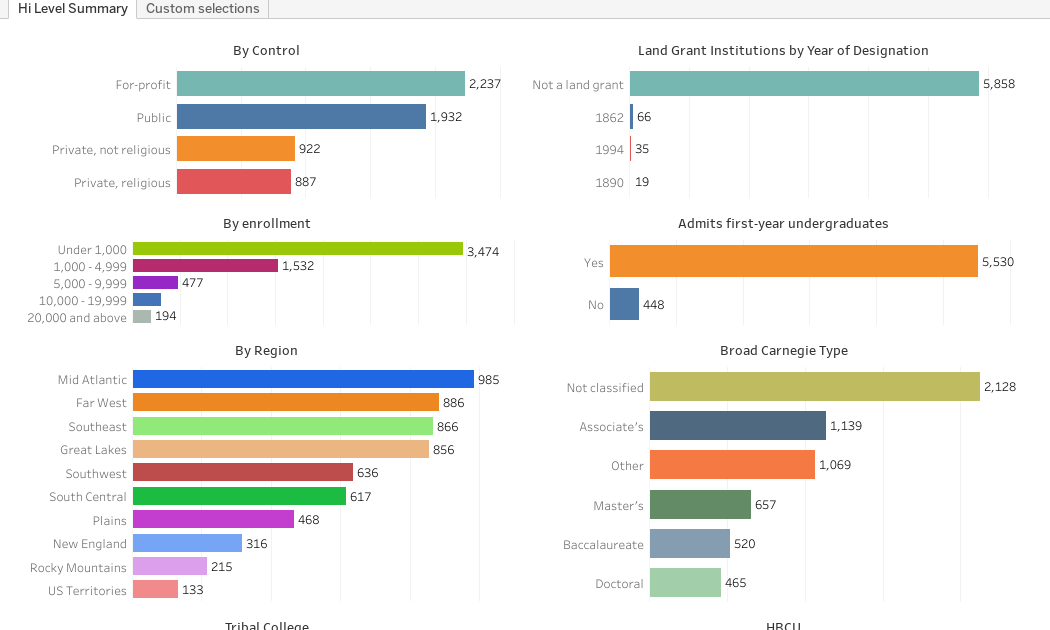
    But if we start with all the IPEDS institutions that enrolled at least one student in 2022, you get 5,978.  And that’s where the fun begins.  

    There are two quick views here.

    The first view (using the tabs across the top) shows several common ways of breaking colleges into groups: By region, Carnegie type, and control, for instance.  It’s not interactive, but you can see how your concept of colleges might be too small.

    The second tab makes up in interactivity what the first tab missed.  Use any of the filters to filter to the number based on your definition: Some of the filters are discrete, some are numeric ranges.  Any combination is fine, and the pink bar will update automatically with the new count.  Be sure to read the instructions at the bottom about how to use the discrete filters.

    Anything jump out at you here? Leave a comment below.

    Source link