Category: marketing

  • How a Napkin Sketch Can Unlock Higher Ed Innovation at Your Institution

    How a Napkin Sketch Can Unlock Higher Ed Innovation at Your Institution

    In higher education, it’s easy to feel stuck.

    You know something isn’t working — maybe enrollment processes are clunky, or student support services feel disconnected. You’ve tried new tools, updated systems, created initiatives to create change, and added staff, but the problem persists.  It’s like there’s a giant boulder in your way, and no matter how hard you push, it doesn’t budge.

    It turns out, you don’t need a bulldozer – just a napkin sketch to start building momentum to move the boulder standing in the way.

    It’s a surprisingly simple concept, using visual design thinking exercises to help colleges and universities get unstuck. Not with more tech, or a fancy AI solution, but with more clarity to understand how things work today to create a framework for change tomorrow.

    Because real innovation in higher education doesn’t come from software or a technology — it starts with understanding the systems and the processes you already have so you can visualize what they could be.

    What is a napkin sketch?

    The napkin sketch is exactly what it sounds like: a back-of-the-napkin-style drawing that quickly maps out how a particular process actually works in your institution so it can be reimagined.

    It’s low-tech, but high-impact.

    Think of it as building a gameboard for players to play. Like a Monopoly board, everyone knows the players, the rules, and the steps. It makes the choices that need to be made for each player’s turn clear.  When these choices are laid out visually, it becomes much easier to pinpoint where the real opportunities (and challenges) are.

    What does the napkin sketch exercise entail?

    I usually start these sessions by asking one simple questions with a key follow-up

    • What’s the opportunity for ‘impact’? (What are you trying to accomplish?)
    • What’s preventing progress?

    Then we get to work. Together, we sketch out the entire process: from first interaction to the final outcome. We account for every step, system, and stakeholder that’s involved. We highlight the costs, the tools and technology handoffs, potential delays, and where things might be falling through the cracks.

    We typically conduct the sketch in a virtual drawing space, where we can collaborate in real time to map out the full process. It’s not about polished visuals — it’s about building a shared understanding of how things operate today.

    And in about 60-90 minutes, we always have at least one person in the group say out loud “I didn’t realize that’s how it actually works.” And another will inevitably ask “You’re going to send us this napkin sketch, right? I want to print it out.”

    Ready for a Smarter Way Forward?

    Higher ed is hard — but you don’t have to figure it out alone. We can help you transform challenges into opportunities.

    What can the napkin sketch reveal?

    In our experience working with hundreds of institutions of all shapes and sizes, we’ve found that many face surprisingly similar challenges. This exercise consistently shines a light on hidden opportunities, creating a blueprint for change.

    Common things we uncover include:

    • Manual, repetitive tasks that could be automated or streamlined
    • Workarounds that have become permanent fixtures without anyone questioning them
    • Disconnects between departments, systems, or technologies
    • Operational silos that prevent teams from seeing the full picture or collaborating effectively
    • Missed opportunities to better track, analyze, or act on data
    • Unclear ownership of key steps in the process

    In short, the napkin sketch helps institutions see what’s really going on — and what needs to change to move forward.

    Why does it work?

    Higher ed innovation often stalls because teams are too close to the problem or too deep in their own silo to see the bigger picture. The napkin sketch breaks through that by creating a space for everyone involved to step back and collaborate.

    Here’s why it’s effective:

    • It’s fast — most sessions take an hour or two.
    • It’s visual — helping teams align quickly and clearly.
    • It’s collaborative — bringing together voices from across departments.
    • It’s actionable — revealing next steps that are grounded in reality.

    Most importantly, it shifts the focus away from jumping to solutions and toward understanding the system. Once you understand the system, smart solutions become much more obvious — and effective.

    Real examples of the napkin sketch in action

    Whether it’s enrollment workflows, transcript processing, student communications, or data handoffs between systems or teams, the napkin sketch exercise can help untangle a wide variety of operational challenges. No two institutions are exactly alike, but many face similar complexities — manual processes, siloed teams, and unclear ownership that stall progress.

    Here are a few discoveries we uncovered in recent napkin sketch sessions I’ve led:

    • One institution realized how many steps were involved in processing transcripts — with staff toggling between platforms, uploading the same file in multiple places, and doing manual comparisons. Once the process was mapped, we explored how AI could handle the course match evaluations — saving hours of staff time each week.
    • Another team sketched out their enrollment outreach process and discovered they were sending multiple conflicting messages to students at the same time. The sketch helped them realign their communications and reduce student confusion.
    • A third school wanted to integrate a new tool into their tech stack, but the sketch revealed that the underlying workflow was broken — and that no tool would help until the foundational process was improved.

    In each case, the aha moment didn’t come from buying something new — it came from clearly seeing what was already happening so it could be improved upon.

    What could your napkin sketch uncover?

    If you’re wrestling with outdated processes, disconnected systems, or unclear handoffs — you’re not alone. Many institutions are trying to drive higher ed innovation with limited resources and overwhelming complexity.

    But you don’t need to have all the answers right now. You just need a clearer view of the problem so you can develop a thoughtful solution.

    That’s what the napkin sketch offers: a simple, collaborative way to map your reality, uncover opportunity, and take a smarter next step forward.

    Let’s sketch it out — and see what we find!

    Ready to uncover what’s holding you back?

    Reach out to schedule your own session and take the first step toward smarter solutions.

    Source link

  • Do More with Less: 7 Strategic Advantages of Shared Services in Higher Education

    Do More with Less: 7 Strategic Advantages of Shared Services in Higher Education

    College administrators wear many hats to ensure their institutions thrive. Stakeholders expect them to be visionaries, budget stewards, tech experts, and student champions. However, wearing too many hats can hinder the ability to meet more strategic and forward-thinking institutional demands, effectively diluting leadership capacity and outcomes. 

    How can administrators remove some of those hats without losing control or spending more? 

    How can they guide their institutions to achieve better outcomes with fewer resources?  

    At the 2024 Collegis Education Summit, keynote speaker Dr. John Smith-Coppes, president of Joyce University, shared his advice for achieving higher ed excellence amid market paradigms, shifting learner expectations, and capacity constraints.

    “Embrace your institutional superpower and then partner for expertise. You have to know what you are really good at, but also where you might need help. Having the bravery to objectively look at the brutal facts can take you from good to great. Keep this in mind: Your institution is perfectly designed to get the outcomes it’s getting.”

    -Dr. John Smith-Coppes, President of Joyce University

    Dr. Smith-Coppes is right. If you’re not getting the results you want, you have to shine a light on the operation and consider what adjustments or changes will better position your institution for desired outcomes.

    To echo Dr. Smith-Coppes and answer the earlier questions, working with a strategic partner who has deep expertise in higher education shared services and can manage certain responsibilities more efficiently can get your institution closer to turning aspiration into reality. A true partnership is not about simply outsourcing tasks. Rather, it’s a strategic way to gain access to specialized knowledge, proven methodologies, and scalable resources, all while enabling administrators to focus on their core areas of expertise.

    Mounting challenges facing higher ed leaders

    When I talk to administrators, the conversation inevitably turns to the challenge of doing more with less. They consistently grapple with four key issues:

    • Budget Cuts: Funding is uncertain or shrinking, forcing them to rethink the allocation of resources.
    • Advancing Technology: Technology is rapidly evolving, leaving administrators to scramble after the next advancement or emerging capability.
    • Socioeconomic Pressures: With some questioning the value of postsecondary education, relevant programs with affordable tuition have never been more critical.
    • Employee Turnover: Retaining top talent is difficult, leaving critical gaps.

    But none of these issues surprise us. On the contrary, Collegis Education has partnered with numerous public and private institutions of varying sizes and levels of brand recognition to address these challenges, uncovering advantageous pathways toward more sustainable and fruitful operations.

    The results speak for themselves. Administrators gain more time to leverage their core strengths to elevate their institution’s mission and educational outcomes while actualizing a variety of clear benefits. Here is what Collegis Education continues to deliver for our shared-service partners.

    Seven ways shared services in higher education deliver results

    Institutions that leverage shared services experience benefits in a variety of key areas. Explore some of the most significant advantages:

    1. Improved financial stability

    Predictability and optimization are the key words here. With our solutions for technology management, enrollment management, and student services, institutions know exactly what to budget every year. At the same time, we find cost savings by getting a better return on technology investments, strategically decommissioning redundancies, and renegotiating contracts.

    2. Enhanced operational efficiency

    Is there a better way to reach an institution’s goals more efficiently? More often than not, the answer is yes. We help bring these opportunities to the surface by fully assessing the school’s infrastructure, technology, processes, and other operating procedures. This assessment denotes areas of excellence and points of failure as well as identifies where lag or waste exists. With these insights, we can identify and prioritize emerging opportunities to drive improvement. All this informs a multiyear roadmap that guides higher ed leaders on how to thoughtfully implement changes that engage key stakeholders to accelerate the change management cycle.

    3. Objective perspective & best practices

    We bring a unique perspective to our recommendations based on our work with other schools while protecting each school’s anonymity and uniqueness. This helps give you a baseline of how your school performs when compared to similar ones. Are you leading or lagging? As an unbiased third party, we offer fresh ideas backed by the knowledge of the results they have produced. It’s a great way to eliminate the “but this is how we’ve always done it” objection and gain buy-in from internal staff.

    4. Risk mitigation & accountability

    There’s rarely a higher ed situation we haven’t already dealt with at another institution. Our partners benefit from this experience, allowing them to proactively avoid operational and technical risks. They also benefit tremendously from having a partner who holds themselves accountable to quantifiable outcomes measured by agreed-upon service level agreements (SLAs). Together, these provide a lot of peace of mind when it comes to issues like cybersecurity, compliance, disaster recovery, and business continuity.

    5. Specialized expertise without the overhead

    Hiring and retaining experienced staff is challenging enough. Finding people with skill sets to leverage evolving technology capabilities like artificial intelligence (AI) is a whole other story. That’s why our partners rely on Collegis to provide the expertise that’s hard to find. We’re software-agnostic and implement solutions that are in the school’s best interest from a financial, operational, and strategic perspective without the need for full-time employees to manage them.

    6. Data-enabled decision making with full transparency

    Data at most institutions is stored in siloes, with limited stewardship and governance over its quality and consistency. However, many of the “data” solutions in the market today are complicated and difficult to implement and support.

    This is why we built Connected Core, a scalable higher education industry cloud solution that integrates siloed data sets, systems, and applications to enable institutional intelligence. This proven approach and methodology for collecting, connecting, and activating institutional data eliminates data doubt and gives leaders the confidence to make quickly make strategic decisions with confidence.

    7. Focus on core mission & educational outcomes

    By outsourcing some functions, administrators can redirect resources and energy to what truly matters: student success. By reducing the number of hats they wear, leaders can instead focus on using the tools they have on hand to manage strategic initiatives that drive institutional growth.

    Strategic delegation to yield better outcomes

    Some leaders fear losing control through outsourcing, and rightfully so. Too many vendors tout “partnership” when, in fact, they are trying to build an unhealthy dependency that is not mutually beneficial.

    That’s just not us. It fundamentally goes against our values and who we are as a company.

    Our partnerships are built on collaboration and shared governance. Institutions set priorities, and all actions follow clear assessments, implementation plans, and progress reviews. Our partners gain greater control over technology, enrollment, and budgets. Control isn’t lost, but visibility and accountability are gained.

    Shared-services models allow administrators to confidently offload specific responsibilities. Leveraging external expertise amplifies your internal strengths and empowers your leaders to focus on building and maintaining a thriving campus community.

    But the first step is starting the conversation with the right partner.

    Innovation Starts Here

    Higher ed is evolving — don’t get left behind. Explore how Collegis can help your institution thrive.


    Source link

  • Graduate Student Insights and Perspectives

    Graduate Student Insights and Perspectives

    Facing challenges in enrollment, retention, or tech integration? Seeking growth in new markets? Our strategic insights pave a clear path for overcoming obstacles and driving success in higher education.

    Unlock the transformative potential within your institution – partner with us to turn today’s roadblocks into tomorrow’s achievements. Let’s chat.

    Source link

  • Rethinking Your Student Population

    Rethinking Your Student Population

    Rethink your student population whitepaper

    Adult learners are higher ed’s future

    Reskilling, upskilling and lifelong learning are creating a big opportunity for higher education to become the go-to resource for career-minded adults. But not all adult learners are alike. In this report, we break them down into four types of adult learners (Career Advancer, Career Builder, Discerning Academic and Hesitant Learner).

    Download the white paper with the following insights for each persona:

    • Top motivations
    • Recruitment strategies
    • Program optimization recommendations

    Collegis Education surveyed 1,000 adult learners interested in pursuing degrees for this white paper, Rethink Your Student Population. Discover who makes up the majority of the adult learner market and how to target your outreach to grow your enrollment in this untapped population.

    Also, get key takeaways in our infographic The Adult Learners You’re Ignoring.

    Download Now

    MktoForms2.loadForm(“//087-TII-060.mktoweb.com”, “087-TII-060”, 1789);

    Additional Resources

    The post Rethinking Your Student Population appeared first on Collegis Education.

    Source link

  • How to Unlock Graduate Enrollment Growth [Webinar]

    How to Unlock Graduate Enrollment Growth [Webinar]

    Your graduate programs should be thriving, but if you’re relying on outdated outreach tactics, you’re leaving enrollments on the table. Today’s grad students expect more personalization, relevance, and connection. And if you’re not aligning with their needs, another institution will. The only way to meet them where they are is by asking the right questions and getting real answers. That’s exactly what Collegis Education and UPCEA did, and now we’re pulling back the curtain to share what we found.

    Unlock Graduate Enrollment Growth
    Proven Strategies for Engaging Graduate Students
    Date
    : April 8, 2025
    Time: 2:00 pm (Eastern) / 1:00 pm (Central)

    Tracy Chapman

    Chief Academic Officer

    Collegis Education

    Headshot of Bruce Etter

    Bruce Etter

    Senior Director Research & Consulting
    UPCEA

    Join Tracy Chapman, Chief Academic Officer at Collegis Education, and Bruce Etter, Senior Director of Research & Consulting at UPCEA, for their upcoming webinar “Unlock Graduate Enrollment Growth: Proven Strategies for Engaging Graduate Students.” In this session, they’ll reveal some surprising discoveries about graduate enrollment and the factors that drive impact and growth.

    • Graduate student needs and expectations
    • Why grad students disengage during their enrollment journey
    • What information grad students are willing to give you and when
    • How to best communicate and reach graduate students actively evaluating programs
    • Presidents
    • Provosts
    • Enrollment leaders 
    • Marketing leaders

    At the end, we’ll leave room for questions and conversion, and all attendees will receive a copy of the entire research report. 

    See you on April 8! 

    Source link

  • Inside the Minds of Grad Students: 5 Key Findings from Our Latest Study on Graduate Enrollment

    Inside the Minds of Grad Students: 5 Key Findings from Our Latest Study on Graduate Enrollment

    As a higher education leader, it’s no secret that you’re facing a fiercely competitive graduate enrollment landscape. You know as well as I do that understanding what prospective students want and how they behave isn’t just helpful – it’s crucial to your institution’s success. That’s why we teamed up with UPCEA to conduct a deep dive into today’s post-baccalaureate students, uncovering their unique needs, expectations, and wants.

    We’ve published those insights in our latest report to help colleges and universities fine-tune their graduate enrollment strategies and deliver real results. You can download the complete report here: “Building a Better Pipeline: Enrollment Funnel Needs and Perspectives from Potential Post-Baccalaureate Students“

    Our research focused on individuals who expressed at least some interest in pursuing advanced education, and this study sheds light on what matters most to potential graduate students—everything from program types and communication preferences to application expectations.

    As we dug into the data, some obvious themes emerged. Here are five key findings that can prepare your institution to stand out in this tight market and guide you in shaping strategies that resonate, engage, and deliver results.

    1. Graduate enrollment is a crowded market—and the stakes are high

    This is no surprise to those working in higher ed in recent years. Graduate enrollment is slowing, with just a 1.1% projected increase over the next five years. Adding to the challenge, 20% of institutions dominate 77% of the market. For everyone else, it’s a fierce battle for a shrinking pool of candidates. To win, you’ll need a sharp, focused approach.

    2. Online programs are the clear favorite

    Did you know that 71% of prospective students are “extremely” or “very” interested in fully online programs? Hybrid formats come in a close second, while traditional in-person options are struggling to keep pace. The data confirms that flexibility isn’t a trend—it’s a necessity.

    3. Program information is a make-or-break factor

    Here’s something we see far too often: quality programs losing prospective students simply because critical details—like tuition costs and course requirements—are buried or missing entirely from the school’s website. In fact, 62% of students indicated they would drop off early in their search for this exact reason.

    The fix? It’s simpler than you might think. By optimizing your program pages and doubling down on SEO, you can turn passive visitors into engaged prospects.

    4. Financial transparency builds trust

    Sticker shock is real. High application fees, vague cost information, and limited financial aid details are among the top reasons students abandon the application process late in the game. By addressing these concerns clearly and directly, you’re not just solving a problem, you’re building trust.

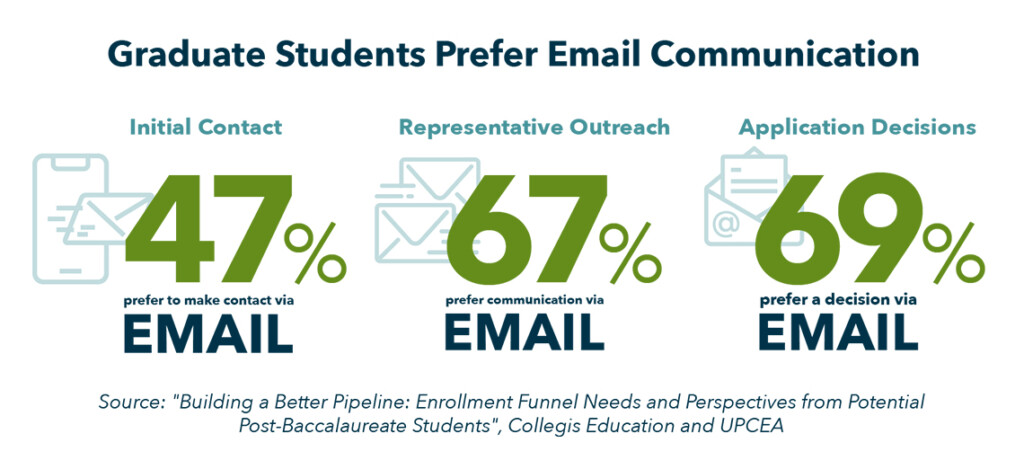
    When it comes to connecting with prospective graduate students, email reigns supreme. Whether it’s inquiring about programs (47%), application follow-ups (67%), or receiving application decisions (69%), email is the channel students trust the most.
    But here’s the catch: your emails have to be timely, personalized, and relevant in order to make an impact.

    The key to graduate enrollment success is just a click away

    The insights highlighted above are just the tip of the iceberg. Imagine what’s possible when you apply them to your graduate enrollment strategy.

    If you’re ready to refine your approach and stay ahead of the curve, we’ve got you covered. Our report dives deeper into the data and uncovers actionable insights, including:

    • Positioning your online and hybrid offerings to meet growing demand
    • Optimizing program pages to emphasize the information students value most
    • Communicating financial information proactively to convert candidates
    • Building email outreach strategies that build trust and keep students engaged

    Grab your complimentary copy of the report today, and let’s start building a better pipeline together!

    Your roadmap to winning in the competitive graduate market.

    Optimize Your Enrollment Funnel

    Get the latest data on graduate student enrollment trends. Download the full report now.

    Source link

  • 2025 Higher Education Trends: What to Watch & How You Can Plan

    2025 Higher Education Trends: What to Watch & How You Can Plan

    Higher education is experiencing transformative shifts as institutions respond to societal, economic, and technological changes. This year is set to bring new opportunities and challenges. We’re always keeping a pulse on the industry and where it’s headed so we can stay proactive and prepared –– ready to support our partners through whatever conditions they’re facing.

    10 most impactful higher ed trends for 2025

    To help institutions stay ahead, we asked our team of experts to share their predictions for this year’s most impactful trends in higher education. From AI and digital transformation to new enrollment strategies, these insights highlight what’s shaping the future of higher ed— and how institutions can adapt.

    1. Increased mergers and consolidations

    The pace of mergers and consolidations among smaller colleges is expected to accelerate in 2025, according to Collegis Education CEO Kim Fahey. With financial pressures and declining enrollment, many institutions will view mergers as a strategic alternative to closure. But these transitions are anything but simple.

    “Mergers involve unique technology requirements and complex data management challenges,” Fahey explains. Successfully integrating applications, systems, and hardware requires expert guidance. Higher ed leaders will look to partner with experienced organizations to help navigate these intricacies.

    2. Heightened focus on data privacy and security

    The information security landscape is becoming increasingly intricate. With 21 comprehensive state privacy laws, alongside European Union (EU) regulations, federal rules, and Title IV requirements, compliance challenges are mounting.

    “Smaller schools often lack the experience and qualifications to manage these threats,” notes Dr. Jason Nairn, CISSP, Collegis VP of Information Technology. Cyberattacks, like phishing and social engineering, are relentless. In 2025, institutions must prioritize more robust cybersecurity measures, leveraging external partnerships and security tools to protect sensitive data.

    3. Acceleration of digital transformation

    Cloud migration will take center stage as institutions transition away from outdated, on-campus systems. While many schools still rely on highly customized platforms, which limits their ability to adopt or migrate to more modern technology, the adaptability and scalability of cloud platforms are simply too compelling to ignore.

    Furthermore, technology infrastructures must be sufficiently modernized in order to capitalize on emerging tech innovations in AI and predictive analysis. This process can’t happen overnight –– it’s an evolution, according to Fahey.

    “Cloud migrations take 18+ months, so schools need to act now,” she emphasizes. An institution-wide commitment to digital transformation will not only modernize operations but also position institutions to stay competitive in an increasingly tech-driven environment.

    4. Adoption of shared services models

    Financial constraints will push smaller schools toward shared services and consortium models to access the technology and expertise they need at a manageable scale. These models allow institutions to pool resources and reduce costs but require significant change management, according to Jeff Certain, VP of Solution Development at Collegis.

    “This will require schools to standardize and make some concessions,” Certain explains. “This could pose a challenge, but they may not have an option.” Institutions must embrace these shifts to remain sustainable while navigating limited budgets.

    5. Growth in career-focused and flexible education

    Programs aligning with workforce needs will gain momentum in 2025. Alternative credentials like microcredentials and certificates will become more prominent, offering shorter, career-oriented pathways for learners.

    “Institutions will increasingly recognize and credit learning outside the classroom, exploring more direct pathways into the workforce,” predicts Dr. Tracy Chapman, Chief Academic Officer for Collegis. This reflects growing demand for flexible, career-focused education that meets student and employer expectations.

    6. Ed tech consolidation and market impact

    It is not just colleges and universities facing consolidation. Ed tech companies and services providers are also reshaping the landscape with their own mergers and acquisitions. While these changes may offer schools more comprehensive solutions, they may not necessarily align with institutional objectives.

    “Some recent acquisitions have led to poorer customer experiences,” Fahey observes. Institutions must carefully evaluate new partnerships to ensure they will deliver meaningful improvements.

    7. Higher Focus on Retention

    With the “enrollment cliff” looming, institutions must double down on maintaining their existing student base as a key to sustainability. Purposeful and cost-effective retention strategies will play a pivotal role in maintaining financial health, as retaining current students is often more cost-effective than recruiting new ones.

    “Retention strategies build stronger, more loyal communities,” says Patrick Green, VP of Enrollment Strategy. Forward-looking schools have perceived the importance of fostering a sense of belonging across the student lifecycle and are providing robust support networks that improve student persistence and satisfaction.

    8. Rise of value-focused marketing

    Students and families are increasingly demanding clear ROI from their education. As a result, institutions will need to demonstrate how their programs lead directly to employment and career advancement.

    “Building relationships with regional industries and showcasing job placement rates will be essential,” advises Tanya Pankratz, AVP of Marketing at Collegis. Marketing efforts will need to start highlighting tangible outcomes (e.g., alumni success stories, job placement rates, and employer partnerships) to win over prospective students.

    9. Expanded role of AI and emerging technologies

    AI and other emerging technologies will revolutionize higher education operations. From enrollment management and personalized marketing to virtual campus tours using augmented reality (AR) and virtual reality (VR), technology has the means to dramatically enhance the student experience –– or wreak technical havoc if data, platforms and tools are misaligned.

    “AI-driven tools make personalization more accessible, but the strategy remains critical,” notes Dan Antonson, AVP of Data and Analytics. Institutions must invest in data infrastructure to fully harness these advancements in order to build and maintain a competitive edge.

    10. Proliferation of strategic partnerships

    Higher ed institutions are increasingly recognizing that they don’t need to own the entire value chain. In 2025, strategic partnerships will play a more prominent role.

    “Institutions will double down on their core mission of education and seek out partners to support other critical functions,” Dr. Chapman explains. These partnerships provide access to technology, expertise, and resources, allowing schools to focus on what they do best — educating students.

    Opportunities on the horizon for higher ed

    As evident in this compilation of higher ed trends, the landscape is set for significant change in 2025 and beyond. Institutions that proactively address these trends will be well-positioned to navigate challenges and seize opportunities. By embracing digital transformation, fostering strategic partnerships, and adopting value-driven approaches, schools can ensure long-term success in an evolving marketplace.

    Excited about the opportunities that lie ahead? Collegis Education has the experience and expertise to guide you through any twists and turns you may face. We’ll help you stay on the leading edge instead of chasing trends. Connect with us and let’s start creating solutions together.

    Innovation Starts Here

    Higher ed is evolving — don’t get left behind. Explore how Collegis can help your institution thrive.

    Source link

  • 2025 Trends in Marketing and Communications

    2025 Trends in Marketing and Communications

    Given my first job out of university was with Vichy L’Oreal where I served briefly as a junior product manager (because I was worth it) I tend to keep an eye of marketing and communication trends, always a moving target. As soon as one has upskilled, or briefed a sub-contractor, the goalposts have moved once again. Nonetheless, largely driven by the furious pace of technological advancements, and the slower shifts in social behaviours, we have seen several trends in 2024.

    Platforms like TikTok, Instagram Reels, and YouTube Shorts have continued to rise to dominance in the social media space, with brands leveraging these formats to create engaging, bite-sized content in the form of short-form video content. Alongside this we have seen commercial organisations allocate significant budgets to creator marketing, where influencers and content creators play a significant role in promoting products and services. The two trends together are just now beginning to be leveraged by universities, and to a lesser extent schools, by encouraging students and staff to generate marketable, authentic, content.

    Another trend of 2024 has been the nascent use of AI and marketing science to finetune marketing strategies and generate targeted personalise content. This, alongside with focussing on omnichannel, consolidated, messaging regardless of the device or platform promises to be a cost saving approach once embedded.

    Everyone is fighting for brand recognition more than ever, so it is not surprising that we see several educational institutions, at all levels, exploring new branding avenues.

    As we look forward to 2025, we can already identify several new trends emerging in marketing and communications. Ubiquitous debate about AI and Machine Learning promises to dominate, particularly as it relates to the regulation of responses to sales queries by AI tools. These should produce a wealth of insights into marketing content creation for those organisations that successfully close the loop.

    The increasing use voice search across platforms requires institutions to think about how their ‘audio-brand’ runs in a crowded space. If the organisation is the ‘London School of Economics and Political Science’ but everyone who is already in the know says ‘LSE’, not problem. What about those that don’t?

    The web is awash with predictions about the impact of AR and VR for 2025, but having presented at a conference in 2019 on AR/VR and Learning Design, and being assured that universal adoption was within 12-18 months… I am still holding my breath. There are great examples of 3D campus walk-throughs, and I suspect for most that works well enough.

    The focus for everyone in marketing and communications, in education as much as elsewhere, will (almost) undoubtedly be on the importance of innovation and authenticity. The trend that keeps giving.

    Source link

  • Attracting International Graduate Students – Edu Alliance Journal

    Attracting International Graduate Students – Edu Alliance Journal

    May 31, 2022, by Don Hossler – Setting a Context for Recruiting International Graduate Students

    There is a dearth of research on the factors that influence international graduate students to select the graduate program in which s/he will enroll. For decades, my advice to enrollment managers has been to look at the research on what influences the enrollment decisions of high ability domestic undergraduates and assume that many of the same factors will be at play. Keep in mind that for these prospective students the decision to enroll out of home country is a risky decision. It is risky because many of these students will have never lived out of their home countries. Students from more affluent families may have traveled abroad, but many  prospective students will not have done so. They are unaccustomed to the cultural norms in other countries.

    Recruiting international graduate students involve different considerations. For example, international students seeking master’s degrees in applied areas such as MBAs, and students looking at Ph.D. programs in STEM fields will have different concerns. Prospective students may have never studied in a setting where the language of the host country was the only language spoken. If a student is from some regions of Africa, Asia, or South America it is possible that the teaching style to which they have been exposed is didactic. But if the student is looking at studying in Western Europe, Canada, the United States the instructional style will be more dialectic, with give and take between students and faculty. All of these factors should be considered when universities/specific graduate programs craft recruitment strategies.

    Female students from Europe or North America, may be reluctant to consider graduate programs in the Middle East or parts of Asia because the roles of women, both inside and outside of the classroom is more constrained. Women from more religiously conservative Islamic countries may not be allowed to travel outside of home country without a male chaperone (Muharem). When graduate programs are considering the applications from students who have not grown-up in western industrialized countries consideration should be given to the fact that GRE score may not accurately reflect the abilities of prospective students. It should be clear by this point those institutions who seek to recruit graduate students from across the globe need to do their homework to be culturally sensitive.

    The Importance of Program Quality

    For graduate programs that seek to attract the best students from around the globe there are some universal truths.

    1. One of the differences between graduate and undergraduate programs is that students are likely to have courses taught by some of the leading scholars in the field. Graduate programs need to capitalize on this when attempting to recruit international students.
    2. The ranking of a graduate program is of great import. The further a graduate program is removed from being ranked among the best programs in the world, the more difficult it becomes to attract top graduate students.
    3. The reputation of individual faculty members also matters. In top ranked MBA programs, or in a STEM field for example, there may be a single professor that is regarded to be amongst the best researchers in the world in his or her field.
    4. For prospective graduate students looking only at elite programs, it is important that they have a chance to interact with faculty members by phone, video conferencing, email, and visits to campus prior to enrollment. There is always the risk that a  world-renowned professors will treat students like they are lucky to be talking to him/her – which is a mistake. Returning to a theme from my last essay on recruiting international undergraduates, graduate programs should court these top students, they will have other choices. Do not treat them like you are their only choice.
    5. Another important consideration for prospective students is the opportunity to participate in internships or to serve as research assistants (and later in post-doc fellowships). For more applied master’s degree programs, the opportunity to be part of consulting efforts can be a consideration. Finally, the longer the time period allowed for time spent in internships or in post-graduate fellowships – the better.
    6. In addition, cost matters. Prospective doctoral students in STEM fields will assume that they will get a research assistantship that will cover all, or most, costs. Most master’s degree programs do not include assistantships, thus tuition and fees, along with the availability of financial aid will influence their decisions.

    In addition to the factors above, there are other considerations for prospective students. In fields and programs, where students hope to become pre-eminent researchers there is often a preference that instruction be in English. There are practical reasons for this preference. For prospective doctoral students, the majority of the top journals in STEM fields are published in English. Often conference papers are presented in English. In the case of business, both spoken and written English is the lingua franca of international business.

    While less important, there are other considerations for prospective students. The permeability of the country culture in which the institution has been admitted can also be a consideration. Can students easily connect with other students and the wider community? Personal safety is also a factor. For example, this is often a concern about studying in the United States. In addition, any recent perceived mistreatment of international students quickly spreads across the globe. The visa process put into place by the Trump administration or China’s decision to expel all international students during the pandemic are examples of government policies that can influence the decisions of future graduate students.

    Many  international students are admitted and enroll in less prestigious graduate programs so high rankings are not always a key factor. Some students coming from Third World Countries may hope to immigrate to the country in which they choose to study. Thus, the probabilities of legal immigration can matter. Proximity to extended family and of course the probability of being admitted can be a factor.

    What Should Graduate Programs Do?

                Graduate programs that seek to enroll international students need to organize themselves to do this effectively. Unlike efforts to enroll undergraduates, where the image of an entire university plays a major role in matriculation decisions, the prestige and structure of an individual graduate program is what matters. The faculty of the program, with the support of the academic unit in which the program is housed, need to be clear eyed about the program’s strength and weaknesses. In addition, graduate programs need  to collect information on all of the students who applied, which ones were admitted, and where they enrolled. The use of data is critical especially for programs that are seeking to move higher in rankings schemes.

                Successful efforts require more organizational structure and focus than is often found at the program level. Any fellowships and scholarships need to be used in a strategic and coordinated manner. Programs need to develop communication strategies and targeted web pages –  this is necessary regardless of how highly ranked a graduate program may be. Both the communication streams and the website need to be customized to reflect the unique interests of international students. The concerns of prospective international doctoral students in Education are different from those of potential master’s students in Bioinformatics, or potential Ph.D., students in Materials Science.

                For universities and for graduate programs that seek to enroll more international graduate students there are a host of factors that influence students’ enrollment decisions. Program leaders need to be thoughtful and strategic in order to achieve their goals. Less prestigious programs may need to consider using recruiting agents, similar to undergraduate recruitment. It is likely to be necessary to assign many of these tasks to a professional staff position who has the time and expertise to create a highly integrated recruitment, admissions, and scholarship function.


    Donald Hossler a member of the Edu Alliance Group Advisory Council is an emeritus professor of educational leadership and policy studies at Indiana University Bloomington (IUB). He currently serves as a Senior Scholar at the Center for Enrollment Research, Policy and Practice in the Rossier School of Education, at the University of Southern California. Hossler has also served as vice chancellor for student enrollment services, executive associate dean of the School of Education, and the executive director of the National Student Clearinghouse Research Center.

    Hossler’s areas of specialization include college choice, student persistence, student financial aid policy, and enrollment management. Hossler has received career achievement awards for his research, scholarship, and service from the American College Personnel Association, the Association for Institutional Research, the College Board, and the National Association of Student Personnel Administrators. He recently received the Sonneborn Award for Outstanding Research and Teaching from IUB and was named a Provost Professor.


    Edu Alliance Group, Inc. (EAG) is an education consulting firm located in Abu Dhabi, the United Arab Emirates, and Bloomington, Indiana, USA. We assist higher education institutions worldwide on a variety of mission-critical projects. Our consultants have accomplished university/college leaders who share the benefit of their experience to diagnose and solve challenges.

    EAG has provided consulting and successful solutions for higher education institutions in Australia, Egypt, Georgia, India, Kazakhstan, Morocco, Nigeria, Uganda,  United Arab Emirates, and the United States.

    Edu Alliance offers higher education institutions consulting services worldwide. If you like to know more about how Edu Alliance can best serve you, please contact Dean Hoke at [email protected] 

    Source link