Category: Students

  • A sea change in student partnership

    A sea change in student partnership

    A few years back now, someone who worked for one of Scotland’s sector agencies liked to draw a comparison when talking about student-centredness.

    They said that conservation charities passionately place wildlife at the heart of everything they do, but crucially would never put representatives of flora and fauna on committees (imagine the mess).

    Therefore, my erstwhile and esteemed colleague would argue, when institutional leaders proudly claim to be “student-centred” it reveals nothing about how they involve students in shaping their experiences.

    Of course, you can diligently monitor wildlife and use your data to make good decisions, in a manner not dissimilar to learning analytics in education, but the difference is that students can then go on to be a part of conversations in a way that wildlife never can.

    Waterproof papers

    My mind was cast back to this parallel when I saw the recent news that the Scottish Association for Marine Science (SAMS), one of our partners here at the University of the Highlands and Islands (UHI), has put The Ocean on its governing body.

    It’s a move that SAMS’ Director Nick Owens admits “could be seen as trivial or ‘greenwashing’”, and we might imagine other specialist institutions making similar gestures in the disciplines they so richly embody and advance.

    For instance a conservatoire could put “Music” on their board, or an agricultural college “The Land”.

    Nick explains further, however:

    The Ocean is clearly a metaphor in this context and cannot represent itself in human terms.”

    That point is vital because, if we go back to our parallel, SAMS has already gone much further with its other main cause – students.

    Like all constituent parts of UHI and indeed our university overall, SAMS has student membership on its governing body, not to just sit there and wave like the ocean might, or to flap about disruptively like a bird among a wildlife charity’s trustees.

    Instead, we expect of student governors an informed, constructive and active contribution.

    As my colleague Aimee Cuthbert wrote on Wonkhe a year ago, we have a major project that is making that student membership truly effective and impactful across UHI’s complex governance arrangements.

    On a basic level we want to build on national guidelines such as Scotland’s codes of good governance for colleges and universities and support packages such as those from the College Development Network.

    The wet room

    In our own unique context we want to make sure UHI’s governing bodies do not merely talk about students as an abstract concept or worthy concern, and instead have them in the room to provide meaningful input about students’ diverse and complex experiences and the implications for students of the difficult decisions that must be made.

    That means a lot of work with those involved in our governing bodies, exploration of the key issues on our boards’ desks at a time of change, and helping our local officers impact on their individual partner governing bodies while also working together as a team to impact on decisions that are UHI-wide.

    A core part of our project is therefore that very human process of communication – supporting the networking, sharing practice and informal relationship building that makes student governors truly a part of the process in a way that an ocean can’t be.

    So, when someone tells you their institution is student-centred, that’s arguably the very least we might expect, and in isolation such a declaration risks viewing students in the same way that others might view wildlife.

    The Ocean as governor, therefore, is not only a striking metaphor for SAMS’ important mission, but has added power in benchmarking our perceptions of those we claim to be here for – reminding us that there’s a big difference between caring about students and actively involving them as partners.

    Source link

  • 25 (Mostly AI) Sessions to Enjoy in 2025 – The 74

    25 (Mostly AI) Sessions to Enjoy in 2025 – The 74


    Get stories like this delivered straight to your inbox. Sign up for The 74 Newsletter

    South by Southwest Edu returns to Austin, Texas, running March 3-6. As always, it’ll offer a huge number of panels, discussions, film screenings, musical performances and workshops exploring education, innovation and the future of schooling.

    Keynote speakers this year include neuroscientist Anne-Laure Le Cunff, founder of Ness Labs, an online educational platform for knowledge workers; astronaut, author and TV host Emily Calandrelli, and Shamil Idriss, CEO of Search for Common Ground, an international non-profit. Idriss will speak about what it means to be strong in the face of opposition — and how to turn conflict into cooperation. Also featured: indy musical artist Jill Sobule, singing selections from her musical F*ck 7th Grade.

    As in 2024, artificial intelligence remains a major focus, with dozens of sessions exploring AI’s potential and pitfalls. But other topics are on tap as well, including sessions on playful learning, book bans and the benefits of prison journalism. 

    To help guide the way, we’ve scoured the schedule to highlight 25 of the most significant presenters, topics and panels: 

    Monday, March 3:

    11 a.m. — Ultimate Citizens Film Screening: A new independent film features a Seattle school counselor who builds a world-class Ultimate Frisbee team with a group of immigrant children at Hazel Wolf K-8 School. 

    11:30 a.m. — AI & the Skills-First Economy: Navigating Hype & Reality: Generative AI is accelerating the adoption of a skills-based economy, but many are skeptical about its value, impact and the pace of growth. Will AI spark meaningful change and a new economic order, or is it just another overhyped trend? Meena Naik of Jobs for the Future leads a discussion with Colorado Community College System Associate Vice Chancellor Michael Macklin, Nick Moore, an education advisor to Alabama Gov. Kay Ivey, and Best Buy’s Ryan Hanson.

    11:30 a.m. — Navigation & Guidance in the Age of AI: The Clayton Christensen Institute’s Julia Freeland Fisher headlines a panel that looks at how generative AI can help students access 24/7 help in navigating pathways to college. As new models take root, the panel will explore what entrepreneurs are learning about what students want from these systems. Will AI level the playing field or perpetuate inequality? 

    12:30 p.m. — Boosting Student Engagement Means Getting Serious About Play: New research shows students who are engaged in schoolwork not only do better in school but are happier and more confident in life. And educators say they’d be happier at work and less likely to leave the profession if students engaged more deeply. In this session, LEGO Education’s Bo Stjerne Thomsen will explore the science behind playful learning and how it can get students and teachers excited again.

    1:30 p.m. — The AI Sandbox: Building Your Own Future of Learning: Mike Yates of The Reinvention Lab at Teach for America leads an interactive session offering participants the chance to build their own AI tools to solve real problems they face at work, school or home. The session is for AI novices as well as those simply curious about how the technology works. Participants will get free access to Playlab.AI.

    2:30 p.m. — Journalism Training in Prison Teaches More Than Headlines: Join Charlotte West of Open Campus, Lawrence Bartley of The Marshall Project and Yukari Kane of the Prison Journalism Project to explore real-life stories from behind bars. Journalism training is transforming the lives of a few of the more than 1.9 million people incarcerated in the U.S., teaching skills from time management to communication and allowing inmates to feel connected to society while building job skills. 

    Tuesday, March 4:

    11:30 a.m. — Enough Talk! Let’s Play with AI: Amid the hand-wringing about what AI means for the future of education, there’s been little conversation about how a few smart educators are already employing it to shift possibilities for student engagement and classroom instruction. In this workshop, attendees will learn how to leverage promising practices emerging from research with real educators using AI in writing, creating their own chatbots and differentiating support plans. 

    12:30 p.m. — How Much is Too Much? Navigating AI Usage in the Classroom: AI-enabled tools can be helpful for students conducting research, outlining written work, or proofing and editing submissions. But there’s a fine line between using AI appropriately and taking advantage of it, leaving many students wondering, “How much AI is too much?” This session, led by Turnitin’s Annie Chechitelli, will discuss the rise of GenAI, its intersection with academia and academic integrity, and how to determine appropriate usage.  

    1 p.m. — AI & Edu: Sharing Real Classroom Successes & Challenges: Explore the real-world impact of AI in education during this interactive session hosted by Zhuo Chen, a text analysis instructor at the nonprofit education startup Constellate, and Dylan Ruediger of the research and consulting group Ithaka S+R. Chen and Ruediger will share successes and challenges in using AI to advance student learning, engagement and skills. 

    1 p.m. — Defending the Right to Read: Working Together: In 2025, authors face unprecedented challenges. This session, which features Scholastic editor and young adult novelist David Levithan, as well as Emily Kirkpatrick, executive director of the National Council of Teachers of English, will explore the battle for freedom of expression and the importance of defending reading in the face of censorship attempts and book bans.

    1 p.m. — Million Dollar Advice: Navigating the Workplace with Amy Poehler’s Top Execs: Kate Arend and Kim Lessing, the co-presidents of Amy Poehler’s production company Paper Kite Productions, will be live to record their workplace and career advice podcast “Million Dollar Advice.” The pair will tackle topics such as setting and maintaining boundaries, learning from Gen Z, dealing with complicated work dynamics, and more. They will also take live audience questions.

    4 p.m. — Community-Driven Approaches to Inclusive AI Education: With rising recognition of neurodivergent students, advocates say AI can revolutionize how schools support them by streamlining tasks, optimizing resources and enhancing personalized learning. In the process, schools can overcome challenges in mainstreaming students with learning differences. This panel features educators and advocates as well as Alex Kotran, co-founder and CEO of The AI Education Project.

    4 p.m. — How AI Makes Assessment More Actionable in Instruction: Assessments are often disruptive, cumbersome or disconnected from classroom learning. But a few advocates and developers say AI-powered assessment tools offer an easier, more streamlined way for students to demonstrate learning — and for educators to adapt instruction to meet their needs. This session, moderated by The 74’s Greg Toppo, features Khan Academy’s Kristen DiCerbo, Curriculum Associates’ Kristen Huff and Akisha Osei Sarfo, director of research at the Council of the Great City Schools.

    Wednesday, March 5:

    11 a.m. — Run, Hide, Fight: Growing Up Under the Gun Screening & Q&A: Gun violence is now the leading cause of death for American children and teens, according to the federal Centers for Disease Control and Prevention, yet coverage of gun violence’s impact on youth is usually reported by adults. Run, Hide, Fight: Growing Up Under the Gun is a 30-minute documentary by student journalists about how gun violence affects young Americans. Produced by PBS News Student Reporting Labs in collaboration with 14 student journalists in five cities, it centers the perspectives of young people who live their lives in the shadow of this threat. 

    11:30 a.m. — AI, Education & Real Classrooms: Educators are at the forefront of testing, using artificial intelligence and teaching their communities about it. In this interactive session, participants will hear from educators and ed tech specialists on the ground working to support the use of AI to improve learning. The session includes Stacie Johnson, director of professional learning at Khan Academy, and Dina Neyman, Khan Academy’s director of district success. 

    11:30 a.m. — The Future of Teaching in an Age of AI: As AI becomes increasingly present in the classroom, educators are understandably concerned about how it might disrupt their teaching. An expert panel featuring Jake Baskin, executive director of the Computer Science Teachers Association andKarim Meghji of Code.org, will look at how teaching will change in an age of AI, exploring frameworks for teaching AI skills and sharing best practices for integrating AI literacy across disciplines.

    2:30 p.m. — AI in Education: Preparing Gen A as the Creators of Tomorrow: Generation Alpha is the first to experience generative artificial intelligence from the start of their educational journeys. To thrive in a world featuring AI requires educators helping them tap into their natural creativity, navigating unique opportunities and challenges. In this session, a cross-industry panel of experts discuss strategies to integrate AI into learning, allowing critical thinking and curiosity to flourish while enabling early learners to become architects of AI, not just users.

    2:30 p.m. — The Ethical Use of AI in the Education of Black Children: Join a panel of educators, tech leaders and nonprofit officials as they discuss AI’s ethical complexities and its impact on the education of Black children. This panel will address historical disparities, biases in technology, and the critical need for ethical AI in education. It will also offer unique perspectives into the benefits and challenges of AI in Black children’s education, sharing best practices to promote the safe, ethical and legal use of AI in classrooms.

    2:30 p.m. — Exploring Teacher Morale State by State: Is teacher morale shaped by where teachers work? Find out as Education Week releases its annual State of Teaching survey. States and school districts drive how teachers are prepared, paid and promoted, and the findings will raise new questions about what leaders and policymakers should consider as they work to support an essential profession. The session features Holly Kurtz, director of EdWeek Research Center, Stephen Sawchuk, EdWeek assistant managing editor, and assistant editor Sarah D. Sparks.

    2:30 p.m. — From White Folks Who Teach in the Hood: Is This Conversation Against the Law Now? While most students in U.S. public schools are now young people of color, more than 80% of their teachers are white. How do white educators understand and address these dynamics? Join a live recording of a podcast that brings together white educators with Christopher Emdin and sam seidel, co-editors of From White Folks Who Teach in the Hood: Reflections on Race, Culture, and Identity (Beacon, 2024).

    3:30 p.m. — How Youth Use GenAI: Time to Rethink Plagiarism: Schools are locked in a battle with students over fears they’re using generative artificial intelligence to plagiarize existing work. In this session, join Elliott Hedman, a “customer obsession engineer” with mPath, who with colleagues and students co-designed a GenAI writing tool to reframe AI use. Hedman will share three strategies that not only prevent plagiarism but also teach students how to use GenAI more productively.  

    Thursday, March 6:

    10 a.m. — AI & the Future of Education: Join futurists Sinead Bovell and Natalie Monbiot for a fireside discussion about how we prepare kids for a future we cannot yet see but know will be radically transformed by technology. Bovell and Monbiot will discuss the impact of artificial intelligence on our world and the workforce, as well as its implications for education. 

    10 a.m. — Reimagining Everyday Places as Early Learning Hubs: Young children spend 80% of their time outside of school, but too many lack access to experiences that encourage learning through hands-on activities and play. While these opportunities exist in middle-class and upper-income neighborhoods, they’re often inaccessible to families in low-income communities. In this session, a panel of designers and educators featuring Sarah Lytle, who leads the Playful Learning Landscapes Action Network, will look at how communities are transforming overlooked spaces such as sidewalks, shelters and even jails into nurturing learning environments accessible to all kids.

    11 a.m. — Build-a-Bot Workshop: Make Your Own AI to Make Sense of AI: In this session, participants will build an AI chatbot alongside designers and engineers from Stanford University and Stanford’s d.school, getting to the core of how AI works. Participants will conceptualize, outline and create conversation flows for their own AI assistant and explore methods that technical teams use to infuse warmth and adaptability into interactions and develop reliable chatbots.  

    11:30 a.m. — Responsible AI: Balancing Innovation, Impact, & Ethics: In this session, participants will learn how educators, technologists and policymakers work to develop AI responsibly. Panelists include Isabelle Hau of the Stanford Accelerator for Learning, Amelia Kelly, chief technology officer of the Irish AI startup SoapBox Labs, and Latha Ramanan of the AI developer Merlyn Mind. They’ll talk about how policymakers and educators can work with developers to ensure transparency and accuracy of AI tools. 


    Get stories like these delivered straight to your inbox. Sign up for The 74 Newsletter

    Source link

  • Philadelphia Schools Could Start Before Labor Day for the Next 2 Years – The 74

    Philadelphia Schools Could Start Before Labor Day for the Next 2 Years – The 74


    Get stories like this delivered straight to your inbox. Sign up for The 74 Newsletter

    Philadelphia students could head back to classes before Labor Day for the next two years, according to proposed academic calendars the district released Tuesday.

    The pre-Labor Day start for the 2025-26 and 2026-27 calendars will allow for longer spring and winter recesses as well as additional cultural and religious holidays throughout the year, district officials said this week.

    Superintendent Tony Watlington also confirmed Tuesday that district schools and offices will be closed on Friday for the Philadelphia Eagles celebratory Super Bowl parade.

    “We look forward to celebrating the Eagles’ victory as a community, and we hope that our students, staff and families will do so safely and responsibly,” Watlington said in a statement.

    The question of whether to start before or after Labor Day has rankled families and district leaders in recent years, in part because many Philly schools do not have adequate air conditioning. That has forced some buildings to close or dismiss students early due to excessive heat in the first week back.

    This school year, the first day back landed before Labor Day, and 63 schools without air conditioning dismissed students early, during the first week of classes. However, school started after Labor Day in 2023-24, and heat closures still impacted students’ learning time that first week.

    Watlington said at his state of the schools address this year that over the past three school years, the number of schools without air conditioning has shrunk from 118 to 57 thanks in part to a donation from Eagles quarterback Jalen Hurts.

    Shakeera Warthen-Canty, assistant superintendent of school operations and management at the district, said their academic calendar recommendations this year are built off of a survey and several in-person feedback sessions.

    The majority of parents and caregivers who responded preferred a post-Labor Day start, the survey found. But students, teachers, school staff, and community members reported they overwhelmingly preferred starting the school year before Labor Day.

    Some 16,400 parents, students, school staff, principals, and community members responded to the survey the district sent out last September, Warthen-Canty said.

    Respondents also said they wanted more frequent breaks for longer durations to accommodate family vacations, as well as time to rest, support mental health, and prevent staff burnout.

    State law says districts must have a minimum of 180 student days, or a minimum of 900 instructional hours for elementary school students and 990 hours for middle and high school students. The district’s collective bargaining agreement with the teachers union also requires 188 teacher work days, as well as a minimum of 28 professional development hours.

    The district officials’ calendar recommendations will go to the school board for a vote before they are enacted.

    If approved, winter recess would be seven days in 2025-26 and eight days in 2026-27, while spring break would be five days both years.

    In addition to the five state and national holidays (Memorial Day, Independence Day, Christmas, Thanksgiving, and New Year’s Day), Philadelphia school district school holidays in 2025-26 and 2026-27 would include:

    • Labor Day
    • Rosh Hashanah
    • Yom Kippur
    • Indigenous Peoples Day
    • Veterans Day
    • Martin Luther King Jr. Day
    • Presidents Day
    • Lunar New Year
    • Eid al-Fitr
    • Good Friday
    • Eid al-Adha
    • Juneteenth

    This school year, both Indigenous Peoples Day and Veterans Day were school days.

    As for how the new calendar may interact with Philadelphia Mayor Cherelle Parker’s commitment to “extended-day, extended-year” school: Deputy Superintendent Jermaine Dawson said this week the district has ensured any expansion of that program will work “alongside our calendar of school days.”

    This story was originally published at Chalkbeat, a nonprofit news site covering educational change in public schools.


    Get stories like these delivered straight to your inbox. Sign up for The 74 Newsletter

    Source link

  • Social mobility is about to die – and university won’t help

    Social mobility is about to die – and university won’t help

    In 1994, the year that HESA was born and we started to count those with degrees from former polytechnics in the stats, about 225,000 full-time home-domiciled students graduated with a first degree in the UK.

    Today the Russell Group enrols about 350k. Funny that those who say too many people go to university tend to stay tight lipped about that part of the sector’s “dilution”.

    Ten years later, then funding council boss Howard Newby said:

    [T]he English—and I do mean the English—do have a genius for turning diversity into hierarchy and I am not sure what we can do about that, to be quite honest. It is very regrettable that we cannot celebrate diversity rather than constantly turning it into hierarchy.

    The switch of circa 125,000 students from poly to university in the early 90s was one of the signature moments of the status/sorting panic that has accompanied the expansion of higher education over time.

    The story runs something like this. Access to university has never been evenly distributed across the social-economics. And having a degree seems to bestow upon graduates socio-economic advantages.

    So over the long-run, rather than doing the hard yards of making entry distribution fairer – which, whatever method is used, necessarily involves saying “no” to some who think they have a right to go – the easier thing has always been to say “yes” and expand instead.

    Hence when in 2018 OfS had a choice between Option 1:

    …it obviously couldn’t persuade ministers to front out Option 1. So everyone let Option 2 happen instead – only without the money to support it. And now look at the mess we’re in.

    Option 2 – whether applied to the whole sector or just the elite part – creates a problem for those who enjoy the relative rarity of the signalling. The signal is less powerful, partly because there are few who look back on their time at university and think “maybe if it was truly meritocratic I wouldn’t have made it in”.

    It also ought to be expensive to expand – so over time both universities and their students are instead expected to become more and more efficient, or fund participation through future salary contributions to pay for the expansion.

    And if overall participation levels off, Option 2 applied just to the elite part of the sector yanks students away from everywhere else – with huge geographical and social consequences along the way.

    There is a human capital upside of mass participation. The better educated the population, the more inventive and healthy and happy and productive it will be in general. But without other actions, that doesn’t address the relative inequalities of getting in or getting on.

    Onwards and upwards

    The phrase “social mobility” doesn’t actually appear in the 2024 Labour Manifesto – but it’s lurking around in the opportunity mission as follows:

    We are a country where who your parents are – and how much money they have – too often counts for more than your effort and enterprise… so breaking the pernicious link between background and success will be a defining mission for Labour.

    Good luck with that. Part of the question for me that surrounds that is the scale of that challenge insofar as it concerns higher education – and what is coming soon in the stats that will make that easier or harder.

    For the past few decades, different iterations of the “efficiencies” needed to massify – which focussed largely on the transfer of the costs of participation from state to graduate – have had three core features designed to reconcile the expansion and efficiency thing with the goals of social mobility before, during and after HE:

    • Initiatives (a mix of sticks and carrots, inputs and outcomes and getting in v getting on) aimed at broadening the characteristics of those getting in into higher education
    • No upfront participation costs via loans to students for maintenance and tuition – so being in it felt “equal”
    • Loan interest and income-contingent repayment arrangements designed to redistribute some of the relative economic success to the less successful

    Taken together, the idea has been that accessing the signalling benefits will be easier via expansion and fairness fixes; that the experience itself resembles the “school uniform” principle of everyone having a fairly similar experience; and then that those who reap the economic rewards shoulder the biggest burden (and in that a burden a bit bigger than it actually cost) in paying for it all.

    You tackle inequality partly through opportunity, and partly through outcomes – the rich pay more both than others and more than the actual cost. So central was redistribution to the design of the fee and loan system in the last decade that the government announced and formally consulted on a plan for early repayment mechanisms to stop people on high incomes being able to “unfairly buy themselves out of this progressive system”.

    But a decade on, the government is in a real bind. The initiatives aimed at broadening the characteristics of those enrolling into higher education look much less impactful than just expanding – especially in “high tariff” providers.

    The cost of living – especially for housing – is wrecking the “school uniform” principle unless we were to loan students even more money – which has its… costs.

    And having reduced interest on student loans to inflation – paid for by a longer loan term – it’s hard to think of a more politically toxic move than slapping it back on, however redistributive it will look on an excel sheet.

    A bigger mountain to climb

    That all exacerbates the social mobility challenge. Students cluster into the Russell Group because that group of providers now has the same “meaning” for the press and parents that “university” had prior to 1992.

    Whether in the Russell Group or not, the differential student experiences of haves and have-nots (both inside and outside of the curriculum) will show up both in their actual skills and what they can “sell” to employers. And the most successful graduates from the most attractive-sounding universities will pay less for university across their lifetime, while everyone else will pay more.

    In a way though, even thinking about social mobility or the redistributive graduate contribution scheme in terms of relative lifetime salary is the biggest problem of all. Because given what’s coming, it really should be the least of our worries.

    Since Tony Blair increased tuition fees to £3,000, above-inflation house price growth has delivered an unearned, unequal and untaxed £3 trillion capital gains windfall in Britain. 86 per cent above inflation house price growth over the past 20 years has delivered capital gains on home owners’ main residences worth £3 trillion – now a fifth of all wealth in Britain.

    The value of household wealth stood at around three times the value of national income throughout the 1960s and 1970s – but since the 1980s, the rate at which households have accumulated wealth has accelerated, outpacing the growth in national income, so that the stock of household wealth was estimated to be 7.6 times GDP at the end of 2020.

    Wealth matters. For those who have accumulated it, it provides a better ability to absorb shocks to income, easier access to lower-cost credit, and facilitates investment in significant assets such as housing. But it’s not equally held.

    Wealth is about twice as unequal as the income distribution, and because growth in wealth is outpacing growth in household income it is harder for those currently without it to accumulate it, and enjoy the same benefits outlined above – because as the value of assets rise relative to income, it becomes harder for someone to “save” their way up the wealth distribution.

    The least wealthy third of households have gained less than £1,000 per adult on average, compared to an average gain of £174,000 for the wealthiest ten per cent. Gains have been largest in London, where on average people have gained £76,000 since 2000, and smallest in the North East of England, with an average gain of just £21,000.

    As Robert Colville points out in The Times:

    We have come to realise that what is really dividing our society, as that £5.5 trillion starts to cascade down the generations, is not the boomers’ greed but their love.

    There’s an age aspect to the inequality – those aged 60+ have seen the biggest windfalls at around £80,000 on average – compared to an average of less than £20,000 for those under 40 years of age. But that age aspect also points to something hugely important that’s coming next – because eventually, those older people will die – and who they transfer their wealth to, and what it’s invested in, will matter. Because not only does wealth inequality dwarf wage inequality, it also predicts and drives it.

    Student transfers

    Here thanks to the Resolution Foundation we can see how intergenerational transfers (both gifts and inheritances) will become increasingly important during the century, as older households disperse their wealth at death via inheritances. It estimates that those transfers are set to double over the next 20 years as the large baby-boomer cohort move into late retirement – and it is likely that more wealth will be dispersed by these households while they are alive through gifts.

    And it’s when that ramps up that the interaction with any tuition fee system that will really start to matter.

    Since 2015/16, DfE figures for England tell us that between 10.1 and 13.6 per cent of entrants at Level 6 have self-funded. Some of that will be PT/CPD type activity, some of it students running out of SLC entitlement, and some not drawing down debt for religious reasons – but most will be people who can just afford it.

    Of course what a fixed-ish percentage hides a bit is the number growth – if HE participation has been growing “at the bottom” of the social-economics, a fixed-ish percentage means that more on equivalent incomes are paying upfront. In 2022/23, a record 54,700 entrants were marked up as “no award or financial backing”.

    In the original £9,000 fees system, it made little sense to opt-out of student loans – because the vast majority never paid it back in full by design. But now with a cheaper (in real terms) tuition fee, a frozen repayment threshold and an extended term of 40 years, the calculation has changed – suddenly it makes much more sense to avoid the debt if you can.

    And so given that paying for your younger relatives’ tuition fees represents a way of investing some of that inheritance in way that avoids inheritance tax, we’d have to assume that unchecked, not only will richer graduates in the loan scheme get a much better lifetime deal than they did a few years ago, more and more won’t be in the scheme at all.

    (The green line is the system we had for most of the last decade – the grey line the system the Conservatives slipped past everyone on their way out).

    Even if every penny of an inheritance was drained away on paying for HE upfront, if we compare two graduates – one with 40 years of graduate repayments ahead of them, and one without, it doesn’t take long to clock how impossible social mobility becomes for otherwise notionally equal graduates.

    Then assume that those getting their fees and costs paid for them while they’re a student are clustered into the Russell Group and its signals already – and lay on top of that the fact that those without a windfall coming are more likely to be those with a pretty thin “student experience” and so without the skills or cultural capital to cheat the socio-economic odds, and you pretty quickly need to give up and go home.

    The problem that that all leaves is pretty significant – partly because wealth inequality is already more stratified than income, partly because it drives the type and value of HE experience a student might have, and partly because HE participation has a much better track record at delivering salary gains and salary redistribution than it does at delivering wealth gains or wealth redistribution.

    Put another way, it might be a rite of passage, and it might be good to have a better educated population, but without the prospect of it delivering social mobility, it will lose both real and symbolic value.

    Hierarchy or diversity?

    So in reverse order, what can be done? On the way out, if there must be a graduate contribution system, not only does it have to return to attempting to redistribute from the richest to the poorest, it has to do so by expecting a fair chunk of that boomer windfall to fund some redistribution.

    An above inflation interest rate has to return – and upfront fee payers shouldn’t be able to just buy a better education for themselves, as they can in the US – they should be expected to contribute more into the pot for everyone’s benefit. Higher fees, but only for for upfront payers – DfE needs to dust off that consultation from the last decade, and fast.

    During, we’ll need to redouble efforts to re-establish at least a notional run at the school uniform principle – carefully calibrating student income and experience to return to a baseline where everyone experiences something similar.

    Some of that is about reducing the costs of participation rather than loaning more money to meet them, some is about defining a contemporary student experience so that those who need to work can do so with dignity while extracting educational value, and those that don’t are expected to. It’s also about a credit system that recognises the educational value of extracurricular activity – so that everyone has time to take part in it.

    Then on the way in, we need more mixing – we do need Scenario 1 to return as a much tougher target.

    As well as that, the clustering up the league tables as a way of avoiding harder questions about access in our elite institutions almost certainly needs to stop. Taken to its logical conclusion, in a couple of decades there will only be 24 universities left (and in the minds of the press and parents, we’re arguably already there) – but if Labour facilitates only 19 cities having students and graduates in them, both it and everywhere else is doomed.

    Labour, in other words, has to start saying no:

    • It could say “no” to current university growth altogether, letting further education grow to soak up demand as polytechnics did when universities were capped in the 80s;
    • It could say “no” to any more university growth in current locations, allowing expansion into other places with all the economic and social benefits that would bring;
    • It could say “no” to any more “residential” places at universities, causing colleges and universities to become more comprehensive as they rush to make commuting more normal;
    • Or it could say “no” to “low value” courses, on the assumption that supply and then demand will flow into “high value” ones – if, of course, it could find a credible way of differentiating between the two.

    Part of the balancing act to choking off clustering is one other thing that should matter to Labour. The scandal isn’t that applicant X can’t quite get into the Russell Group with 3 A*s. It’s that we still have a system that somehow writes off the student and the university they attend if they don’t.

    Making it much more attractive to commute (coupled with a domestic Erasmus), talking up not just alternatives to university but universities that aren’t the Russell Group, abolishing the archaic degree classification system, ripping up all the quality systems that have singularly failed to “assure” the press and the public that quality can be found elsewhere, and forcing through some institutional subject specialisms (and obvious vocational excellence) within the system would all help.

    Do all of that, and maybe one day, a senior figure in HE might be able to claim that mass higher education – and all the rich benefits it brings – both survived and thrived because it finally found a way to celebrate diversity rather than forever turning it into hierarchy.

    Source link

  • OfS is starting to better understand the student interest

    OfS is starting to better understand the student interest

    Part of the point of having a regulator focused on students, rather than – say – a funding council or a department, was always about acting in “the student interest” rather than, say, the “provider” interest.

    But ever since HEFCE started talking about “the student interest” back when it made the Quality Assurance Agency bid to become its quality assurance agency, there’s always been a vague sense that “the student interest” is only ever really definable by reference to what it isn’t, rather than what it is.

    Can you define “a seminar”? Maybe not. Is 150 people in a room “a seminar?” Nope. And so on.

    In theory, once you know what “the student interest” actually is, you can then embed it into regulatory priority setting, regulatory design and regulatory activity.

    It’s a laudable principle, but as the idea hit reality it turned out that the sheer diversity and complementarity of student interests are not easily understood or quickly realised.

    As the Office for Students (OfS) has dealt with “monster of the week” framings of freedom of speech and grammar in assessment, a common criticism has been that student interest has been “ventriloquised” to back (sometimes questionable) ministerial priorities.

    And in areas where the body it has been using to define the student interest has gone against the views of ministers – for example on decolonisation and inclusive curricula – there appears to have been a concerning tendency to silence competing voices.

    Have students historically been able to trust OfS to advocate for their interests? It’s not entirely clear. The publication of new research into student priorities is therefore supposed to centre aspects of the authentic student voice within regulation and policy.

    Research findings

    OfS has worked with polling companies and conducted its own surveys and focus groups to gather information. Sources include:

    • Polling conducted by Savanta (1,761 students and graduates)
    • Two online focus groups conducted by YouGov
    • A YouGov online survey (750 responses) with prospective students, current students and graduates
    • An online focus group with students from small and specialist providers, arranged with the support of GuildHE
    • The Office for Students Student Panel

    Though this is a fair amount of evidence, OfS is clear that what is presented is a snapshot – the interests and priorities of students will evolve in future. The outputs from this exercise have helped to shape the recent OfS strategy – future strategic thinking would need to be shaped by more recent examples of this kind of engagement.

    The research is presented in four themes, covering student experiences and expectations, the idea of students as consumers, student interests in the long and short term, and the relationship between the student interest and the public interest.

    As presented, each section offers headline findings and key results from polling followed by a range of illustrative quotes from individual students.

    Students expect a high quality education that “reflects their financial investment and the promise that was made to them” – this includes opportunities to engage in social and extra-curricular activities. Academic and personal needs should be supported, and students also expect opportunities that will help their future careers.

    Yougov polling found that 79 per cent of undergraduates believed that university had either met or exceeded their expectations – 91 per cent felt they would end up with a credible qualification, 90 per cent felt they would leave with credible knowledge of their subject area.

    In contrast students do not feel they have received sufficient one-on-one support from staff, and have experienced disruption from the Covid-19 restrictions on activity and industrial action. More widely, the cost of living has had an impact on studies (60 per cent of students polled by Savanta agreed) – students were clear there is insufficient financial support available. And there is a persistent feeling that tuition fees are too high – 60 per cent felt their degree represented value for money.

    Specific issues have included difficulties in finding suitable and affordable accommodation, and a lack of mental health support for those who need it. Savanta polling suggested that 28 per cent of undergraduates felt contact hours had been insufficient to support their learning, 32 per cent of undergraduates had issues with the way their course has been taught, and 40 per cent said that one of the three biggest influences on their success was financial support.

    I was promised x amount of hours in person and I wasn’t able to due to strikes/Covid. Online lectures/seminars were not fruitful at all. (Male, 23, graduate, YouGov focus group)

    You can’t do anything without your health and with the stress that can come with the intense study and financial restraints of university life it is particularly important that the university supports students so they can maintain good wellbeing. (Male, 20, higher education student, YouGov focus group)

    Lots of different things can influence student interests. Cultural differences can mean some students might need varying levels of support to properly enjoy university life. Socioeconomic backgrounds for example can require that students will have an interest in needing either more financial support or the ability to balance part time work with studies.’ (Female, 23, higher education student, YouGov focus group)

    As signalled over the summer, students as a whole do not like the term “consumer”, feeling that the term implied education could be bought rather than acquired through personal effort. That said, there was an identification with the idea of “student rights” – both in terms of promises being met and access to refunds.

    And the idea of students as “investors” in their education was not viewed favourably either – students don’t consider their financial contribution as a choice, preferring to think about how they invest their time and effort.

    Students are not really given consumers rights, as seen by Covid year students who want money back. If you are given a false promise … there should be a way to complain … but [there] is not really. (Female, 18, further education student, YouGov focus group)

    It is much more difficult to complain, and essentially impossible to claim a refund. (Female, 20, higher education student, YouGov focus group)

    I have a right to get what I was expecting when I signed up for the degree… This means having teaching provision in line with what was advertised. (Female, 20, higher education student, YouGov focus group)

    There is a slight preference (60 to 40 per cent) for a provider focus on long-term rather than short-term student interests.

    By “short term”, students mean their day-to-day experiences – so stuff like academic support, progression and success, costs of living, and mental well being. “Long term” interests extend beyond graduation, revolving around career preparation and progression, skills for employment, and networking.

    I think in the short-term, academic and pastoral support with exams and coursework deadlines is most important, as well as general support with aspects of student life such as managing finances, finding accommodation etc. (Female, 20, higher education student, YouGov focus group)

    For me long-term encompasses the whole of the time I spend at university and then the years after where my degree affects my career progression etc. (Female, 23, higher education student, YouGov focus group)

    You’ll have spotted that there’s less information in these sections as we go on – the last one gives another inconclusive split – according to students, providers should focus on delivering student benefits (66 per cent) rather than public benefits (36 per cent).

    There were “a number of perceived conflicts” between student and public interest – these were “related” to tuition fees and accommodation, but we are not told what they are precisely.

    From the focus group quotes we can deduce that there is a public interest in developing graduates. The public interest may be to minimise student debt, while individual students might benefit by not paying off loans – the public might not like student accommodation blocks in city centres, while students do.

    That these hang off a mere handful of focus group quotes is frustrating and limits the usefulness of the insights. That “provider interest” is missing is also frustrating – plenty of students will argue with themselves and each other about the extent to which their personal interests can conflict with those of “the university”.

    I think a long-term interest of developing inquisitive, interested graduates who want to continue to learn about and critically analyse the world around them is an incredibly important part of a robust society. (Female, 33, higher education student, YouGov focus group)

    Student debt is a clear conflict of interest between students and the public interest. It is in the public interest to minimise student debt as a lot of it is not paid off by the students, however an individual student is benefiting by not paying off their student loans. (Female, 20, higher education student, YouGov focus group)

    Student accommodation is another example. Generally, members of the public don’t like having large student accommodation blocks built in city centres, however many students would like to live close to university and of course, in a cheaper accommodation. (Female, 20, higher education student, YouGov focus group)

    Also frustrating is the extent to which the findings seem to assume that students can’t or won’t consider their community or collective interests – understanding the extent to which, for example, student A is prepared to cross-subsidise student B’s mental health support or more expensive teaching probably matters much more than knowing who’s thinking short-term or longer-term, when surely pretty much everyone has both rattling around in their head.

    So what?

    For anyone who works with students, or has met students, none of these findings will come as a huge surprise. There are many formal and informal surveys of students and graduates, and this new research largely acts as a way of reinforcing what is already known.

    For critics, not being able to see the underpinning polling data raises all sorts of questions – like what was asked, who was asked, when were they asked it, what the differences were by characteristic or provider type, and how the results were weighted – partly because one way for a regulator to prioritise is by focussing in on those most at risk, or most unhappy, and so on.

    It’s also possible to raise an eyebrow at some of the conclusions that OfS Director for Fair Access and Participation John Blake draws from the research. When he says, for example, that he has “discovered” that students have two categories of expectation – one relating to their experiences of higher education (what studying feels like) and the other relating to what it gets them in the future – you are left thinking “well what else would they have expectations about” if not “good job the whole of your quality improvement medals scheme, a review of which involved a shed ton of research with students, also framed things in terms of experience and outcomes”.

    It’s possible to have expectations that are too high given OfS’ form, legal remit and the realities of day to day expectations. Jim often notes that while students’ unions will carry out plenty of research into “the student interest”, they’re still going to run a freshers fair, a course rep system and elect some full-time sabbatical officers in March – just as for all the research that providers do on their strategies, they pretty much all still vow to deliver excellent teaching, groundbreaking research, something something knowledge exchange and civic, and something something buildings HR and finance. For all the high blown rhetoric about change on inception, OfS is still a cruise ship not a speedboat.

    One thing that does still feel missing is not so much the recognition that diverse students have different priorities and interests – that does come out vividly in Blake’s blog – but that when you have a fixed remit and limited resources, you do have to prioritise. Add in that sometimes diverse interests are opposed, and you then have to set out how and who makes the calls, and then demonstrate that that has impacted what you do and how you do it. You do get the sense that there are passionate people in there who recognise that – but that there’s still a way to go in delivering the old “whole provider strategy” thing inside OfS.

    There’s also the partner question. Perhaps the newly souped-up interest board will get to do some of this, but if you take that two-thirds/one-thirds split on student v public interest, the point about student as partner is that they are seen both as capable of holding both thoughts in their head at once, and capable of contributing to a discussion about how you find a way through what can feel like a contradiction. It’s true on freedom of speech v freedom from harm , it’s true on “high academic standards” v “supporting students to succeed”, and true on the often contested balance between student feedback and academic authority. Education is always co-produced, even if one side is young and paying for it and the other “provides” it.

    Nevertheless, while eight years in is a bit late to be properly considering how the “student interest” is defined strategically, this is a good start. Over the coming year it says it will share further student insight based on polls and engagement that it has done – that might be on a topic with direct links back into its regulation, or something of regulatory interest to OfS but where it’s not yet planning direct regulation, or unable to act directly. The theory of change is that that sort of information can suggest areas of focus for providers (and while it doesn’t say so, for ministers) and support informed choice by students.

    If nothing else, it should allow students and their representatives to test whether the issues they’ve spoken on – on accommodation, on support, on their rights, and on value for money – will be acted on meaningfully by a regulator that is starting to realise just how important keeping promises to students is.

    Source link

  • The secret life of university applicants

    The secret life of university applicants

    In Spring 2023, 150 students from humanities and social sciences at our university stepped up to share something deeply personal -their reasons for pursuing higher education.

    Through brief, heartfelt recorded monologues, they opened a window into what university truly means to them.

    We ended up with nearly 160 pages of raw, unfiltered transcripts. Inspired by the power of verbatim theatre, where authentic dialogue bridges the gap between characters and audience, we have curated a collection of student voices.

    These firsthand accounts cut through the cliches narratives often associated with university life. Instead, they reveal the real stories, struggles, and aspirations driving students forward in today’s complex world of higher education. This is their voice, their truth, shared directly with you.

    Going to university was the scariest and the best thing

    From “screaming at the back of the car” and “crying tears of joy” to “relief” and “apprehension”, we got a glimpse into the rollercoaster of emotions students felt when they got their university acceptance letters.

    For most, it was the first big decision of their adult lives, and it was not an easy one. One student said:

    …going to university was the scariest and the best thing, the best decision, that I’ve made so far in my 19 years of existence.

    Another felt the decision to enter higher education was made:

    …not with trepidation as a reasonable person [but] with courage and self-assuredness that only ignorance and youth can bestow in such abundance.

    Dealing with such conflicting emotions is rarely simple. So, it is not a surprise that some of the surveyed students thought about dropping out, especially in their first year. They found their degrees “boring” or “very difficult” or wondered “was the amount of work something I was prepared for?”

    I’d rather pursue a passion… than end up working a job

    A recurring thread in many students’ reflections during this study was the dilemma between entering the workforce immediately or pursuing higher education. No doubt pursuing higher education is largely viewed as the “only option towards a better paying career” and a “comfortable job without a lot of physical demands”.

    While some of them questioned whether university “is worth all the debt”, most agreed that the skills acquired through higher education are crucial for getting “further in life” and earning “more than the minimum wage”.

    But their testimonies revealed other considerations that go beyond material gains and jobs prospects.

    In our survey, students made it loud and clear – it is also about the love and passion for what they do. “Studying what I truly love”, “something I’d enjoy studying every single day of my life”, and chasing that “passion and interest to grow as a person” often took priority, leaving material gains or “just getting into a certain job” in the background.

    Just working a job for working sake didn’t feel like a good use of my time.

    Students, while contemplating their future, felt that:

    …university does feel like a good safety net to hop into… [the] perfect avenue to give myself more options to explore different careers.

    We also saw several students entering higher education determined to “dig, dig, dig [to find out their] passions”.

    More than rankings

    For some students, university felt like a “clear, logical” move toward their career goals. For others, it was more than a decision – they felt it was “compulsory” or even a personal “duty”.

    There were also students who approached their university pursuits with less conviction.

    I didn’t have anything else to do, so I ended up going to university.

    I was not ready for the 9 to 5 life.

    When else in my life would I be able to just decide to move away [from home] and receive funding from the government to help me?

    Some expected higher education to create for them “a pathway towards finding some meaning in my life”. Others choose their university because its name was the same “as my great grandmother’s”.

    As we see when it comes to university studies, students bring a whole mix of ambitions to the table. So, it is no surprise that choosing a subject or a university is a deeply personal issue influenced by several factors.

    Among these, university rankings often emerged as a decisive factor. Many students associated high rankings with better career prospects, with one stating:

    …it is a lot more important where the university stands in ranking over what degree you’re doing.

    Another shared:

    I wouldn’t have been able to live with myself if I hadn’t at least tried [to enter an Oxbridge institution]

    …highlighting the importance for them of the prestige tied to certain universities. This sentiment was echoed by another student who observed:

    …people were looked down on if they didn’t apply to Oxford and Cambridge.

    However, it is worth noting that some students in our sample cautioned against making decisions based solely on rankings. They acknowledged that prioritising rankings over programme suitability can lead to dissatisfaction.

    I realised that I can’t force myself to like a subject or excel in a subject that I don’t enjoy.

    …one student reflected, emphasising the importance of choosing a programme aligned with personal interests and strengths. Others recognised that decisions “purely because of rankings,” without considering the nature of the programme, may result in regret, as students risk enrolling in courses they ultimately dislike.

    Reading through the transcripts, it became clear that students do not make their choices in a vacuum. Instead, they are influenced by a network of factors, including family, friends, mentors, and the vast array of information available online. These influences collectively shape the way students see their future and guide their decisions.

    Family, as expected, is a primary source of influence and will be discussed in detail in a separate section. Friends, however, also play a significant role. As one student shared:

    …it feels like you are doing something big with your friends [from which you] didn’t want to be left out.

    Mentors were another important factor. One student explained:

    …before coming to university, I spoke to people who were in the positions that I wanted to be in,”

    …highlighting the impact of role models on their decisions. Additionally, many students turned to platforms like YouTube for guidance. One student described their process, saying:

    I watched so many videos… YouTube videos on people’s experiences in different towns from Manchester to London to Liverpool, to Bristol to Birmingham.

    This underscores the significant role of online content in shaping their choices.

    Surveyed students also highlighted factors such as facilities, location and the associated lifestyle as significant influences on their university decisions. One student remarked that it was more important studying in London than having a good university ranking.

    Since all students surveyed for this project were studying at a London institution, their comments frequently referenced the “dynamic lifestyle” of London, described as “the place to be” where “everything is happening”.

    For many, being in London was about more than academics. It was about the opportunity to “see new things […] and explore different cultures”, “take part in so many events”, live in a place which is “buzzing 24/7” where they can “randomly, spontaneously […] see Wicked”, reflecting the unique cultural vibrancy that London offers.

    Prospective students were looking for everything that matters to them, and this highlights the importance of providing students with proper guidance to navigate wisely the labyrinth of educational choices.

    Several students commented on the importance of universities’ open days. Initially perceived as an “excuse to have a day off school”, one student recounted that it was during an open day that university became a “real option” for them.

    Surveyed students express enthusiasm for these events, describing them as the “first actual experience” and an opportunity to “envision my new life”. During these visits, they engaged with current students and staff, feeling “the passion within the department”.

    More importantly, they feel heard. As one student remarked:

    [I got the opportunity] to talk about things that interested me with someone that was interested in hearing my perspective.

    University has given me the space to explore who I am as a person.

    To these students, university was the bridge to adulthood. It was for them the place to find “freedom” and “independence” – two words frequently encountered in the transcripts of their recordings.

    They leave home with some apprehension, that is true, but they embrace it. And they “love that element of university”, are “really excited for the independence that university promised”, and “do not regret it”. Many viewed university as the opportunity to “learn how to live life without living with your parents”. It is striking to see so many young people eager to learn

    …important life skills such as cooking, cleaning, and shopping.

    University has given me the space to explore who I am as a person.

    Expressions such as “get out of my shell”, “without hiding in the closet”, and “without feeling scrutinised by my parents” frequently appeared in the monologues. Moving away to study at university provided a unique opportunity to embrace independence.

    As one student put it, university offered the chance to “do what I wanted to do, how I wanted to do it, exactly when I wanted to do it”. Several of the students in this study deliberately chose universities far from home, often making these decisions “without telling my parents”.

    For the young individuals in this study, university is seen as more than just an academic journey. It represents a transformative space for personal growth. It is described as a place to “grow as a person in terms of independence, but also experiences”.

    Students also view university as a setting that provides the “freedom and encouragement to be myself, fully and unapologetically, both personally, professionally, and creatively”.

    You have to go to university… it’s what we expect you to do

    While friends, mentors, and lifestyle factors shape many aspects of students’ choices, family remains a key part of the narrative. From these monologues, we see its role as both inspiring and constraining.

    Constraining in that students appear to enter higher education out of guilt or obligation to their families.

    One student mentioned pursuing higher education studies due to “the cultural aspect and expectation within my family”, another to make “the family proud and happy despite not sharing the sentiment”, and another simply because it is “what my family wanted me to do anyway, so… I just end up doing it”.

    The desire to enter higher education was coerced by a feeling that otherwise they would have “wasted everything that my parents have done for me”, and “disappoint them”, and that “would have been the worst thing”.

    Prior academic attainment of family members was also sometimes perceived as limiting students’ choices. In terms of degree choice, students mentioned that families with a background in certain fields “wouldn’t agree with me exploring [other] degrees” and “I feel like my parents just don’t understand that there are opportunities outside of this field”.

    Other students whose families had completed higher education claimed that their decision to join university was so that they would not be the “odd one out” or to prove that ”they are not dumb”, and that their intellectual ability reflects “somehow that of my family’s or my post-code’s”.

    My mum always wanted me to have a lot more. More choice in my life and so university really allows me that.”

    Family can also serve as a source of power and inspiration, fueling students’ academic journeys. Many said their family’s academic achievements and backgrounds inspired them to join university and choose specific subjects.

    One student cited the “admiration” for their grandfather’s life and job as “primarily the reason” to choose their subject. Another passionately spoke of wanting to “follow my parents’ first steps”. Another enthusiastically praised their parent’s commitment “to spend whatever they have saved in their lives to afford what they think is important” for their children.

    It was been fascinating to see what university meant for students whose family did not attend university. To them university was the opportunity to “take advantage of opportunities many of the members of my family didn’t have”, as “it was just seen as something unattainable for us of this economic class, race and learning difficulties”.

    The dialogues shared within families hold immense power. In these intimate moments, life altering decisions often take shape. A student recalled their mother’s wisdom:

    …university is not just about getting that qualification […] It’s personal worth. And once you have that education, no one can take it away from you.

    Another reflected on the life-story of their mother, her unfinished studies, and the aspirations that span generations:

    Oh child, you know when you graduate, it’s going to be like I’m graduating as well […] which I guess is true because the amount of support that I had from my mum and my family has been like insane.

    I can go to university so I can get one step closer to my dreams.

    For some of the students surveyed, university was more than a path to knowledge – it was a journey for recognition, a way to overcome societal barriers, and to “fulfil [their] dreams in life”.

    One student said their studies will help them reach “the standing in society” they think they deserve, and will allow them “to be taken more seriously”. A student with a disability told us it is a means to “overcome low expectations that people in the society have for people like me”.

    For this student, it is their “liberation mechanism” to “escape the oppression that I felt I was facing and move my life towards a more success-oriented trajectory”.

    In their testimonies, students expressed dreams of becoming Supreme Court judges, CEOs, working in politics or international organisations. They acknowledged that without university education, as one student said,

    …I just didn’t have the confidence to dream big

    …I do feel proud when I say hey, I’m a [. . . ] student. It’s kind of nice when people are like, wow!

    Reading the transcripts felt like tuning into the unfiltered thoughts of students standing at the crossroads of their academic and professional lives. Their stories form a vivid tapestry of dreams, ambitions, and doubts about joining university each one unique, each one unfiltered.

    Our aim was not to evaluate their motivations or rank the importance of the influences they shared with us. Instead, we gave space for their voices to be heard. Because listening to these stories matters.

    It reveals the beautiful complexity behind their decisions and helps us understand them better. And perhaps, it will inspire us to create a learning environment that truly supports them, one that meets them where they are and helps them get where they are going.

    We would like to thank Lyubomir Vasilev for valuable research assistance and helpful comments and discussion. Financial support for this project was provided by the Queen Mary University of London’s Westfield Fund for Enhancing the Student Experience. Authors: Dr. Emmanouil Noikokyris, Reader in Economics and Finance Education, School of Economics and Finance, Queen Mary University of London; Emanuela Nova, Strategic Project Manager, School of Economics and Finance, Queen Mary University of London


    Source link

  • Counslr Launches in New Mexico and Illinois; Expands Footprint in New York to Increase Access to Mental Health Support

    Counslr Launches in New Mexico and Illinois; Expands Footprint in New York to Increase Access to Mental Health Support

    NEW YORK, NY – Counslr, a leading B2B mental health and wellness platform, announced today that it has expanded its footprint into the State of New Mexico starting with a partnership with Vista Nueva High School, Aztec, NM; and into the State of Illinois starting with a partnership with Big Hollow School District, Ingleside, IL. These initial partnerships will empower students and staff to prioritize their mental health by enabling them to access unlimited wellness resources and live texting sessions with Counslr’s licensed and vetted mental health support professionals, who are available on-demand, 24/7/365. By increasing accessibility to Counslr’s round-the-clock support, Vista Nueva and Big Hollow aim to bridge gaps in mental health support for students and staff, enabling those who previously did not or could not access care, whether due to cost, inconvenience, or stigma, to receive the support they desire.

    1 in 6 youth suffer from a mental illness, but the majority do not receive mental health support due to substantial obstacles to care. Additionally, mental health is even a bigger challenge in rural America due to unique barriers, including fewer providers resulting in longer wait times or insufficient access to crucial mental health services. This resource scarcity underscores the urgency for additional resources and innovative solutions to bridge this critical gap in mental health care for school communities.

    “We are happy to be able to offer students another tool that they can use to support their mental well-being. Knowing that students have been able to speak with a professional outside of school hours helps us know this app was needed and is useful,” states Rebekah Deane, Professional School Counselor, Vista Nueva High School. “We hope this tool also assists students in learning how to navigate systems so that when they graduate high school they know these options exist and they can continue to seek out support when necessary.”

    As factors such as academic pressures, social media influence, burnout and world events contribute to heightened stress levels and mental health challenges, schools throughout the country are recognizing the growing need to offer more accessible resources and preventative mental health services to both students and staff.

    “Counslr provides an extremely easy-to-access platform for those who otherwise may not seek the help they need, and we are very excited to join Counslr in this partnership. We are all very well aware of the impact that technology has had on the mental health of our students and we feel that Counslr can meet our students in a setting they are comfortable with,” states Bob Gold, Big Hollow School District Superintendent. “Outside of our students, we are thrilled to be able to offer this service to the amazing adults who work with our students every day. There are so many families dealing with some sort of trauma, and the life of an educator is no different.  These adults tend to give so much of themselves to their students, so we strongly feel that our efforts here to join with Counslr is our way of providing an opportunity for our educators to focus on their own mental health.”

    In addition to the geographic expansion,Counslr has also expanded its existing footprint in states like New York, most recently partnering with the Silver Creek Central School District to support its students and staff.  

    “We know mental health needs are on the rise, for students and adults.  To me, Counslr is a resource our students and staff both deserve,” states Dr. Katie Ralston, Superintendent, Silver Creek Central. “In the beginning stages at Silver Creek Central, it has proven to be an asset, as it offers access to everyone on the spot, any day, for any situation.”

    “Supporting diverse populations of students and faculty across the country clearly illustrates that mental health knows no boundaries,” said Josh Liss, Counslr CEO. Adding that, “With 86% of Counslr’s users being first-time care seekers, we strive to reach these silent sufferers who need help, but do not or cannot access it, no matter where they are located.”

    ABOUT COUNSLR

    Counslr is a text-based mental health support application that provides unlimited access to robust wellness resources and live texting sessions with licensed professionals, 24/7/365. Users can access support on-demand within two minutes of opening the app, or by scheduled appointment. Through real-time texting, users enjoy one-on-one, private communication with a licensed counselor that can be conducted anytime, anywhere. Counslr was designed to help individuals deal with life’s day-to-day issues, empowering individuals to address concerns while they are “small” to help ensure that they stay “small”. Counslr partners with organizations of all shapes and sizes (companies, unions, nonprofits, universities/colleges, high schools, etc) so that these entities can provide Counslr’s services to their employees/members/students at no direct cost. For more information, please visit www.counslr.com.

    eSchool News Staff
    Latest posts by eSchool News Staff (see all)

    Source link

  • Fun with Participation Rate Data

    Fun with Participation Rate Data

    Just a quick one today, mostly charts.

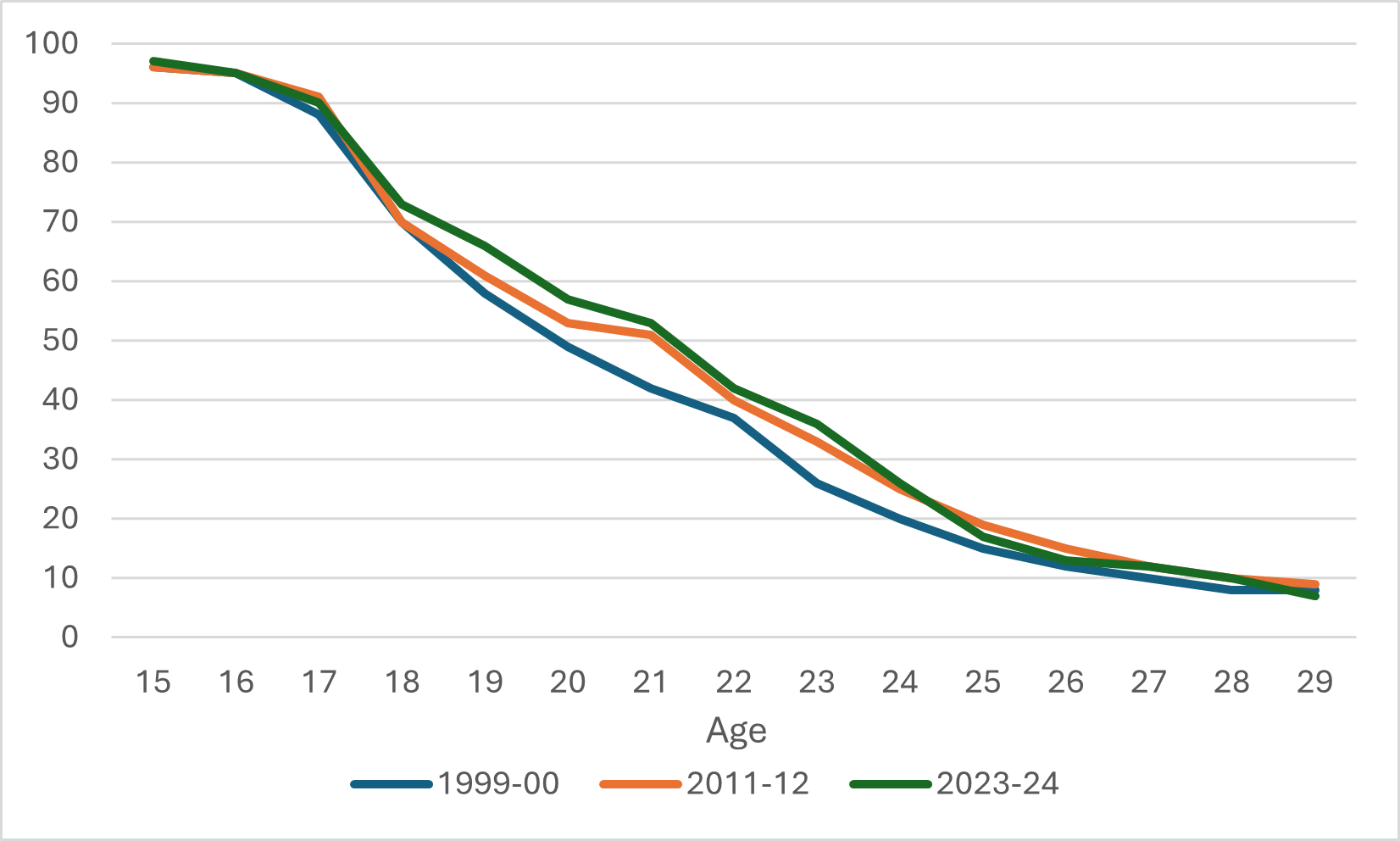
    Back in the fall, StatsCan released a mess of data from the Labour Force Survey looking at education participation rates—that is, the percentage of any given age cohort that is attending education—over the past 25 years. So, let’s go see what it says.

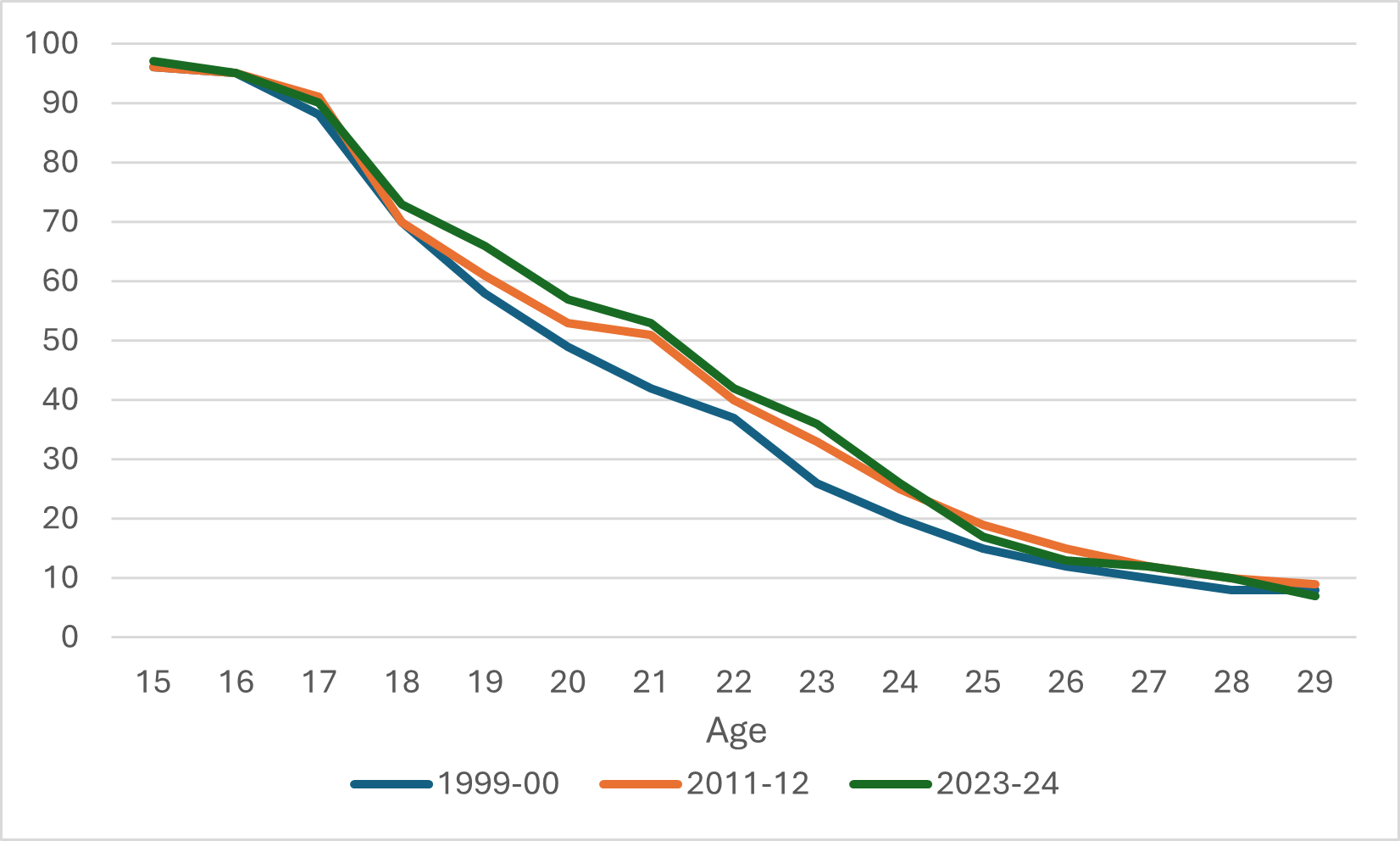
    Figure 1 shows total education participation rates, across all levels of education, from age 15 to 29, for selected years over the past quarter century. At the two ends of the graph, the numbers look pretty similar. At age 15, we’ve always had 95%+ of our population enrolled in school (almost exclusively secondary education, and from age 26 and above, we’ve always been in the low-tweens or high single digits. The falling-off in participation is fairly steady: for every age-year above 17, about 10% of the population exits education up until the age of 26. The big increase in education enrolments that we’ve seen over the past couple of decades has really occurred in the 18-24 range, where participation rates (almost exclusively in universities, as we shall see) have increased enormously.

    Figure 1: Participation rates in Education (all institutions) by Age, Canada, select years 1999-00 to 2023-24

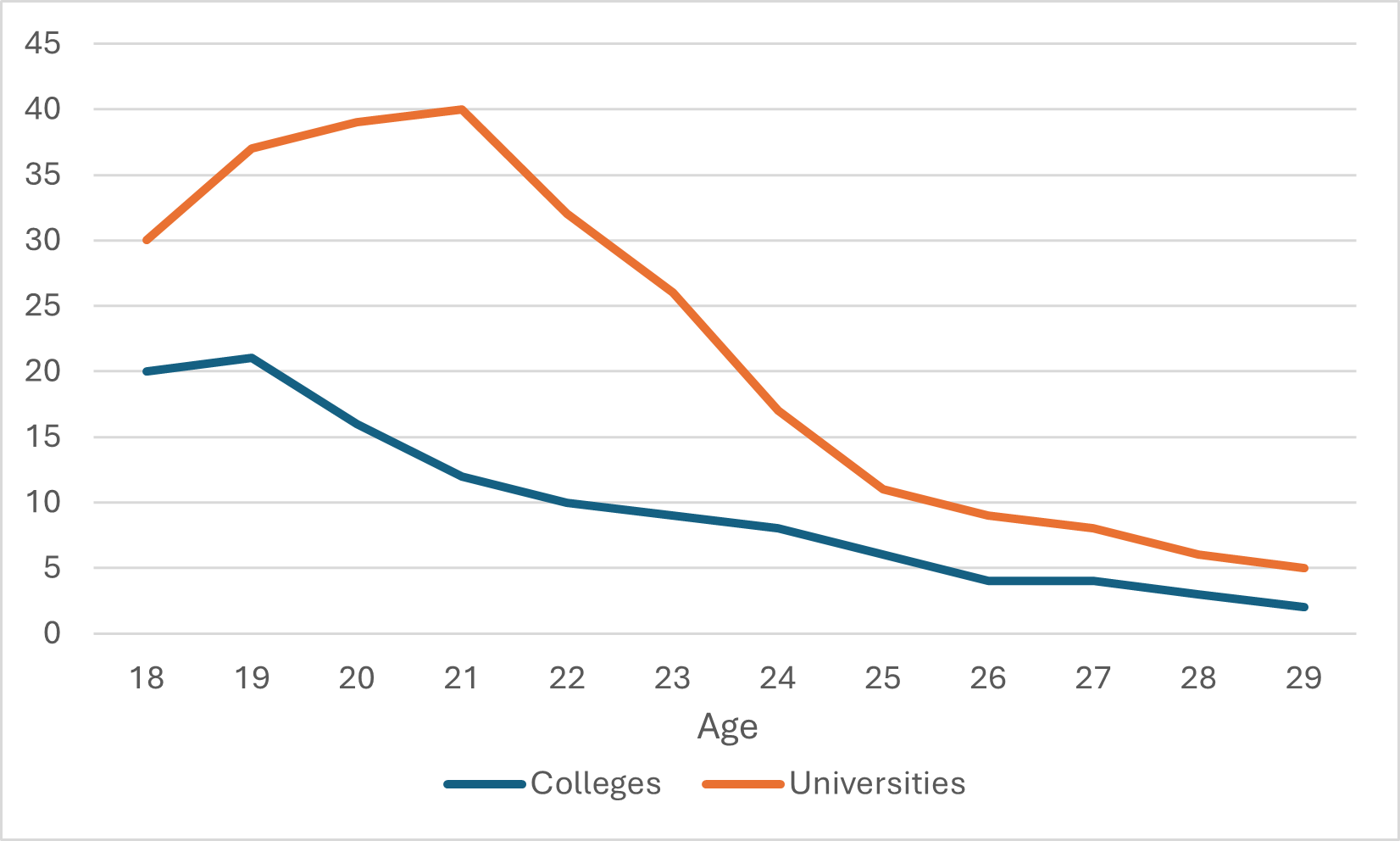
    Figure 2 shows current participation rates by age and type of postsecondary institution. People sometimes have the impression that colleges cater to an “older” clientele, but in fact, at any given age under 30, Canadians are much more likely to be enrolled in universities than in colleges. Colleges have a very high base in the teens because of the way the CEGEP system works in Quebec (I’ll come back to regional diversity in a minute), and it is certainly true that there is a very wide gap in favour of universities among Canadians in their mid-20s. But while the part rate gap narrows substantially at about age 25, it is never the case that the college participation rate surpasses the university one.

    Figure 2: Participation Rates by Age and Institution Type, Canada, 2023-24

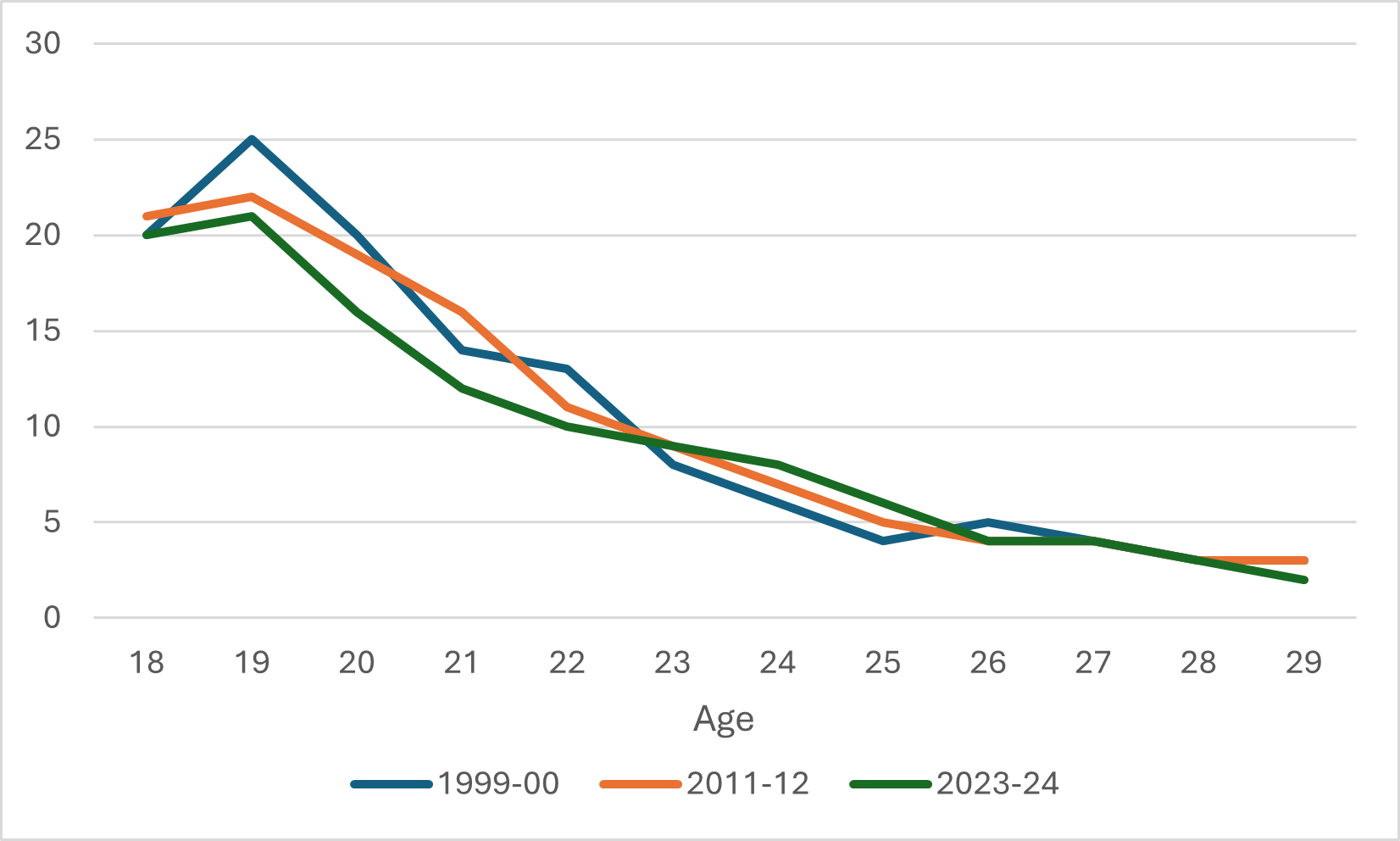
    Figure 3 shows college participation rates by age over time. What you should take from this is that there has been a slight decline in college participation rates over time in the 19-23 age range, but beyond that not much has changed.

    Figure 3: College Participation Rates by Age, Selected Years, 1999-2000 to 2023-24

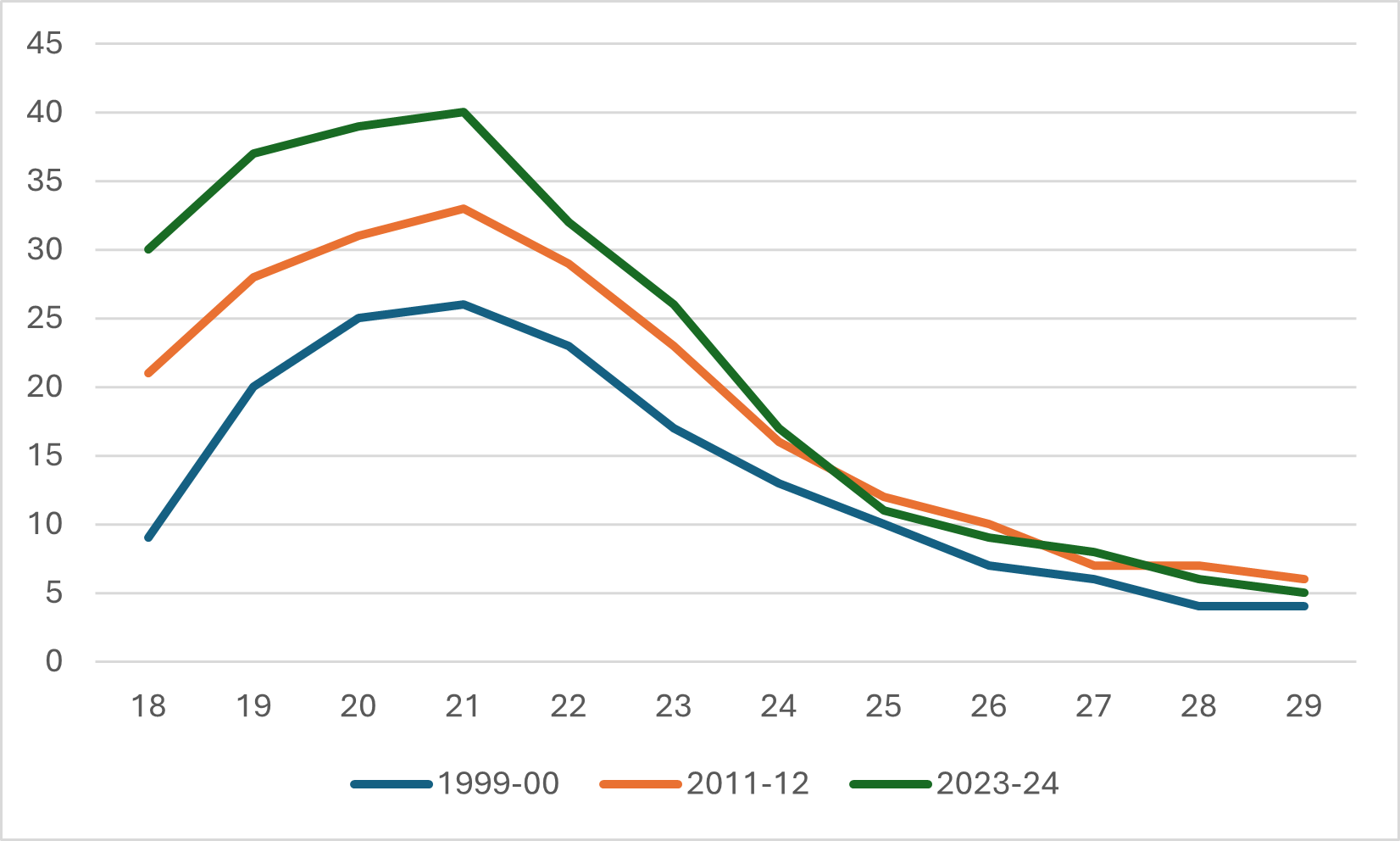
    Figure 4 uses the same lens as figure 3 only for universities. And it’s about as different as it can be. In 1999, fewer than one in ten Canadians aged 18 was in university: now it is three in ten. In 1999, only one in four 21 year-olds was in university, now it is four-in-ten. These aren’t purely the effects of increased demand; the elimination of grade 13 in Ontario had a lot to do with the changes for 18-year-olds; Alberta and British Columbia converting a number of their institutions from colleges to universities in the late 00s probably juices these numbers a bit, too. But on the whole, what we’ve seen is a significant increase in the rate at which young people are choosing to attend universities between the ages of 18 and 24. However, beyond those ages the growth is less pronounced. There was certainly growth in older student participation rates between 1999-00 and 20011-12, but since then none at all.

    Figure 4: University Participation Rates by Age, Selected Years, 1999-2000 to 2023-24

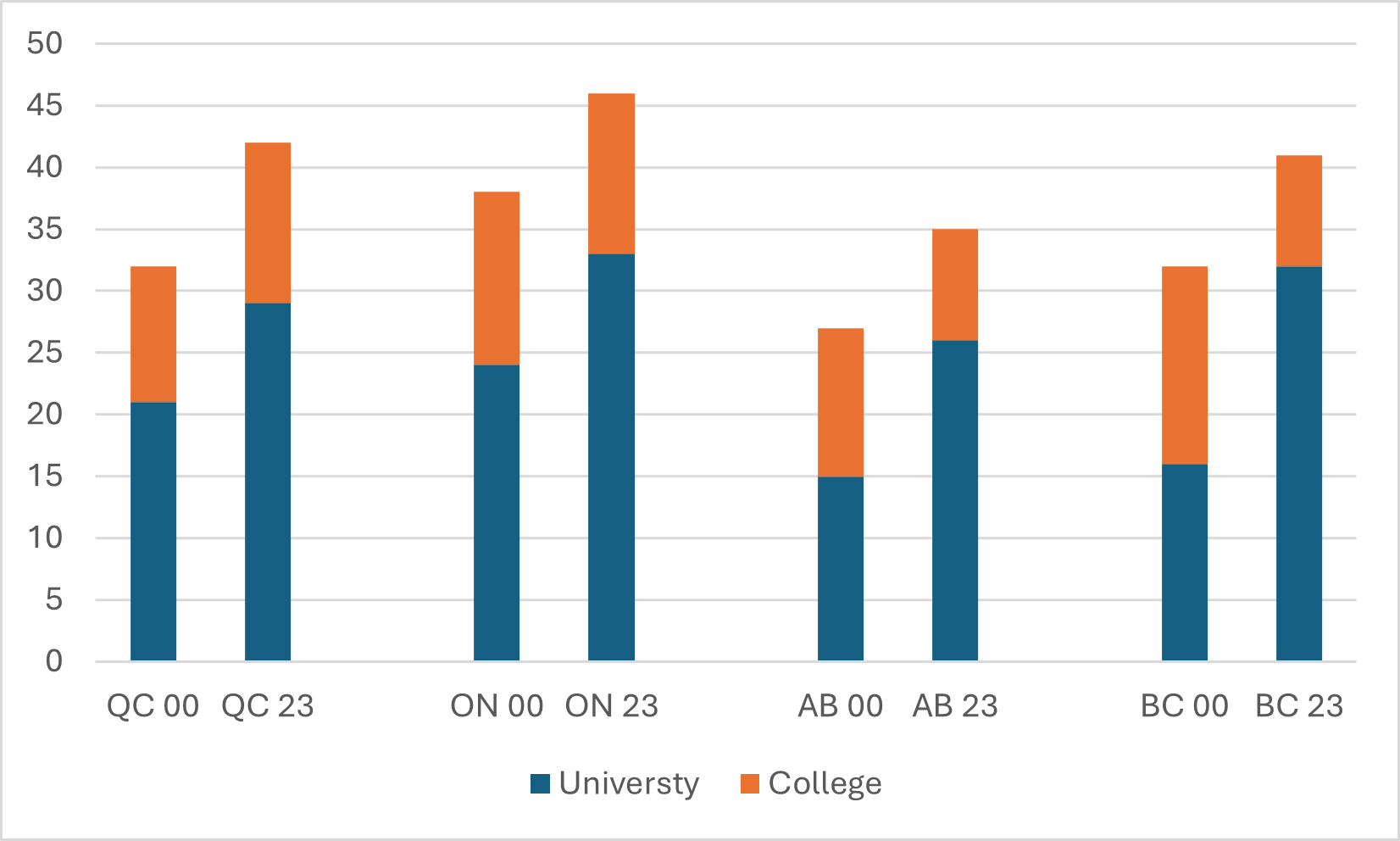
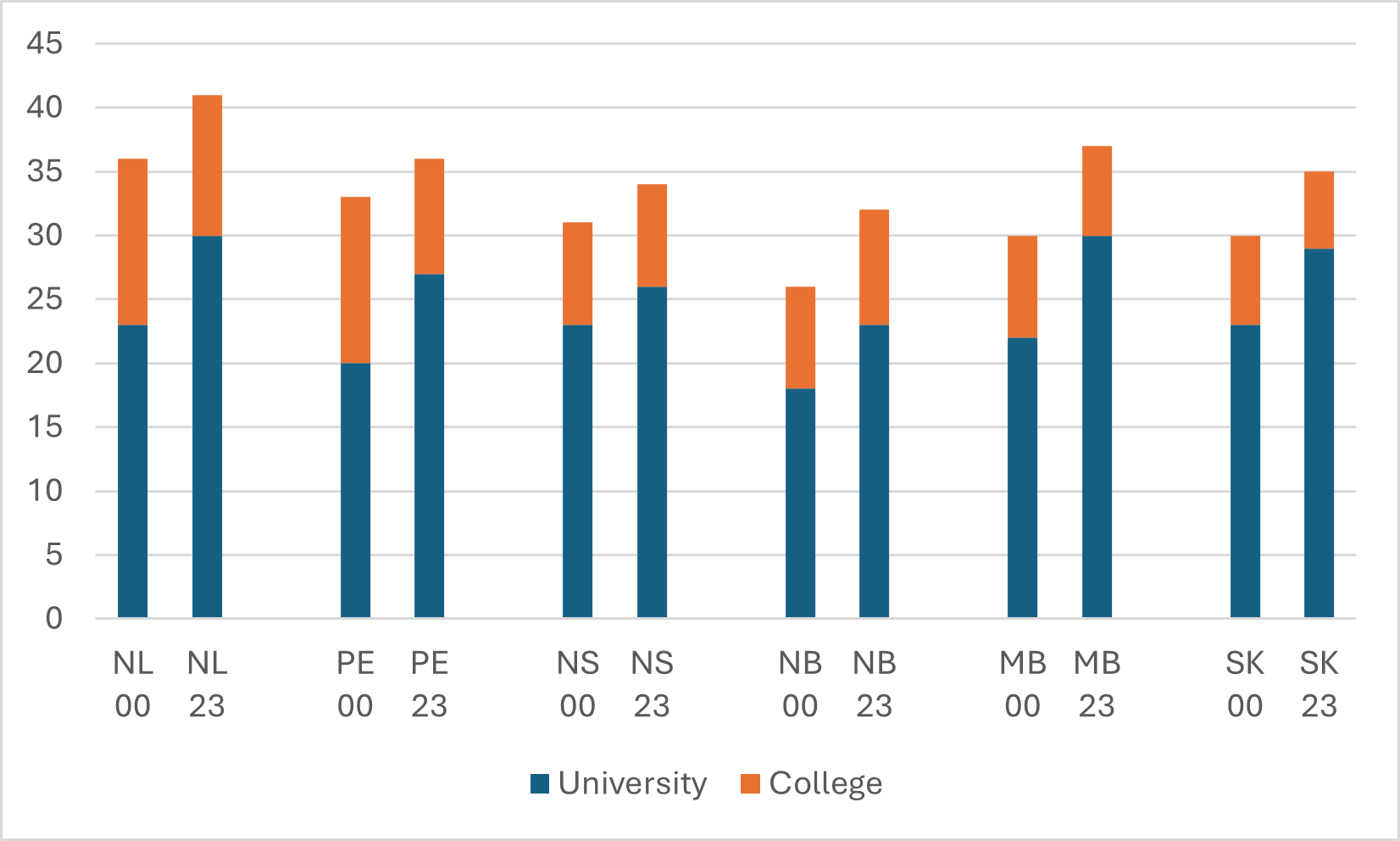
    So much for the national numbers: what’s going on at the provincial level? Well, because this is the Labour Force Survey, which unlike administrative data has sample size issues, we can’t quite get the same level of granularity of information. We can’t look at individual ages, but we can see age-ranges, in this case ages 20-24. In figures 5 and 6 (I broke them up so they are a bit easier to read), I show how each province’s university and college participation rates in 2000 vs. 2023.

    Figure 5: University Participation Rates for 20-24 Year-olds, Four Largest Provinces, 2000-01 vs. 2023-24

    Figure 6: University Participation Rates for 20-24 Year-olds, Six Remaining Provinces, 2000-01 vs. 2023-24

    Some key facts emerge from these two graphs:

    • The highest participation rates in the country are in Ontario, Quebec, and British Columbia.
    • In all provinces, the participation rate in universities is higher than it is for colleges, ranging from 2.5x in Quebec for over 4x in Saskatchewan.
    • Over the past quarter century, overall postsecondary participation rates and university participation rates have gone up in all provinces; Alberta and British Columbia alone have seen a decline in college participation rates, due to the aforementioned decision to convert certain colleges to university status in the 00s.
    • Growth in participation rates since 2000 has been universal but has been more significant in the country’s four largest provinces, where the average gain has been nine percentage points, and the country’s six smaller provinces, where the gain has been just under five percent.
    • Over twenty-five years, British Columbia has gone from ninth to second in the country in terms of university participation rates, while Nova Scotia has gone second to ninth.
    • New Brunswick has consistently been in last place for overall participation rates for the entire century.

    Just think: three minutes ago, you probably knew very little about participation rates in Canada by age and geography, now you know almost everything there is to know about participation rates in Canada by age and geography. Is this a great way to start your day or what?

    Source link

  • Curtain call on traditional time-intensive drama training

    Curtain call on traditional time-intensive drama training

    Recent closures of renowned actor training courses, including the Bristol Old Vic Theatre School’s undergraduate provision and the abrupt collapse of the Academy of Live and Recorded Arts, have laid bare a crisis in drama training. This isn’t only about funding shortfalls; it’s about the very structures and traditions of training, which risk shutting out those able to succeed.

    The financial strain on institutions is undeniable. The historical freeze in undergraduate tuition fees and the high-intensity delivery required in drama and other forms of intensive arts training like dance and music education have made traditional models almost unsustainable. Specialist institutions, unable to cross-subsidise, have stretched themselves to the limit – expanding course offerings, increasing intakes, internationalisation and growing postgraduate provision, where costs can be better covered. Meanwhile, government support through welcome specialist funding streams such as Institution Specific Funding have proven insufficient to address the root challenges.

    These efforts, while necessary, have unintended consequences. Over-speedy expansion creates great challenges for the quality of the learning experience, while institutional survival strategies rarely address the deeper, systemic issues at play. The question is not just how to survive in this increasingly precarious environment, but how to rethink the system entirely.

    The hidden barrier of time poverty

    The financial barriers to entering drama training are well-documented, but there is a more insidious form of exclusion that demands urgent attention: time-poverty.

    As highlighted in a recent Unipol and HEPI report, the average cost of student rent in London now exceeds the maximum maintenance loan, leaving students struggling to make ends meet. This financial reality forces many to take on part-time work, but the intensive nature of traditional actor training – 30-40 hours a week, often with irregular schedules – leaves little room for paid employment. The result? Only those who can afford not to work can afford to train.

    Traditional training models require high levels of physical presence and stamina. While these methods have been celebrated for their rigour, they exclude those with caring responsibilities, disabilities requiring time flexibility, or the need to support themselves financially. This isn’t just a financial issue – it’s a fundamental inequity in how time is valued in training.

    Addressing time-poverty isn’t about making marginal adjustments; it requires a paradigm shift. Drama schools must reimagine training models to prioritise accessibility and sustainability without compromising quality. Flexible delivery methods, guaranteed non-contact periods for work or rest, and rethinking the necessity of long, traditional schedules are all potential starting points. If we are to be equitable in the way almost all drama schools claim as a value, we must redesign what “intensity” in training means for excellent students who do not arrive with the economic means required. The current system is exclusionary.

    Some institutions are already leading the way. Identity School and Access All Areas have successfully adapted their training processes to accommodate a broader range of students. The Collective Acting Studio excels at balancing time pressures with rigorous training, redefining how intensity can be delivered. These organisations boast impressive alumni who are actively working successfully in the industry. Notably, Sally Ann Gritton, Principal of Mountview, emphasises in her book, The Independent Actor, that long, gruelling days are neither effective nor beneficial for students. These examples prove that change isn’t just possible – it’s essential if we want the arts to become more inclusive.

    Why it matters

    The stakes couldn’t be higher. The creative industries contribute over £100 billion to the UK economy annually, with drama training forming the backbone of the talent pipeline. Rose Bruford College alumna like Jessica Gunning, who recently won Emmy and Golden Globe awards, or Sara Huxley, whose work on Mr. Bates vs. the Post Office catalysed governmental action, exemplify the global impact of British arts education.

    However, the arts are more than an economic driver – they shape how we see ourselves, societal narratives, build empathy, and are key in defining our cultural identity. If access to training is restricted to the privileged, the stories we tell become narrower and less representative. Equity in the arts is not just an educational issue; it is a societal imperative.

    Nearly a decade ago, calls for greater class diversity in the arts sparked important conversations. In 2016, a report from the London School of Economics revealed that only 27 per cent of actors came from working-class backgrounds. While this discussion was absorbed into the broader issue of societal inequality, solutions remained vague and largely limited to the idea of increased funding. Today, with budgets tighter than ever, this approach feels increasingly out of reach.

    In recent years, established actors, including household names like Julie Walters and Christopher Eccleston have voiced concerns that they would no longer be able to afford the cost of training. Their warnings highlight a system where financial barriers stifle talent, despite the well-meaning calls for bursaries and other competitive financial support. The result? A cycle where potential is lost, and the arts grow less accessible.

    We need bold leadership across the sector. Institutions must collaborate to share best practice, experiment with alternative training models, and advocate for systemic support. There are innovative models, and we must deal with the friction preventing them from spreading. Policymakers and trainers must recognise that funding is only one part of the equation; addressing time-poverty is critical to ensuring a truly inclusive arts education.

    The arts are at their best when they reflect the richness of society. It’s time to move beyond tradition and reimagine drama training for a new generation—one where potential, not privilege, determines success.

    Anyone interested in being part of this conversation is welcome to contact the authors directly.

    Source link

  • There’s nothing certain about the circumstances when a duty of care applies to students

    There’s nothing certain about the circumstances when a duty of care applies to students

    The Secretary of State for Education was recently asked in Parliament if she would meet with campaigners to discuss the “duty of care” owed by higher education providers to their students.

    Janet Daby – the Minister for Children, Families and Wellbeing in the Department for Education (DfE) responded on her behalf, and also outlined the department’s current view on the law for holding negligent institutions to account.

    At first glance, her response was unhelpful – arguing the department’s position is that a duty of care in higher education may arise in “certain circumstances”:

    Such circumstances would be a matter for the courts to decide, based on the specific facts and context of the case being considered, and will be dependent on the application by a court of accepted common law principles.

    It would be easy to argue that lawmakers, including Janet Daby and skills minister Jacqui Smith, should not simply defer to the courts on matters of law and institutional accountability.

    After all, lawmakers have the power to create laws – so overall responsibility doesn’t rest solely with judges and their judicial interpretation of common law principles.

    But perhaps Daby’s response was more helpful than it looked – because it directly confronts misleading statements that have persisted since 2023, particularly those made by former Minister Robert Halfon.

    Although some might view her answer as a cautious response, in reality, it was a breath of fresh air – a much-need step in addressing the confusion that has clouded our understanding of legal responsibilities in higher education.

    From Halfon’s Law to Daby’s Law

    To grasp the significance of Janet Daby’s correction, we must first revisit the origins of the confusion – what I’ll call here Halfon’s Law.

    Introduced by Robert Halfon in 2023, it laid the foundation for a misrepresentation of the legal duties owed by higher education providers to their students. Halfon’s Law is a belief that stemmed from a misunderstanding of online material, initially presented in a now-deleted AMOSSHE blog that was published in 2015.

    In responding to the 128,000+ registered voters who signed our parliamentary e-petition calling for a statutory duty of care, Halfon asserted his department’s belief that universities already owed their students a broad and generalised duty of care. He said:

    Higher Education providers do have a general duty of care to deliver educational and pastoral services to the standard of an ordinarily competent institution and, in carrying out these services, they are expected to act reasonably to protect the health, safety and welfare of their students. This can be summed up as providers owing a duty of care to not cause harm to their students through the university’s own actions.

    At first glance, this might sound reasonable, but in truth, it was far from accurate. By conflating a general moral and legal principle – to act in a way that avoids causing harm to others – with a formal, court recognised duty of care that only arises in specific, legally-defined circumstances and relationships, Halfon introduced a dangerous oversimplification.

    It was a distortion used to justify dismissing the petitioners’ call for a statutory duty of care, effectively silencing important conversations about the protections that students need.

    Halfon’s Law, with the documented source having now been quietly removed from its original website, was a misstep in understanding the complexities of legal responsibilities in higher education. Its fall from grace is something to be celebrated.

    Enter Daby’s Law: Janet Daby’s response marks a shift towards legal clarity. A duty of care may arise in certain specific circumstances, but ultimately, it is the courts that will determine the existence and application of any such duty on a limited case-by-case basis – should lengthy and costly litigation ever actually occur.

    As it stands therefore, nobody truly knows what protections are in place, leaving students vulnerable, and institutions at risk of being punished for failing to do the right thing. As such, Daby’s position not only corrects the errors of Halfon’s Law, but also raises significant concerns, including the urgent need for a properly codified duty that both universities and their students can understand.

    The advocacy that led to Daby’s law

    Daby’s correction of the record didn’t happen by chance. It was the direct result of relentless behind-the-scenes efforts from advocates, especially ForThe100, who recognised the need to dismantle Halfon’s contention? – since it was a significant barrier preventing meaningful progress.

    For too long, Halfon’s Law and its sweeping and factually incorrect statements had clouded the conversation around student safety and wellbeing, effectively stopping us from moving forward and pushing for the protections students desperately need. Too many policymakers thought it true – and so dismissed the need for a dedicated duty.

    The subtle shift in content and tone, while preferable to outright inaccuracy, introduces its own set of challenges. Without clear or codified guidance, students, families, and institutions are left to navigate a murky and uncertain legal landscape.

    That vagueness is deeply problematic. It means widespread confusion about rights and responsibilities, leaving institutions uncertain of their obligation, and exposed to unforeseen legal liabilities – while students are left unsure of the protections they can depend on.

    Worse, the lack of clear, direct, and upfront standards is a reactive rather than proactive system, shifting the burden onto individuals to seek legal recourse only after harm has occurred.

    This approach neither prioritises prevention nor ensures accountability, leaving gaps in a system meant to put students first.

    It is now crucial that the government corrects the public response to our petition without delay. Halfon’s Law remains embedded in the official narrative, and its continued presence in government communications perpetuates confusion, and blocks meaningful progress.

    More importantly, for over five decades, students have been without adequate legal protection, and this gap continues to undermine their safety and wellbeing.

    Nobody should be reassured by a duty that arises in “certain circumstances” where those circumstances would be a matter for “the courts to decide”. Students and universities need instead to know where they stand – with the same sort of clarity on offer for the duty of care that universities as employers owe to their staff.

    The next step is for the government to act – taking concrete steps toward enacting statutory reform that holds higher education institutions accountable for their acts and omissions with regard to student safety and wellbeing, and giving students and their families the confidence that when they enrol into a university, they know the minimum “duty of care” that they can actually expect.

    Source link