
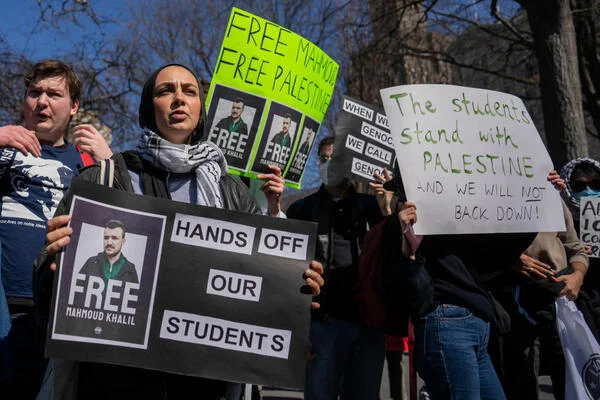
The administration’s push to deport international students and scholars prompted protests and lawsuits.
David Dee Delgado/Getty Images News
Federal government officials targeted and arrested international students for First Amendment–protected activity last year, despite internal concerns about the legality of such efforts, newly unsealed court documents show.
Dossiers and summaries compiled by government officials used to justify legal action against international students targeted by the Department of Homeland Security do not include allegations of criminality but instead focus on their participation in pro-Palestinian protests.
Documents show such arrests were in connection with students exercising their First Amendment rights, with DHS officials casting pro-Palestinian protests as antisemitic and arguing that targeted individuals presented a threat to U.S foreign policy based on their activism.
While a judge ruled against the federal government last fall, documents unsealed on Thursday offer new insights into the case. That same day, U.S. District Judge William Young also ruled that the Trump administration’s policy of targeting international students and faculty members for their activism was unlawful and in violation of the First Amendment and the Administrative Procedure Act, and he imposed limits on how the federal government may pursue related immigration actions.
Targets named in the documents include Mahmoud Khalil, Rümeysa Öztürk, Mohsen Mahdawi, Yunseo Chung—all current students or recent graduates—and Badar Khan Suri, a postdoctoral fellow at Georgetown University. All were targeted for speech protected by the First Amendment.
In a memo intended for U.S. Secretary of State Marco Rubio, subordinates flagged various transgressions that they argued justified action against international students and scholars, such as leading campus protests. In the case of Öztürk, the justification was that she had written an op-ed in a student newspaper in which she called for Tufts University, which she attends, to divest from companies with direct ties to Israel due to concerns about Palestinian casualties.
Federal officials tried to tie Suri to Hamas through his wife, a Palestinian American whose father once advised a Hamas leader. A government memo included claims from outside sources that Suri “actively spreads the terror group’s propaganda and promotes virulent antisemitism.” DHS officials have repeated such claims publicly but have not provided any evidence.
Officials painted protest activities broadly as antisemitic, arguing in one document that targets such as Khalil were “creating a hostile environment for Jewish students and indicating support for a designated terrorist organization.” However, documents did not include evidence of any ties to or support for Hamas. Instead, officials broadly framed participation in protests or social media posts critical of the Israeli government and military as inherently supportive of Hamas.
But even as they targeted students, federal officials knew they were on shaky legal ground.
“Given the potential that a court may consider his actions inextricably tied to speech protected under the First Amendment, it is likely that courts will scrutinize the basis for this determination,” federal government officials wrote in a memo that justified the arrest of international scholars.
Before issuing the order Thursday, Young blasted federal officials from the bench last week, proclaiming that Rubio and U.S. Secretary of Homeland Security Kristi Noem failed to uphold the Constitution and engaged in a “conspiracy to pick off certain people” for their beliefs, despite clear First Amendment concerns.
Free speech advocates have sharply criticized the federal government for arresting and attempting to deport international students solely based on their pro-Palestinian activism.
“Newly unsealed evidence makes it even clearer that Rubio and Noem knew they were targeting students based solely on their political speech and that they knew this policy was unconstitutional. They just didn’t care,” Jameel Jaffer, director of the Knight First Amendment Institute at Columbia, which supported plaintiffs in the case, wrote online. “The policy had nothing to do with fighting antisemitism and everything to do with suppressing legitimate and constitutionally protected criticism of Israel.”
The lawsuit against the Trump administration was filed last year by the American Association of University Professors and the Middle East Studies Association. In a social media post following the order, AAUP president Todd Wolfson wrote, “This ruling is not everything we needed or expected but it is still a significant step forward.”
DHS officials did not respond to a request for comment.