
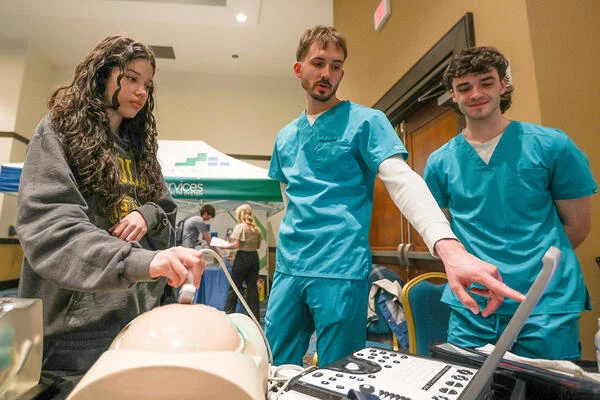
Employers prefer to hire graduates who have participated in applied, hands-on experiences.
Jason Ardan/The Citizens’ Voice/Getty Images
While fewer than half of Americans have confidence in higher education, new data shows that 85 percent of employers believe colleges and universities are adequately preparing students for the workforce. And they especially value degrees from institutions that emphasize constructive dialogue and disagreement.
Those are two of the big takeaways from “The Agility Imperative: How Employers View Preparation for an Uncertain Future,” a new report the American Association of Colleges and Universities published Thursday. In the ninth iteration of the report since 2006, the group commissioned Morning Consult to survey 1,030 executives and hiring managers in August about their attitudes toward higher education.
“This is our strongest case yet that the separation between workforce and civic skills is false,” said Ashley Finley, author of the report and vice president for research at AAC&U. “In the face of a public narrative that questions the value of college education, employers are higher education’s biggest fans. They value the ways in which colleges are preparing students to be nimble and agile for an uncertain future.”
‘Avoiding Groupthink’
According to the survey, 94 percent of employers said it’s equally important for colleges to prepare a skilled and educated workforce and to help students become informed citizens; 92 percent said it’s also important for colleges to create an environment where students of all backgrounds feel supported and to help them engage with and serve their communities. And 96 percent of employers said it’s useful for college graduates to be able to engage in constructive dialogue across disagreement; 80 percent are confident colleges and universities are helping students develop those skills.
“Employers want people who can grapple with differences of opinion because they know that strengthens the workplace,” Finley said. “Diverse teams are often the most effective because it’s through the process of disagreement that they arrive at better solutions by avoiding groupthink.”
Those results come at a time of intensified scrutiny and skepticism about the value of higher education from both the general public and policymakers. According to a survey the Pew Research Center published in October, 70 percent of Americans believe higher education is generally “going in the wrong direction,” citing high costs, poor preparation for the job market and lackluster development of students’ critical thinking and problem-solving skills.
In addition to focusing on career and technical education and using postgraduation earnings as the primary metric of a degree’s value, the Trump administration and its allies in Congress and state legislatures are also policing university curricula and faculty speech. Over the past year, political pressure has led numerous institutions—including Texas A&M University and the University of Oklahoma—to suspend or fire faculty and administrators who made comments that conflict with certain conservative viewpoints on race, gender and other topics.
But that’s not the type of learning environment most employers, regardless of political affiliation or age, want graduates to come from, according to the report.
Eighty-five percent of employers—including 90 percent of Democrats, 75 percent of Independents, 83 percent of Republicans, 87 percent of those under age 40 and 74 percent of those over age 50—said they would look more favorably upon a degree from an institution known for respecting diverse perspectives on political, economic and social issues in the curriculum. Additionally, 82 percent of respondents—including 83 percent of Democrats, 78 percent of Independents, 83 percent of Republicans, 85 percent of those under age 40 and 74 percent over age 50—said they would look more favorably upon a degree from an institution that’s not subject to government restrictions on what students learn and discuss.
The share of employers who strongly agreed with those statements has also increased by several percentage points since 2023, when the previous iteration of the survey asked the same questions.
“So much of workforce preparedness in the next few decades is going to involve durable skills amid the rapid proliferation of artificial intelligence,” Lynn Pasquerella, president of AAC&U, said. “We need to train individuals who can engage across differences and bring skills, competencies and dispositions computers can’t bring. That involves directly the capacity to engage with others who are different from oneself.”
In addition to valuing degrees that promote open inquiry, more than three-quarters of employers said they were more likely to hire graduates who participated in applied, hands-on experiences while in college, including internships, holding leadership roles or working on community-based projects. And 81 percent of employers said microcredentials are also valuable when they’re making hiring decisions.
“Employers are looking for more than just transcripts. They want portfolios and demonstrations of applied skills and competencies,” Pasquerella said. “The more colleges can do to provide a more comprehensive, complete picture of students’ abilities inside and outside the classroom, the more confidence they can create with employers.”