
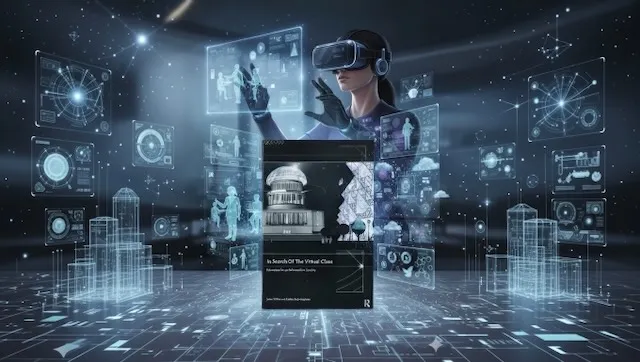
In 1995, Tiffin and Rajasingham envisaged…
‘Shirley zips into her skin-tight school uniform, which on the outside looks something like a ski suit. The lining of the suit in fact contains cabling that makes the suit a communication system and there are pressure pads where the suit touches skin that give a sense of touch. Next, she sits astride something that is a bit like a motorbike, except that it has no wheels and is attached firmly to the floor. Her feet fit on to something similar to a brake and accelerator and her gloved hands hold onto handlebars. She shouts, “I’m off to school, Dad.” Her father, who is taking time out from his teleworking, begins to remind her that the family are going teleshopping in the virtual city later in the day, but it is too late, his daughter has already donned her school helmet. She is no longer in the real world of her real home, she is in the virtual world of her virtual school.’
(Tiffin & Rajasingham, 1995). Cover note
Thirty years ago, for many, this was the future of education. The authors presented a radical future for training and education inspired by emerging technologies and the promise of ubiquitous connectivity. It looked forward to a world of education that made full use of Augmented Reality (AR) and Virtual Reality (VR). It did ask serious questions about how society would be affected and how the majority of students would be trained in these new technologies and new pedagogies. How would Shirley develop as an individual, given that her interactions with teachers and fellow students were all virtual?
In May 2019, I was invited to deliver a presentation at an AR/VR Conference in Auckland. I re-read Tiffin and Rajasingham’s book. My presentation was ‘Designing Learning Making use of AR/VR’. In short, my pitch to the “we are within a year or two…” crowd was that the technology already exists. What was lacking were meaningful, scalable user cases. This is still my concern. What is AR/VR actually good for?
The technology is here … somewhere
Ongoing technical advances in AR and VR continue to nudge higher education from passive consumption toward the promise of immersive, high-stakes experiential learning. More importantly, educational designers have stopped promising a ‘Shirley-like’ experience and are working to meet specific learning outcomes.
That is not to say that many institutions in the Occidental world still have their virtual learning labs with areas for tethered high-performance simulation, untethered mobile exploration, and collaborative “Mixed Reality” (MR) hubs. Equipped with high-fidelity Head-Mounted Displays (HMDs), such as the Apple Vision Pro or HTC Vive Pro Eye, which often include integrated eye-tracking for behavioural research, there are VR-ready workstationswith NVIDIA RTX GPUs or wearable Backpack PCs for untethered movement. All of which is a significant investment.
Justifiable in computing, animation, or physical movement contexts, certainly. But difficult to justify for the purpose of designing learning experiences across a range of disciplines.
User-Cases
There are, of course, some fairly self-evident user cases for which these labs develop learning experiences. VR (and to a lesser extent AR) has been developed in the medicine and nursing programmes to provide “low-risk simulations,” where students practice surgical procedures or volatile chemical experiments repeatedly without the associated material costs or physical dangers. AR is used for “real-time project overlays,” enabling students in Architecture and Engineering to visualise Building Information Modelling (BIM) data directly on physical construction sites.
One should remain cautious about the limits of the apparent immersion and its claims to represent experiential learning. While hardware manufacturers and VR/AR design agencies claim improvements in retention of up to 75% compared to traditional lectures (ClassVR, n.d.), evidence for specific, measurable skills is harder to find. Depending on the skills and abilities one seeks to develop in a student, there are certainly better ways to do so than in a traditional teacher-led classroom setting. But fieldwork, real-world work-based exposure, and even well-crafted educational videos are also likely to be better than ‘sit-and-listen’ contexts.
I am particularly dubious of contexts in which there is no haptic response, given that very few benefit from Shirley’s haptic suit.
The evidence for effective AR/VR training experiences comes primarily from large manufacturers that need staff to be familiar with expensive machinery before they are introduced to hands-on training. Knowing which widget goes into which do-dah saves time during mentored training. But there is still the need to know whether a screw is tightened correctly, can you feel it slip into the groove, or do you feel the tension? As Boeing is finding. (Perkins & Salomon, 1989)
I am not averse to AR/VR developments in higher education. Still, departments need to think carefully about where limited resources are allocated and which skills and abilities are genuinely being developed and assessed. More of that on Friday’s Subscriber’s post on Substack
For a contemporary review of the current state of AR/VR, explore the blogs on Treeview Studio (Torrendell, 2026).
References
ClassVR. (n.d.). Benefits of VR. ClassVR. Retrieved 9 February 2026, from https://www.classvr.com/benefits-of-virtual-reality-in-education/
Perkins, D. N., & Salomon, G. (1989). Are Cognitive Skills Context-Bound? Educational Researcher, 18(1), 16–25. https://doi.org/10.2307/1176006
Tiffin, J., & Rajasingham, L. (1995). In search of the virtual class: Education in an information society. Routledge.
Torrendell, H. (2026, January 4). Virtual Reality Guide 2026: Complete VR Technology Overview – Treeview. https://treeview.studio/blog/virtual-reality-complete-guide