
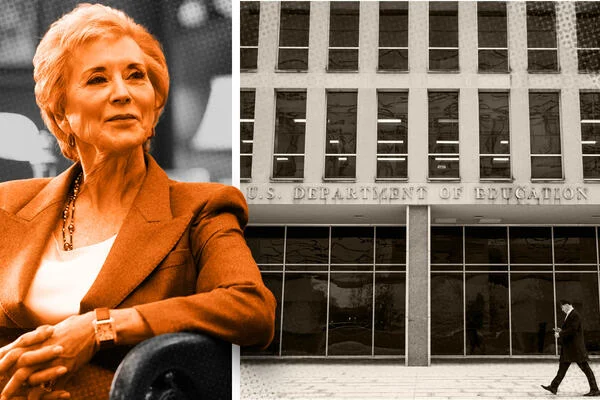
The Education Department said late last year that the grant program, which has funded student success initiatives, would support projects related to accreditation reform, civil discourse, artificial intelligence and workforce training.
Photo illustration by Justin Morrison/Inside Higher Ed | Anna Moneymaker/Getty Images | Pete Kiehart for The Washington Post via Getty Images
More than 70 colleges, universities, nonprofits and other organizations are sharing $169 million to advance a number of the Trump administration’s priorities.
Those include accreditation reform, promoting civil discourse, short-term workforce training programs and advancing the use of artificial intelligence in higher education. The Education Department announced the grant competition in November and said Monday that it had awarded the funds, which have historically gone to programs that support student success.
Colleges received funding to switch accreditors, start short-term programs that will be eligible for the new Workforce Pell program, hold workshops on constructive dialogue and support peer-to-peer engagement in civil dialogue.
Just over $50 million apiece went to the AI, civil discourse and Workforce Pell priorities, while projects related to accreditation received nearly $15 million, according to an Inside Higher Ed analysis of department data. All the grants in this tranche are for four years.
Two new accreditors planning to seek federal recognition—the Postsecondary Commission and the Commission for Public Higher Education Inc.—each received $1 million. The department also awarded $1 million to the University of Rochester for its plans to establish an accreditor focused on higher education certificate programs that serve students with intellectual disabilities, and another $1 million to Valley Forge Military College, which wants to create a new hybrid accrediting agency for military-aligned associate and certificate programs. (Valley Forge Military College is one of several institutions that have indicated interest in the Trump administration’s compact for higher education.)
Meanwhile, Davidson College’s Institute for Public Good is getting nearly $4 million to create the Deliberative Citizenship Network across 100 colleges and universities, according to a news release. Among other goals, the network aims to train faculty and staff on how to facilitate forums on difficult topics and create teaching resources that can be widely shared.
“With this funding, we will reach thousands of students and educators nationwide,” Chris Marsicano, executive director of the institute, said in a statement. “Davidson’s Institute for Public Good will serve as a national hub that connects research, teaching and public engagement around respectful inclusion across political viewpoints—no matter how unpopular on campus—as well as participating in community efforts to examine, talk through and solve big problems.”
The department’s initial announcement about the awards didn’t provide specific information about the funded projects, but the agency briefly posted documents Monday afternoon outlining which institutions received awards and for how much. Inside Higher Ed captured some of that information before the documents were taken down and compiled the details into a searchable database below. A department spokesperson said the final documents should be posted next week.
In the meantime, Inside Higher Ed reached out to the identified institutions for more information about how they plan to use the grant funding. The database will be updated as they respond.
The grant money comes from the Fund for Improvement of Postsecondary Education, which has historically supported programs related to student success. Those include the Basic Needs, Veteran Student Success and Postsecondary Student Success programs. But in November, the Education Department announced plans to send the funds to a different special projects program—a move that Democrats and advocates criticized. Department officials say this round of funding, for which they “received a historic number of applications,” will help to support students through their academic journeys.
“This historic investment will realign workforce programs with the labor market, break up the accreditation cartel and support institutions who want to change accreditors, and strengthen responsible use of AI in the classroom,” said Ellen Keast, a department spokesperson, in a statement. “These investments will open new, affordable higher education alternatives to American families, and we are very excited to see federal dollars driving change in the sector that is long overdue.”
Some critics have raised concerns about the truncated grant-review process. Typically, the FIPSE grant competition opens in the spring and awards go out by Dec. 31, one former department official said. They also question who will administer the program moving forward. Like other higher ed grant programs, FIPSE is slated to move to the Labor Department under agreements announced late last year.