We develop a college list based on your student’s academic profile, personal preferences, and financial parameters.
Included Tools:Our exclusive Student & Parent Portals offer advanced college search capabilities unavailable anywhere else.
📅 Application Strategy & Planning
We guide students through deadlines, requirements, and priorities unique to each school.
Included Tools:Our proprietary App Tracker maps every task by college to keep you on pace and fully informed.
✍️ Personal Statements & Essays
We provide structured support for brainstorming, drafting, revising, and polishing personal statements and supplemental essays.
Included Tools:A collaborative Google Drive folder gives us a shared workspace for timely feedback and revision support.
💰 Financial Aid & Scholarships
We go beyond the FAFSA, helping you navigate institutional aid, merit scholarships, and cost-conscious strategies.
Guiding Principle:The best way to afford college is to choose wisely—and we’ll help you do just that.
🎤 Interviews & Academic Profiles
Students will be prepared for college interviews, resume creation, and academic profiles that highlight strengths and achievements now and in the future.
Included Tools:We help students document activities and skills in ways that support their applications and future goals.
If, like me, you grew up watching Looney Tunes cartoons, you may remember Yosemite Sam’s popular phrase, “There’s gold in them thar hills.”
In surveys, as in gold mining, the greatest riches are often hidden and difficult to extract. This principle is perhaps especially true when institutions are seeking to enhance the postgraduate taught (PGT) student experience.
PGT students are far more than an extension of the undergraduate community; they represent a crucial, diverse and financially significant segment of the student body. Yet, despite their growing numbers and increasing strategic importance, PGT students, as Kelly Edmunds and Kate Strudwick have recently pointed out on Wonkhe, remain largely invisible in both published research and core institutional strategy.
Advance HE’s Postgraduate Taught Experience Survey (PTES) is therefore one of the few critical insights we have about the PGT experience. But while the quantitative results offer a (usually fairly consistent) high-level view, the real intelligence required to drive meaningful enhancement inside higher education institutions is buried deep within the thousands of open-text comments collected. Faced with the sheer volume of data the choice is between eye-ball scanning and the inevitable introduction of human bias, or laborious and time-consuming manual coding. The challenge for the institutions participating in PTES this year isn’t the lack of data: it’s efficiently and reliably turning that dense, often contradictory, qualitative data into actionable, ethical, and equitable insights.
AI to the rescue
The application of machine learning AI technology to analysis of qualitative student survey data presents us with a generational opportunity to amplify the student voice. The critical question is not whether AI should be used, but how to ensure its use meets robust and ethical standards. For that you need the right process – and the right partner – to prioritise analytical substance, comprehensiveness, and sector-specific nuance.
UK HE training is non-negotiable. AI models must be deeply trained on a vast corpus of UK HE student comments. Without this sector-specific training, analysis will fail to accurately interpret the nuances of student language, sector jargon, and UK-specific feedback patterns.
Analysis must rely on a categorisation structure that has been developed and refined against multiple years of PTES data. This continuity ensures that the thematic framework reflects the nuances of the PGT experience.
To drive targeted enhancement, the model must break down feedback into highly granular sub-themes – moving far beyond simplistic buckets – ensuring staff can pinpoint the exact issue, whether it falls under learning resources, assessment feedback, or thesis supervision.
The analysis must be more than a static report. It must be delivered through integrated dashboard solutions that allow institutions to filter, drill down, and cross-reference the qualitative findings with demographic and discipline data. Only this level of flexibility enables staff to take equitable and targeted enhancement actions across their diverse PGT cohorts.
When these principles are prioritised, the result is an analytical framework specifically designed to meet the rigour and complexity required by the sector.
The partnership between Advance HE, evasys, and Student Voice AI, which analysed this year’s PTES data, demonstrates what is possible when these rigorous standards are prioritised. We have offered participating institutions a comprehensive service that analyses open comments alongside the detailed benchmarking reports that Advance HE already provides. This collaboration has successfully built an analytical framework that exemplifies how sector-trained AI can deliver high-confidence, actionable intelligence.
Jonathan Neves, Head of Research and Surveys, Advance HE calls our solution “customised, transparent and genuinely focused on improving the student experience, “ and adds, “We’re particularly impressed by how they present the data visually and look forward to seeing results from using these specialised tools in tandem.”
Substance uber alles
The commitment to analytical substance is paramount; without it, the risk to institutional resources and equity is severe. If institutions are to derive value, the analysis must be comprehensive. When the analysis lacks this depth institutional resources are wasted acting on partial or misleading evidence.
Rigorous analysis requires minimising what we call data leakage: the systematic failure to capture or categorise substantive feedback. Consider the alternative: when large percentages of feedback are ignored or left uncategorised, institutions are effectively muting a significant portion of the student voice. Or when a third of the remaining data is lumped into meaningless buckets like “other,” staff are left without actionable insight, forced to manually review thousands of comments to find the true issues.
This is the point where the qualitative data, intended to unlock enhancement, becomes unusable for quality assurance. The result is not just a flawed report, but the failure to deliver equitable enhancement for the cohorts whose voices were lost in the analytical noise.
Reliable, comprehensive processing is just the first step. The ultimate goal of AI analysis should be to deliver intelligence in a format that seamlessly integrates into strategic workflows. While impressive interfaces are visually appealing, genuine substance comes from the capacity to produce accurate, sector-relevant outputs. Institutions must be wary of solutions that offer a polished facade but deliver compromised analysis. Generic generative AI platforms, for example, offer the illusion of thematic analysis but are not robust.
But robust validation of any output is still required. This is the danger of smoke and mirrors – attractive dashboards that simply mask a high degree of data leakage, where large volumes of valuable feedback are ignored, miscategorised or rendered unusable by failing to assign sentiment.
Dig deep, act fast
When institutions choose rigour, the outcomes are fundamentally different, built on a foundation of confidence. Analysis ensures that virtually every substantive PGT comment is allocated to one or more UK-derived categories, providing a clear thematic structure for enhancement planning.
Every comment with substance is assigned both positive and negative sentiment, providing staff with the full, nuanced picture needed to build strategies that leverage strengths while addressing weaknesses.
This shift from raw data to actionable intelligence allows institutions to move quickly from insight to action. As Parama Chaudhury, Pro-Vice Provost (Education – Student Academic Experience) at UCL noted, the speed and quality of this approach “really helped us to get the qualitative results alongside the quantitative ones and encourage departmental colleagues to use the two in conjunction to start their work on quality enhancement.”
The capacity to produce accurate, sector-relevant outputs, driven by rigorous processing, is what truly unlocks strategic value. Converting complex data tables into readable narrative summaries for each theme allows academic and professional services leaders alike to immediately grasp the findings and move to action. The ability to access categorised data via flexible dashboards and in exportable formats ensures the analysis is useful for every level of institutional planning, from the department to the executive team. And providing sector benchmark reports allows institutions to understand their performance relative to peers, turning internal data into external intelligence.
The postgraduate taught experience is a critical pillar of UK higher education. The PTES data confirms the challenge, but the true opportunity lies in how institutions choose to interpret the wealth of student feedback they receive. The sheer volume of PGT feedback combined with the ethical imperative to deliver equitable enhancement for all students demands analytical rigour that is complete, nuanced, and sector-specific.
This means shifting the focus from simply collecting data to intelligently translating the student voice into strategic priorities. When institutions insist on this level of analytical integrity, they move past the risk of smoke and mirrors and gain the confidence to act fast and decisively.
It turns out Yosemite Sam was right all along: there’s gold in them thar hills. But finding it requires more than just a map; it requires the right analytical tools and rigour to finally extract that valuable resource and forge it into meaningful institutional change.
This article is published in association with evasys. evasys and Student Voice AI are offering no-cost advanced analysis of NSS open comments delivering comprehensive categorisation and sentiment analysis, secure dashboard to view results and a sector benchmark report. Click here to find out more and request your free analysis.
Every great discovery begins long before a headline or journal article.
Behind every experiment, dataset, and lecture lies a community of highly skilled technical professionals, technologists, facility managers, and infrastructure specialists. They design and maintain the systems that make research work, train others to use complex equipment, and ensure data integrity and reproducibility. Yet their contribution has too often been invisible in how we assess and reward research excellence.
The pause in the Research Excellence Framework (REF) is more than a scheduling adjustment, it’s a moment to reflect on what we value within the UK research and innovation sector.
If we are serious about supporting excellence, we must recognise all those who make it possible, not just those whose names appear on papers or grants, but the whole team, including technical professionals whose expertise enables every discovery.
Making people visible in research culture
Over the past decade, there has been growing recognition that research culture, including visibility, recognition, and support for technical professionals is central to delivering world-class outcomes. Initiatives such as the Technician Commitment, now backed by more than 140 universities and research institutes, have led the way in embedding good practice around technical professional careers, progression, and recognition.
Alongside this, the UK Institute for Technical Skills and Strategy (UK ITSS) continues to advocate for technical professionals nationally to ensure they are visible and their inputs are recognised within the UK’s research and innovation system. These developments have helped reshape how universities think about people, culture, and environment, creating the conditions where all contributors to research and innovation can thrive.
A national capability – not a hidden workforce
This shift is not just about fairness or inclusion, it’s about the UK’s ability to deliver on its strategic ambitions. Technical professionals are critical to achieving the goals set out in the UK Government’s Modern Industrial Strategy and to the success of frontier technologies such as artificial intelligence, quantum, engineering biology, advanced connectivity, and semiconductors. These frontier sectors rely on technical specialists to design, operate, and maintain the underpinning infrastructure on which research and innovation depend.
Without a stable, well-supported technical professional workforce, the UK risks losing the very capacity it needs to remain globally competitive. Attracting, training, and retaining this talent necessitates that technical roles are visible and recognised – not treated as peripheral to research, but as essential to it.
Why REF matters
This is where the People, Culture and Environment (PCE) element of the REF becomes critical. REF has always shaped behaviour across the sector. Its weighting signals what the UK values in research and innovation. Some have argued that PCE should be reduced (or indeed removed) to simplify the REF process, ease administrative burden, or avoid what they see as subjectivity in the assessment of research culture. Others have suggested a greater emphasis on environment would shift focus away from research excellence, or that culture work is too challenging to consistently assess across institutions. But these arguments overlook something fundamental, that the quality of our research, the excellence we deliver as a sector, is intrinsically tied to the conditions in which it is produced. As such, reducing the weighting of PCE would send a contradictory message, that culture, collaboration, and support for people are secondary to outputs rather than two sides of the same coin.
The Stern Review and the Future Research Assessment Programme both recognised the need for a greater focus on research and innovation environments. PCE is not an optional extra, it is fundamental to research integrity, innovation, and excellence. A justifiably robust weighting reflects this reality and gives institutions the incentive to continue investing in healthy, supportive, and inclusive environments.
Universities have already made significant progress on this by developing new data systems, engaging staff, and benchmarking culture change. There is clear evidence that the proposed PCE focus has driven positive shifts in institutional behaviour. To step away from this now would risk undoing that progress and undermine the growing recognition of technical professionals as central to research and innovation success.
Including technical professionals explicitly within REF delivers real benefits for both technical professionals and their institutions, and ultimately strengthens research excellence. For technicians, recognition within the PCE element encourages universities to create the kind of environments in which they can thrive – cultures that value their expertise, provide clearer career pathways, invest in skills, and ensure they have the support and infrastructure to contribute fully to research. Crucially, REF 2029 also enables institutions to submit outputs led by technical colleagues, recognising their role in developing methods, tools, data, and innovations that directly advance knowledge.
For universities, embedding this broader community within PCE strengthens the systems REF is designed to assess. It drives safer, more efficient and sustainable facilities, improves data quality and integrity, and fosters collaborative, well-supported research environments. By incentivising investment in skilled, stable, and, empowered technical teams, the inclusion of technicians enhances the reliability, reproducibility, and innovation potential of research – ultimately raising the standard of research excellence across the institution.
From hidden to central
REF has the power not only to measure excellence, but to shape it. By maintaining a strong focus on people and culture, it can encourage institutions to build the frameworks, leadership roles, and recognition mechanisms that enable all contributors, whether technical, academic, or professional, to contribute and excel.
In doing so, REF can help normalise good practice, embed openness and transparency, and ensure that the environments underpinning discovery are as innovative and excellence driven as the research itself.
Technical professionals have always been at the heart of UK research. Their skill, creativity, and dedication underpin every discovery, innovation, and breakthrough. What’s changing now is visibility. Their contribution is increasingly recognised and celebrated as foundational to research excellence and national capability.
As REF evolves, it must continue to reward the environments that nurture, develop, and sustain technical expertise. In doing so, it can help ensure that technical professionals are not just acknowledged but firmly established at the centre of the UK’s research and innovation system – visible, recognised, and vital (as ever) to its future success.
Professor Adrian Wright, Dr Mark Wilding, Mary Lawler and Martin Lowe
Published:
A new major report from HEPIand the University of Central Lancashire reveals the realities of UK student lifeand highlights how paid work is increasingly an everyday part of the student experience.
Student Working Lives (HEPI Report 195), written by Professor Adrian Wright, Dr Mark Wilding, Mary Lawler, Martin Lowe, draws on extensive research to show how students are juggling study, employment and caring responsibilities in the midst of a deepening cost-of-living crisis. The findings paint a striking picture of students for whom paid work has become a necessity, not a choice. Findings suggest two-thirds of students work to cover their basic living costs, and 26% of students work to support their families.
The report looks at the type of work students are employed in, as well as the impact this has on their study. It calls for systemic reform across the higher education sector to design a higher education that moves away from assuming a full-time residential model, and supports student realities.
McMahon is committed to fulfilling the president’s campaign promise—shutting down the department and putting herself out of a job.
Jim Watson/AFP/Getty Images
To Education Secretary Linda McMahon, outsourcing education-related grant programs to other federal departments is just a “proof of concept” for her larger goal—closing the 45-year-old agency.
“Let’s move programs out on a temporary basis. Let’s see how the work is done. What is the result? What is the outcome?” she said in an all-staff meeting at the department Tuesday, shortly after publicly announcing six interagency agreements. “And if it has worked and we have proven that this is the best way to do it, then we’ll ask Congress to codify this and make it a permanent move.” (The meeting was closed to the public. All quotes are pulled from a recording obtained by Inside Higher Ed.)
In 20 minutes, the secretary explained her plan and the framework through which she hopes her employees and the nation will view it.
“We are not talking about shutting down the Department of Education. We are talking about returning education to states where it belongs,” she said. “That is the right messaging.”
McMahon cited polling that she said showed that while the public doesn’t support shutting down ED, respondents are more supportive when they hear the plan still preserves ED’s programs by sending them to other agencies.
A restructuring like the one in Tuesday’s announcement has been rumored for months, and the changes mirror recommendations outlined in Project 2025—a conservative blueprint that called for closing ED. (The education section of Project 2025 was spearheaded by Lindsey Burke, who is now the department’s deputy chief of staff for policy and programs.)
To advance President Trump’s goal of shuttering the agency, McMahon has previously shipped career and technical education programs to the Department of Labor and laid off nearly half of her staff.
But while the secretary said she understands the “unrest” and “uncertainty” the reductions in force have caused and stressed that they were hard decisions made with the “greatest of thought and care,” she stood firm on her belief that they were necessary.
“I applaud and appreciate everything that every one of you in this room is doing and has done over the years,” she said. “I’m not saying to any one of you that your efforts aren’t good enough—what I’m saying is the policies behind those efforts have not been good enough.”
By co-managing, “we can be more efficient and economical,” she said. “For instance, we’ve utilized Labor’s system now on grant drawdowns, and we’ve drawn down over 500 already, and they work very proficiently. It’s a better system than we had here.”
Although some conservatives praised the administration’s actions, others cast doubt on their magnitude or argued they were distracting attention from what really matters. For Margaret Spellings, former education secretary under President George W. Bush, that’s the “economic emergency” of improving student outcomes.
“Moving programs from one department to another does not actually eliminate the federal bureaucracy, and it may make the system harder for students, teachers and families to navigate and get the support they need,” she said. “We need to keep the main thing the main thing, and that is how to improve education and outcomes for all students.”
McMahon, on the other hand, told employees that this move is key to doing just that.
“We want to make sure that [students] understand there are many opportunities for them … that there are programs that will give them a great livelihood, whether they want to be electricians or doctors or Indian chiefs,” she said. “We are not closing education; we are lifting education up.”
Billionaires and the ultra-wealthy have no place in setting the future agenda for higher ed. We – the students, community members, workers that actually make the campus work – do.
In Michigan, the MI HELU coalition decided that we wanted to get ahead of the curve by providing candidates with a forum that focused exclusively on Higher Education and the challenges we are facing.
Together, we’re fighting back against the demonization of higher ed and we won’t cave to governmental bullying to water down our education system with the goal of elimination. Our students deserve better, and so do we.
Founded in 2020 during the initial phase of the COVID-19 pandemic, Scholars for a New Deal for Higher Education (SNDHE) is a group of teachers and researchers committed to rebuilding our colleges and universities so that they can be a true public resource for everyone.
And now [New York is] being punished by a federal government that sees organized labor, public education, and social investment as threats instead of strengths.
Public protest and influencing public opinion is keeping UCW (CWA Local 3821) busy. Members have been fighting fiercely to Defend Remote Work at their state institutions.
We invite you to support HELU’s work by making a direct financial contribution. While HELU’s main source of income is solidarity pledges from member organizations, these funds from individuals help us to grow capacity as we work to align the higher ed labor movement.
This audio is auto-generated. Please let us know if you have feedback.
Dive Brief:
University of Nebraska-Lincoln’s faculty senate on Tuesdaypassed a no-confidence resolution in the public institution’s chancellor, Rodney Bennett, in part over allegations of poor leadership and financial management.
In a 60-14 vote, faculty approved a measure calling for Bennett’s removal and formally stating no-confidence over allegations of “failures in strategic leadership, fiscal stewardship, governance integrity, external relations, and personnel management.”
The no-confidence vote — UNL’s first — follows fierce debate at the university over Bennett’s plan to cut a handful of academic programs as part of a broader effort toslash $27.5 million from UNL’s budget.
Dive Insight:
The no-confidence resolution reflects faculty pushback against Bennett since September, when the chancellor unveiled a proposal to slash six programs — which he later reduced to four — as part of a budget-reduction plan.
Criticisms have focused largely on what faculty say is a lack of transparency about how, precisely, programs were judged worthy of keeping or cutting. They also allege that Bennett, who joined UNL as chancellor in 2023, has largely failed to include faculty in the decision-making process.
The budget process and timeline precluded “meaningful faculty and departmental leadership consultation” and “undermines the possibility of completing a thorough review of evidence, consequences, and public comments,” according to a Nov. 3 memo the faculty senate circulated ahead of the no-confidence resolution.
As to the timeline, Bennett announced his initial proposal on Sept. 12, and roughly two months later issued his final recommendation, which the University of Nebraska System’s regents plan to vote on at a Dec. 5 meeting.
The memo also questioned Bennett’s approach to reducing UNL’s deficit, saying that his plan relies on “immediate cost-reductions and across-the-board cuts rather than multi-year fiscal modeling or revenue diversification.”
“This system is a $3.5 to $4 billion enterprise, and we are damaging it for $27.5 million,” Faculty Senate President John Shrader said in prepared remarks at a Nov. 4 meeting.“These cuts are going to be devastating to this campus. So damaging to be irreparable.”
The memo further said Bennett had been “noticeably absent” from several faculty senate meetings and accused him of having periods of sparse contact with thesenate’s executive committee, despite UNL bylaws calling for him to meet twice a month with the panel.
“Faculty shared governance represents one of many voices of institutions of higher education,” University of Nebraska System President Jeffrey Gold said in a statement emailed Wednesday. “We value the voice of UNL’s faculty; however, ultimate decisions rest with the Board of Regents.
A UNL spokesperson said Wednesday that Bennett does not plan to comment on the no-confidence vote.
In October, an academic advisory body of faculty, staff, students and administrators tasked with reviewing Bennett’s plan called for more time to consider alternatives to ending programs and voted against winding down four of the original six programs Bennett originally put forward for closure.
Bennett’s final plan spares two programs that were on the chopping block but still included two others that the Academic Planning Committee voted against eliminating.
“None of us want to be in this space, where the decisions we must make will inevitably impact the lives of individuals and change how we do some things on campus,”Bennettsaid in November when announcing his final proposal. “However, our reality is that UNL’s expenses have been greater than its revenue for many years.”
The proposal would slash UNL’s statistics, educational administration, Earth and atmospheric sciences, and textile, merchandising and fashion design programs.
UNL’s chapter of the American Association of University Professors, which has actively opposed the cuts, lauded Tuesday’s no-confidence vote by the faculty senate.
“The faculty has made clear that this chancellor does not have what it takes to lead our flagship institution,”UNL AAUP President Sarah Zuckerman, who is an educational administration professor at the university, said in a statement Tuesday. “We will not accept a lack of transparency, the exclusion of faculty from decision-making, or the erosion of our university’s 156-year-old mission to educate Nebraska’s students.
A 61-year-old Tennessee man is finally free after spending a shocking 37 days in jail — all for posting a meme.
Retired police officer Larry Bushart told a local radio station he’s “very happy to be going home” after his nightmarish ordeal.
But for Larry and FIRE, the fight isn’t over.
In September, after Charlie Kirk’s assassination, Larry shared a meme on a Facebook thread about a vigil in Perry County, Tennessee. The meme quoted President Donald Trump saying, “We have to get over it” following a January 2024 school shooting at Perry High School in Iowa. The meme included the commentary, “This seems relevant today …”
The meme that Larry Bushart shared on Facebook.
Just after 11 p.m. on Sept. 21, four officers came to Larry’s home, handcuffed him, and took him to jail. He was locked up for “threatening mass violence at a school.” His bond — an astronomical $2 million!
Police justified the arrest by saying that people took the meme as a threat to their high school, which has a similar name to the one where the school shooting occurred 20 months earlier. However, police have been unable to produce any evidence that members of the public took the meme as a threat. As The Interceptnoted: “There were no public signs of this hysteria. Nor was there much evidence of an investigation—or any efforts to warn county schools.”
Larry was jailed for more than five weeks. But that wasn’t the only thing he suffered. During that time, he lost his post-retirement job doing medical transportation and missed the birth of his granddaughter.
Bushart during his arrest in September, Perry County, Tennessee.
Prosecutors finally dropped the charges — only after the arrest went viral. Now a newly freed Larry, who spent over three decades with law enforcement and the Tennessee Department of Correction, is preparing to sue.
“A free country does not dispatch police in the dead of night to pull people from their homes because a sheriff objects to their social media posts,” FIRE’s Adam Steinbaugh toldThe Washington Post. Now, FIRE is representing Larry to defend his rights — and yours.
A meme doesn’t become a threat just because a sheriff says it is. In America, there are very few exceptions to the First Amendment, including true threats or incitement of imminent lawless action.
Jailing first, justifying later, flips those limits on their head. If officials can arrest you because they dislike your social media posts, then none of us are safe to express ourselves.
Artificial Intelligence is reshaping how school administrators, from K–12 principals to university registrars, manage operations, make decisions, and communicate with stakeholders. As resources tighten and expectations rise, AI tools for school administrators offer a powerful opportunity to do more with less. In the 2023–24 school year, a growing majority of K–12 staff are now using AI tools in their work. In a recent Ellucian survey, 61% of higher ed respondents said they’re already using AI, and about 80% cited productivity and efficiency as their main reasons for adopting it.
This isn’t just a tech trend. It’s a real shift in how schools function. AI can automate repetitive tasks, surface data-driven insights, and generate personalized communications. For busy administrators, that means less time on paperwork and more time supporting students and staff.
In this article, we’ll break down how AI is transforming educational management. You’ll see practical use cases, benefits like faster decision-making and streamlined workflows, and what to watch out for when it comes to ethics and implementation. Whether you’re running a district office or managing a registrar’s team, this guide will help you lead smarter and work more efficiently, with AI as your partner.
Are you ready to improve visibility, engagement, and enrollment?
Partner with HEM for solutions designed to help your institution stand out.
How AI Enhances Decision-Making for Administrators
How does AI help school administrators make better decisions? AI’s greatest strength in school management lies in transforming raw data into clear, actionable insights. Administrators regularly face overwhelming volumes of information, grades, attendance, budget reports, and surveys that can be difficult to parse manually. AI tools help by quickly identifying patterns that support evidence-based decisions.
Predictive analytics, for example, can forecast enrollment trends or flag early warning signs. A high school principal might spot which student groups are at risk of chronic absenteeism, while a registrar could project staffing needs for upcoming semesters based on historical data.
AI dashboards make this analysis easy to interpret. They can highlight underused programs, suggest reallocating resources, or model different outcomes to support strategic planning. If an extracurricular activity shows consistently low participation, the system might recommend shifting resources to better-performing initiatives.
The result is faster, more informed decision-making. With AI as a planning partner, administrators gain a sharper view of their institution and can act with confidence and precision.
Automating Routine Administrative Tasks with AI
What routine administrative tasks can AI automate in schools? From attendance logs to class schedules, school administrators are buried in repetitive tasks that sap time and focus. AI is stepping in to take care of the busywork, streamlining operations and giving staff space to lead more strategically.
Take attendance tracking. Instead of manual entry, AI-powered systems can log student presence through smart ID cards or facial recognition check-ins. These tools don’t just record absences; they spot trends. A sudden drop in attendance? The system flags it, prompting early intervention. Some schools now pair attendance with performance data to identify at-risk students before grades slip or disengagement deepens.
Scheduling is another pain point. Building a timetable involves balancing staff availability, room assignments, student choices, and course caps. AI algorithms solve this puzzle fast. In Boston, a genetic algorithm optimized school bus routes in under an hour, cutting 50 buses and saving $5 million annually. That same principle applies to class scheduling, resource allocation, and beyond.
Report generation also gets a boost. AI tools for school administrators can pull data and format it into accurate, ready-to-send reports, such as monthly summaries, performance dashboards, and compliance logs, without human input. Even tedious data entry tasks like processing forms or invoices are simplified through OCR-powered automation.
Need to review a long policy or school social media policy? AI tools now scan, summarize, and highlight what matters. Post-meeting? Transcription services like Otter.ai generate action items and summaries within minutes.
The impact is clear: by automating the everyday, AI frees up time for what truly matters, strategic thinking, collaboration, and student support.
AI for Communication and Writing in School Administration
Strong communication is central to effective school leadership. Yet writing everything from newsletters to policy updates can eat up an administrator’s already busy schedule. That’s where AI can step in, not to replace the human voice, but to support it.
Generative AI tools like Grammarly, ChatGPT, and Jasper are helping school leaders draft clearer, more consistent communications. Do you need to send a monthly update to parents? AI can suggest section headers, polish grammar, and help set the right tone. Drafting a memo to staff? AI can create a first version that administrators can refine for local context. These tools are especially helpful when writing in a non-native language or tailoring content to a specific reading level.
They also save time on summarizing. AI can distill a lengthy school board report into a concise briefing in seconds, or help craft sensitive messages with more precision. One district principal used AI to write a winter holiday letter. The tone was spot on, but the AI mistakenly referenced sledding, forgetting the school was in a warm climate. The principal simply edited it. This type of human oversight ensures accuracy while significantly reducing drafting time.
AI’s reach extends beyond written documents. Many schools and universities now use chatbots to handle FAQs around enrollment, deadlines, and policies. Georgia State’s “Pounce” chatbot reduced summer melt by 21 percent by keeping students engaged. CSUN’s “CSUNny” improved retention by providing 24/7 support. In K–12, chatbots answer parent questions or send automated reminders, freeing staff from phone call overload.
In short, AI acts as a communication partner, speeding up writing, strengthening clarity, and helping administrators stay connected without burning out.
Key Benefits of AI in School Management
When thoughtfully implemented, AI can significantly improve how schools are run, especially for administrators balancing limited resources, increasing demands, and time-sensitive responsibilities. Here are five key advantages that AI brings to school management.
Greater Efficiency and Time Savings AI handles repetitive, time-consuming tasks such as data entry, attendance tracking, report generation, and scheduling. Automating these processes minimizes errors and frees up valuable hours for principals and support staff to focus on more impactful activities, like supporting teachers, engaging with parents, and driving instructional improvements. According to the McKinsey report, AI tools can help educators and administrators reclaim 20 to 40 percent of their time previously spent on routine tasks.
Cost Savings and Better Use of Resources Schools often operate on tight budgets. AI helps by identifying operational inefficiencies and suggesting cost-saving alternatives. AI also helps in allocating resources more wisely, whether adjusting staffing based on predicted needs or identifying underutilized facilities to repurpose. These efficiencies help schools manage tight budgets. Schools can avoid unnecessary expenditures by relying on AI analysis to guide decisions.
Smarter, Data-Driven Decisions AI systems analyze student performance, behaviour trends, and resource utilization far more quickly than a human could. For instance, if data shows that a particular grade level is struggling in math, school leaders can intervene early with targeted support. Having these insights readily available leads to stronger decisions grounded in real evidence.
Stronger, Personalized Communication AI-powered tools like chatbots and automated messaging platforms allow schools to provide timely, personalized updates to parents and students. From attendance alerts to event reminders, these systems ensure important information gets delivered and acted on, without staff needing to make dozens of phone calls or send multiple emails.
Strategic Focus and Innovation By handling operational tasks in the background, AI gives administrators more bandwidth to focus on long-term priorities. Whether that’s improving school culture, mentoring educators, or piloting new programs, leaders can spend less time buried in paperwork and more time driving change.
Challenges of Implementing AI for School Administrators
What challenges do schools face when implementing AI tools? The potential of AI in education is vast, but unlocking it requires more than just installing a new tool. For school administrators, adopting AI often brings a mix of excitement and logistical complexity. Here are the key implementation challenges leaders should be prepared to navigate.
Upfront Costs and Infrastructure Needs Launching AI systems can involve steep initial costs. Schools may need to purchase licenses, upgrade hardware, or improve network connectivity. Basic requirements like reliable internet and compatible devices can be hurdles, especially in underfunded or rural districts. While grants or partnerships may offset expenses, planning for these investments is essential.
Staff Training and Resistance to Change AI adoption means changes in workflows. Teachers, clerical staff, and leadership teams must learn how to use new tools effectively. Resistance often stems from fear of job displacement or lack of familiarity. Providing professional development, starting with small pilots, and showing quick wins are all important steps in gaining staff buy-in.
Data Integration and Quality Issues AI is only as good as the data it works with. Many schools operate with siloed or inconsistent data systems. AI needs clean, well-integrated data to function properly. If attendance, grades, or behaviour logs aren’t standardized, outputs can be skewed or misleading. Administrators may need to revamp data practices and work closely with IT teams to ensure accuracy and consistency.
Ongoing Maintenance and Oversight AI tools aren’t set-it-and-forget-it. They require regular updates, monitoring, and occasional recalibration. Schools without dedicated IT support may struggle to sustain them. Assigning responsibility for AI upkeep and budgeting for long-term maintenance are key to success.
Human Trust and Role Clarity Some staff may worry that automation threatens their jobs. Others may be skeptical of the AI’s accuracy. Administrators should communicate clearly that AI augments human work, not replaces it, and maintain human oversight to ensure outputs are reviewed and contextualized.
Addressing these challenges proactively can turn early hurdles into long-term advantages.
Ethical and Privacy Considerations with AI in Schools
Alongside technical and logistical challenges, school administrators must carefully consider the ethical implications of using AI. Because education involves minors and sensitive data, ethical missteps can have lasting consequences. From student privacy to algorithmic bias, it’s essential to put safeguards in place that prioritize safety, equity, and transparency.
Data Privacy and Security AI systems often require access to student records, health information, and sometimes even biometric data. Feeding this information into cloud-based tools or algorithms increases the risk of misuse or breaches. Administrators must ensure that all systems meet rigorous data protection standards, and that families are informed about what data is collected and how it’s used. Best practices include strong encryption, regular audits, transparent data policies, and opt-out or deletion options when appropriate. Over-surveillance, like constant monitoring or facial recognition, can also undermine trust. Schools must strike a balance between data-driven insights and preserving a respectful learning environment.
Bias and Fairness AI systems trained on historical data can unintentionally reinforce existing inequalities. Predictive models used to identify at-risk students, allocate resources, or evaluate staff must be tested for fairness across race, gender, and socioeconomic status. If unchecked, biased outputs could deepen disparities instead of correcting them. Administrators should work with vendors to ensure diverse training data and conduct regular audits of AI decisions. Involving stakeholders, teachers, parents, and even students in reviewing AI use helps bring community accountability into the process.
Transparency and Accountability Schools should avoid “black box” tools that make recommendations without clear reasoning. Any AI system used to inform decisions, like admissions or discipline, should offer interpretable outputs and allow for human oversight. Clear policies must be in place to define who is responsible if the AI makes a mistake. Human judgment should always remain central.
Academic Integrity and Human Development Generative AI tools raise new questions about cheating, originality, and learning. Administrators must set clear guidelines on acceptable and unacceptable use, emphasizing that AI should support learning, not replace it. Over-reliance on AI for writing or problem-solving can weaken essential student skills. Responsible use requires balancing innovation with the core educational mission of developing thinkers and communicators.
Equity of Access AI should not become a new driver of inequality. If only well-funded schools can afford effective AI tools, achievement gaps will widen. Public institutions, nonprofits, and policymakers must work together to promote equitable access through shared resources, training, and support. Every student deserves the benefits of smart technology, not just those in the most resourced districts.
In short, the power of AI for school management must be matched with principled leadership. Ethical implementation demands vigilance, humility, and transparency, qualities that define the best
How to Implement AI in School Administration
Bringing AI into school administration is a strategic process, not a quick plug-and-play solution. To maximize its benefits and minimize disruption, education leaders need to approach AI adoption methodically. Here’s a roadmap for successfully implementing AI in school operations.
Assess Needs and Define Goals Start with a clear-eyed look at current workflows. What drains staff time? Where are inefficiencies or bottlenecks? Pinpoint specific areas where AI could make a meaningful difference, such as automating repetitive data entry or improving enrollment forecasting. From there, define measurable goals, like reducing schedule conflicts or increasing the speed of report generation. These targets will shape your entire implementation and help evaluate success.
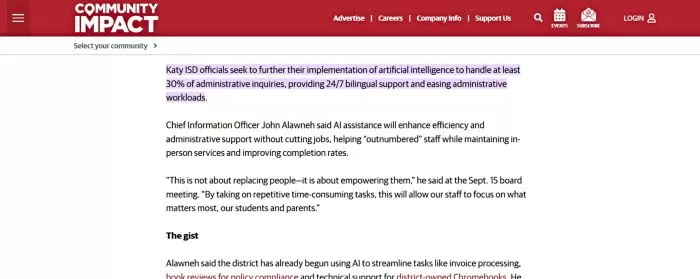
Example: Katy Independent School District (Texas, USA): Facing a growing administrative burden, Katy ISD recognized that its support staff were “outnumbered” by high volumes of repetitive tasks (answering routine inquiries, data entry, etc.). District leaders set a concrete goal for their AI initiative: have AI handle roughly 30% of routine administrative inquiries – with 24/7, bilingual support – so that human staff can focus on high-value interactions. This target was born from a needs assessment of where staff time was being drained. By defining this goal (30% automation of inquiries), Katy ISD created a clear metric for success and a focused vision: use AI as a virtual assistant to improve responsiveness to families while freeing staff for more complex student and parent needs.
Research and Select the Right Tools Not all AI tools are created equal. Once you’ve identified priorities, explore tools designed for education. Look for platforms that integrate easily with your existing systems (SIS, LMS, HR) and are user-friendly for staff. Prioritize solutions with strong vendor support and a track record in the education sector. Talking to peer institutions or reviewing relevant case studies can offer valuable insights.
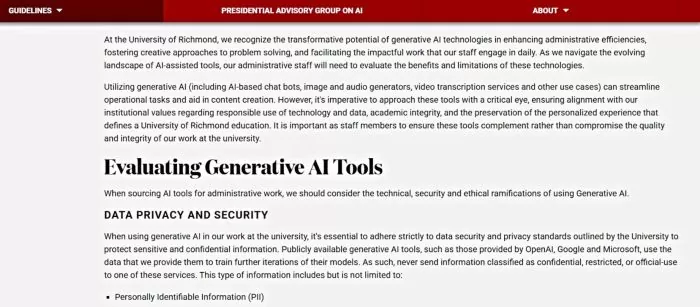
Example: University of Richmond (Virginia, USA): In higher education, institutions are also methodical in choosing AI for administrative use. The University of Richmond explicitly notes the “transformative potential of generative AI…in enhancing administrative efficiencies”, but pairs that excitement with careful evaluation criteria. In official staff guidelines, the university directs its administrative teams to critically vet AI tools for technical fit, security, and ethical considerations. Staff are encouraged to pilot new AI-based services (from chatbots to transcription tools) in a controlled manner – checking that any chosen tool aligns with data privacy policies and the university’s values.
Start with a Pilot Choose a small-scale pilot to test your chosen tool. This might mean introducing a scheduling AI in one department or using a chatbot for financial aid inquiries. Track outcomes closely—are tasks being completed faster? Are users more satisfied? Gather feedback and refine the approach before expanding. A strong pilot builds confidence and creates internal champions.
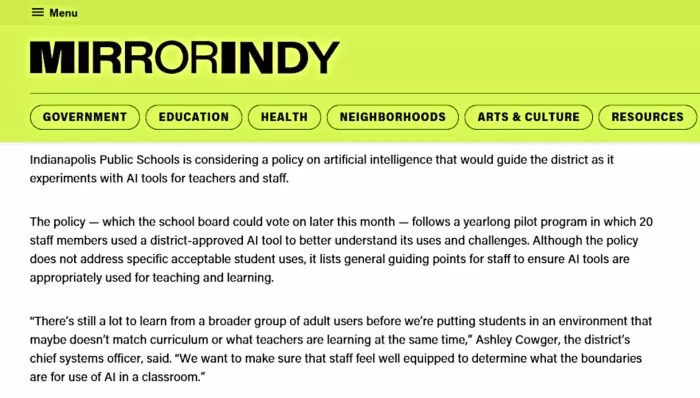
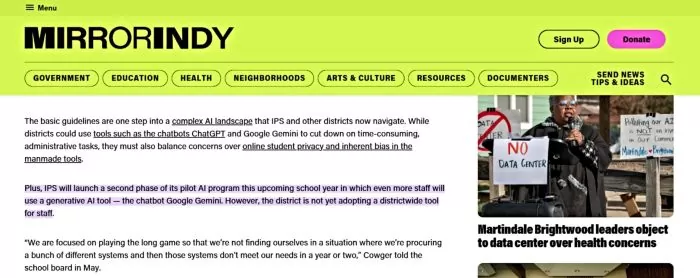
Example: Indianapolis Public Schools (Indiana, USA): IPS illustrates the wisdom of beginning AI adoption on a small scale. In the first year of its AI initiative, the district ran a pilot with just 20 staff members using a district-approved AI tool to handle some of their tasks. This limited pilot let IPS observe real-world uses and challenges (e.g., how an AI writing assistant might help draft reports) without impacting all schools. District leaders gathered feedback and saw improvements, which informed an official AI policy in development. This phased pilot approach gave IPS the chance to refine guidelines and train users in between phases.
Train Staff and Build Buy-In Training is critical. Provide hands-on sessions, user guides, and a forum for questions. Explain how the AI will support, not replace, staff, and share early successes. Framing AI as a helpful assistant rather than a threat makes adoption smoother. Emphasize the time-saving potential and how it frees up staff for more meaningful work.
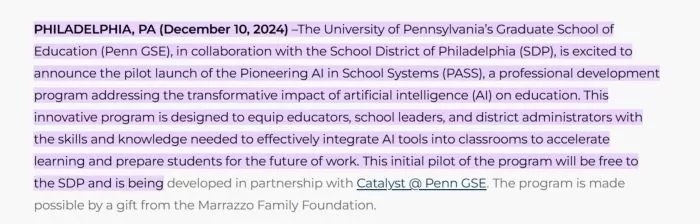
Example: School District of Philadelphia (Pennsylvania, USA): Philadelphia’s public school system, in partnership with the University of Pennsylvania, launched a first-of-its-kind AI training pilot to ensure educators and administrators were on board and prepared. The program, called PASS (Pioneering AI in School Systems), was announced in late 2024 and offers multi-tiered professional development free to a pilot group of district staff. Crucially, PASS explicitly targets mindset and skill-building: it trains district administrators on strategic planning for AI, guides school leaders on implementing AI tools in their schools, and coaches teachers on using AI to enhance (not replace) instruction.
Scale Gradually and Integrate Thoughtfully With a successful pilot in hand, plan for phased implementation. Avoid overwhelming staff by rolling out AI features in stages: first attendance, then scheduling, then reporting. Make sure each step integrates well with existing workflows. Be prepared to revise outdated processes to accommodate the new tool, and keep communication open throughout the transition.
Example: Indianapolis Public Schools (Indiana, USA): After its initial small-scale pilot, IPS is deliberately not rushing into a district-wide rollout – exemplifying thoughtful integration. The district is entering a second pilot year with more staff and a new tool (Google’s Gemini chatbot), but has held off on immediately procuring a permanent, system-wide AI platform. This restraint is intentional: IPS leaders want to ensure any AI tool is truly effective and fits their needs before integrating it into all schools. They are also developing an AI Advisory Committee (including administrators, teachers, tech, and legal experts) to guide integration and update usage policies as the pilot expands. By scaling usage gradually – first 20 staff, now a larger cohort, still not yet student-facing – IPS can adjust its data integration, security settings, and training materials in parallel.
Monitor, Measure, Improve Implementation doesn’t stop at rollout. Regularly assess whether the AI is meeting your goals. Track KPIs like time saved, error rates, or satisfaction levels. Use this data to fine-tune the system and report outcomes to stakeholders. AI platforms often improve with use, especially those built on machine learning. Feeding back your school’s data will make them more effective over time.
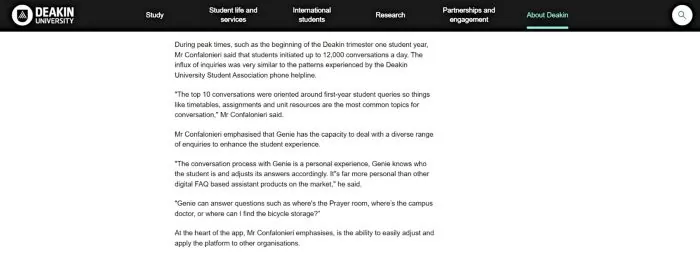
Example: Deakin University (Victoria, Australia): Deakin’s IT and administrative teams exemplify continuous improvement with their AI-powered student services. The university’s digital assistant “Genie” was rolled out in stages and is closely monitored for usage and performance. Since launching across campus, Genie’s user base has more than doubled within a year over 25,000 students having downloaded the app, a metric the university tracks to gauge adoption. Deakin’s Chief Digital Officer noted they analyze conversation data: at peak times, Genie handles up to 12,000 conversations a day, and they review the top categories of student questions (e.g., timetable info, assignment deadlines). By identifying the most common inquiries, the team continuously updates Genie’s responses and adds new features. This ongoing measurement extends to quality checks – the university monitors whether Genie’s answers resolved students’ issues or if human staff had to follow up, informing further training of the AI.
Foster a Culture of Innovation Successful AI integration requires a mindset shift. Leaders should create an environment where staff feel empowered to try new approaches and share feedback. Celebrate wins, learn from setbacks, and reinforce that AI is a tool to enhance human capacity, not replace it.
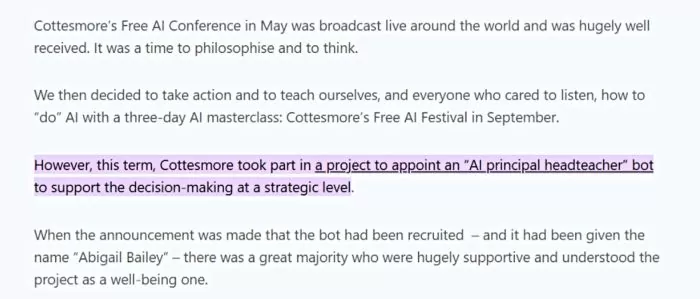
Example: Cottesmore School (West Sussex, UK): This independent boarding school has embraced an innovation-first culture in its administration, particularly with AI. Headmaster Tom Rogerson gained international attention in 2023 for appointing an AI chatbot as an “assistant headteacher” – named “Abigail Bailey” – to support strategic decision-making. The move was less about the tech itself and more about signaling to staff and students that experimenting with new ideas is welcome. Rogerson frames the project as a well-being and innovation initiative: the AI assistant serves as a “strategic leadership mentor,” providing impartial insights, while human leaders remain in charge. In addition to this high-profile experiment, Cottesmore has hosted free AI conferences and masterclasses for educators. For example, the school ran an “AI Festival” where staff from Cottesmore and other schools tried out AI tools and shared ideas in a collaborative environment. By openly discussing both the opportunities and challenges of AI, and even inviting outside experts to weigh in, the headmaster created a safe space for his team to be curious and creative.
Implementing AI in school administration is an ongoing journey, but with a clear strategy and commitment to collaboration, schools can unlock new levels of efficiency, insight, and impact. The result is a smarter, more responsive administrative operation that supports the broader mission of education.
Final Thoughts
AI is transforming education management by enhancing, not replacing, the work of school administrators. It takes on time-consuming tasks, delivers faster insights from data, and strengthens communication with students, families, and staff. The result is more time for leaders to focus on strategy, mentorship, and school culture.
At HEM, we view AI as a vital part of a modern, responsive education strategy. Schools that adopt AI thoughtfully are better prepared to navigate enrollment shifts, budget pressures, and rising expectations. The key is clear planning, ethical use, and keeping people at the centre.
AI gives administrators the support they need to lead more effectively. With the right approach, it can elevate the quality and impact of school leadership.
Are you ready to improve visibility, engagement, and enrollment?
Partner with HEM for solutions designed to help your institution stand out.
Frequently Asked Questions
Question: How does AI help school administrators make better decisions?
Answer: AI’s greatest strength in school management lies in transforming raw data into clear, actionable insights. Administrators regularly face overwhelming volumes of information, grades, attendance, budget reports, and surveys that can be difficult to parse manually. AI tools help by quickly identifying patterns that support evidence-based decisions.
Question: What routine administrative tasks can AI automate in schools?
Answer: From attendance logs to class schedules, school administrators are buried in repetitive tasks that sap time and focus. AI is stepping in to take care of the busywork, streamlining operations and giving staff space to lead more strategically.
Question: What challenges do schools face when implementing AI tools?
Answer: The potential of AI in education is vast, but unlocking it requires more than just installing a new tool. For school administrators, adopting AI often brings a mix of excitement and logistical complexity.
Holiday shopping doesn’t need to empty your wallet or your sanity bar. Here’s a lineup of fun little treasures for friends, family or that one person who says “I don’t need anything” every year.
This list features 22 highly rated and well received items handpicked by Student Life Network!
P.s. You can also totally gift these to the most deserving person on planet earth… YOU! Treat Yo-self
*Prices reflect the date of November 28, 2025.
Flower candle warmer lamp
~$31+ (after tax)
For: Candle lovers who want the scent without worrying about an open flame.
For: People who always run low on battery when out. Perfect for small pockets and purses while packing a full charge. Make sure you get the charging port that’s compatible!
Pro tip: Students get a 6-month trial of Amazon Prime for FREE! Start your trial today and get fast two-day shipping as well as exclusive perks on affiliated services (Prime Video, Twitch, Prime Photos).