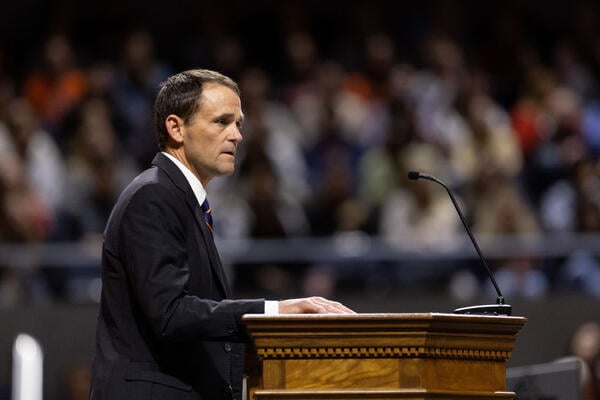
Former University of Virginia president Jim Ryan has broken his silence concerning his abrupt resignation, accusing the Board of Visitors of dishonesty and complicity in his ouster, which came amid federal government scrutiny over the university’s diversity, equity and inclusion practices.
In a 12-page letter to the UVA Faculty Senate on Friday, Ryan wrote that he was “stunned and angry” over the board’s lack of honesty as it faced pressure from the federal government to force him out due to an alleged failure to dismantle DEI initiatives. Ryan also wrote that recent letters by UVA rector Rachel Sheridan and Governor Glenn Youngkin do not “present an accurate accounting of my resignation,” which prompted him to release his own statement.
Inside Higher Ed has uploaded Ryan’s full letter below.
Ryan’s letter follows a message Sheridan sent to the UVA Faculty Senate on Thursday. In that letter, Sheridan downplayed the pressure from the federal government to force Ryan out. While she acknowledged that the Department of Justice “lacked confidence in President Ryan to make the changes that the Trump Administration believed were necessary to ensure compliance,” she disputed the notion that his resignation was part of the agreement that the university recently reached with the federal government to pause investigations into DEI practices.
The full text of that letter is available below.
Also on Thursday, Youngkin sent a letter related to Ryan’s departure to Governor-elect Abigail Spanberger, who has called for UVA to halt its ongoing presidential search until her board picks are in place. The Republican governor pushed back on his Democratic successor’s claims that Ryan was ousted as a result of federal overreach and accused her of interfering in the search. Youngkin also accused Ryan of “not being committed to following federal law.”
That letter has been uploaded in full below.
This is a breaking news story and will be updated.
On November 26 dozens of articles written by News Decoder students will go to a panel of three judges as part of our twice-yearly storytelling competition. One of the criteria they will use to decide on the winners is this: Did the student report the story objectively, without bias? It is one of five criteria (another being total subjectivity on the part of each judge — sometimes a story is just a really great story).
Here is the question: How does one define bias? You’d think I’d be able to answer this question easily, since I’ve written whole articles on objectivity, which is commonly thought of as the absence of bias. Webster’s Dictionary defines bias as an inclination of temperament or outlook, or an instance of such prejudice.
Basically, you are for something or against something. A problem with trying to eliminate bias is often we don’t recognize when we lean more one way or another. If something is true it is true, right? How can truth be biased? But how many ridiculous arguments revolve around competing definitions of truth?
News Decoder correspondent Enock Wanderema is an experienced journalist but he’s currently studying behavioral science. Two things he’s been thinking about are what is known as availability bias and confirmation bias.
Availability bias is our tendency to rely on what we can remember. If we can remember it, it seems more important or more true. That leads to us raising importance stuff that recently happened since we remember it more easily.
With confirmation bias, we tend to search for, interpret and remember information that confirms what we already believe and we overlook anything that contradicts those beliefs.
“This happens automatically because constantly questioning everything we believe would be cognitively exhausting,” he wrote. “It means we can become trapped in false beliefs even when contradictory evidence accumulates and this matters enormously in contexts that are complex, novel, abstract or ideologically loaded; exactly the kinds of situations modern life presents constantly, but which were rare in ancestral environments.”
Bias in journalism
This becomes more problematic when we talk about journalists. “Journalists are the primary gatekeepers of information about complex issues people cannot directly experience but journalists are humans with the same biases,” Wanderema said.
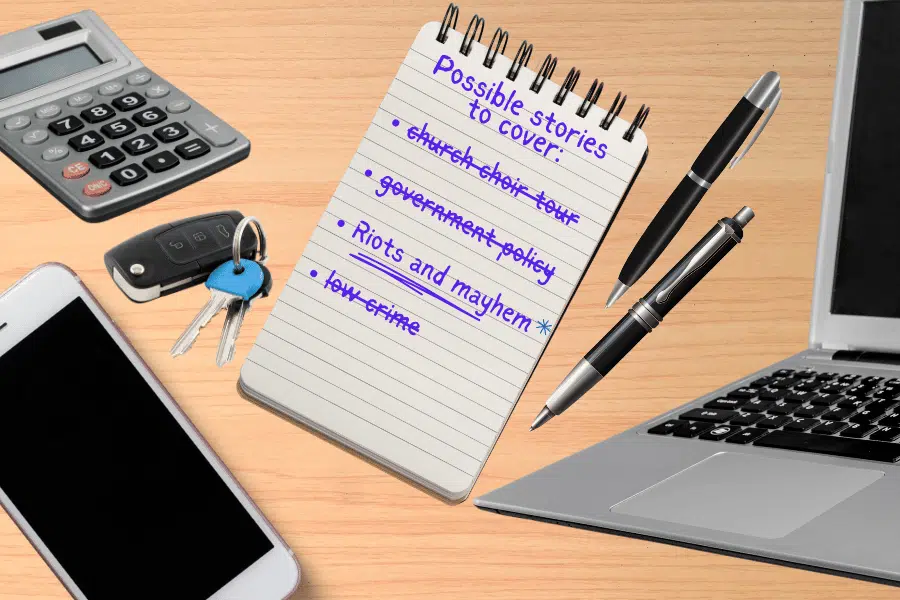
These biases come into play with the stories reporters or news organizations choose to cover or not cover. They inadvertently rely on what they remember and are familiar with when deciding if something is important enough to cover and deciding the events and people to ignore.
This can lead to whole populations of people made invisible and important events ignored. If something has been happening and no one has covered it, how important can it be?
News Decoder Correspondent Paul Sochaczewski struggles with the idea of bias not only with news stories but in writing non-fiction biographies of people long dead. “All journalism has bias,” he wrote. “Point of view, word choice, selection of details, who to quote and accuracy of that quote and so on.”
In a 300-page book you can’t tell someone’s whole life story, but in summing up the life it is the biographer who decides what events are important and which ones paint the most accurate portrait of a person. It is the biographer who decides what to leave out.
A picture of reality
In some ways bias in storytelling is like the decisions a photographer makes in taking a photo. How many photos taken of me made me look awful? And yet there were a few that made me look better than I generally do. It had to do with the lighting available at the time and the photographer’s desire to make me look good.
The photographer isn’t making anything up but by adjusting where I stand, what’s around me, how my hair falls — and having the sun on my face the right way, she can change my look from an old hag who just woke up in a terrible mood to a beautiful person in the prime of her life.
News Decoder Correspondent Barry Moody says that you show bias when you lean towards one side or the other, either in the way you present the information or in giving more space to one side of an argument. Instead, you should present the facts and let your readers decide whether they have an opinion. “But don’t allow your own, either consciously or subconsciously to intrude,” he said.
Kirby Moss, a professor of journalism and mass communication at the California Polytechnic University Humboldt in California sees bias as the inability or lack of awareness to critique your own perspective.
That goes back to the notion of objectivity being the absence of bias. It is difficult to eliminate our own bias if we don’t recognize it in the first place.
Wanderema said that our biases are often mental shortcuts that allow us to process the too much information we are constantly bombarded with, most of it from media rather than from direct experience. We pay attention to some things but not others. We are skeptical of some facts but easily accept others.
“The result is a complex feedback loop where journalists’ biases shape coverage, coverage triggers audience biases, audience preferences reinforce journalistic practices and the entire system systematically distorts public understanding of reality,” Wanderema said. “Not through deliberate deception, but through the predictable operation of cognitive shortcuts that evolved to help humans navigate immediate physical environments.”
Personally, in addressing the thorny problem of bias, I rely on what I have long decided should be the first rule of journalism: honesty. When reporting, I try to lay out facts as I’ve discovered them, after making a genuine effort to explore different perspectives and sides. But as Moss explained, it is important that I explore my own perspective so that I can then fess up to readers my own biases and conclusions. This lets them know where I stand so that they can accept or reject the conclusions I’ve made.
In trying to eliminate our biases, we end up deceiving not just our readers, but ourselves.
Questions to consider:
1. What is confirmation bias?
2. In what ways can personal bias affect what stories you choose to tell?
This audio is auto-generated. Please let us know if you have feedback.
How well did you keep up with this week’s developments in K-12 education? To find out, take our five-question quiz below. Then, share your score by tagging us on social media with #K12DivePopQuiz.
AI is now at the center of almost every conversation in education technology. It is reshaping how we create content, build assessments, and support learners. The opportunities are enormous. But one quiet risk keeps growing in the background: losing our habit of critical thinking.
I see this risk not as a theory but as something I have felt myself.
The moment I almost outsourced my judgment
A few months ago, I was working on a complex proposal for a client. Pressed for time, I asked an AI tool to draft an analysis of their competitive landscape. The output looked polished and convincing. It was tempting to accept it and move on.
Then I forced myself to pause. I began questioning the sources behind the statements and found a key market shift the model had missed entirely. If I had skipped that short pause, the proposal would have gone out with a blind spot that mattered to the client.
That moment reminded me that AI is fast and useful, but the responsibility for real thinking is still mine. It also showed me how easily convenience can chip away at judgment.
AI as a thinking partner
The most powerful way to use AI is to treat it as a partner that widens the field of ideas while leaving the final call to us. AI can collect data in seconds, sketch multiple paths forward, and expose us to perspectives we might never consider on our own.
In my own work at Magic EdTech, for example, our teams have used AI to quickly analyze thousands of pages of curriculum to flag accessibility issues. The model surfaces patterns and anomalies that would take a human team weeks to find. Yet the real insight comes when we bring educators and designers together to ask why those patterns matter and how they affect real classrooms. AI sets the table, but we still cook the meal.
There is a subtle but critical difference between using AI to replace thinking and using it to stretch thinking. Replacement narrows our skills over time. Stretching builds new mental flexibility. The partner model forces us to ask better questions, weigh trade-offs, and make calls that only human judgment can resolve.
Habits to keep your edge
Protecting critical thinking is not about avoiding AI. It is about building habits that keep our minds active when AI is everywhere.
Here are three I find valuable:
1. Name the fragile assumption Each time you receive AI output, ask: What is one assumption here that could be wrong? Spend a few minutes digging into that. It forces you to reenter the problem space instead of just editing machine text.
2. Run the reverse test Before you adopt an AI-generated idea, imagine the opposite. If the model suggests that adaptive learning is the key to engagement, ask: What if it is not? Exploring the counter-argument often reveals gaps and deeper insights.
3. Slow the first draft It is tempting to let AI draft emails, reports, or code and just sign off. Instead, start with a rough human outline first. Even if it is just bullet points, you anchor the work in your own reasoning and use the model to enrich–not originate–your thinking.
These small practices keep the human at the center of the process and turn AI into a gym for the mind rather than a crutch.
Why this matters for education
For those of us in education technology, the stakes are unusually high. The tools we build help shape how students learn and how teachers teach. If we let critical thinking atrophy inside our companies, we risk passing that weakness to the very people we serve.
Students will increasingly use AI for research, writing, and even tutoring. If the adults designing their digital classrooms accept machine answers without question, we send the message that surface-level synthesis is enough. We would be teaching efficiency at the cost of depth.
By contrast, if we model careful reasoning and thoughtful use of AI, we can help the next generation see these tools for what they are: accelerators of understanding, not replacements for it. AI can help us scale accessibility, personalize instruction, and analyze learning data in ways that were impossible before. But its highest value appears only when it meets human curiosity and judgment.
Building a culture of shared judgment
This is not just an individual challenge. Teams need to build rituals that honor slow thinking in a fast AI environment. Another practice is rotating the role of “critical friend” in meetings. One person’s task is to challenge the group’s AI-assisted conclusions and ask what could go wrong. This simple habit trains everyone to keep their reasoning sharp.
Next time you lean on AI for a key piece of work, pause before you accept the answer. Write down two decisions in that task that only a human can make. It might be about context, ethics, or simple gut judgment. Then share those reflections with your team. Over time this will create a culture where AI supports wisdom rather than diluting it.
The real promise of AI is not that it will think for us, but that it will free us to think at a higher level.
The danger is that we may forget to climb.
The future of education and the integrity of our own work depend on remaining climbers. Let the machines speed the climb, but never let them choose the summit.
Laura Ascione is the Editorial Director at eSchool Media. She is a graduate of the University of Maryland’s prestigious Philip Merrill College of Journalism.
For Generation Z, the old story of social mobility—study hard, go to college, work your way up—has lost its certainty. The class divide that once seemed bridgeable through education now feels entrenched, as debt, precarious work, and economic volatility blur the promise of progress.
The new economy—dominated by artificial intelligence, speculative assets like cryptocurrency, and inflated housing markets—has not delivered stability for most. Instead, it’s widened gaps between those who own and those who owe. Many young Americans feel locked out of wealth-building entirely. Some have turned to riskier bets—digital assets, gig work, or start-ups powered by AI tools—to chase opportunities that traditional institutions no longer provide. Others have succumbed to despair. Suicide rates among young adults have climbed sharply in recent years, correlating with financial stress, debt, and social isolation.
And echoing through this uncertain landscape is a song that first rose from the coalfields of Kentucky during the Great Depression—Florence Reece’s 1931 protest hymn, “Which Side Are You On?”
Come all you good workers,
Good news to you I’ll tell,
Of how the good old union
Has come in here to dwell.
Which side are you on?
Which side are you on?
Nearly a century later, those verses feel newly urgent—because Gen Z is again being forced to pick a side: between solidarity and survival, between reforming a broken system or resigning themselves to it.
The Class Divide and the Broken Ladder
Despite record levels of education, Gen Z faces limited social mobility. College remains a class marker, not an equalizer. Students from affluent families attend better-funded universities, graduate on time, and often receive help with housing or job placement. Working-class and first-generation students, meanwhile, navigate under-resourced campuses, heavier debt, and weaker professional networks.
The Pew Research Center found that first-generation college graduates have nearly $100,000 less in median wealth than peers whose parents also hold degrees. For many, the degree no longer guarantees a secure foothold in the middle class—it simply delays financial independence.
They say in Harlan County,
There are no neutrals there,
You’ll either be a union man,
Or a thug for J. H. Blair.
The metaphor still fits: there are no neutrals in the modern class struggle over debt, housing, and automation.
Debt, Doubt, and the New Normal
Gen Z borrowers owe an average of around $23,000 in student loans, a figure growing faster than any other generation’s debt load. Over half regret taking on those loans. Many delay buying homes, having children, or even seeking medical care. Those who drop out without degrees are burdened with debt and little to show for it.
The debt-based model has become a defining feature of American life—especially for the working class. The price of entry to a better future is borrowing against one’s own.
Don’t scab for the bosses,
Don’t listen to their lies,
Us poor folks haven’t got a chance
Unless we organize.
If Reece’s song once called miners to unionize against coal barons, its spirit now calls borrowers, renters, adjuncts, and gig workers to collective resistance against financial systems that profit from their precarity.
AI and the Erosion of Work
Artificial intelligence promises efficiency, but it also threatens to hollow out the entry-level job market Gen Z depends on. Automation in journalism, design, law, and customer service cuts off rungs of the career ladder just as young workers reach for them.
While elite graduates may move into roles that supervise or profit from AI, working-class Gen Zers are more likely to face displacement. AI amplifies the class divide: it rewards those who already have capital, coding skills, or connections—and sidelines those who don’t.
Crypto Dreams and Financial Desperation
Locked out of traditional wealth paths, many young people turned to cryptocurrency during the pandemic. Platforms like Robinhood and Coinbase promised quick gains and independence from the “rigged” economy. But when crypto markets crashed in 2022, billions in speculative wealth evaporated. Some who had borrowed or used student loan refunds to invest lost everything.
Online forums chronicled not only the financial losses but also the psychological fallout—stories of panic, shame, and in some tragic cases, suicide. The new “digital gold rush” became another mechanism for transferring wealth upward.
The Real Estate Wall
While digital markets rise and fall, real estate remains the ultimate symbol of exclusion. Home prices have climbed over 40 percent since 2020, while mortgage rates hover near 8 percent. For most of Gen Z, ownership is out of reach.
Older generations built equity through housing; Gen Z rents indefinitely, enriching landlords and institutional investors. Without intergenerational help, the “starter home” has become a myth. In America’s new class order, those who inherit property inherit mobility.
Despair and the Silent Crisis
Behind the data lies a mental health emergency. The CDC reports that suicide among Americans aged 10–24 has risen nearly 60 percent in the past decade. Economic precarity, debt, housing insecurity, and climate anxiety all contribute.
Therapists describe “financial trauma” as a defining condition for Gen Z—chronic anxiety rooted in systemic instability. Universities respond with mindfulness workshops, but few confront the deeper issue: a society that privatized risk and monetized hope.
They say in Harlan County,
There are no neutrals there—
Which side are you on, my people,
Which side are you on?
The question lingers like a challenge to policymakers, educators, and investors alike.
A Two-Tier Future
Today’s economy is splitting into two distinct realities:
The secure class, buffered by family wealth, education, AI-driven income, and real estate assets.
The precarious class, burdened by loans, high rents, unstable work, and psychological strain.
The supposed democratization of opportunity through technology and education has in practice entrenched a new feudalism—one coded in algorithms and contracts instead of coal and steel.
Repairing the System, Not the Student
For Generation Z, the American Dream has become a high-interest loan. Education, technology, and financial innovation—once tools of liberation—now function as instruments of control.
Reforming higher education is necessary, but not sufficient. The deeper work lies in redistributing power: capping predatory interest rates, investing in affordable housing, curbing speculative bubbles, ensuring that AI’s gains benefit labor as well as capital, and confronting the mental health crisis that shadows all of it.
Florence Reece’s song endures because its question has never been answered—only updated. As Gen Z stands at the intersection of debt and digital capitalism, that question rings louder than ever:
Which side are you on?
Sources
Florence Reece, “Which Side Are You On?” (1931).
Pew Research Center, “First-Generation College Graduates Lag Behind Their Peers on Key Economic Outcomes,” 2021.
Dēmos, The Debt Divide: How Student Debt Impacts Opportunities for Black and White Borrowers, 2016.
EducationData.org, “Student Loan Debt by Generation,” 2024.
Federal Reserve Bank of St. Louis, Gen Z Student Debt and Wealth Data Brief, 2022.
CNBC, “Gen Z vs. Their Parents: How the Generations Stack Up Financially,” 2024.
WUSF, “Generation Z’s Net Worth Is Being Undercut by College Debt,” 2024.
Newsweek, “Student Loan Update: Gen Z Hit with Highest Payments,” 2024.
The Kaplan Group, “How Student Debt Is Locking Millennials and Gen Z Out of Homeownership,” 2024.
CDC, Suicide Mortality in the United States, 2001–2022, National Center for Health Statistics, 2023.
Brookings Institution, “The Impact of AI on Labor Markets: Inequality and Automation,” 2024.
CNBC, “Crypto Crash Wipes Out Billions in Investor Wealth, Gen Z Most Exposed,” 2023.
Zillow, “U.S. Housing Affordability Reaches Lowest Point Since 1989,” 2024.
It is tempting to regard AI as a panacea for addressing our most urgent global challenges, from climate change to resource scarcity. Yet the truth is more complex: unless we pair innovation with responsibility, the very tools designed to accelerate sustainability may exacerbate its contradictions.
A transformative potential
Let us first acknowledge how AI is already reshaping sustainable development. By mapping patterns in vast datasets, AI enables us to anticipate environmental risks, optimise resource flows and strengthen supply chains. Evidence suggests that by 2030, AI systems will touch the lives of more than 8.5 billion people and influence the health of both human and natural ecosystems in ways we have never seen before. Research published in Nature indicates that AI could support progress towards 79% of the Sustainable Development Goals (SDGs), helping advance 134 specific targets. Yet the same research also cautions that AI may impede 59 of those targets if deployed without care or control.
In practice, this means smarter energy grids that balance load and demand, precision agriculture that reduces fertiliser waste and environmental monitoring systems that detect deforestation or pollution in real time. For a planet under pressure, these scenarios offer hope to do less harm and build more resilience.
The hidden costs
Even so, we must confront the shadows cast by AI’s advancements. An investigation published earlier this year warns that AI systems could account for nearly half of global data-centre power consumption before the decade’s end. Consider the sheer scale: vast server arrays, intensive cooling systems, rare-earth mining and water-consuming infrastructure all underpin generative AI’s ubiquity. Worse still, indirect carbon emissions tied to major AI-capable firms reportedly rose by 150% between 2020 and 2023. In short, innovation meant to serve sustainability imposes a growing ecological burden.
Navigating trade-offs
This tension presents an essential question: how can we reconcile AI’s promise with its cost? Scholars warn that we must move beyond the assumption that ‘AI for good’ is always good enough. The moment demands a new discipline of ‘sustainable AI’: a framework that treats resource use, algorithmic bias, lifecycle impact and societal equity as first-order concerns.
Practitioners must ask not only what AI can do, but how it is built, powered, governed and retired. Efficiency gains that drive consumption higher will not deliver sustainability; they may merely escalate resource demands in disguise.
A moral and strategic imperative
For educators, policymakers and business leaders, this is more than a technical issue; it is a moral and strategic one. To realise AI’s true potential in advancing sustainable development, we must commit to three priorities:
Energy and resource transparency: Organisations must measure and report the footprint of their AI models, including data-centre use, water cooling, e-waste and supply-chain impacts. Transparency is foundational to accountability.
Ethical alignment and fairness: AI must be trained and deployed with due regard to bias, social impact and inclusivity. Its benefits must not reinforce inequality or externalise environmental harms onto vulnerable communities.
Integrative education and collaboration: We need multidisciplinary expertise, engineers fluent in ecology, ethicists fluent in algorithms and managers fluent in sustainability. Institutions must upskill young learners and working professionals to orient AI within the broader context of planetary boundaries and human flourishing.
MLA College’s focus and contribution
At MLA College, we recognise our role in equipping professionals at this exact intersection. Our programs emphasise the interrelationship between technology, sustainability and leadership. Graduates of distance-learning and part-time formats engage with the complexities of AI, maritime operations, global sustainable development and marine engineering by bringing insight to sectors vital to the planet’s future.
When responsibly guided, AI becomes an amplifier of purpose rather than a contraption of risk. Our challenge is to ensure that every algorithm, model and deployment contributes to regenerative systems, not extractive ones.
The promise of AI is compelling: more accurate climate modelling, smarter cities, adaptive infrastructure and just-in-time supply chains. But the challenge is equally formidable: rising energy demands, resource-intensive infrastructures and ungoverned expansion.
When responsibly guided, AI becomes an amplifier of purpose rather than a contraption of risk
Our collective role, as educators and practitioners, is to shape the ethical architecture of this era. We must ask whether our technologies will serve humanity and the environment or simply accelerate old dynamics under new wrappers.
The verdict will not be written on lines of code or boardroom decisions alone. It will be inscribed in the fields that fail to regenerate, in the communities excluded from progress, in the data centres humming with waste and in the next generation seeking meaning in technology’s promise.
About the author: Professor Mohammad Dastbaz is the principal and CEO of MLA College, an international leader in distance and sustainability-focused higher education. With over three decades in academia, he has held senior positions including deputy vice-chancellor at the University of Suffolk and pro vice-chancellor at Leeds Beckett University.
A Fellow of the British Computer Society, the Higher Education Academy, and the Royal Society of Arts, Professor Dastbaz is a prominent researcher and author in the fields of sustainable development, smart cities, and digital innovation in education.
His latest publication, Decarbonization or Demise – Sustainable Solutions for Resilient Communities (Springer, 2025), brings together cutting-edge global research on sustainability, climate resilience, and the urgent need for decarbonisation. The book builds on his ongoing commitment to advancing the UN Sustainable Development Goals through education and research.
At MLA College, Professor Dastbaz continues to lead transformative learning initiatives that combine academic excellence with real-world impact, empowering students to shape a sustainable future.
In August, the Trump administration issued an executive action ordering colleges and universities to submit disaggregated data about their applicants and prove they are following the letter of the law when it comes to race in admissions. But a new notice, published to the Federal Register Wednesday, clarifies that the mandate only applies to four-year institutions.
“We posed a directed question to the public to seek their feedback … [and] based both upon our initial thinking and public comment, we propose limit[ing] eligibility of [the new IPEDS Admissions and Consumer Transparency Supplement] to the four-year sector,” the notice stated.
Colleges that are obligated to comply must still submit six years’ worth of application and admissions data, disaggregated by student race and sex, during the next survey cycle, it said. But any college that admits 100 percent of its applicants and does not award merit or identity-based aid will be exempt.
Since the action was first published, institutions across the sector have warned the Trump administration that collecting and reporting such data would be a difficult task and place an undue burden on admissions offices. But with smaller staff sizes and limited resources, community colleges were particularly adamant about the challenge the requirement posed.
“It’s not just as easy as collecting data,” Paul Schroeder, the executive director of the Council of Professional Associations on Federal Statistics, toldInside Higher Ed in August. “It’s not just asking a couple questions about the race and ethnicity of those who were admitted versus those who applied. It’s a lot of work. It’s a lot of hours. It’s not going to be fast.”
Sterling College will close at the end of the spring semester, officials announced Wednesday.
The small college in Craftsbury Common, Vt., will cease operations in May due to “persistent financial and enrollment challenges,” according to a statement posted on its website.
“We understand that this news is difficult and deeply personal for every member of our community. Sterling College has always been more than a place of learning; it has been a home where curiosity, creativity, and compassion thrived,” officials wrote in the closure announcement.
Sterling, which offered “transdisciplinary, experiential, competency-assessed educational programs,” according to its website, historically capped enrollment at 125 students. Founded in 1958, Sterling is one of a few U.S. work colleges, a model that allows students to keep tuition down via campus labor. Residential students at Sterling work five hours per week in different roles.
Federal data shows that Sterling only had a head count of 78 students in fall 2023.
While the college managed to eke out modest surpluses in recent years, it had a meager endowment of just over $1.1 million, much of that restricted, according to financial documents.
Sterling is now the second institution to announce a closure this month, following Trinity Christian College in Illinois, which is shutting down next year due to similar challenges.
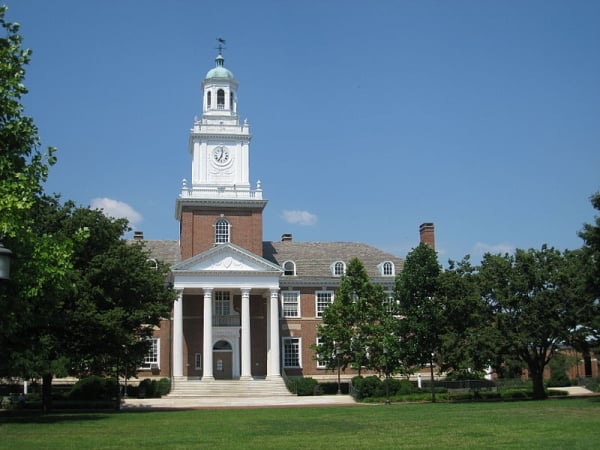
Johns Hopkins University announced Thursday that it’s eliminating tuition, fees and living expenses for its Homewood campus undergraduates whose families make less than $100,000 a year; students whose families earn up to $200,000 will pay no tuition. It joins a wave of other institutions—especially private, selective ones—that have announced tuition guarantees.
In a news release, the university said the change “means students from a majority of American families, including middle-class families earning above the national median household income of $87,730, can attend Hopkins at no expense.”
Further, Hopkins said, “Most families with incomes up to $250,000 will continue to qualify for significant financial aid. Even those with annual incomes exceeding $250,000 may qualify, especially when there are multiple children in college at the same time.”
Most of the university’s undergrads study on the Homewood campus, in North Baltimore. The release said the new aid levels “will go into effect for eligible current students in the spring 2026 semester and for new, incoming students next fall.”
In a message to the university community, JHU president Ron Daniels said that since businessman and former New York mayor Michael Bloomberg donated $1.8 billion to the university in 2018, Hopkins’s share of Pell Grant–eligible students rose from 15.4 percent to 24.1 percent, the highest proportion in university history.
“Our financial aid investment has continued to grow, inspired by Mayor Bloomberg’s transformative gift, with generous contributions by more than 1,200 donors who have given $240 million for financial aid at Hopkins over the last several years,” Daniels wrote. “We are in their collective debt.”
New early-applicant data from the Common App found that applications from Black, low-income, first-generation and rural potential students are all up compared to this point last year. However, international applications dipped, and the most selective institutions are experiencing the smallest application growth compared to other types of institutions. Applicants are also increasingly choosing to submit standardized test scores.
The Common App report, released Thursday, is the first in a series of monthly research briefs on college applicant trends typically released between November and March. The November brief showed that applicants, and applications, rose over all compared to this time last year, with notable growth among particular groups.
For example, applications from those who identified as Black or African American increased 16 percent and multiracial applicants rose 11 percent compared to the same time last application season. The report also found that applicants who identified as first-generation grew by 12 percent, while low-income applicants, who qualified for a Common App fee waiver, increased at more than twice the rate of other applicants. Rural applicants grew by 15 percent compared to last year, while thosefrom metropolitan areas grew only 6 percent.
But the number of international students applying dropped 9 percent compared to this point last year, driven by a 14 percent drop in applicants from India, which has historically been the second-biggest source of international applicants on the Common App platformafter China. Applicants from Asia broadly and from Africa also dropped significantly, 9 percent and 18 percent respectively, with a whopping 43 percent decline in applicants from Ghana. These trends suggest theTrump administration’s policies, including international student visa delays and denials, may be deterring students.
At a time when highly selective institutions are under new political pressures, the report found that colleges and universities with admit rates of 25 percent or below had the slowest application growth, at 4 percent. Applications to other types of institutions grew at two or three times that rate.
The return of standardized test requirements at some institutions is also driving more applicants to submit test scores. Notably, applications reporting scores rose 11 percent compared to this time last year. However, students who identify as underrepresented minorities or first-generation or who qualify for a Common App waiver were less likely to share their scores.