Blog

  • Northwestern Settles With Trump Administration

    Northwestern Settles With Trump Administration

    pabradyphoto/Getty Images

    Northwestern University has reached an agreement with the Trump administration to restore federal research funding. The university will pay the federal government $75 million and enact various changes. In return, the federal government will lift a freeze on millions in research funding.

    As part of the settlement, Northwestern agreed to adhere to federal antidiscrimination laws and to not give preferences in admissions, scholarships, hiring or promotion that are based on race, color or national origin; to maintain clear free speech policies; and to mandate antisemitism training for all students, faculty and staff. University officials will also reverse a 2024 deal made with pro-Palestinian student protesters in which Northwestern agreed to provide more support for Muslim, Middle Eastern and North African students and greater financial transparency.

    The settlement also bars Northwestern’s Feinberg School of Medicine from performing “hormonal interventions and transgender surgeries” on minor patients, according to language in the agreement. However, university officials have said that does not reflect a change in practice. Instead the agreement merely codifies that Northwestern will not provide such services.

    Northwestern is now the sixth university to strike a deal with the Trump administration, following settlements with the University of Pennsylvania, Columbia University, Brown University, the University of Virginia and Cornell University. Of those settlements, Northwestern has the second-highest financial payout at $75 million, trailing only Columbia, which agreed to pay $221 million. Unlike the Brown and Cornell settlements, all of the money will go directly to U.S. government.

    A Path Forward

    Northwestern leadership cast the settlement as a win, despite the $75 million payout.

    “It was the best and most certain method to restore our federal funding both now and in the future,” interim president Henry Bienen said in a video message following the settlement.

    The Trump administration froze $790 million in federal research funding earlier this year amid concerns about alleged antisemitism on campus following pro-Palestinian demonstrations in 2024. Last year, at the height of the protests, then-president Michael Schill struck a deal with pro-Palestinian students, known as the Dearing Meadow agreement, which has now been scuttled. That deal was heavily scrutinized by Congress when Schill testified in May 2024. (Schill would later resign, stepping down this fall amid the standoff over frozen federal research funding.)

    Though Harvard University brought a successful lawsuit against the federal government, prompting a judge to rule in July that a similar funding freeze there was illegal, Northwestern aimed to avoid a costly and protracted legal battle in an effort to quickly restore research dollars.

    Bienen argued in the video that “suing would have cost time and money that we believe the university could not risk” and the settlement was “the best path forward for us to be able to turn the page.” Despite an endowment valued at more than $14 billion, Bienen said, the university could not afford to sustain its research mission on its own. Had that freeze continued, Bienen said it would “gut our labs, drive away faculty, and set back entire fields of discovery.”

    Northwestern, like other wealthy institutions hit with federal funding freezes, has made a number of cost-cutting moves as it navigated sudden financial challenges related to the research enterprise. Earlier this year Northwestern eliminated 425 jobs as part of overall budget reductions.

    Now the federal funding spigot is set to be turned back on, though officials noted on the university website that “some terminated grants will not be reinstated, specifically those the federal government has cut” and that “these decisions were not specific to Northwestern.”

    The university did not admit to any wrongdoing in the settlement.

    Northwestern also answered a question that has been hanging over numerous other universities in its settlement communications, stating that it will not sign the Trump administration’s proposed “Compact for Academic Excellence in Higher Education.” Originally floated to only a few universities before it was opened to all, the compact would provide preferential treatment in federal funding in return for various changes, many of which experts warn would undermine academic freedom. So far, few institutions have expressed interest in the proposal.

    A Landmark Deal

    Federal officials also hailed the settlement with Northwestern as a win.

    “Universities that receive federal funding have a responsibility to comply with the law, including protecting against racial discrimination and antisemitism,” Assistant Attorney General Harmeet K. Dhillon of the Justice Department’s Civil Rights Division said in a news release. “We appreciate the significant improvements Northwestern has made and are gratified to reach an agreement that safeguards of rights [sic] of all the university’s applicants, students, and employees.”

    Education Secretary Linda McMahon called the settlement a landmark deal.

    “The deal cements policy changes that ‘will protect students and other members of the campus from harassment and discrimination,’ and it recommits the school to merit-based hiring and admissions. The reforms reflect bold leadership at Northwestern, and they are a roadmap for institutional leaders around the country that will help rebuild public trust in our colleges and universities,” McMahon said in the DOJ news release that announced the settlement.

    Source link

  • 3,000 Children Repeating Third Grade Under New Indiana Literacy Requirement – The 74

    3,000 Children Repeating Third Grade Under New Indiana Literacy Requirement – The 74


    Get stories like this delivered straight to your inbox. Sign up for The 74 Newsletter

    About 3,000 Indiana students are repeating third grade this school year for not meeting the state’s reading proficiency standards.

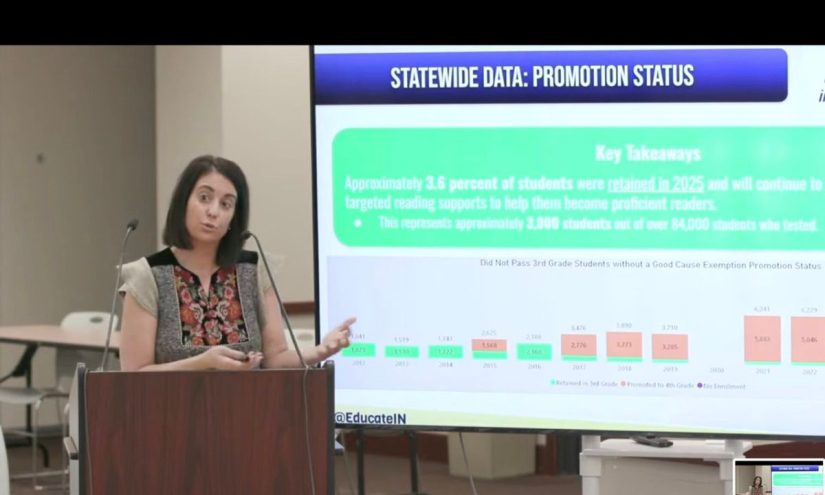
    Data released Wednesday by the Indiana Department of Education showed 3.6% of the 84,000 children who took the statewide IREAD exam were retained in third grade under the first enforcement of a requirement approved by the Legislature in 2024.

    Those 3,040 retained students are more than seven times the 412 children held back in third grade two years ago.

    Education Secretary Katie Jenner credited improved performance by students in the IREAD exam given last school year with the retention figure being lower than anticipated when the literacy requirement was being debated.

    “The numbers that were being thrown out is that it would be 7,000 to 10,000 that this law would trigger retention,” Jenner told State Board of Education members. “But, in fact, a huge shout out to our teachers and our people, we have thousands of kids who are now readers.”

    Education officials announced in August that 87.3% of third graders — about 73,500 out of more than 84,000 students statewide — demonstrated proficient reading skills in 2024-25. They hailed the nearly five percentage point improvement from the previous school year as the largest year-to-year jump since the state began IREAD testing in 2013.

    That left about 10,600 children who didn’t meet the standard, with almost 7,000 being given “good cause exemptions” to avoid retention. Nearly 75% of those given exemptions were special education students and about 24% are English learners with less than two years of specific literacy services.

    Anna Shults, the Department of Education’s chief academic officer, said the new retention requirement was having its intended effect.

    “We are now ensuring that students that are promoted on to grade four are doing so with an ability to read and show mastery of key foundational reading skills,” Shults told the State Board of Education.

    The Department of Education will have an online dashboard providing breakdowns of the Indiana Reading Evaluation and Determination assessment, or IREAD, by school district and individual schools, including charter schools and nonpublic schools.

    Officials noted about 670 children who didn’t meet the literacy standards were not enrolled in Indiana schools this year, saying they likely moved out of state or were being homeschooled.

    Jenner said a determination would need to be made about those students if they returned to Indiana schools.

    “That’s a question that we’ll need to sort through, because some may move back into Indiana, or if they left for homeschool may come back in,” Jenner said. “Because we’re looking at every unique student, I think we’ll try to figure out exactly where they are.”

    According to 2023 data, 13,840 third-graders did not pass I-READ-3. Of those, 5,503 received an exemption and 8,337 did not. Of those without an exemption, 95% moved onto 4th grade while only 412 were retained.

    Indiana Capital Chronicle is part of States Newsroom, a nonprofit news network supported by grants and a coalition of donors as a 501c(3) public charity. Indiana Capital Chronicle maintains editorial independence. Contact Editor Niki Kelly for questions: [email protected].


    Did you use this article in your work?

    We’d love to hear how The 74’s reporting is helping educators, researchers, and policymakers. Tell us how

    Source link

  • Medugrift and the price makers in higher education

    Medugrift and the price makers in higher education

    In the United States, the cost of higher education is not a natural phenomenon. It is deliberately constructed by a network of institutional actors who function as price makers: university presidents, chief financial officers, boards of trustees, governors, and state legislators. They determine what students pay, how institutions are structured, and whose interests higher education ultimately serves. Their decisions shape tuition, labor conditions, program priorities, and the balance between education and the expanding world of medugrift—the hybrid system where medicine, education, debt, and corporate extraction intersect.

    For decades, the American public has been told that tuition rises because education is inherently expensive. But as Richard Wolff argues in his critiques of the “War on the Working Class,” the economic decisions shaping tuition, labor costs, athletics, administrative growth, and capital projects reflect class priorities. The price makers choose which costs are fundamental and which are negotiable. They choose what gets built, who gets hired, and how much debt institutions take on. They choose who pays.

    University presidents now act more like corporate executives than academic leaders. They negotiate seven-figure salaries, travel globally for fundraising, and preside over campuses where luxury construction often outruns academic needs. They approve budgets that elevate branding and athletics while pressuring academic departments to justify their existence through profit metrics. Tuition increases rarely slow presidential compensation; instead, they are framed as regrettable necessities dictated by “the market” or “competitive realities.”

    CFOs enforce a financial logic that prioritizes credit ratings, cash reserves, and debt-financed expansion. They present budgets as neutral, but each line reflects a hierarchy of value. Instruction is cast as a cost center. Staff health care, faculty benefits, and student services become “inefficiencies.” Meanwhile, massive expenditures on consultants, real estate, information systems, and administration are justified as essential to “modernization.” The result is predictable: the people who teach and learn bear the burden while those who administer expand.

    Trustees represent another layer of price making. Often drawn from banking, private equity, real estate, biotech, and corporate medicine, trustees bring a worldview shaped by capital accumulation rather than public service. They authorize tuition hikes, approve investment strategies, and greenlight partnerships that blend public education with private profit. Many trustees sit simultaneously on hospital boards or medical investment firms, allowing medugrift to flourish in the shadows of institutional legitimacy. Their decisions shape which programs expand, which shrink, and which students are offered genuine opportunity.

    State governors and legislators are external architects of scarcity. Since the 1980s, state governments have systematically defunded public higher education while channeling resources to mass incarceration, gambling revenue schemes, corporate tax breaks, and subsidies to companies like Amazon. These choices undermine the ability of public institutions to remain affordable and force them to operate increasingly like private universities. The shift from public funding to tuition revenue is not inevitable; it is a political strategy. HBCUs and tribal colleges have lived with this manufactured scarcity for generations. Their chronic underfunding—documented in numerous state audits and federal investigations—illustrates what happens when government treats education for marginalized communities as optional.

    The emergence of medugrift reveals a deeper structural problem. At the intersection of higher education and corporate medicine sits an engine of extraction. University medical systems leverage public funding, student tuition, and philanthropic contributions to build financial empires that often serve administrators first and communities last. Medical schools charge extreme tuition while placing students into debt-heavy paths. University hospitals consolidate regional health systems, increasing costs while reducing access. Research produced through public dollars is routinely captured by private pharmaceutical or biotech companies. Meanwhile, residents and faculty in these health systems often endure poor working conditions and stagnant pay. Medugrift conceals itself behind the prestige of medicine, but its logic mirrors that of predatory education: privatize gains, socialize losses, and extract from those with the least bargaining power.

    Who determines the costs to students? The answer lies in the aggregated decisions of these actors. When a university raises tuition to protect its bond rating, that is a decision. When trustees invest in athletics while cutting humanities programs, that is a decision. When governors choose prisons over scholarships, that is a decision. When state legislatures allow gambling revenue to substitute for stable taxation, that is a decision. Each choice shifts the financial burden downward while consolidating power upward.

    This is not simply mismanagement; it is a class project. The people who determine prices do not feel them. Students, families, adjunct instructors, and underfunded communities do. For working-class students, particularly those from historically excluded backgrounds, the price makers have built a system defined by debt, precarity, and limited mobility.

    Nothing about this system is inevitable. There was a time when public universities were affordable, when trustees included community members and labor leaders, when presidents were educators, and when medical centers served the public rather than corporate conglomerates. If the price makers can build this system, a more democratic and humane system can be built to replace it.

    The question for the coming decade is not whether higher education is too expensive. The public has already reached its verdict. The question is whether students, workers, and communities will continue to let the price makers—and the medugrift machinery attached to them—define who gets educated, who gets indebted, and who gets left behind.

    Sources

    Richard D. Wolff, Understanding Socialism; Capitalism Hits the Fan

    Elisabeth Rosenthal, An American Sickness

    Harriet A. Washington, Medical Apartheid

    Rebecca Skloot, The Immortal Life of Henrietta Lacks

    Alondra Nelson, Body and Soul

    State Higher Education Finance (SHEF) Reports

    U.S. Department of Education, Office for Civil Rights, HBCU Funding Analyses

    Source link

  • WEEKEND READING The art of reimagining universities: a vision for higher education

    WEEKEND READING The art of reimagining universities: a vision for higher education

    Join HEPI for a webinar on Thursday 11 December 2025 from 10am to 11am to discuss how universities can strengthen the student voice in governance to mark the launch of our upcoming report, Rethinking the Student Voice. Sign up now to hear our speakers explore the key questions.

    This blog was kindly authored by Professor Rathna Ramanathan, Provost, Central Saint Martins; Executive Dean for Global Affairs and Professor of Design and Intercultural Communication, University of the Arts London.

    The structure of our universities is stuck in the past. The recent post-16 education and skills white paper praises our universities as globally excellent institutions but calls for a reorientation towards national priorities and greater efficiency. As academics and creatives functioning as outsiders, we can use this position productively to define future pathways.

    We’re living through multiple crises at once – climate emergency, polarization, AI disruption – yet most universities still organize themselves around departments created decades ago. Institutions talk endlessly about ‘interdisciplinary collaboration’ and ‘preparing students for the future’, yet their actual structures often make both nearly impossible.

    At Central Saint Martins, University of the Arts London, we have tried something different. We have redesigned the College by rethinking what an art and design college should focus on and how it can work, guided by shared principles that emerged from asking: ‘What does it look like when we work together at our best?’

    The real question

    We ask students to be creative, adaptive, bold. To embrace complexity and imagine different futures. What could our universities achieve if we reorganised ourselves with the same creativity we demand from students?

    The institutions that thrive in the coming decades won’t be those defending traditions most fiercely. They will be those with the courage to redesign themselves for the world emerging, not the one they were built for. That’s uncomfortable. Structural change is difficult and uncertain. Letting go of familiar categories and hierarchies requires trust. Building new collaborative cultures alongside new organisational structures demands sustained effort. This discomfort might be precisely the point. If universities can’t model the adaptive, experimental, principles-led thinking we claim to teach, why should anyone trust us to prepare the next generation for an uncertain future? More bluntly, if we don’t practice what we teach, do we deserve to thrive?

    The problem: structure shapes everything

    For over a century, universities have organised themselves into disciplinary silos. This made sense when knowledge was more stable, and career paths were more predictable. But today’s urgent challenges  don’t heed disciplinary boundaries and require insights from science, policy, economics, ethics, design, and creative practice simultaneously.

    Most universities recognise this. They create joint programmes and support cross-department initiatives. Yet the fundamental architecture remains unchanged: separate budgets, isolated governance structures, academic staff working within disciplinary lanes. It’s like trying to renovate a house by rearranging the furniture while leaving the walls intact.

    For students, this disconnect is glaring. They see interconnected problems everywhere, yet are asked to choose a single discipline and stay within it. They want to learn how to think, not just master a predetermined skill set. Traditional university structures also inadvertently reinforce whose knowledge counts and whose doesn’t, often privileging Western over non-Western perspectives, theory over practice, and individual achievement over collective wisdom. In an era demanding intercultural, community-centred, and future-focused approaches, these inherited biases have become institutional liabilities.

    The experiment: principles before structure

    Central Saint Martins’ transformation began with a fundamental question: ‘What does it look like when we work together at our best?’ From this inquiry emerged five core principles that now guide decision-making at College level: address shared conditions that transcend disciplines; seek common ground through equitable collaboration; treat the whole life of the College as creative material; bring practice to every space; and deepen connections with communities beyond our walls. These aren’t aspirational statements. They’re operational principles that inform the creation of a new structure: ‘Schools of Thought’.

    Three schools of thought: foundations, not hierarchies

    Most university ‘schools’ function as management layers above departments with administrative structures for top-down control. At Central Saint Martins, we are inverting this model. Our Schools of Thought establish shared foundations beneath courses and programmes, creating common ground where disciplines naturally converge.

    Each school aims to be transdisciplinary (integrating ways of thinking), not merely multidisciplinary (putting disciplines side-by-side). They’re collective, not just collaborative. The naming strategy – C + S + M = CSM – emphasises the whole over parts. Rather than reinforcing disciplinary boundaries, they create space for working across schools while adapting to changing conditions.


    C School [Culture]
    explores culture as a vital form of enquiry and expression, developing thinking and practice across art, performance and curation. It recognises culture in the immediate world around us, understanding it as a sense-making activity.


    S School [Systems]
    explores how different forms of designing allow us to understand and intervene in the complex human systems shaping our world through graphic communication, product and industrial design, architecture, business innovation, and creative enterprise.


    M School [Materials]
    investigates radical approaches to materials, making, and meaning-making through fashion, textiles, and jewellery to digital interaction, scientific innovation, and multi-species regeneration.

    Why principles matter more than plans

    What makes this transformation different from typical restructuring is its foundation in shared principles rather than predetermined outcomes. The principles emerged from collective reflection on the College’s actual lived experience, examining when authentic collaboration and meaningful impact happen. They aim to capture the heart of the College’s culture rather than imposing an abstract ideal. They create coherence without rigidity, alignment without conformity.

    Schools of Thought are not viewed as resolved but as vehicles for ongoing transformation. They provide low-walled frameworks for continuous evolution, adapting to changing conditions while staying true to core values. As communities and conversations develop, the schools themselves will transform, shaped by the very practices they enable.

    The deeper shift: embedding justice and sustainability

    Traditionally, art and design education has reinforced colonial perspectives, unsustainable production and cultural hierarchies; biases that reproduce invisibly through inherited disciplinary structures. The principle of ‘addressing shared conditions’ makes complicity in global crises unavoidable rather than optional, preventing justice and sustainability from being relegated to elective courses or diversity initiatives.

    ‘Seeking common ground’” creates space for marginalised knowledge systems, while ‘taking the whole life of the College as material’ reveals institutional truths through the lived experiences of our staff and our students rather than stated values alone.

    We can’t truly prepare students for the climate crisis, technological disruption, or polarisation by adding modules to unchanged systems. The structure needs to embody the values and capacities these challenges demand.

    What creativity teaches

    Creative education isn’t primarily about self-expression or beautiful objects. But approached as Central Saint Martins has, creativity becomes a methodology for engaging with uncertainty as traditional certainties collapse.

    ‘Bring practice to every space’ makes thinking-in-formation visible, cultivating comfort with ambiguity and the capacity to learn from failure—all critical for navigating unpredictable futures. “Deepen external connections” recognises that knowledge develops through genuine dialogue with communities beyond institutional walls, not expert pronouncements.

    These approaches value prototyping and iteration over perfect solutions, holding contradictory ideas simultaneously, collaborating across difference, and making abstract possibilities tangible. We want to apply creative principles to institutional transformation, treating the restructuring as an experimental, collaborative, and iterative process rather than a top-down plan.

    Lessons for all higher education

    Although rooted in creative arts, the principles-led approach transfers across sectors. Imperial College London’s recently launched Schools of Convergence Science reflects similar recognition that traditional structures no longer serve contemporary challenges. Structural change requires more than new organisational charts. It requires:

    • Culture shifts embedded in governance: Principles that guide decision-making at every level, ensuring new structures don’t simply replicate old patterns.
    • Foundation-level transformation: Creating common ground where collaboration becomes natural rather than requiring special initiatives.
    • Recognition of complicity: Acknowledging how inherited structures perpetuate problems, then actively working to transform those conditions.
    • Treating institutional structure as material: Applying the same creative, experimental, iterative approaches we teach students.
    • Making the whole life of the institution visible: Valuing informal experience alongside formal roles, practice alongside theory, collective wisdom alongside individual expertise.

    Any university can ask itself: What principles characterise when we work at our best? How could we design structures that enable rather than constrain that work? What would it mean to organise around shared conditions rather than inherited categories?

    As higher education gets increasingly othered in new policies, outsiders can provide the breakthroughs needed by taking a fresh perspective. As ‘The genius of the amateur’ points out, outsiders often succeed because progress is about generating models which we then test, apply and refine. We can’t do this alone at Central Saint Martins, University of the Arts London, we need to do this collectively: to genuinely practice for ourselves what we teach and to create a space which isn’t about silos or othering but where all of us are welcome.

    Source link

  • School Admissions Anxiety Hits Parents of Young Children, Too – The 74

    School Admissions Anxiety Hits Parents of Young Children, Too – The 74

    A few factors have made selecting an elementary school particularly challenging in recent years. For one, there are simply more schools for parents to pick from over the past few decades, ranging from traditional public and private to a growing number of magnet and charter programs. There are also new policies in some places, such as New York City, that allow parents to select not just their closest neighborhood public school but schools across and outside of the districts where they live.

    As a scholar of sociology and education, I have seen how the expanding range of school options – sometimes called school choice – has spread nationwide and is particularly a prominent factor in New York City.

    I spoke with a diverse range of more than 100 New York City parents across income levels and racial and ethnic backgrounds from 2014 to 2019 as part of research for my 2025 book, “Kindergarten Panic: Parental Anxiety and School Choice Inequality.”

    All of these parents felt pressure trying to select a school for their elementary school-age children, and school choice options post-COVID-19 have only increased.

    Some parents experience this pressure a bit more acutely than others.

    Women often see their choice of school as a reflection of whether they are good moms, my interviews show. Parents of color feel pressure to find a racially inclusive school. Other parents worry about finding niche schools that offer dual-language programs, for example, or other specialties.

    Navigating schools in New York City

    Every year, about 65,000 New York City kindergartners are matched to more than 700 public schools.

    New York City kindergartners typically attend their nearest public school in the neighborhood and get a priority place at this school. This school is often called someone’s zoned school.

    Even so, a spot at your local school isn’t guaranteed – students get priority if they apply on time.

    While most kindergartners still attend their zoned schools, their attendance rate is decreasing. While 72% of kindergartners in the city attended their zoned school in the 2007-08 school year, 60% did so in the 2016-17 school year.

    One reason is that since 2003, New York City parents have been able to apply to out-of-zone schools when seats were available. And in 2020, when the COVID-19 pandemic began, all public school applications moved entirely online. This shift allowed parents to easily rank 12 different school options they liked, in and outside of their zones.

    Still, New York City public schools remain one of the most segregated in the country, divided by race and class.

    Pressure to be a good mom

    Many of the mothers I interviewed from 2015 through 2019 said that getting their child into what they considered a “good” school reflected good mothering.

    Mothers took the primary responsibility for their school search, whether they had partners or not, and regardless of their social class, as well as racial and ethnic background.

    In 2017, I spoke with Janet, a white, married mother who at the time was 41 years old and had an infant and a 3-year-old. Janet worked as a web designer and lived in Queens. She explained that she started a group in 2016 to connect with other mothers, in part to discuss schools.

    Though Janet’s children were a few years away from kindergarten, she believed that she had started her research for public schools too late. She spent multiple hours each week looking up information during her limited spare time. She learned that other moms were talking to other parents, researching test results, analyzing school reviews and visiting schools in person.

    Janet said she wished she had started looking for schools when her son was was 1 or 2 years old, like other mothers she knew. She expressed fear that she was failing as a mother. Eventually, Janet enrolled her son in a nonzoned public school in another Queens neighborhood.

    Pressure to find an inclusive school

    Regardless of their incomes, Black, Latino and immigrant families I interviewed also felt pressure to evaluate whether the public schools they considered were racially and ethnically inclusive.

    Parents worried that racially insensitive policies related to bullying, curriculum and discipline would negatively affect their children.

    In 2015, I spoke with Fumi, a Black, immigrant mother of two young children. At the time, Fumi was 37 years old and living in Washington Heights in north Manhattan. She described her uncertain search for a public school.

    Fumi thought that New York City’s gifted and talented programs at public schools might be a better option academically than other public schools that don’t offer an advanced track for some students. But the gifted and talented programs often lacked racial diversity, and Fumi did not want her son to be the only Black student in his class.

    Still, Fumi had her son tested for the 2015 gifted and talented exam and enrolled him in one of these programs for kindergarten.

    Once Fumi’s son began attending the gifted and talented school, Fumi worried that the constant bullying he experienced was racially motivated.

    Though Fumi remained uneasy about the bullying and lack of diversity, she decided to keep him at the school because of the school’s strong academic quality.

    Pressure to find a niche school

    Many of the parents I interviewed who earned more than US$50,000 a year wanted to find specialty schools that offered advanced courses, dual-language programs and progressive-oriented curriculum.

    Parents like Renata, a 44-year-old Asian mother of four, and Stella, a 39-year-old Black mother of one, sent their kids to out-of-neighborhood public schools.

    In 2016, Renata described visiting multiple schools and researching options so she could potentially enroll her four children in different schools that met each of their particular needs.

    Stella, meanwhile, searched for schools that would de-emphasize testing, nurture her son’s creativity and provide flexible learning options.

    In contrast, the working-class parents I interviewed who made less than $50,000 annually often sought schools that mirrored their own school experiences.

    Few working-class parents I spoke with selected out-of-neighborhood and high academically performing schools.

    New York City data points to similar results – low-income families are less likely than people earning more than them to attend schools outside of their neighborhoods.

    For instance, Black working-class parents like 47-year-old Risha, a mother of four, and 53-year-old Jeffery, a father of three, who attended New York City neighborhood public schools themselves as children told me in 2016 that they decided to send their children to local public schools.

    Based on state performance indicators, students at these particular schools performed lower on standard assessments than schools on average.

    Cracks in the system

    The parents I spoke with all live in New York City, which has a uniquely complicated education system. Yet the pressures they face are reflective of the evolving public school choice landscape for parents across the country.

    Parents nationwide are searching for schools with vastly different resources and concerns about their children’s future well-being and success.

    When parents panic about kindergarten, they reveal cracks in the foundation of American schooling. In my view, parental anxiety about kindergarten is a response to an unequal, high-stakes education system.

    Bailey A. Brown, Assistant Professor of Sociology, Spelman College

    This article is republished from The Conversation under a Creative Commons license. Read the original article.

    Source link

  • Power, Proxy, and the People Caught in Between

    Power, Proxy, and the People Caught in Between

    The Western Hemisphere is entering a new and dangerous phase of global rivalry—one shaped by old imperial habits, new economic pressures, and resurgent great-power maneuvering. From Washington to Beijing to Caracas, political leaders are escalating tensions over Venezuela’s future, reviving a familiar script in which Latin America becomes the proving ground for foreign powers and a pressure cooker for working-class people who have no say in the geopolitical games unfolding above them.

    What looks like a confrontation over oil, governance, or regional security is better understood as a collision of neoliberal extraction, colonial legacies, and competing empires, each claiming moral authority while pursuing strategic advantage. In this moment, it is essential to remember what history shows again and again: ordinary people—soldiers, students, workers—pay the highest price for elite ambitions.


    A Long Shadow: U.S. Intervention in Latin America Since the 1890s

    The U.S. role in Latin America cannot be separated from its imperial foundations. Over more than a century, Washington has repeatedly intervened—militarily, covertly, and financially—to shape political outcomes in the region:

    • 1898–1934: The “Banana Wars.” U.S. Marines were deployed throughout the Caribbean and Central America to secure plantations, protect U.S. investors, and maintain favorable governments in Cuba, Puerto Rico, Nicaragua, Haiti, the Dominican Republic, Panama, and Honduras.

    • 1954: Guatemala. The CIA overthrew democratically elected President Jacobo Árbenz after he challenged United Fruit Company landholdings.

    • 1961: Bay of Pigs Invasion. A failed U.S.-backed attempt to overthrow Fidel Castro.

    • 1973: Chile. U.S. support for the coup against Salvador Allende ushered in the Pinochet dictatorship and a laboratory for neoliberal economics.

    • 1980s: Nicaragua, El Salvador, Guatemala. Funding death squads, supporting Contra rebels, and fueling civil wars that killed hundreds of thousands.

    • 1989: Panama. A full-scale U.S. invasion to remove Manuel Noriega, with civilian casualties in the thousands.

    • 2002: Venezuela. U.S. officials supported the brief coup against Hugo Chávez.

    • 2020s: Economic warfare continues. Sanctions, diplomatic isolation, and support for factions opposing Nicolás Maduro all sustain a long-running pressure campaign.

    This is not ancient history. It is the operating system of U.S. hemispheric influence.


    China’s Expanding Soft Power and Strategic Positioning

    While the U.S. escalates military signaling toward Venezuela, China is expanding soft power, economic influence, and political relationships throughout Latin America—including with Venezuela. Beijing’s strategy is centered not on direct military confrontation but on long-term infrastructure, trade, and diplomatic partnerships designed to reduce U.S. dominance.

    Recent statements from Beijing underscore this shift. Chinese President Xi Jinping publicly backed Venezuelan President Nicolás Maduro, describing China and Venezuela as “intimate friends” as the U.S. intensifies military pressure in the region. China’s role extends beyond rhetoric: loans, technology transfers, energy investments, and political support form a web of influence that counters U.S. objectives.

    This is the new terrain: the U.S. leaning on sanctions and military posture, China leveraging soft power and strategic alliances.


    Russia as a Third Power in the Hemisphere

    Any honest assessment of the current geopolitical climate must include Russia, which has expanded its presence in Latin America as part of its broader campaign to counter U.S. power globally. Moscow has supplied Venezuela with military equipment, intelligence support, cybersecurity assistance, and diplomatic cover at the United Nations. It has strengthened ties with Nicaragua, Cuba, and other governments willing to challenge U.S. regional dominance.

    Russia’s involvement is not ideological; it is strategic. It seeks to weaken Washington’s influence, create leverage in distant theaters, and embed itself in the Western Hemisphere without deploying large-scale military forces. Where China builds infrastructure and invests billions, Russia plays the spoiler: complicating U.S. policy, reinforcing embattled leaders when convenient, and offering an alternative to nations seeking to escape U.S. hegemony.

    The result is a crowded geopolitical arena in which Venezuela becomes not just a domestic crisis but a theater for multipolar contention, shaped by three major powers with very different tools and interests.


    Neoliberalism, Colonialism, and the Repeating Pattern

    Viewed in historical context, today’s crisis is simply the newest iteration of a long-standing pattern:

    1. Colonial logics justify intervention. The idea that Washington must “manage” or “stabilize” Latin America recycles the paternalism of earlier eras.

    2. Neoliberal extraction drives policy. Control over energy resources, access to markets, and geopolitical leverage matter more than democracy or human well-being.

    3. Foreign powers treat the region as a chessboard. The U.S., China, and Russia approach Latin America not as sovereign equals but as terrain for influence.

    4. People—not governments—bear the cost. Sanctions devastate civilians. Military escalations breed proxy conflicts. Migration pressures rise. And working-class youth are recruited to fight battles that are not theirs.

    This is why today’s developments must be understood as part of a wider global system that treats nations in the Global South as resources to exploit and battlegrounds to dominate.


    A Warning for Those Considering Enlistment or ROTC

    In moments like this, the pressure on young people—especially working-class youth—to join the military increases. Recruiters frame conflict as opportunity: tuition money, job training, patriotism, adventure, or stability. But the truth is starker and more political.

    Muhammad Ali’s stance during the Vietnam War remains profoundly relevant today. He refused the draft, famously stating that the Vietnamese “never called me [a slur]” and declaring that he would not fight a war of conquest against people who had done him no harm.

    The same logic applies to today’s geopolitical brinkmanship. Young Americans are asked to risk their lives in conflicts that protect corporate interests, reinforce imperial ambitions, and escalate global tensions. Venezuelan workers, Chinese workers, Russian workers, and U.S. workers are not enemies. They are casualties-in-waiting of decisions made by governments and corporations insulated from the consequences of their actions.

    Before enlisting—or joining ROTC—young people deserve to understand the historical cycle they may be pulled into. Wars in Latin America, proxy or direct, have never served the interests of everyday people. They serve empires.


    Sources

    • Firstpost. “Xi Backs Maduro, Calls China and Venezuela ‘Intimate Friends’ as Trump Steps Up Military Pressure.”

    • Greg Grandin, Empire’s Workshop: Latin America, the United States, and the Rise of the New Imperialism

    • Naomi Klein, The Shock Doctrine

    • Stephen Kinzer, Overthrow: America’s Century of Regime Change

    • U.S. Congressional Research Service reports on U.S. policy in Venezuela and China-Latin America relations

    • UN Human Rights Council documentation on sanctions and civilian impact

    Source link

  • Data: who’ll be worst affected by England’s international fee levy?

    Data: who’ll be worst affected by England’s international fee levy?

    Long-awaited details of the mooted levy on international students at English universities – due to take effect in 2028 – were released with Rachel Reeves’ Budget earlier this week to a largely negative reaction from international education stakeholders.

    Instead of the expected 6% tax on international student income suggested in the immigration white paper, the Treasury is instead consulting on a £925-per-international-student flat fee.

    However, under the proposals, each provider will receive an allowance covering their first 220 international students each year – meaning that many small or specialist institutions will be spared the tax.

    But larger institutions with higher numbers of international students will bear the brunt of the levy.

    HESA data from the 2023/24 academic year – the most recently available figures – gives an indication of which providers could be worst hit by the levy, although enrolment numbers may have changed since then and could shift dramatically before the policy finally comes into effect.

    London is the region set to be most impacted by the levy, with England’s capital welcoming the most international students. Meanwhile, the North East had the fewest.

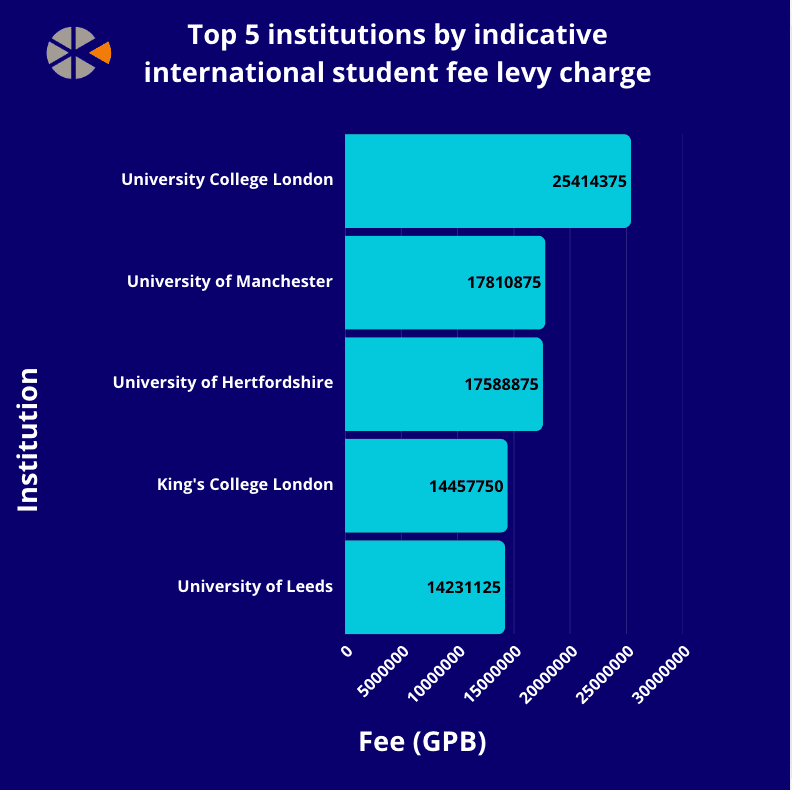
    Here’s our round up of the top five institutions that risk losing out the most.

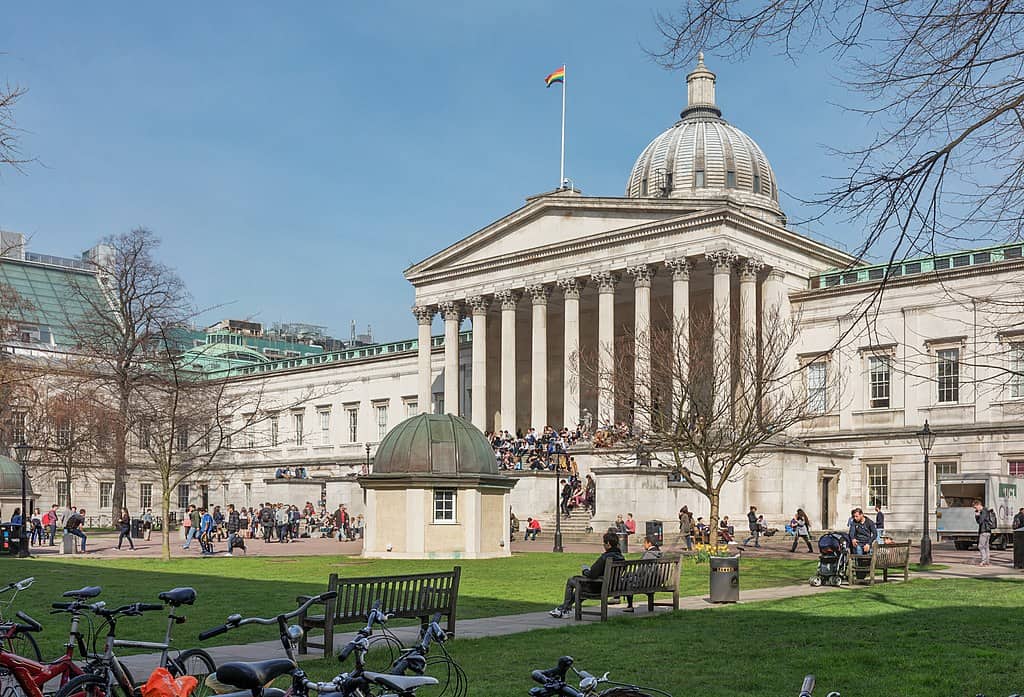
    University College London (UCL)

    Of the 614,000 international students at English institutions in the 2023/24 academic year, UCL was home to the largest amount, at 27,695.

    Under the proposals, if UCL had the same number of international students under the levy, it would be liable to pay over £25 million.

    The University of Manchester

    Coming in second is the University of Manchester, which had 19,475 international students in 2023/24. This would mean it would have to pay almost £18m under the levy proposals.

    The University of Hertfordshire

    In third place is the University of Hertfordshire, with 19,235 international students in 2023/24 – a levy amount of just over £17.5m.

    Kings College London

    Up next is Kings College London, with 15,850 international students, meaning it would be taxed a little under £14.5m

    The University of Leeds

    Another large metropolitan university set to be hit hard by the levy is the University of Leeds, with 15,605 international students. If enrolments numbers stay the same into 2028, it could face costs of over £14.2m.

    Source link

  • Fewer New International Students Enroll at U.S. Colleges Amid Trump Restrictions – The 74

    Fewer New International Students Enroll at U.S. Colleges Amid Trump Restrictions – The 74


    Get stories like this delivered straight to your inbox. Sign up for The 74 Newsletter

    New international students enrolling at U.S. colleges declined sharply this fall, a concerning development for universities that rely on those students for research, tuition revenue and the diversity they bring to campus culture. It could, however, create more space for U.S. residents at those campuses.

    Enrollments of new international students were down 17% compared to fall 2024, according to a report released Monday by the Institute of International Education, which surveyed more than 800 colleges about their fall 2025 enrollments. The institute, a nonprofit organization based in New York, publishes an annual report that examines the enrollment of international students. 

    The fall data was not broken down by state, so the scale of decline in California is unclear. At USC, which enrolls more international students than any other California college, overall enrollment of international students is down 3% this fall, according to a campus spokesperson. That includes returning and first-time students, so the drop could be much higher for new arrivals. USC this fall enrolls about 12,000 international students, or 26% of its total student population, according to the college. About half of those students are from China. 

    The declines come amid a changing landscape for international students under the Trump administration, which has delayed visa processing, created travel restrictions and pressured some campuses to recruit and admit fewer students from other countries. The colleges surveyed this fall by the institute cited visa application concerns and travel restrictions as top factors in the decline. 

    “We are confronting major headwinds with what I would say are poor policy decisions that the administration is taking. And that is creating a climate for international students that signals that you’re not welcome here,” said Fanta Aw, CEO of NAFSA, a nonprofit for international education and exchange.

    President Donald Trump has said that he wants to lower the number of international students at U.S. colleges to leave more room at those campuses for U.S. students. “It’s too much because we have Americans that want to go there and to other places, and they can’t go there,” he said earlier this year, referencing the number of international students at Harvard and other universities.

    For the full 2024-25 academic year, new international student enrollments were down by 7%, driven by a 15% drop among new international graduate students, compared to 2023-24. However, the number of new undergraduates was up by 5%. Trump took office in January, just before the start of the spring semester at most colleges. 

    In the U.S., students from India were the largest group of international students, accounting for 30.8% of all international students, followed by students from China, with 22.6% of enrollments.

    In the 2024-25 academic year in California, the largest share of international students were from China, and they made up 35.4% of enrollments, followed by students from India at 20.9%. Overall enrollment of international students in California was down 1.1% in 2024-25. 

    USC enrolled the most international students of any California university, followed by four University of California campuses: Berkeley, Los Angeles, San Diego and Irvine. According to the report, the total number of enrolled international students were: 12,020 at Berkeley, 10,769 at UCLA, 10,545 at San Diego, and 7,638 at Irvine.

    Across the state, international students make up about 7% of enrollments at four-year colleges, according to the Public Policy Institute of California. They make up a large share of graduate students, accounting for 31% of graduate students at UC campuses, 15% at private nonprofit universities, and 12% at California State University campuses. 

    Freya Vijay, 20, a third-year student from Canada studying business administration at USC, said she always planned to come to the United States for college. 

    “In terms of business and just the economy, you have Wall Street, you have New York, Chicago, L.A., and San Francisco, all these big cities that dominate what’s going on in the world,” she said. “So immediately, in terms of opportunity, my mind was set on the States.” 

    In addition to visa and travel restrictions, the Trump administration has directly requested — or threatened, as some have called it — California campuses to limit enrollments of international students. The administration’s compact offer to USC last month would have forced the university to cap international enrollment at 15% for undergraduates and limit enrollment from any one country to 5%.

    USC has since rejected the compact, which also would have required the university to make a number of other changes, including committing to “transforming or abolishing institutional units that purposefully punish, belittle and even spark violence against conservative ideas.” 

    Separately, in a settlement proposal to UCLA, the Trump administration calls on the campus to ensure that “foreign students likely to engage in anti-Western, anti-American, or antisemitic disruptions or harassment” are not admitted. UCLA is still in negotiations with the administration and has not yet reached a deal. The Trump administration has charged the campus with antisemitism and civil rights violations. 

    Even amid the turmoil, experts say they expect California universities to continue recruiting international students. Julie Posselt, a professor of education at USC’s Rossier School of Education, noted that at research universities, much of the research is being carried out by international graduate students. 

    “Especially in STEM fields, international students are really central to the research functions of universities,” Posselt said. “Enrolling international students is not optional. It is absolutely a part of the fabric of what makes universities great.” 

    On top of that, colleges have financial incentives to enroll international students. That’s especially true at UC campuses, which charge international students and students from other states much higher rates of tuition than California residents. In the 2026-27 academic year, new international and out-of-state undergraduates at UC will pay nearly $52,000 in tuition, more than triple what in-state students will be charged. Nonresidents in graduate programs also generally pay higher rates than residents.

    Facing pressure from the state Legislature to make more room for California residents, UC in 2017 passed a policy to cap nonresident enrollment at 18%, with a higher percentage allowed for campuses that were already above that mark. But the system still gets significant tuition revenue from nonresidents, including international students, which UC says supports the system’s core operations and helps to lower the cost of attendance for California residents.  

    In a Nov. 10 interview with Fox News, Trump seemed to acknowledge the importance of international students, saying colleges might “go out of business” without them.

    “You don’t want to cut half of the people, half of the students from all over the world that are coming into our country — destroy our entire university and college system — I don’t want to do that,” he said. 

    International students also bring diverse perspectives and “a richness to the campus culture,” said Stett Holbrook, a spokesperson for the University of California system. “That’s something we really appreciate and try to cultivate.”

    At USC, the presence of international students from more than 130 countries means there are “innumerable opportunities at USC to encounter different perspectives” and “experience new cultures,” a spokesperson said in a statement. 

    Vijay, the USC student from Canada, said she regularly boasts about USC to friends, adding that she hopes attending remains an option for other international students. 

    “I always think it’s just such a great opportunity and that no international student should ever take it for granted,” she said. “I wish other internationals could experience it.”

    This story was originally published on EdSource.


    Did you use this article in your work?

    We’d love to hear how The 74’s reporting is helping educators, researchers, and policymakers. Tell us how

    Source link

  • Why Prospective Enlistees and Supporters Should Think Twice

    Why Prospective Enlistees and Supporters Should Think Twice

    For many young Americans, the Reserve Officers’ Training Corps (ROTC) or other military‑linked opportunities can look like a ticket to education, steady income, and a chance to “see the world.” But the allure of scholarships, structure, and economic opportunity often hides a deeper reality — one that includes moral danger, personal risk, and long-term uncertainty.

    Recent events underscore this. On November 24, 2025, the United States Department of Defense (DoD) announced it was opening a formal investigation into Mark Kelly — retired Navy captain, former astronaut, and current U.S. Senator — after he appeared in a video alongside other lawmakers urging U.S. troops to disobey “illegal orders.” The DoD’s justification: as a retired officer, Kelly remains subject to the Uniform Code of Military Justice (UCMJ), and the department said his statements may have “interfered with the loyalty, morale, or good order and discipline of the armed forces.”

    This episode is striking not only because of Kelly’s prominence, but because it shows how even after leaving active service, a veteran’s speech and actions can be subject to military law — a stark reminder that joining the military (or training through ROTC) can carry obligations and consequences long after “service” ends.

    Moral, Legal & Personal Risks Behind the Promise

    When you consider military service — through ROTC or otherwise — it’s important to weigh the full scope of what you may be signing up for:

    Potential involvement in illegal or immoral wars: ROTC graduates may eventually be deployed in foreign conflicts — possibly ones controversial or condemned internationally (for example, interventions in places like Venezuela). Participation in such wars raises real moral questions about complicity in human rights abuses, “regime-change,” or other interventions that may lack democratic or legal legitimacy.

    Domestic deployment and policing: Military obligations are increasingly stretching beyond foreign wars. Service members — even reservists — can be called in to deal with domestic “disputes,” civil unrest, or internal security operations. This raises ethical concerns about policing one’s own communities, and potential coercion or suppression of civil and political rights.

    Long-term oversight and limited freedom: The investigation of Senator Kelly shows that veterans and officers remain under DoD jurisdiction even after service ends. That oversight can restrict free speech, dissent, or political engagement. Those seeking to escape economic hardship or limited opportunities may overlook how binding and enduring those obligations can be — even decades later.

    Psychological and bodily danger: Military service often involves exposure to combat, trauma, physical injury — not to mention risks such as sexual assault, racism, sexism, and institutional abuse. Mental health consequences like PTSD are common, and the support systems for dealing with them are widely criticized as inadequate.

    Institutional racism, sexism, and inequality: The military is an institution with historic and ongoing patterns of discrimination — which can exacerbate systemic injustices rather than alleviate them. For individuals coming from marginalized communities, the promise of “a way out” can come with new forms of structural violence, exploitation, or marginalization.

    Career precarity and institutional control: Even after completing education or training, the reality of “limited choices” looms large. Military obligations — contractual, legal, social — can bind individuals long-term, affecting not just their mobility but their agency, conscience, and ability to critique the system.

    Why Economic Incentives Often Mask the Real Costs

    For many, the draw of ROTC is economic: scholarships, stable income, a way out of challenging socioeconomic circumstances, or a ticket out of a hometown with limited opportunity. These incentives are real. But as the recent case with Mark Kelly makes clear, the costs — legal, moral, social — can be far greater and more enduring than advertised. What looks like an escape route can become a lifetime of obligations, constraints, and potential complicity in questionable policies.

    A Call for Caution, Conscience, and Awareness

    Prospective enlistees deserve full transparency. The decision to join ROTC or the military should not be sold merely as an educational contract or a job opportunity — it is an entrance into a deeply entrenched institution, one with power, obligations, and potential for harm. The new controversy around Mark Kelly ought to serve as a wake-up call: if even a decorated former officer and sitting U.S. senator can be threatened decades after service, young people should consider carefully what they may be signing up for.

    If you — or someone you care about — is thinking of joining, ask: What kind of wars might I be asked to fight? What does “service” really cost — and who pays?

    Sources:

    Source link

  • Integrity Bill passes as government vows crackdown on “quick-buck” operators

    Integrity Bill passes as government vows crackdown on “quick-buck” operators

    The Albanese government has passed legislation that it says will strengthen the integrity of the international education sector, despite sector concerns about some elements of the reforms set to impact higher and international education.

    The Education Legislation Amendment (Integrity and Other Measures) Bill 2025 proposes amendments across several key acts within education, including the Education Services for Overseas Students Act (ESOS)

    “With the passing of this legislation, we now have more tools to stop unscrupulous individuals in the international education system trying to make a quick buck,” said education minister Jason Clare.

    In a statement on the Bill’s passing, the federal government chose to highlight some of the changes it is set to bring about, including:

    • Enabling the banning of commissions to education agents for onshore student transfers
    • Requiring most prospective VET providers excluding TAFEs to first deliver courses to domestic students for two years before they can apply to teach overseas students as evidence of their commitment to quality education
    • Cancelling the registration of providers that fail to deliver a course to overseas students for 12 consecutive months to help deal with ‘phoenixing’
    • Giving ministers the power to limit or cancel a providers’ ability to deliver courses where it is in the public interest or there are systemic quality issues

    Education providers will also now require authorisation from TEQSA to deliver Australian degrees offshore. The government described these changes as “light-touch, set transitional arrangements and utilise information that providers already hold”.

    “Australia’s future success requires a focus on quality, integrity and a great student experience. That’s why we’re cracking down on exploitation, increasing transparency, and safeguarding the reputation of our sector,” said Julian Hill, assistant minister for international education.

    We’re cracking down on exploitation, increasing transparency, and safeguarding the reputation of our sector
    Julian Hill, assistant minister for international education

    According to Hill, the changes will “protect genuine students and support high-quality providers”.

    Ministers say the reforms are about “safeguarding” Australia’s reputation as a world leader in education but certain parts of the Bill garnered fierce criticism from the sector. A public call for submissions gathered concerns about changes to the definition of an education agent and whether ministerial intervention powers were appropriately balanced, among other changes.

    The Bill is set to tighten oversight of education agents by broadening the legal definition of who qualifies as an agent and introducing new transparency requirements around commissions and payments.

    Elsewhere, one of the most significant points of concern related to new ministerial powers over provider and course registrations. The Bill would allow the minister to make legislative instruments suspending the processing of applications for provider registration – or registration of new courses – for periods of up to 12 months.

    The new Bill closely mirrors last year’s version but drops the proposed hard cap on international student enrolments that contributed to the earlier Bill’s failure in parliament. Instead, the government is managing new enrolments through its National Planning Level and visa processing directive MD115, rather than legislated limits.

    Source link