Blog

  • DOJ Sues California Over In-State Tuition for Noncitizens

    DOJ Sues California Over In-State Tuition for Noncitizens

    The U.S. Department of Justice sued the state of California on Thursday, challenging a state law that allows undocumented students to pay in-state tuition rates. The lawsuit also targets the California Dream Act, which offers state financial aid to undocumented students who meet certain requirements.

    The complaint, filed in the Eastern District of California, targets the state, Governor Gavin Newsom, state attorney general Rob Bonta, the University of California Board of Regents, the California State University Board of Trustees and the California Community Colleges’ Board of Governors.

    “California is illegally discriminating against American students and families by offering exclusive tuition benefits for non-citizens,” Attorney General Pamela Bondi said in a statement.

    California marks the sixth state the federal government has sued over such policies, but unlike some of the others, California plans to fight back. The state is home to more than 102,000 undocumented students, who have been permitted to pay in-state tuition rates since 2001 if they met certain requirements. Undocumented students have also been allowed to access state financial aid for more than a decade, according to the Higher Education Immigration Portal.

    Newsom has repeatedly pushed back on the Trump administration’s policies, including immigration crackdowns. The DOJ filed another lawsuit against the state on Monday, after Newsom signed a bill banning face coverings for federal immigration agents. The DOJ also recently sued Newsom and California Secretary of State Shirley Weber over the state’s redistricting plan.

    Bondi said in her statement that the DOJ will “continue bringing litigation against California until the state ceases its flagrant disregard for federal law.”

    But Newsom isn’t backing down.

    “The DOJ has now filed three meritless, politically motivated lawsuits against California in a single week,” Marissa Saldivar, a spokesperson for the governor’s office, said in a statement to Inside Higher Ed. “Good luck, Trump. We’ll see you in court.”

    By contrast, Texas and Oklahoma, faced with similar lawsuits this summer, swiftly sided with the DOJ, quashing in-state tuition benefits for their undocumented students. The Kentucky Council on Postsecondary Education also agreed to stop offering in-state tuition to noncitizens in September, a few months after the DOJ sued, but the legal battle is ongoing. A judge recently allowed a group of Kentucky undocumented students, represented by the Mexican American Legal Defense and Educational Fund, to intervene in the case. Legal fights in Minnesota and Illinois have also continued as the states defend their in-state tuition policies against DOJ challenges.

    The government argues that such laws violate a federal statutory provision that says undocumented people can’t receive higher ed benefits unless citizens are also eligible. The DOJ has asserted that states can’t permit undocumented students in a state to pay lower tuition rates while denying out-of-state citizens the same benefit. Proponents of California’s current policy argue it allows any nonresident who meets certain requirements—including spending three years in a California high school—to access in-state tuition, not just undocumented students.

    Rachel Zaentz, a spokesperson for the University of California system, said system leaders believe they’ve acted within the law.

    “For decades, the University of California has followed applicable state and federal laws regarding eligibility for in-state tuition, financial aid, and scholarships,” Zaentz said in a statement sent to Inside Higher Ed. “While we will, of course, comply with the law as determined by the courts, we believe our policies and practices are consistent with current legal standards.”

    California Community Colleges Chancellor Sonya Christian said in a similar memo that the system “will follow all legal obligations and fully participate in the judicial process alongside our state partners” but “statutes referenced in the lawsuit have been in place for many years and have been implemented in accordance with long-standing legal guidance.”

    “Although we cannot comment on ongoing litigation, our commitment remains unchanged: we will continue to ensure that all students who qualify under state law have access to an affordable, high-quality education,” Christian said. “We will also continue to comply fully with all current federal and state requirements.”

    Iliana Perez, executive director of the advocacy organization Immigrants Rising, called the latest lawsuit an “an affront to the decades of hard-fought student-led advocacy for equitable access to postsecondary education.” She also noted the challenge comes just a week before college applications are due at public four-year institutions in the state.

    “This challenge is a callous attempt to have students second-guess their dreams,” Perez said in a statement. “We have one message for this Administration; we will not be deterred!”

    Source link

  • Don’t Underestimate Value of a Human Network (opinion)

    Don’t Underestimate Value of a Human Network (opinion)

    This week is Thanksgiving in the United States, a time when many of us come together with family and friends to express gratitude for the positive things in our lives. The holiday season can also be a challenging time for those who are far from family and grappling with the prevalent loneliness of our modern era.

    Perhaps worse than missing the company of others over the holidays is being with family who hold different views and beliefs from your own. The fact is, though, that when we come together with a large, diverse group of people at events we are bound to find a variety of viewpoints and personalities in the room.

    People are complex and messy, and engaging with them is often a lot of work. Sometimes it seems easier to just not deal with them at all and “focus on ourselves” instead. Similarly, the vast amount of information available online often leads many graduate students and postdocs to think they can effectively engage in professional development, explore career options and navigate their next step on their own. Indeed, there are many amazing online tools and resources to help with a lot of this but only by engaging other people in conversation can we fully come to understand how various practices, experiences and occupations apply to us as unique beings in the world. Generic advice is fine, but it can only be tailored through genuine dialogue with another person, though some believe they can find it in a machine.

    Generative artificial intelligence (AI) technology has accelerated since the launch of ChatGPT in November 2022 and now many people lean on AI chatbots for advice and even companionship. The problem with this approach is that AI chatbots are, at least currently, quite sycophantic and don’t, by default, challenge a user’s worldview. Rather, they can reinforce one’s current beliefs and biases. Furthermore, since we as humans have a tendency to anthropomorphize things, we perceive the output of AI chatbots as “human” and think we are getting the type of “social” relationship and advice we need from a bot without all the friction of dealing with another human being in real life. So, while outsourcing your problems to a chatbot may feel easy, it cannot fully support you as you navigate your life and career. Furthermore, generative AI has made the job application, screening and interview process incredibly impersonal and ineffective. One recent piece in The Atlantic put it simply (if harshly): “The Job Market is Hell.”

    What is the solution to this sad state of affairs?

    I am here to remind readers of the importance of engaging with real, human people to help you navigate your professional development, job search and life. Despite the fear of being rejected, making small talk or hearing things that may challenge you, engaging with other people will help you learn about professional roles available to you, discover unexpected opportunities, build critical interpersonal skills and, in the process, understand yourself (and how you relate with others) better.

    For graduate students and postdocs today, it’s easy to feel isolated or spend too much time in your own head focusing on your perceived faults and deficiencies. You need to remember, though, that you are doing hard things, including leading research projects seeking to investigate questions no one else has reported on before. But as you journey through your academic career and into your next step professionally, I encourage you to embrace the fact that true strength and resilience lies in our connections—with colleagues, mentors, friends and the communities we build.

    Networks enrich your perspectives, foster resilience and can help you find not only jobs, but joy and fulfillment along the way. Take intentional steps to build and lean on your community during your time as an academic and beyond. Invest time, gratitude and openness in your relationships. Because when you navigate life’s challenges with others by your side, you don’t just survive—you thrive.

    Practical Tips for Building and Leveraging Networks

    For graduate students and postdocs, here are some action steps to foster meaningful networks to help you professionally and personally:

    Tip 1: Seek Diverse Connections

    Attend seminars, departmental events, professional conferences and interest groups—both within and outside your field.

    Join and engage in online forums, LinkedIn groups and professional organizations that interest you. Create a career advisory group.

    Tip 2: Practice Gratitude and Generosity

    Thank peers and mentors regularly—showing appreciation strengthens relationships, opens doors and creates goodwill.

    Offer help, such as reviewing your peers’ résumés, sharing job leads or simply listening. Reciprocity is foundational to strong networks.

    Tip 3: Be Vulnerable and Authentic

    Share struggles and setbacks. Vulnerability invites others to connect, offer advice and foster mutual support.

    Be honest about your goals; don’t feel pressured to follow predefined paths set by others or by societal norms.

    Tip 4: Leverage Formal Resources

    Enroll in career design workshops or online courses, such as Stanford University’s “Designing Your Career.”

    Utilize university career centers, alumni networks and faculty advisers for information and introductions.

    Tip 5: Make Reflection a Habit

    Set aside time weekly or monthly to review progress, map goals and consider input from your network.

    Use journaling or guided exercises to deepen self-insight and identify what you want from relationships and careers.

    Tip 6: Cultivate Eulogy Virtues

    Focus not just on professional “résumé virtues,” but also on “eulogy virtues”—kindness, honesty, courage and the quality of relationships formed.

    These provide lasting meaning and fuel deep, authentic connections that persist beyond job titles and paychecks.

    Strategies for Overcoming Isolation

    Graduate students and postdocs are at particular risk for isolation and burnout, given the demands of research and the often-solitary nature of scholarship. Community is a proven antidote. Consider forming small groups with fellow students and postdocs to share resources, celebrate milestones and troubleshoot professional challenges together. Regular meetings can foster motivation and accountability. These can be as simple as monthly coffee chats to something more structured such as regular writing or job search support groups. And, while online communities are not a perfect substitute for support, postdocs can leverage Future PI Slack and graduate students can use their own Slack community for help and advice. You can also lean on your networks for emotional support and practical help, especially during stressful periods or setbacks.

    Another practical piece of advice to build your network and connections is volunteer engagement. This could mean volunteering in a professional organization, committees at your institution or in your local community. Working together with others on shared projects in this manner helps build connections without the challenges many have with engaging others at purely social events. In addition, volunteering can help you develop leadership, communication and management skills that can become excellent résumé material.

    Networking to Launch Your Career

    Through the process of engaging with more people through an expanded network you also open yourself up to serendipity and opportunities that could enhance your overall training and career. Career theorists call this “planned happenstance.” The idea is simple: By putting yourself in community with others—attending talks, joining professional groups, volunteering for committees—you increase the odds that unexpected opportunities will cross your path. You meet people who do work you hadn’t considered, learn about opportunities before they’re posted and hear about initiatives that need someone with your skills earlier than most.

    When I was a postdoc at Vanderbilt University, I volunteered for the National Postdoctoral Association (NPA), starting small by writing for their online newsletter (The POSTDOCket), and also became increasingly involved in the Vanderbilt Postdoctoral Association (VPA). These experiences were helpful as I transitioned to working in postdoctoral affairs as a higher education administrator after my postdoc. Writing for The POSTDOCket as a postdoc allowed me to interview administrators and leaders in postdoctoral affairs, in the process learning about working in the space. My leadership in VPA showed I understood some of the needs of the postdoctoral community and could organize programming to support postdocs. I have become increasingly involved in the NPA over the past six years, culminating in being chair of our Board of Directors in 2025. This work has allowed me to increase my national visibility and has resulted in invites to speak to postdocs at different institutions, the opportunity to serve on a National Academies Roundtable, and I believe helped me land my current role at Virginia Tech.

    I share all this to reiterate that in uncertain job markets, it’s tempting to focus on polishing résumés or applying to ever more positions online. Those things can matter—but they’re not enough. Opportunities often come through both expanding your network and engaging with people and activities we care about. They can present themselves to you via your network long before they appear in writing and they often can’t be fully anticipated when you initially engage with these “extracurricular activities.” A good first step to open yourself up to possibilities is to get involved in communities outside your direct school or work responsibilities. Doing so will improve your sense of purpose, help you build key transferrable skills, increase your connections and aid in your transition to your next role.

    Your training and career should not be a solitary climb, but rather a collaborative, evolving process of growth and discovery. A strong community and network are critical to your longterm wellbeing and success. And, in a world where setbacks and uncertainty are inevitable, connection is the constant that turns possibility into progress.

    Chris Smith is Virginia Tech’s postdoctoral affairs program administrator. He serves on the National Postdoctoral Association’s Board of Directors and is a member of the Graduate Career Consortium—an organization providing a national voice for graduate-level career and professional development leaders.

    Source link

  • Embedding AI, not bolting it on

    Embedding AI, not bolting it on

    Over the weekend, we published a blog on the teacher training placement crisis.

    Today’s blog was kindly authored by Janice Kay, Director at Higher Futures, and former Provost and Senior Deputy Vice-Chancellor at the University of Exeter.

    We must become AI-first institutions.

    The Office for Students recently made a welcome intervention, encouraging universities to make “bold changes to adapt in this increasingly challenging environment.” And they’re right.

    But it begs the question: why aren’t we being bold? Why, as a sector, do we tend to squeeze AI tools into what we already do, instead of using this moment to completely rethink how we teach, how we support students, and how we assess?

    In short: how do we give our educators the confidence and the skills to think differently?

    Deliberate, purposeful workforce planning

    My argument is that we need to move from this slow, piecemeal adaptation towards something much more deliberate: an AI-first approach to workforce planning across the whole institution.

    Every role should have a clear expectation of AI competence, and every member of staff should be supported to reach it. That means embedding AI capability as a core institutional priority, not an afterthought. And yes, that also means some traditional job roles will change dramatically, and some will disappear altogether through automation.

    Where do we start? We start by understanding where we are. AI competency isn’t about everyone becoming data scientists, it’s about understanding the basics: what AI and large language models actually are, what they can and can’t do, how AI-driven analytics work, and how to use prompts effectively – from simple to sophisticated requests.

    Embedding digital skills into professional growth

    There are already some great examples of this kind of thinking. Take the University of Exeter. As part of its new Digital Strategy, it’s been assessing staff confidence and motivation in using digital tools. Over 41% of staff have engaged so far, with 778 self-assessments completed, a great base for building digital confidence across the organisation. But this also shows the need to be specific: the skills an educator needs are not the same as those of a programme administrator, or a student welfare advisor.

    Once we’ve established those levels of competency, the next step must be a serious, well-supported development programme. For example, educators might want to learn how to use AI tools that generate automated feedback, analyse discussion forums, or predict student engagement and dropout risk. Institutions can and should create incentives for staff to develop these skills. That might be through micro-credentials, workload allocation, and even promotion criteria. And, crucially, people need time – time to experiment, play, fail and learn. AI proficiency shouldn’t be an optional extra. It should be part of the job.

    We also need to be intentional about developing AI leaders. We can’t just leave it to chance. We should be identifying and empowering the people, both academics and professional staff, who can critically evaluate new technologies and embed them in ways that are ethical, pedagogically sound, and discipline specific. These are the people who can bring real meaning to personalisation in learning. And AI fluency shouldn’t just mean technical know-how. It needs to sit alongside learning science, assessment integrity and data ethics. As the recent Skills England report put it, we need technical, non-technical and responsibility skills.

    AI as a foundation, not a feature

    Ultimately, this is about structural change. We need to transform the AI competence of the higher education workforce, but that transformation must go together with how our institutions use AI and digital technologies themselves.

    AI systems should be built into academic and student workflows, not bolted on.

    The Kortext–Saïd partnership is a great example of this. It’s helping academics reimagine learning so that it becomes genuinely personalised. Embedding an AI assistant right into the virtual learning environment is reshaping how modules, materials and assessments are designed.

    As Mark Bramwell, CDIO of Saïd Business School put it, the partnership is:

    empowering our faculty and learning designers to create smarter, data-driven courses and giving our students a more adaptive, hyper-personalised and engaging learning environment.

    That’s exactly the kind of bold partnership we need more of, projects that not only enhance teaching and learning, but also build the AI skills and confidence our workforce needs to thrive in the future. What I want to do is move past the broad debate about whether we should adopt AI technologies. The question isn’t just if we adopt AI in higher education, but how, especially when it comes to our workforce.

    Join Janice Kay, Mark Bramwell and other key sector voices at Kortext LIVE on 11 February 2026 to discuss ‘Leading the next chapter of digital innovation’. Find out more and secure your seat here.

    Source link

  • I didn’t think I needed the help or advice, but a new literacy teaching coach from afar gave me the self-confidence I lacked

    I didn’t think I needed the help or advice, but a new literacy teaching coach from afar gave me the self-confidence I lacked

    by Thomas MacCash, The Hechinger Report
    November 24, 2025

    I was the only guy in my education classes at Missouri State University, and until this year I was the only male out of nearly 100 teachers in my school. My approach to teaching is very different, and more often than not was met with a raised brow rather than a listening ear.  

    I teach kindergarten, and there are so few men in early childhood education that visitors to my classroom tend to treat me like a unicorn. They put me in a box of how I am “supposed” to be as a male in education without knowing the details of my approach to teaching.  

    As a result, I’d grown skeptical about receiving outside help. When someone new came into my classroom to provide unsolicited “support,” my immediate thought was always, “OK, great, what are they going to cook up? What are they trying to sell me?” I’d previously had former high school administrators come into my classroom to offer support, but they didn’t have experience with the curriculum I used or with kindergarten. The guidance was well-intentioned, but not relevant. 

    Related: A lot goes on in classrooms from kindergarten to high school. Keep up with our free weekly newsletter on K-12 education.  

    My entire view of getting help and support changed when Ashley Broadnax, a literacy coach from New Orleans, nearly 700 miles away, came into my class in St. James, Missouri, population 3,900. Ashley works for The New Teacher Project, or TNTP, a nonprofit aiming to increase students’ economic and social mobility. Once a month for a full academic year, she came in to help us transition to a “science of reading” approach, as part of a special pilot program, the Rural Schools Early Literacy Collaborative. 

    I never thought I would love having a literacy coach and their feedback, but I now believe it is something that can work for many teachers. I hope that as Missouri and other states transition to new ways of teaching reading, more coaches will be available for others who could use the support. The state says that over 15,000 teachers may get trained in the science of reading to help build our knowledge of how children learn to read and what type of instruction is most effective.  

    Ashley had used the curriculum herself and was on hand to provide timely support. This was the first time I received relevant feedback from a former teacher who had firsthand experience with the lessons I was leading.  

    It completely changed my approach and my students’ learning. Although I come from a family of teachers — my mom, grandma and brother all taught — I had started teaching two weeks out of college, and I wasn’t familiar with the new reading curriculum and didn’t have a lot of self-confidence. 

    When Ashley came in for the very first visit, I knew working with her was going to be different. Even though she had never been to St. James, she was sensitive to the rural context where I’ve spent all my life. We’re 90 minutes southwest of St. Louis and a little over an hour southeast of Jefferson City, the state capital. In St. James, you may see a person on a horse riding past a Tesla a few times a year. I’ve seen this world of extremes play out in school open houses and in the learning gaps that exist in my kindergarten classroom.  

    Ashley had researched our community and was open to learning more about our nuances and teaching styles. She was also the first coach I’d met who actually had taught kindergarten, so she knew what worked and what didn’t. As a young teacher with a significant number of students with special needs, I really appreciated this.  

    Related: How coaches for teachers could improve reading instruction, close early academic gaps 

    Ashley provided me with a pathway to follow the new curriculum while also maintaining my unique approach to teaching. Everything came from a place of ensuring that teachers have what they need to be successful, rather than an “I know better than you do” attitude. She would let me know “I loved how you did this” and she’d ask, “Can you extend it in this way?” or tell me, “This was great, here’s how you can structure it a bit further.” 

    Not everything she did to help was profound. But her little tips added up. For example, the curriculum we used came with 10 workbooks for each student as well as stacks of literature, and I needed help integrating it into my lessons.  

    I soon noticed a shift in my ability to teach. I was learning specific ways to help students who were on the cusp of catching on, along with those who weren’t getting it at all.  

    Throughout the course of the year, we saw how our students were more quickly achieving proficiency in English language arts. In my school, according to the Missouri Department of Elementary and Secondary Education, the percentage of kindergartners reading on grade level went from 82 percent in the fall to 98 percent in the spring; the percentage of first graders on grade level went from 41 percent to 84 percent.  

    There were similar gains across the other schools in my county participating in the pilot program; one school had all of its kindergarten and first grade students demonstrate growth on reading assessments. Those students, on average, made gains that were more than double typical annual growth, TNTP found. 

    I attribute a great deal of this progress to the support from Ashley and her peers. I know I am a better educator and teacher for my students. Her support has made a change for the better in my grade and classroom. 

    Thomas MacCash is a kindergarten teacher at Lucy Wortham James Elementary in St. James, Missouri.  

    Contact the opinion editor at [email protected].  

    This story about literacy teaching coaches was produced by The Hechinger Report, a nonprofit, independent news organization focused on inequality and innovation in education. Sign up for Hechinger’s weekly newsletter.

    This <a target=”_blank” href=”https://hechingerreport.org/teacher-voice-im-a-new-male-kindergarten-teacher-in-rural-missouri-extra-support-made-a-huge-difference-to-my-class/”>article</a> first appeared on <a target=”_blank” href=”https://hechingerreport.org”>The Hechinger Report</a> and is republished here under a <a target=”_blank” href=”https://creativecommons.org/licenses/by-nc-nd/4.0/”>Creative Commons Attribution-NonCommercial-NoDerivatives 4.0 International License</a>.<img src=”https://i0.wp.com/hechingerreport.org/wp-content/uploads/2018/06/cropped-favicon.jpg?fit=150%2C150&amp;ssl=1″ style=”width:1em;height:1em;margin-left:10px;”>

    <img id=”republication-tracker-tool-source” src=”https://hechingerreport.org/?republication-pixel=true&post=113481&amp;ga4=G-03KPHXDF3H” style=”width:1px;height:1px;”><script> PARSELY = { autotrack: false, onload: function() { PARSELY.beacon.trackPageView({ url: “https://hechingerreport.org/teacher-voice-im-a-new-male-kindergarten-teacher-in-rural-missouri-extra-support-made-a-huge-difference-to-my-class/”, urlref: window.location.href }); } } </script> <script id=”parsely-cfg” src=”//cdn.parsely.com/keys/hechingerreport.org/p.js”></script>

    Source link

  • Everything is Awesome: Legos® to Teach Teamwork and Communication – Faculty Focus

    Everything is Awesome: Legos® to Teach Teamwork and Communication – Faculty Focus

    Source link

  • Everything is Awesome: Legos® to Teach Teamwork and Communication – Faculty Focus

    Everything is Awesome: Legos® to Teach Teamwork and Communication – Faculty Focus

    Source link

  • A government running out of road still sets the economic weather for higher education

    A government running out of road still sets the economic weather for higher education

    For a party that it’s become fashionable to criticise for failing to have prepared for power, Labour has in fact set an awful lot of ambitious policy machinery into motion over the last 16 months.

    There’s barely been a month go by without some large-scale reform to how the country is governed, organised, and understood as a sum of diverse parts and competing pressures, and we’ve had our work cut out thinking through the implications of each for the higher education sector: from devolution to industrial strategy, from health reform to an explicit tying together of skills and migration (which has barely got started yet), from a new communities strategy to belatedly moving skills policy to the Department for Work and Pensions.

    Whatever your views on the merits and mechanics of these, and the many other initiatives that different departments have launched, they are all downright interesting – and pose a plethora of questions for how higher education fits in and demonstrates value.

    But all need time. The overall ambitions of devolution are still on their starting blocks as councils pitch their ideas for new geographies; the industrial strategy was explicitly badged as bearing fruit in 2035; the NHS workforce plan that should really have been alongside the 10-year health plan has been delayed to the spring – and so on and so on. No-one involved in pulling together all these long-term reforms did so under the assumption that all the pieces would be in place within one parliamentary term.

    Yet here we now are, with the commentariat consensus being that both Keir Starmer and Rachel Reeves are toast, and public sentiment pointing emphatically in that direction as well – though this is not to say the party cannot regain momentum under a new leader. The sector is already asking questions about how to prepare for a Reform government (as discussed in the most recent instalment of our new HE Influence newsletter, I should mention).

    The post-16 white paper presented a somewhat upbeat vision of what the government would like higher education’s role to feel like across the country, but was weaker on any kind of immediate reform, proposing instead that traditionally glacial changes to research funding, a piece-by-piece strengthening of the Office for Students’ remit, and putting FE, HE and business in the same room would do much of the heavy lifting, given time and goodwill.

    All this feels like a recipe for the sector to retreat to more comfortable home territory over the next few years, fighting battles over the international student levy, the size of teaching grants, and the shape of the REF, and gradually giving up on pushing for a central role in the government’s overall vision for the country, given the increasing probability that dreams like a planned and unswerving industrial strategy will all be swept away in 2029.

    Quite what’s to be done about all this is a question for another day – with the Budget looming on Wednesday, and admittedly still three and a half years in office remaining for Labour, the other thing that’s worth reflecting on is quite how much the choices the Chancellor makes around tax, public spending, debt, and general macroeconomics will determine the success – or otherwise – of higher education institutions in England over the next few years. These big tickets items all impact the sector deeply, however much the temptation might be to throw one’s hands up in the air, snipe about a “tax” on overseas recruitment, and start looking at what opposition parties can be convinced of.

    Labour on labour

    There’s a pretty strong case to be made for the most consequential policy decision for universities since Labour came to power being the decision to hike employer national insurance contributions in last autumn’s budget. Clearly it has cost universities a small fortune, and the move also sucked up a sizeable slice of the government’s various funding “boosts” for schools and FE colleges – and the NHS and elsewhere – leaving less putative generosity to go around.

    But perhaps most importantly of all, the ENICs rise has decimated the labour market for young people – in the court of public opinion at least – by making new hires and part-time workers more expensive, all while AI is supposedly making them obsolete.

    The result is that university graduates – and the institutions ever more judged on those graduates’ success – are seen to be in a right old state. The Guardian was the latest to take a run at this last week, with tales of qualified grads banging their heads against the job application wall, accompanied by analysis from the paper demonstrating that almost half of all jobs lost since Labour came to power were among the under-25s. Down in the small print we see that this is driven almost entirely via reduced employment of 16- and 17-year-olds, but the vibes aren’t good, even if less hyperbolic analysis from the likes of the Institute of Student Employers and Prospects Luminate paints merely a concerning, rather than cataclysmic, picture.

    The sad fact is that, longer term, this deluge of negative publicity about the value of a degree – alongside a necessary tailing off of the supposed “graduate premium” as a viable sector talking point as the minimum wage heads ever up – will inevitably move from being fodder for anti-HE journalists to actually driving changes in young people’s decision-making (even if a tight jobs market in the short-term often pushes graduates back towards postgraduate study) and scar the sector’s ability to make its case for its value.

    The result is that keeping a watchful eye on Labour’s economic moves around the costs associated with employment – both on Wednesday and beyond – has become a matter of some importance for higher education. Further increases in the national living wage over the next few years, lower-profile changes to business taxation, and even wildcards like any surprise revenue-raising changes to the growth and skills levy, all hold the possibility of making this problem worse. All while leading to higher costs for universities and making it harder for students to work alongside their studies, despite this being ever more necessary.

    Pound in pocket

    Rachel Reeves finally taking the plunge with an income tax rise, as a good proportion of the Labour backbenches were calling for, seems to have definitively fallen off the table for the Budget – with a handful of consequences worth noting for the sector.

    First, it will almost certainly mean that future spring and autumn statements will be equally fraught, as the Treasury fails to leave clear blue water between its spending plans and its spending rules. By not maintaining a sensible “headroom”, public finances will remain permanently at the mercy of external shocks and OBR downgrades, and we’ll probably be back here in less than six months’ time wondering what levers will need to be pulled. At least at some point in the Parliament, said levers will end up being haircuts to departmental budgets rather than new taxes or further borrowing.

    Following on from this, the use of a basket of smaller revenue-raising measures to partially fill the gap left by not raising income tax increases the likelihood that this shortfall gets filled by employment-related measures – that is, all the issues we’ve been over above, which have serious consequences for universities as large employers who are not quite in the public sector (as may be the case this week if rumoured changes to salary sacrifice rules go ahead).

    And the other effect that an income tax rise would have achieved, which the “smorgasbord” approach will not to the same extent, is bringing down inflation.

    Inflation is arguably the most serious financial threat that higher education institutions face. Even if many within the sector, both in internal conversations and public pronouncements, are often quite happy to let audiences believe that measures like the dependants ban are what’s most responsible for blowing a hole in HE finances, the fundamentals weren’t sound even before the post-pandemic recruitment glut.

    While tuition fees and maintenance loans in England (and, at least for one year, Wales) are now linked to inflation, or more precisely to inflation forecasts – Office for Budget Responsibility predictions on Wednesday will set the levels for 2026–27 – the idea of any measures to compensate for all the shortfalls baked in over several years of rocketing price rises appears to have been permanently nixed.

    And it’s worth bearing in mind that the index link does not mean that either student maintenance or teaching funding will actually keep pace with inflation in the coming years. For one thing, OBR forecasts have repeatedly underestimated inflation, and there’s no corrective mechanism in the system. For student maintenance, even if predictions come true, other features of the system mean that the average, rather than maximum, maintenance loan continues to be worth less each year.

    For teaching funding, it’s important to stress that Labour has in no way committed to keeping the overall package inflation-proofed. While tuition fees are the major part here, other elements such as high-cost subject funding took a real-terms tumble this year, and no-one is predicting that the reforming the Strategic Priorities Grant means upward movement on how much it’s worth – the reverse is far likelier, given DfE’s commitments elsewhere.

    University staff have had a decade or more of below inflation pay rises, and there doesn’t seem any serious capacity or appetite among higher education employers to do fundamental work here – the year-on-year squabbles will continue, and high levels of inflation over the coming years will eat further into staff remuneration and the attractiveness of higher education careers.

    And inflation-linked rises in tuition fees will also change applicant behaviour. One thing we’ll start getting a sense of on Wednesday will be the likelihood of when fees will cross the (supposedly) psychologically important barrier of £10,000. Back in March, the OBR was expecting RPIX to run at 2.7 per cent in Q1 2027, and 2.8 per cent in Q1 2028, which would lead to tuition fee caps of around £9,790 in 2026–27 and around £10,065 in 2027–28. We won’t know for certain until autumn 2026, but the picture will start to come into focus.

    Now the significance of fees being materially above, rather than roughly equal to, £10k is perhaps overstated. But DfE isn’t really sure – it has reportedly commissioned modelling on how students will respond to rises, but the results aren’t due until the spring.

    All in all, there’s a whole host of reasons why Budget decisions and their effect on inflation, as well as the OBR forecasts themselves, have become heavily intertwined with the future behaviour and wellbeing of higher education staff and students.

    Gilt trips

    Perhaps the most overlooked publication of the last few years for really understanding how the Treasury thinks about higher education is the Institute for Fiscal Studies analysis of how the interplay between interest rates and Treasury gilts affect the cost of student loans.

    In a nutshell, it costs far more for the government to borrow than it used to (the 15-year gilt yield has continued to rise since the IFS did its sums in January 2024), and so it’s very reluctant to allow for too much expansion in the student loan book – it’s a far cry from when the broad strokes of student finance were put in place by the coalition government, and this was basically thought of as free money.

    This goes a long way to explain why the government is so reticent to use the student loan book in any radical way – and thus we see things like a real-terms freeze in tuition fees being presented as if it’s an almost saint-like act of generosity to the sector, or the foundering of DfE’s tepid-but-probably-genuine desire to properly boost maintenance loans.

    We’re waiting for the specifics (hopefully) of maintenance grant implementation on Wednesday, but the cost of government borrowing feels like it has played a role in the last year of behind-the-scenes policy deliberations here. In the run-up to last autumn’s Budget, there was plenty of speculation, and government nods to the press, about the potential for movement on the overall maintenance package and grants in particular. Clearly the battle with the Treasury was lost, and DfE was told to come up with an alternate source of funding – hence the international student levy. What we don’t yet know is to what extent grants will replace, rather than supplement, loans – if what we see is a switch from one to the other, the expense to the public purse of borrowing is a likely primary driver, especially given the hidden costs associated with annual tuition fee rises. While the sector isn’t really getting any more money in real terms, this isn’t to say that the government’s finances are not being stretched by indexing fees.

    What this all means is that, unfortunately, the sector needs to keep an eye on the gilts market. The supposed flip-flop on raising income tax has already done some damage here, and the government repeatedly needing to borrow more than it expected to is another issue. There’s a wider question of perceived government competence around balancing the books that drives behaviour too – confidence is in short supply as it is, and it will get worse if the Starmer era implodes. This all equates to longer-term uncertainty about the use of the student loan book.

    Even if you’ve given up on the Labour government in its current form, and are pinning hopes on a future government being more receptive to calls for support and investment in both universities and students, Number 10 and the current Treasury team are still setting the economic weather. While much of the sector will be waiting for the moment Rachel Reeves stops speaking on Wednesday to see the fee levy policy paper – assuming there is one, and the can doesn’t get kicked – there are many reasons to think the wider public finances are a much more important determinant of the future of higher education. And it’s one that isn’t painting a particularly cheery picture at the moment.

    Source link

  • Can there ever be a definitive graduate premium?

    Can there ever be a definitive graduate premium?

    The idea of a graduate premium is a central plank of the way the Westminster government justifies the level of tuition fees, the existence of maintenance loans, and the design of an increasingly punishing repayment system based on earnings.

    In essence we tell applicants that they will earn more on average, so they will pay more for the privilege of study.

    One policy question that urgently needs attention is whether the graduate premium in an expanding and diverse system is equal to the task of supporting increasingly onerous repayments – and how much (or how little) of this debt needs to be waived because of low graduate salaries in certain industries.

    We should not fall into the trap of equating low salaries with the “worth” of undergraduate study: however poorly we pay them we need the army of graduates that run the public sector, and even the industrial strategy admits that without the (infamously low pay) creative industries we may as well pack up the idea of civilisation and go home.

    But we do need to think about whether the system as a whole stacks up in periods like we have been living through – low wage growth overall and high interest rates. And at this point the graduate repayment (annual earnings) threshold isn’t far off the annualised minimum wage.

    The minimum

    The national minimum wage, since 1999, has set hourly lower limits on pay at various age points.

    Compliance is high among employers (though not complete: ONS estimates around 447,000 or 1.5 per cent of all jobs held by those aged 16 or over were paid below the relevant minimum wage). It has raised earnings among the very lowest paid in society.

    It has probably been the single most transformative means of addressing poverty in recent times: in most years since the minimum has risen beyond inflation – in real terms the value of the higher rate has increased by 77 per cent since it was introduced.

    [Full screen]

    Over a period where wages more generally have largely stagnated in real terms this is a remarkable uplift – and it is to the credit of governments of all stripes that this policy of direct and tangible improvements to low pay has continued through multiple economic downturns.

    But is it possible that a large increase in the earnings of the lowest decile will have an impact on the way we understand the earnings benefits that a degree could bring?

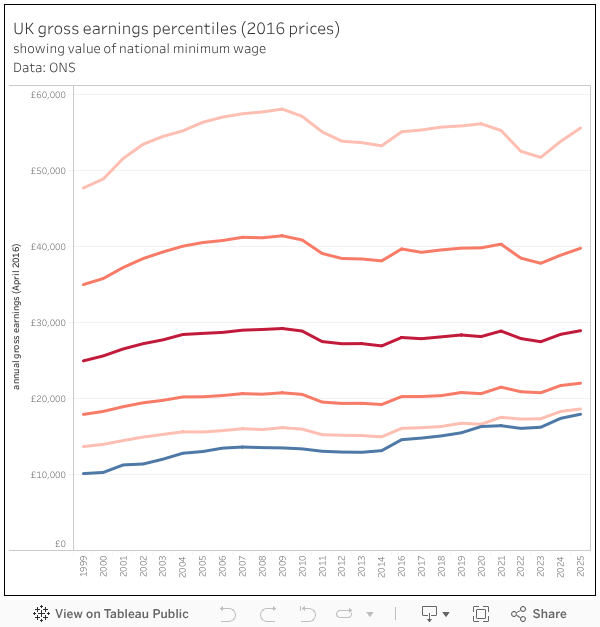
    Certainly if we plot the minimum wage against income percentiles (these are gross figures, at 2016 prices) it is notable how close its value has crept to the tenth percentile of income, suggesting that earnings at the lower end of the spectrum are now bunching at a higher real-terms level.

    [Full screen]

    The question has to be what, if any, impact this has on the graduate earnings premium and thus repayments.

    Low earners and graduates

    Currently around 10 per cent of those in employment are paid an hourly wage equivalent to the national minimum wage. If this rate of pay was linked to a full time role (eight hours a day for each of the 253 annual working days in England) it would make for annual earnings of around £24,700.

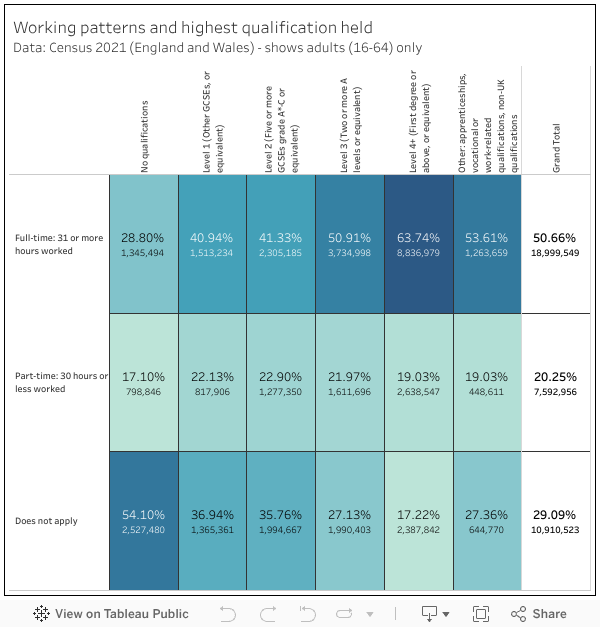
    However, workers on a low hourly wage are more likely to be on part-time hours, while we also know that the likelihood of you holding a full time job increases in line with the highest qualification you hold.

    [Full screen]

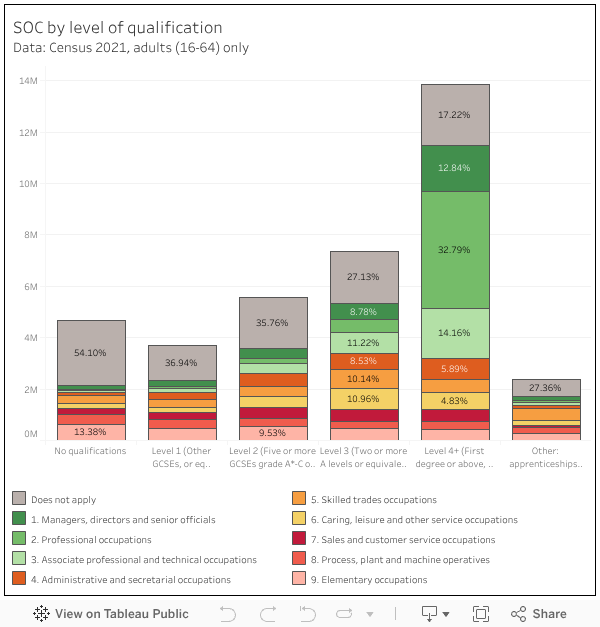
    The jobs involved are more likely to be elementary roles. In the main, jobs like this are primarily held by those with lower level qualifications, or no qualifications at all.

    [Full screen]

    Conversely, jobs done by graduates are far more likely to be full time, and are more likely to be managerial, professional, and associated professional roles – what the Office for Students calls “graduate jobs” than those with other levels of qualification. Around 60 per cent of graduates are in these roles, compared with around 27 per cent of those with level 3 qualifications (two A levels, so enough to have the option to attend some kind of higher education).

    Strikingly, the number (not the proportion) of graduates in “non-graduate” jobs is broadly similar to the number of those qualified to level 3 with “non-graduate” jobs.

    LEO and the minimum wage

    Instinctually, you’d expect a graduate to be earning comfortably above what is set at a national minimum for reasons of avoiding worker poverty. For this reason, it is fair to assume that gross earnings below the minimum wage relate to part-time work. The canonical failing of LEO is that it doesn’t differentiate between part-time and full-time work, but from the Census (so, 2020–21 issues apply to a certain extent) we know that graduates are less likely to be in part-time work (and more likely to be working at all) than all other groups.

    However, there are industry-based differences, and it is reasonable to assume that subject-based differences between earnings are derived from these. To give one obvious example, part-time work is a huge deal in creative and performing arts – so a lower than expected graduate salary in subjects like these would suggest that graduates are participating (at low/no pay) in the industry they have trained for and supporting this with part-time work.

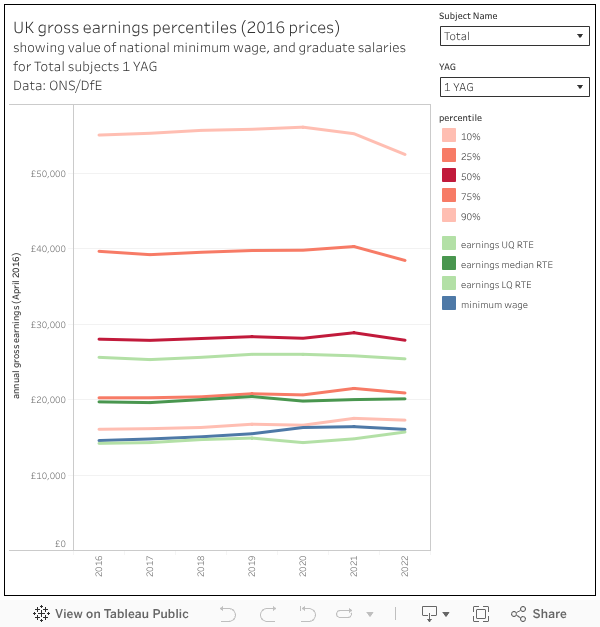
    With this caveat in mind, I have plotted LEO earnings against income percentiles for the whole working population and the value of the national minimum wage, all indexed to 2016 prices. The available LEO data extends from 2016 through to 2022, and in the latter year salaries across the economy experienced a real-terms downturn – something which (as we see from the chart above) has been cancelled out over the past few years.

    [Full screen]

    The two filters allow you to choose a subject area of interest, and to look at graduate gross earnings 1,3,5, and 10 years after graduation for each tax year.

    The median gross earnings of graduates is slightly above the median gross earnings of all earners (all ages, all levels of qualification) after ten years – though there is substantial industry-driven variation by subject. After one year (so comparing the gross earnings of 21-22 year olds with national averages) graduate earnings are around the lower quartile – and the intervening years see the difference between the two gradually bridged.

    Recall here that graduates are included within the percentile values – we are not looking here at a premium over non-graduates but a premium when compared to all earners. At the end of the day graduates are probably more concerned with the buying power of their own earnings than whether they are doing better than non-graduates.

    And, given how close the minimum wage is to the repayment threshold, looking at the premium over the minimum wage  (in cash term) is probably a more reasonable thing to do than I would have thought back at the birth of LEO.

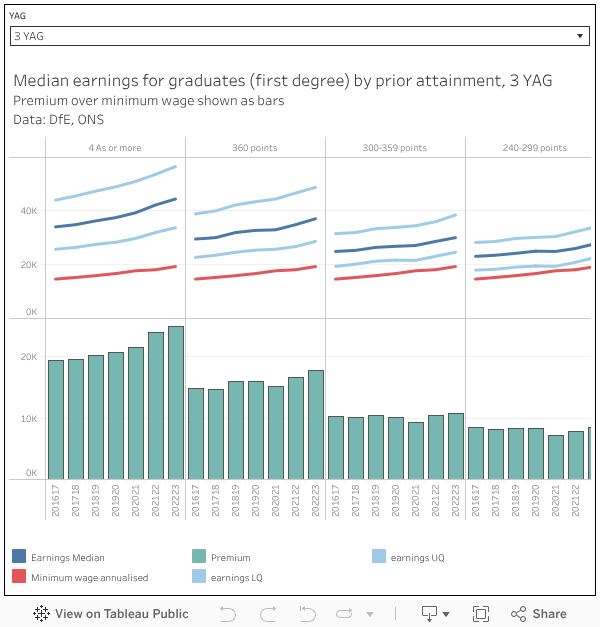
    We know prior attainment is one indicator of future salary (mostly as an indicator of deprivation more generally) so hear is a visualisation that plots LEO by prior attainment against the annualised minimum wage.

    [Full screen]

    How earnings are annualised in LEO

    The temptation with LEO is to read the figures as salaries, and to be fair the presentation of the data does everything it possibly can to encourage that reading. But inside the sausage machine, things are very different.

    The medians and quartiles familiar to us are based on individual graduate tax records for pay as you earn (PAYE, usually used by people in employment) and self assessment (SA, usually used by freelancers and the self-employed).

    With PAYE, earnings for a given tax year are divided by the number of days of employment recorded, to give an average daily wage. This is then multiplied by the number of working days in a tax year (which would appear to be different across the UK due to differing numbers of bank holidays: so 253 in England, 252 in Scotland, and 251 in Northern Ireland) to give annualised earnings.

    Because SA doesn’t offer dates of employment, LEO just uses the raw earnings. Annualised PAYE and raw SA income are then added together to give the final figure for each graduate, which are then used to produce the median and quartile data that is published.

    Another way

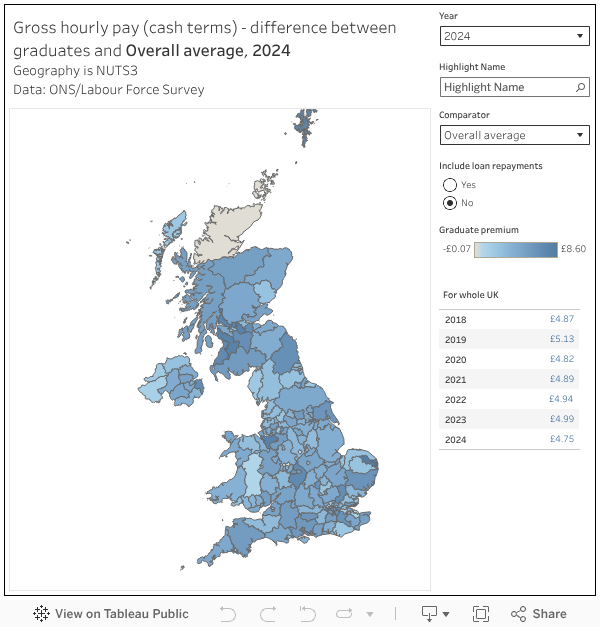
    I chanced upon some Labour Force Statistics data which neatly cuts across this issue by using gross hourly pay (and as luck would have it, broken down by NUTS3 regions over a number of years) as a measure of earnings. Big thanks to the ONS team for answering my questions on this one, and offering me information on the numbers in each group and an extra year of data.

    Now, LFS isn’t half as good as administrative data – it is a large, representative, survey of UK residents which has been dogged by low response rates in recent years – but it was, at the time, official statistics and thus is worth taking reasonably seriously. We do get two big benefits – the first is with hourly earnings we can confirm like with like, rather than needing to compensate for differing patterns of work; while the second is we get some regional data.

    A note of caution on that latter one – I’d be looking at the UK wide figures more closely as the NUTS3 regions (roughly equivalent to a top level local authority) may have quite low numbers of workers in each group (see the tooltips).

    [Full screen]

    What jumps out at me here is a clear and substantial wage premium for being a graduate, both nationally and in pretty much any area of the country. This largely holds against any qualification group of comparators, against average hourly earnings for everyone, and (very much) against the national minimum wage for the year in question. If you include loan repayments (take nine per cent off the hourly gross) there are a handful of areas of the UK where graduates are paid less than those with level three qualifications – and these largely map to other measures of deprivation.

    You would expect a result like that given what we know about the impact of place on income and the tendency among graduates to move to maximise opportunities and earnings. But even so, national premiums do hold up and appear to be broadly stable or growing since 2018. You can see the impact of the pandemic here – where graduate earnings overall remained stronger during 2020 and 2021.

    I should note here again that if you compare graduates with all earners, you are including the graduates themselves on both sides of the equation.

    Reasons to be GLMS

    Now you are probably ahead of me here, but the government used to do a graduate focused look at labour force survey data – imaginatively enough, called “graduate labour market statistics” (GLMS). I say “used to” because the 2024 iteration (released in summer 2025) is to be the last one ever. There’s an open consultation (follow the link) if you have thoughts on that – but you need to hurry, as responses are requested by the start of next month.

    The ostensible reason for discontinuing GLMS is the problems faced by LFS – the falling number of responses leading to issues with sample variability. Since 2024 it has been badged as “official statistics in development” (meaning that testing of quality, volatility, and an ability to meet user needs is underway), while improvements have been made that affect data throughout 2023 and 2024. From 2025 these improvements are fully in effect, and from 2026 a new “transformed labour force survey” (TLFS) will be the means by which ONS generates its whole suite of employment data.

    GLMS has clearly had some recent issues (although to be clear, these issues have not had a meaningful impact on the published national level data) but the data above suggests that it does have the potential (with appropriate caveats) to provide a more nuanced look at qualification level and regional data. Certainly, comparing the graduate population with those who hold at least the two A levels or equivalent that could get them into higher education feels like a simple and meaningful comparison we could learn from.

    A transformed LEO?

    If we are interested in graduate earnings premiums, the most useful thing that could be included in future LEO releases is hourly earnings. This would neatly address the part-time work issue, and focus directly on earning power rather than working patterns (which may vary for a number of reasons).

    Of course, earnings are only one part of the benefit of being a graduate – and for some (I’m looking at my creative peers here) the ability to make enough money to live on by doing the thing they love is probably going to be a bigger incentive than the ability to earn more than their neighbour. That’s not to say the salary data isn’t important for them to see, but telling me that I won’t earn much as a musician is not going to stop me from wanting to study music.

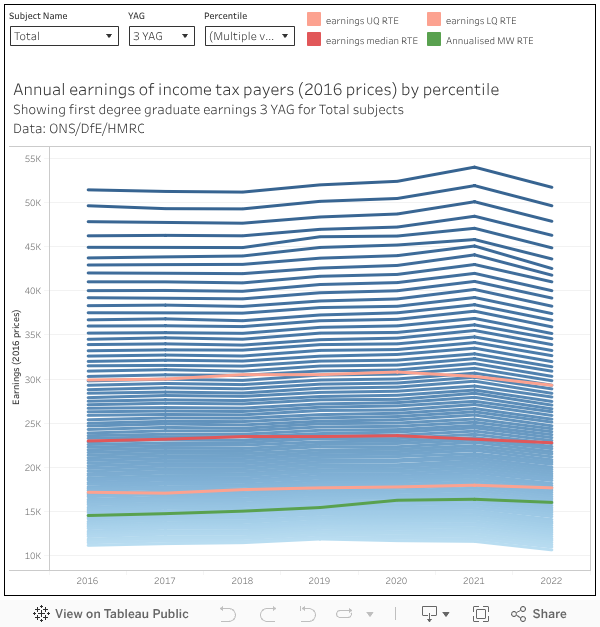
    That said, it does appear that (over the last few years at least) median graduate earnings have remained stable (or grown slightly) in real terms when compared to a given percentile of income tax payers. This isn’t a fair comparison – in that LEO data includes non-taxpayers and this particular HMRC data does not, but as a benchmarking tool it is interesting. By default I’m showing all but the top 10 percentiles of taxpayer income, alongside LEO by subject, and the minimum wage (all at 2016 prices).

    [Full screen]

    We know in LEO that a number of factors influence earnings: provider and subject (yes), but also prior disadvantage (of which prior attainment is one visible metric), sex, industry of employment (an economist will earn more in a bank than in a university), and region of employment. And if you control for all of these factors you are not going to get big enough groups to make statistically valid observations.

    All of which is a rather maths-heavy way of saying that past performance does not tell us a great deal about the future career prospects and earnings of a single applicant chosen at random. Looking at very broad, national, figures suggests to me that a boost in earning power (which grows throughout your career) is available for three years of study – but I would caveat that by saying if your sole interest in higher study is to increase your earning power then there are other metrics available that could help you maximise this particular benefit.


    Source link

  • What the Universities Accord missed: O’Kane – Campus Review

    What the Universities Accord missed: O’Kane – Campus Review

    The lead reviewer of Australias universities Mary O’Kane has outlined what the Universities Accord missed during her address at the University of Sydney 2025 Bradley Oration .

    Please login below to view content or subscribe now.

    Membership Login

    Source link

  • 350 jobs go at CSIRO – Campus Review

    350 jobs go at CSIRO – Campus Review

    Australia’s leading science and research agency will cut hundreds of jobs across the nation as rising costs outpace funding.

    Please login below to view content or subscribe now.

    Membership Login

    Source link