Blog

  • Asia reaping the benefits as market becomes multipolar

    Asia reaping the benefits as market becomes multipolar

    The market is “rebalancing” as students increasingly consider destinations in Asia and the Middle East, Harry Anderson suggested at East Asia Education Week in Jakarta, Indonesia last week.

    The deputy director at Universities UK International (UUKi) told delegates that the international landscape is now “more multipolar, more policy-sensitive”.

    This is leading to growth beyond anglophone countries and the rise of what is becoming known as the ‘big 14’ – particularly as students from Asia look to destinations within the same region for well-regarded and affordable options.

    According to Sonia Wong, regional research analyst at the British Council, East Asia is seeing a surge in intermobility. ” Everything is in East Asia’s favour,” she said, pointing out that East Asian institutions tend to do well in university rankings and are much closer to home as well as offering value for money in fees and living costs, making them more attractive choices for many students.

    Countries across East and Southeast Asia are ramping up efforts to grow international students cohorts. Japan is in the midst of an internationalisation drive, international students are flocking to Malaysia, and South Korea reached its goal of attracting 300,000 to the country two years early in late 2025.

    Meanwhile, Indonesia is positioning itself as a regional hub for transnational education in Southeast Asia, with plans to open as many as 10 new STEM- and medical-focussed campuses.

    Its deputy minister of higher education, science and technology, Stella Christie, told the conference she was confident that Indonesia could be a “great research nation, that we can be a great higher education ecosystem”.

    “We should have confidence,” she said, indicating that Indonesian President Prabowo Subianto’s conviction was the reason he was “working with UK stakeholders to “bring the best of the best” to the country.

    We are really open for business but it is not business as usual
    Stella Christie, Indonesian government

    “We are really open for business but it is not business as usual,” said Christie, stressing that the goal was to build capacity through partnerships.

    “What we want is technology transfer, what we want is for our local lecturers to be upskilled to these partnerships and have their doors opened so they can actually be part of the global research ecosystem,” she said.

    But Christie also suggested that Indonesia stands ready to welcome more international students into the country. “We also can be a magnet that draws from the regions across East Asia to come and study in Indonesia,” she said.

    Despite the region’s pull, though, Wong maintained that the UK was still a great choice for international students.

    Compared to the US and Australia “the UK really is still value for money”, she suggested, as programs in those countries are often longer – meaning that shorter degrees in the UK offer relative value for money.

    Source link

  • DOJ Sues Harvard

    DOJ Sues Harvard

    The Trump administration filed a lawsuit Friday accusing Harvard University of failing to comply with a federal investigation into whether its admissions processes are discriminatory.

    The federal government alleged in a court filing that the Ivy League university has unlawfully withheld “information necessary to determine whether Harvard, which has a recent history of racial discrimination, is continuing to discriminate in its admissions process.” The Trump administration alleged in the lawsuit that Harvard “has slow-walked the pace of [document] production and refused to provide pertinent documents relating to applicant-level admissions decisions.”

    The Trump administration said in the filing that it brought legal action “solely to compel Harvard to produce documents relating to any consideration of race in admission” and is not accusing Harvard of discriminatory conduct, seeking monetary damages or the revocation of its federal funding.

    “The Justice Department will not allow universities to flout our nation’s federal civil rights laws by refusing to provide the information required for our review,” Assistant Attorney General Harmeet K. Dhillon of the Justice Department’s Civil Rights Division said in a DOJ news release. “Providing requested data is a basic expectation of any credible compliance process, and refusal to cooperate creates concerns about university practices. If Harvard has stopped discriminating, it should happily share the data necessary to prove it.”

    Attorney General Pamela Bondi said in the same news release that the Department of Justice “will continue fighting to put merit over [diversity, equity, and inclusion] across America.”

    Applicant data sought by the DOJ includes grade point average, standardized test scores, essays and extracurricular activities, disaggregated by race and ethnicity, according to the court filing, which also noted that the federal government’s initial requested deadline was April 25 of last year. Harvard provided hundreds of pages of documents in response but the court filing says it handed over “aggregated admissions data”—not “individual-level applicant data.”

    A Harvard spokesperson denied claims of wrongdoing in an emailed statement.

    “Harvard has been responding to the government’s inquiries in good faith and continues to be willing to engage with the government according to the process required by law,” the spokesperson wrote to Inside Higher Ed. “The University will continue to defend itself against these retaliatory actions which have been initiated simply because Harvard refused to surrender its independence or relinquish its constitutional rights in response to unlawful government overreach.”

    Friday’s lawsuit is the latest salvo from the Trump administration in a nearly yearlong fight with Harvard that has included efforts to cut off $2.2 billion in federal research funding and to prevent it from hosting international students. Harvard has managed to successfully fend off those efforts and sued the Trump administration last April. Harvard won that legal battle with the federal government last fall but remains in the crosshairs of the Trump administration, as the president and others have accused Harvard of permitting antisemitism, among other allegations.

    Despite Harvard’s legal victory, rumors of a settlement have persisted for months. Any such deal would follow similar agreements struck with the University of Pennsylvania, Columbia University, Brown University, the University of Virginia, Cornell University and Northwestern University

    However, while a deal has supposedly been in the works for months, Harvard reportedly has been resistant to pay a fine as part of any such settlement. Earlier this month The New York Times reported that the federal government had dropped its request for a fine as part of the settlement, only to be immediately countered by Trump, who demanded Harvard pay $1 billion.

    Source link

  • DOJ Sues Harvard

    DOJ Sues Harvard

    The Trump administration filed a lawsuit Friday accusing Harvard University of failing to comply with a federal investigation into whether its admissions processes are discriminatory.

    The federal government alleged in a court filing that the Ivy League university has unlawfully withheld “information necessary to determine whether Harvard, which has a recent history of racial discrimination, is continuing to discriminate in its admissions process.” The Trump administration alleged in the lawsuit that Harvard “has slow-walked the pace of [document] production and refused to provide pertinent documents relating to applicant-level admissions decisions.”

    The Trump administration said in the filing that it brought legal action “solely to compel Harvard to produce documents relating to any consideration of race in admission” and is not accusing Harvard of discriminatory conduct, seeking monetary damages or the revocation of its federal funding.

    “The Justice Department will not allow universities to flout our nation’s federal civil rights laws by refusing to provide the information required for our review,” Assistant Attorney General Harmeet K. Dhillon of the Justice Department’s Civil Rights Division said in a DOJ news release. “Providing requested data is a basic expectation of any credible compliance process, and refusal to cooperate creates concerns about university practices. If Harvard has stopped discriminating, it should happily share the data necessary to prove it.”

    A Harvard spokesperson denied claims of wrongdoing in an emailed statement.

    “Harvard has been responding to the government’s inquiries in good faith and continues to be willing to engage with the government according to the process required by law,” they wrote to Inside Higher Ed. “The University will continue to defend itself against these retaliatory actions which have been initiated simply because Harvard refused to surrender its independence or relinquish its constitutional rights in response to unlawful government overreach.”

    Friday’s lawsuit is the latest salvo from the Trump administration in a nearly yearlong fight with Harvard that has included efforts to cut off $2.2 billion in federal research funding and to prevent it from hosting international students. Harvard has managed to successfully fend off those efforts and sued the Trump administration last April. Harvard won that legal battle with the federal government last fall but remains in the crosshairs of the Trump administration, as the president and others have accused Harvard of permitting antisemitism, among other allegations.

    Despite Harvard’s legal victory, rumors of a settlement have persisted for months. Any such deal would follow similar agreements struck with the University of Pennsylvania, Columbia University, Brown University, the University of Virginia, Cornell University and Northwestern University

    However, while a deal has supposedly been in the works for months, Harvard reportedly has been resistant to pay a fine as part of any such settlement. Earlier this month The New York Times reported that the federal government had dropped its request for a fine as part of the settlement, only to be immediately countered by Trump, who demanded Harvard pay $1 billion.

    Source link

  • San Francisco Teachers Strike Ends With Tentative Agreement on Raises, Benefits – The 74

    San Francisco Teachers Strike Ends With Tentative Agreement on Raises, Benefits – The 74


    Get stories like this delivered straight to your inbox. Sign up for The 74 Newsletter

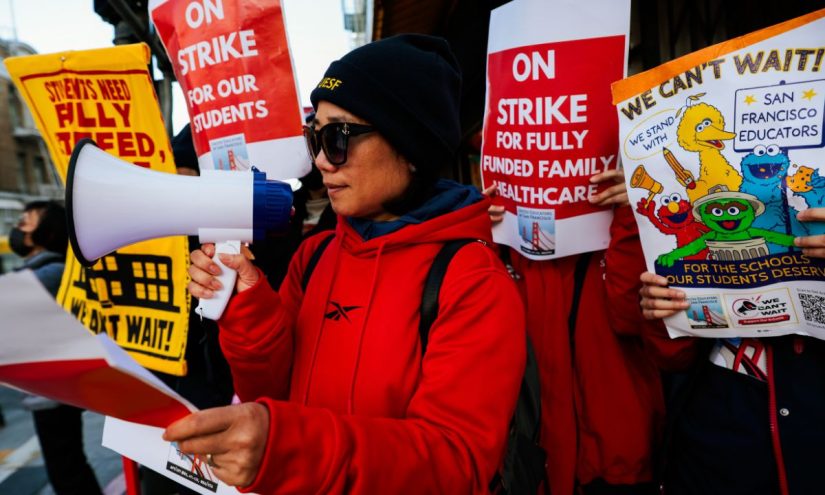
    A historic, week-long strike for United Educators of San Francisco came to an end Friday when the union and San Francisco United School District agreed on a tentative contract after nearly a year of negotiations.

    The union won fully-funded health care and an 8.5% raise over two years for classified staff including paraprofessionals. Teachers will get a 5% raise over two years. It’s a compromise between the district’s original offer of 2% and the union’s demand of an increase between 9% and 14%.

    Improving special education working conditions was also a key demand for the union. The tentative agreement includes caseload reductions, increased pay for added duties and requirements to ensure students receive special education services in a timely manner.

    United Educators of San Francisco began its first strike in nearly 50 years on Monday after 11 months of failed negotiations with the district. Schools were shuttered for roughly 50,000 students as thousands of educators flocked to picket lines. More than 250 principals, office clerks and custodians in two other unions went on a sympathy strike in solidarity. 

    “None of this would have been possible without the thousands of you who have shown up to our board actions, signed petitions to commit to our campaign, written letters to our Board of Education, and — in the last four days — shown up in the rain to support your big bargaining team in the streets,” the union said in a statement. “This strike has made it clear what is possible when we join together and fight for the stability in our schools that many have said was out of our reach.”

    While staff reported to work on Friday, students will return on Feb. 18 after two previously scheduled holidays. Superintendent Maria Su said in a statement that the agreement marked “a new beginning.”

    “I recognize that this past week has been challenging,” she said. “Thank you to the (district) staff, community-based partners, and faith and city leaders who partnered with us to continue centering our students in our work every day. I am so proud of the resilience and strength of our community. ”

    Other contract wins include limits on the district’s use of artificial intelligence, according to the union. The district and union also agreed on a proposal to classify schools as sanctuary spaces for immigrant students, staff and families. The policy bars federal Immigration and Customs Enforcement agents from entering school grounds or obtaining records without a criminal judicial warrant. Staff will also receive three hours of training to enforce these policies.

    The union said information about the contract ratification process will be announced in the near future and leaders are planning to host town halls. The agreement still needs to be approved by both the union and school board. 

    “We know our work is not done,” the union said. “While we didn’t win everything we know we deserve, this strike allowed us to imagine our schools and classrooms as they should be with staffing levels high enough that our students can learn and thrive.  This is a foundation for a stable district.”


    Did you use this article in your work?

    We’d love to hear how The 74’s reporting is helping educators, researchers, and policymakers. Tell us how


    Source link

  • Aviation Knows How to Learn From Failure. Too Bad Education Does Not – The 74

    Aviation Knows How to Learn From Failure. Too Bad Education Does Not – The 74


    Get stories like this delivered straight to your inbox. Sign up for The 74 Newsletter

    On Jan. 28, 2025, the U.S. Department of Education released 2024 NAEP results, showing that 41% of fourth graders read below Basic. That’s 95,000 more than in 2022, bringing the total to 1.6 million who struggle to make simple inferences from the text as they read. For elementary students from low-income families in 10 states, the news was especially bad: They were reading 1.5 grade levels lower than similar students a decade ago.

    The following day, an Army helicopter collided with an airliner in the skies over Washington, D.C., killing 67 people — the first mass fatality aviation accident in the U.S. in nearly 16 years. The rarity of such disasters reflects aviation’s remarkable safety record: Flying at 30,000 feet is safer than driving or walking.  

    What separates these two disasters is how differently aviation and education learn from failure. Here are three ideas education leaders can take from aviation.  

    First, it’s important to create forums for deeply analyzing what went wrong. After every accident, the National Transportation Safety Board conducts prolonged investigations, extracting lessons that prevent future disasters. The NTSB begins by recognizing that complex failures have multiple causes, investigating aircraft design, crew procedures, air traffic control, routes and flight conditions. 

    Six months after the D.C. crash, the NTSB issued an interim report that stimulated immediate changes in technology use, landing routes and rules for how aircraft separation is maintained. Last month, on the anniversary of the crash, a final report detailed the accident chain, explaining what went wrong.  

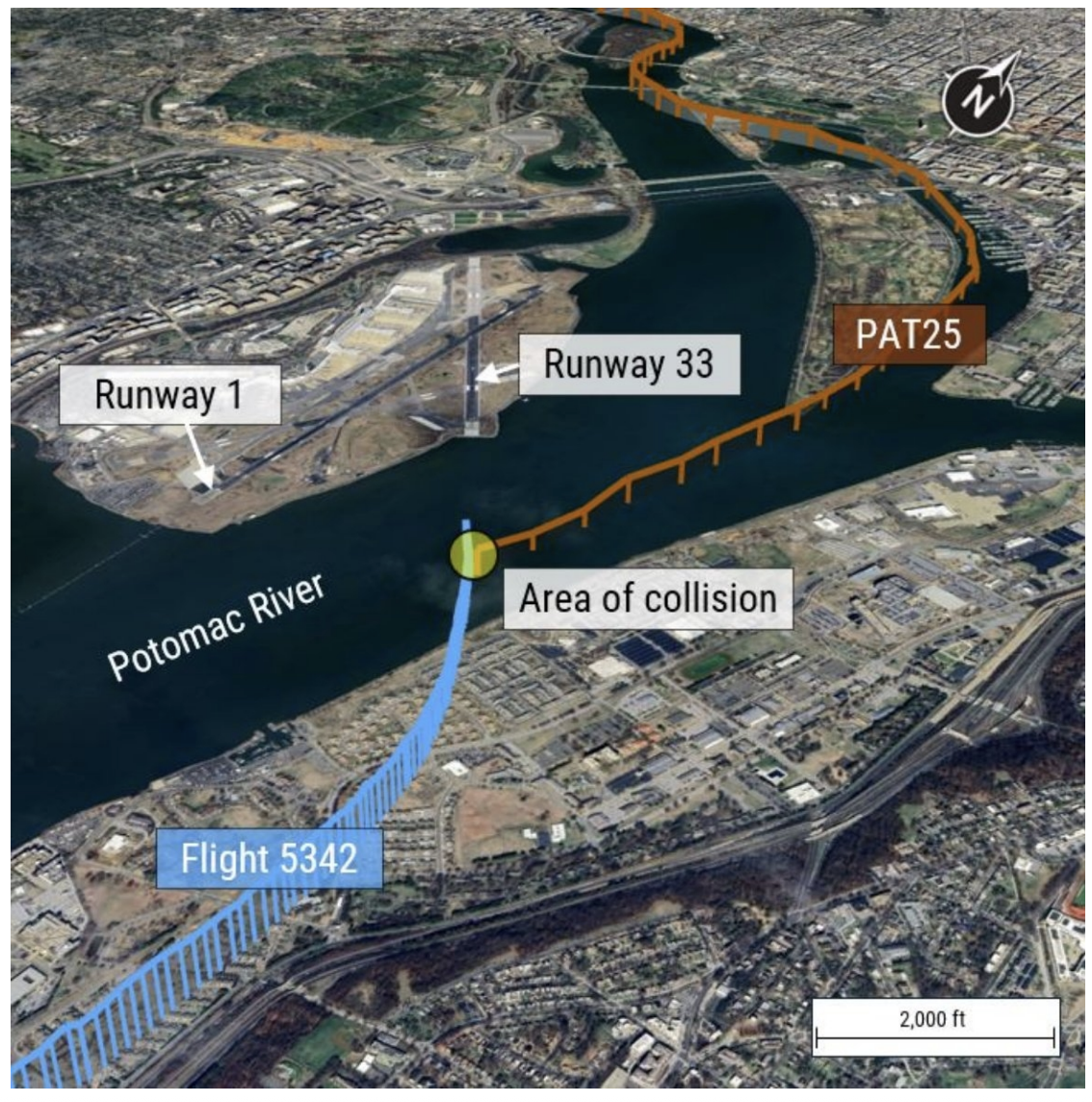
    Google Earth image with preliminary flight-tracking data for PSA Airlines Flight 5342 (blue line) and radar data for Army helicopter PAT25 (orange line). (National Transportation Safety Board)

    Contrast this with Delaware, one of the 10 states that saw a steep drop in early reading scores. A new strategic plan from Gov. Matt Meyer and the state Department of Education lays out four priorities. The plan reasonably starts with “access to grade-level instruction” — but what’s missing is any public diagnosis about current obstacles fornstudents reading below grade level, or why the failure occurred for so many kids in the first place. 

    States and districts don’t need an entity as structured as the NTSB, but they would benefit from spending several months analyzing data and developing cases of student reading success and failure at each grade. Disseminating those cases would be a powerful learning tool for real improvement. 

    Second, aviation benefits from a culture of psychological safety. Airline crews don’t have a rigid hierarchy; instead, junior pilots are trained to speak up during critical moments. Tools like pre-flight checklists create predictable ways to voice concerns without seeming insubordinate. A safety reporting system allows pilots to report concerns anonymously, without fear of punishment. 

    Most school leaders struggle with this concept. Superintendents too often blame individual teachers for problems that stem from systemic issues. Novice teachers report they feel less secure than veteran colleagues, in part because they find it difficult to ask for help and admit when they’re struggling.

    Building cultures of safety in schools means regarding mistakes as part of innovation. NYC Reads, the ambitious reform using research-backed curricula in all elementary schools, showed slim results the first two years. The process demanded that teachers unlearn practices they thought had been good for kids and asked them to teach grade-level books for all students — a heavy lift.

    Finally, last spring, scores jumped citywide. Two community school district superintendents, Cristine Vaughn and Roberto Padilla said they gave their teachers room to learn during this time. “We tried to set the expectations that this is new for everybody and we’re not going to expect perfection right out of the gate,” Vaughn told me in a research interview. Said Padilla, “Blame would hurt our progress and momentum. We don’t whip through a school evaluating principals and teachers for what they’re still learning.”

    Finally, school leaders need to think in systems. Root-cause analysis is an essential part of every airline accident investigation, digging beneath immediate and obvious causes. The NTSB maps any human error back to organizational and systemic precursors. 

    The book Learning to Improve describes schools as complex environments where many parts need to interact well with one another, but breakdowns can easily occur. It cites a decades-old effort to add instructional coaches in Los Angeles schools. Hundreds were hired in a few weeks, but no one mapped out the logic of how coaches would change teaching and learning within the larger system. Results in the schools with coaches were disappointing.

    The 95,000 additional students now reading below Basic on NAEP would fill 500 Boeing 737s. What happened to them last year wasn’t fatal, but they’ve experienced the educational equivalent of a sudden drop in cabin pressure. 

    The question isn’t whether school systems can learn from failure — aviation proves they can. The question is whether superintendents, principals and teachers have the courage to look honestly at what went wrong, create conditions where everyone can speak up and trace problems to their systemic roots. The next wave of students is waiting for educators to decide.  


    Did you use this article in your work?

    We’d love to hear how The 74’s reporting is helping educators, researchers, and policymakers. Tell us how

    Source link

  • Employers to shape Illinois Tech’s Mumbai campus as regional interest grows

    Employers to shape Illinois Tech’s Mumbai campus as regional interest grows

    On the sidelines of the groundbreaking ceremony for Illinois Institute of Technology’s Mumbai campus on Tuesday, Mallik Sundharam, vice president for enrolment management and student affairs at the university, said the move reflects shifting mobility trends, with employers increasingly moving to where talent is.

    “In the past 20 years, globally mobile learners have increased from 1.2 million to 7.4 million. Gone are the days when students simply moved to developed nations for education followed by employment,” Sundharam told The PIE News.

    “In the past five years alone, 33 global capability centres have been established in India. The country is no longer seen just in terms of volume or service capacity – it is increasingly viewed as a hub of talent,”

    “As employers move to where talent is, it is natural for universities to follow. We launched the strategy, ‘meet the learners where they are’, to serve employers and students where they are, which is the whole vision behind establishing this campus.”

    The first intake will be around 250 students, and the campus will have capacity for close to 1,200
    Mallik Sundharam, Illinois Institute of Technology

    It marks vthe first US institution approved by the UGC to establish a degree-granting campus in India. The campus will be established in the Godrej business district in the Mumbai suburb of Vikhroli, spanning approximately 90,000 square feet, with support from Illinois Tech alum and Godrej & Boyce managing director, Jamshyd Godrej.

    It is expected to open within the next three months, with classes beginning in Fall 2026, and will serve as the university’s Mumbai headquarters for three to five years before relocating to the Maharashtra government-backed International Educity on the outskirts of Navi Mumbai, according to Sundharam.

    “The first intake will be around 250 students, and the campus will have capacity for close to 1,200. We are already seeing strong interest from Dubai, the Middle East, Africa and Southeast Asia,” he said.

    For Sundharam, Illinois Tech’s India journey has been transformative – from broadcasting distance-learning programs via video cassettes in 1998 to launching a degree-granting campus offering AI, computer science and business programs with strong industry integration.

    While the Vikhroli campus – a replica of Chicago landmark S. R. Crown Hall – is set to feature modern laboratories, co-working spaces and sports facilities, its potential differentiator lies in the introduction of Illinois Tech’s Elevate program, a four-year blueprint designed to prepare students for employment after graduation.

    The university will be working with industry behemoths such as Godrej, Tata, Reliance, Chase and Steelcase, along with more than 100 other employers in the Godrej business district, who will participate in work-and-learn programs in which they will advise on curriculum, contribute to teaching and host students in structured, degree-integrated work placements.

    Like the branch campuses of UK and Australian universities that have recently opened in India, supporting students’ transition into strong employment outcomes will be central to Illinois Tech’s strategy, at a time when only 55% of Indian graduates are projected to be globally employable in 2025.

    “We have three layers of integration. One is the advisory board, where the CEOs of these companies will advise from an overall structural perspective. We also embed them in our curriculum, so they will be teaching some of our courses, both as guest lecturers and in degree-granting capacities,” stated Sundharam.

    “The last part is employer embedment through co-op programs, where students spend six months in school and six months working with employers. In some cases, they will do three days of school and two days of employment in a given week,” he added.

    He highlighted that students will be introduced to 21st-century skills, including business communication, in the first year, practise them in the second semester, be exposed to employers in the third, and work with them in subsequent semesters, earning badges as they build the skills they need.

    To facilitate these industry-integrated programs, international staff from Illinois Tech’s Chicago campus, Indian academics, and US- and foreign-educated scholars will jointly deliver courses.

    Students at the India campus will also have the opportunity to spend a semester or a year at the Chicago campus at no additional cost. Additionally, the India campus will partner with the University of Mumbai, one of the largest university systems in the world.

    “We have signed an MoU with the University of Mumbai. If students want to learn about Mumbai culture or history, there’s no better partner than the University of Mumbai,” said Sundharam.

    “We see it as an ecosystem that we are creating. We are going to learn from each other, depend on each other, and see how we can support each other.”

    While the undergraduate program at the Mumbai campus will cost around INR 16 lakh (nearly £13,000) and postgraduate programs around INR 20 lakh (£16,000), the university aims to leverage its 10,000-strong India alumni network to create an endowment fund to improve affordability and access for students who need it most.

    “For us, it’s a holistic admissions process. We don’t want a single examination to be a barrier to access. We look at the last three years of high school grades and SOPs, evaluating students on how they present themselves rather than just one score,” the VP said.

    “And with the endowment for scholarships, we’ll have a way to increase access and award students who deserve it, including those from low-income backgrounds.”

    Despite a 17% drop in US international enrolments in 2025/26, Illinois Tech has weathered the storm through global expansion, including through partnerships in Kazakhstan and China. The university now sees India’s competitive IBC landscape as a test to differentiate itself through a multi-disciplinary, skill-focused US-style education.

    “I think US universities have always been well known for experiential learning, so we believe in not educating students just through knowledge, but through skills. That’s what’s going to be very unique,” stated Sundharam.

    “Students make decisions on which path to take in 11th or 12th grade when they really don’t know what they want. This (Mumbai campus) will give them an opportunity to be multi-disciplinary. They may want to do engineering but not have an engineering background – our approach allows them to explore that.”

    And how does the university see suggestions that international universities coming into India have an upper edge over India’s own universities? It sees it as an opportunity to evolve Indian higher education while learning from Indian educators.

    “If you look at any industry in India, the first aspect of growth comes from privatisation, and the second comes from internationalisation, whether it’s the telecom industry or others. That’s the phase of growth we are going through in education,” said Sundharam.

    “Currently at Illinois Tech, even with first-generation students, the employment rate is 92%. That shows what the education system can provide. We also have a lot to learn from Indian educators. We should see this as a collaboration — we aim to evolve the education industry rather than compete with it.”

    Source link

  • ICE Threatens Children’s Short-Term Health, Long-Term Prospects – The 74

    ICE Threatens Children’s Short-Term Health, Long-Term Prospects – The 74


    Get stories like this delivered straight to your inbox. Sign up for The 74 Newsletter

    Dulcie and her family, who live in the Twin Cities metro, are afraid every day when they leave for work and school.

    “All of my friends are staying at home. No one comes out. It gets to me,” said Dulcie, who declined to use her last name because she fears retribution from federal agents, who have been detaining citizens and legal immigrants.

    Recently, Dulcie began driving her parents to work every morning before school, as early as 4 a.m. — because she is afraid they might disappear.

    “I would rather do that than never hear from them. I’d rather know at least where to look for them then never hear a single word from them probably,” she said.

    Like many area schools, Dulcie’s school is offering an online option for students worried about coming to school, but she has continued to go to school in-person, even if she doesn’t always feel like it.

    “Most of the time I don’t even want to go because everything just feels so depressing,” Dulcie says.

    The nation’s conscience has been shocked by high-profile incidents of federal immigration enforcement agents engaging children, including apprehending preschooler Liam Ramos on his way home from school.

    But the impact on children and their families extend beyond these viral incidents, affecting the lives of children and families broadly across race, immigration status and economic class in the Twin Cities. The ongoing immigration surge of around 2,300 federal agents has created a climate of fear — not just for the criminals and undocumented immigrants they claim to be targeting — but for ordinary families trying to maintain the routines and normalcy of childhood.

    “We are just kids, and instead of being kids and living our lives as kids, we have to step up and support our community,” said Taleya Addison, an 18-year-old senior at FAIR School for Arts in downtown Minneapolis. She said her best friend’s father has been in ICE detention for weeks, and his mother is a stay-at-home mom. The family is struggling, so Addison has been picking up groceries and running errands for them.

    With a Trump executive order in hand allowing stepped up immigration enforcement around schools and churches, federal agents have detained at least nine students in Columbia Heights, which canceled school Feb. 2 after feds were observed stalking bus stops and schools around arrival and dismissal.

    Duluth Public Schools, Fridley Public Schools and Education Minnesota, the state’s teachers union, filed a lawsuit against the feds, alleging the Trump administration violated the Administrative Procedures Act by rescinding the sensitive areas policy that had previously protected schools from immigration enforcement activity.

    Among the many incidents around schools:

    On the day of Renee Good’s killing, immigration agents deployed chemical irritants and smoke outside of Roosevelt High School in Minneapolis. After the murder of Alex Pretti, federal agents deployed smoke outside of an elementary school in Minneapolis.

    On Jan. 14, federal agents were spotted gathering outside of an elementary school around dismissal time in St. Louis Park.

    Roseville schools reported that on Jan. 21 immigration enforcement agents used a school parking lot as a staging area.

    Parents interviewed by the Reformer said immigration agents have lurked outside of schools in Minneapolis, and one said agents in a vehicle concealed themselves in the parent pickup line at a suburban school, while staff scrambled to get students safely inside.

    Federal agents have also been confronted after lurking around daycares in the Twin Cities.

    On Jan. 14, Robbinsdale Area Public Schools reported that a parent waiting at a bus stop had been taken by federal agents. And on Jan. 23, Hopkins Public Schools reported that two students and their parents had been taken by federal agents in an incident witnessed by another parent in the district.

    On Jan. 15, two vans transporting students and staff from St. Paul Public Schools were stopped by federal agents.

    On Jan. 27, Anoka Hennepin Public Schools reported that two of its vans had also been stopped by federal immigration agents while students and staff were on board. And on Jan. 29, Richfield Middle School reported that federal agents had boarded a bus while students were on board.

    The Reformer spoke with more than a dozen Twin Cities teens, parents of younger children and teachers to understand the impact on the daily lives of children. Their experiences range from the minor inconveniences of having extracurricular activities postponed or canceled, to fearing for their own safety leaving the house for school or work.

    Students have gone missing from school

    Heather, who declined to use her last name because she fears retribution against her students and school, teaches English learners at a middle school in the Twin Cities. Since her district introduced an online learning option, her typical class of 20 students is down to just four or five students in person. Many students are also not showing up online either.

    Although absenteeism has been worse since the killing of Good on Jan. 7,  Heather has had students regularly missing school because of concerns about immigration enforcement since November. One student has temporarily moved in with family out of state because their parents believe they are safer there.

    Heather said she is concerned that many of her students who have moved to online learning might never come back to the classroom.

    Student absenteeism is also putting some funding at-risk for Minnesota school districts. When students miss more than 15 consecutive days of school, districts are required by state law to drop students from enrollment. Most K-12 school funding in Minnesota is tied to enrollment, averaged over the school year, so as students remain absent for extended periods, districts will start to lose funding.

    Significant short-term and long-term consequences for children are already well documented

    Researchers have previously shown the impact of intensive immigration enforcement, beginning with short-term effects like missed school and increased anxiety.

    When immigration enforcement increased in California’s Central Valley last year, students missed 22% more days of school, with the youngest students missing the most days. Missing school is tied to lower academic outcomes.

    But the long-term impacts extend beyond academic outcomes. In the year following an immigration raid on a meatpacking plant in Morrison, Tenn., in 2018, researchers found consequences for children’s wellbeing up to a year after the raid.

    They documented more suspensions and expulsions from school for student behavior, and a doubling of serious mental health disorders including substance use disorder, depression, self‐harm, and suicide attempts or ideation. Children were more likely to be victims of sexual abuse in Morrison in the year following the raid.

    The Morrison raid was a single incident that resulted in detention of about 100 adults. By contrast, Minnesota has been subject to intense, ongoing enforcement actions that have now lasted for over two months and affected thousands of families.

    Recent research in Florida suggests the impact extends beyond families caught in the enforcement dragnet. A recent study of students in Florida, where immigration enforcement increased significantly at the start of the second Trump administration, found that student test scores dropped for American-born Spanish-speaking students just as much as for those born outside the U.S. They also found a decline in test scores for Hispanic students broadly, not just those who speak Spanish.

    The same Florida study also showed that the impacts were more significant for students in middle and high school, among girls and students already struggling in school. And, for schools with higher concentrations of poverty, increased immigration enforcement had a larger impact on students, controlling for other student characteristics.

    Once higher rates of absenteeism kick in, the negative effects can spread to an entire school community. Teachers struggle getting students back up to speed after they miss even one day of classroom instruction, data show. And, research during the COVID-19 pandemic showed that students and families can struggle to resume attending school regularly when their routine has been disrupted by time away from in-person learning.

    A student alters her daily routines after a killing near her home

    Children in the Twin Cities aren’t just facing the threat of federal detention. Hattie, a Black high school senior who declined to use her last name for fear of federal retribution, lives near where federal officers shot and killed Alex Pretti. The killing, along with the continuous presence of federal immigration enforcement activity around her home, has created a fearful atmosphere. She and her friends have quit taking their customary strolls around the neighborhood or taking the bus to get around.

    Hattie said she doesn’t feel like she is a target for federal agents. As a Black woman, however, she knows they would see her, and assumes they’d read her as an opponent.

    “I’m scared to go out there because you really never know when or where or who or why,” Hattie said.

    She said she has noticed subtle changes in her school, like more Latino students choosing to attend online and extra security around.

    “I can definitely see the difference in who takes the bus, who’s walking home,” Hattie said.

    She’s struggled to manage the stress.

    “At least for me, personally speaking, I’m not really coping. It’s just like, let’s just make it to the next day and not be targeted,” Hattie says.

    Like many others around the Twin Cities, Hattie has also been spending her time helping to organize donations and support for people staying at home for their own safety. She said that while people definitely need food, households sheltering in place also need toys and activities for children stuck inside, assistance getting medical care, and even help taking laundry to the laundromat.

    Effects of immigration enforcement felt in suburbs

    Eve, who has one parent who is an immigrant to the United States, attends high school in a suburb of the Twin Cities. Although she and her family haven’t had direct interactions with federal agents, she has been impacted in smaller ways: A friend’s birthday was moved out of Minneapolis because the friend group comprised a diverse group with many immigrant parents.

    Eve, who declined to use her last name because she fears retribution from the feds, said that despite the challenges, the crisis has yielded some positive outcomes, like seeing small gatherings outside of her school at dismissal expressing opposition to ICE, and demonstrators on overpasses and street corners regularly expressing similar sentiments.

    Eve’s school has also had ongoing fundraisers to help support those more impacted by immigration enforcement. Seeing people come together and express opposition to what is happening has been a silver lining for her, she said.

    Eve’s mother said that she has expressed concerns about her father, although he is a naturalized citizen. Although Eve said she thinks most of her classmates and teachers are opposed to what is happening, her mother said Eve has expressed concern about a few students expressing racism and hatred of immigrants at school.

    Dulcie is the only person in her friend group of Latinas that is attending in-person school. She said almost all of the Latino students at her school have chosen the online option. The school’s Latino Club has moved its meetings online.

    She said some of her teachers struggle to simultaneously manage classroom and online instruction. Some of her classes have a Spanish-speaking co-teacher or aide, which she said is helpful for keeping the online students on-track. But most of her classes lack this additional support.

    Her friends are doing their best to log into online classes, and keep up with the teacher. In her classes without an aide, Dulcie said, she has started using her cellphone in class to text with her friends online to help them keep up. Her school, like many in the Twin Cities, has a strict no cellphone policy. But she said her teachers understand.

    Counselors at Dulcie’s school, which is racially and economically integrated, have been collecting donations for students and their families impacted by the federal siege. Dulcie said that she hasn’t asked for any help though because she feels guilty when others need more. She is also concerned that students attending online are feeling more disconnected from school, and are not aware of the assistance available through the school.

    Most of her friends are no longer leaving their homes. While online school allows them to stay safely inside, she said that many are growing restless and bored, spending too much time on their phones or screens, like during the early days of the pandemic.

    But in some ways worse, because at least during the COVID pandemic, her friends were leaving the home, Dulcie said.

    Dulcie said she worries that if the intensity of immigration enforcement activity continues, she and her friends could miss out on important milestones, like prom and graduation. It is already keeping her friends from celebrating their birthdays.

    “I’ve gone through two historic moments already,” Dulcie said, referring to the COVID pandemic and murder of George Floyd. “It’s like, too much.”

    Minnesota Reformer is part of States Newsroom, a nonprofit news network supported by grants and a coalition of donors as a 501c(3) public charity. Minnesota Reformer maintains editorial independence. Contact Editor J. Patrick Coolican for questions: [email protected].


    Did you use this article in your work?

    We’d love to hear how The 74’s reporting is helping educators, researchers, and policymakers. Tell us how
    Source link

  • The High Court rules on EHRC’s guidance on single-sex

    The High Court rules on EHRC’s guidance on single-sex

    Back in May last year, I suggested that universities might usefully consult on how they’d handle single-sex provision in light of the Supreme Court’s ruling in For Women Scotland on the meaning of “woman” in the Equality Act 2010.

    The sector’s dominant posture at the time was a collective “we’re waiting for the guidance” – and we still are.

    The EHRC’s statutory Code of Practice for services, public functions and associations – the document that is supposed to translate the Supreme Court’s ruling into practical direction for employers and service providers – remains on the Minister for Women and Equalities’ desk, where it has been since September 2025.

    What has arrived is a High Court ruling on the EHRC’s interim update – the stopgap document it published in April 2025, revised opaquely in June, and then removed from its website in October in what it described as an attempt to “encourage” the Minister to approve the Code.

    The interim update set out what the Commission thought the ruling meant for single-sex facilities – primarily toilets, changing rooms and washing facilities – in both workplaces and public-facing services.

    Its core propositions were that single-sex facilities must be genuinely single-sex by biological sex, that admitting trans women to women’s facilities would mean they were no longer single-sex and would have to be open to all men, and that where possible mixed-sex facilities should be provided alongside single-sex ones.

    Three anonymous trans claimants – each of whom had been told by their employers, within weeks of the guidance being published, to stop using the toilets matching their lived gender – challenged the guidance as unlawful.

    The judge (Mr Justice Swift) found the interim guidance was a lawful and broadly accurate statement of the law and rejected all three grounds of challenge from the individual claimants.

    But within that headline, the detail matters – not least because the legal principles extend well beyond toilets to every women-only service, group, role and activity that a university or SU might provide, from women’s officer positions and self-defence classes to counselling services, support groups and sports teams.

    Workplace facilities – form versus substance

    The most emphatic part of the judgment concerns the 1992 Workplace Regulations.

    The claimants had argued that those regulations only require employers to provide separate rooms with signs saying “men” and “women” – not to actually restrict who uses them.

    The judge rejected that firmly, saying the argument “places form over substance” and ignores the “obvious purpose” of the regulations – “the provision of private space for each sex for reasons of conventional decency”.

    He confirmed that “man” and “woman” in the regulations mean biological man and biological woman, and that:

    an employer would not comply with the obligation under regulation 20 … if he permitted the room for women to be used by some men and vice versa

    On the “policing” concern – that employers would need to station someone at the toilet door – the judge was dismissive. An employer who “in good faith adopted and applied a policy” that female toilets were for biological women and male ones for biological men:

    …would do what is required. The employees concerned would know what was expected of them.

    The idea that compliance requires monitoring each person each day, he said, reveals:

    …a ‘logic’ so strict that it is divorced from reality.

    He also explicitly declined to follow the Edinburgh Employment Tribunal’s reasoning in Kelly v Leonardo, which had described a biological sex interpretation as “unworkable”.

    For universities, many of whose toilet blocks serve staff and students simultaneously – making them both workplace facilities under the 1992 Regulations and services under Part 3 of the Equality Act – the dual status is the practical complicator.

    A facility that has to comply with the workplace regs as an employer obligation may also need to work as student-facing provision where the legal framework and expectations may differ.

    But it’s not just the workplace regs

    The more triumphalist commentary from Sex Matters et al already risks missing something important at paragraph 42, where the judge is clear – even where an employer provides single-sex facilities as required by the workplace regulations:

    …the consequence will not be that a transsexual person is required to use the lavatory that corresponds to biological sex.

    Why? Schedule 22 of the Equality Act provides a defence for employers complying with the workplace regulations – but only against sex discrimination and pregnancy/maternity claims. It doesn’t cover gender reassignment discrimination.

    So a university can’t just point to the workplace regs as a complete answer to a trans employee’s claim. It must also ensure its provision is not discriminatory on grounds of gender reassignment – which in practice means providing additional gender-neutral or individual-use facilities.

    The judge endorsed EHRC’s position that expecting trans people simply to use the facility matching their biological sex, with no alternative, would not be proportionate and would amount to gender reassignment discrimination.

    That principle – proportionality, and the obligation to think about what happens to the people you’re excluding – extends beyond toilets. If a university restricts a women’s staff network, a women’s mentoring programme, a women-only counselling service, or a women’s rep role to biological women and makes no alternative provision for trans staff or students, the same proportionality test under paragraph 28 of Schedule 3 is likely to kick in.

    The service provision nuance

    Meanwhile, the point that GLP is leading on in its public response is also more nuanced than the messaging suggests.

    The EHRC’s interim guidance said flatly that if trans women are permitted to use a single-sex female facility, all biological males must be permitted to use it. The logic is that you can’t exclude some men while admitting others without discriminating on grounds of sex. The same logic would apply to any single-sex service – a women’s support group, a women’s changing room, a women-only event.

    The judge didn’t fully endorse this. He said whether a man excluded from a “trans-inclusive” women’s service would succeed in a direct sex discrimination claim depends on the facts – specifically, whether the different treatment is also less favourable treatment.

    He drew on Smith v Safeway, where different hair-length rules for men and women were held to be different but not less favourable treatment, and said there would be “scope for a strong argument” that a trans-inclusive policy could similarly involve different but not less favourable treatment – at least where the provision is otherwise broadly equivalent.

    But he also said the EHRC’s more cautious position “rests on factual premises that are permissible” and that the court “should hesitate before concluding that the guidance as issued was unlawful”.

    In other words, the EHRC wasn’t wrong – but the position is more fact-dependent than the interim guidance suggested. GLP’s case update claims the ruling means “service providers may lawfully allow trans women to use women’s facilities without being forced to open them to cis men” and that the draft Code of Practice will need rewriting.

    That’s a reasonable but optimistic reading – and it depends on the exact wording of the draft Code, which of course hasn’t been published.

    The death of the shifting comparator

    This bit matters for how universities and SUs might structure women’s representation. In Croft v Royal Mail (2003), one Court of Appeal judge had suggested that at some point during transition, the appropriate legal comparator should shift – so that eventually a trans woman would be compared with other women, and excluding her from women’s provision would need to be justified on that basis.

    The judge said this reasoning “cannot survive the reasoning in For Women Scotland”. There is no stage of transition at which the law treats a trans woman as equivalent to a biological woman for Equality Act purposes.

    For anyone with women’s officer roles, women’s societies, Athena Swan structures, or women’s networks that were premised – even implicitly – on the idea that trans women who had progressed sufficiently in transition should be treated as women under the EA, that premise is gone.

    The “gossip” point

    The three claimants raised concerns that being forced to use gender-neutral facilities would out them as trans. The judge acknowledged these were “sincerely held” but said:

    ..it ought rarely, if ever, be the case that a person using a unisex lavatory rather than an available single-sex one will ever be a matter of comment by others…

    He went on to argue that workplace gossip is something everyone can expect to bear “from time to time”.

    GLP has been vocal in response – it argues that the judgment reveals judges who:

    …assume they understand the reality of what it is to be trans in a transphobic world.

    The outing risk extends well beyond toilets. If a trans woman who has been attending a women’s staff network or accessing a women’s counselling service in a university for years is suddenly excluded, the visibility of that change is far greater – and the consequences in a small department or research group potentially more acute – than someone switching which toilet they use.

    Whether courts will take the same view of outing risk in those contexts is unclear, and the appeal is likely to test this point.

    The floor, the ceiling, and common sense

    Another passage universities might pay close attention to comes at paragraphs 25-27. The judge notes that neither the Equality Act nor the workplace regulations provide:

    …a comprehensive code on when or in what form lavatories or other facilities must be provided or who may or must use them.

    But both provide:

    …a floor for provision of facilities. But neither provides a ceiling.

    He describes as “fanciful” the idea that these laws “seek to regulate every possibility that can arise, day-to-day,” and observes that talk of a “right” to use a particular lavatory is, if intended as a legal right, “a bizarre turn of phrase.”

    Then:

    Those who provide facilities whether to the public or to their employees should comply with the law but also be guided by common sense and benevolence rather than allow themselves to be blinkered by unyielding ideologies.

    It’s a caution against rigid approaches from either direction, in a case both sides have framed as existential – and a description of what universities have largely muddled along with, given the absence of statutory guidance has made it so hard to do with confidence.

    What happens now

    Everything still hinges on the Code of Practice. Under sections 14-15 of the Equality Act 2006, the EHRC can only issue it with the Secretary of State’s approval, and it must then be laid before Parliament.

    The Good Law Project (GLP) argues the judgment forces a rewrite. Sex Matters wants it laid “without further delay.” The Minister for Women and Equalities – who, notably, intervened in this case without backing the EHRC’s position on service provision, and whose submissions the judge found “not easy to follow” – could approve it, send it back, or sit on it. We don’t know the draft’s exact wording, and we don’t know what the Minister will do.

    GLP has announced it will appeal, with a focus on workplace provisions and the outing risk, and has indicated willingness to go to Luxembourg or Strasbourg. That could extend the timeline considerably. The Kelly v Leonardo ET decision may also be appealed, though the judge’s emphatic rejection of its reasoning makes that a harder road.

    Meanwhile, the judge described the EHRC’s own process – revising the interim update without flagging changes, then taking it down to pressure the Minister – as “very unsatisfactory”.

    The sector has now been navigating these issues for nearly a year without statutory guidance. Universities and their SUs that have been waiting for the guidance before making decisions on facilities, services, groups, roles and events are running out of road – and may need to make those decisions based on their own reading of the legal framework, in the knowledge that the position may yet shift.

    Neither the ruling, nor the Code when it arrives, will tell any individual university what to do about its specific toilet block, its women’s officer role, its changing rooms, its counselling services, or its sports provision. The obligation to make those decisions proportionately, thoughtfully, and with what the judge called “common sense and benevolence” still falls on the sector.

    Source link

  • Realising the educational potential of mass higher education

    Realising the educational potential of mass higher education

    Author:
    Paul Ashwin

    Published:

    This blog was kindly authored by Paul Ashwin, Lancaster University. It is based on a new Open Access book Realising the Educational Potential of Mass Higher Education which was written by an international team of Paul Ashwin, Mags Blackie, Jenni Case, Jan McArthur, Nicole Pitterson, Reneé Smit, Ashish Agrawal, Kayleigh Rosewell, Alaa Abdalla and Benjamin Goldschneider. It can be downloaded here

    There is an increasing disillusionment with mass higher education from both sides of the political spectrum. From the political left, there is a sense of the betrayal of higher education’s promise. This is ascribed to the corporatisation of universities, with a lower quality education offered to students and institutions more focused on prestige and money than speaking truth to power in the face of human atrocities and the devastation of the planet. From the political right, higher education is seen as uninterested in advocating for freedom of speech, having been taken over by a left-wing elite who do not provide anything of educational value to students.

    Whilst coming from different directions these perspectives share the common concern that, in the move to mass higher education, educational rigour has been lost. As a greater number and variety of students have access to higher education, it is claimed that more and more students who are not interested in learning, are studying in impoverished educational institutions, that are not interested in educating them. There are increasingly urgent questions raised about why university degrees demand that students study over several years, in special institutions, taught by expensive teachers who are committed to sustained scholarship in their subject areas. 

    Does higher education transform students?

    Often, the response to these kinds of questions is to argue for the transformative power of higher education. Yet whilst the process of transformation may seem plausible in the arts, humanities and social sciences, does it meaningfully describe how students benefit from studying more fact-based STEM subjects, which are seen as crucial to the global economy? We tried to answer this question through a seven-year longitudinal international research project involving students studying undergraduate degrees in chemistry or chemical engineering in England, South Africa and the USA. These students were from six universities with different levels of prestige, and we followed them from their first undergraduate year for up to four years after graduation.

    We found that the educational potential of these STEM-based degrees lay in the ways that they brought students into relationship to knowledge, that changed their way of engaging with the world. This involved degree programmes taking students inside knowledge so that they could understand how it was relevant for their engagement with the world. Importantly, the knowledge that students engaged with did not consist of single, coherent, authoritative, flat and fixed pieces of knowledge. They were bodies of knowledge that had a structure, and it was this structure that allowed students and graduates to use this knowledge in a variety of contexts

    For students to develop these relationships with structured bodies of knowledge and to go inside knowledge, they needed to understand their study of their subjects as an educational process. If students saw their study of their degree only in instrumental terms, they tended not to see these bodies of knowledge from the inside and were less able to use the knowledge from their degrees in a variety of contexts once they had graduated.  

    So what?

    If this is the case for supposedly fact-based subjects, it seems likely that it will also be the case across higher education. Understanding the educational potential of higher education in this way helps to answer the urgent questions prompted by the disillusionment with mass higher education.

    This is because giving students access to these structured bodies of knowledge is dependent on the programmatic nature of higher education and students being engaged with these bodies of knowledge over an extended period. It requires educational institutions to create the conditions in which this can happen. This is why students need to intensively study systematic degree programmes over several years in special institutions with teachers who have living relationships to knowledge they are teaching. This education cannot be offered by stacking micro-credentials like Lego bricks with no attention given to who is learning them and how they can be sequenced to support particular students to develop understanding.   

    In the face of disillusionment with mass higher education, it takes a great deal of confidence and nerve for universities to modestly assert the value of engaging students with structured of bodies of knowledge. Yet this is where the educational potential of mass higher education lies. Universities are staffed by the most highly educated people in the world; if we cannot meet the challenge of explaining this to wider society, then how much is our belief in the power of knowledge and education actually worth?

    Source link

  • How a Connecticut School Slashed Its Chronic Absenteeism Rate – The 74

    How a Connecticut School Slashed Its Chronic Absenteeism Rate – The 74


    Get stories like this delivered straight to your inbox. Sign up for The 74 Newsletter

    Norwalk, Connecticut — The solution to one of the most persistent problems in education today may lie in the work occurring in a small breakroom deep inside Ponus Ridge STEAM Academy. In the room, five school officials sit around a little table, laptops open, running swiftly through a long list of middle school students who have major attendance problems. 

    “Out with the flu for a week.”

    “He’s moving to Texas.” 

    “When we said we would show up at her house, she started coming.”

     “I don’t know where to go with him. When all his teachers are here, he’s OK, but he takes advantage of subs.”

    Assistant Principal Evan Byron runs the meeting; grade-level counselors go through every student in danger of being chronically absent, missing 10% of the school year. On this day, Jan. 13, near the halfway mark of the school year, the team ran through 25 seventh-grade students in about 10 minutes. 

    While the pace is rapid, it can be detailed, as they observed one student’s absenteeism problem stemmed from the days she had French class. Since the class isn’t required, they hope to resolve this issue by moving her to another subject. 

    Their data is up-to-the-minute: They know whether all the students notified yesterday are in the building today; they know how parents are likely to react to repeated warnings; and they can even take an educated guess that the upcoming travel basketball season might improve one student’s attendance. 

    The school follows a strict regimen about absences: an email home if a student misses two days in a row, a letter home once a student misses six days, another letter at 12 days, and an email home each day a student is absent if they have missed more than 10 days. School officials can also schedule home visits, where they can show parents a student’s academic and attendance records while extolling the wide variety of classes and extra curriculars that may entice a student into attending. 

    “It’s effective,” Byron said. “A lot of students magically show up” after these correspondences. For any student who reaches the level of chronically absent –18 absences out of 180 school days – the school sends a referral to the state Department of Children and Families. 

    “That’s an absolute last resort,” said principal Damon Lewis. 

    Chronic absenteeism has spiked in schools nationwide since 2020’s pandemic. Before then, the number of students who missed at least 10% of school was about three of every 20 students, or 15%, said Nat Malkus, deputy director of education policy studies at the American Enterprise Institute think tank. Data from 39 states and Washington, D.C., showed that number nearly doubled to 28.6% at its height, he said, although it has dropped back slightly under 23% in the last year. Malkus tracks school attendance nationwide at the Return 2 Learn website.

    “The permission structure of when it’s OK to miss school loosened up” after schools were closed for the COVID-19 virus, Malkus said. If the new normal of students chronically absent is above 20%, “that’s not good.” 

    At Ponus, a middle school in a small city north of New York City, Lewis and his team were not immune to this trend. The 637-student school’s chronically absent rate spiked to 31% after the pandemic; Lewis and his administrators were able to slice that number to under 10% in just one year. 

    A lot of what Ponus officials do is the hard work of paying close attention to students and their patterns. Lewis mentions attendance in every weekly email he sends to all parents; homeroom teachers keep close tabs on their students; and the biweekly attendance meetings aim to make sure no student slips between the cracks. 

    Assistant principal Evan Byron (center) runs the school’s biweekly attendance meetings where grade-level counselors report on every student in danger of becoming chronically absent. (Wayne D’Orio)

    During the January meeting, seventh grade counselor Kaitlin Douglas points out a student who nearly did just that. “She wasn’t missing consecutive days, so she was flying under our radar,” Douglas said, noting that the student popped up on her list because of the total days missed. 

    “It’s an all-hands-on-deck initiative,” Principal Lewis said. “We drew a line in the sand and said, ‘We’re not doing this anymore.’ ”

    While all this effort is put into attendance, Lewis and his team have revamped the school to make children want to attend. “We try to entice the student back to school” through high-interest courses such as robotics, 3D printing, music technology, he said. The school has also beefed up its afterschool clubs; it currently offers 17 options ranging from weightlifting and rock band to crochet and jewelry making. 

    Norwalk has become a choice district, meaning any student inside the city’s 23 square miles can attend any of the city’s five middle schools. (The Concord Magnet school is a K-8 school on the same campus as Ponus Ridge.) For the first time, the school has a waiting list this year, Lewis said proudly. 

    Francesco and Brayden Christopher – who enjoy pointing out that they are in grades 6-7, hand motion included – attend the school from across town because their parents like the teachers and the people. “My dad texts with [principal Lewis] every day,” Brayden said. 

    Eighth grader Olivia Hempstead agreed that her family was impressed with the frequent communication when her older brother attended the school. She said she has a “true relationship” with principal Lewis and that he cares about students without trying to be their friend. “I’ve never heard him yell,” she added. 

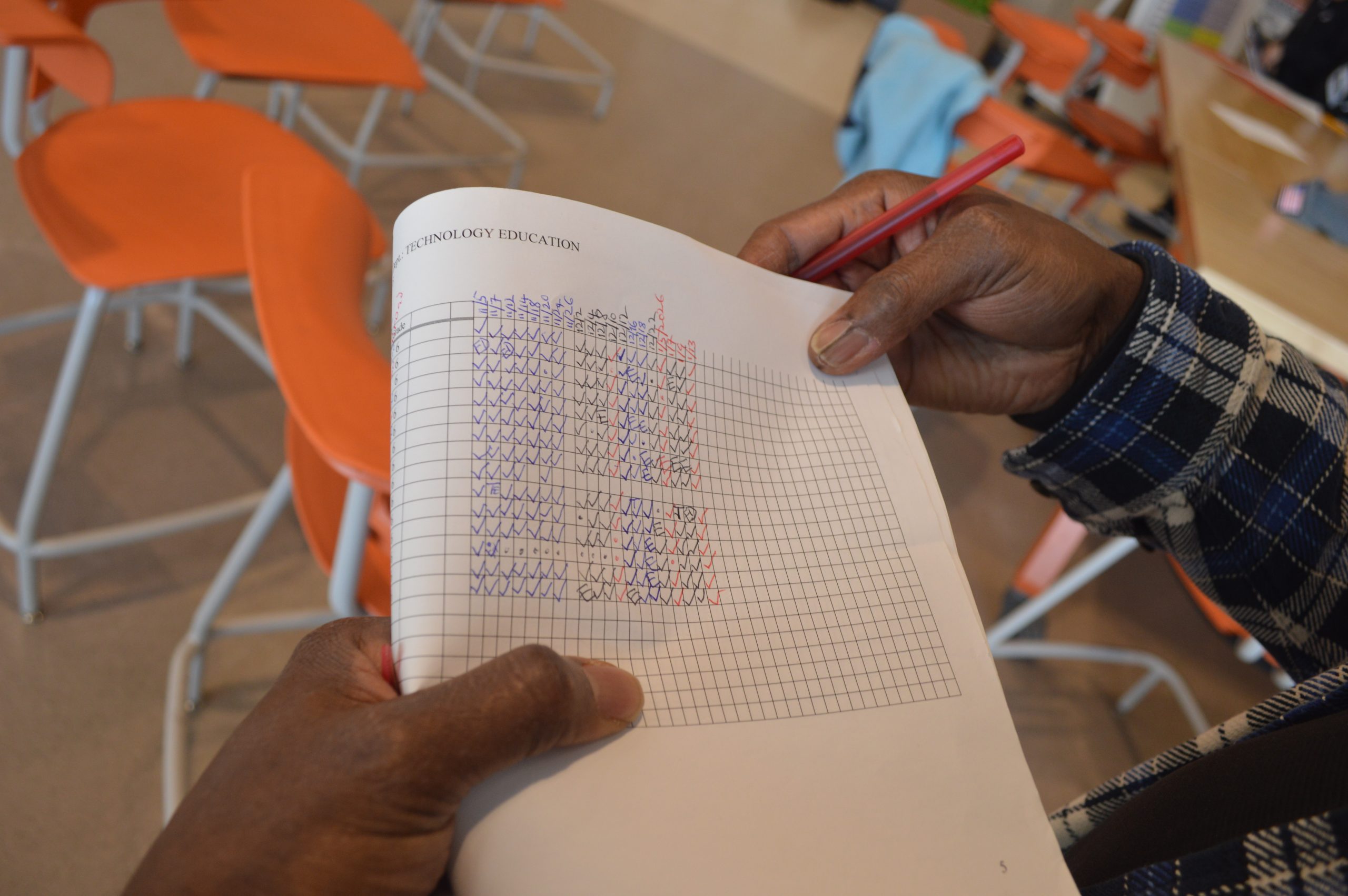
    Technology education teacher Isaac Iwuagwu shares his handwritten attendance list. Ponus Ridge has whittled its chronic absenteeism rate from a post-pandemic high of 31% to under 10%, better than any school in the Norwalk district. (Wayne D’Orio)

    Lewis, who has been principal at Ponus Ridge for 11 years, works to include the entire community in the school. He features Walk-Through Wednesdays where anyone can visit the school once a month, a Hispanic parent group and an in-school food pantry for families. When ICE raids began in the city, he brought immigration attorneys to the school for a night-time event so parents could learn their rights. “I want to meet people where they are, and they are hungry for resources,” he said. 

    Three of every four Ponus Ridge students are eligible for free or reduced lunch and 90% are students of color. 

    Lewis was named the Middle Level National Principal of the Year by the National Association of Secondary School Principals this year. Lewis “demonstrates how visionary leadership can transform school communities,” said association CEO Ronn Nozoe. 

    The attendance increase has had other benefits for Ponus Ridge students. Even though the school’s overall accountability index from the state is a mediocre 61.9 on a scale to 100, Lewis said his students’ Preliminary SAT scores have outpaced the district, the state and the nation. The school also outperforms its district and the state for ninth grade students on track to graduation. This measure looks at former Ponus Ridge students after their first year of high school; 91.5% are on track to graduate within four years, slightly ahead of the city’s 89.3%. 

    But the area Ponus Ridge really stands out in is attendance. Of the city’s 21 schools, Ponus has by far the lowest rate of students chronically absent, with 9.1% in 2024-25 compared to Norwalk’s overall 17.2% rate. AEI’s Malkus points out that the increase in student absences has consequences even for students who aren’t chronically absentAchievement on standardized tests is pretty linear, he said, meaning the more days students miss, the worse they tend to achieve. “The long-term challenge is to change people’s behavior,” he added. 

    Lewis and other administrators understand how difficult that can be. Sometimes parents complain about all the school’s correspondence, but the school remains committed to following its plan. “We’re not afraid to put our heads in the lion’s mouth,” Lewis said about dealing with criticism. 

    “When people say to me, ‘Stop sending emails,’ I say, ‘Send your son to school and I will,’ ” Lewis said. “I try to tell them, this is bigger than Ponus. This is a life lesson.”

    But not all parents resist the emails, the principal added. In one recent case, a father had to leave home for work before his child left for school. When he saw an email mid-morning that his son wasn’t at school, the father called the school and said he was leaving work to go home. “He’ll be there within the hour,” he told Lewis. 


    Did you use this article in your work?

    We’d love to hear how The 74’s reporting is helping educators, researchers, and policymakers. Tell us how
    Source link