Blog

  • Addressing Student-Centered Transfer Reform in Los Angeles

    Addressing Student-Centered Transfer Reform in Los Angeles

    California’s community college–to–four-year university transfer pipeline has not delivered the outcomes students need. While 80 percent of community college students intend to transfer, just 19 percent reach a California State University campus within four years. The gap is stark. While there have been numerous statewide efforts to define clear pathways to California State University and the University of California, time and time again it’s taken local innovation and collaboration between sending and receiving colleges to make a real difference.

    In Los Angeles, which enrolls a quarter of the state’s students, educators and partners have spent nearly a decade working to support student-centered transfer innovations by focusing attention on implementation of the associate degree for transfer (A.D.T.), a 2+2 pathway intended to offer community college students guaranteed admission to the CSU and an efficient path to graduation. Cross-sector education and workforce collaboratives like the L.A. Compact and the L.A. Region K–16 Collaborative, both convened by UNITE-LA—a nonprofit advancing equitable education and career pathways—have stewarded this work.

    In 2017, UNITE-LA brought together leaders from California State University, Northridge; the L.A. Community College District; and other local public and private universities to attempt to solve a common challenge: re-engaging students who stopped out. Recognizing that institutions had a shared responsibility to support this student population, California’s first reverse-transfer program was born.

    CSUN Connections went further than traditional reverse-transfer models by helping disengaged students seamlessly transfer their credits to a partnering community college, apply them to an A.D.T. when available and then transfer back to CSUN to complete their bachelor’s with all the benefits of an associate degree. This work required us to take stock of the student data and identify where institutional and systemwide policy barriers, including degree offerings, residency requirements and program misalignments, were costing students additional time and money

    Concurrently, campus partners wanted to better understand A.D.T. pathway availability and student outcomes from a regional perspective. Recognizing that the benefits of the A.D.T. unravel when such degrees are not locally available or, when available, rendered inaccessible by enrollment impaction, 16 community colleges and four CSUs engaged in historic data sharing to assemble a clearer picture.

    The findings were clear: The A.D.T. was not yielding the desired results. Students who earn the A.D.T. transfer to CSU at half the rate of non-A.D.T. earners. A.D.T. earners often did not complete their degree in two years, and many did not enter CSU in the same field of study. This is due, in part, to the fact that A.D.T.s are not offered locally in many high-paying fields in popular majors like STEM and health. Students of color, especially L.A.’s African American student population, were even less likely to earn the degree, transfer or enter high-demand fields.

    In response, UNITE-LA convened a 2021 community of practice focused on improving transfer pathways in the region, asking, to what extent do our educational systems yield inequities in transfer, and for whom? Why is this happening? And how might we bring change? The group surfaced systemic challenges and also revealed that meaningful solutions must be developed at the campus level.

    From 2022 to 2024, UNITE-LA piloted a new approach: the Student-Centered Transfer Redesign Process. In partnership with California State University, Dominguez Hills; Cal Poly Pomona; and their feeder community colleges, campus administrators and staff in academic affairs, student services and enrollment management worked together alongside faculty to diagnose barriers and design strategies to improve transfer and bachelor’s attainment.

    The process went beyond policy change—it built campus capacity. Participants gained deeper understanding of equity gaps, stronger cross-campus relationships and hands-on tools for problem solving. Empathy interviews with transfer students shifted the focus from what students did or didn’t do to what they experienced, learned and overcame. This perspective is critical to making a student-ready system instead of making students conform to existing policies that don’t serve them.

    For example, through the Transfer Redesign Process, CSUDH looked at data-backed recommendations of the statewide AB 928 Committee and assessed the viability of expanding its campus emergency aid program for prematriculated transfer students. Such aid could help incoming transfer students navigate unexpected expenses associated with transfer, such as moving costs, childcare costs and additional transportation expenses like up-front parking or transit pass fees.

    In another example, Cal Poly Pomona sought to partner with a feeder community college to implement eTranscript in order to create faster and more consistent transcript and data-sharing processes to support transfer student success. As noted in a recent study of five public institutions in California, despite improvements in available technology, transcript sharing remains a highly manual process that can delay transfer students in receiving final credit-evaluation decisions that are needed for accurate advisement and on-time course registration.

    These efforts underscore a core lesson: Localized collaboration is essential for effective implementation of state policy, to diagnose new challenges as they arise, to develop responsive solutions from the ground up and then to advocate for the scaling of innovations that work. The size of California’s higher education systems and complexity of degree pathways require more robust investments to support this type of cross-campus work. State-funded initiatives like the K–16 Collaboratives have provided flexible funding to make it possible in places like Los Angeles. But sustained, dedicated funding is key to turning localized innovation into statewide reforms that reach all Californians. With the state’s Cradle-to-Career Data System, the new Master Plan for Career Education and proposed Education Interagency Council, California has an opportunity to embed these lessons statewide.

    Los Angeles is fortunate in that it has a coalition of education leaders willing to cut through the bureaucracy and advance change for the well-being of students. It’s taken data sharing, relationship building, intermediaries and a creative blend of funding, but our students deserve systems that work. Campuses deserve resources to improve them. By aligning funding, policy, practice and partnership, we can ensure their success—and, in turn, the prosperity of our communities and our state.

    Adam Gottlieb is the director of postsecondary strategy and policy at UNITE-LA. 

    Source link

  • Summer Courses to Help Incoming College Students Adjust

    Summer Courses to Help Incoming College Students Adjust

    National data suggests today’s college students are less prepared to succeed in college than previous cohorts, due in part to the COVID-19 pandemic and remote instruction. Students lack academic and socio-emotional readiness, administrators say, prompting colleges to implement new interventions to get them up to speed.

    For years, Mount Saint Mary’s University in California has offered a summer bridge program for students who may be less prepared to make the transition to college, such as first-generation students.

    This summer, MSMU launched Summer Pathways, which is designed for all incoming students to get a head start on college. They complete two college courses for free and are able to connect with peers and explore campus before starting the term.

    “We felt the earlier we can engage students, the better,” said Amanda Romero, interim assistant provost.

    How it works: Summer Pathways is a six-week, credit-bearing experience that takes place in the middle of the summer, after orientation in June but before classes start in August.

    During the program, students complete a Summer Pathway seminar and one additional introductory course, choosing among sociology, English and mathematics.

    Students take classes Mondays, Wednesdays and Fridays; on Tuesdays and Thursdays they participate in workshops about managing their time, dealing with impostor syndrome or maintaining well-being.

    “We’ve invited the whole campus community to come in, meet with our students in person, talk about their careers, their offices, how they ended up at the Mount, what their hopes and aspirations are for the future,” said Elizabeth Sturgeon, interim assistant provost and director for Summer Pathways.

    The goal is to make students aware of campus resources and connect them with faculty and staff early in their college careers.

    The program also takes students on fun excursions around Los Angeles, including to the ballet, the Hollywood Bowl and the Getty Museum.

    The experience is free, and students are given a $250 stipend to help pay for gas and food. They can also pay $3,000 to live in a residence hall for the six-week program if they don’t want to commute to campus each day.

    A community approach: While many faculty work on eight-month contracts and have the summers off, Sturgeon and Romero said it wasn’t difficult to get professors engaged and on campus for the program.

    “We had departments that had never participated in Summer Pathways before, never knew what it was about, opting in and coming down in person to present to our students,” Sturgeon said.

    “It’s important for our core faculty to get in front of students, and this is a great opportunity to do just that,” Romero said.

    Returning students also stepped up to serve as peer mentors for new students.

    The program has paid off thus far, leaders said, with students hitting the ground running at the start of the term.

    “It offers a smoother transition,” Romero said. “A lot of anxiety with starting a new place is ‘where’s this, where’s that, where do I go?’”

    “They know what the resources are, they know where to park, what to order in the cafeteria,” Sturgeon said. “They have a friend group; they have that one peer mentor who’s their friend they can reach out to. From day one, in the business of being a college student, they’re an alum after six weeks.”

    What’s next: In summer 2025, 66 out of 90 incoming students participated in Summer Pathways, engaging in five different courses. And 98.5 percent of them matriculated in the fall.

    In the future, campus leaders hope to introduce project-based learning into the courses, interweaving the university’s mission as a Sisters of St. Joseph of Carondelet institution.

    “We just want to make it bigger going forward, with more classes and students participating,” Sturgeon said.

    The overarching dream is to get all incoming students to sign up, but administrators recognize that those who don’t live in the region may face additional barriers to engaging in in-person activities because they lack housing. Sturgeon and Romero are pushing for additional resources to offer housing and seeking solutions to address the need for additional funding and staffing.

    If your student success program has a unique feature or twist, we’d like to know about it. Click here to submit.

    Source link

  • The post-16 pivot: why higher education needs to lean into the skills revolution

    The post-16 pivot: why higher education needs to lean into the skills revolution

    This blog was kindly authored by Dr. Ismini Vasileiou, Associate Professor at De Montfort University.

    The government’s new Post-16 Education and Skills White Paper reframes how the UK prepares people for work, learning, and life. It promises a simpler, more coherent system built around quality, parity of esteem, and progression – introducing new V-Levels, reforming Level 3 and below qualifications, and setting out clearer routes into higher education and skilled employment.

    Within it there is an unmistakable message for universities: higher education is no longer a separate tier but a partner in a joined-up skills ecosystem.

    This direction of travel strongly echoes the recommendations of the Cyber Workforce of the Future white paper, which called for a unified national skills taxonomy, stronger coordination between education and employers, and consistent frameworks for developing technical talent. The government’s post-16 reforms, though broader in scope, now seeks to achieve at system level what the cyber sector has already begun to pilot.

    Reimagining pathways: from fragmentation to flow

    At the heart of the White Paper lies the ambition to create “a seamless system where every learner can progress, without duplication or dead ends.” The proposed V-Levels for 16-19-year-olds aim to sit alongside A-Levels, replacing hundreds of overlapping technical qualifications and creating a nationally recognised route into both higher technical and academic study.

    Reforms to Level 2 and entry-level qualifications will introduce new “Foundation Programmes” that build essential skills and prepare learners for work or further study. Alongside these, stepping-stone qualifications in English and Mathematics will replace automatic GCSE resits, acknowledging that linear repetition has failed to deliver progress for many young people.

    The emphasis on simplified, stackable routes reflects the very principles behind the Cyber Workforce of the Future model, which proposed interoperable learning pathways connecting schools, further education, higher education, and industry within a single skills continuum. What began as a sector-specific call for alignment in cyber is now being written into national policy.

    Higher education’s new context

    The White Paper links post-16 reform directly to the Industrial Strategy and to Skills England’s mission to align learning with labour-market demand. For universities, several themes stand out:

    • Progression and parity: Higher education is expected to work together with further education and employers to ensure that learners completing V-Levels and higher technical qualifications can progress seamlessly into Level 4, 5, and 6 provision.
    • Higher Technical Qualifications (HTQs): The expansion of HTQs in growth areas such as AI, cyber security, and green technology positions universities as key co-developers and deliverers of technical education.
    • Quality and accountability: The Office for Students will have powers to limit recruitment to poor-quality courses and tie tuition-fee flexibility to demonstrable outcomes, reinforcing the need for robust progression and employability data.
    • Lifelong learning and modularity: The commitment to the Lifelong Learning Entitlement demands interoperability of credits across further education and higher education – another concept long championed in the cyber-skills ecosystem.

    Taken together, these reforms require universities to move beyond disciplinary silos and become brokers of opportunity – enabling flexible, lifelong learning rather than simply delivering three-year degrees.

    From strategy to delivery: lessons from cyber that can scale

    The Cyber Workforce of the Future paper provides a live example of how the government’s post-16 vision can be delivered in practice. Its framework rests on three transferable pillars:

    1. Unified skills taxonomy – mapping qualifications and competencies against occupational standards to create a common language for education and industry.
    2. Education – industry bridge – aligning curriculum design and placements to real-world demand through structured partnerships between universities, FE colleges, and employers.
    3. Inclusive pipeline development – embedding equity and access by designing pathways that work for diverse learners and career changers, not just traditional entrants.

    These principles are not unique to cyber; they represent a template for how any technical or digital field can align with the White Paper’s objectives. The challenge now is scaling this joined-up approach nationally across disciplines – from advanced manufacturing to health tech and green energy.

    Six priorities for universities

    1. Redefine admissions and progression routes
      Recognise new qualifications such as V-Levels and HTQs as rigorous, valued entry points to higher education.
    2. Co-design regional skills ecosystems
      Partner with futher education colleges, local authorities, and industry to map regional growth sectors and align provision accordingly.
    3. Develop flexible, modular curricula
      Build stackable learning blocks that learners can access and re-enter throughout their careers under the Lifelong Learning Entitlement.
    4. Co-create with employers
      Move from consultation to collaboration, embedding placements, apprenticeships, and micro-credentials that reflect labour-market demand.
    5. Support learner transition
      Provide structured academic and digital-skills support for students from vocational or stepping-stone routes.
    6. Measure outcomes transparently
      Track progression, attainment, and employability by qualification route to evidence value and inform continuous improvement.

    Opportunities and risks

    The White Paper’s success will depend on genuine partnership between universities, further education providers, and employers. Without coordination, the new structure could replicate old hierarchies – leaving V-Levels or technical routes seen as second-tier options. Similarly, tighter regulation must not deter universities from widening participation or admitting learners who require additional support.

    The cyber-skills sector demonstrates what can work when these risks are managed: clear frameworks, shared standards, and collaborative delivery that bridges academic and technical domains. Replicating this across disciplines will require sustained investment and policy stability, not short-term pilots.

    A new social contract for tertiary education

    The Post-16 Education and Skills White Paper represents a genuine reset for tertiary education – one that values technical excellence, lifelong learning, and regional growth alongside academic achievement.

    Its goals mirror those already embedded within the Cyber Workforce of the Future initiative: building a national system where education and employment are continuous, mutually reinforcing stages of one journey. The cyber model shows that when universities act as integrators –  connecting further education, employers, and government – policy ambitions translate into measurable workforce outcomes.

    What began as a sector-specific experiment can now serve as a blueprint for system-wide reform. If universities across all disciplines embrace this pivot, they can help turn the White Paper’s vision into reality – a cohesive, agile, and inclusive skills ecosystem ready for the future economy.

    Source link

  • A Structural Approach to Writing

    A Structural Approach to Writing

    This presentation introduces a powerful structural framework for academic writing that helps writers organize their essays and research papers more effectively. The Thesis Statement Map approach demonstrates how a well-crafted thesis statement can serve as a blueprint for the entire paper, guiding both the writer and the reader through a logical progression of ideas.

    At the core of this method is the understanding that a good thesis statement does more than simply state an argument. It maps directly to the sections of your paper in a clear, predictable way. The thesis statement serves dual purposes: it prepares the reader’s mind for background information, definitions, and contexts about the subject, while also introducing the key topics that will contain supporting evidence. This evidence can take various forms, including statistics, historical information, examples, illustrative scenes, personal experiences, or lab and field results.

    The structural framework begins with the thesis statement at the top, which should clearly state your rhetorical goal followed by the key topics that will map to your body sections. This is followed by a section providing background, contexts, and definitions that connects to the reader’s existing experience and knowledge. The body of the paper then unfolds through three main topic sections, each beginning with a strong topic sentence and supported by relevant evidence.

    The discussion section plays a crucial role in synthesizing ideas, pointing out connections between topics, proposing counterarguments, and incorporating thoughts from other scholars or sources. Finally, the conclusion brings together the thesis and topics, highlights new insights gained through the analysis, discusses broader implications, and offers suggestions or recommendations.

    This systematic approach helps writers avoid common organizational pitfalls and ensures that every section of the paper serves a clear purpose in supporting the overall argument.

    — Susan Smith Nash, Ph.D. 

    Source link

  • Can You Keep a Secret? – Teaching in Higher Ed

    Can You Keep a Secret? – Teaching in Higher Ed

    This post is one of many, related to my participation in Harold Jarche’s Personal Knowledge Mastery Workshop.

    The Medium: The “Smart” Phone

    Shhhh… Don’t tell anyone, but our 13 year-old son will likely be getting his first “smart” phone for Christmas this year. I don’t think he has ever read my blog, so we should be good until December. As long as you cooperate with this secret surprise.

    I remember reading a few years back that the average child in the United States gets a phone at the age of 11. That seemed really early to me then. By the time Christmas rolls around, he will be about a month away from turning 14, which seems awfully late.

    Our son would agree.

    He tells us that he and one other guy in school are the only kids without a phone at this point. This may sound like a stereotypical story of woe that young people tell their parents to let them have something. But when we discuss the subject, there’s a common theme:

    What he really wants is a camera, disguised as a phone.

    A primary driver for his wanting the camera and messaging functionality is his upcoming middle school Washington DC trip in the Spring. When I tossed the idea around of getting him a camera, instead, he had no interest in that, though. Dave and I have talked a lot about it and figure this is a good time for him to get a phone and we’ve started our discussions about how we want to handle that, as parents.

    Dave and I talk more about these tensions in the second half of the video we recorded of us unboxing and playing with Justin Shaffer’s Alignment: A Course Design Deck.

    We also link in the video’s notes to the parent resources from The Social Institute, which are recommended by the academic leadership at our kids’ school. Now, on to why I’m bringing up smart phones in this particular post.

    McLuhan’s Media Tetrad

    Jarche introduces those of us participating in his Personal Knowledge Mastery Workshop to McLuhan’s Media Tetrad this week. I’ve seen the diagram on Jarche’s blog, before, but never slowed myself down enough to spend time soaked in it, like I have today.

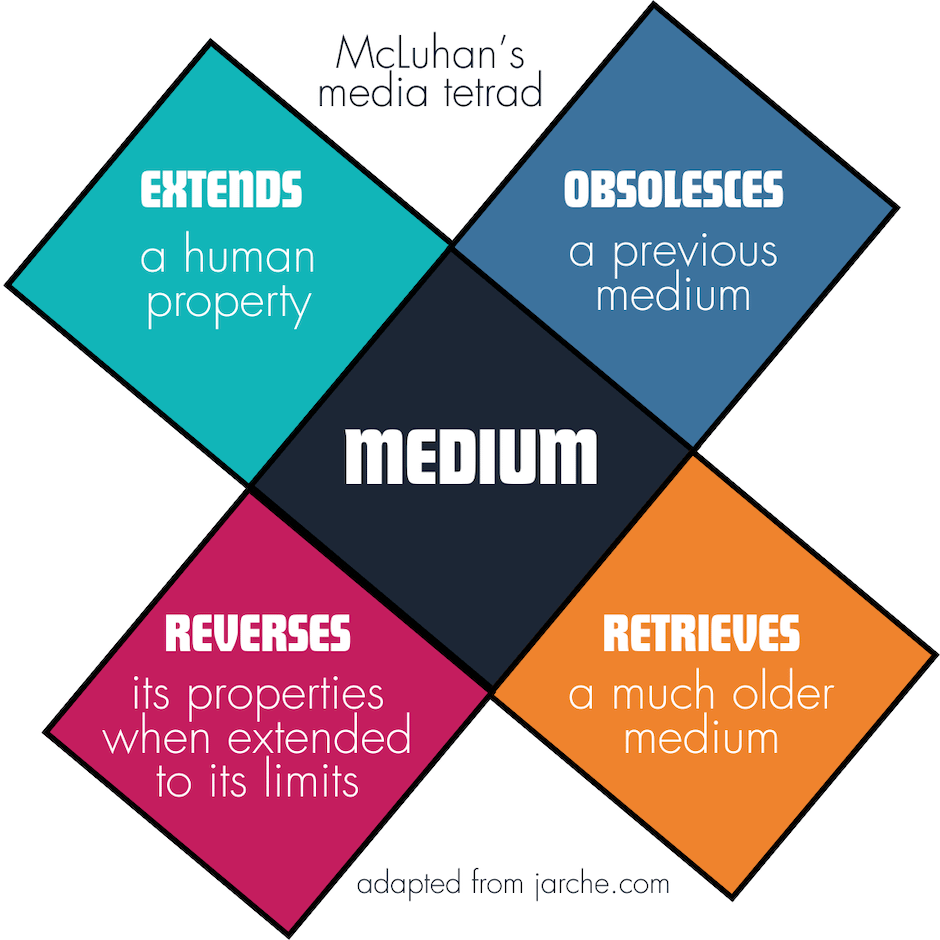
    A diamond-shaped diagram illustrating McLuhan’s media tetrad. The center diamond is labeled “Medium.” Four surrounding diamonds describe its effects: the top says “Obsolesces — a previous medium,” the right says “Retrieves — a much older medium,” the bottom says “Reverses — its properties when extended to its limits,” and the left says “Extends — a human property.” The image is adapted from jarche.com


    Here’s my best, novice’s understanding of the framework:

    It starts with a new medium.

    McLuhan posits through his Laws of Media that every new medium results in four effects. Jarche explains that under McLuhan’s laws, each new medium:

    Extends a human property,

    Obsolesces the previous medium (& makes it a luxury good)

    Retrieves a much older medium &

    Reverses its properties when pushed to its limits

    When we take time to understand what happens with new media, we can put in place steps to negate or minimize the negative effects. Ample examples exist of ways that social media extends humans’ voices, while ultimately making healthy, human-to-human conversation obsolete. Then, our more tribal affiliations can kick in (Twitter, anyone?) and we reverse into “populism and demagoguery,” according to Jarche’s example.

    Jarche writes:

    The reversals are already evident — corporate surveillance, online orthodoxy, life as reality TV, constant outrage to sell advertising. The tetrads give us a common framework to start addressing the effects of social media pushed to their limits. Once you see these effects, you cannot un-see them.

    My Example

    As I mentioned earlier, I’ve selected the “smart” phone as the medium to analyze.

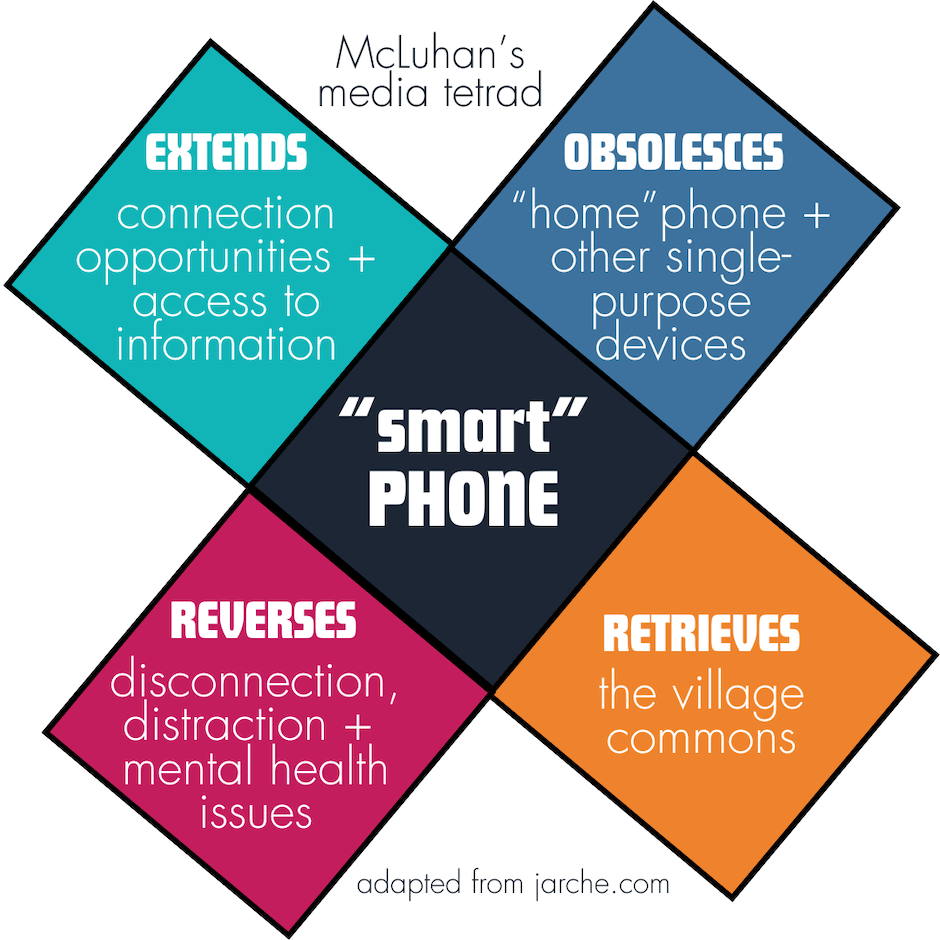
    Here’s my attempt at the tetrad:

    A diamond-shaped diagram showing McLuhan’s media tetrad applied to the “smart” phone. The center diamond says “smart phone.” The four surrounding diamonds explain its effects: top—“Obsolesces: ‘home’ phone and other single-purpose devices”; right—“Retrieves: the village commons”; bottom—“Reverses: disconnection, distraction, and mental health issues”; left—“Extends: connection opportunities and access to information.” The image is labeled “adapted from jarche.com.”

    Jarche suggested that we first explore what the technology enhances and then what it obsolesces. That felt easy and hard, simultaneously. Today’s “smart” phones contain so many features that the definition of what this technology is can be blurred. Our son, for example, has understandably brought up that when adults raise concerns about phones, they can often be actually talking about social media (which he presently has zero interest in).

    The “smart” phone:

    • Extends: connection opportunities and access to information
    • Obsolesces: “home” phone + other single-purpose devices

    As Jarche predicted, these two elements of the tetrad were fairly easy to identify (though I could have chosen to go in a bunch of different directions). I can still recall what it felt like to go with my brother to a convenience store that was about two miles from our house and involved climbing down a super steep, dirt hill. The idea that I could have called my Mom to ask her to pick us up, so we could have avoided the steep hill on the way home would not have occurred to me at the time.

    That’s despite the fact that we watched Star Trek as a family and they had these transporter beams that would transmit the characters in the show from the starship and a planet’s surface.


    Leonard Nimoy William Shatner Star Trek 1968Leonard Nimoy William Shatner Star Trek 1968

    The idea of extending our home phone to one that could be carried around in my pocket (if women’s pants had pockets, that is…) would have been a welcome idea to me. Then, there are all the other single-purpose devices that the “smart” phone can take the place of, such as:

    • 📞 Landline phone
    • 📷 Camera
    • 🎧 MP3 player
    • 🗺️ GPS
    • Alarm clock
    • 📺 Video player
    • 💾 Disk or hard drive
    • 📝 Notepad
    • 🧮 Calculator
    • 💡 Flashlight
    • 💳 Wallet
    • 🧭 Compass
    • ✉️ Mail service

    I could have kept going with that list for a long time and just be getting started.

    Productive Struggle

    Cognitive psychologists talk about how helpful productive struggle can be in the learning process. As Jarche thought we might, I had trouble with what the smart phone might retrieve a much older medium, in terms of the way I had anchored the framework with the other two components (extends and obsolesces). I then moved my focus over to the reverses portion of the tetrad and thought how it was the polar opposite (disconnection) of what it promises to extend (connection).

    For the retrieves part, I kept getting stuck between two, broad ideas: the pubic square or the commons.

    I considered how the promise of today’s phones as the device to connect us with others and with information winds up making loneliness more likely and seeding a potential decline in mental health. I also fixated on how the “extends, obsolesces, and reverses” descriptions I had come up with were more geared toward individuals, yet the promise of the common good is only possible when we come together in community.

    I would like to learn more about the history of the public square, as well as regarding the commons in medieval and early modern Europe. I’m also intrigued to keep my learning going regarding “the commons” in digital contexts (Wikipedia, Wikis, Creative Commons, etc.). There are also a lot of places I continue to want to explore about the attention economy and surveillance capitalism.

    Until next time, when I share my reflections from Jarche’s Fake News lesson. That should be fun, ehh? Nothing going on there in the world, right? 🫠 

    Source link

  • The white paper kept quiet on market exit

    The white paper kept quiet on market exit

    The Department for Science, Innovation and Technology’s annual report in early July said that the government was working on a legislative programme to “ensure higher education sector access to an insolvency regime.”

    Yet for all that Monday’s post-16 white paper compiled together much of the ongoing work that had been trickling out of Whitehall for the previous 12 months, such plans were notable by their absence.

    Similarly, the Office for Students’ 2025–26 business plan said it was putting together proposals for a system whereby a “validator of last resort” for the English sector, which would protect students if the provider that validates their degree exits the market, as well as a possible “bespoke clearing system” for students in the event that their institution closes.

    Again, neither of these ideas got airtime in the white paper, despite skills minister Jacqui Smith having given her endorsement to the latter in comments to the media.

    The white paper in fact steers wholly clear of policy thinking around what would happen in the (ever more likely) event that a large English higher education provider finds itself in severe financial distress threatening its very viability. This omission is even more stark even against a background where we know that this risk has been scored “critical” and “very likely” on the DfE risk register, and the Office for Students has told the Commons education committee that it would be unlikely that it could “secure reasonable outcomes” for students if a large multi-faculty university closed, reeling off a list of all the ensuing risks ranging from students losing access to their academic records to PGRs whose work is tied to a particular supervisor finding transfer “difficult or impossible.”

    Perhaps the government simply wanted to steer clear of any negative news as it seeks to pat itself on the back for putting higher education on a “firm financial footing”, by way of keeping tuition fees at the same level in real terms (as long as inflation forecasts do not prove to be underestimates) while piling on additional costs to universities in areas including national insurance, pensions and a future fee levy. But – especially given that the white paper rounded up almost every policy initiative that is currently underway elsewhere in government, OfS and UKRI – it does feel, rather, that the idea of making legislative change to pre-empt issues around “market exit” has disappeared from the government’s to-do list.

    Pros and cons

    The education committee’s ongoing inquiry into higher education funding, which has the risks around insolvency as one of its central concerns, is shedding some light on the issues involved, both in the written evidence that has come the committee’s way and the first hearing which took place on Tuesday this week.

    Neil Smyth of lawyers Mills & Reeve told the committee that the fundamental answer to the question of what happens to an insolvent university which is not incorporated as a company – a large slice of the sector – is that “no-one quite knows”. He emphasised that there is debate about what the law entails, noting:

    At the moment, it is believed that the only insolvency process that would be available for a royal chartered entity or non-corporate entity would be to be wound up by the court as an unregistered company. That is a terminal process, it is a shutdown process, it is not a process that allows you to continue to trade.

    This uncertainty complicates what advice can be given to university governors about their responsibilities and liabilities – and also makes it difficult to see how student protection can be regulated for in such a situation. Mills & Reeve’s evidence to the committee adds that the unclear dispensations for unsecured creditors has, in their experience, led to something of a “land grab” among creditors:

    Key creditors, including pension providers, have sought to improve their position by demanding legal mortgages over land as these confer the contractual remedy of fixed charge receivership. This leads to highly expensive and time-consuming legal due diligence at just the point where the HEI can ill-afford those costs.

    Smyth, as he has previously argued on Wonkhe, told the committee that the advantages of some kind of restructuring regime being introduced included clarity for governors, confidence for lenders, and – as exists in the relatively new further education special administration regime – the potential for legal protections for students’ academic interests. That said, he warned that he couldn’t see a university coming out intact from such a process, given that student demand would inevitably collapse once the institution went into administration.

    However, Universities UK – represented at the committee hearing by chief executive Vivienne Stern – has moved away from advocating for a special administration regime. As the representative body’s evidence to the committee puts it:

    Universities UK’s current view is that it would be preferable to work with government, regulators and other sector bodies to clarify how existing arrangements can apply to higher education institutions, supported by stronger contingency planning at institutional level, and at the level of government, regulators and funders.

    The consequences of a large scale institutional failure would be so significant that policy effort should be primarily focussed on averting this outcome, rather than on mitigating its impact after the event.

    Stern highlighted the risk that a formal administrative process could be drawn out and expensive, and might even make it more likely that an institution collapses once entry into regime had taken place.

    The committee’s report will make a recommendation – it could be that Universities UK’s line of thinking has already swayed the government away from such a move. Committee chair Helen Hayes hinted that the committee will conclude that formal systems are needed, via her question to the effect of what would happen if there were a slew of insolvencies in short succession which compromised governmental and regulatory capacity to thrash out suitable arrangements behind the scenes.

    Fuzzy logic

    Keeping the threat of market exit – and the massive and unpopular clean-up job that would accompany it – hanging over the government’s head rather than handing off responsibility to a predetermined legal and fiduciary process is, sad to say, probably one of the few trump cards the sector still has to play around advocating for greater government investment.

    The lessons from FE, where a special administration regime has been in place for a few years now, are that the government seems reluctant to let things go as far as formal processes. In higher education, while it would depend on geography and circumstances, the smart money is probably still on Labour stepping in before push came to shove in a similar way to how the SNP felt forced to in Dundee.

    But there won’t be a Labour government forever. Future ministers who were relaxed (on paper) about universities going bankrupt would almost certainly be less keen to have to step in and make the final decisions in the places affected – while perhaps not being so worried if it ended up being purely a matter for the courts and the banks – and so keeping things fuzzy might end up being a sensible long-term strategy for the sector with an eye beyond 2029.

    That said, the apparent move away from government interest in legislating for a higher education insolvency regime doesn’t really explain why the white paper was quite so silent on other mitigating actions and the whole question of student protection (especially given its inclination towards “consolidation”). Is it really betting the house on the magical healing properties of holding tuition fees stable in real terms?

    Source link

  • We need to talk about high-tariff recruitment behavior

    We need to talk about high-tariff recruitment behavior

    There’s a storm brewing in UK higher education and, if we’re honest, it’s been brewing for a while.

    We all know the pattern. Predicted grades continuing to be, well, predicted. Students stacking their UCAS applications with at least one high-tariff choice. Those same high-tariff universities making more offers, at lower grades, and confirming more students than ever before.

    Confirmation charts that had us saying “wow” in 2024 are jaw-dropping in 2025 and by 2026 we’ll need new numbers on the Y axis just to keep up.

    [Full screen]

    On their own, you could shrug and rationalise these shifts: post-pandemic turbulence, demographic rises and dips depending on where you regionally look, financial pressures. But together? Here’s your perfect storm.

    Grades remain overpredicted because schools and colleges know universities will flex at offer stage and, in all likelihood, at confirmation. Universities flex because grades are overpredicted, and because half-empty halls of residence don’t pay the bills. Students expect both to continue, because so far, they have.

    This is not harmless drift. It’s a cycle. And it’s reshaping the market in ways that don’t serve students, teachers, or institutions well.

    What’s really at stake

    Sure, more students in their first-choice university sounds like a win. But scratch beneath the surface and the consequences are real.

    For students, it’s about mismatched expectations. That ABB prediction might have got you a BCC place confirmed, but the reality of lectures and labs can feel a whole lot tougher. The thrill of “getting in” can be followed quickly by the grind of “catching up” and not everyone has the support infrastructure available to bridge the gap.

    For schools and teachers, it’s a lose–lose. Predict realistically and you risk disadvantaging your pupils against those down the road with a more generous hand. Predict optimistically and you fuel the cycle, while the workload and stress keep piling up.

    For universities, tariffs are being squeezed like never before. If ABB, BBB, and BCC are all getting the same outcome, what does “high-tariff” even mean anymore? And what happens to long-term planning if your recruitment strategy rests on quietly bending standards just a little more each year?

    And for the sector as a whole, there’s the reputational hit. “Falling standards” is a headline waiting to be written, at a time when the very value of HE is under political scrutiny, that’s not the story we want to hand over. It doesn’t matter how nuanced the reality is, because nuance rarely makes the cut

    How long can we keep this up?

    The uncomfortable truth is the longer we let this run, the harder it’ll be to unravel. Predictions that don’t predict. Offers that don’t mean what they say. A confirmation system that looks more like a safety net than a filter. Right now, students get good news, schools celebrate, universities fill places. everyone’s happy…until they’re not.

    We all know the ideas that surface. Post-qualification admissions. Post-qualification offers. The radical stuff. I’m not convinced they’re coming back, that ship feels well and truly sailed after multiple crossings.

    Sector-wide restraint sounds great in theory. But let’s be real, who’s going to blink first at a time when most of the sector is unlikely to welcome a restraint on numbers of entrants.

    And then there’s regulation. Hard rules on entry standards, offers, or tariffs. Politically tempting, practically messy, and likely to create more problems than it solves. Do we really want government second-guessing how universities admit students? I’m not sure we do.

    None of this is easy. But pretending nothing’s wrong is also a choice and, in both the short and long-term, not a very good one.

    Time for a proper conversation

    Please don’t take this as a “booo, high-tariff unis” article. These are some of the best institutions in the world, staffed by incredible people doing incredible work. But we can’t ignore the loop we’re stuck in.

    Universities want stability. Teachers want credibility. Students want fairness. Right now, we’re not giving any of them what they need. Because if offers don’t mean what they say, and predictions don’t accurately predict, what exactly are we asking applicants to believe in?

    Unless we start having the grown-up conversation about how predictions, offers, student decision making and confirmation intertwine and interact, the storm will keep building.

    We often see and hear about specific mission groups having their own conversations about admissions, recruitment-type topics but, very rarely, do you see or hear anything cross-cutting in the sector which I think is a missed opportunity. Anyone want to make an offer?

    Source link

  • Furore over Stanford University AI conference – Campus Review

    Furore over Stanford University AI conference – Campus Review

    A controversial conference at a prestigious American university where AI will author and review academic research papers has faced worldwide backlash as Australian academics join the debate about the event.

    Please login below to view content or subscribe now.

    Membership Login

    Source link

  • Intl students caught in child, drug trafficking – Campus Review

    Intl students caught in child, drug trafficking – Campus Review

    The federal government will crack down on actors using international students that come to Australia as a means to fund child exploitation, human trafficking and drug trade efforts.

    Please login below to view content or subscribe now.

    Membership Login

    Source link