Blog

  • Hispanic-serving colleges scramble to fill gaps left by federal grant cuts

    Hispanic-serving colleges scramble to fill gaps left by federal grant cuts

    by Olivia Sanchez, The Hechinger Report
    February 3, 2026

    CHICO, Calif. — As an undergraduate studying psychology at California State University, Chico, Gabriel Muñoz thought that his degree might lead him to a career in human resources. Not because he was excited about that prospect — he wasn’t — but because he wasn’t sure what other options he’d have. 

    Then he learned about the university’s Future Scholars Program, in which undergraduate students get paid to do summer research and have access to mentors and professional development workshops. He applied and was accepted, and the experience sparked in him a love of research, he said; now he plans to enroll in a master’s program in psychology at Chico State and go on to earn his Ph.D. and become a college professor. 

    Muñoz had no idea that this program that changed his life was paid for by a federal grant for Hispanic-serving institutions, or HSIs. He learned that on the day he learned it had been terminated. He will be one of the last students to go through it.

    University leaders say Chico State is losing more than $3 million in federal funds, as part of a larger cancellation of more than $350 million in grants to minority-serving institutions (MSIs). Now, around the country, those colleges are hustling to find ways to replace or do without the money, which covered such things as research grants, laboratory equipment, curricular materials and student support programs — budget items whose benefits extended to all students, not only Hispanic students or those from other ethnic groups.

    In making the sweeping cuts last fall, the Trump administration argued that MSI programs were racially discriminatory because, to be eligible for the funding, institutions had to enroll a certain percentage of students from a certain race or ethnicity. To be considered an HSI, a college’s full-time undergraduate enrollment must be at least 25 percent Hispanic.

    Experts emphasize, however, that these colleges serve many low-income and first-generation students, regardless of ethnicity. 

    “The thing about HSIs is that they’re so diverse,” said Marybeth Gasman, executive director of the Center for Minority Serving Institutions at Rutgers University. “They have really large numbers of Latinx students, but they also have large numbers of Black students and Asian students and low-income white students, too. I have to stress how short-sighted it is for the federal government to take this money away.” 

    As Congressional leaders argued over final budget legislation amid the partial government shutdown this week, it appeared that some education funding, including money for HSI grants, would be restored to the proposed budget. But the Education Department would retain the authority to decide how, or if, that funding would be distributed. 

    Chico State is one of 171 HSIs in California and 615 across the country, according to the Hispanic Association of Colleges and Universities. Less than a third of these institutions have been receiving HSI funding, meaning roughly 200 colleges nationwide are now figuring out how to maintain defunded programs or end them in the way that is least disruptive to students. 

    Related: Interested in more news about colleges and universities? Subscribe to our free biweekly higher education newsletter.

    Created in 1992, the HSI program was designed to help more Hispanic students succeed in college and earn degrees by boosting academic offerings, program quality and institutional stability. 

    Data shows that these students need the boost. Across the country, Hispanic students at four-year colleges graduate at lower rates than their white counterparts — about 52 percent compared to 65 percent, according to a 2023 analysis of 2021 federal data by Excelencia in Education. And 2022 census data showed that only about 21 percent of Hispanic adults had a bachelor’s degree or higher, compared to 42 percent of white adults. 

    Advocates for educational equity say HSI programs help Hispanic students achieve academic success and ultimately help enhance the future of the nation’s workforce. 

    “It is not about affirmative action. This is not about picking students and giving students a plus because they are Black, Latino or otherwise,” said Francisca Fajana, director of racial justice strategy at LatinoJustice PRLDEF, a national nonprofit that advocates for Latino legal rights.“That’s not what this program is about. It’s really about the institutions themselves building capacity.”

    The Hispanic Association of Colleges and Universities and LatinoJustice PRLDEF filed a motion to intervene in a federal lawsuit brought by the anti-affirmative-action group Students for Fair Admissions, which argues against HSI funding. That lawsuit, and the solicitor general declaring the HSI program unconstitutional in response, is the reason the Education Department eliminated the program, according to an email from a department spokesperson. Fajana said that although she believes there is a sound case for maintaining the HSI grant program, “this is really a David versus Goliath-type battle.” 

    Chico State, part of the California State University System, has roughly 13,000 students, about 38 percent of whom are Hispanic according to federal data, on a small, grassy campus about an hour and a half north of Sacramento. Though the city of Chico has roughly 101,000 people, the university also serves many rural communities in northern California. 

    Since earning the HSI designation a decade ago, the university has received roughly $26 million in grant funding, said Teresita Curiel, the university’s director of Latinx equity and success. She said the money had allowed the university to provide valuable services to Hispanic and low-income students, but made up only a small percentage of the university’s overall budget. 

    Curiel said that among the programs losing funding is Bridges to Baccalaureate, the umbrella group that provides undergraduate research opportunities and transfer student mentoring for Hispanic and low-income students in the behavioral and social sciences, and one called Destino, which helps students in the College of Engineering, Computer Science and Construction Management to prepare to enter the workforce. 

    A program that provided research fellowships and tuition subsidies to graduate students, known as the Graduate Education Access & Opportunity Program, or Great-Op, will also end as a result of lost federal funding. 

    Related: As colleges lose enrollment, some turn to one market that’s growing: Hispanic students 

    After three remaining HSI grants end contractually in September of this year, the university will have just one active HSI grant: $163,874 from the National Science Foundation to pay for equipment upgrades in the engineering college, according to Curiel. 

    “If we’re going to be successful as a university, we have to intentionally think about how we’re going to support Latinx students — grant money or not,” said Leslie Cornick, Chico State’s provost, who is now working with other campus leaders to make up for lost funding. 

    Sabrina Marquez, who manages the Bridges to Baccalaureate and Future Scholars programs, said that in the two years that the programs’ grant has been active, more than 80 students have been paid to do research, lead summer orientation or serve as mentors to transfer students. The support is worth more than a paycheck, she said, because it often helps students better understand their own interests and opens doors to more options after they graduate.

    Many students who enter the Future Scholars Program don’t really know what it means to do research, Marquez said.

    Ysabella Marin, a senior psychology major who plans to graduate early, said she was one of those students. It wasn’t until she was paired with Gabriel Muñoz through the mentoring program that she learned it was even possible for undergraduates to do research. Her work in the Future Scholars Program focused on the impact of social media on men’s body image. 

    “To me, research was always something that was kind of scary, to be honest,” Marin said. But she felt empowered by her experience — more confident, and more comfortable talking to her professors, she said. And it’s helped her figure out that she wants to enroll in a master’s program to study developmental psychology.

    It’s difficult to quantify the program’s success since it’s only been active for two years, said Ryan Patten, interim dean of the College of Behavioral and Social Sciences. Anecdotally, though, he and Marquez have noticed that it’s helped many students realize their academic interests and develop a sense of belonging on campus. 

    Patten said that some aspects of the program will continue in the spring and summer with leftover money, “and then it ends.” 

    Related: Trump’s admissions data collection strains college administrators

    At other colleges, leaders have been pinching pennies in order to keep similar programs running. 

    At Southwestern College in the San Diego area, college president Mark Sanchez said the school’s leaders are not willing to sacrifice a program that helps first-year students adjust to life on campus. The college serves a binational community of students living in the United States and Mexico; many are the first in their family to go to college. The first-year experience program connects students with mentors for cultural activities and advisers who hook them up with tutoring as needed. Sanchez said the program has been extended to students in their second year, too. Instead of being funded with HSI grant money, Sanchez said, the programs will now be paid for out of the college’s general fund. 

    California State University, Channel Islands has received roughly $40 million in HSI grant funding since earning the label a decade ago, said Jessica Lavariega Monforti, the university’s provost. Most of the money has gone toward programs to support the academic success of Hispanic and low-income students, she said. 

    Among the programs being discontinued is one called Soar at CI, which focuses on helping more Latino students to and through college by using culturally responsive outreach to students and enhancing transfer pipelines from nearby community colleges, she said. More experienced students offered career mentoring to younger students, hosted a podcast and invited alumni to come back to campus to host workshops on career preparedness. Lavariega Monforti said that leaders will try to incorporate aspects of this program into other areas of campus life, but that the university can’t afford to keep it going long-term without the HSI funding. 

    Related: A case study of what’s ahead with Trump DEI crackdowns: Utah has already cut public college DEI initiatives

    Before beginning his first semester at Chico State, Matthew Hernandez, now a senior computer science major, enrolled in both a computer science boot camp (funded through Destino), and a calculus boot camp, both designed to prepare students to thrive in their college classes. Hernandez said that success in the calculus boot camp is measured by a placement test at the beginning and the end, and he went from scoring 44/100 before the boot camp to a near-perfect score by the end.

    Lupe Jimenez, who oversees the Destino program, said the computer science boot camp is unlikely to continue because of the funding cuts. 

    Data from the university shows that students involved in STEM support programs such as Destino were more likely to stay enrolled after their first year (92 percent compared to 86 percent of their peers in similar majors) and more likely to graduate (63 percent graduate within six years, compared to 58 percent of their peers). 

    Natalie Gonzalez, a senior mechatronic engineering major who attended both boot camps with Hernandez, said she spent most of her free time on campus in the Destino student center — studying, getting extra help from the advisers, even dropping by between classes to get a snack. She’s made most of her friends at Chico State through Destino programs, she said, and the student center often feels like a social hub. The center won’t close because it’s home to other STEM support resources, Jimenez said.

    Karen Contreras, who graduated with a degree in biochemistry in December, said she initially had trouble finding her place in STEM as a first-generation college student before she learned about the Chico STEM Connections Collaborative, a program similar to Destino that is funded by an HSI grant that cannot be canceled without an act of Congress. Through that group, she got paid to do research on idiopathic scoliosis in Japanese rice fish. In the fish lab, Contreras found mentors and friends and a purpose within her major. 

    Chico student Isaac Arreola said that when he first started as a student assistant in the office of graduate studies, he didn’t even know what graduate school was. Now, four years later, he’s still working there and is a graduate student himself — thanks to tuition assistance from Great-Op. With that funding gone, he’s been scrambling to find scholarships he can apply for and facing the disappointing reality that he may have to take out loans in order to stay enrolled. 

    Muñoz, too, still has graduate school aspirations, despite limited funding opportunities. With Great-Op off the table, he said he plans to pay what he can out of pocket and apply for student loans to cover the rest.

    Contact staff writer Olivia Sanchez at 212-678-8402 or [email protected]

    This story about Hispanic-serving institutions was produced by The Hechinger Report, a nonprofit, independent news organization focused on inequality and innovation in education. Sign up for our higher education newsletter. Listen to our higher education podcast.

    This <a target=”_blank” href=”https://hechingerreport.org/hispanic-serving-colleges-scramble-to-fill-gaps-left-by-federal-grant-cuts/”>article</a> first appeared on <a target=”_blank” href=”https://hechingerreport.org”>The Hechinger Report</a> and is republished here under a <a target=”_blank” href=”https://creativecommons.org/licenses/by-nc-nd/4.0/”>Creative Commons Attribution-NonCommercial-NoDerivatives 4.0 International License</a>.<img src=”https://i0.wp.com/hechingerreport.org/wp-content/uploads/2018/06/cropped-favicon.jpg?fit=150%2C150&amp;ssl=1″ style=”width:1em;height:1em;margin-left:10px;”>

    <img id=”republication-tracker-tool-source” src=”https://hechingerreport.org/?republication-pixel=true&post=114579&amp;ga4=G-03KPHXDF3H” style=”width:1px;height:1px;”><script> PARSELY = { autotrack: false, onload: function() { PARSELY.beacon.trackPageView({ url: “https://hechingerreport.org/hispanic-serving-colleges-scramble-to-fill-gaps-left-by-federal-grant-cuts/”, urlref: window.location.href }); } } </script> <script id=”parsely-cfg” src=”//cdn.parsely.com/keys/hechingerreport.org/p.js”></script>


    Source link

  • Coaxing accepted students to show up

    Coaxing accepted students to show up

    by Jon Marcus, The Hechinger Report
    February 3, 2026

    MINNEAPOLIS — Kathy Cabrera Guaman not only survived the nail-biting process of applying to college; she got into three. 

    But the celebrations were short-lived. Now she was sitting somberly and absorbing how much work comes after that triumphant moment of acceptance and before she sets foot in a classroom in the fall. 

    For incoming students at most colleges and universities, this has long meant slogging through endless and complex steps they’re left mostly on their own to figure out — financial aid, loans, majors, placement tests, class registration, housing, roommates, textbooks, a meal plan, health insurance, public transportation, immunizations.

    That’s what brought Guaman to a conference room in the admissions offices of Augsburg University, where she’s decided to enroll and where admissions director Stacy Severson was walking her through those logistics. 

    Severson explained what Guaman’s financial aid would and wouldn’t cover, when to register for classes, where to look for outside scholarships — even which express bus to take to the campus if she chooses to commute.

    The support Severson was offering is part of a surprisingly novel approach now being rolled out nationwide to try not only to make the process of admission simpler, but to enlist admissions officers as guides for students navigating the equally complex process that confronts them after that. 

    As generations of applicants to college have experienced, this is not the traditional role of admissions counselors, who have historically been sealed off behind closed doors and not available to help with any of these things — gatekeepers in a process seemingly meant to emphasize the exclusive nature of their institutions.

    Related: A trend colleges might not want applicants to notice: It’s becoming easier to get in 

    But as university enrollment falls and Americans increasingly question the returns on a college education, once intimidating admissions offices are getting involved in making sure accepted students have what they need to actually show up.

    “I was afraid to ask for help,” said Guaman, a high-scoring student at a high school in the Minneapolis suburb of Apple Valley who will be the first in her family to go to college. Until Severson reached out, “I had no idea what I was doing at all. It was scary.”

    What’s been happening at Augsburg, called admissions success coaching, will be rolled out nationwide this year to an initial 10 to 15 additional schools through a pilot program managed by the National Association for College Admission Counseling, or NACAC, as part of what it calls a “reimagining” of the admissions process.

    “It’s really a transformation of the admissions officer job,” said Paul Pribbenow, Augsburg’s president, in his office on the private campus of about 2,400 undergraduates. “In five years, the great majority of institutions will be doing some version of this.”

    Related: Interested in innovations in higher education? Subscribe to our free biweekly higher education newsletter.

    That’s largely because the market has changed so much. Starting in the fall, the number of 18-year-old prospective first-year college students will begin a long decline. The proportion of high school graduates going directly to college is also way down, from a peak of 70 percent in 2016 to 62 percent in 2022, the most recent year for which the figure is available from the U.S. Department of Education. And the proportion of accepted students who actually enroll — called, by admissions professionals, the “yield” — has been slipping, according to NACAC. 

    These dramatic shifts are pushing up acceptance rates — and changing the standoffish culture of admission.

    “Some admissions offices don’t even post their admissions officers’ names or contact information,” said Erwin Hesse, director of NACAC’s new Center for Innovation in College Admission. “There’s this mysterious handoff that happens, when there’s a bunch of students who still haven’t decided whether they’re coming to your college, and the only answer that you have for them is, ‘We’ve already admitted you. Go talk to your academic adviser.’ ”

    The admissions process, said Hesse, a former admissions officer himself, “feels like it’s overwhelming for no reason. We’re expecting way too much of 17-year-olds.” Now, he said, “everyone is on board to make it less complicated, and to remove as many barriers as possible.”

    Many universities have adopted “direct admission,” in which students who meet certain academic requirements are accepted without even applying. More than 400,000 students were offered direct admission for the last academic year, according to the National College Attainment Network. 

    Meanwhile, schools including Virginia Tech are starting to use artificial intelligence to help read undergraduate admissions essays. 

    Both of these developments are freeing up time for once-invisible admissions officers to come out of their offices and help the students they’ve accepted follow through and enroll. At Augsburg, for example, direct admission has cleared the equivalent of a collective 48 hours a week off admissions officers’ schedules, said Robert Gould, vice president for strategic enrollment management.

    The scope of the culture shift that’s happening is symbolized by the slogan the university has attached to this work. Instead of applying to Augsburg, it tells students, “Augsburg Applies to You.”

    That doesn’t just mean helping them enroll at Augsburg. In coaching sessions on the same day Kathy Cabrera Guaman was meeting with admissions director Stacy Severson, admissions counselors encouraged some accepted students to go back and take a second look at other colleges they were considering, to be sure of their decisions.

    “Definitely go visit again,” one, Phil Sauer, told high school senior Kaden Sheldon, who was still choosing between another university and Augsburg. “Then just figure out what’s best for you.” 

    Wherever students go, said Gould, that kind of benevolence can leave them with a good impression of Augsburg they might share with college-bound classmates and younger siblings.

    Related: Colleges ease the dreaded admissions process as the supply of applicants declines

    “Deeper relationships create demand,” Gould said. “They work as a recruitment tool.”

    At a presentation on the campus on a subzero Minnesota morning, where accepted and prospective students in hoodies or sportcoats yawned and stretched while their parents guzzled coffee and picked at miniature breakfast pastries, there appeared to be as much goodwill for Augsburg as there were complaints about the treatment people had received from the admissions offices at other universities and colleges. Parents and students also universally bemoaned the lack of help they got from high school college counselors, who handle caseloads averaging 405 students apiece, according to NACAC.

    By comparison, “these guys have been very friendly,” Barbara Young said of the admissions officers at Augsburg, where she had come with her daughter, Kealy, a high school junior. 

    At Augsburg, “the first thing that happened is that the admissions officer came over and introduced herself, and that has not happened anywhere else,” said Kristen Campos of Chicago, who was visiting the school with her husband and their student. 

    When their older children went through the same process at a big state university, Campos said disdainfully, the admissions office doors were closed to them. “We never spoke to an admissions officer,” she said.

    Colleges and universities can only benefit by making time to ease applicants’ doubts, said Pribbenow, the president of Augsburg. 

    “There are a whole lot of students that would come to you if you would help them see themselves at your school,” he said.

    Related: The number of 18-year-olds is about to drop sharply, packing a wallop for colleges — and the economy 

    Back at Augsburg’s office of admissions, Severson was wrapping up her time with Guaman.

    They talked about how to find some classmates who might want to carpool to the campus once school starts, and split the $195-per-semester parking fee. That class registration for the fall begins in May. Which days and at what hours to schedule classes, if Guaman decides to continue to work part-time. How one of her employers, a fast-food chain, offers scholarships to its employees that could help her pay for textbooks and other costs. Whether to take out student loans. 

    As they wrapped up, Severson made sure Guaman had her email address and number. 

    “Remember, I’m just a phone call or text or email away. You won’t be rid of me yet,” she said. “I’m here to help you.”

    Contact writer Jon Marcus at 212-678-7556, [email protected] or jpm.82 on Signal.

    This story about college admission was produced by The Hechinger Report, a nonprofit, independent news organization focused on inequality and innovation in education. Sign up for our higher education newsletter

    This <a target=”_blank” href=”https://hechingerreport.org/college-admissions-office-new-role-accepted-students/”>article</a> first appeared on <a target=”_blank” href=”https://hechingerreport.org”>The Hechinger Report</a> and is republished here under a <a target=”_blank” href=”https://creativecommons.org/licenses/by-nc-nd/4.0/”>Creative Commons Attribution-NonCommercial-NoDerivatives 4.0 International License</a>.<img src=”https://i0.wp.com/hechingerreport.org/wp-content/uploads/2018/06/cropped-favicon.jpg?fit=150%2C150&amp;ssl=1″ style=”width:1em;height:1em;margin-left:10px;”>

    <img id=”republication-tracker-tool-source” src=”https://hechingerreport.org/?republication-pixel=true&post=114534&amp;ga4=G-03KPHXDF3H” style=”width:1px;height:1px;”><script> PARSELY = { autotrack: false, onload: function() { PARSELY.beacon.trackPageView({ url: “https://hechingerreport.org/college-admissions-office-new-role-accepted-students/”, urlref: window.location.href }); } } </script> <script id=”parsely-cfg” src=”//cdn.parsely.com/keys/hechingerreport.org/p.js”></script>

    Source link

  • The Hickson review on university-investor links makes the case for commercialisation as a team sport

    The Hickson review on university-investor links makes the case for commercialisation as a team sport

    At the bottom of page fifteen of his new independent report commissioned by UKRI on university and investor links Tony Hickson Chief Business Officer, Cancer Research UK and Cancer Research Horizons, writes that:

    Innovation and economic growth is a team sport from end to end, involving individual researchers, institutions, investors, supporting infrastructures as well as agencies, government and philanthropy.

    A good idea without any funding or support will never make any impact. A bad idea with funding and support will fail. Accepting innovation and growth as a “team sport” means prioritising the growth of the ecosystem over yet another debate on equity, and it means shifting the collective behaviours of investors, businesses, universities, and researchers, rather than rehashing the forever debate on how to make academics more entrepreneurial (whatever that means.)

    One way or another

    On the face of it this is a report that follows the likes of McMillan, Dowling, Rees, and Tracey in wrestling with how to get good ideas out of universities and into the economy.  In the context of UKRI’s significant change of approach toward more explicitly supporting economic growth this review feels like it has been published at exactly the moment it has an audience willing to listen and able to act. It is a review which does not seek to just engage with the economy as it is but position the partnership between universities, governments and their agencies, and investors, as a force for shaping the economy itself.

    It is less a guide on how to do commercialisation more of a prospectus on how to build a more prosperous country with universities at its heart.

    The review is entirely explicit that this isn’t just about changing how universities work (albeit there are far reaching proposals on forcing universities to disclose IP policies, incentivising entrepreneurial activity, and new formula funding for proof-of-concept work) . Taking a good idea to a funded proposition depends on the effective interaction between the production of knowledge, the availability of capital, infrastructure (including business support), the availability of talent, and proper policy and regulation. It is how all the actors work together that can make the ecosystem successful.

    The analysis presented here is that parts of the ecosystem are working well. The UK government has been successful in continually funding high-quality research and producing the kind of stable investment environment through HEIF and other funds that businesses enjoy. The parts not working so well include the availability of specialist capital, regional distribution of research, the diversity of institutions and topics being funded, the lack of specialist support in some areas, and the lack of investor expertise or understanding in some fields.

    The better ecosystem is therefore about making all of the players within it coalesce around clear goals with clear incentives and better support. As respondents to the field work highlighted the UK is not large enough to try to succeed at everything nor is it small enough to coalesce assets around a few key areas. Clearer goals and more targeted support requires better relationships between universities and investors.

    Living in the real world

    As any frequent attendee of university-business collaboration events will tell you, universities are often called slow moving, bureaucratic, not entrepreneurial enough, or otherwise shielded from how the real world works. There is an analysis of university commercialisation that suggests that if universities acted more like businesses they would be better at attracting more investment. This analysis is unhelpful in placing the focus on one actor within a complex ecosystem and underplays the extent to which the stability of universities, and therefore the investment certainty they can bring, is actually their greatest contribution to the ecosystem.

    It turns out UK universities are already pretty good at commercial activity. The UK is second only to the US in terms of value generated from university spin-outs. The UK is a leader in the number of venture capital exits (against behind the US). And university spin-outs are showing growth in venture capital investment at later stages where later stage investment more broadly is growing at a slower rate.

    The university-investor relationship is also more complicated than is often assumed. For a start, there is no single approach to commercialisation and there is no single kind of investor. Commercialisation might include spin-outs but it also includes consultancy, licensing, partnerships, and start-ups. Venture capital may be the single most popular kind of funding (excluding grants) but the landscape includes family offices, government, private equity, university affiliated funds, and others.

    There is also a difference between universities being able to produce economic goods and those economic goods being deployed in the right places, at the right time, to the maximum impact. Hickson’s report highlights that proof of concept funding is hard to come by, specialist support for specific deep-tech sectors is limited, and the availability of capital for certain areas can be limited.


    Call me

    In his foreword Hickson writes that “There is no shortage of good ideas and the long-held myth that the UK excels at research but struggles with commercialising ideas out of academia is increasingly outdated.”

    Dispelling this myth requires more work to support access to finance (and the right kind of finance), improving university-investor relationships and mutual understanding, reframing how success is recognised within universities, and improving the shared the capacity of universities and investors to work together. The opportunity is for universities to not only seize the mantle of economic growth but to increase their own impact through research.

    There is a lot to like in the review but it is perhaps strongest in being clear that all actors have a role in university-investor supported economic growth. UKRI, as the commissioners of this work, has already committed to looking at unlocking pension capital, supporting sector-specific accelerators, more regionally focussed funding interventions, and working with partnerships to expand specialist training. The success of a proposal to shift the university-investor ecosystem depends on how the ecosystem responds. If UKRI can set out a ten year vision with new metrics for commercial activity, while strengthening the national innovation economy, and nudging capital markets to more closely align with university needs, then this review could come to be seen as a turning point for the whole sector.

    Source link

  • The missing infrastructure of racial equity in doctoral education

    The missing infrastructure of racial equity in doctoral education

    Across the sector, the persistent underrepresentation of Black students in doctoral study is well known, and yet progress remains painfully slow.

    The explanations are familiar – lack of belonging, limited access to networks, uneven supervisory cultures, and structural barriers that shape everything from application confidence to funding success. What is less clear is what effective, scalable solutions look like in practice.

    The Accomplished Study Programme in Research Excellence (ASPIRE) offers one. Over three cohorts, ASPIRE has supported 59 Black students to develop the confidence, research skills, and networks needed to enter postgraduate research. Fifteen have secured and started fully funded PhD places across UK institutions.

    To put that in context – sector data consistently shows that Black applicants are significantly less likely than their white peers to progress to funded doctoral study, often by a margin of 20–30 percentage points. Against this backdrop, ASPIRE’s progression rate is not just impressive; it is structurally significant.

    The programme, therefore, raises a pressing question for the sector – what would doctoral education look like if mentorship, belonging, and culturally literate support were treated as core academic infrastructure rather than discretionary extras?

    A different kind of intervention

    To understand ASPIRE’s impact, it’s necessary to examine what lies beneath its surface – the philosophical and pedagogical foundations that shape how students are engaged. ASPIRE doesn’t operate within deficit narratives.

    Instead, it draws on Ubuntu and Omoluabi, African philosophies centred on dignity, community, and moral responsibility. These frameworks shape the programme’s relational ethos and challenge the assumption that doctoral preparation is purely technical.

    Students engage in conversations about identity, cultural capital, and the unspoken rules of academic life. They are supported not only to strengthen their research skills but to negotiate the power structures and tacit expectations that often make postgraduate pathways opaque.

    If doctoral education operates through a web of unwritten norms and relationship-dependent opportunities, ASPIRE works because it makes those norms visible and negotiable.

    The power of community

    Evaluation data from surveys, listening rooms, interviews, and reflective journals consistently show that community is ASPIRE’s most transformative asset. Participants describe the programme as the first academic space where their ambitions felt ordinary rather than exceptional, and where their experiences were understood without explanation.

    Belonging here isn’t incidental – it’s deliberately engineered. Structured dialogue, peer networks, and proximity to senior academics and funders help demystify postgraduate research and broaden students’ sense of possibility.

    For Black students who frequently encounter isolation or racialisation, belonging is not a soft outcome. It is the baseline condition for academic persistence and success.

    While ASPIRE’s impact on students is clear, its organisational implications demand equal attention. This is where the programme shifts from a developmental intervention to a diagnostic tool.

    ASPIRE’s anti-racist workshops for supervisors and senior leaders encourage institutions to interrogate their own cultures – assumptions about potential, inconsistencies in supervisory practice, and structural barriers that shape admissions and retention. In demonstrating what effective support looks like, ASPIRE simultaneously exposes what institutions have failed to provide.

    Over to the sector

    ASPIRE shows that genuine transformation requires relational, cultural, and structural work. Three implications are unavoidable:

    • Personalised, culturally literate mentorship needs to be mainstreamed, not siloed into pilot projects.
    • Belonging should be recognised as an academic outcome, not an intangible bonus.
    • Equity work must move from the margins to the centre of policy and practice, particularly in how institutions recruit, train, and support supervisors.

    If the sector is committed to reshaping who becomes a researcher, it can’t keep treating programmes like ASPIRE as exceptional stories. They are evidence. Evidence of what works, evidence of what has long been missing, and evidence of what institutions could choose to implement now.

    And with that evidence now on the table, the question is no longer whether transformation is possible. The real question is whether universities are willing to confront the inequities they have long normalised – or whether they’re content to let programmes like ASPIRE do the work their systems should already be doing.

    Source link

  • Not introducing a special administration regime for English higher education providers will be a missed opportunity

    Not introducing a special administration regime for English higher education providers will be a missed opportunity

    Just over a year ago, I wrote about why the higher education sector needed a special administration regime. Much has happened since then, but it now appears that such a regime will not be implemented.

    I will endeavour to explain below how this has come about – and why I think it is missed opportunity.

    Last summer, the House of Commons Education Committee called for evidence on financial distress in the HE sector and my firm gave written evidence. I also gave oral evidence to the committee in October on why a special administration regime was required.

    At the end of November, the Minister for Skills gave evidence to the committee and suggested that a HE provider could trade through a compulsory liquidation.

    The committee queried that and wrote to the minister, asking her to clarify her comments. The minister’s response has recently been published.

    In the response it is suggested that an HE provider, assuming that they are not a company, could be traded through compulsory liquidation, in combination with the appointment of a special manager (usually an accountant), as has happened in insolvency processes of national importance like Carillion, Thomas Cook, British Steel and, more recently, Liberty Steel.

    The price of support

    However, this still leaves the other areas where a special administration regime, akin to that in the FE sector, could benefit the HE sector, as I set out in my original article.

    In a compulsory liquidation, the insolvency legislation currently offers no additional protection or priority to students, above and beyond their claims as unsecured creditors.

    In the minister’s oral evidence to the committee, she said that the government would support students in respect of the insolvency process of a HE provider – but stopped short of saying that it would support the organisation itself.

    On a previous assignment we acted on a couple of years ago, a conservative value was put on claims of £50,000 per student on a disorderly close down of a HE provider, for the inconvenience of a shut down, the need to find another course with another provider, probably having to restart their course, and lost time in the job market. That is a total cost of £500m for a provider with 10,000 students.

    It remains to be seen, because it has never been done, whether compulsory liquidation and appointment of special managers, in respect of a HE provider, can avoid a disorderly shut down.

    Strengthening governance

    The government’s white paper majors on governance, and recent events in the sector have demonstrated the need for good and strong governance in financially distressed situations. Trustees need the legislation to help them meet these requirements.

    As I have said previously, the vast majority of HE providers are not companies, and therefore it is not clear whether the Companies and Insolvency legislation apply to them. It is possible that a university could be wound up by the court as an unregistered company and, if so, then these pieces of legislation would apply. In those circumstances, the trustees could be personally liable if they fail to act in the best interest of creditors and/or do not have a reasonable belief that the HE provider could avoid an insolvency process.

    Such lack of clarity is the last thing trustees need in a financially distressed situation where personal liability may be an issue.

    A special administration regime, applying the Companies and Insolvency legislation to all HE providers, regardless of their constitution or whether they are incorporated, would allow trustees to have a much clearer idea of the risks that they are taking, and the approach that they should follow to protect stakeholders.

    Using the compulsory liquidation/special manager route does not achieve that clarity, without the introduction of further legislation.

    A missed opportunity

    In addition to there being no viable insolvency process for the majority of HE providers, there is also no viable enforcement route for secured lenders. That is a bad thing because, if secured lenders have no route to recovering their money, then they are not going to be incentivised to lend more into the sector.

    As I observed to the committee, there is no appetite by lenders to instigate an insolvency process against a HE provider – but knowing they could, I believe, will encourage lenders to lend into the sector.

    There is an attempt in the sector to argue that an insolvency process, for those HE providers that are not companies, is not required. I think that that is a very optimistic view, because it relies on two large assumptions.

    Firstly, that underperforming providers can merge with other providers to cut their overhead costs and avoid an insolvency process, and secondly, whether in respect of a merger or otherwise, someone will fund substantial amounts of money to avoid a provider insolvency process. The minister has already confirmed that that will not be the DfE/Treasury.

    Another argument against special administration is that it will result in a number of HE insolvency processes. There is no evidence to support that, and the experience in the FE sector is the exact opposite.

    Compulsory liquidation/special manager may be the new administration for HE providers, but, as set out above, there is so much more that a special administration regime could achieve, and I believe that a failure to implement such legislation will be a missed opportunity.

    Source link

  • The Federal Bureau of Investigation (of protected speech)

    The Federal Bureau of Investigation (of protected speech)

    Last Monday, FBI Director Kash Patel announced an investigation into Signal group chats that Minnesotans are using to track ICE activity. Independent journalist Cam Higby spurred the move with an X thread that appears to show users of the encrypted messaging app reporting ICE sightings and sharing license plate numbers of agency vehicles. What the thread doesn’t show is evidence of a crime.

    Patel claimed sharing such information is illegal if it “leads to a break in the federal statute or a violation of some law,” adding, “you cannot create a scenario that illegally entraps or puts law enforcement in harm’s way.” Border czar Tom Homan sounded even more certain. Asked about the chats later that week, he said, “I’m not going to show our hand. But they’ll be held accountable. Justice is coming.” 

    But speech does not lose constitutional protection simply because it might lead others to break the law. That was true when progressive commentators warned about “stochastic terrorism” — the idea that conservative rhetoric on hot-button issues incites violence against minority groups — and it’s true now. There isn’t even evidence in the leaked Signal chats that anyone did use the information to commit a crime. 

    Consider the relevant First Amendment exceptions. True threats are serious expressions of intent to physically harm a specific person or group. Incitement is speech intended and likely to produce imminent lawless action. Conspiracy consists of an agreement to commit a specific crime and an overt act toward carrying it out. Aiding and abetting involves intentionally and substantially assisting a specific criminal act. None of these categories covers the mere sharing of information that others can use — and have been using — for lawful purposes, such as protesting, observing, or documenting public law enforcement activity. Higby’s X thread shows nothing more.

    As the Supreme Court put it, “The freedom of individuals verbally to oppose or challenge police action without thereby risking arrest is one of the principal characteristics by which we distinguish a free nation from a police state.”

    Of course, anyone who assaults a federal agent or physically interferes with an enforcement operation can and should be prosecuted. But, absent evidence of conspiracy or aiding and abetting, as those terms are actually defined under the law, that crime does not retroactively strip speech of First Amendment protection. Google Maps isn’t culpable if someone uses it to vandalize an ICE facility or an abortion clinic. 

    What they’re actually doing is taking words that sound like they describe crimes and quietly stretching their meanings until they cover a wide range of protected activity.

    It’s possible to imagine circumstances in which anti-ICE activists’ speech would lose constitutional protection. For example, if two people share an ICE agent’s whereabouts and agree to meet there to assault the agent, then start taking action toward committing that crime, they would be guilty of conspiracy. Outside such narrow circumstances, however, the First Amendment protects sharing information about enforcement, much as millions of drivers do every day when they report police locations on apps like Waze.

    These First Amendment exceptions are narrow and precise by design. They capture a sliver of speech that is inseparable from criminal conduct, without giving the government sweeping power to suppress dissent.

    The FBI’s investigation fits a broader pattern. The Trump administration has repeatedly threatened to go after Americans for protesting, monitoring, or speaking about immigration enforcement. Officials frame these threats as crackdowns on “doxxing,” “impeding,” or “obstructing” federal agents. What they’re actually doing is taking words that sound like they describe crimes and quietly stretching their meanings until they cover a wide range of protected activity, hoping that the scary labels will blunt any pushback or skepticism.

    This tactic is an example of what my colleague Angel Eduardo calls “linguistic parasitism” — the “stealth-redefinition or expansion of a word, phrase, or concept’s meaning while seizing upon its common meaning to elicit the desired response.” But this administration isn’t eliciting the desired response from civil libertarians. Every time an official says “doxxing” or “impeding,” I hear the voice of Inigo Montoya: “You keep using that word. I do not think it means what you think it means.” When you drill down, you realize these accusations often refer to activities like filming ICE agents and posting photos and videos of them online.

    A month after President Trump’s inauguration, Homan asked the Justice Department to investigate Rep. Alexandria Ocasio-Cortez for “impeding” law enforcement by releasing a webinar and flyer explaining people’s constitutional rights during ICE encounters. Last July, after CNN reported on ICEBlock — an app that lets users report ICE sightings due to concerns over the agency’s “alleged civil rights abuses and failures to adhere to constitutional principles” — Homan again urged DOJ to investigate whether CNN was illegally impeding law enforcement by reporting on the app. ICEBlock itself later disappeared from the App Store, and Attorney General Pam Bondi acknowledged that the DOJ has “demanded” the tech company remove it — a textbook example of jawboning.

    In August, ICE tagged the Department of Justice in a repost of a Libs of TikTok’s post accusing Connecticut Rep. Corey Paris for “doxxing ICE’s live location” and demanding prosecution. What had Paris done? He announced on Instagram that he received reports of ICE activity in his district and urged residents to “remain vigilant” and “seek out trusted legal and community resources if needed.” Paris ultimately was not charged with a crime for noting that law enforcement activity was taking place somewhere in a 2.5-square-mile area. 

    This isn’t just about opposition to ICE. It’s about the right of every American to criticize, discuss, protest, observe, and document what the government is doing.

    Given this pattern of  threats and rhetoric, it’s no surprise that incidents keep emerging in which federal agents confront and threaten protesters and observers for exercising their First Amendment rights. In one recent video, a masked ICE agent told a woman recording him that he was photographing her car because “we have a nice little database and now you’re considered a domestic terrorist.”

    Maybe the FBI’s Signal investigation will quietly fade away. But the chilling effect will remain. It was bad enough when, during Joe Biden’s presidency, the FBI pressured social media companies to censor protected speech deemed dangerously misleading. Now the bureau is treating protected speech on an encrypted messaging app as grounds for criminal investigation. 

    This isn’t just about opposition to ICE. It’s about the right of every American to criticize, discuss, protest, observe, and document what the government is doing, regardless of who is in power or what the cause is. 

    The government can punish violence. It can punish actual obstruction. What it cannot do is erase the line between criminal conduct and free speech. Once that line disappears, no one’s rights are safe. 

    Source link

  • The paper was her lifeboat — UMD called it interference 

    The paper was her lifeboat — UMD called it interference 

    Riona Sheikh walked onto the University of Maryland’s campus her freshman year not knowing a soul. “I was a little lonely,” she recalls. It was September 2024, and the Maryland native didn’t have a large wave of high school classmates who’d joined her at UMD. These were uncharted waters. 

    TAKE ACTION

    In high school, Sheikh had been on the student paper, and she thought joining one at UMD could be her lifeboat. She saw the diverse array of student-run outlets on UMD’s campus staffed with journalists from a range of backgrounds: La Voz LatinaThe Black ExplosionMitzpehThe Diamondback. The tradition of starting independent publications had run strong at UMD for decades. Her desire for community and passion for journalism could be melded together, she realized. What was stopping her from creating her own? 

    A month later, she founded Al-Hikmah, the campus’s first Muslim student newspaper. At first, she thought the idea would flounder. “I had zero confidence in starting it, but I did it anyway,” she remembers. She sent interest forms out to other students still feeling unsure. But within a year, they had a 16-member staff and an established digital presence

    Drawing on her experience as a high school student journalist, Sheikh wanted her tenure as founder and editor-in-chief to prioritize editorial independence. Her high school journalism teachers had generally been open to letting the students report on broad swaths of topics — until  Oct. 7, 2023, that is. After the attacks, they said the school paper wouldn’t report on any aspects of the Israeli-Palestinian conflict, “because it’s too controversial,” Sheikh recalls them telling her. Al-Hikmah would be different: students would be able to report on events even if they were controversial. 

    It took almost exactly a year for Sheikh to be proven wrong. 

    On Oct. 21, Sheikh and one of her Al-Hikmah colleagues, Rumaysa Drissi, decided to cover protests outside of Jimenez Hall, where Students Supporting Israel were hosting an event that featured Israel Defense Forces soldiers. Prior to the event, Sheikh and Drissi had asked SSI if they could report on the event from the classroom and were told no. So they covered the protesters’ response outside, until they noticed protesters entering the building with their signs. Sheikh and Drissi decided to follow to capture first-hand footage and photography of a controversy as it unfolded — Sheikh filming on her cellphone, and Drissi taking photos on her camera. 

    That decision would prove consequential. Sheikh and Drissi were detained alongside two protesters in the building’s hallway, during which time the Al-Hikmah reporters repeatedly stated they were student journalists and offered to call their on-duty editor. 

    Footage from both the reporters and UMPD officers shows that after Sheikh reiterated that she was a student journalist, a UMPD officer responded, “That doesn’t mean anything. You were screaming and disrupting the event.” Despite the cameras capturing the entire interaction, no footage shows either Sheikh or Drissi shouting. 

    Nevertheless, Sheikh and Drissi were handed down student conduct charges from the university, including “intentionally and substantially interfering with the lawful freedom of expression of others” and “engaging in disorderly or disruptive action that interferes with University or community activities.” Their filming and photography — basic newsgathering — was now cloaked in terms of interference and disruption. 

    Reporting reshaped as disruption 

    In December, FIRE’s Student Press Freedom Initiative (SPFI) sent a letter to UMD’s Office of General Counsel, urging the school to drop the charges. SPFI’s letter called on the university to refrain from punishing the journalists who covered the disruptive protest. Student reporters documenting others who may be engaged in misconduct, SPFI argued, shouldn’t be exposed to the same charges, investigations, and punishments as the people they’re covering. So far, the school has refused to drop the charges. 

    An associate general counsel from UMD reasoned that “the students at issue are alleged to have done more than merely cover, as journalists, other individuals’ protest of the SSI event; instead, it is alleged they were aware of and participated in such protest, albeit by recording and planning on reporting on it, rather than waving signs and shouting.” Coverage of a protest, it seems, equals participation in said protest in the eyes of UMD officials. 

    “It’s like we’re being treated as if we just did something else entirely,” Sheikh says. “It makes me worry about our coverage of pro-Palestinian protests in the future.”

    Sheikh and Drissi are awaiting their disciplinary hearings and face the possibility that their coverage will land them with sanctions. 

    ‘A lens that I can keep’ 

    During her sophomore year, Drissi joined Al Hikmah as a writer and photographer. She had always considered herself a creative person — picking up sketching, drawing and, from there, photography. It was photography that stuck. “It connects me to the world and lets me see it through a lens that I can keep,” she says. 

    Leading up to the coverage of the Oct. 21 protest, the Al-Hikmah photographer who originally had been assigned to go expressed their hesitancy. Drissi volunteered instead. “I switched in with them,” she recalls. “I’ll cover this event, because people deserve to see what’s actually happening,” she remembers thinking. 

    To that end, Drissi hasn’t allowed the university’s investigations to stop her reporting. Both she and Sheikh have continued their coverage, which includes community, global, and faith issues. Drissi described covering her community as a “duty” — especially since being detained and placed under investigation. 

    “It feels even more important to me to make sure that student voices are heard,” she says. 

    Al-Hikmah, like its staffers, has no plans of slowing down. The paper is taking additional steps to safeguard its journalists who report on protests, like getting press passes, Sheikh says. In the meantime, Al-Hikmah will keep sailing through uncharted waters. 

    “You’re always going to face obstacles and barriers when you’re carving out a new space, but we have to remember why we’re doing this, and who we’re doing it for.”

    Source link

  • How Donor Advised Funds Are Reshaping Higher Ed Philanthropy

    How Donor Advised Funds Are Reshaping Higher Ed Philanthropy

    There is a $38 trillion shift currently underway in American philanthropy, and it isn’t happening via the mailbox. As Millennials and Gen Z become the recipients of the greatest transfer of wealth in history, via inheritance, career success, and other milestones of economic maturity, they aren’t just changing who gives. They are changing how they give. Donor Advised Funds (DAF) are becoming the giving method of choice for these emerging leaders, and as a current DAF donor and former annual giving practitioner I have experience from both sides of this equation.

    I know what it’s like to be presented with a monthly leadership donor list from your CRM, find yourself staring at 50 entries from the community foundation, and left wondering which are board members waiting for a thank you. I also know how it feels to direct a distribution to a cause you’re deeply invested in and worry that something went wrong when it takes a month for acknowledgement to arrive.

    Luckily, strategies and solutions are emerging that address the friction, complication, and mismatched experience expectations and will greatly increase the benefits to all nonprofits that adopt them.

    The modern DAF landscape: A shift in the philanthropic “wallet”

    DAFs are no longer a niche tool for the ultra-wealthy. With over 3.5 million DAF donors in the U.S. across all economic levels, the DAF has become the preferred vehicle for many emerging leaders. The fastest-growing population of DAF users is under the age of 40.

    According to data from the forthcoming The National Alumni Survey for 2026, 82% of alumni are philanthropic either financially or through volunteering, yet only 35% made a gift to their alma mater in the last year.* This isn’t a lack of generosity; it’s a preference for impact-focused giving and modern gifting experiences. There is an expectation for speed and information that more traditional methods of gift acceptance and stewardship can’t always match.

    DAFs aren’t a parking lot for wealth. Donors, especially younger donors, are using DAFs to be thoughtful, generous, and strategic about their generosity and to generate the max benefit for the organizations they support. These donors know they want to give, and it’s important that your organization be in step with them via clear communication, personalized outreach, and user-friendly distribution methods.

     *The 2026 National Alumni Survey will be available in March 2026.

    The DAF opportunity for fundraisers with DAF

    DAF gifts represent $12 billion in annual nonprofit revenue, while DAFs are often associated with major gifts—and for good reason. Nearly 70% of DAF gifts are under $1,000, often representing initial gifts or stepping-stones to higher engagement with your organization. Solid stewardship and communication strategy with these emerging prospects are key to developing the mutual beneficial philanthropic relationship that will drive future pipeline sustainability.

    You likely have donors now who are considering or have recently started managing their giving via DAFs and that represents great opportunity for you. According to the 2025 Annual DAF Fundraising Report, donors who switch from traditional methods to DAF show a 10x increase in their total giving to that organization and have higher year-over-year retention rates compared to traditional donors (60% to 46%).

    The message is clear: when you make it easy for a donor to give via their DAF, they give more, and they stay longer.

    A five-step strategy for holistic DAF success

    1. Tell them: Your acceptance of DAF gifts should be as apparent as your “Give Now” button and mailing address for checks. Make sure all your staff are well-versed and familiar with your DAF options and policies, this isn’t just a planned gift role anymore.
    2. Find them: Determine how DAF donors are currently tracked in your CRM and implement new processes if they don’t currently exist. Use wealth-screening or other key identifiers create lists of likely DAF users and leverage specific marketing in appeals and staff outreach to help these donors “self-identify” before an official gift is made.
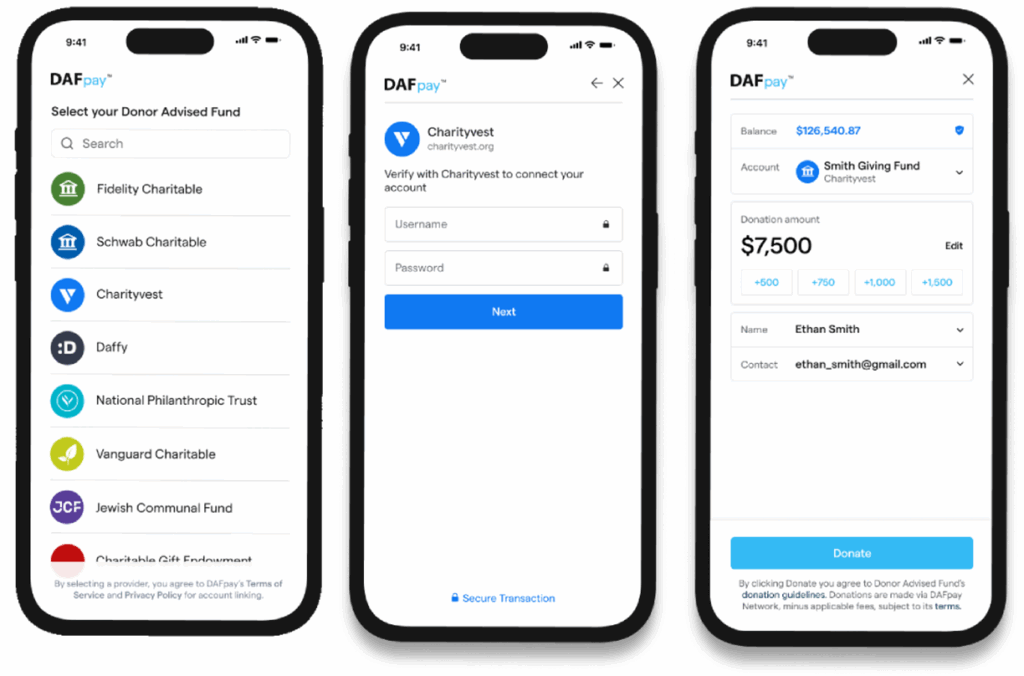
    3. Convert them: While DAF donors are sophisticated and informed, 88% will still give outside their DAF for spontaneous gifts. Many will abandon the process due to complication. If they have to leave the organization’s site, log in to a portal, find an EIN, etc., they will often default to a smaller credit card gift or lose the “giving moment” entirely. Address the friction by ensuring the “Give via DAF” option is as prominent and easy as a credit card transaction.
    4. Track them: The current distribution and reconciliation process for DAF gifts is a mess. From “mystery checks” to EFTs with no or limited individual donor data we risk a myriad of negative process outcomes from inadvertent duplicate records, hard/soft credit mismatch, to a worst-case scenario of not being able to thank a donor at all. We need to be finding and implementing systems that capture ALL the critical information at moment of gift so we can quickly acknowledge, reconcile, and develop the relationship with these donors.
    5. Grow them: Once you know who your DAF donors are and they are utilizing this strategic method to give, make sure your donor relations and renewal communications are tailored to reflect this. You could create special recognition groups or levels, craft donor impact stories centering on DAF support, participate in special events such as National DAF Day, or build custom challenges and matches into your existing giving days or crowdfunding models.

    What can you do today? Encoura + RNL ScaleFunder & DAFpay

    While building and executing a comprehensive and robust DAF strategy will take time and collaboration, addressing the key problem of friction for donors can happen now. Encoura+RNL is proud to offer Chariot DAFPay integration as a part of our ScaleFunder digital giving platform.

    DAFpay by Chariot

    Conclusion: Use DAFs to make it even easier for donors to give

    The shift in the donor landscape isn’t a future possibility; it’s an active reality. By bridging the gap between donor intent and a seamless digital experience, your institution isn’t just modernizing a transaction, you are securing your place as a top philanthropic priority for the next generation.

    Watch our webinar, Starting at the Source: A Look into Data-Driven Paths to Donor Growth, where we dive into more detail on insights about how DAF donors are changing the landscape to learn more.

    Talk with our fundraising experts

    Let’s talk about how you can increase donor engagement and strengthen your donor pipeline. Ask for a free consultation with our experts.

    Schedule consultation

    Source link

  • Free speech in Trump 2.0

    Free speech in Trump 2.0

    One year into Trump 2.0, we examine the
    administration’s record on free speech and how it compares to the
    president’s campaign pledge to “bring back free speech to
    America.”

    We also discuss recent ICE protests, including the
    right to carry a gun and to film law enforcement, and what these
    encounters reveal about protest rights today.

    Today we are joined by:

    • Clark Neily, senior vice president
      for legal studies at the Cato Institute

    • Timothy Zick, professor of
      government and citizenship at William & Mary Law School and author
      of the new book
      Trump 2.0: Executive Power and the First Amendment

    • Conor Fitzpatrick, supervising
      senior attorney at FIRE

    Zick is also the author of
    Public Protest and Governmental Immunities
    ,
    Managed Dissent: The Law of Public Protest
    , and

    Arming Public Protests
    .

    Timestamps:

    00:00 Intro

    01:47 ICE protests:
    Alex Pretti
    , filming police, and the right to carry a
    gun

    13:30 How to hold law enforcement accountable

    19:10
    Don Lemon
    ‘s arrest

    23:27 Trump’s retribution politics and the “domestic
    terrorist” label

    35:05 FCC pressure and attacks on the media

    39:40 Free speech for noncitizens

    53:49 Attacks on higher education

    58:40 Trump 1.0 vs. Trump 2.0

    01:02:25 What reforms are needed?

    1:09:13 Outro


    Read the transcript here.

    Enjoy listening to the podcast? Donate to FIRE today
    and get exclusive content like member webinars, special episodes,
    and more.

    If you became a FIRE Member
    through a donation to FIRE at thefire.org and would like access to
    Substack’s
    paid subscriber podcast feed, please email [email protected].

    Source link

  • Free speech in Trump 2.0

    Free speech in Trump 2.0

    One year into Trump 2.0, we examine the
    administration’s record on free speech and how it compares to the
    president’s campaign pledge to “bring back free speech to
    America.”

    We also discuss recent ICE protests, including the
    right to carry a gun and to film law enforcement, and what these
    encounters reveal about protest rights today.

    Today we are joined by:

    • Clark Neily, senior vice president
      for legal studies at the Cato Institute

    • Timothy Zick, professor of
      government and citizenship at William & Mary Law School and author
      of the new book
      Trump 2.0: Executive Power and the First Amendment

    • Conor Fitzpatrick, supervising
      senior attorney at FIRE

    Zick is also the author of
    Public Protest and Governmental Immunities
    ,
    Managed Dissent: The Law of Public Protest
    , and

    Arming Public Protests
    .

    Timestamps:

    00:00 Intro

    01:47 ICE protests:
    Alex Pretti
    , filming police, and the right to carry a
    gun

    13:30 How to hold law enforcement accountable

    19:10
    Don Lemon
    ‘s arrest

    23:27 Trump’s retribution politics and the “domestic
    terrorist” label

    35:05 FCC pressure and attacks on the media

    39:40 Free speech for noncitizens

    53:49 Attacks on higher education

    58:40 Trump 1.0 vs. Trump 2.0

    01:02:25 What reforms are needed?

    1:09:13 Outro

    Enjoy listening to the podcast? Donate to FIRE today
    and get exclusive content like member webinars, special episodes,
    and more.

    If you became a FIRE Member
    through a donation to FIRE at thefire.org and would like access to
    Substack’s
    paid subscriber podcast feed, please email [email protected].

    Source link