Blog

  • The political weaponry of disinformaton

    The political weaponry of disinformaton

    Begoña Gómez, the wife of Spanish Prime Minister Pedro Sánchez, was born a man by the name of Begoño. Some 500 kilos of gold were once found in her house on the Canary Islands. She is now being blackmailed with material stolen from her mobile phone while she was on a trip to Morocco. Oh, and she headed a drug-trafficking cartel.

    If you believe even some of these stories as a Spaniard, you’d think your country had gone insane. You’d think you were being ruled by a class of deceiving drug traffickers. Lies, or rather disinformation, are nothing new in Spain, but in recent years they have been forming increasingly coherent narratives of an alternative reality.

    They are often a fantasy that sometimes does brush up against reality: last June, several higher-ranking members of the governing party Partido Socialista Obrero Español (PSOE), or Spanish Socialist Workers’ Party, were forced to step down due to a corruption case. Private messages emerged in which they talked about large sums of money and escort services.

    The case was particularly painful for Prime Minister Pedro Sánchez, who came into power fighting corruption.

    In 2018, as leader of the opposition, he called a vote of no confidence involving then Prime Minister Mariano Rajoy. That government fell, and since then Sánchez has led consecutive governments, on a promise to finally eradicate the systemic corruption that plagues Spain.

    “This [latest corruption case] is confirming the narrative that all politicians lie, all politicians steal, all politicians are there for their personal gain,” said Alba Tobella, director of Catalan fact-checking platform Verificat. “Every case of corruption serves to further reinforce this idea.”

    A flood of falsehoods

    Through their website and social media, Verificat checks the accuracy of news spread over the internet. They noticed that from the moment Sánchez came into power, institutions on the right have tried hard to discredit him.

    “Anything that can be used to delegitimize Pedro Sánchez will be used against him,” Tobella said. “Any failure in Spain is directly linked to Pedro Sánchez.”

    These disinformation campaigns were particularly evident during the 2017 referendum for independence of Catalonia, when falsehoods from both sides were widespread. That period was one of the reasons Verificat was founded.

    Another surge of false information swept through the country in 2024, following the flooding disaster in the Valencia area in which at least 229 people died. At the time, misinformation spread among the local population quickly, because people felt the government had failed to protect them.

    What is new though, Tobella said, is that hoaxes are becoming increasingly complex and nuanced. She notes a normalization of these alternative realities, which some people are completely immersed in.

    “It’s like a complete disconnection of the audience from the truth, as well as a lack of interest in seeking the facts,” she said.

    The spreaders of fabricated “facts”

    Much of the disinformation reaches people through social media and WhatsApp messages, as is shown on the websites of fact checkers like Verificat. Some websites and media outlets also contain this kind of fake news, and it is sometimes spread by politicians such as Santiago Abascal, leader of radical-right party Vox.

    Now, following the latest corruption cases involving the PSOE, misinformation has again found fertile ground. Even though Sánchez has acted and those involved in the corruption have stepped down, a general feeling of being unprotected persists among the Spanish population. In a Eurobarometer survey this summer, a whopping 90% of Spaniards said they considered corruption to be “widespread” — one of the worst scores in the EU.

    Sebastiaan Faber, a professor of Hispanic Studies at Oberlin College in the United States, sees parallels with what is happening in the United States and elsewhere in the world.

    “What is going on is a very conscious undermining of trust,” Faber said. “Creating doubt about science, about the judicial system, public health institutions. The goal is to push people away from traditional institutions so that maintaining them will be seen as less important.”

    Faber, who wrote several books about Spain, the Spanish Civil War and the long dictatorship under Francisco Franco that ended in 1975, notes clear links between the way misinformation is used as a political tool in Spain and the United States.

    “They, for instance, try to keep sending the message that any left-leaning government is illegitimate,” Faber said. “That goes back to ’36. The Franco regime was based on the idea that the elected government had forged the election results and that they were financed by Russia, with anti-Spanish ideas. It’s always a repetition of portraying the left as immoral.”

    Actual corruption and phony accusations

    Faber sees a clear connection between these Francoist tactics and Trumpism. Figures surrounding Trump during his rise, such as his former political advisor Steve Bannon, represent a group of people that actively try to deconstruct democracy.

    Bannon once famously stated: “Flood the zone with shit.” He was referring to the creation of a deluge of half-truths and lies so consistent that people lose track of reality. Social media are an effective way to do so.

    These tactics of disinformation campaigns crossed the ocean twice, Faber said. It could be seen under Franco, who constantly spread lies about the legitimate Segunda Republica government of Spain.

    That made its way up to the United States. There, similar lies and disinformation campaigns culminated in Trump loyalists storming the Capitol in an attempt to stop Congress from certifying Joe Biden’s 2020 presidential election victory. These same tactics, a deluge of disinformation, are now being copied again in Europe to delegitimize people in power, such as Pedro Sánchez.

    Faber doubts that the public is ready to believe all the disinformation about Sànchez even with the proven case of corruption in the Prime Minister’s own political party. “I would say that the receptiveness for fake news is very much defined by your political preferences and the information bubbles [you] are in,” he said.

    Alienating voters

    The corruption case might leave those on the right feeling further alienated from the left-wing government however, and they might start to believe additional falsehoods about the government and Sánchez.

    And on the left, a general sense of hopelessness has now taken hold, as becomes clear when speaking with Spaniards about the case since the story of the corruption case broke.

    Tobella said that what’s important here, is that people understand that it’s never only ‘the other side’ that behaves badly. For example, from a Catalonian perspective, where sentiments can at times be very anti-Spanish, there’s a long-standing myth that Catalonian politicians are less corrupt than those politicians in the national government in Madrid.

    At the time of the interview with Tobella, the corruption case involving Catalonian leader Jordi Pujol had just begun. Pujol was in power for 24 years, and now faces charges of money laundering and criminal association.

    “These accusations are extremely serious,” Tobella said. “If it is said that there is no corruption in Catalonia, I think that that is maybe the oldest myth going around. It is clear that there are also very serious cases here.”

    So what can be done to counter the weakening of democracy through disinformation, especially when an alternative narrative does intersect with reality, as happens with these corruption cases? Debunk the lies, sift through hoaxes and show where claims rely on questionable evidence. In short, flood the zone with truth.

    “Well, what we already do, right?” Tobella said.


    Questions to consider:

    1. What is new about the latest round of disinformation in Spain?

    2. Why might disinformation campaigns have limited power when it comes to changing the minds of political supporters?

    3. Do you generally trust the politicians representing you in government? What affects how you feel about them?

    Source link

  • What K-20 leaders should know about building resilient campuses

    What K-20 leaders should know about building resilient campuses

    Key Points:

    When a school building fails, everything it supports comes to a halt. Learning stops. Families scramble. Community stability is shaken. And while fire drills and lockdown procedures prepare students and staff for specific emergencies, the buildings themselves often fall short in facing the unexpected.

    Between extreme weather events, aging infrastructure, and rising operational demands, facility leaders face mounting pressure to think beyond routine upkeep. Resilience should guide every decision to help schools stay safe, meet compliance demands, and remain prepared for whatever lies ahead.

    According to a recent infrastructure report card from the American Society of Civil Engineers, the nation’s 98,000 PK-12 schools received a D+ for physical condition–a clear signal that more proactive design and maintenance strategies are urgently needed.

    Designing for resilience means planning for continuity. It’s about integrating smarter materials, better systems, and proactive partnerships so that learning environments can bounce back quickly–or never go down at all.

    Start with smarter material choices

    The durability of a school begins at ground level. Building materials that resist moisture, mold, impact, and corrosion play a critical role in long-term school resilience and functionality. For example, in flood-prone regions, concrete blocks and fiber-reinforced panels outperform drywall in both durability and recovery time. Surfaces that are easy to clean, dry quickly, and don’t retain contaminants can make the difference between reopening in days versus weeks.

    Limit downtime by planning ahead

    Downtime is costly, but it’s not always unavoidable. What is avoidable is the scramble that follows when there’s no plan in place. Developing a disaster-response protocol that includes vendors, contact trees, and restoration procedures can significantly reduce response time. Schools that partner with recovery experts before an event occurs often find themselves first in line when restoration resources are stretched thin.

    FEMA’s National Resilience Guidance stresses the need to integrate preparedness and long-term recovery planning at the facility level, particularly for schools that often serve as vital community hubs during emergencies.

    Maintenance as the first line of defense

    Preventative maintenance might not generate headlines, but it can prevent them. Regular inspections of roofing, HVAC, plumbing, and electrical systems help uncover vulnerabilities before they lead to shutdowns. Smart maintenance schedules can extend the lifespan of critical systems and reduce the risk of emergency failures, which are almost always more expensive.

    Build flexibility into the design

    Truly resilient spaces are defined by their ability to adapt, not just their physical strength. Multi-use rooms that can shift from classroom to shelter, or gymnasiums that double as community command centers, offer critical flexibility during emergencies. Facilities should also consider redundancies in HVAC and power systems to ensure critical areas like server rooms or nurse stations remain functional during outages.

    Include restoration experts early

    Design and construction teams are essential, but so are the people who will step in after a disaster. Involving restoration professionals during the planning or renovation phase helps ensure the layout and materials selected won’t hinder recovery later. Features like water-resistant flooring, interior drainage, and strategically placed shut-off valves can dramatically cut cleanup and repair times.

    Think beyond the building

    Resilient schools need more than solid walls. They need protected data, reliable communication systems, and clear procedures for remote learning if the physical space becomes temporarily inaccessible. Facility decisions should consider how technology, security, and backup systems intersect with the physical environment to maintain educational continuity.

    Schools are more than schools during a crisis

    In many communities, schools become the default support hub during a crisis. They house evacuees, store supplies, and provide a place for neighbors to connect. Resilient infrastructure supports student safety while also reinforcing a school’s role as a vital part of the community. Designs should support this extended role, with access-controlled entries, backup power, and health and sanitation considerations built in from the start.

    A resilient mindset starts with leadership

    Resilience begins with leadership and is reflected in the decisions that shape a school’s physical and operational readiness. Facility managers, superintendents, and administrative teams must advocate for resilient investments early in the planning process. This includes aligning capital improvement budgets, bond proposals, and RFP language with long-term resilience goals.

    There’s no such thing as a truly disaster-proof building. But there are schools that recover faster, withstand more, and serve their communities more effectively during crises. The difference is often found in early choices: what’s designed, built, and maintained before disaster strikes.

    When resilience guides every decision, school facilities are better prepared to safeguard students and maintain continuity through disruption.

    Latest posts by eSchool Media Contributors (see all)

    Source link

  • The Educated Underclass Without Borders

    The Educated Underclass Without Borders

    Gary Roth’s The Educated Underclass describes a growing population of college-educated people who, despite credentials and effort, are increasingly locked out of stable, dignified work. While Roth’s analysis focuses primarily on the United States, the framework extends naturally—and urgently—to international students educated in the U.S. and to the global labor markets they enter after graduation. When immigration regimes, artificial intelligence, and comparative higher education systems are considered together, the educated underclass emerges not as a national failure, but as a transnational condition produced by modern higher education itself.

    U.S. colleges and universities aggressively recruit international students, presenting the American degree as a global passport to opportunity. These students pay higher tuition, subsidize institutional budgets, and enhance global prestige. What is far less visible is that access to the U.S. labor market after graduation is narrow, temporary, and increasingly unstable. Programs such as Optional Practical Training and the H-1B visa tie legal status to continuous employment, transforming graduates into a compliant workforce with little leverage. Job loss does not merely mean unemployment; it can mean removal from the country.

    Indian students in STEM fields illustrate this dynamic clearly. Drawn by promises of innovation and demand, they enter graduate programs in computer science, engineering, and data analytics, only to find themselves funneled into a lottery-based visa system dominated by outsourcing firms and consulting intermediaries. Visa dependency suppresses wages, discourages job mobility, and creates a workforce that is educated but structurally insecure. Roth’s educated underclass is visible here, but intensified by deportability.

    Artificial intelligence compounds this precarity. Entry-level technical and analytical roles—software testing, junior programming, data cleaning, research assistance—are increasingly automated or augmented. These were precisely the jobs that once absorbed international graduates. AI-driven labor contraction now collides with rigid visa timelines, turning technological displacement into enforced exit. Immigration policy quietly performs the work of labor market triage.

    Chinese students in business, economics, and the social sciences encounter a different version of the same trap. U.S. employers are often reluctant to sponsor visas outside STEM, while Chinese labor markets are saturated with domestically educated elites. Meanwhile, geopolitical tensions—intensified during the Trump administration—have normalized suspicion toward Chinese students and scholars, particularly in research-adjacent fields. The American degree, once a clear marker of distinction, increasingly yields managerial precarity, contract work, or prolonged dependence on family support.

    China’s own higher education system complicates this picture. Massive state investment has expanded elite universities and research capacity, producing millions of highly credentialed graduates each year. Yet employment growth has not kept pace. Underemployment among Chinese graduates has become routine, and returnees from U.S. programs often find that their foreign credentials no longer guarantee elite status. In both systems, education expands faster than secure work, producing surplus aspiration and managed disappointment.

    Canada is often presented as a counterexample to U.S. hostility toward international students, but its outcomes reveal similar structural dynamics. Canadian universities rely heavily on international tuition, while immigration pathways—though more predictable—still channel graduates into precarious labor markets. Many international students end up in low-wage service or contract work unrelated to their degrees while awaiting permanent residency. At the same time, domestic Canadian graduates face rising competition for limited professional roles, particularly in urban centers. The result is not inclusion, but stratified precarity distributed across citizenship lines.

    These global dynamics have domestic consequences that are rarely acknowledged honestly. International students and foreign graduates are increasingly perceived as occupying educational and professional positions that might otherwise go to people whose families have lived in the United States for generations. In elite universities, graduate programs, and competitive labor pipelines, institutions often prefer international applicants who pay full tuition, arrive pre-trained by global inequality, and are more willing to accept insecure work.

    For historically rooted communities—Black Americans, Indigenous peoples, and long-established working-class families—the resentment is especially acute. After centuries of exclusion from education and professional employment, they are told that opportunity is scarce and must now be globally competitive. The contradiction is profound: a nation that never fully delivered educational justice at home markets opportunity abroad while declaring it unattainable domestically.

    Trump-era immigration policies exploited this tension by framing foreign students and workers as threats rather than as participants in a system designed by elites. Travel bans, visa restrictions, attacks on OPT, and open hostility toward immigrants transformed structural failure into cultural conflict. Yet the animosity did not originate with Trump. It reflects decades of policy choices that expanded higher education without expanding secure employment, substituted global labor arbitrage for domestic investment, and left working- and middle-class Americans to absorb the losses.

    Universities play a central role in sustaining this arrangement. They function as global sorting machines, extracting tuition from abroad, conferring credentials with declining labor-market value, and disclaiming responsibility for outcomes shaped by immigration law and AI-driven contraction. Career services rarely confront these realities directly. Transparency would threaten enrollment pipelines, so silence prevails.

    In Roth’s terms, this enlarges the educated underclass while fracturing it internally. Domestic and foreign graduates are pitted against one another for shrinking footholds, even as both experience debt, insecurity, and diminishing returns on education. The conflict is horizontal, while power remains vertical.

    The educated underclass is no longer emerging. It is already global, credentialed, indebted, and increasingly unnecessary to the systems that trained it. Until institutions, employers, and governments in the U.S., Canada, China, and beyond are held accountable for the scarcity they engineer, higher education will continue to function not as a ladder to mobility, but as a mechanism for managing inequality across borders.


    Sources

    Gary Roth, The Educated Underclass

    Harriet A. Washington, Medical Apartheid

    Elisabeth Rosenthal, An American Sickness

    OECD, Education at a Glance

    U.S. Citizenship and Immigration Services, OPT and H-1B program materials

    National Foundation for American Policy, reports on H-1B labor markets

    Georgetown University Center on Education and the Workforce, credential inflation studies

    International Labour Organization, global youth and graduate employment reports

    China Ministry of Education, graduate employment statistics

    Statistics Canada, international students and labor market outcomes

    David Graeber, Bullshit Jobs

    Richard Wolff, writings on global labor surplus and credentialism

    Source link

  • New Year’s Resolutions for Higher Ed

    New Year’s Resolutions for Higher Ed

    As we enter the new year, I want to share some thoughts about what higher education needs to accomplish as a sector in 2026. I view these as resolutions: tough challenges we need to tackle with courage and determination. Are you ready?

    Fix Accreditation

    I have participated in accreditation as a college president, a law school faculty member and as a board member of the NWCCU, the Northwest’s regional accreditor, and so I say this from experience: Our accreditation system is horrible. It wastes massive amounts of time and accomplishes almost nothing to guarantee students a good education. We need to scrap it and start over. Instead of multiyear cycles, we should review schools every five years, in a process that takes no more than six months. It should focus on just three things: student outcomes, responsible financial management and academic freedom. Schools that do not meet strong, clear, objective standards in these areas should be placed on probation and, ultimately, decertified if they fail to improve. We have to stop rubber-stamping failure.

    Discuss Creating a True National Higher Ed System

    If I use the phrase “American higher education system” with colleagues from Europe and Asia, they laugh. “System? You don’t have a system! You have a giant collection of unregulated institutions that perform very inconsistently, many of them for-profit scams.”

    There is so much truth in this reaction. The venerable Higher Education Act of 1965 no long meets our national needs. We need to start a rational discussion about reform of the higher education regulatory landscape. We need a smaller number of higher-performing universities, we need to eliminate institutions with poor outcomes that provide limited or no real return on investment, we need to provide truly affordable undergraduate programs in every state, we need to cut regulations and legal rules that drive up the cost of compliance, and we need to limit student debt. This is not the year for reform—Congress is a divided mess. But we need to start discussing the future.

    Focus on Community Colleges

    The foundation of American higher education is the part of the sector we talk about least: our community colleges. Community college is the best place to provide four vital services our students and our country desperately need: remedial education to make up for poor K–12 schools, valuable job training in skills and trades to help students prepare for the workplace, ESL classes to help nonnative English speakers thrive, and low-cost general education to help students determine whether they want to proceed to a four year degree.

    Community college quality is inconsistent across the United States: excellent in some states, poor in others. As a result, there is no one-size-fits-all set of reforms we need to enact. Every state government needs to have a serious, honest conversation led by the governor on how to strengthen and improve this vital sector.

    Start Low-Cost, High-Quality Undergraduate Experiments

    College costs too much. Instead of pretending this is not true, we need to develop new low-cost, high-quality models. We cannot rely on new institutions to do this: The entry costs and accreditation barriers are too high.

    Here’s a place to start.

    The eight (relatively wealthy) Ivy League universities should jointly create Ivy College, a low-cost undergraduate lab school in a place they currently don’t serve, like Los Angeles. They should cut everything ancillary to great undergraduate education that drives up costs. That means no research, no sports and recreation, no subsidized activities, no alumni association, no communications department, no health and counseling, no permanent campus (just rented office space). They should reduce the number of majors and the number of electives. Simplify admission, with a lottery for every student scoring 1100 or above on the SAT. Get federal regulatory waivers for compliance cost drivers.

    If we tried this for four years, we would learn so much! Then, the Big Ten schools should follow suit.

    Advertise on Television

    A recent Pew poll found that 70 percent of Americans think higher education is headed in the wrong direction. How do we improve public trust in higher education? Reform will help, yes, but we also need a more effective approach to public relations. When other industries run into trouble, they don’t rely on heartfelt op-eds and books published by university presses to make their case. They launch proactive television and a social media ad campaigns.

    ACE should enlist the top 100 universities to bankroll ads that explain the ROI of higher education and the value of university research to national security, health and the economy. Trusted figures should explain why college matters. Celebrities should explain why they benefited from college. And we should remind people that American research universities helped win the Second World War.

    John Kroger served as president of Reed College, attorney general of Oregon, chief learning officer of the U.S. Navy and a visiting faculty member at Harvard and Yale Universities and Lewis and Clark College.

    Source link

  • College Food Pantry Helps Students Combat Food Insecurity

    College Food Pantry Helps Students Combat Food Insecurity

    With rising food costs and uncertain federal food-assistance benefits wreaking havoc on families nationwide, Alicia Wright has found relief in an unlikely place: her community college’s food pantry.

    Wright, a student at Roxbury Community College, said her campus food pantry has been lifesaving, especially as she juggles classes while raising her 6-year-old daughter, Olivia.

    “I was like, ‘Oh snap—I don’t have to trek around Boston to find food from other local pantries,’” said Wright, a theater major who is scheduled to graduate in 2027. “Having it right there really changed the game for me.”

    Wright is one of more than 1,500 students who have relied on the pantry, better known as the Rox Box, since its launch in October 2023, according to Nancy Santos, RCC’s Project Access director.

    Roxbury Community College students shop for food and personal care essentials at the Rox Box.

    Roxbury Community College

    Designed to mirror a neighborhood grocery store, the pantry carries items such as food, diapers and personal care essentials and is funded entirely by the community.

    “If I find myself going to class thinking about how I didn’t go grocery shopping this weekend, I know I can pick up something from the Rox Box,” Wright said, adding that students receive 30 points each month to redeem for items they need.

    “That lets me be more present in class … [and] really does allow peace of mind,” Wright said.

    Like Wright, nearly 60 percent of college students nationwide have experienced at least one form of basic needs insecurity in the past year, according to a recent Hope Center survey.

    According to Swipe Out Hunger, a nonprofit dedicated to ending college student hunger, student visits to campus food pantries have increased by 30 to 50 percent over the past year across its more than 900 campus partners nationwide.

    Origin story: The Rox Box started as an extension of Project Access, an initiative designed to address the nonacademic issues that can prevent degree completion at the Boston-area college.

    Santos said the Rox Box has met a strong need, serving more than 300 students each month.

    “It’s really taken off,” Santos said. “We see the athletes and everyone walking around with their little bags that say ‘Rox Box,’ and they’re proud that they’re going.”

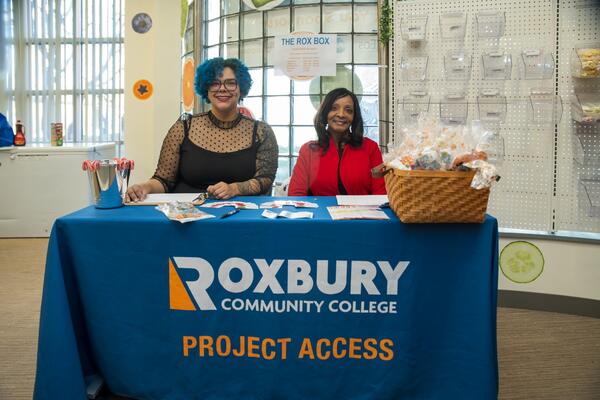
    Two women, one with blue hair wearing a black dress with a sheer overlay, and one with shoulder-length dark hair wearing a red top, sit behind a table with a blue tablecloth that says "Roxbury Community College Project Access."

    Roxbury Community College Project Access director Nancy Santos (right) sitting with a student worker at the Rox Box.

    Roxbury Community College

    She noted that demand continues to rise, with more than 1,700 visits from over 1,500 students between September and December 2025.

    “We know the need is out there, because 1,700 visits on our campus is a large number when we only have 2,400 students enrolled,” Santos said, noting that RCC’s student body is predominantly Black, Latino and Pell Grant eligible.

    Santos said she regularly surveys students who rely on the Rox Box and has found that nearly 40 percent worry their food won’t stretch until the next time they can afford to buy more, while nearly 30 percent have changed their eating habits to make the provisions last longer.

    She underscored how the federal government shutdown last fall contributed to growing “uneasiness” and “insecurity” around RCC students’ food needs.

    This comes as nearly 40 percent of public college students in Massachusetts experienced food insecurity last year.

    “The numbers are alarming to us,” Santos said. “Our faculty have even shared that they can sometimes see students are distracted or they don’t come to school if they’re hungry … [and] it really does affect their grades.”

    To ensure the Rox Box runs smoothly, Santos said, they hired a coordinator who is an RCC alum and had previously relied on the pantry.

    “She started as a work-study, so she worked in the pantry with us, and when she graduated we hired her back,” Santos said. “In doing so, the students identify with her and they see there’s a path. They see where they are isn’t where they’ll always be.”

    Santos said the pantry helps students feel supported and actively works to reduce the shame around needing help.

    “I often say that the shame is not that you are food insecure, the shame is that [food insecurity] exists,” Santos said. “Don’t pretend it isn’t happening. Address it and embrace it and let’s figure out a way to wipe it out.”

    What’s next: Santos said starting a campus food pantry is a “big undertaking” but worthwhile for other institutions looking to create their own.

    “We are a small college, but we care for our students,” Santos said. “When students are fed and when they’re able to concentrate and really study, it helps them go across the finish line.”

    Wright agreed, adding that actively listening to students’ needs and implementing those changes really fosters a sense of trust and community.

    “We tell them our views and what we need and everything, and then we see things being done about it,” Wright said. “It really allows us to feel seen, heard and supported.”

    Ultimately, Wright said, RCC really gets it right about seeing students “holistically.”

    “We’re not just students—we’re entrepreneurs, we’re parents, we’re our parents’ caregivers,” Wright said. “A lot of us are already full-grown people who have lived life and know how to survive, [but] we just need a bit more support that shows [the college is] here for your success.”

    Want to help students battling food insecurity? You can support The Rox Box here.

    Get more content like this directly to your inbox. Subscribe here.

    Source link

  • SAT Requirements Should Be Aligned With Mission (opinion)

    SAT Requirements Should Be Aligned With Mission (opinion)

    The autonomy of states in setting their own higher education policies creates a series of natural experiments across the United States, offering insights into what approaches work best in particular contexts. Given the importance of local considerations, there are few universal policy prescriptions that can be recommended with confidence. Sadly, this complexity was overlooked in Saul Geiser’s recent Inside Higher Ed essay entitled “Why the SAT Is a Poor Fit for Public Universities.”

    My position is not that all, or even any, public universities should require standardized test scores. In fact, I share Geiser’s view that a university’s “mission shapes admission policy.” However, it is because of this principle that I contend that the SAT cannot be dismissed as a poor fit for public universities without considering how institutions operationalize their missions and define their institutional priorities.

    Vertical Stratification Within a Public University System

    In my view, Geiser’s argument is fundamentally flawed in his comparison of elite private institutions to public university systems, which often include an elite flagship campus alongside a broader range of institutions. Geiser’s comparison is particularly surprising given his long-standing association with the University of California system.

    The California Master Plan for Higher Education has long been studied and celebrated for establishing a public postsecondary education system consisting of institutions with differentiated missions and admission processes. Under its original design, the community colleges provided open access to all high school graduates and adult learners, offering a stepping-stone to the four-year institutions. The California State University institutions admitted the top third of high school graduates, focusing on undergraduate education and teacher preparation. The University of California institutions were reserved for the top eighth of high school graduates and emphasized research and doctoral education.

    By using high school class rank to sort students into the different tiers of the system, the Master Plan established a baseline for admissions to both UC and CSU institutions. This framework enabled the emergence of two elite public flagship campuses in Berkeley and Los Angeles that prioritized academic excellence alongside accessible undergraduate institutions in the CSU system that served as drivers of economic development and social mobility.

    Reorienting the analysis to a comparison between elite public and private institutions would have provided a stronger basis for discussing selective admissions, as both of these institutional types receive far more applications than available spaces in their first-year cohorts. In these circumstances, institutions must make choices about how to differentiate among a pool of qualified applicants.

    It is common to start with assessing an applicant’s academic achievement. In a competitive pool, this assessment is less about whether the applicant meets minimum academic standards of the university and more about how the applicant has achieved above and beyond other applicants to the same program or institution. In a competitive admission pool, academic excellence is often an important distinction, but it can be defined in different ways.

    Assessing Academic Excellence

    Many researchers agree that the use of both high school GPA and standardized test scores yields the most accurate assessment of academic potential, rather than relying on either measure alone. Geiser’s own research from 2002 shows that combining both high school GPA and test scores better predicted UC students’ first-year grades than just high school GPA alone. Therefore, I was surprised that he presented the use of GPAs and test scores in admission policies as mutually exclusive alternatives.

    Although somewhat dated, a compelling finding from his 2002 analysis was that the combination of SAT Subject Test scores (discontinued in 2021) and high school GPA accounted for a greater proportion of variance in UC students’ first-year GPA than the combination of GPA and SAT scores. This finding suggests that precollege, discipline-specific achievement is important.

    This should come as no surprise, as college curricula for artists, anthropologists and aeronautical engineers differ substantially. It is reasonable to expect that the predictors of success in these programs would also differ. As such, academic programs within universities may be well served by setting admission standards calibrated to the specific competencies of their respective disciplines—a portfolio for the artist, an academic paper for the anthropologist and a math exam for the engineer.

    Although Geiser maintains that “academic standards haven’t slipped” at the UCs since they went test-free four years ago, a recent Academic Senate report from the University of California, San Diego, revealed that about one in eight first-year students this fall did not meet high school math standards on placement exams despite having strong high school math grades—a nearly 30-fold increase since 2020—and about one in 12 did not even meet middle school standards. This mismatch between GPAs and scores on course placement exams underscores critics’ concerns about inflation of high school GPAs and undermines the reliability of GPAs as a sole marker of academic achievement. The authors of the report called for an investigation of grading standards across California high schools and recommended the UC system re-examine its standardized testing requirements.

    It is understandable that faculty in quantitative disciplines, such as engineering and finance, would want to better gauge the readiness of applicants for their programs by considering test scores, if only the results from the SAT or ACT math sections, in light of these findings. However, if one in 12 students are not meeting middle school math standards, then the greater concern is that these students, regardless of major, will require remediation, creating longer, more expensive and more difficult paths to graduation.

    Variation in Standardized Testing Requirements Across States

    I was surprised Geiser did not acknowledge this report, instead arguing that the reinstatement of standardized test requirements at Ivy League institutions “provided intellectual cover for the SAT’s possible revival” nationwide. This characterization overlooks the fact that some public institutions in at least 11 states—Alabama, Arkansas, Florida, Georgia, Indiana, Louisiana, Mississippi, Ohio, Tennessee, Texas and West Virginia —already require standardized test scores in admission, according to the College Board. Notably, Florida public universities never suspended their test requirements during the COVID pandemic when all of the Ivies did.

    In Georgia and Tennessee, public universities waived test requirements during the COVID pandemic but subsequently moved to reinstate the requirements for the University of Tennessee system and for at least seven of the 26 institutions in the University System of Georgia, including the Georgia Institute of Technology and the University of Georgia.

    Among public universities in Texas and Ohio, only the states’ flagships, the University of Texas at Austin and the Ohio State University, reinstated standardized test requirements for all students. While the flagship in Indiana remains test optional, the state’s premier land-grant institution requires test scores—Purdue University reinstated the requirement in 2024. And in Alabama, both the land-grant, Auburn University, and the flagship, the University of Alabama at Tuscaloosa, have announced plans to reinstate required test scores for all first-year applicants.

    In some states, public institutions, including Southern Arkansas University, Fairmont State University in West Virginia and Alcorn State University, a historically Black institution in Mississippi, waive test requirements for students with higher GPAs. In practice, this approach prioritizes performance in the classroom but offers low-performing high school students a second chance to demonstrate their proficiency and potential.

    These examples show how variations in admission practices across institutions enable public systems to pursue their missions and diverse sets of state goals that may not be possible for any single institution within their system. These systems can offer broad access to four-year programs while also upholding academic standards and pursuing academic excellence. Whether that means all, some or none of the institutions in a public system require the SAT or ACT depends on the goals and strategies of each of the states.

    While most public institutions adopted test-optional admissions during the pandemic, California implemented a test-blind policy that prohibited the consideration of test scores. Based on my experience as an admission officer, I applaud this decision. Test-optional admission is an easy policy decision, but I have seen how test-optional policies can create two different admission processes, where test scores are essentially required for some groups of students and not for others. Test-optional policies muddy the waters, offering less transparency in an already complicated process. The UC and CSU systems avoided this mistake by establishing equal grounds for evaluating applicants, but this does not mean that other public institutions need to do the same.

    Aligning Admissions With Mission

    Public universities are facing numerous enrollment pressures. Shifting state and regional demographics continue to force admission leaders to adjust their recruitment strategies and admission policies. The growing prominence of artificial intelligence appears apt to redefine the academic experience and admission processes, but exactly when and how are unknown. Meanwhile, the expected increase in states’ financial obligations in relation to Medicaid is likely to increase reliance on tuition revenue, which will ultimately shape the budgets and enrollments of higher education institutions.

    A uniform, one-size-fits-all approach to admissions policy, such as test-blind admissions for all public universities, does not respect the autonomy of states and institutions and does not serve the diversity of institutional contexts. Public universities should continue to tailor admissions policies to their specific needs, which may include variation across campuses within a public system or even among programs within the same institution. What matters most is that admission policies remain transparent, are applied consistently to all applicants within a program and closely align with the institution’s mission and public purpose.

    Ryan Creps is an assistant professor in the Graduate School of Education at the State University of New York at Buffalo and was previously an admission officer at Brown University. His research focuses on college admission practices and postsecondary enrollment trends.

    Source link

  • College Costs, Accreditation Likely Top Focus for Congress

    College Costs, Accreditation Likely Top Focus for Congress

    Lowering college costs, boosting accountability and reforming accreditation will likely be at the top of congressional Republicans’ to-do list for 2026. But as public approval ratings for President Trump continue to decline and midterm elections loom, higher education policy experts across the political spectrum say congressional conservatives could be running out of time.

    The push for more affordable higher education has been gaining momentum for years, and while it was a common refrain at the committee level in 2025, complex and sweeping debates over tax dollars soaked up much of lawmakers’ attention.

    First, the Republicans passed their signature piece of legislation, the One Big Beautiful Bill Act, which cut taxes for wealthy individuals, increased them for elite universities and overhauled the student loan system. Then, they turned their attention to disagreements on the federal budget—an impasse that led to the record 43-day government shutdown.

    But in the few cases where members of the GOP did get to home in on college cost issues, whether via legislation or hearings, an underlying theme emerged—holding colleges accountable for their students’ return on investment.

    Higher education experts have no doubt that concern will continue in 2026, but Congress won’t have the time or the oxygen needed to nail down real changes unless they figure out how to fund the government, which runs out of money again Jan. 31.

    “The Republican majority is very conscious that it may be on the clock, and this would argue for trying to move rapidly and get things done,” said Rick Hess, a senior fellow and director of education policy studies at the American Enterprise Institute, a right-leaning think tank. “But with the narrow and fractious House majority, the way the budget is going to chew up time going into January and the pressure on the Senate to get judges confirmed, it’s just going to be a challenge for them to find much time to move further higher ed–related legislation.”

    Legislative Actions

    Republicans spent much of 2025 using their control of Congress and the White House to pass what many industry leaders have described as the largest overhaul to higher education policy in more than a decade—the One Big Beautiful Bill Act. And while policy experts were initially skeptical that this multi-issue package could pass given the complex, restrictive nature of a legislative process called reconciliation, the GOP found a way.

    The final bill, signed into law July 4, served as a major win for the GOP, expanding federal aid for low-income students to include nontraditional short-term training programs, limiting loans for graduate students, consolidating the number of repayment plans and increasing taxes on wealthy colleges, among other provisions.

    Conservative policy experts like Hess praised the overhaul as “a much-needed and positive set of changes.”

    “There’s certainly more that can be done, but I think it moved us in a substantially better direction than we’ve been,” he added.

    But aside from OBBBA, little legislation concerning colleges and universities advanced. Only one bill tracked by Inside Higher Ed, the Laken Riley Act, reached the president’s desk. That law gave state attorneys general increased power over visas that could affect some international students and scholars. Others, including the Protection of Women and Girls in Sports Act, a bill that forbids trans women from participating in women’s sports, and the DETERRENT Act, a bill designed to restrict foreign academic partnerships, made it out of the House in a matter of weeks but then got stuck in the Senate.

    The story of 2025 in higher ed is a big, dramatic one, but it’s almost entirely one of executive branch activity.”

    —Rick Hess, AEI

    So when asked what congressional accomplishments stood out from 2025, progressive policy experts told Inside Higher Ed they didn’t see much. The things that did happen, they added, hurt students and institutions more than they helped.

    “‘Accomplishments’ is not really the word I would use considering the challenges that higher education faced this year,” said Jared Bass, senior vice president of education at the Center for American Progress. “I don’t think that Congress actually met the moment for affordability or defending and preserving higher education.”

    Instead, he said, legislators placed the burden of cost on the backs of students.

    “The Republican argument is by cutting access to these loans they’ll actually drive down costs. But we’ll have to wait and see if that happens,” he explained. “But I would say it didn’t actually make college more affordable. It just made resources less available.”

    Hearings Highlight Priorities

    Congress did, however, hold a number of higher ed–related hearings to dive into their priorities, which included improving the transparency of financial aid offers, establishing stronger records of the skills students gain and elevating ideological concerns like allegedly illegal use of diversity, equity and inclusion practices and liberal biases in the Truman Scholarship program.

    Although the House Committee on Education and Workforce hosted a greater number of higher ed hearings, some of the more notable panels came from the Senate Health, Education, Labor and Pensions Committee.

    “They actually wanted to put the ‘E’ back in HELP and focus on education issues,” said Emmanual Guillory, senior director of government relations at the American Council on Education, a leading higher ed lobbying group. “That wasn’t really the case under prior leadership. So that was good.”

    Chairman Bill Cassidy, a Republican from Louisiana, right, and ranking member Sen. Bernie Sanders, Independent of Vermont, lead the Senate Health, Education, Labor and Pensions Committee.

    Tom Williams/CQ–Roll Call Inc./Getty Images

    Much of the shift in interest, Guillory added, was likely tied to new leadership. This was the first year that Sen. Bill Cassidy, a Louisiana Republican, held the gavel. In the last Congress, Cassidy had served as ranking member.

    The House Committee on Education and Workforce also had new leadership, as Rep. Virginia Foxx of North Carolina handed the baton to Rep. Tim Walberg from Michigan. But it was the Senate’s tactics that led to more meaningful legislative progress in ACE’s view.

    “Mr. Walberg may have pushed a slightly more aggressive agenda. The House definitely had more hearings in the higher ed space and tackled more hard-punching issues, but in the Senate they took a different approach,” Guillory said. “When it came to those difficult issues and conversations, the Senate chose to discuss those a bit more quietly and really work on solutions with stakeholder groups and ask, ‘How can we be influential with actual legislation?’”

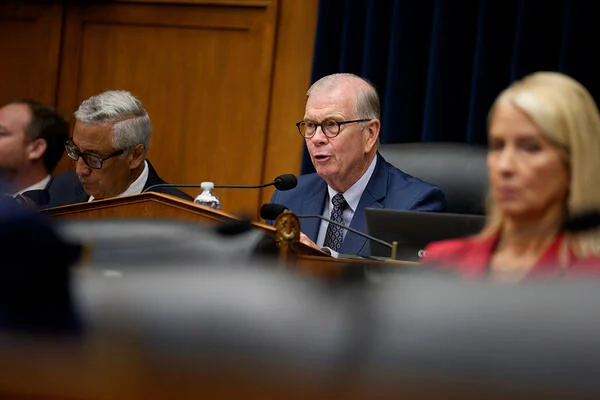
    Tim Walberg is in focus at the center of the frame, sitting next to Rep. Bobby Scott of Virginia, the ranking member. Walberg is a white man with thinning gray hair and glasses, and Scott is an older Black man with white hair and square-framed glasses.

    Chairman Tim Walberg took over the House Education and Workforce Committee in 2025.

    Andrew Harnik/Getty Images

    When asked for their reflections on the year, Cassidy and Walberg pointed to OBBBA, which they touted as a historic reform to drive down college costs and limit students from taking on insurmountable debt. But while Walberg then looked back to the ongoing antisemitism discussions and concerns about “hostile learning environments,” Cassidy touted his legislation aimed at helping students better understand the cost of college.

    “College is one of the largest financial investments many Americans make, but there is little information to ensure students make the right decision,” he said. “That is why I introduced the College Transparency Act to empower families with better information so they can decide which schools and programs of study are best suited to fit their unique needs and desired outcomes.”

    Democrats Fight Back

    Meanwhile, Democrats in both chambers said they were forced to spend much of their time and attention maintaining the Department of Education, an agency they say is needed to do much of the work to fulfill Republicans’ priorities, be it addressing antisemitism and other civil rights issues or driving down college costs.

    From his early days on the campaign trail in 2024, Trump has promised to dismantle the department, and starting in March of 2025, he began doing so—all without congressional approval.

    First, the president laid off nearly half of the agency’s staff. Then, just a week later, he signed an executive order directing Education Secretary Linda McMahon to close down the department “to the maximum extent appropriate and permitted by law.”

    Later, he tried to slash federal spending, redistribute grant dollars and use the government shutdown to lay off even more employees. Most recently, Trump approved a series of six interagency agreements that reallocate many of ED’s responsibilities to other agencies.

    Through it all, the Democrats repeatedly decried his “attack” on higher ed. They used statements, town halls and demonstrations outside the department to draw attention to decisions they said would be “detrimental” to “students, teachers and educators.”

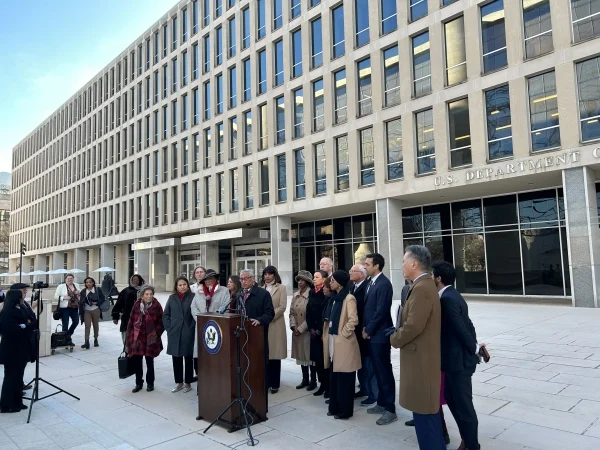
    Lawmakers stand at a podium outside the Education Department building, dressed for winter.

    Lawmakers tried to access the Education Department in February but were denied entry.

    Katherine Knott/Inside Higher Ed

    Rep. Bobby Scott, a Virginia Democrat and ranking member of the House education committee, said he has spent much of his year in defense mode, pushing back against each of these actions.

    “The administration has been dismantling the Department of Education, making access to education much less available,” he said. “And we’ve been trying to keep it together.”

    But both Scott and Sen. Patty Murray, a Washington Democrat and former educator, acknowledged that as members of the minority, they can only do so much. A few Republicans have joined them in voicing concern about specific issues, but not enough, they say.

    “We’ve had some successes—forcing some funding to be restored and rejecting, for example, President Trump’s push to slash Pell Grants by half in our draft funding bill for the coming year—but ultimately, we need a whole lot more bipartisan outrage and pushback from Republicans to truly start to undo the sweeping damage Trump has already caused,” Murray said.

    And it wasn’t just Democrats who raised concerns.

    “Congress has done very little to ask important questions, to ask the executive branch to justify some of the actions it is taking,” said Hess from AEI. “Hill Republicans are very much marching in lockstep to what the White House asks. The story of 2025 in higher ed is a big, dramatic one, but it’s almost entirely one of executive branch activity.”

    What’s Ahead in 2026?

    Now that congressional Republicans have completed a number of the tasks they set for themselves back in January 2025, most experts say two remaining items—college cost and accreditation reform—will be top priorities in 2026.

    Most sources Inside Higher Ed spoke with anticipated that college cost reduction and transparency would be addressed first, largely because related bills made it out of a House committee in December and senators held a hearing on the topic. The bills, which would standardize financial aid offers and create a universal net price calculator, have already gained some significant bipartisan support.

    Meanwhile, many remain skeptical of Republicans’ proposals for accreditation. Although no exact legislative language has been released, GOP lawmakers and Trump officials at the Department of Education have called for a major overhaul to not only ensure better student outcomes but also to deconstruct a what they see as a systemic liberal bias.

    “I would hope to see a focus on accreditors taking an active role and not just sort of a check-the-box approach to quality assurance,” said Carolyn Fast, director of higher education policy at the Century Foundation, a left-leaning think tank. “What I’m concerned about is some of the efforts to reform accreditation don’t seem necessarily as concerned about making sure that the system is working in terms of their role as gatekeepers of federal funds … but more about political and cultural war issues.”

    Bass from CAP said that he will be keeping a close eye on the midterm election campaign trail for a pulse on higher ed policy in general this year, as it gives the public a chance to speak up and direct change.

    “I’m curious to see how conversations about affordability play out, not just for higher education or education over all, but just for the country,” he said. “There are going to be over 30 gubernatorial races next year, and the debate gets shaped over key issues like higher education, like college costs, like affordability. So it will be very interesting to see how both parties are going to show up.”

    Source link

  • Digital by design: a vision of resilience for the sector of 2030

    Digital by design: a vision of resilience for the sector of 2030

    This blog was kindly authored by Heidi Fraser-Krauss, Chief Executive of Jisc.

    UK higher education is in a period of profound change. Artificial intelligence, data-driven research, and new models of learning are redefining what it means to deliver value to students and society. At the same time, institutions must navigate complex risks, from cyber threats to infrastructure demands, while responding to significant financial challenges and ensuring they remain agile, competitive, and a key delivery partner in supporting the government’s growth ambition. The question is not whether technology will transform education, but how we harness it to strengthen the sector for the long term.

    Jisc’s 2030 vision was developed with these realities in mind. Designed not as a digital revolution but rather an evolution, it ensures that Jisc is focused on providing the tertiary education, research, and innovation sectors across the UK with the secure infrastructure, digitally empowered leadership, economic sustainability, and agility needed to meet the next decade head-on. Here’s how its four pillars align with the sector’s most pressing needs.

    1. Sector leadership and strategic influence

    For universities and colleges to thrive in a rapidly evolving digital landscape, the sector needs a strong, informed voice influencing national policy. Decisions on AI governance, cybersecurity standards, and digital research infrastructure will shape the conditions for innovation and competitiveness. By ensuring these policies are informed by evidence-based research and insights into how digital, data, and technology are experienced and managed across education and research, the sector can secure investment, reduce risk, and create an environment where technology drives better outcomes for learners, researchers, and the broader economy.

    That voice must also ensure smart use of data – where Jisc’s role as the designated data body, through its merger with the Higher Education Statistics Agency, helps reduce burden and improve insight. Strategic partnerships, such as the recent agreement with the Association of Colleges and collaborations with Colleges Wales, Ufi VocTech Trust, and Universities UK strengthen advocacy and ensure digital priorities reflect the needs of learners and educators across all nations. Over the next five years, Jisc’s deeper engagement with government, funders, and senior leaders will be critical to embedding digital thinking into policy and strategy across the UK.

    2. Focus on sector-wide challenges

    Digital infrastructure underpins everything from research breakthroughs to everyday learning. As demand for bandwidth and data grows, driven by AI, high-performance computing, and new learning models, the sector needs networks and security systems that can scale.

    At the same time, financial pressures compound these challenges. Rising costs, resource constraints, and the need to keep pace with digital technology affects all institutions. Collective negotiations with major vendors can deliver significant savings, while shared services for cloud, cybersecurity, and data management reduce duplication and free up resources for teaching and research.

    These efficiencies work only if the underlying infrastructure is strong. The Janet network remains the backbone for UK education and research. Projects such as the Isambard AI supercomputer at the University of Bristol highlight the scale of future requirements: vast data flows and advanced computing power that demands resilient, high-capacity connectivity. Sustaining and strengthening Janet, alongside robust cybersecurity measures, ensures institutions can innovate confidently, protect intellectual property, and remain globally competitive. This is about creating the conditions for progress, not just for today, but for the next decade.

    3. Financial sustainability and commercial focus

    To continue delivering value and protect essential services, Jisc must operate sustainably. For 12 years, Jisc has operated on flat cash funding, even as demand for digital infrastructure and services has grown exponentially. To continue meeting members’ evolving needs, Jisc is becoming more commercially focused, developing sustainable models and exploring new ways to support members. This approach ensures that collaboration continues to be at the heart of all that we do, and that every institution, regardless of size, can access the tools and infrastructure needed to succeed.

    4. Operational excellence and agility

    Embedding digital into strategy also means ensuring the organisations that support education are fit for the future. Jisc is investing in its own products, services, and back-office systems to deliver a more streamlined, joined-up experience for members. By removing silos and modernising processes, we aim to save money and provide greater value, while responding quickly to emerging needs. These changes are designed to make it easier for institutions to access the infrastructure, data, and expertise they need, without complexity or duplication, helping the sector focus on what matters most: teaching, research, and innovation.

    Looking ahead to 2030

    At Jisc, we are fully aware of the scale of the challenges facing the sector, and we take our supportive responsibilities seriously. The next five years will define how UK tertiary education responds to the accelerating pace of digital change. Our commitment is not only to help institutions meet those challenges, but to ensure they can seize the opportunities that digital and data present, helping students, researchers, and all of us across the UK to prosper in the future.

    We will work with our members to create the right conditions for innovation: secure infrastructure, smarter use of data, and a culture that sees digital as integral to strategy, not an add-on. By working collectively and planning for scale, we can turn complexity into opportunity and ensure learners and researchers benefit from world-class technology.

    The challenge is clear, and so is our ambition: to make digital transformation the foundation for the sector’s future.

    Source link

  • School closures are accelerating in rural America. But research on whether they help students is mixed

    School closures are accelerating in rural America. But research on whether they help students is mixed

    by Chris Berdik, The Hechinger Report
    January 5, 2026

    PEACHAM, Vt. — Early on a chilly fall morning in this small Vermont town, Principal Lydia Cochrane watched a gaggle of kids chase one another and a soccer ball around their school recess yard. Between drop-off and first bell, they were free, loud and constantly moving. 

    With only about 60 students in prekindergarten through sixth grade, Peacham Elementary is the sort of school where all the kids know one another and locals regularly respond to calls for supplies and volunteers for field trips and other school activities. Cochrane gestured at the freshly raked wood chips around the swings and climbing structures, one of many tasks Peacham families completed at a recent community workday.

    “With a small school, the families know how crucial it is to support it and ensure it succeeds, and so they show up for it,” said Cochrane. 

    Peacham is also a type of school that’s disappearing nationwide, as education systems grapple with plunging enrollments and rising costs. Amid declining birth rates and growing competition from private-school voucher programs, the number of students in U.S. public schools dropped about 2.5 percent between 2019 and 2023, according to the most recent federal data. Fewer students leads to higher per-pupil spending, because district staffing and other expenses largely remain in place despite enrollment drops, and states are increasingly trying to escape the education budget crunch via school consolidation: In the past three years alone, at least 10 states have considered measures to mandate or incentivize district mergers

    These pressures are especially keen in rural areas where the smallest schools predominate and play an outsized role in community life. Vermont, the nation’s most rural state, has lost about 20 percent of its K-12 public school student population in the past two decades. That’s helped push per-pupil costs and property taxes to the breaking point. Early in 2025, the state’s governor and education secretary released a plan to overhaul Vermont education, proposing massive district consolidation as the foundation for sweeping changes in school funding, curricula and academic standards. 

    The Legislature responded with its own comprehensive plan, which passed last summer as Act 73, calling for a minimum of 4,000 students per district, a threshold now met by only 1 of the state’s 119 districts. 

    District mergers are not the same as school closures, but one invariably leads to the other, as they have in Vermont’s other recent waves of district consolidations. The scope of Act 73’s proposals have ignited intense pushback from people fearing the loss of local control over education, even from a majority of the task force created to map options for bigger districts. 

    This month, the state Legislature will consider whether to push forward or completely rethink the process, a debate that will be closely watched by rural education advocates nationwide. Backers of school consolidation maintain that the crises of declining enrollment, falling test scores and tight education budgets demand a bold response and that consolidating schools is necessary to control costs and more equitably distribute resources and opportunities. 

    Opponents say the evidence that widespread school consolidation saves money — or helps students — is mixed at best, and that success depends highly on local context. They want any mergers and closings to be voluntary and done with a clear-eyed accounting of what’s to be gained and lost. 

    Related: A lot goes on in classrooms from kindergarten to high school. Keep up with our free weekly newsletter on K-12 education.

    Vermont’s student-teacher ratio of 11 to 1 is the lowest in the nation, and the state now spends nearly $27,000 per student, second only to New York State. That has triggered spikes in local taxes: In 2024, Vermonters facing double-digit property tax increases subsequently rejected nearly one-third of school budgets when they next went to the polls.

    The school budget revolts led Republican Gov. Phil Scott and his recently appointed education secretary, Zoie Saunders, to propose an education overhaul in January 2025 that would have divided the state into five regional districts serving at least 10,000 kids each. That plan was then superseded by Act 73, which created a redistricting task force of lawmakers and education leaders to map options for the Legislature to consider when it returns to work this month. 

    Saunders argues that school consolidation is key to the broader education transformation that Vermont needs in order to tackle several interconnected challenges, including rising student mental health issues, falling test scores and stubborn achievement gaps. “Many of these issues are hard to solve unless we address our issues around scale and funding,” she said in an interview. “We had to think about reform in a way that was going to focus on funding, quality and governance, because they’re all connected.”

    The state has consolidated schools several times before. Most notably, in 2015, Act 46 triggered several years of mergers — first voluntary, then required — that eliminated dozens of districts and led many small schools to close. 

    Jessica Philippe, a Peacham parent who was on the school board at the time, recalled the worry that the district and its elementary school would be swallowed up. Many of Vermont’s smallest districts, including Peacham, operate only an elementary school and cover the higher grades by paying tuition for students to attend public or certain private schools outside the district. 

    “It seems like this is a cycle we have to go through,” she said. “Every five or 10 years, we have to fight to keep this place, because people from away think, oh, that’s just a few kids we have to disperse.”

    The Peacham school board fended off that threat by showing the state board of education ample data that Peacham Elementary was viable and that there wasn’t much money to be saved from a merger. In fact, the state has never done a full financial analysis of Act 46. At the very least, the mergers failed to stem the spending and tax hikes that triggered Act 73.  

    The only comprehensive accounting of Act 46 was done by a Vermont native, Grace Miller, for her 2024 undergraduate thesis at Yale University where she studied economics and education. In her analysis of 109 districts between 2017 and 2020, she found that mergers did yield some savings, but it was soaked up by new spending such as higher salaries in newly combined districts and higher costs to bus students to and from schools farther away.

    Meanwhile, some of the fastest-growing educational costs in Vermont are arguably outside school and district control, such as skyrocketing health care premiums, which account for about 15 percent of district spending. According to data from KFF (formerly the Kaiser Family Foundation), Vermonters pay the highest “benchmark” health care premiums of any state, nearly $1,300 a month, almost double what they paid just five years ago. The state has also shifted other financial burdens onto districts, such as capital construction costs for schools, which the state hasn’t funded in nearly two decades.

    “We need to be focused on those core cost drivers,” said Rebecca Holcombe, a Vermont state representative and member of the redistricting task force, “not because there aren’t small schools that are inefficient and might not make it, but because even if we addressed them, we’d barely touch the real problem.” 

    Holcombe, who was the state’s education secretary when Act 46 passed, believes some school consolidation makes sense for Vermont, but not mandated mergers, especially at the scale proposed by Act 73. She was among the eight of 11 task force members who voted not to include maps of new, bigger district options in their final report in early December.  

    Instead they proposed a 10-year plan to create five regional “cooperative education service areas” where districts would pool resources to coordinate services — such as transportation, special education and professional development — and generate savings through scale. It also proposed that the state offer financial incentives to districts that voluntarily merge, centered on creating or strengthening high schools to serve students from combined districts and beyond. 

    Speaking to reporters, Gov. Scott admonished the task force a few days after its members voted to forward only the shared services plan to the state Legislature without mapping options for consolidating districts. “They didn’t redraw the lines,” he said. “They failed.” 

    When lawmakers reconvene on Jan. 6, it’s unclear how they’ll handle recommendations from a task force that arguably rebuked its founding legislation. They could ignore the task force and create their own maps of 4,000-student districts. They might amend Act 73 to fit the task force’s proposal. 

    Or they might start fresh. 

    Related: A school closure cliff is coming. Black and Hispanic students are likely to bear the brunt

    Seated in her office at Doty Memorial School in Worcester, a small Vermont town north of Montpelier, Principal Gillian Fuqua choked up when explaining her change of heart — from opposing to supporting a plan to close the school she’s overseen since 2019. Doty has about 60 K-6 students this year, and Fuqua slides a paper across her desk showing projections based on town birth records that enrollment could drop to 40 by the fall of 2028. 

    “It’s absolutely heartbreaking to me,” she said. “But we have to think about what we want for our kids, and we’re not in a good place right now.”

    Worcester is one of five towns merged into a single district by Act 46 in 2019. For two years in a row, the district has considered closing Doty, which would require voter approval. Last year, the plan was shelved without a vote after residents protested. But now a vote has been scheduled for February 10. 

    This past fall, when the district restarted consolidation discussions, Fuqua joined the “configuration committee” and dropped her previous opposition to closing the school. It already must combine two grades in classrooms to meet state minimums for class size. Fuqua worried that if classes shrink further, teachers might struggle to foster soft skills such as teamwork, collaborative problem solving and navigating a diversity of opinions. A larger school, she continued, could also support a full-time instrumental music teacher instead of the one-day-a-week instructor that Doty kids get, as well as a full-time librarian. 

    Indeed, there is ample evidence from Vermont and other states that merged schools can expose students to more and varied learning opportunities. A report released in 2024 by the Vermont Agency of Education, based on surveys and superintendent interviews from seven districts that merged early in the Act 46 era, highlighted merged districts saving, adding or restarting school offerings such as literacy intervention services, world languages and after-school extracurricular activities. 

    Nevertheless, education researchers stress that sending students to a bigger school with more resources doesn’t necessarily mean improved academic achievement or well-being. “These students are often experiencing an enormous transition, and there are a whole bunch of factors that can affect that,” said Mara Tieken, an education professor at Bates College who studies school consolidation. 

    School closings tend to be in more disadvantaged areas, for instance, and students there now take longer bus rides that cut into time for studying, sleep and after-school programs. Another variable is whether students from a closed school all transfer to the same new school, or are “starburst” out because no single school can accommodate them all. Tieken said it takes serious planning “to smooth that transition for new students, to create a culture that’s welcoming.”

    Research on student outcomes following school mergers reflects this tangle of factors. Some studies indicate that consolidation improves test scores, especially when students move to higher-performing schools. Others find little academic impact or lower performance in the first years after merging, more missed school days and behavioral issues and longer-term disadvantages in college graduation, employment and earnings as young adults

    “The answer to virtually every question about school consolidation is: It depends,” said Jerry Johnson, director of the Rural Education Institute and professor of educational leadership at East Carolina University, who has researched school consolidation for decades. 

    Related: Merger madness? When schools close — forever 

    Whatever might be gained from a merger, many Doty parents (and students) remain opposed. In interviews, several said their tiny school provides something incredibly valuable and increasingly rare: human connection and community. In places like Worcester, a local school is one of the few spaces that regularly brings folks together and serves as a magnet for the young families that sustain small-town life.

    Rosie Close, a fifth grader at Doty, described a tradition of students making and serving  soup at the town’s free “community lunch” held every Wednesday at the town hall. “If they closed Doty,” she said, “that would kind of take away part of the town, too.”

    While some Doty families had deep roots in the area, others moved to town more recently, including Caitlin Howansky, mother of a third grader. Howansky grew up in New York City, where she went to an elementary school with more than 30 kids per class.

    “Nobody outside of that classroom necessarily knew my name or knew me as a whole person. I was just one of the crowd,” she said. 

    By contrast, Howansky said, the teachers at Doty “know every kid’s strengths and weaknesses across the whole building.”

    That doesn’t mean that she and her neighbors are blind to demographic or economic realities, especially when housing, health care and so much else is getting more expensive. Early in December, for instance, Vermonters learned that property taxes would likely be spiking again next year, by nearly 12 percent on average.

    “A lot of people are saying, if we fight this again, are they just going to come back and try again next year?” Howansky said. “And is it fair to the children to live under this constant threat and this constant stress of not knowing?”

    She still thinks the fight against a merger is worth it, but said, “Everyone has to figure out where to draw their individual line.”

    Contact editor Caroline Preston at 212-870-8965, via Signal at CarolineP.83 or on email at [email protected].

    This story about rural school closures was produced by The Hechinger Report, a nonprofit, independent news organization focused on inequality and innovation in education. Sign up for the Hechinger newsletter.

    This <a target=”_blank” href=”https://hechingerreport.org/schools-are-closing-across-rural-america-heres-how-a-battle-over-small-districts-is-playing-out-in-one-state/”>article</a> first appeared on <a target=”_blank” href=”https://hechingerreport.org”>The Hechinger Report</a> and is republished here under a <a target=”_blank” href=”https://creativecommons.org/licenses/by-nc-nd/4.0/”>Creative Commons Attribution-NonCommercial-NoDerivatives 4.0 International License</a>.<img src=”https://i0.wp.com/hechingerreport.org/wp-content/uploads/2018/06/cropped-favicon.jpg?fit=150%2C150&amp;ssl=1″ style=”width:1em;height:1em;margin-left:10px;”>

    <img id=”republication-tracker-tool-source” src=”https://hechingerreport.org/?republication-pixel=true&post=114097&amp;ga4=G-03KPHXDF3H” style=”width:1px;height:1px;”><script> PARSELY = { autotrack: false, onload: function() { PARSELY.beacon.trackPageView({ url: “https://hechingerreport.org/schools-are-closing-across-rural-america-heres-how-a-battle-over-small-districts-is-playing-out-in-one-state/”, urlref: window.location.href }); } } </script> <script id=”parsely-cfg” src=”//cdn.parsely.com/keys/hechingerreport.org/p.js”></script>

    Source link

  • Instead of defining Black children by their test scores, we should help them overcome academic barriers and pursue their dreams

    Instead of defining Black children by their test scores, we should help them overcome academic barriers and pursue their dreams

    by Nosakhere Griffin-EL, The Hechinger Report
    January 5, 2026

    Across the U.S., public school districts are panicking over test scores.

    The National Assessment of Educational Progress, or the Nation’s Report Card, as it is known, revealed that students are underperforming in reading, with the most recent scores being the lowest overall since the test was first given in 1992.

    The latest scores for Black children have been especially low. In Pittsburgh, for example, only 26 percent of Black third- through fifth-grade public school students are reading at advanced or proficient levels compared to 67 percent of white children.

    This opportunity gap should challenge us to think differently about how we educate Black children. Too often, Black children are labeled as needing “skills development.” The problem is that such labels lead to educational practices that dim their curiosity and enthusiasm for school — and overlook their capacity to actually enjoy learning.

    As a result, without that enjoyment and the encouragement that often accompanies it, too many Black students grow up never feeling supported in the pursuit of their dreams.

    Related: A lot goes on in classrooms from kindergarten to high school. Keep up with our free weekly newsletter on K-12 education.

    Narrowly defining children based on their test scores is a big mistake. We, as educators, must see children as advanced dreamers who have the potential to overcome any academic barrier with our support and encouragement.

    As a co-founder of a bookstore, I believe there are many ways we can do better. I often use books and personal experiences to illustrate some of the pressing problems impacting Black children and families.

    One of my favorites is “Abdul’s Story” by Jamilah Thompkins-Bigelow.

    It tells the tale of a gifted young Black boy who is embarrassed by his messy handwriting and frequent misspellings, so much so that, in erasing his mistakes, he gouges a hole in his paper.

    He tries to hide it under his desk. Instead of chastening him, his teacher, Mr. Muhammad, does something powerful: He sits beside Abdul under the desk.

    Mr. Muhammad shows his own messy notebook to Abdul, who realizes “He’s messy just like me.”

    In that moment, Abdul learns that his dream of becoming a writer is possible; he just has to work in a way that suits his learning style. But he also needs an educator who supports him along the way.

    It is something I understand: In my own life, I have been both Abdul and Mr. Muhammad, and it was a teacher named Mrs. Lee who changed my life.

    One day after I got into a fight, she pulled me out of the classroom and said, “I am not going to let you fail.” At that point, I was consistently performing at or below basic in reading and writing, but she didn’t define me by my test scores.

    Instead, she asked, “What do you want to be when you grow up?”

    I replied, “I want to be like Bryant Gumbel.”

    She asked why.

    “Because he’s smart and he always interviews famous people and presidents,” I said.

    Mrs. Lee explained that Mr. Gumbel was a journalist and encouraged me to start a school newspaper.

    So I did. I interviewed people and wrote articles, revising them until they were ready for publication. I did it because Mrs. Lee believed in me and saw me for who I wanted to be — not just my test scores.

    If more teachers across the country were like Mrs. Lee and Mr. Muhammad, more Black children would develop the confidence to pursue their dreams. Black children would realize that even if they have to work harder to acquire certain skills, doing so can help them accomplish their dreams.

    Related: Taking on racial bias in early math lessons

    Years ago, I organized a reading tour in four libraries across the city of Pittsburgh. At that time, I was a volunteer at the Carnegie Library, connecting book reading to children’s dreams.

    I remember working with a young Black boy who was playing video games on the computer with his friends. I asked him if he wanted to read, and he shook his head no.

    So I asked, “Who wants to build the city of the future?” and he raised his hand.

    He and I walked over to a table and began building with magnetic tiles. As we began building, I asked the same question Mrs. Lee had asked me: “What do you want to be when you grow up?”

    “An architect,” he replied.

    I jumped up and grabbed a picture book about Frank Lloyd Wright. We began reading the book, and I noticed that he struggled to pronounce many of the words. I supported him, and we got through it. I later wrote about it.

    Each week after that experience, this young man would come up to me ready to read about his dream. He did so because I saw him just as Mr. Muhammad saw Abdul, and just like Mrs. Lee saw me — as an advanced dreamer.

    Consider that when inventor Lonnie Johnson was a kid, he took a test and the results declared that he could not be an engineer. Imagine if he’d accepted that fate. Kids around the world would not have the joy of playing with the Super Soaker water gun.

    When the architect Phil Freelon was a kid, he struggled with reading. If he had given up, the world would not have experienced the beauty and splendor of the National Museum of African American History and Culture.

    When illustrator Jerry Pinkney was a kid, he struggled with reading just like Freelon. If he had defined himself as “basic” and “below average,” children across America would not have been inspired by his powerful picture book illustrations.

    Narrowly defining children based on their test scores is a big mistake.

    Each child is a solution to a problem in the world, whether it is big or small. So let us create conditions that inspire Black children to walk boldly in the pursuit of their dreams.

    Nosakhere Griffin-EL is the co-founder of The Young Dreamers’ Bookstore. He is a Public Voices Fellow of The OpEd Project in partnership with the National Black Child Development Institute.

    Contact the opinion editor at [email protected].

    This story about Black children and education was produced byThe Hechinger Report, a nonprofit, independent news organization focused on inequality and innovation in education. Sign up for Hechinger’sweekly newsletter.

    This <a target=”_blank” href=”https://hechingerreport.org/opinion-instead-of-defining-black-children-by-their-test-scores-we-should-help-them-overcome-academic-barriers-and-pursue-their-dreams/”>article</a> first appeared on <a target=”_blank” href=”https://hechingerreport.org”>The Hechinger Report</a> and is republished here under a <a target=”_blank” href=”https://creativecommons.org/licenses/by-nc-nd/4.0/”>Creative Commons Attribution-NonCommercial-NoDerivatives 4.0 International License</a>.<img src=”https://i0.wp.com/hechingerreport.org/wp-content/uploads/2018/06/cropped-favicon.jpg?fit=150%2C150&amp;ssl=1″ style=”width:1em;height:1em;margin-left:10px;”>

    <img id=”republication-tracker-tool-source” src=”https://hechingerreport.org/?republication-pixel=true&post=114013&amp;ga4=G-03KPHXDF3H” style=”width:1px;height:1px;”><script> PARSELY = { autotrack: false, onload: function() { PARSELY.beacon.trackPageView({ url: “https://hechingerreport.org/opinion-instead-of-defining-black-children-by-their-test-scores-we-should-help-them-overcome-academic-barriers-and-pursue-their-dreams/”, urlref: window.location.href }); } } </script> <script id=”parsely-cfg” src=”//cdn.parsely.com/keys/hechingerreport.org/p.js”></script>

    Source link