Blog

  • Tech Titans, Ideologues, and the Future of American Higher Education — 2026 Update

    Tech Titans, Ideologues, and the Future of American Higher Education — 2026 Update

    This article is an update to our June 2025 Higher Education Inquirer report, Tech Titans, Ideologues, and the Future of American Higher Education. Since that report, the landscape of higher education has evolved dramatically. New developments — the increasing influence of billionaire philanthropists like Larry Ellison, private-equity figures such as Marc Rowan, and the shocking assassination of Charlie Kirk — have intensified the pressures on traditional colleges and universities. This update examines how these forces intersect with ideology, governance, financial power, and institutional vulnerability to reshape the future of American higher education.

    American higher education is under pressure from multiple directions, including financial strain, declining enrollment, political hostility, and technological disruption. Yet perhaps the greatest challenge comes from powerful outsiders who are actively reshaping how education is perceived, delivered, and valued. Figures such as Donald Trump, Elon Musk, Peter Thiel, Sam Altman, Alex Karp, Charlie Kirk, Larry Ellison, and Marc Rowan are steering resources, ideology, and policy in ways that threaten traditional universities’ missions. Each brings a distinct ideology and strategy, but their combined influence represents an existential pressure on the system.

    Larry Ellison, the billionaire founder of Oracle, has pledged to give away nearly all his fortune and already directs hundreds of millions toward research, medicine, and education-related causes. Through the Ellison Institute of Technology, he funds overseas campuses and scholarship programs at institutions like the University of Oxford. Ellison represents a “disruptor” who does not challenge degrees outright but reshapes the allocation of educational resources toward elite, globally networked research.

    The University of Phoenix cyberbreach is more than another entry in the long list of attacks on higher education. It is the clearest evidence yet of how private equity, aging enterprise software, and institutional neglect have converged to create a catastrophic cybersecurity landscape across American colleges and universities. What happened in the summer of 2025 was not an unavoidable act of foreign aggression. It was the culmination of years of cost-cutting, inadequate oversight, and a misplaced faith in legacy vendors that no longer control their own risks.

    The story begins with the Russian-speaking Clop cyber-extortion group, one of the most sophisticated data-theft organizations operating today. In early August, Clop quietly began exploiting a previously unknown vulnerability in Oracle’s E-Business Suite, a platform widely used for payroll, procurement, student employment, vendor relations, and financial aid administration. Oracle’s EBS system, decades old and deeply embedded across higher education, was never designed for modern threat environments. As soon as Clop identified the flaw—later assigned CVE-2025-61882—the group launched a coordinated campaign that compromised dozens of major institutions before Oracle even acknowledged the problem.

    Among the most heavily affected institutions was the University of Phoenix. Attackers gained access to administrative systems and exfiltrated highly sensitive data: names, Social Security numbers, bank accounts, routing numbers, vendor records, and financial-aid-related information belonging to students, faculty, staff, and contractors. The breach took place in August, but Phoenix did not disclose the incident until November 21, and only after Clop publicly listed the university on its extortion site. Even after forced disclosure, Phoenix offered only vague assurances about “unauthorized access” and refused to provide concrete numbers or a full accounting of what had been stolen.

    Phoenix was not alone. Harvard University confirmed that Clop had stolen more than a terabyte of data from its Oracle systems. Dartmouth College acknowledged that personal and financial information for more than a thousand individuals had been accessed, though the total is almost certainly much higher. At the University of Pennsylvania, administrators said only that unauthorized access had occurred, declining to detail the scale. What links these incidents is not prestige, geography, or mission. It is dependency on Oracle’s aging administrative software and a sector-wide failure to adapt to a threat environment dominated by globally coordinated cybercrime operations.

    Marc Rowan, co-founder and CEO of Apollo Global Management, has leveraged private-equity wealth to influence higher education governance. He gave $50 million to Penn’s Wharton School, funding faculty and research initiatives and has recently pushed alumni to withhold donations over issues of campus policy and antisemitism. Rowan also helped shape the Trump administration’s Compact for Academic Excellence, linking federal funding to compliance with ideologically driven standards. He exemplifies how private wealth can steer university governance and policy, reshaping priorities on a national scale. Together, Ellison and Rowan illustrate the twin dynamics of power and influence destabilizing higher education: immense private wealth, and the ambition to reshape institutions according to their own vision.

    With these powerful outsiders shaping the landscape, traditional universities increasingly face pressures to prioritize elite, donor-driven projects over broad public missions. Private funding favors high-prestige initiatives over public-access education, and large contributors can dictate leadership and policy directions. University priorities shift toward profitable or ideologically aligned projects, creating a two-tier system in which elite, insulated institutions grow while public universities struggle to compete, widening disparities in access and quality.

    The stakes of this upheaval have become tragically tangible. The assassination of Charlie Kirk in 2025 was a horrific reminder that conflicts over ideology, money, and influence are not abstract. Violence against public figures engaged in higher education policy and advocacy underscores the intensity of polarization and the human costs of these struggles. Such events cast a shadow over campuses, donor boards, and political advocacy alike, highlighting that the battle over the future of education is contested not only in boardrooms and legislatures but in life and death.

    Students face shrinking access to affordable, publicly supported higher education, particularly those without means or connections to elite institutions. Faculty may encounter restrictions on academic freedom and institutional autonomy, as donor preferences and political pressures increasingly shape hiring, curriculum, and governance. Society risks losing the traditional public mission of universities — fostering critical thinking, civic engagement, and broad social mobility — as education becomes more commodified, prioritizing elite outcomes over the public good.

    Building on our June 2025 report, this update underscores the accelerating influence of tech titans, ideologues, and billionaire philanthropists. Figures such as Ellison and Rowan are reshaping not just funding streams but governance structures, while the assassination of Charlie Kirk painfully illustrates the human stakes involved. Traditional colleges face a stark choice: maintain their public mission — democratic access, critical inquiry, and civic purpose — or retreat into survival mode, prioritizing donor dollars, corporate partnerships, and prestige. The pressures highlighted in June are not only continuing but intensifying, and the consequences — for students, faculty, and society — remain profound.


    Sources

    Fortune: Larry Ellison pledges nearly all fortune (fortune.com)

    Times Higher Education: Ellison funds Oxford scholars (timeshighereducation.com)

    Almanac UPenn: Rowan gift to Wharton (almanac.upenn.edu)

    Inquirer: Rowan donor pressure at Penn (inquirer.com)

    Inquirer: Rowan and Trump’s Compact (inquirer.com)

    Higher Education Inquirer original article (highereducationinquirer.org)

    Source link

  • NIH Approves 100s of Grant Applications It Shelved or Denied

    NIH Approves 100s of Grant Applications It Shelved or Denied

    The National Institutes of Health is deciding, per court agreements, whether to award or deny droves of grant applications that the agency previously either rejected or shelved. This funding was stalled last year amid the Trump administration’s blunt moves to restrict research into certain disfavored topics, such as diversity, equity and inclusion—though researchers and state attorneys general said officials shot down a greater range of projects, including ones that could save lives.

    The NIH’s agreements, laid out in court filings in two ongoing lawsuits, are already bearing fruit. A spokesperson for the Massachusetts attorney general’s office, which is leading one of the cases, said the agreement in that suit promises decisions on more than 5,000 grants nationally. On Dec. 29, the date of the agreement, the NIH issued 528 grant decisions, 499 of which were approvals, the spokesperson said.

    A spokesperson for the American Civil Liberties Union, which is leading the other case, said the agreement in that case involves about 400 grants. He said the NIH awarded at least 135 out of 146 applications in a batch of decisions on Dec. 29.

    The filings set a series of dates by which the NIH agreed to decide on awarding or denying other types of grants. The last deadline is July 31.

    The agreements are another example of the Trump administration reversing many of its sweeping cuts to research funding in response to litigation. Researchers and organizations filed suit after suit last year after the NIH and other federal funding agencies abruptly terminated previously awarded grants and sat on applications for new ones.

    In a news release, the ACLU said the grants that the NIH will now decide on “address urgent public health issues, including HIV prevention, Alzheimer’s disease, LGBTQ+ health, and sexual violence.” ACLU of Massachusetts legal director Jessie Rossman said in the release that the NIH’s “unprecedented” and “unlawful” actions put “many scientists’ careers in limbo, including hundreds of members of the American Public Health Association and the UAW union.”

    ACLU lawyers are among the attorneys representing those groups, Ibis Reproductive Health and individual researchers in a suit they filed in April against the NIH and the larger Health and Human Services Department for stalling and rejecting grant funding. Democratic state attorneys general filed a similar suit in the same court, the U.S. District Court of Massachusetts.

    The agencies agreed to decide these grant applications in exchange for the plaintiffs dismissing some of their claims. The agencies didn’t admit wrongdoing.

    In a news release, the Massachusetts attorney general’s office said the Trump administration “indefinitely withheld issuing final decisions on applications that had already received approval from the relevant review panels,” leaving the states that sued “awaiting decisions on billions of dollars.”

    The release said that, for example, when the suit was filed in April, the University of Massachusetts “had 353 applications for NIH funding whose review had been delayed, signifying millions in potential grant funding that would aid in lifesaving medical research.” Massachusetts attorney general Andrea Joy Campbell said in a statement that “lifesaving studies related to Alzheimer’s disease, cancer, and other devastating illnesses were frozen indefinitely—stealing hope from countless families across the country and putting lives at risk.”

    It’s unclear how much money the NIH may dole out in total. An HHS spokesperson told Inside Higher Ed that the “NIH cannot comment on the status of individual grant applications or deliberations.”

    “The agency remains committed to supporting rigorous, evidence-based research that advances the health of all Americans,” the spokesperson said. HHS and the NIH didn’t provide interviews or further comment.

    Meanwhile, a legal fight continues over grants that the NIH previously approved but later canceled.

    Lingering Questions

    In June, in these same two cases, U.S. District Judge William Young ordered the NIH to restore grants the agency had awarded but then—after Trump retook the White House—terminated midgrant.

    Young, a Reagan appointee, criticized the federal government for not formally defining DEI, despite using that term to justify terminating grants. He said at a hearing that he’d “never seen racial discrimination by the government like this” during his four decades as a federal judge.

    But, two months later, the U.S. Supreme Court, in a 5-to-4 preliminary decision, stayed Young’s ruling ordering restoration of the grants. Justice Amy Coney Barrett, a Trump appointee, wrote for the majority that Young “likely lacked jurisdiction to hear challenges to the grant terminations, which belong in the Court of Federal Claims.” However, STAT reported that the NIH had restored more than 2,000 terminated grants following Young’s ruling, and it didn’t reverse course after the Supreme Court decision.

    That question of whether researchers with canceled grants must ultimately try their luck before the Court of Federal Claims is now before the U.S. First Circuit Court of Appeals. There’s a hearing Tuesday in that matter.

    Questions linger about when the grant fight will really end. In a video interview with journalist Paul Thacker—released Wednesday and previously reported on by STAT—NIH director Jay Bhattacharya said that, despite the grant restorations, any grants dealing with DEI that come up for renewal this year won’t be funded. Bhattacharya distinguished between cutting a grant and not renewing it.

    He said that, “as best I can understand the legal aspects,” the courts have said his agency can’t cut restored grants. “But, when it comes to renewal, those grants no longer meet NIH priorities … so when they come up for renewal over the course of the year, we won’t renew them,” he said.

    Bhattacharya said the NIH’s DEI-related work “did not actually have any chance of improving the health of minority populations.” He said, “I think that the shift away from DEI is of a piece with the rest of what we’re trying to do at the NIH, which is to do research that actually makes the lives of people better.”

    Source link

  • big ambitions drive New Zealand’s comeback

    big ambitions drive New Zealand’s comeback

    Here are five stories from 2025 that painted a picture of renewed confidence and long-term ambition for New Zealand’s international education sector.

    1. NZ debuts growth plan as it eyes 35k more international students

    One of the biggest signals of intent this year came with the launch of New Zealand’s International Education Going for Growth plan. The strategy laid out an ambitious vision to lift international enrolments by 35,000 and nearly double the sector’s value to NZ$7.2 billion by 2034. Measures such as increased student work hours and expanded post-study opportunities made it clear the country is back in growth mode – but with an emphasis on quality and sustainability.

    2. International student satisfaction in New Zealand remains strong at 87%

    International students continue to rate New Zealand highly. Survey results showed overall satisfaction holding strong at 87%, with education quality, welcoming communities and arrival experiences all scoring particularly well. The data offered reassurance that recovery hasn’t come at the expense of the student experience.

    3. Study visa applications to NZ dip, approval rate jumps nearly 7%

    While study visa applications to New Zealand dipped slightly year on year, approval rates jumped by nearly seven percentage points to around 88%. The data pointed to shifting demand – with applications easing from China but stronger approval volumes from India and Nepal, alongside more positive outcomes for students who did apply.

    4. NZ releases new tertiary education strategy to boost economy

    The release of New Zealand’s Tertiary Education Strategy 2025–2030 reinforced the government’s message that education and economic growth are deeply connected. The strategy focused on skills, workforce alignment and stronger employment outcomes, while also reshaping the domestic tertiary landscape.

    5. NZ’s international education sector delivers NZ$4.5bn economic boost

    Rounding out the year, fresh figures confirmed just how important international education has become to New Zealand’s economy. The sector delivered a NZ$4.5bn boost, placing it among the country’s top export earners. With enrolments continuing to rise and growth policies now in place, the numbers underlined why international education remains firmly on the government’s agenda.

    Source link

  • Judge rules in Trump’s favour over $100K H-1B visa fee hike

    Judge rules in Trump’s favour over $100K H-1B visa fee hike

    The judge ruled on December 23 that it was within the President’s powers to regulate immigration, rejecting arguments brought by the Chamber of Commerce that the proclamation exceeded Trump’s statutory authority.  

    “The parties’ vigorous debate over the ultimate wisdom of this political judgment is not within the province of the courts,” wrote the Obama-appointed judge Beryl Howell.  

    “So long as the actions dictated by the policy decision and articulated in the Proclamation fit within the confines of the law, the Proclamation must be upheld.” 

    The lawsuit is among two other cases challenging Trump’s controversial $100K fee for H-1B petitions, which the plaintiffs argued would lead companies, hospitals and other employers to cut jobs and weaken the services they provide to the public.  

    It was brought by the US Chamber of Commerce – the world’s largest business federation with roughly 300,000 members – and the Association of American Universities (AAU), which represents 69 US-based research universities. 

    Following the proclamation, the administration clarified international students changing status in the US would be exempt from the fee, though stakeholders have said it will undermine America’s leadership in education, research and innovation.  

    Zuzana Cepla Wootson, deputy director of federal policy at the Presidents’ Alliance, called the judge’s decision “deeply disappointing”. 

    “The United States must stop deterring the very talent that strengthens our classrooms, fuels our economy, and drives American innovation,” she said, urging Congress to “pursue bipartisan solutions that support US prosperity and competitiveness”.  

    The White House welcomed the ruling as a victory for American workers, vowing that Trump would continue to protect them from being replaced by “cheap, foreign labour”.

    “The $100,000 payment accompanying any new H1-B petition is a necessary and long-overdue first step to reform the H-1B visa program that has been abused at the expense of hardworking Americans,” White House spokesperson Taylor Rogers told The PIE.

    The fee, which is still being challenged by two other lawsuits, hikes the cost of an H-1B visa petition by more than 20 times the previous charge, which ranged between $2,000 and $5,000.  

    The H-1B visa program enables US employers to temporarily hire international workers in “specialty occupations” from healthcare to computer science and financial analysis. California’s tech industry is particularly reliant on the visa stream.   

    The United States must stop deterring the very talent that strengthens our classrooms, fuels our economy, and drives American innovation

    Zuzana Cepla Wootson, Presidents’ Alliance

    “The $100,000 fee makes H-1B visas cost prohibitive for businesses, especially small- and medium-sized businesses that can least afford it,” Chamber of Commerce executive vice president Daryl Joseffer said after the ruling.  

    He said the chamber was considering further legal action and underscored the positive economic benefits of the H-1B stream, which has been found to reduce unemployment rates and lead to faster wage growths for US employers, according to the National Foundation for American Policy (NFAP).  

    Howell’s ruling came the same day as the government finalised a rule to replace the random H-1B selection process with a weighted system favouring higher earners – something critics say will harm the US tech industry and dampen the country’s appeal among international students. The new process will come into effect on February 27.  

    Source link

  • 5 lessons learned from top school administrators in 2025

    5 lessons learned from top school administrators in 2025

    This audio is auto-generated. Please let us know if you have feedback.

    In 2025, K-12 Dive’s conversations with school and district leaders covered best practices, challenges overcome and lessons learned on a variety of topics, from providing remediation to students to engaging with school communities. As 2026 gets underway, we’re taking a look back at those conversations to spotlight five key takeaways that offer guidance and insight as you enter the second half of the school year.

    Keep an ear out for the voices that aren’t always heard

    “I am responsive to the community I’m serving, a true public servant. And in our community here, the historically marginalized populations are sometimes not invited and, in certain cases, are just simply invisible. What I try to do … is not to put them to the side — because that would be inappropriate as well — but I hear them loud and clear.

    This is a headshot of Alex Marrero, superintendent of Denver Public Schools in Colorado.

    Alex Marrero

    Permission granted by Denver Public Schools


    “I’m concerned about the community member who may not be the fifth-generation Coloradan but is in Colorado because they migrated here. I’m concerned about those who have a different way of seeing education. The cultural component plays a major part.

    “There’s certain cultures where they don’t feel like they should say what the school system should do, because where they’re from, the school system is usually right and ‘Who are they to impose their thoughts?’ How can I empower them to say, ‘That’s not how we function here?’ That’s the hardest part.”

    Alex Marrero, superintendent of Denver Public Schools in Denver, Colorado

    Remediation doesn’t have to feel like ‘baby work’

    “Sometimes, people think middle school students will feel embarrassed that they are lacking in some skills. And you do have some students that do feel that way.

    This is a headshot of Thelma Ramsey-Bryant, principal of John L. Costley Middle School in East Orange, New Jersey.

    Thelma Ramsey-Bryant

    Permission granted by Thelma Ramsey-Bryant


    “We find that sometimes students have behavior issues, and when you get to the root of what the behavior issues are, it’s because they have difficulty reading, and they don’t want other students to know, so they act out.

    “We started talking to students about, ‘We want to help you with your reading, and these are the ways that we’re going to do it.’ I had a teacher here who was able to reach the students in a way that didn’t make it feel like it was baby work. We presented them with things that were on their level, but helped them understand that this was going to make them better readers, and they actually gravitated toward it, and they appreciated it.”

    Thelma Ramsey-Bryant, principal of John L. Costley Middle School in East Orange, New Jersey

    When adopting new tech, think first about schools’ needs

    “The biggest thing is just not to be scared, but to ask specifically, ‘What is it that we need? What need are we trying to address?’

    This is a headshot of Scott Langford, director of schools for Sumner County Schools in Tennessee.

    Scott Langford

    Permission granted by Scott Langford


    “I think [artificial intelligence] is best suited right now to meet needs that are defined, like individualized or niche needs that a school might have. … If you identify the need, there are plenty of great AI companies out there. 

    “You also need to talk to not just a sales rep but the CEO or someone fairly high up in the company. In the past, it was just, ‘You can have whatever you want as long as it looks like this, and then you bend what you’re doing to what we produced.’ Now, the best AI companies will almost custom-build a product to meet the needs of your school or district.”

    Scott Langford, superintendent of Sumner County Schools in Gallatin, Tennessee

    Some forms of communication cross language barriers

    “Graphs and charts are universal. It’s really helpful to show a family the picture of [a student’s] growth trajectory, to show them the growth line of other students in that grade level in that school versus the national average versus their own student.

    This is a headshot of Heidi Sipe, superintendent of Umatilla School District in Umatilla, Ore.

    Heidi Sipe

    Permission granted by Heidi Sipe


    “It’s really helpful to drive home the point of ‘Look how much they’ve grown’ or ‘Wait a minute. We have real concerns.’ … Especially when we can see those positive growth trajectories, that’s just really comforting to parents to see that their child is on track.

    “And even if they’re not where they need to be for achievement yet, if they’re growing at or above their peers, we know they’re going to hit that growth trajectory or that growth target, and they’re on the right trajectory. That’s good for parents to hear.”

    Heidi Sipe, superintendent of Umatilla School District in Umatilla, Oregon

    Every role matters in a district turnaround

    “I mean, we were growing [academically] before the pandemic, and it kind of gets lost in the mix, because a lot of districts haven’t grown much since the pandemic. Some haven’t even returned to their original scores they had pre-pandemic. We rebounded very fast.

    This is a headshot of Darin Brawley, superintendent of Compton Unified School District in California.

    Darin Brawley

    Permission granted by Compton Unified School District


    “There’s a lot we need to credit to that. First off, we have a fabulous teaching staff, and we also have great administrators and great students who work toward the common goal of continuous improvement. We have a process in place that really is modeled after Malcolm Baldridge’s performance excellence standards, where we’re constantly benchmarking our performance against our surrounding competitors — aka surrounding school districts — and identifying those districts that we want to perform better than.

    Source link

  • AI use is on the rise, but is guidance keeping pace?

    AI use is on the rise, but is guidance keeping pace?

    Key points:

    The rapid rise of generative AI has turned classrooms into a real-time experiment in technology use. Students are using AI to complete assignments, while teachers are leveraging it to design lessons, streamline grading, and manage administrative tasks.

    According to new national survey data from RAND, AI use among both students and educators has grown sharply–by more than 15 percentage points in just the past one to two years. Yet, training and policy have not kept pace. Schools and districts are still developing professional development, student guidance, and clear usage policies to manage this shift.

    As a result, educators, students, and parents are navigating both opportunities and concerns. Students worry about being falsely accused of cheating, and many families fear that increased reliance on AI could undermine students’ critical thinking skills.

    Key findings:

    During the 2024-2025 school year, AI saw rapid growth.

    AI use in schools surged during the 2024-2025 academic year. By 2025, more than half of students (54 percent) and core subject teachers (53 percent) were using AI for schoolwork or instruction–up more than 15 points from just a year or two earlier. High school students were the most frequent users, and AI adoption among teachers climbed steadily from elementary to high school.

    While students and parents express significant concern about the potential downsides of AI, school district leaders are far less worried.

    Sixty-one percent of parents, 48 percent of middle school students, and 55 percent of high school students believe that increased use of AI could harm students’ critical-thinking skills, compared with just 22 percent of district leaders. Additionally, half of students said they worry about being falsely accused of using AI to cheat.

    Training and policy development have not kept pace with AI use in schools.

    By spring 2025, only 35 percent of district leaders said their schools provide students with training on how to use AI. Meanwhile, more than 80 percent of students reported that their teachers had not explicitly taught them how to use AI for schoolwork. Policy guidance also remains limited–just 45 percent of principals said their schools or districts have policies on AI use, and only 34 percent of teachers reported policies specifically addressing academic integrity and AI.

    The report offers recommendations around AI use and guidance:

    As AI technology continues to evolve, trusted sources–particularly state education agencies–should provide consistent, regularly updated guidance on effective AI policies and training. This guidance should help educators and students understand how to use AI as a complement to learning, not a replacement for it.

    District and school leaders should clearly define what constitutes responsible AI use versus academic dishonesty and communicate these expectations to both teachers and students. In the near term, educators and students urgently need clarity on what qualifies as cheating with AI.

    Elementary schools should also be included in this effort. Nearly half of elementary teachers are already experimenting with AI, and these early years are when students build foundational skills and habits. Providing age-appropriate, coherent instruction about AI at this stage can reduce misuse and confusion as students progress through school and as AI capabilities expand.

    Ultimately, district leaders should develop comprehensive AI policies and training programs that equip teachers and students to use AI productively and ethically across grade levels.

    Laura Ascione
    Latest posts by Laura Ascione (see all)

    Source link

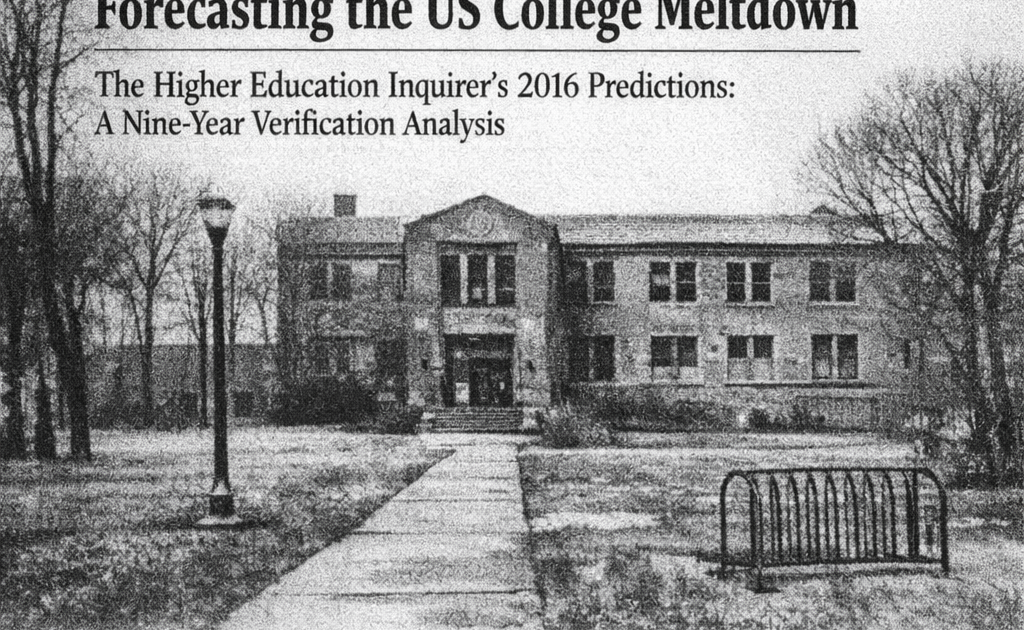
  • How Higher Education Inquirer’s 2016 Warnings Played Out, 2016–2025 (Glen McGhee)

    How Higher Education Inquirer’s 2016 Warnings Played Out, 2016–2025 (Glen McGhee)

    In December 2016, the Higher Education Inquirer published a set of 18 predictions warning of an ongoing “U.S. College Meltdown.” At the time, these warnings ran counter to the dominant narrative promoted by university leaders, accreditation agencies, Wall Street analysts, and much of the higher education press. College, readers were assured, remained a sound investment. Institutional risks were described as isolated, manageable, or limited to a small number of poorly run schools.

    Nearly nine years later, that confidence has collapsed.

    A comprehensive review of publicly available data, investigative journalism, court records, and government reports shows that 17 of the Higher Education Inquirer’s 18 predictions—94.4 percent—have been fully or partially confirmed. What was once framed as speculation now reads as an early diagnosis of a system already in advanced decline.

    This article is not a victory lap. It is an accounting—of warnings ignored, of structural failures compounded, and of a higher education system reshaped less by learning than by debt, austerity, and financial engineering.

    The Growth of Student Debt

    In 2016, total student loan debt stood at approximately $1.4 trillion. By 2025, it had surpassed $1.8 trillion, despite repeated claims that the crisis was stabilizing. Millions of borrowers cycled in and out of forbearance, delinquency, and default, often unaware of the long-term consequences of capitalization, interest accrual, and damaged credit.

    Temporary relief programs—pandemic pauses, income-driven repayment plans, and selective forgiveness—offered short-term breathing room while failing to address the underlying cost structure of higher education. Legal challenges and administrative reversals further destabilized borrower expectations, reinforcing the sense that student debt had become a permanent feature of American life rather than a transitional burden.

    The Higher Education Inquirer warned in 2016 that student loans would increasingly function as a disciplinary mechanism, constraining career choice, delaying family formation, and suppressing economic mobility. That warning has proven prescient.

    Graduate Underemployment and the Erosion of the Degree Premium

    Another core prediction concerned the labor market. While headline unemployment numbers often appeared strong, the quality of employment deteriorated. By the early 2020s, a majority of recent four-year college graduates were underemployed—working in jobs that did not require a degree or offered limited advancement.

    Wages stagnated even as credential requirements rose. Employers demanded more education for the same roles, while offering less stability in return. The result was a generation of graduates caught between rising expectations and diminishing returns.

    This shift exposed a contradiction at the heart of the modern university: institutions continued to market degrees as pathways to prosperity, even as internal data increasingly showed that outcomes varied dramatically by institution, major, race, and class.

    Enrollment Decline and the Demographic Cliff

    The enrollment downturn predicted in 2016 arrived in waves. First came post–Great Recession skepticism. Then demographic decline reduced the number of traditional college-age students. Finally, the pandemic accelerated distrust, remote learning fatigue, and financial strain.

    By the mid-2020s, enrollment losses were no longer cyclical. They were structural.

    Colleges responded not by rethinking pricing or mission, but by cutting costs. Programs were eliminated, faculty positions left unfilled, and student services hollowed out. In rural and working-class regions, entire communities lost anchor institutions that had served as employers, cultural centers, and pathways to upward mobility.

    Institutional Debt, Financialization, and Risk Shifting

    One of the most underreported developments has been the rise of institutional debt. Facing declining tuition revenue, many colleges turned to bond markets to finance operations, capital projects, or refinancing. This strategy delayed collapse but increased long-term vulnerability.

    The Higher Education Inquirer warned that debt-financed survival strategies would transfer risk downward—onto students through higher tuition, onto staff through layoffs, and onto local governments when institutions failed. That pattern has repeated itself across the country.

    Meanwhile, elite universities with massive endowments continued to expand, insulate themselves from risk, and benefit from tax advantages unavailable to less wealthy institutions.

    Closures, Mergers, and Asset Stripping

    Since 2016, well over one hundred colleges have closed, merged, or been absorbed. Many closures were preceded by years of warning signs: declining enrollment, deferred maintenance, accreditation scrutiny, and emergency fundraising campaigns.

    In some cases, institutions sold land, buildings, or entire campuses to survive. In others, boards pursued mergers that preserved branding while eliminating local governance and jobs.

    These were not isolated failures. They were the predictable outcome of a system that prioritized growth, prestige, and financial metrics over resilience and public accountability.

    The Limits of Reform and the Failure of Oversight

    Perhaps the most sobering confirmation of the 2016 analysis is not any single data point, but the broader failure of reform. Despite abundant evidence of harm, regulatory responses remained fragmented and reactive. Accreditation agencies rarely intervened early. Federal enforcement was inconsistent. Media coverage often framed crises as unfortunate anomalies rather than systemic outcomes.

    The Higher Education Inquirer argued in 2016 that the greatest risk was not collapse itself, but normalization—the slow acceptance of dysfunction as inevitable. That normalization is now visible in policy debates that treat mass underemployment, lifelong debt, and institutional instability as the cost of doing business.

    A Crisis Foretold

    The U.S. college meltdown did not arrive as a single dramatic event. It unfolded slowly, unevenly, and predictably—through spreadsheets, bond prospectuses, enrollment dashboards, and borrower accounts.

    The accuracy of these forecasts underscores a deeper truth: the crisis was foreseeable. It was documented. It was warned about. What was missing was the willingness to act.

    The Higher Education Inquirer published its predictions in 2016 not to provoke fear, but to provoke accountability. Nine years later, the record is clear. The meltdown was not an accident. It was a choice—made repeatedly, by institutions and policymakers who believed the system could absorb unlimited strain.

    It could not.


    Sources

    LendingTree; EducationData; Inside Higher Ed; Higher Ed Dive; Forbes; NPR; Brookings Institution; National Bureau of Economic Research (NBER)

    Source link

  • The stories that most resonated with our readers

    The stories that most resonated with our readers

    The pope, news services, snakes and movies in India. These were the most read stories our global correspondents filed in 2025. From our student authors, readers gravitated to stories about mental health and identity.

    The past year marked News Decoder’s 10th anniversary. For a decade we’ve been publishing stories from professional correspondents around the world who help us explain complicated global events and connect what is happening in our own countries to what is happening elsewhere.

    Alongside those stories, we’ve published articles about problems spotted and explored by high school and college students. They give us a sense of what young people care about and worry over. We see them exploring in different ways similar topics and in the process discovering how their concerns are mirrored in places halfway across the world.

    We believe that stories connect people. And by finding and producing stories for people to read and hear, we try to turn confusion into clarity and show that for what seems to be intractable problems solutions exist.

    Now that we are beginning a new year, let’s look back on the stories in 2025 that most resonated with our readers.

    And here’s hoping that 2026 will be a year filled with good news across the globe.

    —Happy new year, from News Decoder.

    Source link

  • 49 predictions about edtech, innovation, and–yes–AI in 2026

    49 predictions about edtech, innovation, and–yes–AI in 2026

    As K-12 schools prepare for 2026, edtech and innovation are no longer driven by novelty–it’s driven by necessity. District leaders are navigating tighter budgets, shifting enrollment, rising cybersecurity threats, and an urgent demand for more personalized, future-ready learning.

    At the same time, AI, data analytics, and emerging classroom technologies are reshaping not only how students learn, but how educators teach, assess, and support every learner.

    The result is a defining moment for educational technology. From AI-powered tutoring and automated administrative workflows to immersive career-connected learning and expanded cybersecurity frameworks, 2026 is poised to mark a transition from experimental adoption to system-wide integration. The year ahead will test how effectively schools can balance innovation with equity, security with access, and automation with the irreplaceable role of human connection in education.

    Here’s what K-12 industry experts, stakeholders, and educators have to say about what 2026 will bring:

    AI becomes fully mainstream: With clearer guardrails and safety standards, AI will shift from pilot projects to a natural part of daily classroom experiences. AI tackles the biggest challenges: learning gaps and mental health: Chronic absenteeism, disengagement and widening readiness levels are creating urgent needs, and AI is one of the only tools that can scale support quickly. Hyper-personalized learning becomes standard: Students need tailored, real-time feedback more than ever, and AI will adapt instruction moment to moment based on individual readiness. AI tutoring expands without replacing teachers: Quick, focused bursts of AI-led practice and feedback can relieve overwhelmed teachers and give students support when they need it most. The novelty era of AI is over: In 2026, districts will prioritize solutions that measurably improve student outcomes, relevance and wellbeing, not just cool features.
    –Kris Astle, Education Expert and Manager of Learning and Adoption, SMART Technologies

    In 2026, workforce readiness will no longer be seen as someone else’s responsibility, but will become a collective mission. Schools, employers, families, and policymakers will increasingly work together to connect students’ strengths to real opportunities. Career and technical education (CTE) and industry certifications will move to the center of the conversation as districts rethink graduation requirements to prioritize alignment between student aptitudes and workforce demand. The goal will shift from ‘graduation’ to readiness. Students don’t lack ambition, they lack connection between what they’re good at and where those talents are needed. When education, industry, and community align, that connection becomes clear. The result? A generation that enters the world not just credentialed, but confident and capable.
    Edson Barton, CEO & Co-Founder, YouScience

    As the number of edtech applications continues to surge across classrooms nationwide, teachers and administrators will need to become increasingly discerning consumers. The challenge for 2026 won’t be finding tools, it will be identifying which ones truly move the needle for teaching and learning. To maximize impact, district leaders should look for tools that demonstrate clear instructional value, support data-driven teaching, and extend what humans alone can accomplish. This includes intentionally selecting tools that embody strong learning science, effectively personalize the learning experience, empower teachers with meaningful data, and align tightly to instructional goals. If a tool doesn’t demonstrably provide purposeful practice to enhance student learning or make teachers’ work easier, it’s unlikely to earn a place in the modern classroom.
    –Dr. Carolyn Brown, Chief academic Officer & Co-Founder of Foundations in Learning, Creator of WordFlight

    In 2026, schools will continue to prioritize clear, consistent communication between families, students and staff. The expectations around what good communication looks like will rise significantly as communication modality preferences evolve and expand. Parents increasingly rely on digital tools to stay informed, and districts will feel growing pressure to ensure their online presence is not only accurate but intuitive, engaging, accessible and available in real time. New elements such as AI chatbots and GEO practices will shift from “nice-to-have” features to essential components of a modern school communication toolbox. These tools help families find answers quickly, reduce the burden on office staff and give schools a reliable, user-friendly way to reach every stakeholder with urgent updates or important news at a moment’s notice. Historically, digital methods of school-to-home communication have been overlooked or deprioritized in many districts. But as competition for students and teachers increases and family expectations continue to rise, schools will be forced to engage more intentionally through digital channels, which are often the only reliable way to reach families today. As a result, modernizing communications will become a core strategic priority rather than an operational afterthought.
    –Jim Calabrese, CEO, Finalsite

    Educator wellness programs will increasingly integrate with student well-being initiatives, creating a truly holistic school climate. Schools may roll out building-wide morning meditations, joint movement challenges, or shared mindfulness activities that engage both staff and students. By connecting teacher and student wellness, districts will foster healthier, more resilient communities while boosting engagement and morale across the school.
    Niki Campbell, M.S., Founder/CEO, The Flourish Group

    In 2026, we will see more talk about the need for research and evidence to guide education decisions in K-12 education. Reports on student achievement continue to show that K-12 students are not where they need to be academically, while concerns about the impact of new technologies on student well-being are on the rise. Many in the education space are now asking what we can do differently to support student learning as AI solutions rapidly make their way into classrooms. Investing in research and development with a focus on understanding  teaching and learning in the age of AI will be vital to addressing current education issues.
    Auditi Chakravarty, CEO, AERDF

    District leaders will harness school safety as a strategic advantage. In 2026, K-12 district leaders will increasingly see school safety as a key driver of their biggest goals–from increasing student achievement to keeping great teachers in the classroom. Safety will show up more naturally in everyday conversations with teachers, parents, and students, underscoring how a secure, supportive environment helps everyone do their best work. As districts point to the way safer campuses improve focus, attract strong educators, and build community trust, school safety will become a clear advantage that helps move the whole district forward.
    Brent Cobb, CEO, CENTEGIX 

    Learning is no longer confined to a classroom, a schedule, or even a school building. New models are expanding what’s possible for students and prompting educators to reconsider the most effective strategies for learning. A key shift is asking students, “What is school doing for you?” Virtual and hybrid models provide students the space and time to reflect on this question, and these non-traditional approaches are expected to continue growing in 2026. Education is shifting from a focus on test-taking skills to an approach that helps students become well-rounded, self-directed learners who understand what motivates them and are better prepared for career readiness and long-term success. With that comes a need for a stronger emphasis on fostering independence. It’s equally important that students learn to build resilience themselves, and for parents and teachers to recognize that letting students stumble is part of helping them without life-altering consequences will support the best citizens of the future. Aligning education with these priorities is crucial to advancing learning for the next generation.
    –Dr. Cutler, Executive Director, Wisconsin Virtual Academy

    With reading skills continuing to lag, 2026 will be pivotal for improving K–12 literacy–especially for middle school students. Schools must double down on evidence-based strategies that foster engagement and achievement, such as targeted reading interventions that help students build confidence and reconnect with reading. We’ll likely see a strong push for tools like digital libraries and personalized reading programs to help learners gain ground before entering high school. Audiobooks and other accessible digital formats can play a key role in supporting comprehension and fluency, particularly when paired with interactive resources and educator guidance. Middle school remains a crucial stage for developing lifelong reading habits that extend beyond the classroom. The top priority will be closing learning gaps by cultivating meaningful, enjoyable reading experiences for students both in and out of school.
    –Renee Davenport, Vice President of North American Schools, OverDrive

    Virtual set design, which is popular in professional theaters and higher education institutions, is now making its way into K-12 theaters. It allows schools to use the technologies they are familiar with such as short-throw projection technology, and combine it with computer graphics, 3D modeling, real-time rendering, and projection mapping technologies to create visually-stunning sets that could not be created by building traditional sets. A great example of this is highlighted in this eSchool News’ article. Overall, virtual sets elevate theater productions at a fraction of the cost and time of building physical sets, and when students are involved in creating the virtual sets, they learn a variety of tech-related skills that will help them in future careers.
    –Remi Del Mar, Group Product Manager, Epson America, Inc.

    In 2026, more school districts will take deliberate steps to integrate career-connected learning into the K–12 experience. As the workforce continues to evolve, educators recognize that students need more than academic mastery – they need technical fluency, transferable skills, and the confidence to navigate unfamiliar challenges. Districts will increasingly turn to curricula that blend rigorous instruction with meaningful, hands-on experiences, helping students understand how what they learn in the classroom connects to real opportunities beyond it. In turn, we’ll see a growing emphasis on activity-, project-, and problem-based learning that promotes relevance, exploration, and purposeful engagement. This shift will also deepen partnerships between schools, local industries, and higher education to help ensure learning experiences reflect real workforce expectations and expose students to future pathways. By embedding these experiences into daily learning, schools can help students develop a strong foundation for lifelong learning and adaptability–redefining educational success to include readiness for life and work.
    –David Dimmett, President & CEO, Project Lead the Way

    AI will push America’s century-old education system to a breaking point. AI will make it impossible to ignore that our current education priorities are obsolete and, for millions, downright harmful. The root cause? Education’s very failed ‘success’ metrics. At long last, high-school math will get its day of reckoning, with growing calls for redirecting focus toward the ideas that matter, not micro-tidbits that adults never use and smartphones perform flawlessly. Society is in a technology revolution, but how we teach our youth hasn’t changed. Frustration is growing. Students are bored and disengaged. Parents are fearful for their children’s future. Career centers will soon become ghost towns as young people question the relevance of what and how they’re being prepared for the future. The schools that rebuild around problem-solving, reasoning, and genuine human creativity will thrive, while the rest stagnate in unavoidable debate about whether their model has any real-world value.
    Ted Dintersmith, Founder, What School Could Be

    In 2026, I anticipate several meaningful shifts in early childhood education. First, with growing recognition of the academic, social-emotional, and physical benefits of outdoor learning, more schools will prioritize creating intentional outdoor learning environments. More than just recess time, this means bringing indoor activities outdoors, so children have the chance to not only learn in nature but about nature. Additionally, as we see expansion in early childhood programs across the nation, I expect a continued focus on play-based learning. Research indicates that is how children learn best, and while there is pressure for academics and rigor, early childhood educators know play can provide that very thing. Lastly, while it’s widely known that children use their senses to learn about the world around them, I see educators being more intentional about meeting the sensory needs of all learners in their classrooms. We’ll continue to see a quest to provide environments that truly differentiate to meet individual needs in an effort to help everyone learn in the way that works best for them.
    –Jennifer Fernandez, Education Strategist, School Specialty

    As district leaders look ahead to 2026, there is a widening gap between growing special ed referrals and limited resources. With referrals now reaching more than 15 percent of all U.S. public school students, schools are under increasing pressure to make high-stakes decisions with limited staff and resources. The challenge is no longer just volume–it’s accuracy. Too often, students–especially multilingual learners–are placed in special ed not because of disability, but because their learning needs are misunderstood. Ensuring that every student receives the right support begins with getting identification right from the start. The districts that will make the most progress in the new year will focus more on improving assessment quality, not speed. This means leveraging digital tools that ease the strain on special ed teachers and school psychologists, streamlining efficiency while keeping their expert judgment at the heart of support. When accuracy becomes the foundation of special ed decision-making, schools can reallocate resources where they’re needed most and ensure that every learner is understood, supported, and given the opportunity to thrive.
    Dr. Katy Genseke, Psy.D., Director of Clinical Product Management, Riverside Insights

    In the coming year, we’ll see more districts formalize removing cell phone access in classrooms and during the school day, along with reducing passive screen time, as educators grapple with student disengagement and rising concerns about attention, learning, and well-being. This shift will spark a renewed emphasis on real-world, hands-on learning where students can physically explore scientific principles and understand where mathematical and scientific ideas come from. Schools will increasingly prioritize experiences that connect scientific concepts to the real world, helping students build curiosity and confidence in their science and math skills. Ultimately, these changes will result in learners seeing themselves in roles connected to these experiences, such as health sciences, bio tech, engineering, agricultural science, and many more, as a way to engage and prepare them for meaningful and in-demand postsecondary professions or further education.
    –Jill Hedrick, CEO, Vernier Science Education

    Across the country, I’m inspired by how many districts are embracing evidence-based literacy practices and seeking stronger alignment in their approach. At the same time, I see areas where teachers require more consistent training, tools, and support to implement these practices effectively. This moment presents a genuine opportunity for leaders to foster greater coherence and enhance implementation in meaningful ways. Looking toward 2026, my hope is that district leaders embrace a comprehensive, long-term vision for literacy and commit to true alignment across classrooms and grade levels. That means giving teachers the time, structure, and support required for effective implementation; leading with empathy as educators adopt new practices; and recognizing that real change doesn’t come from training alone but from ongoing coaching, collaboration, and commitment from leadership. National data make the urgency clear: reading gaps persist in the early grades and beyond, and too many students enter adolescence without the foundational literacy skills they need. It’s time to change the story by building teacher capacity, strengthening implementation, and ensuring every learner at every level in every classroom has access to high-quality, science-backed reading instruction.
    Jeanne Jeup, CEO & Founder, IMSE

    If 2023-2025 were the “panic and pilot” years for AI in schools, 2026 will be the year habits harden. The policies, tools, and norms districts choose now will set the defaults for how a generation learns, works, and thinks with AI. The surprise: students use AI less to shortcut work and more to stretch their thinking. In 2023 the fear was simple: “Kids will use AI to cheat.” By the end of 2026, the bigger surprise will be how many students use AI to do more thinking, not less, in schools that teach them how. We already see students drafting on their own, then using AI for formative feedback aligned to the teacher’s rubric. They ask “Why is this a weak thesis?” or “How could I make this clearer?” instead of “Write this for me.” Where adults set clear expectations, AI becomes a studio, not a vending machine. Students write first, then ask AI to critique, explain, or suggest revisions. They compare suggestions to the rubric and explain how they used AI as part of the assignment, instead of hiding it. The technology didn’t change. The adult framing did.
    –Adeel Khan, CEO, MagicSchool

    School safety conversations will include more types of emergencies. In a 2025 School Safety Trends Report that analyzed 265,000+ alerts, 99 percent of alerts were for everyday emergencies, including medical incidents and behavioral issues, while only 1 percent involved campus-wide events, such as lockdowns. Effective school safety planning must include a variety of types of emergencies, not just the extreme. While most people think of lockdowns when they hear “school safety,” it’s critical that schools have plans in place for situations like seizures or cardiac arrest. In these scenarios, the right protocols and technology save lives–in fact, approximately 1 in 25 high schools have a sudden cardiac arrest incident each year. In 2026, I believe wearable panic buttons and technology that maps the locations of medical devices, like AEDs, will become the standard for responding to these incidents.
    Jill Klausing, Teacher, School District of Lee County 

    One quarter of high seniors say they have no plans for the future, and that percentage will only grow. Educators, nonprofits, and policymakers must work to connect learning with real world skills and experiences because most kids don’t know where to start. DIY digital career exploration and navigation tools are dramatically shaping kids’ futures. High quality platforms that kids can access on their phones and mobile devices are exploding, showing options far beyond a college degree.
    –Julie Lammers, CEO, American Student Assistance

    A significant trend emerging for 2026 is the focus on evidence-based learning strategies that directly address cognitive load and instructional equity. For example, as districts implement the Science of Reading, it will become even more imperative for every student to audibly distinguish soft consonant sounds and phonemes. The hidden challenge is ambient classroom noise, which increases extraneous cognitive load, forcing students to expend unnecessary mental energy just trying to hear the lesson, and diverting their focus away from processing the actual content. Therefore, instructional audio must be treated as foundational infrastructure—as essential to learning as curriculum itself. By delivering the teacher’s voice to every student in the classroom, this technology minimizes the hearing hurdle, enabling all learners to fully engage their brains in the lesson and effectively close achievement gaps rooted in communication barriers.
    –Nathan Lang-Raad, VP of Business, Lightspeed

    AI-driven automation will help schools reclaim time and clarity from chaos: School districts will finally gain control over decades of ghost and redundant data, from student records to HR files through AI-powered content management. AI will simplify compliance, communication, and collaboration: By embedding AI tools directly into content systems, schools will streamline compliance tracking, improve data accuracy, and speed up communication between departments and families. Accessible, data-driven experiences will redefine engagement: Parents and students will expect school systems to deliver personalized, seamless experiences powered by clean, connected data.
    –Andy MacIsaac, Senior Strategic Solutions Manager for Education, Laserfiche

    In the K-12 sector, we are moving away from a ‘content delivery’ model, and toward what I call ‘The Augmented Educator.’ We know that AI and predictive algorithms are improving on the technical side of learning. They can analyze student performance data to spot micro-gaps in knowledge – like identifying that a student is struggling with calculus today because they missed a specific concept in geometry three years ago. That is predictive personalization, and it creates a perfect roadmap for what a student needs to learn. However, a roadmap is useless if the student isn’t fully on board. This is where human-connection becomes irreplaceable. AI cannot empathize with a frustrated 10-year-old. It cannot look a student in the eye and build the psychological safety required to fail and try again. The future of our industry isn’t about choosing between AI or humans; it’s about this specific synergy: Technology provides the diagnostic precision, but the human provides the emotional horsepower. I predict that the most successful tutors of the next decade will be ‘coaches’ first and ‘teachers’ second. They will use technology to handle curriculum planning, allowing them to focus 100 percent of their energy on motivation, pedagogy, and building confidence. That is the only way to keep K-12 students engaged in a digital-first world.
    Gaspard Maldonado, Head of SEO, Superprof

    If there’s one thing we see every day in classrooms, it’s that students learn differently and at their own pace, which is why committing to personalized learning is the next big step in education. This means moving beyond the old “one-size-fits-all” model and finally embracing what we’ve always known about how learning actually works. Personalization gives students something incredibly powerful: a clear sense of their own learning journey. When the curriculum, instruction, and pacing are tailored to their strengths, interests, and needs, students have better clarity and allow them to engage with their education in a way that they wouldn’t be able to in other ways. And for teachers, this shift doesn’t have to mean more complexity. With the support of smarter tools, especially AI-driven insights, the administrative burden lightens, making space for what matters most: mentoring, connecting, and building meaningful relationships with students. But personalization isn’t just about improving academic outcomes. It’s about helping students grow into resilient, self-directed thinkers who understand how to navigate their own path. When we move from generalized instruction to student-centered learning, we take a real step toward ensuring that every student has the chance to thrive.
    –Lynna Martinez-Khalilian, Chief Academic Officer, Fusion Academy

    The conversation around AI in education won’t be about replacement, it will be about renaissance. The most forward-thinking schools will use AI to automate the mundane so teachers can focus on what only humans can do: connect, inspire, and challenge students to think critically and create boldly. The future belongs to those who can harness both computational power and human imagination.
    –Jason McKenna, VP of Global Educational Strategy, VEX Robotics

    Across sectors, educational ecosystems are rapidly evolving toward skills-focused, technology-enabled, models that prepare students for a dynamic future of work. Learners are using online platforms such as iCEV to access course work, create artifacts, and share their knowledge of the subject in a creative and improved manner. Platforms like this will be utilized by CTE teachers to assist learners in building technical competencies by implementing a variety of learning models.
    –Dr. Richard McPherson, Agricultural Science Teacher, Rio Rico High School in the Santa Cruz Valley Unified School District

    In 2026, districts will confront a widening gap between the growing number of students diagnosed with specialized needs and the limited pool of clinicians available to support them. Schools will continue to face budget constraints and rising demand, which will push the field toward greater consolidation and more strategic partnerships that expand access, especially in regions that have long lacked adequate services. The organizations that succeed will be those able to scale nationally while still delivering localized, student-first support. We expect to see more attention focused on the realities of special education needs: the increasing number of students who require services, the truly limited resources, and the essential investment required in high-quality, integrated support systems that improve outcomes and make a measurable difference in students’ lives.
    –Chris Miller, CEO, Point Quest Group

    The future of K-12 projectors lies in integrated, high-performance chipsets that embed a dedicated Small Language Model (SLM), transforming the device into an AI Instructor Assistant. This powerful, low-latency silicon supports native platforms like Apple TV while primarily enabling real-time, on-board AI functions. Instructors can use simple voice commands to ask the projector to perform complex tasks: running real-time AI searches and summarization, instantly generating contextual quizzes, and providing live transcription and translation for accessibility. Additionally, specialized AI handles automated tasks like instant image auto-correction and adaptive light adjustment for student eye health. This integration turns the projector into a responsive, autonomous edge computing device, simplifying workflows and delivering instant, AI-augmented lessons in the classroom. Epson makes a great ultra short throw product that is well suited for a chipset such as this in the future.
    –Nate Moore, Executive Director of Technology, Kearsley Community Schools

    I anticipate a renewed focus on the classroom technologies that most directly strengthen student engagement. In recent research, 81 percent of K–12 IT leaders reported that student engagement is their primary measure of success, and 91 percent expect interactive tools like interactive displays, classroom cameras, and headsets to increase classroom participation in the coming year. This signals a shift toward investing in tools that enable every student to see and be seen, and hear and be heard across all learning environments. Rather than investing in the next big trend, I believe districts will prioritize technologies that consistently help learners stay focused and engaged. The year ahead will be defined not by rapid experimentation, but by the thoughtful adoption of tools that make learning more immersive, inclusive, and meaningful.
    Madeleine Mortimore, Global Education Innovation and Research Lead, Logitech

    Technology advancements will continue to accelerate in 2026 which will have a direct impact on teaching and learning. As schools seek out new and innovative ways to engage students and support deeper learning, I predict immersive technologies such as VR (virtual reality), XR (extended reality), and hybrid learning models which integrate traditional in-person teaching and online learning with VR experiences, will become more mainstream.
    –Ulysses Navarrete, Executive Director, Association of Latino Administrators and Superintendents (ALAS)

    In 2026, mathematics education will continue to shift toward teaching math the way the brain learns, prioritizing visual and meaningful context over rote memorization. By presenting concepts visually and embedding them in engaging, real-world context first, students can better understand the structure of problems, build reasoning skills, and develop confidence in their abilities. Districts that implement research-backed, neuroscience-informed approaches at scale will help students tackle increasingly complex challenges, develop critical thinking, and approach math with curiosity rather than anxiety—preparing them for a future where problem-solving and adaptive thinking are essential.
    –Nigel Nisbet, Vice President of Content Creation, MIND Education

    My prediction for 2026 is that as more people start to recognize the value of career and technical education (CTE), enrollment in CTE programs will increase, prompting schools to expand them. Technology will enhance curricula through tools such as virtual reality and artificial intelligence, while partnerships with industry will provide students with essential, real-world experiences. Moreover, there will be a greater emphasis on both technical and soft skills, ensuring graduates are well-prepared for the workforce.
    –Patti O’Maley, Vice Principal & CTE Coordinator, Payette River Tech Academy & Recently Profiled in Building High-Impact CTE Centers: Lessons from District Leaders

    In 2026, schools are poised to shift from using AI mainly as a time saver to using it as a genuine driver of better teaching and learning. Educators will still value tools that streamline tasks, but the real momentum will come from applications that sharpen instructional practice and strengthen coaching conversations. Observation Copilot is already giving a glimpse of this future. It has changed the way I conduct classroom observations by capturing evidence with clarity and aligning feedback to both district and state evaluation frameworks. As tools like this continue to evolve, the focus will move toward deeper instructional insight, more precise feedback, and richer professional growth for teachers.
    –Brent Perdue, Principal, Jefferson Elementary School in Spokane Public Schools

    The upper grades intervention crisis demands action. Most science of reading policies focus on K-3, but the recent NAEP scores showing historically low literacy among graduating seniors signal where policy will move next. States like Virginia are already expanding requirements to serve older students, and I expect this to be a major legislative focus in 2026. The pandemic-impacted students are now in seventh grade and still struggling. We can’t ignore them any longer.
    –Juliette Reid, Director of Market Research, Reading Horizons

    High schools and career and technical education (CTE) centers are increasingly seeking out opportunities to provide immersive, hands-on experiences that prepare students for the workforce. In 2026, we will see a surge in demand for virtual and augmented reality (VR/AR) tools to fill this need. VR/AR experiences promote deeper understanding, better knowledge retention and faster skills acquisition, giving students a realistic way to experience different careers, understand job expectations, and learn transferable skills like communication and teamwork. Whether it’s by letting students virtually step into the role of a nurse, welder, or chef; or enabling them to participate in a VR simulated job interview, VR/AR helps students build knowledge, skills and confidence as they explore career paths and it will be a critical technology for workforce development in 2026 and beyond.
    –Gillian Rhodes, Chief Marketing Officer, Avantis Education, Creators of ClassVR

    In 2026, expect growing urgency around middle school literacy. The students who were in K–3 during the pandemic are now in middle school, and many still haven’t caught up–only 30 percent of eighth graders are reading proficiently, with no state showing gains since 2022. While there is a myth that students transition from learning to read to reading to learn after third grade, the reality is that many older students need ongoing reading support as they take on more complex texts. Years of testing pressure, fragmented time for reading instruction, and limited focus on adolescent literacy have left students underprepared for complex, content-rich texts. In 2026, expect more states and districts to invest in systemic literacy supports that extend beyond elementary school: embedding reading across subjects, rethinking instructional time, and rebuilding students’ stamina and confidence to tackle challenging material. The middle school reading crisis is as much about mindset as mechanics – and solving it will require both.
    Julie Richardson, Principal Content Designer for Literacy, NWEA

    In 2026, I expect AI in education to shift from novelty to essential infrastructure, provided we keep human involvement and student safety at the center. Across districts we’ve worked with, we consistently see that the  real value of AI is not just in creating faster workflows, but in providing students and teachers with personalized support to result in more effective teaching and learning outcomes. Research and pilot programs show the strongest gains when AI augments human teaching, offering individualized feedback and tailored practice while educators focus on higher-order instruction and student connection. As adoption accelerates, the work ahead is less about whether to use AI and more about building systems that ensure it’s safe, equitable, and pedagogically sound. Beyond just product development,  means districts will need AI strategies that center governance, privacy protections, and investing in professional development so educators have the tools and confidence they need to use AI responsibly.
    Sara Romero-Heaps, Chief Operating Officer, SchoolAI

    In 2026, K–12 education will reach a critical moment as students navigate an increasingly complex, AI-enabled world. The widening gap between the skills students develop in school and the demands of tomorrow’s workforce will draw growing attention, underscoring the need for Decision Education in classrooms nationwide. Students, parents, teachers, and education leaders are all experiencing uncertainty about the future. Schools and districts will need to integrate Decision Education more systematically so students build the dispositions and skills to make informed choices about their learning, careers, and lives. Strengthening decision-making skills gives students greater agency and helps them navigate uncertainty more effectively. Education leaders who prioritize practical approaches to closing this skills gap will be best positioned to help students thrive in a rapidly changing world.
    –David Samuelson, Executive Director, Alliance for Decision Education

    I believe 2026 will be defined by the power of local communities stepping up. We’ll see grassroots networks of educators, families, and community organizations building new models of support at the city, state, and regional levels. There will be even greater local reliance on family engagement organizations and public-private partnerships ensuring no learner gets left behind. The resilience and creativity of local communities will be education’s greatest strength in the year ahead.
    Julia Shatilo, Senior Director, SXSW EDU

    Chronic absenteeism hasn’t eased as districts hoped–it’s proving sticky. At the same time, families are exploring and normalizing hybrid and home learning models. These two patterns may share roots in flexibility, agency, and the search for alignment between how students learn and how schools operate. Taken together, they suggest ​​significant changes in how families relate to school. In response, we’ll likely see districts and states focus on earlier, more flexible outreach and clearer visibility into alternative learning pathways–not sweeping reform, but steady adjustments aimed at keeping students connected, however and wherever learning happens.
    Dr. Joy Smithson, Data Science Manager, SchoolStatus

    The goal for literacy remains the same: Every child deserves to become a capable, confident reader. But our understanding has deepened, and this will shape conversations and best practices ahead. Too often, we’ve examined each dimension of literacy in isolation–studying how children decode words without considering how teachers learn to teach those skills; creating research-backed interventions without addressing how schools can implement them with integrity; and celebrating individual student breakthroughs while overlooking systemic changes needed for ALL students to succeed. We now recognize that achieving literacy goals requires more than good intentions or strong programs. It demands clarity about what to teach, how to teach, how students learn, and how schools sustain success. The future of literacy isn’t about choosing sides between competing approaches, but about understanding how multiple sciences and disciplines can work together through an interdependent, systems-thinking approach to create transformative change. We must strengthen pathways into the profession, provide high-quality teacher preparation programs, support strong leadership, and focus on effective implementation that facilitates high-impact instruction at scale. These aren’t technical challenges but human ones that require solutions that emerge when multiple sciences and systems-thinking converge to drive lasting literacy change–and educational change more broadly.
    –Laura Stewart, Chief Academic Officer, 95 Percent Group

    In 2026, K-12 leaders are done tolerating fragmented data. Budgets are tightening, every dollar is under a microscope, and districts can’t keep making uninformed decisions while insights sit scattered across disconnected systems. When 80 percent of spending goes to people and programs, guesswork isn’t an option. This is the year districts flip the script. Leaders will want all their insights in one place–financial, staffing, and student data together–eliminating silos that obscure the ROI of their initiatives. Centralized visibility will be essential for confident decision-making, enabling districts to spot ineffective spending, remove redundant technology, and strategically redirect resources to interventions that demonstrably improve student outcomes.
    –James Stoffer, CEO, Abre

    America’s 250th anniversary this year will offer an opportunity to connect students with history and civic learning in more interactive and engaging ways. Educators will increasingly rely on approaches that help students explore the stories behind our nation’s landmarks, engage with historical events, and develop a deeper understanding of civic life. By creating hands-on and immersive learning experiences–both in-person and virtually–schools can help students build connections to history and foster the skills and curiosity that support informed citizenship.
    –Catherine Townsend, President & CEO, Trust for the National Mall

    In 2026, AI will move beyond static personalization to create truly adaptive learning paths that adjust in real time. We’ll see systems that can read engagement, emotional tone, and comprehension using signals like voice cues, interaction data, or optional camera-enabled insights. These systems will then adjust difficulty, modality, and pacing in response. The result will be the early stages of a personal tutor experience at scale, where learning feels less like a fixed curriculum and more like a responsive conversation that evolves with the learner. We are going to increasingly see the exploration of immersive learning, and how we can use VR or XR to create tailored experiences to meet specific learning goals. The real potential comes from immersive learning which is backed by learning science and has clear pedagogical patterns: brief, targeted activities that reinforce concepts, whether through gamified exploration or realistic skill-building. The market will mature into offering both creative conceptual journeys and hands-on practice, making immersive learning a strategy for deepening understanding and building real-world skills.
    Dave Treat, Global CTO, Pearson

    In 2026, edtech will move decisively beyond digital worksheets toward tools that truly enrich the teaching experience. Educators will increasingly expect platforms that integrate curriculum, pedagogy, and professional learning–supporting them in real time, not adding to their workload. With AI and better learning design, edtech will help teachers focus more on student inquiry and collaboration, igniting deeper learning rather than just digitizing old practices.
    Chris Walsh, Chief Technology & Product Officer, PBLWorks

    This year, a major pivot point will be how schools choose to allocate funding—toward emerging AI programs like ChatGPT’s education initiatives or toward hands-on materials and science equipment that ground learning in the physical world. Determining how we leverage edtech and AI without sacrificing teacher expertise, nuance, or the human connection that makes classrooms thrive will be especially important.
    –Nick Watkins, Science Teacher, Franklin Pierce School District & Vernier Trendsetters Community Member

    In 2026, independent schools will continue to navigate a period of momentum, with many experiencing rising applications and stronger retention. At the same time, leaders will face ongoing challenges: managing tighter staffing ratios, rising operational costs, and the growing gap between financial aid need and available resources; schools that prioritize strategic and nimble framing of the school’s future, innovative partnerships and programs, and intentional community engagement will be best positioned to support their students and families effectively. Independent schools will also face new opportunities and challenges that come from external forces such as the expansion of school choice and the growth of artificial intelligence. Their overall focus will continue to be on creating sustainable, student-centered environments that balance academic excellence and engagement with social-emotional care and access, ensuring independent schools remain resilient, inclusive, and impactful in a rapidly evolving educational landscape.
    –Debra P. Wilson, President, National Association of Independent Schools

    In 2026, technological advancements will continue to transform test preparation, making learning more accessible, personalized, and efficient. AI, adaptive learning, and optimized UI/UX will enable students to focus on mastering content rather than managing resources or navigating cognitive overload. These tools allow learners to target areas of improvement with precision, creating study experiences tailored to individual strengths, weaknesses, and learning styles. AI will play an increasingly central role in personalizing education, such as smarter study plans that adapt in real time, instant explanations that accelerate comprehension, and 24/7 AI tutoring that provides continuous support outside the classroom. As these technologies evolve, test prep will shift from a one-size-fits-all approach to highly customized learning journeys, enabling students to optimize their preparation and achieve measurable outcomes more efficiently. The next wave of AI-driven tools will not just assist learning, they will redefine it, empowering students to engage more deeply and achieve higher results with greater confidence.
    –Scott Woodbury-Stewart, Founder & CEO, Target Test Prep

    Edtech is advancing at an extremely rapid pace, driven by the proliferation of AI and immersive tools. In the next year, there will be leaps in how these technologies are integrated into personalized learning pathways. Specifically, schools will be able to utilize technology to make education much smarter and more personalized via AI, and more immersive and experiential via augmented and virtual reality. Additionally, the integration of gamification and true learning science is likely to broaden the ways students will engage with complex material. With these advancements, educators can expect the emergence of holistic and integrated ecosystems that go beyond just teaching academic content to ones that monitor and support mental health and well-being, build work-applicable skills, offer college and career guidance, develop peer communities, and follow students throughout their academic careers.
    –Dr. A. Jordan Wright, Chief Clinical Officer, Parallel Learning

    In 2026, meaningful progress in math education will depend less on chasing the next new idea and more on implementing proven instructional practices with consistency and coherence. Schools and districts will need to move beyond fragmented reforms and align leadership, curriculum, and instruction around a shared vision of high‑quality math learning. This includes cultivating strong math identity for learners and educators, balancing conceptual understanding with procedural fluency, and ensuring learning builds logically and cumulatively over time. When systems commit to these evidence‑based principles and support teachers with aligned professional learning, the conditions are set for sustained improvements in student math outcomes nationwide.
    –Beth Zhang, Co‑President of Lavinia Group, K12 Coalition

    Laura Ascione
    Latest posts by Laura Ascione (see all)

    Source link

  • College Meltdown 2026 (Glen McGhee)

    College Meltdown 2026 (Glen McGhee)

    As the United States moves deeper into the 2020s, the College Meltdown is no longer a speculative concept but a structural reality. The crisis touches nearly every part of the system: enrollment, finances, labor, governance, and the perceived value of a college degree itself. The forces fueling this meltdown are not sudden shocks but accumulated pressures — demographic contraction, policy failures, privatization schemes, student debt burdens, and decades of mission drift — that now converge in 2026 with unprecedented intensity.

    The Waning of College Mania

    For decades, higher education sold an uncomplicated dream: go to college, get ahead, and move securely into the middle class. This college mania was promoted by policymakers, corporate interests, university marketers, and a compliant media ecosystem. But the spell is breaking. Students at elite universities are skipping classes, disillusioned not only by campus turmoil but by the reality that a degree, even from a prestigious institution, no longer guarantees a stable future. Employers increasingly question the value of credentials that have become inflated, inconsistent, and disconnected from workplace needs.

    Yet paradoxically, many jobs still require degrees — not because the work demands them, but because credentialing has become a screening mechanism. The U.S. has built a system in which people must spend tens of thousands of dollars for access to a job that may not even require the knowledge their degree supposedly certifies. This contradiction lies at the heart of the meltdown.

    Moody’s Confirms the Meltdown: A Negative Outlook for 2026

    The financial rot is now too deep to ignore. Moody’s Investors Service recently issued a negative outlook for all of U.S. higher education for FY2026, confirming what researchers, debtors, and frontline faculty have been warning for years. Demographic decline continues to shrink the pool of traditional college-age students, leaving hundreds of institutions with no plausible path to enrollment stability.

    Moody’s expects expenses to grow 4.4% in 2026, while revenues will grow only 3.5% — and for small tuition-dependent institutions, revenue growth may fall to 2.5–2.7%. In other words, the business model simply no longer works. Institutions are already turning to hiring freezes, early retirements, shared services, layoffs, and mergers. These austerity strategies hit labor and students hardest while preserving administrative bloat at the top, mirroring broader patterns of inequality across the U.S. economy.

    Compounding the problem, federal loan reforms — particularly the elimination or capping of Grad PLUS loans — threaten universities that rely on overpriced master’s programs as revenue engines. Many of these programs were built during the boom years as financial lifelines, not academic commitments. The bottom is falling out of that model too.

    [Image: HEI’s baseline model shows steady losses between 2026 and 2036. And it could get much worse].  

    White-Collar Unemployment and the Broken Value Proposition

    A new generation is confronting economic realities that undermine the old promise of higher education. Recent data show that college graduates now make up roughly 25% of all unemployed Americans, a startling indicator of white-collar contraction. The unemployment rate for bachelor’s degree holders rose to 2.8%, up half a point in a year.

    If higher education was once treated as an automatic economic escalator, it is now a much riskier gamble — often with a lifetime of debt attached.

    Demographic Collapse and Institutional Failures

    The so-called “demographic cliff” is no longer a future event; colleges in the Midwest, Northeast, and South are already competing for shrinking numbers of high-school graduates. Some institutions have resorted to predatory recruitment, deceptive marketing, and desperate discounting — the same tactics that fueled the for-profit college boom and collapse.

    Meanwhile, the FAFSA disaster, mismanagement at the Department of Education, and the chaos surrounding federal financial aid verification have caused enrollment delays and intensified uncertainty. Institutions like Phoenix Education Partners (PXED) are already trying to shift blame for their own recruitment failures and history of fraud onto the federal government, signaling a new round of accountability evasion reminiscent of the Corinthian Colleges and ITT Tech eras.

    Student Debt, Inequality, and Loss of Legitimacy

    Student debt remains above $1.7 trillion, reshaping the life trajectories of millions and reinforcing racial and class disparities. Black borrowers, first-generation students, and low-income communities bear the heaviest burdens. Many institutions — especially elite medical centers and flagship universities — are simultaneously cash-rich and inequality-producing, perpetuating the dual structure of American higher education: privilege for the few, precarity for the many.

    Faculty and staff face their own meltdown. Contingent labor now constitutes the majority of the instructional workforce, while administrators grow more numerous and more insulated from accountability. Shared governance is weakened, academic freedom is eroding, and political interference is rising, particularly in states targeting DEI programs, history curricula, and dissent.

    The Road Ahead: Contraction, Consolidation, and Possibility

    The College Meltdown will continue in 2026. More closures are coming, especially among small private colleges and underfunded regional publics. Mergers will be framed as “strategic realignments,” but for many communities — especially rural and historically marginalized ones — they will represent the loss of an anchor institution.

    Yet contraction also opens space for reimagining. The United States could choose to rebuild higher education around equity, public purpose, and social good, rather than market metrics and debt financing. That would require:

    • substantial public reinvestment,

    • free or low-cost pathways for essential programs,

    • accountability for predatory institutions,

    • democratized governance, and

    • a commitment to racial and economic justice.

    Whether the nation takes this opportunity remains unclear. What is certain is that the system built on college mania, easy credit, and limitless expansion is collapsing — and Moody’s latest warning simply confirms what students, workers, and communities have felt for years.

    The College Meltdown is here. And it’s reshaping the future of higher education in America.

    Source link