
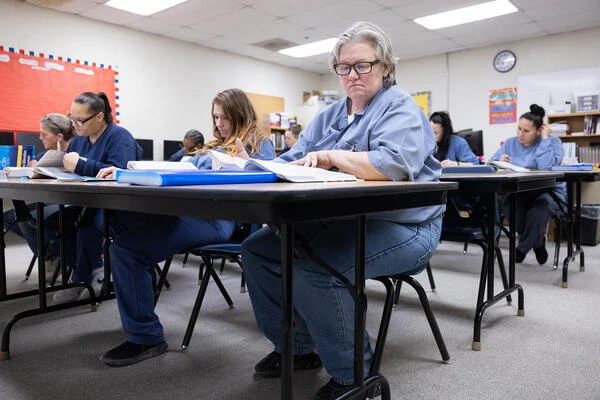
Prison education programs are designed to help people succeed after release, but new research suggests they may actually increase participants’ chances of reincarceration.
An analysis from Grinnell College found that participation in prison education increases an individual’s likelihood of returning to prison within three years of release by 3.4 percentage points—a roughly 10 percent increase compared to those who did not participate. That increase is driven largely by revocations, such as technical violations of release conditions, rather than by new crimes.
“The takeaway from this should not be that prison education is bad,” said Logan Lee, an associate professor of economics at Grinnell and the study’s author. “Instead, what seems to be happening is that there are these unintended consequences.”
The analysis examined more than 22,000 prisoner stints in Iowa, drawing on data from the Iowa Department of Corrections, the Iowa Department of Education, Iowa Workforce Development and Grinnell College to create a comprehensive, individual-level dataset of people released from Iowa prisons between 2014 and 2018.
The research found that participation in prison education programs affects how individuals are released. Those who enroll in college courses are less likely to be released free and clear and more likely to be assigned to work release, which allows eligible inmates to leave prison during the day to work in the community and return at night.
In Iowa, work release often takes place in a halfway house, a structured living environment intended to support people as they transition back into the community. But work release also exposes individuals to more intensive postrelease supervision, which dramatically increases the likelihood of revocation, or being reincarcerated for violating supervision terms, Lee said.
“Work release programs are quite ineffective at achieving their goals, [and] they’re driving a significant increase in people returning to prison,” Lee said. “It’s being assigned far too often at the margins, and some [incarcerated individuals] would be better off on parole or even released free and clear.”
Lee said anecdotal evidence suggests that some correctional officers may resent the idea of “free” education for incarcerated people, pointing out that the requirements for their job are a high school diploma and a clean criminal record. As a result, he said, there is “the potential for some animosity,” with research finding “an increase in misconduct for people who are participating in education programs.”
“Correctional officers are very difficult, high-stress, low-pay jobs,” Lee said. “So you can imagine that that sort of person might go, ‘Look, I kept my nose clean and I didn’t commit any crimes, so why are these people given opportunities that I wasn’t given?’”
However, Lee said case managers, who often recommend how incarcerated individuals are released, don’t share the same resentment. He noted they are “much more likely to have college degrees and interact with prisoners in a different way.”
The background: The U.S. has one of the world’s largest incarcerated populations, with nearly two million people in prison in 2024. This population recidivates at high rates: 46 percent of released prisoners are rearrested within five years, research shows.
U.S. prisons disproportionately house economically vulnerable individuals, many of whom have limited education. Despite historically limited access, prison education programs consistently draw strong interest from incarcerated people. A survey from the National Center for Education Statistics found that 70 percent of incarcerated individuals wanted to enroll in educational programs, and that a majority were academically eligible for college-level courses.
In Iowa, all prison education is offered through local colleges, primarily community colleges. The state funds all GED preparation courses and some postsecondary and vocational programs. Lee said programs offered through some institutions, including Grinnell College and the University of Iowa, are funded by donations.
Across the country, nearly all state and federal prisons provide some form of educational programming. The expectation in both Iowa and nationally is that courses offered inside prisons resemble, as closely as prison guidelines allow, their nonprison counterparts.
“The reality on the ground in most [prisons] is that [incarcerated individuals] only take a couple of courses and then they get released and move on,” Lee said. “You can certainly look at national statistics and see that most people who participate in education in prison are not earning any sort of degree.”
The implications: In addition to his work at Grinnell College, Lee said he previously taught at a women’s prison in Mitchellville, Iowa. He led a “how-to-do-college course,” where he taught writing, critical reading and academic honesty.
Lee described the experience as “eye-opening,” adding that the incarcerated women he taught were highly engaged and deeply interested in the material.
“I saw a real hunger for education, and I do think they got a lot out of the class,” Lee said, noting that he taught 16 students, six of whom were released from prison during the course and 10 of whom eventually completed it.
Providing education in prisons, however, can be challenging. Limited access to technology and learning materials, restrictions on participation times, and situations like lockdowns can interrupt learning opportunities.
“There are just some real challenges with balancing the educational mission with the security demands of the setting,” Lee said. “It’s much more difficult to write a research paper if you can’t get on the internet and start googling stuff.”
Ultimately, Lee emphasized that policymakers, prison administrators and educators need to think “holistically” about the entire system for incarcerated individuals.
“I thought [prison education] might be positive, I thought it might have no effect, but I really did not expect it to increase reincarceration,” Lee said. “If you’re thinking about offering prison education or expanding it, you need to be really aware of the whole system that’s in place and the implications it’s going to have for the people who are participating.”
Get more content like this directly to your inbox. Subscribe here.