
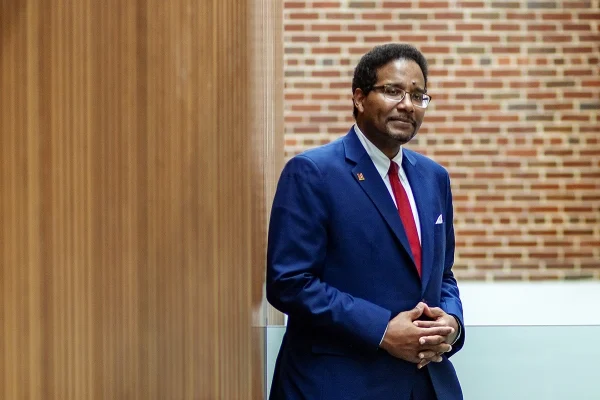
Pines was cleared of misconduct last month.
University of Maryland, College Park
The University System of Maryland and its flagship College Park institution are refusing to release the report of an investigation into whether the flagship’s president committed academic misconduct. That probe cost at least $199,999 and may have cost up to $600,000, The Baltimore Banner reported.
In fall 2024, The Daily Wire, a conservative news outlet, alleged that President Darryll Pines lifted 1,500 words from a tutorial website for a 5,000-word paper he co-authored in 2002 and later reused that same text for a 2006 publication. Pines said the claims were meritless, but Joshua Altmann, who wrote the text Pines was accused of lifting, told Inside Higher Ed, “I do consider it to be plagiarism.”
The investigation, led by a law firm, extended to other articles Pines wrote, and it took more than a year. On Dec. 12, system officials released a statement saying an investigation committee “found no evidence of misconduct on the part of President Pines.”
“The committee did determine that the two works highlighted last year contained select portions of text previously published by another author in the introductory sections,” the statement said. “In a separate text, a discrepancy in assignment of authorship was made. However, President Pines was not found responsible for the inclusion of such text in any of the three works, nor was he found responsible for scholarly misconduct of any kind.”
But neither the system nor College Park released the investigative report. College Park spokesperson Katie Lawson referred Inside Higher Ed’s request for the report to the University System of Maryland. System spokesperson Michael Sandler wrote in an email that, “as a personnel record under the Maryland Public Information Act and per UMD’s Policy on Integrity and Responsible Conduct in Scholarly Work, the report is confidential.”
The Banner, citing documents it received through a public records request, reported that Ropes & Gray, the international law firm hired for the investigation, had a $1,200 hourly billing rate, was paid $199,999 during an “inquiry phase” and received another contract that allowed the total to grow no larger than $600,000.