
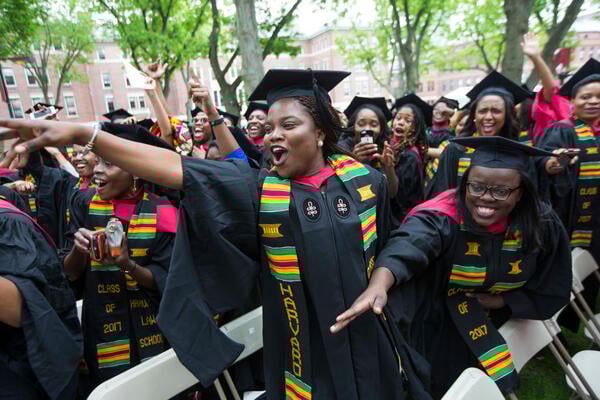
For years, Black students gathered at the University of Cincinnati’s African American Cultural and Resource Center for its traditions, including the Tyehimba Black Graduation Celebration and Akwaaba, a welcome event for new students, among other programs. This year, the AACRC, at least as it once existed, is gone. It’s been rebranded “the Cultural Center” after an Ohio law banned diversity, equity and inclusion activities at public colleges and universities in March.
But Black students and alumni wouldn’t let the center’s traditions and resources die. Black seniors celebrated their graduations at an event held off campus. Freshmen gathered for Akwaaba, organized by students and funded by alumni, who created a foundation to sustain the AACRC’s programming. The United Black Student Association and other student groups have committed to putting on programs throughout the year that were previously handled by AACRC staff.
“Regardless of these changes, there is no policy that can be written that can outlaw OUR spirit, OUR ability to mobilize, OUR right to congregate,” the United Black Student Association wrote on Instagram. “They cannot outlaw our ability to gather, to build, to resist, and to love. Our legacy is not theirs to give or take.”
Amid an escalating anti-DEI movement, students, alumni and off-campus advocates are hustling to fill the gaps left by shuttered and rebranded identity centers, DEI offices and programs across the country. Students and outside organizations, like the Native Forward Scholars Fund, hosted their own affinity group graduations this year as campuses started to cancel such events. Three student clubs broke off from the University of Utah to avoid the state’s limits on public university programs, forgoing university funding. Some students and alumni involved in these efforts say they feel a renewed pressure and responsibility to provide the services colleges are shedding as institutions are caught in the crosshairs of state DEI bans and the Trump administration’s sweeping anti-DEI campaign.
How do we make lemonade out of a lemon?”
—Harlan Jackson, president of the Cincy Cultural Resource Center Foundation
The Cincy Cultural Resource Center Foundation, the nonprofit founded to continue Black student programming at University of Cincinnati, was born out of that sense of duty among alumni. Some graduates involved in the effort spent years pushing for the creation of the African American Cultural and Resource Center and took pride in watching its programs expand and flourish.
“We can’t just stand idly by and just allow something this negative and something this backward to happen at the university,” said Harlan Jackson, president of the foundation and former president of the United Black Association in the late 1980s. “I’m really proud of the diverse community that’s showing up and acknowledging that we’re going to take this on.”
The foundation now has weekly meetings with Black student leaders to determine how best to support their needs, and alumni leaders plan to put three students on the foundation’s board. Students emphasized to alumni that continuing the center’s events and traditions is their top priority, so the foundation is funding these programs, with hopes to also fund student scholarships in the future.
So far, alumni have raised “well over” the roughly $5,000 needed to run Akwaaba and parents’ weekend, with plans to raise half a million dollars within the academic year, said Byron Stallworth, the foundation’s secretary.
Stallworth, who was president of the United Black Association in 1991 when the AACRC opened, said the idea of alumni and students taking the reins is catching on beyond University of Cincinnati as well—three University of Cincinnati alumni, parents of students at other colleges and universities, have asked him questions about how they could start similar efforts to sustain Black student life on their children’s campuses.
“This is a universal problem,” he said, and alumni elsewhere “are aware of what we’re doing.”
Jackson noted that while the rebranding of the AACRC hits close to home, programs and centers dedicated to supports for women and LGBTQ+ students have also suffered cuts because of the Ohio anti-DEI legislation.
He hopes other Ohioans “can look to this model, and we can determine … How do we connect? How do we share? How do we learn? How do we build bridges and partnerships to continue to support the young people developing themselves in the state of Ohio?” he said. “That’s what it’s all about.”
Pressures New and Old
Even with such support, students fighting to keep programs alive without university backing hasn’t necessarily been easy.
Isaac Makanda, co-head of the juvenile justice and political action committee for University of Cincinnati’s NAACP chapter, said students and alumni can’t completely make up for the loss of the African American Cultural and Resource Center. He described running into a Black first-year on campus who didn’t know about Akwaaba or other events happening for Black students on campus. He believes that’s because the new students are without a hub.
When Makanda was a freshman, the AACRC sent out emails telling incoming Black students about events and programs, he said. This student “had no idea about any of these things that were going on because those resources were taken away from him.”
Some student groups have also had to hustle for funding to keep their events running. The Pacific Islander Student Association, which cut ties with the University of Utah alongside the Black Student Union, lost its student group funding in the separation. PISA used to receive at least $5,000 annually from the university, so that loss was a “major hit,” said Mayette Pahulu, vice president of the group.
But she and other student leaders felt it was worth it to have full control over their programming after Utah’s anti-DEI bill became law last year. They didn’t want to be limited by the new strictures on public universities, “whether that be talking about certain subjects, encouraging our members to have their own rights … to host socials that are specific to our heritage, cultures and ethnicities,” Pahulu said. “We would rather lose the funding than our members lose a safe space.”
Now the group raises its own money. PISA student leaders have an ongoing GoFundMe campaign and seek out sponsors for event costs, including the nominal fees required for outside groups to host programs on campuses.
We would rather lose the funding than our members lose a safe space.”
—Mayette Pahulu, vice president of the Pacific Islander Student Association at the University of Utah
Pahulu said the students’ new responsibilities have pros and cons. On one hand, she and other student leaders find themselves pushing hard, with less support, to engage students who are feeling unwelcome on campus amid changes wrought by Utah’s anti-DEI legislation. On the other hand, she believes the new connections they’ve had to make with other student groups, community organizations and businesses to sustain their work could bode well for PISA’s future.
“Even though we’ve taken kind of the short end of the stick, having to scramble around to find these organizations, we’ve honestly started to build a bigger community and network,” she said. “I think in the long run, it will benefit us … We’re working with representatives to get these supports put in place so that the longevity and the sustainability of our organizations can outlast—no matter how drastic the changes may be politically.”
Jackson, the University of Cincinnati alum, said in a similar vein that he’s proud to see students and alumni making the best of the raw deal they’ve been given.
As universities strip away programs at the behest of state lawmakers, “all they’ve done is put more burden on the students,” Harlan said. At the same time, “it gives them opportunity to network with the community, more opportunity to do planning and budgeting, more opportunity to lead in terms of putting together programs and executing programs.” The question is “How do we make lemonade out of a lemon?”
Keisha Bross, director of race and justice at the NAACP, said student organizations—like Black student unions, NAACP chapters and the group of Black sororities and fraternities known as the Divine Nine—have always provided supports and programming for Black students in areas where universities have failed to do so. These groups “stepping in” to fill unmet needs is their “legacy,” she said. But she doesn’t believe the work students are doing, and have historically done, should allow universities to “get off easy” for cutting back programs dedicated to their success.
“We cannot allow colleges to make these really traumatic decisions that are hurting student populations and their leadership, and then just say, ‘Oh well,’” Bross said. “We need to continue to hold universities accountable, because they have a responsibility to the students that they serve. Universities have and should be providing these resources to their students, 100 percent.”