For many institutions of higher education (including the one I work for), Coursera is an important online learning partner. Therefore, it was a big deal when Coursera announced earlier this year that Greg Hart was taking over as CEO from Jeff Maggioncalda. This space seemed like a good place to begin to get to know Greg, and he graciously agreed to answer my questions.
Q: You’ve spent the majority of your career at Amazon, so education is a new space for you. What do you want universities to know about how you’ll approach partnerships, and how will your background influence how you lead Coursera?
A: My background is rooted in building and scaling technology-driven businesses that serve millions of customers. At Amazon, I led the creation and launch of Alexa and later served as the global head of Prime Video. Those roles shaped how I think about innovation, long-term customer value and meaningful experiences at scale. While higher education is a new sector for me, there are clear parallels: At Amazon, we solved enduring customer problems through technology. That same principle applies at Coursera—learners are seeking flexible, high-quality and job-relevant education, often in moments that define the trajectory of their lives. Both our university and industry partners are working with us to meet these evolving needs with world-class learning content, enabled by our platform’s ability to deliver personalized learning experiences at scale.
What makes this work especially meaningful is the higher stakes involved. We’re not just helping people shop or stream content—we’re helping them transform their lives through access to learning. That sense of purpose is what drew me to Coursera. I approach our university partnerships with deep respect for the role higher education plays in society, and I see my responsibility as ensuring Coursera is a trusted, effective and mission-aligned partner for institutions around the world.
Q: Can you update us on Coursera’s business, focusing on the biggest growth drivers and challenges? How confident can universities be in Coursera’s long-term financial resilience as a strategic partner?
A: Coursera is where the world comes to gain new skills and learn from the most trusted institutions. Content is the engine of our business and the foundation of our ecosystem. Today, we partner with more than 350 leading universities and companies, offering job-relevant content across a wide range of domains, including technology, business, AI and data science.
This catalog has attracted more than 175 million learners globally, including more than seven million new registered learners in the first quarter of this year alone. Many learners come to Coursera directly through our platform, while a growing number access content through institutional settings via our enterprise offerings. This entire ecosystem is powered by a unified platform that enables our partners to reach a global audience at scale, leverage data to inform content strategy and skills recommendations and harness advanced AI tools to drive personalized learning and discovery.
Since going public in 2021, we’ve operated as responsible stewards of our capital, balancing disciplined cost management with long-term investments in growing our business and advancing our mission. Coursera is in an extremely stable position financially: We are growing, we generate positive free cash flow, we have a very healthy balance sheet and we have no debt.
In Q1 2025, we delivered $179 million in revenue, up 6 percent year over year on growth in our consumer and enterprise segments and generated over $25 million in free cash flow, marking our strongest quarter of cash performance to date. Based on this strong start, we now expect full-year 2025 revenue to be between $720–730 million, with annual adjusted EBITDA margin improvement of 100 basis points to 7 percent—an outlook that reflects both durable demand and growing operating leverage. As of March 31, 2025, we have approximately $748 million in unrestricted cash and no debt, giving us both the stability and flexibility to invest in platform innovation, expand our content ecosystem and continue supporting our partners and learners around the world.
Q: Given your background in industry, do you see more value in partnerships and content from businesses, like industry microcredentials? How do colleges and degrees factor into your long-term vision?
A: Coursera was founded in 2012 by two Stanford professors, Andrew Ng and Daphne Koller. Universities are, and will continue to be, central to Coursera’s mission and strategy—especially in an era shaped by generative AI, where enduring human skills and trusted credentials are more important than ever. University content is vital not only to degree programs, but also to our offerings for individuals, businesses and governments. Some of our most popular courses are from top university instructors—Jules White of Vanderbilt, Vic Strecher of Michigan, Laurie Santos of Yale and Sydney Finkelstein of Dartmouth.
We do not view degrees and nondegree programs as competing priorities. Rather, we believe in building an interconnected ecosystem that gives learners the flexibility to start with entry-level microcredentials, build towards academic credit and ultimately stack into full degrees. Today, 90-plus entry-level professional certificates are offered by our industry partners, and a third of them carry credit recommendations, making them a natural on-ramp to higher education. Our degree portfolio has expanded to over 50 programs and remains a strategic component of our consumer offering.
Is something in the water—or, more appropriately, in the algorithm? Cheating—while nothing new, even in the age of generative artificial intelligence—seems to be having a moment, from the New York magazine article about “everyone” ChatGPTing their way through college to Columbia University suspending a student who created an AI tool to cheat on “everything” and viral faculty social media posts like this one: “I just failed a student for submitting an AI-written research paper, and she sent me an obviously AI-written email apologizing, asking if there is anything she can do to improve her grade. We are through the looking-glass, folks.”
It’s impossible to get a true read on the situation by virality alone, as the zeitgeist is self-amplifying. Case in point: The suspended Columbia student, Chungin “Roy” Lee is a main character in the New York magazine piece. Student self-reports of AI use may also be unreliable: According to Educause’s recent Students and Technology Report, some 43 percent of students surveyed said they do not use AI in their coursework; 5 percent said they use AI to generate material that they edit before submitting, and just 1 percent said they submit generated material without editing it.
There are certainly students who do not use generative AI and students who question faculty use of AI—and myriad ways that students can use generative AI to support their learning and not cheat. But the student data paints a different picture than the one presidents, provosts, deans and other senior leaders did in a recent survey by the American Association of Colleges and Universities and Elon University: Some 59 percent said cheating has increased since generative AI tools have become widely available, with 21 percent noting a significant increase—and 54 percent do not think their institution’s faculty are effective in recognizing generative Al–created content.
In Inside Higher Ed’s 2025 Survey of Campus Chief Technology/Information Officers, released earlier this month, no CTO said that generative AI has proven to be an extreme risk to academic integrity at their institution. But most—three in four—said that it has proven to be a moderate (59 percent) or significant (15 percent) risk. This is the first time the annual survey with Hanover Research asked how concerns about academic integrity have actually borne out: Last year, six in 10 CTOs expressed some degree of concern about the risk generative AI posed to academic integrity.
Stephen Cicirelli, the lecturer of English at Saint Peter’s University whose “looking glass” post was liked 156,000 times in 24 hours last week, told Inside Higher Ed that cheating has “definitely” gotten more pervasive within the last semester. But whether it’s suddenly gotten worse or has been steadily growing since large language models were introduced to the masses in late 2022, one thing is clear: AI-assisted cheating is a problem, and it won’t get better on its own.
So what can institutions do about it? Drawing on some additional insights from the CTO survey and advice from other experts, we’ve compiled a list of suggestions below. The expert insights, in particular, are varied. But a unifying theme is that cheating in the age of generative AI is as much a problem requiring intervention as it is a mirror—one reflecting larger challenges and opportunities within higher education.
(Note: AI detection tools did not make this particular list. Even though they have fans among the faculty, who tend to point out that some tools are more accurate than others, such tools remainpolarizing and not entirely foolproof. Similarly, banning generative AI in the classroom did not make the list, though this may still be a widespread practice: 52 percent of students in the Educause survey said that most or all of their instructors prohibit the use of AI.)
Academic Integrity for Students
The American Association of Colleges and Universities and Elon University this month released the 2025 Student Guide to Artificial Intelligence under a Creative Commons license. The guide covers AI ethics, academic integrity and AI, career plans for the AI age, and an AI toolbox. It encourages students to use AI responsibly, critically assess its influence and join conversations about its future. The guide’s seven core principles are:
Know and follow your college’s rules
Learn about AI
Do the right thing
Think beyond your major
Commit to lifelong learning
Prioritize privacy and security
Cultivate your human abilities
Connie Ledoux Book, president of Elon, told Inside Higher Ed that the university sought to make ethics a central part of the student guide, with campus AI integration discussions revealing student support for “open and transparent dialogue about the use of AI.” Students “also bear a great deal of responsibility,” she said. They “told us they don’t like it when their peers use AI to gain unfair advantages on assignments. They want faculty to be crystal clear in their syllabi about when and how AI tools can be used.”
Now is a “defining moment for higher education leadership—not only to respond to AI, but to shape a future where academic integrity and technological innovation go hand in hand,” Book added. “Institutions must lead with clarity, consistency and care to prepare students for a world where ethical AI use is a professional expectation, not just a classroom rule.”
Mirror Logic
Lead from the top on AI. In Inside Higher Ed’s recent survey, just 11 percent of CTOs said their institution has a comprehensive AI strategy, and roughlyone in three CTOs (35 percent) at least somewhat agreed that their institution is handling the rise of AI adeptly. The sample size for the survey is 108 CTOs—relatively small—but those who said their institution is handling the rise of AI adeptly were more likely than the group over all to say that senior leaders at their institution are engaged in AI discussions and that effective channels exist between IT and academic affairs for communication on AI policy and other issues (both 92 percent).
Additionally, CTOs who said that generative AI had proven to be a low to nonexistent risk to academic integrity were more likely to report having some kind of institutionwide policy or policies governing the use of AI than were CTOs who reported a moderate or significant risk (81 percent versus 64 percent, respectively). Leading on AI can mean granting students institutional access to AI tools, the rollout of which often includes larger AI literacy efforts.
(Re)define cheating. Lee Rainie, director of the Imagining the Digital Future Center at Elon, said, “The first thing to tackle is the very definition of cheating itself. What constitutes legitimate use of AI and what is out of bounds?” In the AAC&U and Elon survey that Rainie co-led, for example, “there was strong evidence that the definitional issues are not entirely resolved,” even among top academic administrators. Leaders didn’t always agree whether hypothetical scenarios described appropriate uses of AI or not: For one example—in which a student used AI to generate a detailed outline for a paper and then used the outline to write the paper—“the verdict was completely split,”Rainie said. Clearly, it’s “a perfect recipe for confusion and miscommunication.”
Rainie’s additional action items, with implications for all areas of the institution:
Create clear guidelines for appropriate and inappropriate use of AI throughout the university.
Include in the academic code of conduct a “broad statement about the institution’s general position on AI and its place in teaching and learning,” allowing for a “spectrum” of faculty positions on AI.
Promote faculty and student clarity as to the “rules of the road in assignments.”
Establish “protocols of proof” that students can use to demonstrate they did the work.
Rainie suggested that CTOs, in particular, might be useful regarding this last point, as such proof could include watermarking content, creating NFTs and more.
Put it in the syllabus! (And in the institutional DNA.) Melik Khoury, president and CEO of Unity Environmental University in Maine, who’s publicly shared his thoughts on “leadership in an intelligent era of AI,” including how he uses generative AI, told Inside Higher Ed that “AI is not cheating. What is cheating is our unwillingness to rethink outdated assessment models while expecting students to operate in a completely transformed world. We are just beginning to tackle that ourselves, and it will take time. But at least we are starting from a position of ‘We need to adapt as an institution,’ and we are hiring learning designers to help our subject matter experts adapt to the future of learning.”
As for students, Khoury said the university has been explicit “about what AI is capable of and what it doesn’t do as well or as reliably” and encourages them to recognize their “agency and responsibility.” Here’s an excerpt of language that Khoury said appears in every course syllabus:
“You are accountable for ensuring the accuracy of factual statements and citations produced by generative AI. Therefore, you should review and verify all such information prior to submitting any assignment.
“Remember that many assignments require you to use in-text citations to acknowledge the origin of ideas. It is your responsibility to include these citations and to verify their source and appropriateness.
“You are accountable for ensuring that all work submitted is free from plagiarism, including content generated with AI assistance.
“Do not list generative AI as a co-author of your work. You alone are responsible.”
Additional policy language recommends that students:
Acknowledge use of generative AI for course submissions.
Disclose the full extent of how and where they used generative AI in the assignment.
Retain a complete transcript of generative AI usage (including source and date stamp).
“We assume that students will use AI. We suggest constructive ways they might use it for certain tasks,” Khoury said. “But, significantly, we design tasks that cannot be satisfactorily completed without student engagement beyond producing a response or [just] finding the right answer—something that AI can do for them very easily.”
In tandem with a larger cultural shift around our ideas about education, we need major changes to the way we do college.”
—Emily Pitts Donahoe, associate director of instructional support in the Center for Excellence in Teaching and Learning and lecturer of writing and rhetoric at the University of Mississippi
Design courses with and for AI. Keith Quesenberry, professor of marketing at Messiah University in Pennsylvania, said he thinks less about cheating, which can create an “adversarial me-versus-them dynamic,” and more about pedagogy. This has meant wrestling with a common criticism of higher education—that it’s not preparing students for the world of work in the age of AI—and the reality that no one’s quite sure what that future will look like. Quesenberry said he ended up spending all of last summer trying to figure out how “a marketer should and shouldn’t use AI,” creating and testing frameworks, ultimately vetting his own courses’ assignments: “I added detailed instructions for how and how not to use AI specifically for that assignment’s tasks or requirements. I also explain why, such as considering whether marketing materials can be copyrighted for your company or client. I give them guidance on how to cite their AI use.” He also created a specialized chat bot to which students can upload approved resources to act as an AI tutor.
Quesenberry also talks to students about learning with AI “from the perspective of obtaining a job.” That is, students need a foundation of disciplinary knowledge on which to create AI prompts and judge output. And they can’t rely on generative AI to speak or think for them during interviews, networking and with clients.
There are “a lot of professors quietly working very hard to integrate AI into their courses and programs that benefit their disciplines and students,” he adds. One thing that would help them, in Quesenberry’s view? Faculty institutional access to the most advanced AI tools.
Give faculty time and training. Tricia Bertram Gallant, director of the academic integrity office and Triton Testing Center at the University of California, San Diego, and co-author of the new book The Opposite of Cheating: Teaching for Integrity in the Age of AI (University of Oklahoma Press), said that cheating part of human nature—and that faculty need time, training and support to “design educational environments that make cheating the exception and integrity the norm” in this new era of generative AI.
Faculty “cannot be expected to rebuild the plane while flying it,” she said. “They need course release time to redesign that same course, or they need a summer stipend. They also need the help of those trained in pedagogy, assessment design and instructional design, as most faculty did not receive that training while completing their Ph.D.s.” Gallant also floated the idea of AI fellows, or disciplinary faculty peers who are trained on how to use generative AI in the classroom and then to “share, coach and mentor their peers.”
Students, meanwhile, need training in AI literacy, “which includes how to determine if they’re using it ethically or unethically. Students are confused, and they’re also facing immense temptations and opportunities to cognitively offload to these tools,” Gallant added.
Teach first-year students about AI literacy. Chris Ostro, an assistant teaching professor and instructional designer focused on AI at the University of Colorado at Boulder, offers professional development on his “mosaic approach” to writing in the classroom—which includes having students sign a standardized disclosure form about how and where they’ve used AI in their assignments. He told Inside Higher Ed that he’s redesigned his own first-year writing course to address AI literacy, but he is concerned about students across higher education who may never get such explicit instruction. For that reason, he thinks there should be mandatory first-year classes for all students about AI and ethics. “This could also serve as a level-setting opportunity,” he said, referring to “tech gaps,” or the effects of the larger digital divide on incoming students.
Regarding student readiness, Ostro also said that most of the “unethical” AI use by students is “a form of self-treatment for the huge and pervasive learning deficits many students have from the pandemic.” One student he recently flagged for possible cheating, for example, had largely written an essay on her own but then ran it through a large language model, prompting it to make the paper more polished. This kind of use arguably reflects some students’ lack of confidence in their writing skills, not an outright desire to offload the difficult and necessary work of writing to think critically.
Think about grading (and why students cheat in the first place). Emily Pitts Donahoe, associate director of instructional support in the Center for Excellence in Teaching and Learning and lecturer of writing and rhetoric at the University of Mississippi, co-wrote an essay two years ago with two students about why students cheat. They said much of it came down to an overemphasis on grades: “Students are more likely to engage in academic dishonesty when their focus, or the perceived focus of the class, is on grading.” The piece proposed the following solutions, inspired by the larger trend of ungrading:
Allow students to reattempt or revise their work.
Refocus on formative feedback to improve rather than summative feedback to evaluate.
Incorporate self-assessment.
Donahoe said last week, “I stand by every claim that we make in the 2023 piece—and it all feels heightened two years later.” The problems with AI misuse “have become more acute, and between this and the larger sociopolitical climate, instructors are reaching unsustainable levels of burnout. The actions we recommend at the end of the piece remain good starting points, but they are by no means solutions to the big, complex problem we’re facing.”
Framing cheating as a structural issue, Donahoe said students have been “conditioned to see education as a transaction, a series of tokens to be exchanged for a credential, which can then be exchanged for a high-paying job—in an economy where such jobs are harder and harder to come by.” And it’s hard to fault students for that view, she continued, as they receive little messaging to the contrary.
Like the problem, the solution set is structural, Donahoe explained: “In tandem with a larger cultural shift around our ideas about education, we need major changes to the way we do college. Smaller class sizes in which students and teachers can form real relationships; more time, training and support for instructors; fundamental changes to how we grade and how we think about grades; more public funding for education so that we can make these things happen.”
With none of this apparently forthcoming, faculty can at least help reorient students’ ideas about school andtry to “harness their motivation to learn.”
One of the challenges for students entering the workforce is identifying how their experiences in and outside the classroom have prepared them for careers. A 2023 survey by Cengage found that one-third of recent graduates felt underqualified for entry-level roles, and only 41 percent believed their program taught them the skills needed for their first job.
Focused career development opportunities that address unique learner populations, such as working or neurodiverse students, can help bridge the gap between lived experiences and their application to the world of jobs.
Inside Higher Ed compiled various initiatives that increase career readiness for specific student populations.
Neurodiverse Learners
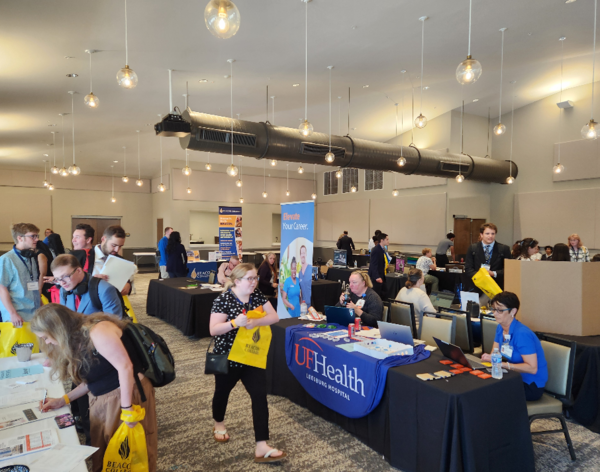
Beacon College in Leesburg, Fla., primarily serves students with learning disabilities, including ADHD and dyslexia. Last year the college established a career fair designed for these learners, which introduces them to employers looking to develop a neurodiverse talent workforce.
Survey Says
Just under half of college students believe their college or university should focus more on helping students find internships and job possibilities, according to a May 2024 Student Voice survey by Inside Higher Ed and Generation Lab.
This spring’s event, Internship Careers and Neurodiversity (ICAN), featured two dozen national and local employers. Success coaches were on site to support students and employers as they engaged with one another, and students could visit the Zen Den if they needed a quiet and private space to process.
ICAN “is designed to remove barriers and reduce anxiety often associated with large-scale ‘convention center’ type events, so Beacon College can empower neurodivergent college students and help increase their participation in networking events elsewhere,” according to an April press release.
Student Athletes
Student athletes have packed schedules while they’re in season, making it difficult to balance athletics, coursework and extracurricular activities, which can sometimes push career development opportunities to the background.
To help student athletes build their confidence in professional settings, Kennesaw State University created a “networking scrimmage” with employers so learners could practice introducing themselves, relay their academic and athletic accomplishments, and discuss career interests in a low-stakes environment, according to a university press release.
Students also heard from three former student athletes who shared their stories of transitioning from sports into the workforce, as well as advice on how to navigate postcollege life.
Adult Learners
In 2023, the University of Phoenix created a digital tool that allows working adult learners to identify skills and goals that will guide them on their career journey.
Students can access Career Navigator through the student portal. The tool allows them to build out demonstrated and self-attested skills and explore job features, including daily tasks and salary range, as well as identify skill gaps they may have when pursuing their desired career.
Student Veterans
After leaving military service, many veterans enroll in college to build career skills and gain further education, but connecting their military experience to civilian life can be a challenge.
The University of Colorado, Denver, provides a one-year cohort program for student veterans, Boots to Suits, to aid their journey, providing personalized academic and career-development resources. Program participants receive job search strategies and career coaching, as well as advice on networking and building their LinkedIn profile and résumé.
Major Programs
While general career fairs and networking opportunities can give students visibility into employers or roles they may not otherwise have considered, tailored events can connect students of a particular discipline to employers looking for their expertise.
Staff at Villanova University identified a problem at their career fairs: The number of employers looking for early-career civil engineers far overshadowed the number of students interested in such jobs. In response, staff created a new event specifically for civil engineering students, allowing employers to connect with potential interns earlier in their college career while also ensuring that students who were interested in other fields were able to engage with organizations that better fit their career goals.
The University of Maryland hosts a Visual Arts Reverse Career and Internship Fair, a flipped model of the career fair in which employers visit a student’s table or booth to engage with their portfolio of work. This allows students to display graphic design, video production and immersive media skills in an engaging way that better reflects their learning and accomplishments.
Do you have a career-focused intervention that might help others promote student success? Tell us about it.
As Pennsylvania State University’s Board of Trustees prepares to decide the fate of seven of its 19 Commonwealth Campuses where enrollment has collapsed over a decade, faculty, lawmakers and some board members are questioning the university’s commitment to the state and say administrators haven’t been transparent about their decision-making process.
University administrators say the enrollment numbers alone don’t support keeping open the seven campuses slated to close. Several of those campuses have seen enrollment fall by more than 40 percent since fall 2014.
Penn State’s Board of Trustees met last week in a private executive session but did not vote on the plan. They’re expected to do so Thursday.
President Neeli Bendapudi has made the case for the closures, arguing such actions are necessary, as the university can no longer sustain all of its branch campuses financially amid severe enrollment declines. She proposed closing the Dubois, Fayette, Mont Alto, New Kensington, Shenango, Wilkes-Barre and York campuses. Those campuses enroll almost 3,200 students altogether, the largest of which is Penn State York with 703 students last fall. The smallest is Shenango, which enrolled 309 students in fall 2024.
Now, as the proposal nears the finish line, its fate is up the air and Bendapudi is facing concerns about the process of reaching the seven names.
A ‘Difficult But Necessary’ Plan
University leadership began drawing up those plans in February after a difficult year for higher education across the Keystone State. Four universities in the state shut down (or ended degree programs, as in the case of the Pennsylvania Academy of the Fine Arts) in 2024. The closures were mostly brought on by enrollment challenges, though some were dogged by concerns about fiscal mismanagement.
University administrators spent the last several months reviewing 12 campuses for possible closure before the list of seven leaked to media outlets last week.
Officials in a 143-page document cast the plan as “difficult but necessary decisions to ensure its long-term sustainability, allowing for continued investment in student success and dynamic learning environments for years to come” amid plunging enrollment and broad demographic challenges.
Officials argued that the seven campuses identified for closure “face overlapping challenges, including enrollment and financial decline, low housing occupancy, and significant maintenance backlog.” They added that “projected low enrollments pose challenges for creating the kind of robust on-campus student experience that is consistent with the Penn State brand” and would require significant investments, including $200 million for facilities alone.
“I believe the recommendation balances our need to adapt to the changing needs of Pennsylvania with compassion for those these decisions affect, both within Penn State and across the commonwealth,” Bendapudi said in a statement when the plan was released.
She added that there is a two-year timeline for closing campuses, so they wouldn’t shut down until the end of the spring 2027 semester.
Now the plan heads to the 36-member Board of Trustees. However, some trustees have openly expressed their opposition to the proposal.
In an interview with Inside Higher Ed, Paterno criticized the proposal as rushed.
“We’ve been presented with two options. One is the status quo, which everybody knows is not viable and is kind of a straw man. The other option is to close all seven campuses,” he said.
Given that the costs of operating those campuses comprise “less than half of 1 percent of our budget,” Paterno said the board should take more time to explore solutions. He argues that the university has not tried to leverage fundraising to support struggling Commonwealth Campuses and that the administration should slow the process down and reach out to potential donors.
“We’d rather be a year late than a day early,” Paterno said.
He also noted the decision to close campuses is not Penn State’s alone. The university is state-affiliated but not state-owned, which gives it a greater degree of autonomy than fully public institutions. But since the university receives some public funds, it must submit plans to close campuses to the Pennsylvania secretary of education, who must then approve the proposal.
‘A Betrayal’
Faculty have concerns about job losses, what will become of rural student populations and an alleged lack of transparency in the closure process.
One faculty member at Penn State Wilkes-Barre, speaking anonymously due to concerns about retribution, noted, “While most faculty saw this coming, it was heartbreaking to see it in writing.”
They questioned Penn State’s support for its Commonwealth Campuses, arguing that “the decision to decrease funding” to those locations that serve in-state students sends a strong message about where Penn State places its priorities” while it invests heavily in its main campus. They also pointed to renovations at Beaver Stadium projected to cost $700 million.
(That project is believed to be the most expensive renovation in the history of college athletics.)
“The lack of shared governance, transparency, and respect for contributions of faculty to Penn State University makes it easy to see why unionization efforts among faculty are needed,” they wrote, highlighting ongoing efforts by the Penn State Faculty Alliance and SEIU 668 to unionize.
Some state politicians have also panned the plan.
State Senator Michele Brooks, a Republican who represents a district that includes the Shenango campus, told Inside Higher Ed in an emailed statement that she recently met with trustees, who conveyed to her and others “that they feel this has been a deeply flawed process.”
She urged Penn State’s administration and governing board to re-evaluate the decision and to work “with communities on innovative ways to reinvest in these campuses and help them grow.”
Republican state representative Charity Grimm Krupa, who serves a district that includes the Fayette campus slated for closure, accused Penn State of betraying its mission in a fiery statement.
“Shutting down the Fayette campus isn’t about financial responsibility; it’s about walking away from the very students Penn State was created to serve,” Grimm Krupa said last week. “It’s a betrayal of the university’s land-grant mission and a slap in the face of rural communities. Abandoning this campus sends a clear message: if you’re not from a wealthy or urban area, Penn State doesn’t see you as worth the investment. That’s disgraceful, and I urge every trustee to vote no against these closures.”
I am currently chair of the philosophy department at the University of Utah. I have taught at “the U” for 32 years. We are a flagship but not an elite university; we admit 89 percent of applicants. Our students range from quite unprepared to extremely capable. For the most part, I have loved my job and have put my heart and soul into it. I have always been proud to be on this faculty helping students at all levels of academic readiness acquire skills in reading, writing, speaking and reasoning that enhance their lives and prepare them for virtually any job. But recently, my pride has evaporated and been replaced with feelings of grief and shame.
This year—my first as chair—has seen profound upheaval. In January 2024, shortly before my term began, the State Legislature passed an anti-DEI bill, prohibiting, among other things, offices and programs related to diversity, equity or inclusion. Administrators were required to purge these three words from university websites and other documents, such as RPT—retention, promotion and tenure review—guidelines, and the university administration interpreted the law as requiring that the Women’s Resource Center, the Black Cultural Center and the LGBT Resource Center be shuttered.
The state has also imposed a “bathroom bill” requiring trans university students to use locker rooms aligning with their sex assigned at birth, has banned Pride flags in public spaces (and in faculty offices if they can be seen through a window), and now requires faculty to post their syllabi in a publicly searchable database. It also prohibits university presidents from taking a stand on any issue that does not bear upon the “mission, role or pedagogical objectives” of the institution. And finally, as the coup de grâce for academic freedom and faculty expertise, it has funded and established the Center for Civic Excellence at Utah State University, mandating that all students take general education courses on the topics of Western civilization and the rise of Christianity. The law establishing the center identifies it as a pilot program to be rolled out to other Utah universities in the future.
Then there is the state of Utah’s version of the national campaign against alleged “waste, fraud and abuse.” Recently passed laws dictate the process by which all post-tenure reviews of faculty must be conducted, curtail shared governance and cut state funds to all Utah public institutions by 10 percent ($60.5 million). Universities can have the funds “reallocated” if they use them for high-demand, high-wage majors. As a result, we lost our History and Philosophy of Science major, which drew some of our best students, many of them double majoring in STEM subjects and working toward careers in medicine and public health. To be clear, eliminating this major will reduce opportunities for students while producing no savings whatsoever; offering it requires no additional staff, advisers or courses beyond what is already in place for our philosophy major. These funding cuts also mean that tenure-line faculty in my department will receive a zero percent raise this year.
In addition to the state’s actions, the upper administration—in seeming alignment with Facebook’s motto of “move fast and break things”—has instituted so many changes in such a short time it is hard to keep track. It abruptly revamped the advising system, brought four colleges under the umbrella of a Colleges and Schools of Liberal Arts and Sciences in a “shared services” arrangement, and keeps rolling out new “student success initiatives.” Whether these changes are wise or not, the pace at which they were made imposed a crushing amount of (mostly stultifying) work on deans and department chairs. Aside from refereeing a few manuscripts for journals, I have not read a piece of philosophy since I became chair, much less written one. In the midst of this, the dean of my college, a strong supporter of philosophy, resigned in the middle of the fall semester and was replaced by someone from outside our college, essentially putting us in receivership.
While all this is happening, my youngest child, who is queer, is deciding where to attend college. He applied to the University of Utah, where he was admitted to the Honors College and received a scholarship. But how can I send him here? I fear for his safety no matter where he lives in our current hate-filled political climate, but still I hesitate to subject him to the environment on my own campus. I will likely incur a hefty bill, then, so he can attend a university out of state.
I had more or less come to terms with this constraint, and was also managing to persevere in my job, when something happened that finally took the wind out of my sails: The president of the university announced, to the surprise of faculty, that returned missionaries from the Church of Jesus Christ of Latter-day Saints will be eligible to receive up to 12 college credits for their service to the church.
I am galled by what all this says about who matters at my university. While students like my child can’t even have a designated room on campus to hang out in with like-minded others—and while the main symbol reminding us of the existence and dignity of students like him is banned from public spaces—returned LDS missionaries, who have an entire institute across from campus dedicated to their spiritual support, can get a full semester of credit, at a greatly reduced cost, essentially for going door to door trying to persuade people to join their church. This set of priorities is so wrong-headed that it verges, for me, on surreal. And yet the administration sees no irony or hypocrisy in naming its Office of Student Experience “U Belong.”
Soon I will be hosting a retirement party for a wonderful colleague who joined the faculty one year before I did. In another era, I would have been sad to see him go but glad to be continuing in what I regard as my vocation. Now I feel nothing but envy. It is time for me, too, to retire, but, alas, that is not an option, because I have four years of out-of-state tuition to pay.
Cynthia Stark is a professor and chair of the philosophy department at the University of Utah.
When you finish a Ph.D., it often feels like you’re standing at a professional fork in the road: stay in academia or go into industry. But what if the real opportunity lies not on either of those well-worn paths, but at their intersection?
That’s where commercialization postdoctoral programs come in—an option many early-career researchers don’t know exists but for which you may be ideally suited.
These programs provide the tools to turn your research into real-world impact. They explore how discoveries made in the lab can become products, services or systems that solve real problems. And they teach you how to think like an entrepreneur, even if you don’t plan to start your own company, which many postdocs find helps them become more competitive for faculty and industry roles.
If you’re curious about how your work could make a broader impact or simply what technology transfer, commercialization or innovation looks like from inside the university, this is your invitation to learn more.
What Are Commercialization Postdocs?
At a basic level, commercialization postdoc programs support Ph.D.s learning how to move research from discovery to application. These programs fall into two general categories:
Technology transfer fellowships train you to manage intellectual property (IP), evaluate market potential and support licensing processes.
Entrepreneurial and IP commercialization fellowships let you work hands-on with university-owned (or your own) innovations to develop them for real-world use.
Both paths expand your skill set well beyond most traditional academic training and do so in a way that positions you to lead innovation in any field or sector.
You’re trained to identify gaps, solve problems and produce new knowledge. Commercialization programs help you understand how to apply those same skills in ways that create value beyond the lab or scholarly community.
Even if you don’t see yourself launching a start-up, learning to assess market needs, build relationships across disciplines and effectively communicate your research vision and unique value proposition can open doors to new kinds of funding, partnerships and diverse career prospects.
From Mindset to Practice: A Case Study in Entrepreneurial Thinking
In spring 2024, Virginia Tech worked with Archer Career to develop a program focused on helping postdocs adopt an entrepreneurial mindset. Through online modules and a full-day, in-person workshop, 19 postdocs from across multiple disciplines engaged in activities including:
Crafting elevator pitches
Identifying the innovative aspects of their research
Mapping and mobilizing their personal and professional networks
Those that attended the program said they felt it filled a gap in their knowledge and appreciated hearing from current Ph.D. entrepreneurs and connecting with peers. They also realized they weren’t alone in their questions about research commercialization and start-up company creation, and that there was space for conversations about innovation that didn’t require giving up their scholarly identities. This event also demonstrated the need for more discussions about the value of an entrepreneurial mindset among academics.
Where Commercialization Postdoc Programs Live
While commercialization postdoc programs are still emerging, there’s a growing list of opportunities across the U.S. that support Ph.D.s building critical technology transfer and entrepreneurial skills.
ASPIRE to Innovate Postdoctoral Fellowship Program—Vanderbilt University: Current Ph.D. students studying biomedical sciences and postdocs affiliated with Vanderbilt School of Medicine apply to receive mentorship, training and networking opportunities to learn how to launch a company and to commercialize technologies discovered at Vanderbilt.
Postdoctoral Entrepreneurship Program—University of Washington: This program gives strong preference to UW postdoctoral researchers or graduating Ph.D. students. It funds “commercially focused individuals” to work in UW labs on translational experiments to identify and obtain funding and to develop a business model.
Ignite Fellow for New Ventures Program—Cornell University: The program aims to build new businesses, “grow entrepreneur scientists and engineers,” and “enrich Cornell’s venture ecosystem.” The program is open to graduating Ph.D.s or master’s students working with a faculty inventor to commercialize technology developed on a Cornell campus.
Activate Fellowship: This program provides two years of support, including “funding, technical resources, and unparalleled support from a network of scientists, engineers, investors, commercial partners, and fellow entrepreneurs.” The program accepts applications in the fall of each year, with the fellowship beginning in early summer the following year. Prospective fellows can apply to work in their local ecosystem or in hubs located across the U.S.:
Runway Startup Postdoc Program—Cornell Tech: “Part business school, part research institution, and part startup incubator,” Runway is focused on digital technologies, and Startup Postdocs are provided with training, mentorship and other resources to support their growth as entrepreneurs. Startup Postdocs arrive with ideas that require time and specialized guidance to develop. The program accepts candidates from anywhere around the world.
Each of these programs offers something slightly different, but they share a common goal—to empower researchers to think beyond the bench and take an active role in translating ideas into action. The Activate Fellows and Runway program at Cornell Tech are especially unique, as they allow a Ph.D. to bring their own ideas with them. The Runway program, which to date has trained 55 postdocs, has also been featured in The Journal of Technology Transfer.
One advantage of participating in a commercialization-focused postdoc program is the access to resources that support your growth. Many programs are embedded in innovation ecosystems, such as tech transfer offices, legal support, start-up incubators and translational research centers. Some even offer seed funding or business mentorship to help you move a technology forward.
What’s Next? A Call to Action
If you’re a postdoc or advising one, you don’t need to have a ready-to-pitch product to benefit from this kind of training. You just need to be curious.
Ask yourself:
What problems does my research help solve?
Who beyond my field might care about this work?
What skills could help me turn this into something people can use?
What resources are available to me to learn more about commercializing research and entrepreneurship?
Whether you want to start a company, work at the intersection of science and policy, or simply make your research more impactful, commercialization training can help you get there.
We also need to do more, collectively, to bring visibility to commercialization programs available to Ph.D.s. This includes:
Raising awareness among graduate students and faculty mentors of the potential for impact and opportunities in commercialization.
Encouraging institutions to embed innovation and entrepreneurship training into core professional development and strengthen their innovation ecosystem.
Supporting peer communities that normalize entrepreneurial thinking in academia.
Tracking and sharing outcomes from postdocs who go through these programs.
Most importantly, we need to keep reminding ourselves and our colleagues that commercialization and entrepreneurship isn’t a detour: It’s a destination that many Ph.D.s are uniquely equipped to reach.
Final Thoughts
You don’t need to have a CEO title in your sights to benefit from entrepreneurial thinking. At its core, commercialization is about connecting your work to the world, and that’s something every researcher and scholar should know how to do. Whether through a fellowship, a campus workshop or self-guided exploration, now is a great time to start learning how your research can make a difference in the world.
And who knows? You might just discover that innovation is your next career frontier.
Chris Smith is Virginia Tech’s postdoctoral affairs program administrator. He serves on the National Postdoctoral Association’s Board of Directors and is a member of the Graduate Career Consortium—an organization providing a national voice for graduate-level career and professional development leaders.
Tomer Joshua serves as associate director of the Runway Startup and Spinouts programs at Cornell Tech and the Jacobs Technion–Cornell Institute, where he supports deep tech and digital start-ups.
Since the release of ChatGPT in 2022, instructors have worried about how students might circumvent learning by utilizing the chat bot to complete homework and other assignments. Over the years, the large language model has enabled AI to expand its database and its ability to answer more complex questions, but can it replace a student’s efforts entirely?
Graduate students at the University of Illinois at Urbana-Champaign’s college of engineering integrated a large language model into an undergraduate aerospace engineering course to evaluate its performance compared to the average student’s work.
The researchers, Gokul Puthumanaillam and Melkior Ornik, found that ChatGPT earned a passing grade in the course without much prompt engineering, but the chat bot didn’t demonstrate understanding or comprehension of high-level concepts. Their work illustrating its capabilities and limitations was published on the open-access platform arXiv, operated by Cornell Tech.
The background: LLMs can tackle a variety of tasks, including creative writing and technical analysis, prompting concerns over students’ academic integrity in higher education.
Researchers sought to understand how a student investing minimal effort would perform in a course by offloading work to ChatGPT.
The evaluated class, Aerospace Control Systems, which was offered in fall 2024, is a required junior-level course for aerospace engineering students. During the term, students submit approximately 115 deliverables, including homework problems, two midterm exams and three programming projects.
“The course structure emphasizes progressive complexity in both theoretical understanding and practical application,” the research authors wrote in their paper.
They copied and pasted questions or uploaded screenshots of questions into a free version of the chat bot without additional guidance, mimicking a student who is investing minimal time in their coursework.
The results: At the end of the term, ChatGPT achieved a B grade (82.2 percent), slightly below the class average of 85 percent. But it didn’t excel at all assignment types.
On practice problems, the LLM earned a 90.4 percent average (compared to the class average of 91.4 percent), performing the best on multiple-choice questions. ChatGPT received a higher exam average (89.7 percent) compared to the class (84.8 percent), but it faltered much more on the written sections than on the autograded components.
ChatGPT demonstrated its worst performance in programming projects. While it had sound mathematical reasoning to theoretical questions, the model’s explanation was rigid and template-like, not adapting to the specific nuances of the problem, researchers wrote. It also created inefficient or overly complex solutions to programming, lacking “the optimization and robustness of considerations that characterize high-quality student submissions,” according to the article.
The findings demonstrate that AI is capable of passing a rigorous undergraduate course, but that LLM systems can only accomplish pattern recognition rather than deep understanding. The results also indicated to researchers that well-designed coursework can evaluate students’ capabilities in engineering.
So what? Based on their findings, researchers recommend faculty members integrate project work and open-ended design challenges to evaluate students’ understanding and technical capabilities, particularly in synthesizing information and making practical judgements.
In the same vein, they suggested that faculty should design questions that evaluate human expertise by requiring students to explain their rationale or justify their response, rather than just arrive at the correct answer.
ChatGPT was also unable to grasp system integration, robustness and optimization over basic implementation, so focusing on these requirements would provide better evaluation metrics.
Researchers also noted that because ChatGPT is capable of answering practice problems, instruction should focus less on routine technical work and more on higher-level engineering concepts and problem-solving skills. “The challenge ahead lies not in preventing AI use, but in developing educational approaches that leverage these tools while continuing to cultivate genuine engineering expertise,” researchers wrote.
Under a new accountability measure recently proposed as part of a larger House budget bill, colleges would have to pay millions of dollars each year to reimburse the government for their students’ unpaid loans.
The plan builds on an idea—known as risk-sharing—that lawmakers and policy analysts have been toying with since at least 2015. As the federal student loan portfolio grew, the goal was to require colleges to have some skin in the game and incentivize them to improve student outcomes.
And while the concept has gained some bipartisan support in theory, higher education institutions have repeatedly argued that it is difficult to create a fair accountability system when many of the variables involved are out of an institution’s control and depend on the decisions of individual students and borrowers.
So far, the higher ed lobby has successfully defeated proposed risk-sharing plans such as the one included in a Republican bill from the last Congress, known as the College Cost Reduction Act. But now, an almost identical proposal is back and at the heart of House Republicans’ plan to cut at least $330 billion from higher education programs over the next 10 years. The overall legislation, which aims to cut $1.5 trillion from the budget, could receive a vote on the House floor this week, though some lawmakers have threatened to block the measure amid concerns that it doesn’t include deeper cuts. Even if the bill fails, it serves as a marker of what House Republicans hope to accomplish moving forward.
Many higher education policy experts warn that practically speaking, the latest risk-sharing plan relies on a complicated formula that’s essentially a black box. Released in late April, the proposal has not been tested enough to know its ramifications, they say, and the limited data available is inconclusive. Some analyses released by conservative groups say the program will be a financial boost for efficient public institutions and penalize bloated private ones. But one study conducted by a lobbying group suggests that public regional and minority-serving institutions that serve high populations of low-income students will get hit the hardest.
“Fundamentally it’s an astonishing level of federal overreach to essentially lump in all institutions of higher education together—public, private, for-profit—and run a convoluted formula to determine winners and losers at the federal level and then redistribute funding,” said Craig Lindwarm, senior vice president of government affairs for the Association of Public and Land-grant Universities.
Democratic politicians also argue that the purpose of the legislation is not truly to hold colleges accountable for student outcomes like graduation rates and income levels, but to crack down on what the government considers overly liberal institutions and fund President Donald Trump’s priorities.
Even some conservative supporters acknowledge that it’s difficult to know the full scope of the bill’s potential impact this early. But they say risk-sharing is a necessary tool to penalize colleges that provide a poor return on investment and ensure the production of a well-prepared, financially stable workforce. They also suggest that the incentives such as additional grant funding to institutions that keep costs low and graduation rates high will offset the penalty for most public institutions.
“With any policy change, we’re not going to be able to predict in advance 100 percent of how this is going to affect everyone, everywhere, all the time. But I don’t think that should be an excuse to not make policy changes,” said Preston Cooper, a senior fellow at the conservative think tank the American Enterprise Institute. “I still think the data we have gives us a general idea of which sorts of institutions would be affected and the magnitudes of the penalties involved.”
So How Does It Work?
The proposed risk-sharing plan would kick in for new loans starting in July 2027, said an aide for Republicans on the House Education and the Workforce Committee. That means colleges wouldn’t be penalized for disruptions to the student loan system that occurred during the pandemic or efforts during the Biden and Trump administrations to overhaul repayment.
If we don’t even understand how this works, why the heck are we passing it? I mean, it’s a concept, but I don’t think it’s the concept that people think it is.”
Jason Delisle, nonresident senior fellow at the Urban Institute
And because borrowers don’t have to start paying back their loans until six months after they graduate or stop out, institutions likely won’t have to pay a penalty until 2029 or 2030 at the earliest, the aide added.
But from then on, institutional payments would be calculated annually—major by major—for each new cohort of borrowers and would continue until they’ve paid off their loans. The amount per cohort could change from year to year, depending on factors such as borrower behavior, postgraduation earnings and college costs. But it’s expected to grow as more and more cohorts are added to the lump sum.
Under the bill, the amount per cohort would be calculated using a three-part formula, which is largely unchanged from what Republicans proposed last Congress in the CCRA.
The first step is to determine a college’s risk-sharing liability, which is how much each institution owes the government. To do that, the formula looks at the difference between how much students were supposed to repay during a given year and how much they actually did. The calculation takes into account the value of any missed or partial payments as well as any interest that the government waived or principal contributions it matched, the committee aide said. It does not, however, include debt waived through programs like Public Service Loan Forgiveness, which was a concern for institutions.
This is the part of the formula that raises the most questions for institutions, as the mechanics of exactly how the risk-sharing liability is calculated are not clearly outlined in the legislation or in a CCRA database published by the education committee Republicans in 2024. And even if it were, much of the data needed to run the formula is not publicly accessible.
“How the formula works is the million-dollar question, and something that we’ve been trying to work on for a year and a half,” one policy expert said. “It’s very complicated and relies on metrics that aren’t publicly available.”
House committee aides counter that colleges have access to student borrower data via the National Student Loan Data System, which can be used to predict future risk-sharing payments. They also point to a recent Dear Colleague letter reminding colleges of their responsibility to monitor borrower payments.
But even then, higher ed lobbyists say, it’s not clear who will be responsible for calculating the liability. If any part of that responsibility falls to campus financial aid administrators, higher ed groups say the plan will increase the administrative burden on colleges.
“If I were a lobbyist, I would just say to all of my members, go to your congressman and say, ‘We don’t know what this does,’” said Jason Delisle, a policy analyst who has worked at think tanks across the political spectrum but is now based at Urban Institute where he’s a nonresident senior fellow. “If we don’t even understand how this works, why the heck are we passing it? I mean, it’s a concept, but I don’t think it’s the concept that people think it is.”
Incentives to Lower Costs
Once that risk-sharing liability is known, the next step in the formula is to figure out how much of that liability fee a college will have to pay. That’s done using what the legislation calls an earning-price ratio, which compares students’ earnings to the federal poverty line and college cost. A higher EPR means a lower final payment. For example, if an institution’s EPR is 0.3, or 30 percent, then it has to pay 70 percent of the original liability.
To further offset the risk-sharing penalty, colleges can also qualify for a new pot of funding proposed in the bill called the PROMISE Grant, which is the third step of the formula. How much a college would get in PROMISE funding depends on the total value of Pell Grants received and the graduation rate of Pell-eligible students. This grant is funded by other colleges’ risk-sharing payments.
Rep. Tim Walberg, a Michigan Republican and chair of the House Education and Workforce Committee, is leading the effort to cut billions from higher education programs.
Bill Clark/CQ-Roll Call Inc. via Getty Images
So, according to data from the House committee, the State Technical College of Missouri should get $3,230,130.50 in PROMISE grants. But the community college would have to pay $9,688, bringing its net gain down to $3,220,442.50. Washington University in St. Louis, however, would receive no PROMISE Grant funding and lose about $3.5 million. (The House Committee data only lists the final risk-sharing payment—not original liability values or EPRs.)
In theory, this data demonstrates how the EPR and the PROMISE Grant are supposed to support colleges that serve low-income students, but many higher ed lobbyists are worried the program will actually do the opposite. That’s largely because colleges can only receive a PROMISE Grant if they agree to lock in tuition rates for each new freshman class. If they can keep tuition costs low, then their EPR scores will only be strong. Some lobbyists say that neither is a feasible option for public colleges and minority-serving institutions, which rely heavily on funding from the state.
“It’s not a coincidence that some of our schools that would get hit the hardest are in states that invest very little in public higher education. Some of our schools in Pennsylvania and Arizona, for example, would fare extremely poorly, and it’s by and large because tuition levels are such a determinative component as it relates to the penalty assessment,” said MacGregor Obergfell, director of governmental affairs at APLU. “To think of what traditional conservative orthodoxy is, it seems pretty unusual that a conservative position is using the federal government to punish state institutions for decisions made by their states.”
Reward or Penalty?
Some higher ed groups also noted that much of the formula either depends on or fails to acknowledge factors outside of a college’s control. Much of this has to do with unpredictable borrower behavior, but there are other factors at play, too; for example, when calculating discounts with the EPR, the formula doesn’t account for differences in the cost of living from college to college.
“Institutions in higher-cost areas are at more of a disadvantage than other institutions,” said Karen McCarthy, vice president of public policy and federal relations for the National Association of Student Financial Aid Administrators. “They have to charge higher prices to reflect higher costs of labor, maintaining facilities and all those types of things.”
The burden of risk-sharing payments may be so high that colleges elect to opt out of the federal student loans program entirely, she added: “Ultimately it would have an impact on lower-income students who have a need both for a Pell Grant and a direct loan to help them meet their cost of attendance.”
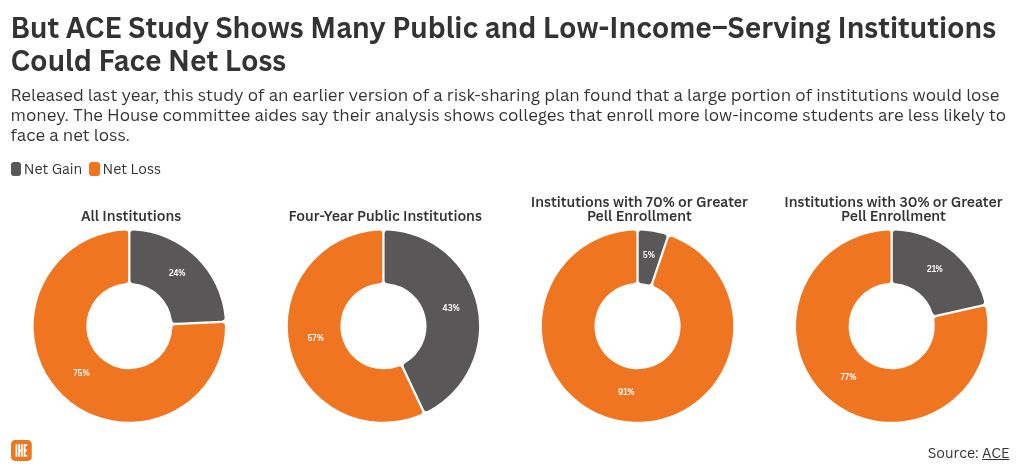
Of colleges that enrolled 70 percent or more low-income, Pell-eligible students, 96 percent would have to pay a risk-sharing penalty and 91 percent would lose money over all when PROMISE Grant is factored in, according to the American Council on Education’s analysis of the House data.
The committee countered that finding with its own analysis of the data, sent to Inside Higher Ed, showing how colleges that enroll the highest share of low-income students should see about $99 more per student, while those that enroll the lowest share would lose about $66 per student.
The ACE analysis as well as the committee’s data are among the few studies that show the estimated impact of the previously proposed risk-sharing plan. None have been updated yet to reflect the latest iteration.
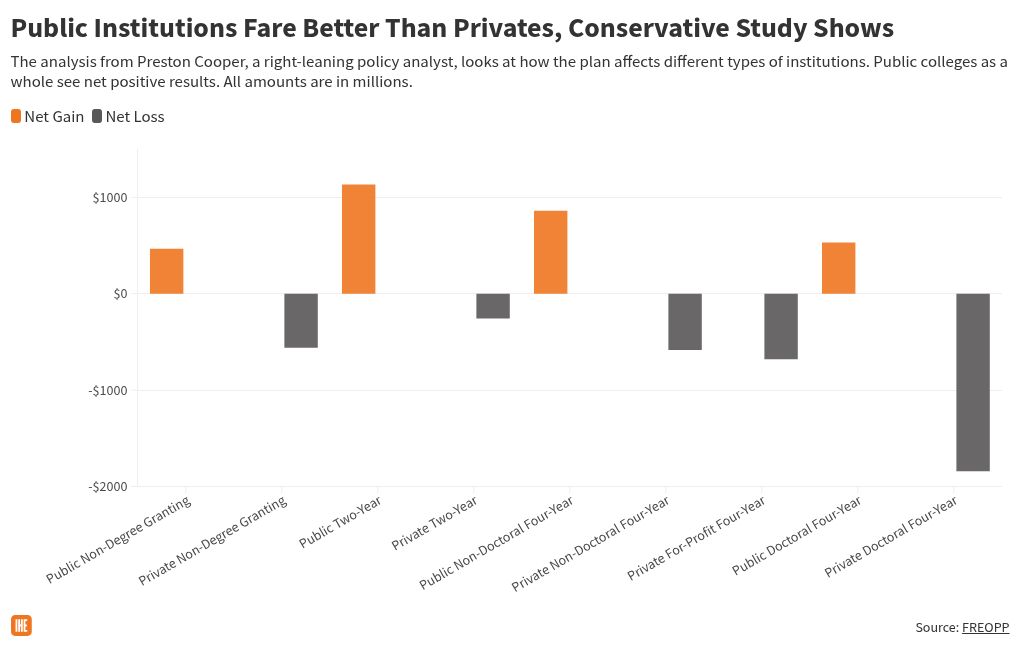
Another analysis from Cooper, the AEI fellow, estimated that public institutions as a whole should get more money under the plan, but private nonprofits are expected to face a substantial penalty.
Although critics point to how the plan would affect individual institutions, particularly small, underresourced schools, proponents argue that the focus should be on the impact to higher education over all, and that colleges can lower their costs to see a payoff.
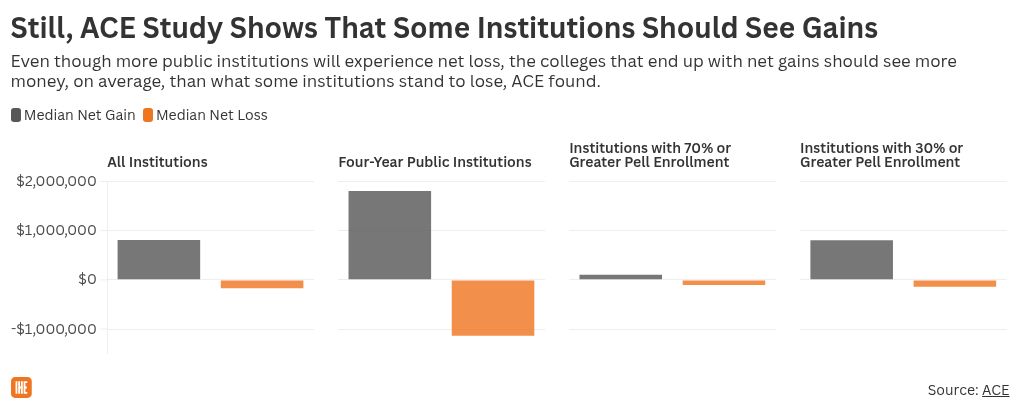
“Because the net gains are significantly larger, the sector as a whole sees a net gain even though more institutions have net losses,” Cooper said. “So, the upside for institutions here is that there are significant rewards available to those which can improve their outcomes.”
At the end of the day, it’s all about how you choose to look at the data.
“I would just like to see [the formula of risk-sharing] play out for a couple of hypothetical colleges based on data that has some bearing on reality,” said Delisle from Urban Institute. “And that’s a hard thing to come by right now.”
The Department of Defense is planning to cap indirect cost reimbursement rates for higher education institutions at 15 percent, according to a May 14 memo signed by Secretary of Defense Pete Hegseth.
“The Department of Defense (DoD) is the steward of the most critical budget in the Federal Government—the budget that defends our Nation, equips our warfighters, and secures our future. That stewardship demands discipline. It demands accountability. And it demands that we say no to waste,” wrote Hegseth.
The memo directs the DOD to develop the new policy within 21 days, marking the fourth federal agency—including the National Institutes of Health, the Department of Energy and the National Science Foundation—that has enacted a plan to cap indirect cost rates at 15 percent. For decades, universities have negotiated with the federal government to calculate bespoke indirect cost reimbursement rates to pay for research costs that support multiple grant-funded projects, such as facilities maintenance, specialized equipment and administrative personnel. (The paragraph has been updated.)
Universities and their trade associations have already sued the NIH, DOE and NSF over these plans, arguing that capping indirect costs would hurt research production and compromise global competitiveness, all while violating multiple aspects of the Administrative Procedure Act, including bypassing congressional authority required to alter indirect cost rates. So far, federal judges have blocked indirect cost caps from taking effect at the NIH and DOE. The NSF agreed to pause the cap until June 13 in order to proceed to summary judgment, which is a way to resolve the case quickly without a full trial.
Matt Owens, president of COGR, which represents research institutions, condemned the DOD’s newly announced plan.
“DOD research performed by universities is a force multiplier and has helped to make the U.S. military the most effective in the world. From GPS, stealth technology, advanced body armor, to precision guided missiles and night vision technology, university-based DOD research makes our military stronger,” Owens said in a statement. “A cut to DOD indirect cost reimbursements is a cut to national security. Less funding for research means less security for our nation.”
Hegseth’s memo claimed that capping the Defense Department’s indirect cost rate for universities would “save up to $900 [million] per year on a go-forward basis,” while also claiming that the department’s “objective is not only to save money, but to repurpose those funds—toward applied innovation, operational capability, and strategic deterrence.” The NIH has also made similarly incompatible assertions. It touted on social media its indirect rate cap plan’s potential to save taxpayers more than $4 billion, while a lawyer for the NIH told a federal judge that the cut was simply a reallocation of funds.
The Defense Department’s plans “will not stop at new grants,” Hegseth wrote, adding that “meaningful savings can also be achieved by revisiting the terms of existing awards to institutions of higher education.” The memo directed the under secretary of defense for research and engineering to do the following within 30 days:
Initiate a departmentwide effort to renegotiate indirect cost rates on existing financial assistance awards to institutions of higher education. “Wherever cooperative, bilateral modification is possible, it shall be pursued.”
“Where bilateral agreement is not achieved, identify and recommend lawful paths to terminate and reissue the award under revised terms.”
“Complete renegotiations or terminations for all contracts by 180 days from the date of this memorandum.”
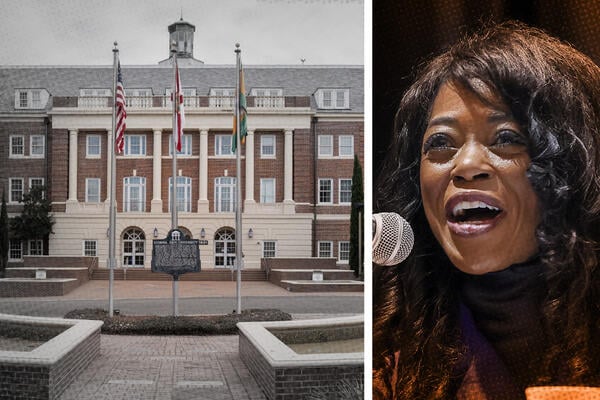
Florida A&M’s Board of Trustees voted 8 to 4 Friday to hire Marva Johnson as president.
Photo illustration by Justin Morrison/Inside Higher Ed | Jemal Countess/Getty Images for NOBCO | JHVEPhoto/iStock/Getty Images
Following a contentious selection process, Florida A&M University hired a new president with no experience working in higher education but long-standing ties to Republican governor Ron DeSantis.
Marva Johnson, a lobbyist for Charter Communications, faced sharp opposition from students and alumni, who dubbed her “MAGA Marva.” But despite questions about her lack of experience, Florida A&M’s board voted 8 to 4 in a Friday meeting to make her the next president.
Johnson was also criticized by community members and board chair Kristin Harper for her salary demands, which included base pay of $750,000 plus performance bonuses. (Two other candidates requested compensation in the $500,000 range, while one other was negotiable.)
Harper was one of the four trustees who voted against hiring Johnson.
“In an age of merit-based hiring decisions, how can one justify settling for a candidate who does not meet all of the position criteria? Or turning a blind eye to exceptionally qualified candidates?” Harper asked.
She added that FAMU community members “have been very clear” with their feedback.
But other trustees emphasized Johnson’s experience in the political world. Jamal Brown, the Faculty Senate president, who sits on the board, argued that FAMU needed a president who has “access and political connections” to ensure the university’s financial success. In voting for Johnson, he argued that “this moment calls for someone who understands the systems that fund and govern us, because right now our survival depends on how we navigate those systems.”
While Johnson has never worked in higher education in any capacity, she spent eight years on the Florida State Board of Education, including time as chair. During the hiring process, critics highlighted her lack of experience, as did some trustees who voted against her.
Johnson beat out Donald Palm, executive vice president and chief operating officer of Florida A&M, who received four votes. Other candidates included Rondall Allen, provost and vice president for academic affairs at the University of Maryland Eastern Shore, and Gerald Hector, senior vice president for administration and finance at the University of Central Florida.
At a tense meet-and-greet with Johnson on Wednesday, the candidate assured the university community she was “not a Trojan horse” and promised she “would fight and win for FAMU.”
However, critics have argued she failed to articulate a clear vision for the university.
Additional drama accompanied the hire when the board cut Harper out of contract negotiations. While board chairs have traditionally negotiated the contract with incoming presidents at Florida A&M, trustees voted to delegate that responsibility to another member at Friday’s meeting.
“I take personal offense at what is happening,” Harper said during that discussion.
Another controversy arose earlier in the search amid speculation that Johnson was added to a list of three finalists at the last minute. Last month trustee Ernie Ellison called to restart the search, arguing, “There are too many clouds hanging over this process.” He stepped down earlier this month and was quickly replaced by a new DeSantis appointee, who then voted to hire Johnson.
Johnson steps into the FAMU job, which is currently held by an interim, after Larry Robinson, who led the university from 2017 to 2024, resigned amid controversy over a fraudulent gift.
Last spring Florida A&M announced at commencement that the university had received a $237 million donation from Greg Gerami, a relatively unknown businessman with no connection to the institution. Florida A&M appeared to ignore warning signs that Gerami had also pledged $95 million to Coastal Carolina University in 2020, despite having no ties to CCU other than previously dating an employee. Gerami walked that donation back due to what he viewed as disrespect by officials at Coastal Carolina. Gerami’s FAMU donation was later invalidated.
Despite the opposition to her candidacy, Johnson fits the profile favored in recent years by the governing boards at Florida’s public institutions, which have emphasized nontraditional applicants. Johnson is one of multiple presidential hires with ties to DeSantis or the GOP since 2022, when the State Legislature passed a bill allowing universities to shield applicant identities until the end of the hiring process, breaking with a long-standing tradition of making those names public. State lawmakers recently proposed injecting more transparency into searches, but that effort failed.
Other political hires include Ben Sasse, a former Republican U.S. senator from Nebraska, who had a short-lived presidency at the University of Florida; former Florida lieutenant governor Jeanette Nuñez at Florida International University; and former state lawmakers Adam Hasner at Florida Atlantic University and Richard Corcoran at New College of Florida, among several others. Former GOP lawmaker Ray Rodrigues was also hired to lead the State University System of Florida in 2022.
The University of Florida is currently in the process of replacing Sasse with an interim appointed to the job after his abrupt departure. Sole finalist Santa Ono, a traditional academic who left the University of Michigan to take the Florida job, marks a reversal of course compared to recent hires. However, Ono’s candidacy has sparked criticism from some conservative power players.