Tag: Career

  • Trump Sends Mixed Signals on Apprenticeship and Job Training

    Trump Sends Mixed Signals on Apprenticeship and Job Training

    President Trump issued an executive order last month instructing federal officials to “reach and surpass” a million new active apprenticeships. It was an ambitious target that apprenticeship advocates celebrated, anticipating new federal investments in more paid on-the-job training programs, in new industries and via a more efficient system.

    “After years of shuffling Americans through an economically unproductive postsecondary system, President Trump will refocus young Americans on career preparation,” federal officials wrote in a fact sheet on the order. They also emphasized that the federal government spends billions on the Workforce Investment and Opportunity Act, or WIOA, and Career and Technical Education, but “neither of these programs are structured to promote apprenticeships or have incentives to meet workforce training needs.”

    Ryan Craig, author of the book Apprenticeship Nation, managing director of Achieve Partners, co-founder of Apprenticeships for America and an occasional contributor to Inside Higher Ed, said it was the first time a president set a goal for the number of apprentices in the U.S., as far as he’s aware.

    Apprenticeships are “one of the few, perhaps the only area of education, of workforce development, where this administration has said, ‘We want more of this,’” he said shortly after the executive order dropped.

    But the excitement for an expanded apprenticeship model in the U.S. might be short-lived. Craig and other apprenticeship advocates worry that Trump’s proposed budget for fiscal year 2026 doesn’t reflect the executive order’s vision. The proposal doesn’t promise any significant new investments in apprenticeship and slashes workforce development spending over all.

    “The left hand doesn’t know what the right hand is doing here,” Craig said. “It’s not the sea change that the executive order promised.”

    Mixed Signals

    Among many highlights for advocates, the order also calls for a workforce development strategy with a focus on scrutinizing workforce programs’ outcomes, which currently aren’t carefully tracked.

    Federal officials were given 90 days to review all federal workforce development programs and come out with a report on strategies to improve participants’ experiences, measure performance outcomes, identify valuable alternative credentials and reform or nix ineffective programs. The executive order also generally called for more transparent performance outcomes data, including earning and employment data, for such programs.

    Trump’s skinny budget makes good on his promise to consolidate workforce development spending and cut programs the administration deems ineffective, but it also offers apprenticeships a small slice of that shrinking pie.

    The proposal includes a $1.64 billion cut to workforce development funding under the Department of Labor and eliminates Job Corps, a free career training program for youth, and the Senior Community Service Employment Program, which offers job training and subsidized employment for low-income seniors. The administration also proposed a new program called Make America Skilled Again, or MASA. States would be required to spend 10 percent of their MASA grants on apprenticeships. Almost $3 billion, including WIOA funding, remains to fund the program, down from $4.6 billion, Work Shift reported.

    The budget promises to “give states and localities the flexibility to spend workforce dollars to best support their workers and economies, instead of funneling taxpayer dollars to progressive non-profits finding work for illegal immigrants or focusing on DEI.”

    Craig supports offering states more flexibility and cutting “train-and-pray programs that have little to no connection to employers or employment outcomes”—but he hoped money saved from those cuts would go toward apprenticeships, which are “by definition good jobs with career trajectories and built-in training.”

    He said a mere 10 percent of block grant funding directed to apprenticeships feels “inconsistent” with the bold goals laid out in the executive order. He had high hopes Trump would consider radically changing how apprenticeships are funded, moving away from time-limited, individual grants to a more robust federal funding structure. At the very least, he believes apprenticeships should get the “lion’s share” of workforce development funding.

    “My hope is it’s just the budget proposal and that things get worked out [to be] more consistent with the executive order,” he said, “but it was disappointing to see that.”

    Vinz Koller, vice president of the Center for Apprenticeship and Work-Based Learning at Jobs for the Future, said he similarly felt hopeful about the executive order’s messaging, in particular its commitment to “further protect and strengthen” registered apprenticeships.

    The wording represented a shift in approach.

    During Trump’s previous term, the president sought to create industry-recognized apprenticeships, an entirely separate apprenticeship system to sidestep what he viewed as inefficiencies in the current system and excessive federal regulation. Koller was glad to see Trump interested in reforming and investing in the current system this time rather than making plans to “throw out the rule book.”

    But the proposed budget isn’t “backing it up,” he said.

    His organization recently put out a policy blueprint for expanding and improving apprenticeship—including calling for stronger incentives for employers and more investment in intermediary organizations that offer programs’ support—but those strategies aren’t possible without more federal funding, Koller said. The policy blueprint points out that in fiscal year 2024, the federal government spent at least $184.35 billion on higher education, while the Department of Labor’s apprenticeship budget was just $285 million.

    But Koller also doesn’t believe slashing higher ed spending is the answer, and he’s worried about the proposed cuts to workforce training and to higher ed in the administration’s proposal. He said the goal is to give learners “choice-filled pathways,” including apprenticeships and other forms of work-based learning, not to “rob Peter to pay Paul.”

    Grant consolidation and streamlining can be “positive,” he said, but “we just want to make sure that the support is there to actually do what is needed on the ground,” across program types. “We don’t want to dismantle the other aspects of a healthy educational workforce infrastructure as we build the new parts.”

    Kerry McKittrick, co-director of the Project on Workforce at Harvard University, said the budget poses a double threat to workforce development funding. Not only would the proposal cut more than a billion dollars, but the budget would also dole out the remaining funds in block grants to states, a funding structure that has been shown to lack oversight and generally decrease funding over time.

    The project’s research found “governors do want more flexibility,” she said. “At the same time, we continue to hear from them that the lack of resources is really the biggest problem with the workforce system and meeting workforce needs … There’s no way we’ll see an expansion in apprenticeship with such a massive cut.”

    Lingering Hopes

    Some apprenticeship proponents remain optimistic.

    John Colborn, executive director of Apprenticeships for America, agreed the skinny budget doesn’t seem like “a recipe for substantial growth of apprenticeship,” but he isn’t giving up on the possibility of bold changes just yet.

    He noted that the budget makes no mention of other possible funding sources for apprenticeship mentioned in the executive order fact sheet, such as career and technical education funds, so there may be plans for other funding streams in the works.

    The proposed budget also alludes to a “reallocation” of adult education funding struck from the Education Department to “better support the innovative, workforce-aligned, apprenticeship-focused activities the Department seeks to promote,” though it doesn’t go into further detail.

    He said, based on the executive order, federal officials still have time to draft a plan, and he’s going to wait until they do before arriving at any final conclusions about how apprenticeships will fare under a second Trump term.

    “It’s probably a mistake to look at the skinny budget as a blueprint for the funding of an apprenticeship growth initiative,” he said. He plans “to take it seriously, because it’s a statement of intent from the president, but to not look to it as a constraining document for how we might be thinking about growing apprenticeships going forward.”

    Shalin Jyotishi, managing director of the Future of Work and Innovation Economy Initiative at the left-wing think tank New America, emphasized that “any administration’s policy direction on apprenticeships should be judged on actions, not only words.”

    He pointed out that multiple executive orders, including a recent one on artificial intelligence education, have called for expanding apprenticeships, but some such programs have also undergone cuts under Trump. He wants to instead see renewed investments, like those Trump made in degree-connected apprenticeships during his first term, and argued the field is “ripe” for such efforts.

    “It’s heartening to see the administration emphasize the importance of registered apprenticeships,” Jyotishi wrote to Inside Higher Ed, “and education and workforce leaders will be looking for follow-through through actions, implementation, and resources.”
    Source link

  • Colleges Spend Heavily on Lobbying

    Colleges Spend Heavily on Lobbying

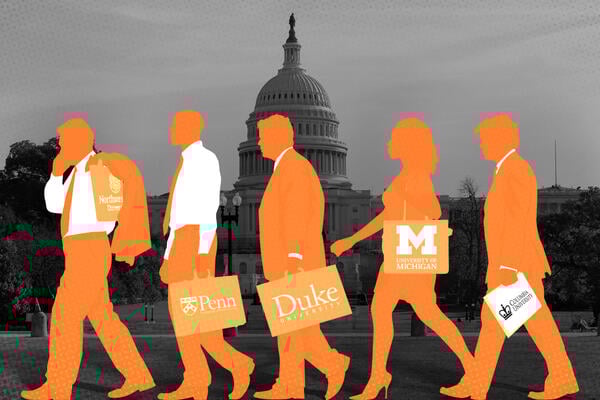
    As President Trump’s broadside attacks on higher education continue, few institutions have shown a willingness to push back publicly. But behind closed doors, the sector has already pumped millions of dollars into federal lobbying efforts this year to plead their case in Washington.

    An Inside Higher Ed analysis of federal lobbying data shows that some of the universities in Trump’s crosshairs have dramatically increased spending this year compared to the first quarter of last year, hiring advocates on the Hill to represent their interests to lawmakers. Northwestern University, for example, has already spent more than $600,000 on federal lobbying this year, compared to $110,000 in the first quarter of 2024. Among individual institutions, Northwestern has spent by far the most on lobbying this year.

    Northwestern is one of multiple institutions that the Trump administration has taken aim at in recent months, abruptly freezing hundreds of millions of dollars in federal research funding over alleged incidents of antisemitism on campus connected to a pro-Palestinian encampment last spring, or the participation of transgender athletes in women’s sports.

    (Northwestern did not respond to multiple requests for comment.)

    Here’s a look at what institutions, namely research universities, have spent on lobbying in the first quarter of 2025, and what issues they have emphasized.

    Lobbying Expenditures

    Since the analysis is focused on research universities, many of which have come under attack by the Trump administration, Inside Higher Ed reviewed the lobbying expenditures primarily by members of the Association of American Universities. Together, they’ve spent almost $9 million this year.

    Areas of focus, according to lobbying disclosures, include federal caps on indirect research cost reimbursements, endowment taxes, the upcoming appropriations bill, international student visa issues, athletics and various pieces of legislation, including the College Cost Reduction Act.

    Several institutions targeted by the federal government are among the highest spenders, including Columbia University, which mostly yielded to a list of Trump administration demands in March. Now federal officials wants more from Columbia, including a possible consent decree. While Columbia has publicly conceded on many fronts, it has quietly worked through back channels in Congress, spending $270,000 on lobbying in the first quarter of 2025. Among the lobbying activities listed: “Outreach and monitoring related to … NSF Funding, and NIH funding, generally.”

    Last year, the university spent $80,000 on lobbying in the first quarter and a total of $350,000 for 2024. Given Columbia’s spending so far this year, it is likely to surpass that in 2025.

    “Columbia values its relationships with our delegation and other officials across all levels of government,” a spokesperson wrote in an emailed response to Inside Higher Ed. “We are eager to tell our story on the vast impact Columbia research and contributions have had on improving lives and generating solutions to society’s most pressing challenges.”

    Other Trump targets, such as the University of Pennsylvania, Yale University, and Harvard University, have also increased lobbying expenditures. Both Penn and Yale spent $250,000 in the first quarter of 2025, followed closely by Harvard at $230,000. Those are noticeable increases from last year, when Yale spent $180,000 on lobbying in the first quarter, Penn spent $150,000, and Harvard spent $130,000.

    Other Top Spenders

    While the focus of Inside Higher Ed’s analysis was AAU members, a few universities outside that organization also cracked the top 10 in lobbying expenditures for the first quarter of 2025.

    After Northwestern, the University of Phoenix has been the top spender on federal lobbying efforts this year, shelling out $480,000 in the first quarter. However, unlike at many other institutions, that number does not represent a significant increase of typical spending.

    Last year, Phoenix, a for-profit institution, spent $1.8 million on federal lobbying.

    Priorities for the university, according to a lobbying disclosure, include such issues as “change of control, and related regulatory requirements.” Phoenix has been lobbying on change of control since at least the spring of 2023 amid efforts to sell the university, which have yet to materialize.

    Northeastern University, which is a research institution but not an AAU member, is also among the country’s top spenders; it laid out $270,000 for lobbying in the first quarter. But that number mirrors what the university spent in each quarter last year as it racked up more than $1 million on lobbying.

    “Like all major research universities, Northeastern engages with the federal government at many levels,” Renata Nyul, Northeastern’s vice president for communications, wrote in an email to Inside Higher Ed. “We work to increase funding for our expanding research enterprise, shape federal policy that affects higher education, and maximize support for student financial aid.”

    Some small liberal arts colleges have also hired federal lobbyists for the first time.

    Is It Working?

    Experts find the increase in lobbying expenditures unsurprising for two reasons. First, there is typically an uptick in lobbying efforts in the early days of a new presidential administration. Second, sectors tend to lobby heavily when presented with new opportunities or major change.

    “Many of the Trump administration’s actions pose existential threats, so universities should be working to address those threats in any way possible. That includes lawyers, appeals to public opinion, all of it, because there have been so many things that affect universities in the first 100 days,” said Beth Leech, a political science professor and lobbying expert at Rutgers University.

    Leech pointed to research funding cuts; rescinded grants; Trump’s broadsides against diversity, equity and inclusion programs; and attacks on academic freedom as key concerns for higher ed institutions.

    She noted that colleges hire lobbyists not only to better understand emerging threats but also to engage lawmakers in conversations about what legislative proposals would mean for higher education.

    “A lot of lobbying is informational, and it’s informational on both sides. The lobbying organization needs to monitor potential threats—not just the Trump administration, but everything that affects an organization, a company, or whatever,” Leech said. “They need to be able to communicate about the impacts of potential threats, because sometimes things come up [in legislation] and lawmakers are just not aware of what some of the implications of some plan might be.”

    Universities are spending heavily on lobbying at a time when the Trump administration appears to be at war with higher education, slashing federal research funding—often without informing institutions—and punishing universities before investigations are concluded. But is it working?

    “They have to try,” Leech said. “They can’t just stand aside and let whatever happens happen.”

    Source link

  • What’s needed to strengthen career and college pathway commitments?

    What’s needed to strengthen career and college pathway commitments?

    This audio is auto-generated. Please let us know if you have feedback.

    WASHINGTON — The momentum for providing all students access to meaningful career and college pathways is growing, but hurdles such as funding, teacher training, reluctance to change and other factors stand in the way, said speakers at the National Pathways Summit on Thursday.

    Experiential learning about careers is what students, families and educators want. Industry leaders also want to employ workers with job skills and essential abilities like problem solving, collaboration and resilience, the speakers told the 300 summit attendees

    And these skills and abilities are not just desirable, but critical to the health of the economy, said Stanley Litow, chair of the National Pathways Initiative, a bipartisan federation of students and leaders from education, business, government, politics and advocacy organizations that promote promising K-12 and higher education career and college preparation programs.  

    “From the business community standpoint, there is an enormous amount of pressure in the labor market around the skills area,” said Litow, a former deputy schools chancellor for New York City Public Schools and former president of the IBM Foundation. He is currently a professor at Columbia University’s School of International and Public Affairs.

    Litow said that by 2030, over 70% of the new jobs created will require some form of postsecondary education, which includes credentials, apprenticeships, two-year and four-year degrees, and other continuing learning programs. 

    But to make career and college preparation successful for students and industries, the education and business communities need to partner to align their needs, Litow said. “We have to break down the barriers, we have to collaborate, we have to work together.”

    Successes and challenges

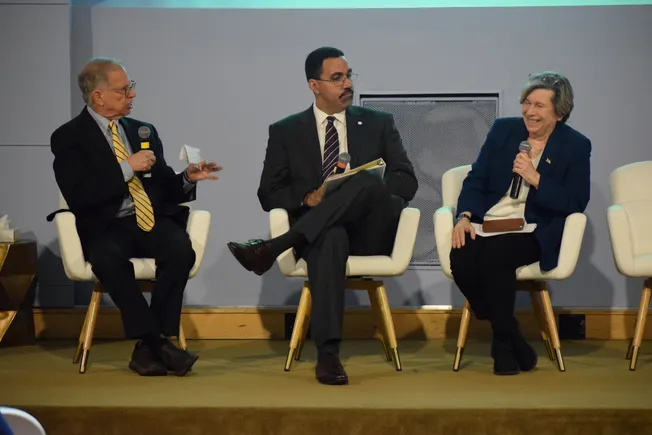
    Randi Weingarten, president of the American Federation of Teachers, and John B. King, Jr., chancellor of the State University of New York and a former U.S. education secretary, both noted that there’s a high level of agreement across the country that workforce preparation in K-12 and higher education is important. 

    They also pointed to several successful programs that are helping students gain the skills necessary for their chosen occupation. King, for example, highlighted the Real Life Rosies program at Mohawk Valley Community College in Utica, New York — a 12-week pre-apprenticeship program that helps women gain advanced manufacturing skills.

    But Weingarten and King also noted obstacles that are stunting students’ access to skill-based learning.

    For one, K-12 school systems “are really terrible at change,” Weingarten said, adding that they “only change when an accountability system changes. And so the problem is we have a really outdated accountability system.”

    Weingarten also said that school systems tend to be risk-averse. “People get blamed” if an initiative isn’t 100% successful, she said. That’s why school accountability systems need to be revised, “to give people permission to do something different.”

    King said one obstacle is that there’s a culture challenge. Some people think that a liberal arts education and career readiness preparation programs are in conflict with each other, he said. “Sometimes people react against talk of careers, because it seems that it is making education just about the job,” he said.

    King also said leaders from all industry sectors need to voice support for education and prioritize learning as an investment, as well as work on solutions to barriers. “We need the business community nudging people on both sides of the aisle to stand up for education and stand up for this vision we’ve been talking about today,” he said.

    Three people are seated at a table on a stage.

    Reo Pruiett, Rashid Ferrod Davis and Don Haddad speak about the P-TECH approach to connecting K-12 students with college and career experiences during a panel at the National Pathways Summit at Gallaudet University in Washington, D.C., on May 8, 2025.

    Permission granted by National Pathways Initiative


    Two diplomas by high school graduation

    Several speakers during another panel discussion highlighted one approach that is helping high school students graduate with both high school and associate degree diplomas while also gaining career skills and connections to potential employers through mentorships, paid internships, and other on-the-job experiences.

    The P-TECH 9-14 school model was created by IBM to encourage public-private partnerships to give high school students specific workplace skills while they earn both diplomas. The first P-TECH school was launched in New York City in 2011.

    Reo Pruiett, chief programs and engagement officer at Communities Foundation of Texas, focuses on improving K-12 and higher education outcomes. She calls the P-TECH approach “game changing.”

    She said the program has helped students gain upward economic mobility and has “demystified” the college experience for students while they are still being supported as high schoolers.

    “I think that’s one thing about P-TECH; It allows us to make sure our students are prepared to dream and not to just settle,” she said.

    Source link

  • Rurality Matters in Evaluating Transfer Outcomes (opinion)

    Rurality Matters in Evaluating Transfer Outcomes (opinion)

    Transfer enrollment rose by 4.4 percent this year, according to recent data from the National Student Clearinghouse Research Center. In total, transfers have grown by 8 percent since 2020, signaling a steady rebound from the sharp declines seen during the pandemic. That’s encouraging news for students seeking affordable, flexible pathways to a degree, as well as for institutions focused on expanding access and supporting completion.

    Less noticed, however, is just how much progress rural students are making. In fall 2023, rural community colleges experienced a 12.1 percent increase in students transferring to four-year institutions. This progress is even more impressive given the historic underinvestment in rural institutions and the well-documented barriers their students face on their path to a four-year degree.

    Many of the country’s small, rural institutions remain on the margins of transfer conversations, partnerships and policy priorities. Here in California, for instance 60 percent of the community colleges with the lowest transfer rates are rural. From low-income students in Appalachia to Latino learners in Texas’s Rio Grande Valley, rural colleges are lifelines for students facing barriers such as poverty, food and housing insecurity, and limited access to transportation and technology. Yet these institutions tend to lack the support, visibility and resources of larger community college systems. They often remain excluded from the design and implementation of transfer initiatives.

    Rural students bring tremendous talent, drive and potential to higher education. Many are the first in their families to attend college. They are often deeply rooted in their communities and, in many cases, seek to use their education to give back and contribute to their local economies.

    Transferring to a four-year institution can dramatically increase the lifetime earnings of these learners, expand their career paths and help meet the growing demand for a highly skilled workforce. Individuals with a bachelor’s degree earn, on average, nearly 35 percent more per year than those with only an associate degree. Four-year degrees open doors to career advancement, civic engagement and personal growth.

    Yet the systemic challenges rural community college students face—from more limited course offerings and degree options to long travel times to campuses to unreliable internet connections—require tailored support and intentional partnership. A one-size-fits-all approach to transfer doesn’t work when rural students are starting from a fundamentally different place than many of their peers.

    For example, rural colleges may not have the staff capacity to manage complex articulation agreements or advocate for their students in statewide transfer initiatives. Their advisers may juggle many roles, serving as counselors, career coaches and transfer liaisons all at once. Meanwhile, students themselves may be unaware of transfer opportunities or discouraged by long distances to four-year campuses, especially when those pathways demand sacrifices they can’t afford to make.

    The health of both our higher education ecosystem and our economy depends on ensuring that all students, regardless of ZIP code, can move easily between two-year and four-year institutions. If efforts to improve transfer overlook rural colleges, they risk deepening existing educational inequities and missing out on a significant segment of our nation’s talent pool.

    Organizations such as the Rural Community College Alliance shine a needed spotlight on how to best collaborate with rural institutions across the country to improve transfer outcomes and better support rural students’ success. Progress starts with listening and taking the time to understand the unique strengths and challenges of rural communities rather than imposing outside solutions.

    The policy landscape will need to evolve to support these efforts. This means increasing investment in rural higher education infrastructure, expanding funding for rural-serving institutions, and creating more flexible transfer frameworks that reflect the realities of rural learners, many of whom are working adults, members of the military, parents, or all of the above. Federal, state and higher education leaders should recognize rurality as a key lens through which to view improving student outcomes, on par with class or race.

    Transfer rates are rising, and more students are finding affordable on-ramps to bachelor’s degrees. But this progress is incomplete unless it reaches every corner of the country, including the small towns and rural communities that are home to millions of students. In a moment when more students are finally moving forward, we can’t afford to leave these learners behind. When rural students succeed, our entire nation benefits.

    Gerardo de los Santos is vice president for community college relations at National University.

    Source link

  • College Programs Support Holistic Student Basic Needs

    College Programs Support Holistic Student Basic Needs

    About three in five college students experienced some level of basic needs insecurity during the 2024 calendar year, according to survey data from Trellis Strategies. Over half (58 percent) of respondents said they experienced one or more forms of basic needs insecurity in the past 12 months.

    Student financial challenges can negatively impact academic achievement and students’ ability to remain enrolled. About 57 percent of students said they’ve had to choose between college expenses and basic needs, according to a 2024 report from Ellucian.

    While a growing number of colleges and universities are expanding support for basic needs resource centers—driven in part by state legislation that requires more accommodations for students in peril—not every campus dedicates funds to the centers. A 2024 survey by Swipe Out Hunger found that of 300-plus campus pantries, two in five were funded primarily through donations. Only 5 percent of food pantries had a dedicated budget from their institution as a primary source of funding.

    Inside Higher Ed compiled four examples of institutions that are considering new or innovative ways to address students’ financial wellbeing and basic needs on campus.

    Penn State University—School Supplies for Student Success

    Previous research shows that when students have their relevant course materials provided on day one, they are more likely to pass their classes and succeed. Penn State’s Chaiken Center for Student Success launched a School Supplies for Student Success program that offers learners access to free supplies, including notebooks, writing utensils and headphones, to help them stay on track academically.

    Students are able to visit the student success center on the University Park campus every two weeks to acquire items, which are also available at two other locations on campus. Learners attending Penn State Altoona and Penn State Hazleton can visit their respective student success center for supplies, as well.

    The program is funded by a Barnes & Noble College Grant program and is sustained through physical and monetary donations from the university community.

    Massachusetts College of Liberal Arts—Essential Needs Center

    The Essential Needs Center was developed from a Service Leadership Capstone course, which required students to complete a community-based service project. One group of students explored rates of basic needs insecurity and established a food pantry to remedy hunger on campus.

    “The program started as a drawer at my desk,” said Spencer Moser, assistant dean for Student Growth and Wellbeing, who taught the course. “Then it grew to fill a shelving unit, a closet and eventually its own space on campus.”

    The center, now a one-stop shop for basic needs support on campus, provides students with small appliances, storage containers, personal care items and seasonal clothing, as well as resources to address housing and transportation needs, including emergency funding grants. Students can also apply for a “basic needs bundle” to select specific items they may require.

    Paid student employees maintain the center but it’s also left “unstaffed” at some hours to address the stigma of seeking help for basic supplies. Between November 2023 and January 2025, over 1,300 students engaged with the center.

    University of New Hampshire—Financial Wellness

    A lack of financial stability can also have a negative impact on student thriving and success. To support students’ learning and financial wellbeing, the University of New Hampshire created an online digital hub that provides links to a budget worksheet, financial wellness self-evaluation, college cost calculator and loan simulator.

    Students can also schedule an appointment to talk with an educator to discuss financial wellness or engage in a financial wellness workshop.

    Roxbury Community College—the Rox Box

    Most colleges operate on an academic calendar, with available hours and resources falling when class is in session. Roxbury Community College in Massachusetts launched a new initiative in winter 2023 to ensure students who were off campus for winter break didn’t experience food insecurity.

    Before the break, staff at the college’s food pantry, the Rox Box, handed out Stop & Shop gift cards and grab-and-go meals, as well as a list of local places students could visit for meals over break.

    Do you have a wellness intervention that might help others promote student success? Tell us about it.


    Source link

  • House Republicans Propose Significant Endowment Tax Increase

    House Republicans Propose Significant Endowment Tax Increase

    Efforts to raise endowment taxes are in motion as the House Ways and Means Committee reportedly plans to unveil changes next week that will increase rates and include more colleges.

    Education leaders have worried about such a rate increase for months. Now the GOP-led committee is expected to propose raising endowment excise taxes from 1.4 percent to up to 21 percent, depending on endowment value per student, Punchbowl News, Politico and other outlets reported. 

    The proposed endowment tax would only apply to private institutions, as it does currently.

    Under the proposed formula, institutions with endowments of $750,000 to $1.25 million per student would reportedly be hit with 7 percent excise tax. That number would climb to a 14 percent tax for colleges with endowments valued at $1.25 to $2 million per student. Colleges at the highest level with endowments of $2 million or more per student would pay 21 percent. (Currently, colleges with endowments worth $500,000 per student or more pay the 1.4 percent tax.)

    The specifics of the tax increase aren’t final and could shift before the committee’s hearing Tuesday.

    Republicans are preparing to move forward with endowment tax increases as part of a broader effort known as reconciliation to cut billions in federal spending and pay for President Donald Trump’s priorities. Other House committees have unveiled their proposed cuts for reconciliation, including a sweeping plan to upend the student loan system, but the Ways and Means bill is crucial to this process.

    GOP motivations for the tax increase appear to be twofold in that it would help fund tax cuts and serve as a punitive measure for colleges they believe have gone “woke.” In 2023, a total of 56 universities paid roughly $380 million in endowment excise taxes.

    “Seven years ago, the Trump tax cuts sparked an economic boom and provided needed relief to working families,” committee chairman Rep. Jason Smith, a Missouri Republican, said in a Friday statement. “Pro-family, pro-worker tax provisions are the heart of President Trump’s economic agenda that puts working families ahead of Washington and will create jobs, grow wages and investment, and help usher in a new golden age of prosperity. Ways and Means Republicans have spent two years preparing for this moment, and we will deliver for the American people.”

    The proposal comes amid the president’s full blown attack on higher education, which has seen the federal government clamp down on research funding, go after colleges for alleged antisemitism, take aim at diversity, equity, and inclusion programs, and attempt to deport international students.

    Since the 1.4 percent endowment excise tax was passed in 2017 during the first Trump administration higher education leaders have long worried that the president would raise it in his second term. 

    As universities increased their lobbying efforts in the early days of Trump 2.0, the potential increase to the endowment tax has been a key concern. Recent lobbying reports show that Harvard University, which has the largest endowment, recently valued at more than $53 billion, Princeton University, Northwestern University, and multiple others, have pressed Congress on the issue. (Northwestern’s chief investment officer said last week that the potential increase would be “destructive.”)

    Smaller institutions, some of which had never hired federal lobbyists before 2025, have also raised concerns about how expanding the endowment tax would harm their educational mission.

    According to an analysis from James Murphy, director of career pathways and post-secondary policy at Education Reform Now, only three universities would pay the highest rate at 21 percent – Princeton, Yale University and the Massachusetts Institute of Technology. Another 10 universities, including Harvard, would get hit with the 14 percent rate.

    An analysis published last month by the investment firm Hirtle Callaghan noted that recently proposed changes to the endowment excise tax would “significantly broaden the universe of colleges and universities that pay the tax from large, wealthy institutions to smaller, regional ones.” That analysis warned that such increases “threaten to do irreparable damage to many schools which are significantly weaker financially than the schools paying the current tax.”

    Multiple higher education associations have previously expressed opposition to the increase. 

    Last fall, American Council on Education president Ted Mitchell sent a letter to Congress, co-signed by 19 other associations, calling for the repeal of the existing endowment tax, arguing that “this tax undermines the teaching and research missions of the affected institutions without doing anything to lower the cost of college, enhance access, or address student indebtedness.”

    Source link

  • How Changes in NCAA Athletics Impact Everyone on Campus, The Key

    How Changes in NCAA Athletics Impact Everyone on Campus, The Key

    College athletics has fundamentally changed in the last two decades. With students earning thousands—sometimes millions—for their name, image and likeness and changing teams with greater ease via the transfer portal, athletics have transformed from amateur levels to something more akin to a professional sports league.

    The imminent ruling on the $2.8 billion House settlement case stands to bring about even more change for the sector.

    In the latest episode of The Key, Inside Higher Ed’s news and analysis podcast, Editor in Chief Sara Custer speaks with Karen Weaver, an adjunct assistant professor in the graduate school of education at the University of Pennsylvania, about what the new landscape means for everyone on college campuses, not just those in the athletic department.

    “College athletics have played a critical role in higher education for over 100 years,” said Weaver. “The problem is that the money that has come into so much of college athletics at the highest level is just astronomical.”

    With coaching salaries well into the millions and eight-figure investments into athletics facilities, the campus starts to look and feel differently, she said. “I think that has an impact on everybody.”

    Meanwhile, ensuring athletes have academic success is further complicated when they can change institutions to pursue more lucrative deals, she said.

    “The transfer portal has created an enormous burden on academic counselors and faculty when athletes are supposed to make normal progress toward a degree—all of that is very confusing now,” she said.

    Weaver explained what policy shifts mean for the future of Olympic teams as well as Division II and III programs. In light of rumors that President Trump plans to sign an executive order to regulate payments for name, image and likeness, Weaver suggested collective bargaining would be a more comprehensive solution to the legal and financial complexities of the current state of affairs.

    “I understand collective bargaining with students is tough, I get that, and it’s messy … but it’s still a legitimate outlet to try to address all of these issues and it needs to be talked about more.”

    Listen to the full episode here.

    Source link

  • Pro-Palestinian Protesters Arrested at Columbia, UW, Beyond

    Pro-Palestinian Protesters Arrested at Columbia, UW, Beyond

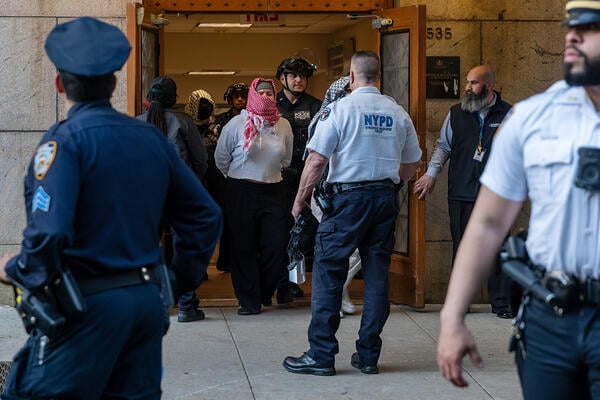
    About 80 pro-Palestinian protesters were arrested at Columbia University Wednesday as they occupied a reading room in the campus’s library, The New York Times and other sources reported.

    The arrests come just over a year after protesters at Columbia occupied Hamilton Hall, an academic building, as part of a massive protest movement that inspired other student demonstrations nationwide but drew ire from Republicans and pro-Israel groups, who argued that the protesters’ chants and signs were antisemitic.

    Columbia isn’t the only campus where protesters are seeking to revitalize the movement as the spring semester winds down. Though their numbers are nowhere near the hundreds that erupted last spring, pro-Palestinian protests have sprung up on several campuses in recent weeks—in some cases honoring the anniversary of last year’s demonstrations or calling for charges against student demonstrators to be dropped.

    “In light of all of the repression that the student movement for Palestine faced in the wake of the encampment last year, it’s important for us to insist on our demands, which have not changed,” a spokesperson for the University of North Carolina at Chapel Hill chapter of Students for Justice in Palestine told The News & Observer regarding a daylong demonstration held at the end of April.

    Ultimately, it seems that most protesters are asking for the same thing they demanded a year ago: for their institutions to divest from companies with ties to Israel. Only an extremely small number of colleges has done so, but that hasn’t deterred students from trying.

    The protests also come amid President Donald Trump’s ongoing attacks on institutions that he believes failed to protect Jewish students during last year’s demonstrations. So far, his administration has frozen billions in federal funding to Columbia and other institutions, and taken steps to deport international students who participated in the protests.

    UW and Columbia

    Columbia students weren’t alone in taking over a campus building in recent weeks. About 75 protesters at the University of Washington occupied a new engineering building, barricading the doors and starting fires in nearby dumpsters Monday night, The Seattle Times reported. The organizers, part of a group called Students United for Palestinian Equality and Return UW, told the paper they wanted to “repurpose a building that is meant to make weapons of war to a place that serves the needs of students and workers and staff at the University of Washington.”

    Three law enforcement agencies were called in to disband the protest; 31 people were arrested.

    Administrators at both Columbia and UW have issued statements condemning the protests on their respective campuses. UW president Ana Mari Cauce called the demonstration “dangerous, violent and illegal building occupation and related vandalism.” She condemned statements by the group celebrating Hamas’s deadly Oct. 7 attack on Israeli civilians, saying the institution would “continue our actions to oppose antisemitism, racism and all forms of biases.”

    In a lengthy message to the Columbia campus, Claire Shipman, the recently installed acting president, called the Wednesday protest “utterly unacceptable.”

    “Let me be clear: Columbia unequivocally rejects antisemitism and all other forms of harassment and discrimination. And we certainly reject a group of students—and we don’t yet know whether there were outsiders involved—closing down a library in the middle of the week before finals and forcing 900 students out of their study spaces, many leaving belongings behind. Our commitment to a safe, inclusive, and respectful campus community is unshakeable, and we will continue to act decisively to uphold these values,” she wrote.

    Both presidents said they attempted to resolve the situation peacefully before sending in police.

    Shipman’s statement earned her the praise from members of the Trump administration’s Task Force to Combat Anti-Semitism, who said in a statement that they are “confident that Columbia will take the appropriate disciplinary actions for those involved in this act.”

    At the same time, the same task force announced it would launch a review of the protest at UW.

    “The Task Force to Combat Anti-Semitism appreciates the university’s strong statement condemning last night’s violence and applauds the quick action by law enforcement officers to remove violent criminals from the university campus,” the task force said in a press release. “While these are good first steps, the university must do more to deter future violence and guarantee that Jewish students have a safe and productive learning environment. The Task Force expects the institution to follow up with enforcement actions and policy changes that are clearly necessary to prevent these uprisings moving forward.”

    Arrests Elsewhere

    In recent weeks, pro-Palestinian protesters have also been arrested at Swarthmore College, Rutgers University, Virginia Commonwealth University and the University of California, Los Angeles.

    At Swarthmore, protesters erected an encampment on Trotter Lawn, a central campus green, on April 30, demanding divestment and the protection of students from the Trump administration. The university began issuing interim suspensions the next day. On May 3, police were called in to tear down the encampment, according to a statement by college president Val Smith. Police arrested nine individuals, including one current and one former student.

    The Rutgers protest, held on April 29, was arranged to oppose an appearance by U.S. Rep. Josh Gottheimer of New Jersey, an Israel supporter who participated in a roundtable on antisemitism at the university’s Hillel. Though they were protesting in a designated area near the Hillel, four individuals—three of them Rutgers students—were charged with rioting after they stepped out of the area, blocking a public sidewalk, according to MyCentralJersey.com.

    At VCU, one person was arrested April 29 during a gathering to commemorate a clash between protesters and police on campus the previous year. A student organizer with the campus’s Students for Justice in Palestine chapter said the event was not a protest. However, university police said it violated a policy that requires authorization for events where students hold signs or banners, The Progress-Index reported. Police asked the students to disperse and arrested one individual who held up a sign chastising police for pepper-spraying protesters last April.

    At UCLA, three individuals were arrested at an on-campus showing of The Encampments, a documentary on the pro-Palestinian encampments of spring 2024. According to the university, the event, which drew about 150 guests, was unauthorized because it was hosted by the campus’s SJP chapter, which was suspended in February. The university indicated that the three individuals were arrested for assaulting a police officer and assaulting and robbing a student.

    ‘Scared to Talk About It’

    Despite the recent increase in protests, the Trump administration’s actions—as well as the penalties levied on student protesters by many institutions over the past year—seem to have quieted some planned demonstrations this spring.

    Emory University was home to an explosive clash between protesters and police on April 25, 2024, which led to 28 arrests. But this year, according to The Emory Wheel, Emory’s student newspaper, only about 50 people showed up to an event commemorating that day.

    One faculty demonstrator told the Wheel that many students no longer felt comfortable protesting.

    “It’s clear that there’s just a lot of people who are afraid,” he said. “You don’t have to actually arrest people sometimes to suppress freedom of speech.”

    Student protesters at the University of Texas at Austin, the site of over 130 arrests in April 2024, expressed a similar sentiment during a protest marking the anniversary of those arrests. About 100 people showed up, according to the university’s student paper.

    “You don’t hear near as many people talking about the genocide that’s going on, even here at UT,” a student told The Daily Texan. “With the 100-plus arrests that [law enforcement] made, people are almost scared to talk about it or to do anything about it.”

    Source link

  • Fulbright-Hays Grants Canceled for the Year

    Fulbright-Hays Grants Canceled for the Year

    The Department of Education canceled this year’s competition for three Fulbright-Hays fellowship programs, adding to the growing list of higher education grants that have been eliminated since President Donald Trump took office in January.

    The decision, announced Thursday on the Federal Register, will affect doctoral students and faculty who applied for the Group Projects Abroad, Doctoral Dissertation Research Abroad and Faculty Research Abroad programs—all of which focus on expanding American expertise in critical languages and are congressionally mandated.

    About 110 individuals and 22 groups from over 55 institutions benefited from these three programs, according to department data, in fiscal year 2022, the most recent year for which data is available. This year, prior to the cancellation, more than 400 applications had been submitted.

    Department officials wrote in Thursday’s announcement that the cancellation is just for fiscal year 2025 and was part of a “comprehensive review” to ensure that all competition criteria and priorities “align with the objectives established by the Trump Administration.”

    But outside critics say these cuts signify larger problems that stem from cutting nearly half of the department’s staff in March.

    The massive reduction in force was sweeping and impacted nearly every sector of the agency, including the International and Foreign Language Education Office, which oversees Fulbright-Hayes. After the cuts, not one IFLE employee remained.

    “When [the department] conducted the reductions in force, it claimed it would continue to deliver on all of its statutory requirements,” said Antoinette Flores, director of higher education accountability and quality at New America, a left-leaning think tank. “But this is evidence that it’s not, and it can’t.”

    The Department of Education did not respond to Inside Higher Ed’s request for further comment on why the cuts were made and whether the program will resume in fiscal year 2026.

    ‘A Loss to Education’

    All three of the canceled programs were signed into law by President John F. Kennedy during the Cold War in response to national security concerns. The goal was to ensure Americans had the international exposure and comprehensive language training necessary to maintain the nation’s diplomatic, economic, military and technological prowess.

    In total, the 12 Fulbright-Hays programs have allocated more than $2 trillion to nearly 58,000 participants since 2000. But now higher education advocates worry that impact will be squandered.

    “This is just a cancellation for these grants for this year, but the entire office that ran these programs was let go. It’s a team that had very specific expertise and knowledge that is not easily transferable or replaceable,” said Flores, who worked as a political appointee in the department during the Biden administration. “This is just one year, but long term, it’s a loss to education over all.”

    IFLE’s former director of institutional services confirmed Flores’s concerns in a court declaration filed in an ongoing lawsuit from Democratic state attorneys general challenging Trump’s efforts to dismantle the department.

    In addition to selecting grant recipients, the anonymous declarant said, IFLE assisted the awardees with securing visas and housing, ensured their work aligned with the goals articulated in their applications, helped establish research affiliations, and responded to safety and security concerns if they arose. Furthermore, each of the 18 staff members had expertise in curriculum development, and most were multilingual—skills the declarant said were “critical.”

    Without the staff’s expertise, maintaining the program and meeting the department’s statutory obligations would likely be impossible, the former director explained.

    “The complete removal of our team, leaving underqualified and overwhelmed staff left to manage these programs, seems to suggest to me that the decision was not made for budgetary efficiency but rather as part of a broader effort to dismantle international education initiatives within the Department and the America[n] education system,” the declarant explained.

    And the consequences will not only fall on this year’s applicants whose proposals will be dismissed, but also on last year’s awardees, who are currently abroad and left with no experienced contact point in the States.

    “We put in lifesaving mechanisms to ensure that scholars overseas are safe,” the declarant said. “The absence of this expertise puts scholars at extreme risk.”

    Source link

  • Choice, culture and commitment in learning, part two

    Choice, culture and commitment in learning, part two

    As I explored in part 1, the implications of Michael Godsey’s article for higher education are profound, particularly in the way it highlights disparities in student motivation, engagement and academic culture between different types of institutions.

    His observations about the buy-in effect at private K-12 schools—where students and their families actively choose and invest in the educational experience—find a parallel in higher education, where the most selective colleges tend to foster stronger academic engagement, often by self-selecting for motivation as much as talent.

    Selective Colleges and the Culture of Academic Commitment

    Just as Godsey observes that students at private schools like his daughter’s exhibit greater enthusiasm and self-discipline, students at elite colleges and universities often display a higher level of academic investment. This is not necessarily because they are inherently more talented but because they have been filtered through a selection process that prioritizes motivation, work ethic and demonstrated academic dedication.

    • Students at these institutions expect rigorous coursework and embrace the challenge rather than resisting it.
    • Faculty are less preoccupied with maintaining order and more focused on deep intellectual engagement because the students themselves uphold a culture of academic seriousness.
    • The peer effect reinforces engagement—when all students around you are driven, it’s harder to disengage without standing out.

    This dynamic is similar to tracking in K-12 schools, where students deemed more academically capable are placed in advanced or honors programs, shielding them from the distractions of less engaged peers. The difference is that in higher education, this sorting happens through admissions rather than within schools.

    The Motivation Gap Across Different Types of Colleges

    At broad-access institutions, such as regional public universities or community colleges, faculty often encounter a wide spectrum of student engagement—some highly dedicated, others struggling with external obligations and some with little intrinsic motivation for academic work. This presents a challenge similar to what Godsey describes in public high schools:

    • Many students don’t see themselves as having bought in to the academic experience. They may be there out of necessity (to qualify for a better job or a chance to participate in athletics) rather than a deep commitment to intellectual growth.
    • External distractions—jobs, family responsibilities, financial pressures—compete with academic priorities, making it harder to sustain focus and engagement.
    • A culture of disengagement can take hold, just as in the public school classrooms Godsey describes, making it difficult for even motivated students to thrive.

    Should Higher Education Track Students More Explicitly?

    One implicit takeaway from Godsey’s argument is that students benefit when they are surrounded by peers who share their academic enthusiasm. This raises a controversial but important question for higher education: Should colleges do more to track students into different learning environments based on motivation and engagement, rather than simply ability?

    In some ways, this already happens:

    • Honors programs at public universities function as internal selective institutions, grouping together highly motivated students and giving them smaller, discussion-driven courses with top faculty.
    • Gated entry into high-demand majors is widespread, often driven to enhance a particular college’s rankings.
    • Specialized cohorts and living-learning communities create subgroups of engaged students who reinforce each other’s academic commitment.
    • Highly structured programs (such as those in STEM and pre-professional tracks) implicitly filter for motivation by their demanding course sequences.

    Yet, tracking within higher education is far less explicit than in K-12 schools. At many institutions, faculty find themselves teaching classes with highly diverse levels of motivation, which can lead to tensions:

    • Should professors lower expectations to accommodate less prepared or less motivated students?
    • Should they hold firm on rigor and risk alienating or failing a significant portion of their class?
    • How can institutions better cultivate a culture of academic commitment, particularly in settings where students do not automatically arrive with strong buy-in?

    Bridging the Motivation Gap in Higher Education

    Rather than creating rigid tracking systems that could exacerbate educational inequalities, colleges need to find ways to embed buy-in within all types of institutions. Possible strategies include:

    • Creating more cohort-based learning models: Small, high-impact learning communities, similar to honors programs but available to all students, can cultivate shared academic identity and accountability.
    • Rethinking advising and orientation: Encouraging intentional major selection and career goal setting early on can help students see education as a personal investment rather than an obligation.
    • Using pedagogical strategies that reinforce engagement: Active learning, project-based work and immersive real-world applications can encourage students to see their studies as meaningful.
    • Reinforcing faculty-student relationships: At elite institutions, students benefit from close faculty mentorship; replicating this at other colleges through structured faculty-student interactions could increase motivation and accountability.

    The Best Schools Don’t Just Teach—They Create a Culture of Learning

    At first glance, the purpose of education seems straightforward: Schools exist to teach students knowledge and skills. But the most effective institutions do far more than simply deliver content. The best schools create an intellectual culture—a shared commitment to curiosity, critical thinking and lifelong learning.

    This distinction is especially relevant in higher education, where student engagement, institutional culture and faculty mentorship shape not just what students learn, but how they learn and apply knowledge beyond the classroom.

    The Difference Between Teaching and Cultivating a Learning Culture

    This distinction is critical. If universities merely teach, students may approach their studies passively, checking off degree requirements with minimal engagement. But when institutions create a vibrant learning culture, students take ownership of their education. They become active participants in discussions, independent researchers and engaged citizens who seek knowledge not just for grades, but for its intrinsic value.

    How a Learning Culture Manifests in Higher Education

    A learning culture is shaped by many factors, including institutional values, faculty engagement, student expectations and extracurricular opportunities. The best colleges and universities foster this culture in several ways:

    1. High-impact educational practices: Research has shown that certain experiences—such as undergraduate research, study abroad, service learning and collaborative projects—dramatically enhance student learning. Institutions that embed these practices into coursework ensure that students don’t just passively absorb information but engage with real-world applications of knowledge. For example:
      1. Portland State University incorporates service learning into its capstone courses, requiring students to work on community-based projects.
      2. CUNY’s Macaulay Honors College integrates research experiences into its curriculum, ensuring students engage in inquiry-driven learning from their first year.
    2. Faculty as mentors, not just lecturers: At institutions with strong learning cultures, faculty members do more than deliver lectures—they mentor students, involve them in research and challenge them to think critically. Close faculty-student relationships create opportunities for intellectual exchange outside the classroom. Some universities institutionalize this by:
      1. Encouraging faculty-student lunches or informal discussion groups (e.g., the University of Michigan’s M-PACT mentoring program).
      2. Embedding research experiences in first-year courses (e.g., the University of Texas at Austin’s Freshman Research Initiative).
    3. Intellectual curiosity beyond the classroom: The best colleges cultivate a campuswide intellectual atmosphere. This happens through:
      1. Public lectures, symposia and visiting scholar programs that expose students to ideas beyond their coursework.
      2. Student-driven initiatives like debate societies, interdisciplinary discussion groups and maker spaces.
      3. Engagement with the arts and humanities, ensuring that even students in technical fields experience creative and philosophical inquiry.
    4. Challenging, not just accommodating, students. Many institutions focus heavily on student retention and satisfaction, sometimes at the cost of intellectual rigor. A true culture of learning, however, challenges students. The best universities set high academic expectations while providing the support needed to meet them. Examples include:
      1. Honors programs and cohort-based learning communities that create rigorous academic environments within broader universities.
      2. Writing-intensive courses across all disciplines, reinforcing analytical skills that extend beyond students’ majors.
      3. Project-based and interdisciplinary coursework that requires synthesis of ideas rather than rote memorization.

    Implications for Colleges and Universities

    If higher education institutions want to cultivate a true learning culture, it must move beyond simply delivering content and reimagine how it engages students. Some key implications include:

    • Rethinking how we measure success: Universities often emphasize graduation rates, job placement and standardized learning outcomes. While these metrics are important, they do not necessarily reflect a thriving intellectual culture. Institutions should also assess engagement: Are students participating in meaningful discussions? Are they involved in research? Are they developing the habits of lifelong learners?
    • Ensuring high-impact practices are accessible to all students: Many transformative experiences—such as study abroad and research opportunities—are disproportionately available to students at elite institutions. Public universities and community colleges must find ways to embed these experiences into the curriculum, making them accessible to part-time, commuter and first-generation students.
    • Prioritizing faculty-student interaction: Universities must incentivize mentorship by valuing faculty engagement with students in promotion and tenure decisions. Large lecture-based institutions should integrate more small-group learning experiences to facilitate faculty-student connections.
    • Encouraging intellectual risk-taking: A culture of learning is not about teaching students to parrot back information but about encouraging them to take intellectual risks. This means fostering open debate, embracing interdisciplinary inquiry and encouraging creative problem-solving.
    • Creating a campus climate that values inquiry: Universities must ask themselves: Do students feel that intellectual curiosity is encouraged? Are there informal spaces for discussion and debate? Are students challenged to think critically about complex issues rather than being shielded from uncomfortable ideas?

    The University as a Catalyst for Lifelong Learning

    A true learning culture does not end at graduation. The best colleges and universities equip students with the intellectual tools to continue learning throughout their lives. This means fostering habits of critical inquiry, a passion for ideas and the ability to adapt to new knowledge.

    The best schools, like the most impactful professors, don’t just teach; they inspire curiosity, cultivate resilience and shape the way students engage with the world. If higher education is to fulfill its democratic and intellectual promise, it must embrace this mission—not just to produce degree holders, but to create lifelong learners.

    Steven Mintz is professor of history at the University of Texas at Austin and the author, most recently, of The Learning-Centered University: Making College a More Developmental, Experiential and Equitable Experience.

    Source link