Tag: Career

  • Fulbright-Hays Grants Canceled for the Year

    Fulbright-Hays Grants Canceled for the Year

    The Department of Education canceled this year’s competition for three Fulbright-Hays fellowship programs, adding to the growing list of higher education grants that have been eliminated since President Donald Trump took office in January.

    The decision, announced Thursday on the Federal Register, will affect doctoral students and faculty who applied for the Group Projects Abroad, Doctoral Dissertation Research Abroad and Faculty Research Abroad programs—all of which focus on expanding American expertise in critical languages and are congressionally mandated.

    About 110 individuals and 22 groups from over 55 institutions benefited from these three programs, according to department data, in fiscal year 2022, the most recent year for which data is available. This year, prior to the cancellation, more than 400 applications had been submitted.

    Department officials wrote in Thursday’s announcement that the cancellation is just for fiscal year 2025 and was part of a “comprehensive review” to ensure that all competition criteria and priorities “align with the objectives established by the Trump Administration.”

    But outside critics say these cuts signify larger problems that stem from cutting nearly half of the department’s staff in March.

    The massive reduction in force was sweeping and impacted nearly every sector of the agency, including the International and Foreign Language Education Office, which oversees Fulbright-Hayes. After the cuts, not one IFLE employee remained.

    “When [the department] conducted the reductions in force, it claimed it would continue to deliver on all of its statutory requirements,” said Antoinette Flores, director of higher education accountability and quality at New America, a left-leaning think tank. “But this is evidence that it’s not, and it can’t.”

    The Department of Education did not respond to Inside Higher Ed’s request for further comment on why the cuts were made and whether the program will resume in fiscal year 2026.

    ‘A Loss to Education’

    All three of the canceled programs were signed into law by President John F. Kennedy during the Cold War in response to national security concerns. The goal was to ensure Americans had the international exposure and comprehensive language training necessary to maintain the nation’s diplomatic, economic, military and technological prowess.

    In total, the 12 Fulbright-Hays programs have allocated more than $2 trillion to nearly 58,000 participants since 2000. But now higher education advocates worry that impact will be squandered.

    “This is just a cancellation for these grants for this year, but the entire office that ran these programs was let go. It’s a team that had very specific expertise and knowledge that is not easily transferable or replaceable,” said Flores, who worked as a political appointee in the department during the Biden administration. “This is just one year, but long term, it’s a loss to education over all.”

    IFLE’s former director of institutional services confirmed Flores’s concerns in a court declaration filed in an ongoing lawsuit from Democratic state attorneys general challenging Trump’s efforts to dismantle the department.

    In addition to selecting grant recipients, the anonymous declarant said, IFLE assisted the awardees with securing visas and housing, ensured their work aligned with the goals articulated in their applications, helped establish research affiliations, and responded to safety and security concerns if they arose. Furthermore, each of the 18 staff members had expertise in curriculum development, and most were multilingual—skills the declarant said were “critical.”

    Without the staff’s expertise, maintaining the program and meeting the department’s statutory obligations would likely be impossible, the former director explained.

    “The complete removal of our team, leaving underqualified and overwhelmed staff left to manage these programs, seems to suggest to me that the decision was not made for budgetary efficiency but rather as part of a broader effort to dismantle international education initiatives within the Department and the America[n] education system,” the declarant explained.

    And the consequences will not only fall on this year’s applicants whose proposals will be dismissed, but also on last year’s awardees, who are currently abroad and left with no experienced contact point in the States.

    “We put in lifesaving mechanisms to ensure that scholars overseas are safe,” the declarant said. “The absence of this expertise puts scholars at extreme risk.”
    Source link

  • Why I Chose University of Florida, by Santa Ono (opinion)

    Why I Chose University of Florida, by Santa Ono (opinion)

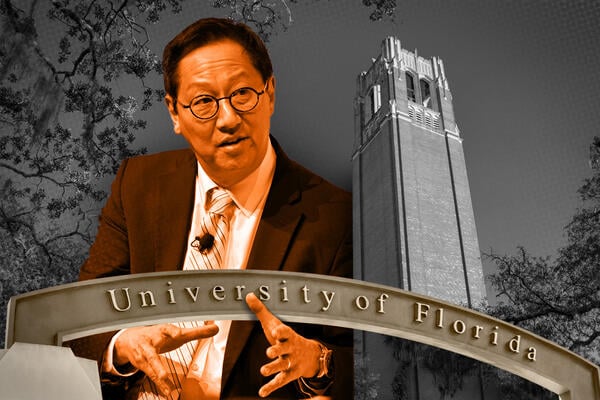
    The University of Florida is already one of the nation’s premier public universities. But it has the potential to be the very best. That belief—in UF’s momentum, its mission and its future—is what led me to pursue the extraordinary opportunity of the UF presidency.

    Santa J. Ono was recently recommended as the sole finalist for the University of Florida presidency. 

    University of Florida

    Over the past several weeks, I’ve had the chance to spend meaningful time with the university’s leadership. I believe deeply in their vision: ambitious, anchored in a culture of excellence and laser-focused on student success. The passion I’ve seen for this institution—including during my visit to campus earlier this week to meet its students, faculty and administrators—is infectious, and the alignment between the Board of Trustees, the Board of Governors, the governor and the Legislature is rare in higher education. This alignment signals seriousness of purpose, and it tells me that Florida is building something truly exceptional. I’m excited to be part of that.

    I believe in Florida’s vision for higher education. I understand its priorities, and I support them. I will execute this vision with clarity, consistency and integrity. I put my name forward for this position because I agree with the state leadership’s vision and values for public higher education. My alignment is rooted in principles—like the renewed emphasis on merit, the strengthening of civics and foundational learning, and the belief that our universities should prepare students not just for careers, but for informed citizenship in a free society.

    Public universities have a responsibility to remain grounded in academic excellence, intellectual diversity and student achievement. That means rejecting ideological capture, upholding the rule of law and creating a culture where rigorous thinking and open dialogue flourish. I share that commitment.

    Like many, I supported what I believed to be the original intent of DEI — ensuring equal opportunity and fairness for every student. That’s something on which most everyone agrees. But over time, I saw how DEI became something else—more about ideology, division and bureaucracy, not student success. That’s why, as president of the University of Michigan, I made the decision to eliminate centralized DEI offices and redirect resources toward academic support and merit-based achievement. It wasn’t universally popular, but it was necessary. I stood by it—and I’ll bring that same clarity of purpose to UF.

    The future of higher education depends on a clear mission, a culture of merit and accountability, and a deep commitment to preparing students to thrive in the real world. That means strengthening partnerships with businesses, supporting agriculture and innovation, and ensuring each student—regardless of background—has the opportunity to reach their full potential.

    I also understand the challenges of leadership in today’s academic environment. During my tenure leading other public universities, I declined to politicize the institutions or publicly oppose national political figures. I did this because I believe universities must serve as platforms for learning, not partisanship or ideological activism.

    Combating antisemitism has been a priority throughout my career. I’ve worked closely with Jewish students, faculty and community leaders to ensure that campuses are places of respect, safety and inclusion for all. I know that the University of Florida has been a national leader in this regard —setting a gold standard in standing firmly against antisemitism and hate. That standard will not change under my leadership. I will continue to ensure that UF is a place where Jewish students feel fully supported, and where all forms of hatred and discrimination are confronted clearly and without hesitation.

    Finally, peaceful protest has a place in campus life. But the University of Florida is not a place for disruption, intimidation or lawlessness. If I am approved, UF will remain a campus where all students are safe, where differing views can be heard and where the rule of law is respected.

    This is an exciting moment for Florida and for the University of Florida. I’m honored to be a part of it. And I’m ready to get to work.

    Santa J. Ono has been recommended as the sole finalist to be the 14th president of the University of Florida. He formerly served as the president of the University of Michigan.

    Source link

  • The New Pope, Leo XIV, Is a ’77 Villanova Grad

    The New Pope, Leo XIV, Is a ’77 Villanova Grad

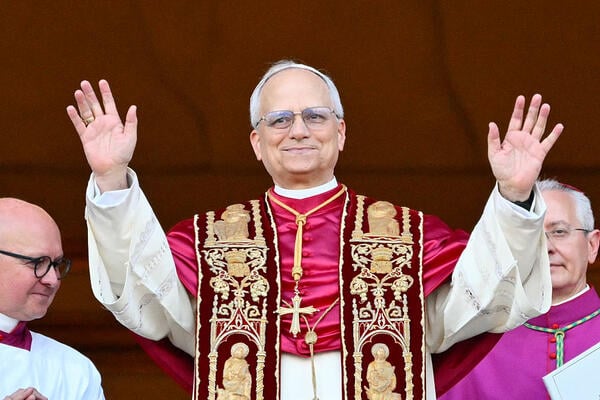
    The Vatican announced the selection of a new pope to lead the Catholic Church on Thursday, the first to come from the United States and the first to hold a bachelor’s degree from a U.S. university.

    Pope Leo XIV, then Robert Prevost, graduated from Villanova University in 1977.

    Pope Leo XIV, born Robert Prevost, is a Chicago native who graduated from Villanova University in Philadelphia in 1977 with a bachelor of science in mathematics. In September of that year, he joined the Order of St. Augustine. He took his solemn vows in August 1981 and earned a master of divinity from the Catholic Theological Union in Chicago in 1982.

    Villanova president Peter M. Donohue said in a statement that the university celebrates the election of Pope Leo XIV.

    “I cannot help but reflect on what his Augustinian papacy will mean to our university community and our world,” Donohue said. “Known for his humility, gentle spirit, prudence and warmth, Pope Leo XIV’s leadership offers an opportunity to reaffirm our commitment to our educational mission.”

    For most of his career, Prevost served in Peru, holding roles as a parish pastor, diocesan official, seminar teacher and administrator before becoming bishop of Chiclayo in 2015. In 2023, Pope Francis appointed Prevost prefect of the Dicastery for Bishops, which increased his visibility and influence in the church, putting him on the path to the papacy.

    In addition to being the first pope from the U.S., Leo is also the first dual-citizen pope, holding citizenship in Peru. He’s also the first Augustinian friar to be elected pontiff, reflecting Villanova’s Augustinian Catholic roots.

    The last pope to take the name Leo also has ties to American higher education. Pope Leo XIII (1878–1903) gave his formal approval for the founding of the Catholic University of America in Washington, D.C., on April 10, 1887, and the university recognizes this date as Founders Day.

    Source link

  • Conservatives Clash Over Ono Hire at UF

    Conservatives Clash Over Ono Hire at UF

    Less than a year after former president Ben Sasse resigned abruptly, the University of Florida has gone in the opposite direction for its next presidential pick, announcing Santa Ono as the sole finalist.

    Ono, who stepped down from the University of Michigan presidency last week after less than three years on the job, brings a wealth of academic and research experience: He also served in the top jobs at the University of Cincinnati and the University of British Columbia.

    Sasse, a Republican U.S. senator from Nebraska when he was hired in late 2022, previously served as president of Midland University, a small institution in his home state. Despite a lack of experience overseeing a massive research enterprise like UF, Sasse fit a profile in demand in Florida, where GOP lawmakers have ascended to presidencies at multiple universities. But his time at UF was short-lived; after less than 18 months on the job, he stepped down amid a spending scandal. At the time, he cited his wife’s deteriorating health as his reason for leaving.

    Ideology has regularly trumped experience in recent Florida presidential hires. Multiple former lawmakers, all Republicans, are at the helm of various state institutions. They include former lieutenant governor Jeanette Nuñez at Florida International University, Adam Hasner at Florida Atlantic University and Richard Corcoran at New College of Florida, among others.

    Considering those recent hiring trends, Ono is an outlier—a traditional higher ed candidate in a state where Republican governor Ron DeSantis and the Florida Board of Governors, most of whom he appoints, have taken active roles in presidential searches.

    And while many faculty members have celebrated the selection of a candidate with strong research and leadership credentials, some conservative figures are pushing back on Ono.

    Now a public battle appears to be brewing over who will lead the University of Florida.

    Opposition Emerges

    When UF announced Ono as the sole finalist for its presidency on Sunday, many observers were shocked that he was leaving his plum job at Michigan so soon. In October, Ono signed an eight-year contract extension with a $1.3 million base salary to keep him at Michigan long term. (Though UF’s compensation package has not yet been released, Ono could earn as much as $3 million a year, according to a salary range set by trustees.)

    But almost seven months later, Ono resigned when his candidacy at UF was announced.

    Given the trend of DeSantis’s involvement in presidential searches across the state, it seems unlikely Ono would have emerged without the governor’s blessing. But other conservative figures have publicly objected to Ono’s candidacy over concerns about diversity, equity and inclusion programs at Michigan, which has been scrutinized for its significant spending on such efforts.

    Chris Rufo, a trustee at New College of Florida who has championed anti-DEI efforts nationwide, strongly opposed the pick and called for UF to reverse course on the hire. Rufo has been a regular critic of DEI at UM.

    “The finalist for the University of Florida presidency is a left-wing administrator who recently declared his support for ‘DEI 2.0’ and claimed that ‘the climate crisis is the existential challenge of our time.’ Florida deserves better than a standard-issue college president,” Rufo wrote on X.

    Congressman Byron Donalds, who represents Florida’s 19th Congressional District and is the expected front-runner to replace DeSantis as governor at the end of his term, has also voiced concerns: “Florida cannot afford to inject wokeness into our flagship university. This selection must be blocked and the search committee must start over,” Donalds wrote in a social media post.

    DeSantis Defends the Pick

    But DeSantis defended the selection in a Wednesday press conference.

    Though he said he was “not involved” with the search and had not talked to Ono, he emphasized that he has faith in UF’s trustees—most of whom he appointed—guiding the pick. He added that the expectations for higher education in Florida were clear, noting the state’s opposition to DEI and what he called a rejection of “woke indoctrination” at state institutions.

    “I don’t think that a candidate would have been selected who is not going to abide by those expectations, and I think that you will likely see that will be very clear in this instance. I will let the process play out, but we have put a real serious stake in the ground on this,” DeSantis said.

    The governor boasted that Florida “led the efforts” to take down diversity initiatives, which he said the Trump administration has since followed on a national level.

    DeSantis also noted that Ono eliminated the University of Michigan’s DEI office in recent months.

    “I don’t think that anyone would want to come to the University of Florida if your goal was to pursue a woke agenda. You’re going to run into a brick wall here in the state of Florida,” DeSantis said.

    If the governor disapproved, he could blow up the search, as he did last month when UF’s College of Liberal Arts and Sciences tried to hire a new dean. In that case, DeSantis ordered the search restarted after his office took issue with DEI statements from candidates. Allowing UF’s hiring effort to proceed seems to suggest at least tacit approval from DeSantis.

    Some members of the Florida Board of Governors have also thrown their support behind Ono, pushing back on criticism. Their support is critical, considering that board has the power to upend presidential searches, which it has done in past searches, such as at FAU in 2023.

    Florida Board of Governors member Alan Levine has taken to social media to urge fellow conservatives, including Rufo, to give Ono a chance and hear him out through the process.

    “Chris, let’s give @SantaJOno a chance to tell his whole story,” Levine wrote in response to Rufo. “He eliminated the DEI office at Michigan. He faced threats and vandalism for standing up to the pro-palestinian/anti-israel/anti-US movement on campus. There seems to be more to Dr. Ono’s actions, and we need to let him tell his story. No candidate is without things they need to explain. I’m open to giving him the chance to do that, particularly given his total body of work.”

    The University of Florida declined to comment on critiques of the candidate.

    Ono Explains

    As Ono exits Michigan, he leaves several controversies in his wake.

    The outgoing president has faced criticism for his handling of pro-Palestinian protests in the aftermath of the Oct. 7, 2023, attacks by Hamas on Israel and the brutal retaliatory offensive by the Israeli military. Several former employees alleged they were fired for engaging in pro-Palestinian protests, prompting a lawsuit against the university, Ono and others, filed earlier this month.

    Michigan has also navigated a series of athletic scandals during Ono’s tenure. Most recently, a former Michigan football coach was accused of hacking the digital accounts of more than 2,000 NCAA athletes and downloading “personal, intimate digital photographs and videos,” according to the U.S. Department of Justice. Matt Weiss, an assistant at UM from 2021 through early 2023, was charged with 14 counts of unauthorized access to computers and 10 counts of aggravated identity theft in March. The incident also prompted multiple lawsuits against the university.

    And Ono shut down Michigan’s DEI office in March, despite objections from constituents.

    But in an op-ed shared exclusively with Inside Higher Ed, Ono made no mention of the lawsuits and avoided most other controversies. Instead, he focused on the potential at the University of Florida, emphasizing his belief “in Florida’s vision for higher education” and UF’s leadership.

    “The passion I’ve seen for this institution—including during my visit to campus earlier this week to meet its students, faculty and administrators—is infectious, and the alignment between the Board of Trustees, the Board of Governors, the governor and the Legislature is rare in higher education. This alignment signals seriousness of purpose, and it tells me that Florida is building something truly exceptional. I’m excited to be part of that,” Ono wrote in the op-ed Thursday.

    Ono echoed themes championed by both DeSantis and Rufo as he argued that universities must reject “ideological capture” and renew “emphasis on merit.” He also sought to distance himself from DEI efforts.

    “Like many, I supported what I believed to be the original intent of DEI—ensuring equal opportunity and fairness for every student. That’s something on which most everyone agrees,” he wrote. “But over time, I saw how DEI became something else—more about ideology, division and bureaucracy, not student success. That’s why, as president of the University of Michigan, I made the decision to eliminate centralized DEI offices and redirect resources toward academic support and merit-based achievement. It wasn’t universally popular, but it was necessary.”

    Ono added that he would bring “that same clarity of purpose to UF.”

    Source link

  • Scholarship Thrives on Peripheral Vision (opinion)

    Scholarship Thrives on Peripheral Vision (opinion)

    The problem with scholarly focus is that it leads where you intend to go. And this is a problem because when you get there, you’re likely to find that your destination isn’t all that interesting. In practice, scholarship is not about effectively carrying out a plan but about exploring a terrain and developing the plan that is warranted by what you discover in that terrain.

    This issue with the act of scholarship in particular is really just an extension of what we know about the act of writing in general. Namely, writing is not the process of explaining the argument that is embedded in your outline but instead the process of finding out what that argument should be. If your paper follows your outline from beginning to end, it’s clear that you haven’t learned anything in the course of writing that paper. You found what you were looking for rather than what was actually out there waiting to be found.

    This reminds me of a question that my friend David Angus used to ask candidates for faculty positions at the University of Michigan College of Education: “Tell me about a time that your research forced you to give up an idea you really cared about.” If you discover something that upsets your thinking, that’s an indicator that you’re really learning something in the course of carrying out your study. This in turn suggests that the reader is likely to learn something from reading your paper on the subject, instead of just confirming a previous opinion.

    Scholars need an intellectual starting place for a piece of research—an established conceptual framework that provides us with a promising angle of approach into a complex intellectual problem space. But the danger is getting trapped within the confines of the conceptual framework in a manner that predetermines the conclusions we reach. Instead, we need to be open to the possibility that our favored framework needs to adapt to the demands of the data we encounter. Perhaps we need to add an additional perspective to this framework or adapt or even discard parts of the framework that don’t seem to be validated by the data at hand. After all, getting things wrong and then correcting them in light of evidence is at the heart of the discipline we call science.

    The need to open ourselves to perspectives that are beyond the scope of our established conceptual frameworks is what calls for us to deploy our peripheral vision. As I used to tell my students, the book you’re looking for may not be the one you need to read, which may be a few books down on the shelf. In this manner, scholarship becomes a process of continually evolving your conceptual framework over time, as each study nudges you in new directions. This is what can make academic pursuits so stimulating, as you bump into problems your current perspective can’t resolve and construct a new perspective that allows you to move forward in developing an argument. You can’t predict where you’re going to end up, but you’ll know that it’s going to be interesting—both for you and for your reader.

    David Labaree is a professor emeritus at Stanford Graduate School of Education. He blogs at davidlabaree.com and his recent books include Being a Scholar: Reflections on Doctoral Study, Scholarly Writing, and Academic Life (2023, Kindle Direct Publishing).

    Source link

  • Why First-Year Comp Classes Give Me Hope (opinion)

    Why First-Year Comp Classes Give Me Hope (opinion)

    First-year composition courses, which are required of incoming students at many colleges and universities, lack cachet. No student gets excited about a comp class, and the faculty who teach these classes usually occupy the low rungs on the academic ladder. And right now, as crisis after crisis batters the country, and the world, first-year composition may seem even less important than usual. But in my 30 years of college teaching, it’s first-year comp classes that give me hope, because they offer the possibility of change.

    These small, discussion-based classes give students much-needed practice in how to disagree without disrespect, and—if these classes were embedded more firmly into university curricula—they could radically reshape not only how students learn but how they participate in public life.

    My students often come into their comp class with a chip on their shoulder: Why should they have to “learn to write”? They got themselves into college, after all, and if they get stuck on a writing assignment, there’s always ChatGPT. First-year writing is a waste of time, they think; they’re in college to take “real” classes, courses that matter.

    I harbor a secret affection for these reluctant students, because I know that their resistance will melt when they discover the immensely practical importance of finding the right words for their ideas—and the accompanying sense of power that comes with being able to express themselves so that others understand them. Universities tell students that comp classes aren’t “content courses,” because writing courses aren’t discipline-specific. But then again, neither is the world we live in: Most of us live, work and think in multiple, overlapping contexts.

    For many students, the composition class is the first (and for some, the only) place in college where they experience a seminar-style class that emphasizes process as much as (or more than) product. The paradigm of a composition course involves a reset: It’s not about “the right answer”; it’s about prioritizing curiosity over certainty and about students discovering not only that they have a voice, but that they can use this voice to explore their world. In the 21st-century university, in which faculty are asked for their “course deliverables,” as if learning were an assembly-line widget, comp classes exemplify an alternative to the sludgy tide of university corporatization.

    Composition classes encourage questions, welcome mistakes and revisions, and value messiness and curiosity. During peer workshops, which are an integral part of these courses, I remind students that grades aren’t pie: Everyone can, conceivably, get an A in the course, so their workshop task is helping one another create more effective writing, not to tear each other’s drafts to shreds. Their success, in other words, does not depend on someone else’s failure.

    There are other disciplines where students work iteratively and collaboratively—computer science, for example. But in composition workshops, students learn to ask the kinds of questions that promote reflection and refinement. They’re quick to pick up on one another’s sweeping generalizations—“throughout history, men and women have always disagreed”—and explain why those sorts of generalizations aren’t effective.

    As they talk, they see how their own experiences might be radically different from those of the people reading their work, and they begin to understand how their experiences, consciously or not, have shaped how they see the world. In classroom conversations and workshops, they learn to disagree without rancor and to understand that how they chose to explain (or not explain) an idea has consequences for how they are understood. In a recent essay in The New York Times, Greg Weiner, president of Assumption University, writes that college campuses “are places where dissenting views deserve an elevated degree of respectful and scholarly engagement.” That’s a tall order for U.S. colleges these days, it seems, but it’s one of the underlying principles of composition classrooms.

    “How could I say this better?” is a question I hear writers ask, to which their readers reply, “What do you really want to say, and why?” Students ask one another to explain the evidence for their claims, to examine their assumptions and to think about alternative ways of presenting their ideas. Composition courses help people become more effective writers because they help people become better listeners: Students learn to disagree without dismissiveness or disrespect. And as they help one another, they see ways to improve their own work; it’s a feedback loop that helps them find critical distance, which is essential for revision. Quite literally, students have to re-see their ideas and consider the impact of those ideas on their audience.

    I remember when a male student from Shanghai read an essay written by a female student from the Persian Gulf about her struggles to be a dutiful daughter. “She totally read my mind,” the Shanghai student proclaimed. “Being a good son, trying to keep my parents happy—it’s exhausting!” His comment prompted a class discussion about the generational struggles they all shared, albeit across wildly divergent cultural experiences. Their differences prompted questions that led to connections; difference became an opportunity for exploration rather than a threat. Students were excited to write the essays that emerged from this conversation; they were invested in examining their own experiences in order to open those experiences to others.

    That’s what reading and writing can give us: moments of connection with other people’s lives, which then help us see ourselves in a new light. Connection and distance, empathy and self-reflection: These are the qualitative moves that students practice in composition class. These are the deliverables.

    These deliverables, however, don’t translate into status for composition teachers, who are typically not tenure-track or tenured; they are often called lecturers rather than professors, despite having a Ph.D. Most of us are what’s known as contingent faculty because we work on renewable contracts (sometimes semester to semester, sometimes in longer increments).

    To be a composition teacher, then, means working in the trenches of the university rather than its ivory towers. I’ve been teaching some version of first-year writing for more than 30 years, and while I might hope otherwise, I know that only one or two semesters of writing instruction isn’t enough to create lasting change, even though the most resistant students admit to feeling like more confident and competent writers by the end of the course.

    If universities had the courage to put composition at the center of their missions, however, they could create real change: What if students had expository writing classes every year for four years, regardless of their majors? Four years of slow, reflective, process-based writing about the world outside their specific subjects, with an emphasis on exploration and curiosity, rather than “the right answer”? What if the ability to reflect and reconsider, the twinned abilities at the heart of critical thinking, were the deliverables that mattered?

    Imagine those students bringing that training into the public sphere. People who are eager to ask questions and interrogate assumptions (including their own), people who think in terms of process rather than product: These are the basic tenets of almost any composition class and yet, increasingly, these attitudes seem almost radical. People trained in this way could re-shape public discourse so that it becomes conversation rather than a series of point-scoring contests.

    First-year comp is a content course. We just need to see that content as valuable.

    Deborah Lindsay Williams is a clinical professor in liberal studies at New York University. She is author of The Necessity of Young Adult Fiction (Oxford University Press, 2023) and co-editor of The Oxford History of the Novel in English: Volume 8: American Fiction Since 1940 (Oxford, 2024).

    Source link

  • Education Dept.’s Penn Demands Show Shift in Title IX

    Education Dept.’s Penn Demands Show Shift in Title IX

    The Department of Education’s demands that University of Pennsylvania “restore” swimming awards and honors that had been “misappropriated” to trans women athletes and apologize to the cisgender women who had lost to them offer a glimpse into how the second Trump administration could use Title IX to force certain changes at colleges, experts and attorneys say.

    The demands, issued April 28 in the form of a proposed resolution agreement, would resolve a civil rights investigation that found Penn violated Title IX by “permitting males to compete in women’s intercollegiate athletics and to occupy women-only intimate facilities.” The Office for Civil Rights didn’t offer specifics, but officials were likely referring to trans swimmer Lia Thomas, who competed on the university’s women’s team in the 2021–22 academic year.

    Today is the deadline for Penn to either agree to the proposed demands or potentially face consequences. Department officials said they would refer to the case to the Justice Department for possible enforcement—a process that could end with the university losing access to federal funding—if Penn didn’t comply. (Penn has already lost $175 million in federal funding over this issue, though White House officials said that decision was separate from the Office for Civil Rights inquiry.)

    Penn is among several colleges and K-12 schools, including San José State University, facing investigations over policies related to trans athletes, but Penn is the first college to be the target of such public demands. Experts say the speed of the investigation, OCR’s unusual demands and the fact that Penn was in compliance with Title IX at the time Thomas competed there reflect a shift toward a more aggressive use of Title IX to further President Donald Trump’s anti-trans agenda.

    The crazy part of all of this is they may be asking Penn to discriminate in doing so, because the Trump administration has its interpretation, but that’s not definitive.”

    —Brett Sokolow, former president of the Association of Title IX Administrators

    Opposing Interpretations

    The administration’s forceful attack on institutions that have been home to high-profile trans women athletes fits with its overall playbook, which includes using any tools at its disposal to advance Trump’s agenda.

    In the case of trans athletes’ participation in athletics, the weapon of choice is Title IX, the 52-year-old law passed to guarantee women equal opportunity to education, which has since been interpreted as a broad tool to address sex-based discrimination and harassment on campus.

    In recent years, though, the relationship between trans students’ rights and Title IX has become complicated. Those on the left argue that the nature of Title IX is to protect students from gender-based discrimination, and that includes discrimination against trans and nonbinary individuals. (Such protections were included in the Biden administration’s short-lived Title IX regulations.) But those on the right argue that allowing trans women to participate women’s sports and to use women’s bathrooms and locker rooms violates the rights of their cisgender teammates—a perspective the Trump administration squarely aligns with.

    “The previous administration trampled the rights of American women and girls—and ignored the indignities to which they were subjected in bathrooms and locker rooms—to promote a radical transgender ideology,” Craig Trainor, acting assistant secretary for civil rights, said in a statement when the Penn investigation was first announced.

    For those in the former camp, Trump’s demands of Penn are just another example of the president using any means possible to erode trans people’s rights.

    “The news out of Penn, to me, was just another example of the way they are, unfortunately, using [Title IX] as a battering ram to beat down safe and inclusive school environments for trans students,” said Emma Grasso Levine, senior manager of Title IX policy and programs at Advocates for Youth, a youth sexual health and LGBTQ+ equality advocacy organization.

    Conservative organizations, though, have applauded the proposed resolution agreement, with the Alliance Defending Freedom, a conservative Christian legal group that has repeatedly sued to prevent trans women from playing on women’s sports teams and using women’s locker rooms and bathrooms, calling it “another step in the right direction to restore fairness and safety in women’s sports.”

    An Aggressive Tack

    Since taking office in January, Trump has rolled back trans students’ rights, including signing an executive order banning trans student athletes from playing on the teams that align with their gender. That order prompted the Penn investigation, but at the time that Thomas was competing, trans women who met certain requirements related to hormone therapy—as Thomas did—were permitted by the NCAA and governmental regulations to compete on women’s teams.

    The NCAA has since changed that rule. But despite the NCAA’s stance and the executive order, current Title IX regulations do not disallow trans women from playing women’s sports. In fact, the regulations are the exact same set of rules, passed by the first Trump administration in 2020, that were in place when Thomas swam for Penn. This raises the question, experts say, of whether Penn should be penalized under Title IX despite the fact that the institution was following those regulations to the best of its ability.

    “That’s the interesting challenge, and probably where Penn will hang its hat if it fights this: ‘There was an interpretation of Title IX in place at the time that Penn followed. And there’s an interpretation of Title IX that’s different now. How is it fair to impose today’s interpretation of Title IX on a previous time period?’” said Brett Sokolow, former president of the Association of Title IX Administrators and chair of the crisis management consulting and law firm TNG Consulting.

    This is just one element of the aggressive tack the Trump administration appears to be taking against institutions that allowed trans women to play women’s sports. Multiple experts also pointed out the quick, almost dizzying timeline of OCR’s investigation into Penn.

    Timeline of Penn Investigation

    Feb. 5: Trump signs executive order prohibiting trans athletes from playing on teams that match their gender identity.

    Feb. 6: Trump launches investigation into Penn. NCAA ends policy allowing trans athletes to play on teams that match their gender identity.

    March 19: Trump administration pauses $175 million in federal funds to Penn.

    April 28: OCR says Penn violated Title IX and must “restore” swimming honors given to trans women.

    Ordinarily, investigations can take years to conclude—something that has often been a pain point for victims’ rights advocates, who argue that those timelines can seriously impede victims’ ability to complete their studies.

    But OCR launched this investigation within a month of Trump entering office—and just two days after he signed the EO related to trans athletes—and resolved it less than three months later.

    It’s also unusual for OCR to target a specific student with a resolution agreement, Sokolow said; most such agreements are stripped of names and identifying details. Although Thomas is not named in the department’s press release, it does call out her sport, swimming, and there have been no other out trans athletes at Penn.

    “It’s very indicative of this administration—and concerning—that they’re targeting one person and demonizing them,” he said.

    Experts also say the demands marks a sharp contrast from how OCR has resolved such cases in the past. Levine said that the requirements in resolution agreements are meant to “meaningfully impact a culture of sex-based harassment,” but she feels that OCR’s demands wouldn’t do that—if such a culture even exists at Penn.

    Title IX ‘Pendulum Swing

    If Penn fights the demands, the case could put the war between those who seek to protect trans athletes from discrimination and those who want to see them excised from their sports teams to the test. And until courts settle the question, students and institutions will be in limbo.

    “The crazy part of all of this is they may be asking Penn to discriminate in doing so, because the Trump administration has its interpretation, but that’s not definitive,” Sokolow said. “It does not have the force of law. If a court were to rule on this that Lia Thomas had rightfully won whatever competition the Trump administration is concerned about, any move to force to Penn to remove those victories could be discriminatory against a person who’s trans.”

    Lia Thomas, a swimmer at University of Pennsylvania, left, and Riley Gaines of the University of Kentucky tied for fifth place in the 200 freestyle at the NCAA swimming championships in March 2022.

    Icon Sportswire/Contributor/Getty Images

    Patricia Hamill, co-chair of the Title IX and campus discipline practice at Clark Hill, a Washington law firm, told Inside Higher Ed via email that the case “highlights the pendulum swing of Title IX in its enforcement and interpretation as well as in the government priorities over the last decade. Institutions are continuously being challenged on how to best to handle these very difficult situations on ground that continues to shift both because of Administration changes but also because of societal changes.”

    Penn had not publicly commented on the proposed resolution agreement as of Wednesday evening. When news broke that the government was suspending its federal funds, Penn officials stressed in a statement that its “athletic programs have always operated within the framework provided by the federal government, the NCAA and our conference.”

    Title IX experts expect that if the university does challenge the proposed agreement in court, it will focus on that very argument—that when Thomas was competing on Penn’s swim team, the university was, in fact, complying with NCAA rules and the department’s guidance.

    Source link

  • Illinois Tech Establishes First U.S. Campus in India

    Illinois Tech Establishes First U.S. Campus in India

    On Wednesday, the Illinois Institute of Technology announced it had reached an agreement with India’s University Grants Commission to establish a branch campus in Mumbai, opening to students in fall 2026. It will be the first degree-granting U.S. institution on Indian soil and Illinois Tech’s first international branch campus.

    For decades, a complicated legal and tax system prevented U.S. institutions from opening campuses in India. Then, in 2020, the Indian government issued a new National Education Policy paving the way, officials promised, for a much easier pathway to fruitful academic partnerships.

    India is a major growth market for U.S. higher education; this year the country surpassed China for the first time as the top origin country for international students in the U.S. Establishing a beachhead in India could help institutions carve out a dominant space for themselves in the lucrative international recruitment market, especially since the vast majority of Indian international students come to the U.S. for postgraduate study.

    When the Indian government announced the NEP 2020 plan, officials envisioned the “top 100 universities in the world” setting up shop in the country. So far, that hasn’t happened.

    Illinois Tech is not a globally renowned university; it’s not even one of the better-known institutions in Chicago. Its undergraduate population numbers only around 3,000 students, and the postgraduate population isn’t much larger. So how did it get ahead of name-brand research universities that have been dipping their toes in the Indian market, like Johns Hopkins and Rice?

    Philip Altbach, professor emeritus at the Center for International Higher Education at Boston College and a longtime expert on academic internationalization, said American institutions have been hesitant even in recent years to invest in Indian branch campuses due to a mix of bureaucratic complications and uncertain financial returns.

    “There hasn’t exactly been a rush to the gates in India from American institutions, and I don’t think there’s going to be anytime soon,” Altbach said. “The challenges of doing business there are still pretty high, and that puts a lot of foreign universities off.”

    Illinois Tech president Raj Echambadi said his university is taking the long view. As the spending power of India’s burgeoning middle class grows along with demand for highly trained workers—especially in engineering and technology—he sees the Mumbai campus as an early investment in a partnership that will become central to American institutions’ global strategies in the years to come. His institution has already begun to see the importance of Indian students to their bottom line: The share of Indian master’s students has risen by nearly 75 percent over the past five years.

    “The potential upside is huge, which means if you get in early the ride is going to be phenomenal,” he said. “In the next 25 years, we’re going to be catching that elephant’s tail.”

    Illinois Tech had a head start on the competition: The institution has been active in the Indian education market since 1996, during a period of rapid technological innovation.

    When demand for skilled workers in exploding fields like communications technology skyrocketed in the mid-1990s, Illinois Tech offered an early version of distance learning, shipping VHS-tape lessons to engineers in Bangalore who wanted to earn credentials that the Indian higher education system had yet to develop.

    Now, Echambadi says, Illinois Tech is meeting new demands in a changing Indian economy; its Mumbai campus will offer 10 degree programs in growth fields like semiconductor engineering. It even has some built-in brand recognition: It’s known as IIT in Chicago, the same acronym as India’s main university system, the Indian Institutes of Technology.

    “India can’t build universities fast enough to meet the growing demand,” Echambadi said. “That’s where we come in.”

    Colleges Hang Back

    Many colleges that wanted to explore opening a campus in India simply may have struggled to navigate the complex application system, even after the NEP was issued. Rajika Bhandari, a longtime international education strategist and the founder of the South Asia International Education Network, said the 2020 NEP took years to translate into practice.

    “U.S. institutions have been trying to enter the Indian market for years, well before the NEP. But the Indian bureaucracy and strict regulations have always been a challenge,” she wrote in an email. “Even with the NEP, it has likely taken a while to implement aspects of the policy and actually get things going.”

    Having a 30-year presence in India, Echambadi said, helped ease the process. He added that it helped that both he and Mallik Sundharam—Illinois Tech’s vice president for enrollment management and student affairs, who led the Mumbai project—are of Indian origin; both attended college there before moving to the U.S. for their graduate degrees. They said their understanding of their home country’s byzantine bureaucracy helped them navigate the system quicker than their competition.

    Sundharam said there’s also a much more receptive attitude in India toward foreign universities and a simpler system. They applied to establish the Mumbai campus earlier this year, and the entire process, from submission to acceptance, took two months. More than 50 foreign institutions have applied to set up a campus in India this year.

    “The Indian government has come a long way,” he said.

    Altbach said U.S. colleges are more likely to establish joint degree programs with Indian universities than full branch campuses. Virginia Tech established the first of these in 2023, also in Mumbai. Other institutions, including Johns Hopkins and Purdue University, have stuck to research partnerships and exchanges. Rice, which was an early proponent of Indian-American higher ed collaboration, established a research center in Kanpur in early 2020, months before the new NEP was introduced. Altbach said he thinks branch campuses will remain the territory of “low- to midlevel research institutions” seeking to boost enrollment.

    But Bhandari, an Indian immigrant and a close observer of the country’s booming education market, said Illinois Tech may be on the vanguard of a new push in academic internationalization.

    As international enrollment in the U.S. staggers from President Trump’s policies to deport student visa holders and crack down on global academic partnerships, Bhandari said physical programs in growth countries like India will become increasingly important. There’s already evidence that Indian student mobility to the U.S. is on the decline: F-1 visa applications from India are down 34 percent from this time last year, according to a recent analysis by Chris Glass, a professor at Boston College’s Center for International Higher Education.

    “Other universities are operating under the assumption that international markets will stay the same, but they won’t,” Sundharam said. “Students may not want to be mobile in five to 10 years. They will want quality higher education at their doorstep.”

    Source link

  • Students Without a Degree Value Higher Ed

    Students Without a Degree Value Higher Ed

    Photo illustration by Justin Morrison/Inside Higher Ed | FG Trade/E+/Getty Images

    American adults who don’t currently have a college degree see value in pursuing higher education, but the cost of a credential, mental health challenges, emotional stress or the flexibility of classes can prevent some from enrolling in and completing a program, according to the results of a survey released today.

    The Lumina Foundation and Gallup surveyed nearly 14,000 adults in October to learn more about their views toward higher education and the barriers they face in attaining a credential. This latest report is part of the State of Higher Education study, which began in 2020.

    Those surveyed include 6,000 adults who are currently enrolled at a college or university, nearly 5,000 people who have some college but no degree, and 3,000 adults who have never enrolled in a college program.

    Fifty-seven percent of those surveyed in 2024 said they considered pursuing at least one degree or credential in the past two years. That’s down two percentage points from the 2023 survey, but significantly up from 44 percent of those surveyed in 2021.

    Most respondents said some form of postsecondary credential was valuable, though bachelor’s degrees, industry certifications and graduate degrees ranked the highest. Among those who aren’t enrolled in college, 24 percent said they’re interested in pursuing an associate degree, while 18 percent have considered a bachelor’s degree. About 22 percent are interested in a certificate program, down slightly from 23 percent in last year’s report.

    Over all, 48 percent of those not currently in college said they are either very likely or likely to enroll in a postsecondary program, though those who stopped out are more likely to re-enroll compared to those who never started in the first place. Additionally, white adults are the least likely to consider some form of higher education in the next five years.

    For those currently enrolled or who stopped out, expected future job opportunities and confidence in the value of the degree or credential were key motivators in their decision to pursue higher education, though those were not the only factors.

    “The consistent link between perceived value and career outcomes underscores the importance of affordability, flexibility and student support—especially for those balancing work, caregiving or mental health struggles,” the report concludes. “To sustain this momentum and close remaining gaps, higher education institutions and policymakers will need to focus on removing barriers and reinforcing the connection between credentials and meaningful, well-paying jobs.”

    Zach Hrynowski, a senior researcher at Gallup, said the survey results show that while adults in the United States are less confident in institutions of higher education, a majority still see “the actual product that they receive from it” as beneficial, and that perceived value drives students to overcome barriers such as cost and flexibility for students who are in rural areas or are caretakers.

    “If people think it’s valuable, they’re going to still go after it. They may hem and haw, say, ‘Is this really worth it? Do I have the money? Why can’t I surmount the barriers?’” he said. “But we haven’t seen a widespread exodus away from higher education as a result of that, and that’s a testimony to the belief and the value of the credential itself.”

    But Hrynowski cautioned that if there was another way for adults to get a good job and socioeconomic improvement, prospective students might choose that option over pursuing a higher education.

    “If there was a paradigm shift and suddenly bachelor’s degrees were not the only pathway, and more and more industries had, for example, an industry certification that could be used in place of a bachelor’s degree, I’m not sure how many people would continue to chase that very expensive degree awarded by the institutions that they don’t trust very much,” he said.

    “I think right now, for a lot of people, pursuing bachelor’s degrees—especially if they’re doing it because it’s the only option—they acknowledge that if they want the benefit, then that’s the price they have to pay.”

    Source link

  • Columbia Lays Off 180 Amid “Intense” Financial Strain

    Columbia Lays Off 180 Amid “Intense” Financial Strain

    Columbia University is laying off 180 researchers after the Trump administration cut the university’s research funding by more than $650 million.

    “Columbia’s leadership continues discussions with the federal government in support of resuming activity on these research awards and additional other awards that have remained active, but unpaid,” university leadership wrote in a memo Tuesday morning. “We are working on and planning for every eventuality, but the strain in the meantime, financially and on our research mission, is intense.”

    While federal agencies such as the National Institutes of Health, the National Science Foundation and the Department of Energy have cut research funding at universities across the country, the Trump administration has specifically targeted a handful of high-profile universities, including Columbia, for allegedly failing to curb antisemitism on campus. 

    Columbia is taking a two-pronged approach to navigating the sudden deep cuts to federal research funding. The first focuses on “continued efforts to restore our partnerships with government agencies that support critical research,” and the university said the second prong is about taking “action to adjust—and in some cases reduce—expenditures based on current financial realities.”

    Despite Columbia’s previous president acquiescing to Trump’s demands to enact numerous policy changes to address alleged unchecked antisemitism if it wanted its funding back, the university is still negotiating to recover it. In the meantime, the layoffs announced Tuesday represent about 20 percent of researchers who are funded “in some manner by the terminated grants,” according the statement signed by Claire Shipman, Columbia’s acting president; Angela V. Olinto, provost; Anne Sullivan, executive vice president for finance; and Jeannette Wing, executive vice president for research. 

    And the layoffs this week likely aren’t the end of the financial repercussions of the cuts to Columbia’s federal research funding. 

    “In the coming weeks and months, we will need to continue to take actions that preserve our financial flexibility and allow us to invest in areas that drive us forward,” the statement said. “This is a deeply challenging time across all higher education, and we are attempting to navigate through tremendous ambiguity with precision, which will be imperfect at times.”

    Source link