West Virginia University’s football team is experiencing a digital Footloose: The coach has prohibited the players from dancing on TikTok. The Foundation for Individual Rights and Expression hopes to reverse the ban.
In March, head football coach Rich Rodriguez told his players that while they could post on TikTok, they weren’t allowed to dance on the platform.
“We have to have a hard edge … and you’re in there in your tights dancing on TikTok ain’t quite the image of our program that I want,” Rodriguez said, according to the Associated Press.
Rodriguez also said he wants the players to focus less on their individual performances and more on the team dynamic—and he believes not dancing on TikTok can help.
FIRE responded by writing a letter last month to the university’s athletic director, Wren Baker, arguing that the ban on dancing violates the athletes’ First Amendment right to free expression.
“WVU players don’t hand in their expressive rights when Rodriguez hands out shoulder pads at the start of training camp,” FIRE wrote in the letter. “Because student-athletes are students first, their right to free expression off the field must be commensurate to other students on campus.”
When Baker failed to respond within a few weeks, FIRE sent another letter, which was posted on X.
“Major NFL players like Tom Brady, Gronk [Rob Gronkowski], and the Kelce brothers maintain robust TikTok presences,” the letter read. “Coaches at public colleges can’t stop their players from posting online, because students—including athletes—have the First Amendment right to express themselves.”
The policy isn’t written anywhere, as Front Office Sportslearned after requesting a copy through the Freedom of Information Act, but FIRE claims “its existence and enforcement violates students’ expressive rights.”
Some college athletes use their social media presences to generate revenue through name, image and likeness opportunities, and many of the top earners through NIL deals are colleges football players, though fewer of their brand opportunities are a result of social media dances.
New College of Florida could soon expand its footprint in a significant way if plans to absorb a nearby museum and local branch campus of the University of South Florida come to fruition.
Current proposals would see New College taking over stewardship of the John and Mable Ringling Museum of Art in Sarasota and other associated properties and merging with USF Sarasota–Manatee. Such moves would nearly double New College’s acreage and triple its enrollment at a time when critics have raised questions about spending at NCF, where the cost to Florida taxpayers per student is roughly 10 times higher than any other institution in the State University System.
The proposed expansion would continue efforts to grow NCF after state leadership tasked a new board in 2022 with shifting the small liberal arts college in a conservative direction and growing its student body, which the administration has so far aimed to do by adding athletic programs.
But critics have raised concerns about a lack of transparency around both potential acquisitions and whether New College has the capacity to manage another campus and a sprawling art museum.
A Contested Acquisition
New College officials have quietly been preparing for a merger with USF Sarasota–Manatee for at least several months, according to public records obtained by WUSF, the local NPR affiliate.
A WUSF public records request turned up a draft press release from New College announcing the merger between the two institutions as well as talking points and details on the transition.
Details in the documents make the deal sound more like an acquisition than a merger.
Students will have the option to transfer to another USF campus “or remain at New College,” according to the documents. Under the proposed plan, USF Sarasota–Manatee employees would possibly be reassigned to other USF campuses or “to comparable roles” at New College.
University of South Florida Sarasota–Manatee main building.
Alaska Miller/Wikimedia Commons
Although it appears that New College would absorb USF Sarasota–Manatee in the merger, New College is the much smaller of the two institutions. In fall 2023, it enrolled 731 students compared to more than 2,000 at USF Sarasota–Manatee, according to details on the university website.
“As we reimagine the future of higher education in Florida, this integration is a testament to the power of collaboration,” New College of Florida president Richard Corcoran said in the news release obtained by WUSF. “Governor [Ron] Desantis [sic] has shown exceptional leadership in enabling this bold vision, one that positions New College to advance as a model of academic excellence while fostering economic innovation and impact in the Sarasota-Manatee region.”
The news release adds, “This collaboration is more than a merger,” casting it as “an opportunity to design a singular institution that meets the demands of the 21st century” and allows USF to focus on its mission as a research university and NCF to become the nation’s top liberal arts college.
“The integration also addresses longstanding inefficiencies, consolidating administrative functions and aligning academic offerings. USF-SM’s programs often overlap with those offered by other public higher education institutions in Sarasota and Manatee counties, including New College and State College of Florida,” part of the draft press release from New College reads.
New College officials did not respond to requests for comment from Inside Higher Ed.
USF president Rhea Law is also quoted in the draft press release, stating that “by coming together, we honor the distinct institution while creating a stronger foundation for the future of both institutions and our communities.”
But USF officials have distanced themselves from the announcement since it emerged publicly.
“Please be aware that the documents are several months old and include a draft press release and talking points that were prepared by New College. USF did not approve the proposal or communications drafted by New College. There have been no plans made to make any such announcement,” USF spokesperson Althea Johnson wrote to Inside Higher Ed by email.
However, Johnson noted that the two institutions have engaged in talks since last fall, when Florida Board of Governors chair Brian Lamb asked them to “identify additional synergies.”
Asked if NCF invented quotes attributed to Law and other USF officials, Johnson reiterated, “USF did not draft or approve of the communications. They were prepared by New College.”
Community members have also opposed the move. Last week more than a dozen former USF Sarasota–Manatee officials and community partners signed on to an open letter against the merger, calling the move “a bad deal for our students and families, employers and community.” They wrote, “There has been no community consultation on the impacts” of the proposal.
The merger proposal would require legislative approval. Although no bill has been filed, Republican state senator Joe Gruters—whose wife works at NCF—has thrown support behind the idea in interviews. Gruters did not respond to a request for comment from Inside Higher Ed.
Expanding Into the Arts
While NCF quietly planned to absorb USF Sarasota–Manatee, an effort to take stewardship of the Ringling Museum, currently administered by Florida State University, was also underway.
Visitors view paintings in the Ringling Museum of Art’s Peter Paul Rubens room.
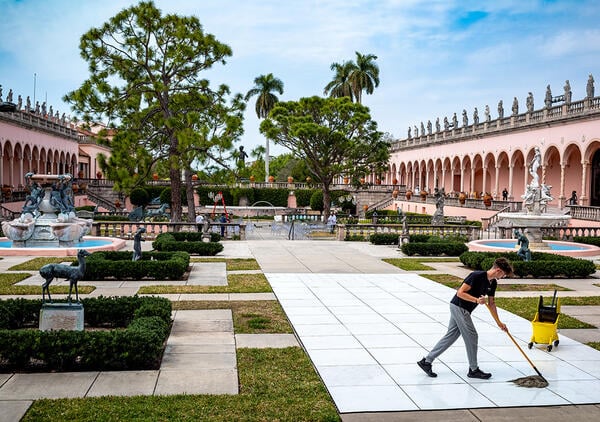
When DeSantis unveiled his state budget plans in February, many observers were shocked to see a proposal for New College to take over the Ringling art museum and affiliated properties, which includes a former home of the namesake founder, and the Ringling Museum of the Circus.
Florida State has had stewardship of the Ringling properties since 2000. FSU’s responsibilities include managing the Ringling’s endowment and employing the staff that operate the facilities, which does everything from curate collections to provide security and other functions. One recent report counted 229 employees on the FSU payroll at the Ringling.
Many museum supporters are appalled at the idea of a New College takeover, including Nancy Parrish, a former member of its board and president of the nascent Citizens to Protect the Ringling. She argues FSU has transformed the Ringling from a property that had fallen into disrepair when it took over stewardship in 2000 to a thriving institution with annual surpluses. Parrish worries that NCF is incapable of taking on the same role and would upend that progress.
“New College is in a costly, complicated, precarious transition. How can it possibly manage an institution larger than itself? And an institution as complicated as a museum was never in its business plan. It’s outrageous government overreach and an outrageous waste of taxpayer money, because it would take millions to replace what FSU provides the museum,” Parrish said.
The timeline for the proposed transition from FSU to NCF by Aug. 1 is also rushed, she argues.
Amid the uncertainty over the Ringling’s future, she said that “donors are fleeing in panic.”
Details on how NCF would take over the operations are not laid out in the DeSantis proposal, and NCF officials did not fulfill a public records request about the transition prior to publication.
“This transition is not only sensible; it is a collective win. It is a win for Sarasota, reinforcing its reputation as a global leader in the arts and higher education; boosting tourism, cultural engagement and economic growth—all while preserving a historical gem,” Corcoran wrote.
He added that NCF stewardship would both expand “research partnerships, student engagement and statewide academic initiatives in the arts and humanities” and provide “an infusion of resources” to allow it “to elevate its world-class exhibitions, research and outreach.”
FSU did not respond to requests for comment from Inside Higher Ed.
The Financial Picture
New College’s potential expansion comes as it has grown in other ways since DeSantis appointed a conservative board that tapped Corcoran, a former GOP lawmaker, as president.
Since 2022, NCF has added six intercollegiate teams and plans to field 24 altogether by 2028. Beyond the inaugural programs in sports such as basketball, baseball and soccer, New College plans to expand to tennis, golf, bass fishing and various other athletic pursuits. NCF is investing in developing its athletic facilities in addition to paying for coaches and athletic scholarships.
New College’s strategic transformation has come with a substantial price tag for taxpayers. The state has already infused New College with millions of dollars since the change in leadership. And NCF’s leaders want more state money—at least $200 million over the next decade.
But that spending has prompted some pushback from the DeSantis-appointed Florida Board of Governors, which oversees New College and other members of the State University System.
FLBOG member Eric Silagy has challenged Corcoran at times on financial transparency and the high cost per student, calculating that NCF spent $91,000 per student in the 2023–24 academic year. The system average is $10,000, Silagy said at a September board meeting.
Corcoran initially disputed that number, arguing it was $68,000 per head.
But at a January meeting, Silagy said he had spoken with Corcoran, who now agreed that figure was between $88,000 and $91,000 per student, a figure Silagy said continues to climb. He projects that NCF could soon spend between $114,000 and $140,000 for each student.
Concerns about fiscal management also prompted a shake-up at the New College Alumni Association last month, when then-director Ben Brown resigned in protest because of “a deteriorating institutional relationship” between the college and alumni, and concerns that Corcoran had squandered funds. Brown also wanted more transparency.
Brown told Inside Higher Ed he is concerned about the state giving Corcoran more power.
“There’s no ingrained alumni opposition to the idea of being part of USF or doing things jointly with USF, but the current alumni sentiment is very clear that for this administration, operating the way it is, to take responsibility for part of USF is dangerous to the state and to the taxpayers,” Brown said.
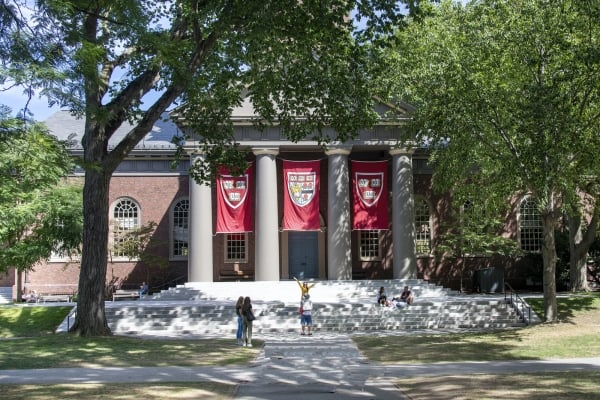
The Trump administration presented Harvard University with a letter Thursday outlining “immediate next steps” the institution must take in order to have a “continued financial relationship with the United States government,” The Boston Globe reported and Inside Higher Ed confirmed.
The ultimatum came just three days after the president’s Joint Task Force to Combat Anti-Semitism notified the university it had been placed under review for its alleged failure to protect Jewish students and faculty from discrimination. If the case follows the precedent set at other universities, Harvard and its affiliate medical institutions could lose up to $9 billion in federal grants and contracts if they do not comply.
Sources say the move is driven less by true concern about antisemitism on campus than by the government’s desire to abolish diversity efforts and hobble higher ed institutions it deems too “woke.” This week alone, the administration has retracted funds from Brown and Princeton Universities. Before that, it targeted the University of Pennsylvania and Columbia University and opened dozens of civil rights investigations at other colleges, all of which are ongoing.
Many of the task force’s demands for Harvard mirror those presented to Columbia last month, including mandates to reform antisemitism accountability programs on campus, ban masks for nonmedical purposes, review certain academic departments and reshape admissions policies. The main difference: Columbia’s letter targeted specific departments and programs, while Harvard’s was broader.
For example, while the letter received by Columbia called for one specific Middle Eastern studies department to be placed under receivership, Harvard’s letter called more generally for “oversight and accountability for biased programs [and departments] that fuel antisemitism.”
Inside Higher Ed requested a copy of the letter from Harvard, which declined to send it but confirmed that they had received it. Inside Higher Ed later received a copy from a different source.
Some higher education advocates speculate that the Trump administration’s latest demands were deliberately vague in the hopes that colleges will overcomply.
“What I’ve learned from various experiences with higher ed law is that it’s unusual to be general in legal documents,” said Jon Fansmith, senior vice president of government relations and national engagement for the American Council on Education. Trump’s “open-ended” letter “starts to look like a fishing expedition,” he added. “‘We want you to throw everything open to us so that we get to determine how you do this.’”
But conservative higher ed analysts believe the demands—even when broadened—are justified.
“Many of these are extremely reasonable—restricting demonstrations inside academic buildings, requiring participants and demonstrations to identify themselves when asked, committing to antidiscrimination policies, intellectual diversity and institutional neutrality,” said Preston Cooper, a senior fellow at the American Enterprise Institute.
Still, he raised questions about how certain mandates in the letter will be enforced.
“When you see this in the context of the federal government trying to use funding as a lever to force some of these reforms, that’s where one might raise some legitimate concern,” he said. “For instance, trying to ensure viewpoint diversity is a very laudable goal, but if the federal government is trying to … decide what constitutes viewpoint diversity, there is a case to be made that that is a violation of the First Amendment.”
What Does the Letter Say?
The demands made of Harvard Thursday largely target the same aspects of higher ed that Trump has focused on since taking office in January.
Some center on pro-Palestinian protests, like the requirements to hold allegedly antisemitic programs accountable, reform discipline procedures and review all “antisemitic rule violations” since Oct. 7, 2023.
Others focus on enforcing Trump’s interpretation of the Supreme Court’s 2023 ruling on affirmative action; the university must make “durable” merit-based changes to its admissions and hiring practices and shut down all diversity, equity and inclusion programs, which the administration believes promote making “snap judgments about each other based on crude race and identity stereotypes.”
The letter was signed by the same three task force members who signed Columbia’s demand letter: Josh Gruenbaum, commissioner of the Federal Acquisition Service; Sean Keveney, acting general counsel for the Department of Health and Human Services; and Thomas Wheeler, acting general counsel for the Department of Education.
The most notable difference in Harvard’s letter is that the task force is demanding “full cooperation” with the U.S. Department of Homeland Security. That department and its Immigration and Customs Enforcement agency have been arresting and revoking visas from international students and scholars who, the government says, are supporting terrorist groups by participating in pro-Palestinian protests.
Will Harvard Capitulate?
Harvard already appears to be taking steps to comply. On Wednesday, the university put a pro-Palestinian student group on probation. The week before, a dean removed two top leaders of the Center for Middle Eastern Studies, which has been accused of biased teaching about Israel.
A letter to the campus community from university president Alan Garber also suggested capitulation is likely.
“If this funding is stopped, it will halt life-saving research and imperil important scientific research and innovation,” Garber wrote following the task force’s review. “We will engage with members of the federal government’s task force to combat antisemitism.”
But Fansmith noted such actions may not be enough to predict whether Harvard will fully acquiesce to the Trump administration’s demands.
“If you look at all of these institutions over the last two years, they’ve been making a number of changes in policies, procedures, personnel and everything else,” he said. “And a lot of that was happening and was at pace before this administration took office and started sending letters.”
Harvard was one of the first three universities that the House Committee on Education and the Workforce grilled about antisemitism on campus in December 2023. Shortly after, then-president Claudine Gay—the first Black woman to lead Harvard—resigned. The university has since been working to make changes at the campus level.
Both Fansmith and Cooper pointed to Trump’s mandates regarding curriculum as the most likely to face opposition, as was the case at Columbia.
A little over a week after the Trump administration laid out its ultimatum, Columbia capitulated and agreed to all but one demand: The university refused to put its department of Middle Eastern studies into receivership, a form of academic probation that involves hiring an outside department chair. Instead, it placed the department under internal review and announced it would hire a new senior vice provost to oversee the academic program.
“You need to be making sure that Jewish students are not subject to harassment,” Cooper said. But “where that crosses the line is if the federal government is telling the universities … ‘this is how you have to appoint somebody to put an academic department into receivership,’ as was the original demand made of Columbia.”
Regardless of how Harvard responds, one thing seems likely: There are more funding freezes to come.
“A lot of folks were expecting Columbia to file a legal challenge, and when that didn’t happen, that might have emboldened the administration a bit to go after some of these other institutions,” Cooper said. But sooner than later, “one of these institutions might say, ‘We’re not going to make the reforms.’”
“I don’t have a great guess as to which institution that will be,” he added, “but I would expect we probably will see a lawsuit at some point.”
This post on CTE and career readiness originally appeared on iCEV’s blog, and is republished here with permission.
For students to be truly prepared for their futures, they need academic knowledge, technical expertise, and workforce skills that translate directly into the workplace. As a career and technical education (CTE) instructor, I see firsthand how career-focused education provides students with the tools to transition smoothly from high school to college and careers.
More News from eSchool News
Many math tasks involve reading, writing, speaking, and listening. These language demands can be particularly challenging for students whose primary language is not English.
In recent years, the rise of AI technologies and the increasing pressures placed on students have made academic dishonesty a growing concern. Students, especially in the middle and high school years, have more opportunities than ever to cheat using AI tools.
As technology trainers, we support teachers’ and administrators’ technology platform needs, training, and support in our district. We do in-class demos and share as much as we can with them, and we also send out a weekly newsletter.
Math is a fundamental part of K-12 education, but students often face significant challenges in mastering increasingly challenging math concepts.
Throughout my education, I have always been frustrated by busy work–the kind of homework that felt like an obligatory exercise rather than a meaningful learning experience.
During the pandemic, thousands of school systems used emergency relief aid to buy laptops, Chromebooks, and other digital devices for students to use in remote learning.
Education today looks dramatically different from classrooms of just a decade ago. Interactive technologies and multimedia tools now replace traditional textbooks and lectures, creating more dynamic and engaging learning environments.
There is significant evidence of the connection between physical movement and learning. Some colleges and universities encourage using standing or treadmill desks while studying, as well as taking breaks to exercise.
This story was originally published by Chalkbeat. Sign up for their newsletters at ckbe.at/newsletters. In recent weeks, we’ve seen federal and state governments issue stop-work orders, withdraw contracts, and terminate…
English/language arts and science teachers were almost twice as likely to say they use AI tools compared to math teachers or elementary teachers of all subjects, according to a February 2025 survey from the RAND Corporation.
The American Association of University Professors is warning college and university lawyers not to provide the U.S. Education Department’s Office for Civil Rights the names and nationalities of students or faculty involved in alleged Title VI violations.
The AAUP’s letter comes after The Washington Postreported last week that Education Department higher-ups directed OCR attorneys investigating universities’ responses to reports of antisemitism to “collect the names and nationalities of students who might have harassed Jewish students or faculty.” The department didn’t respond to Inside Higher Ed’s requests for comment Thursday.
In a 13-page Wednesday letter to college and university general counsels’ offices, four law professors serving as AAUP counsel wrote that higher education institutions “are under no legal compulsion to comply.” The AAUP counsel further urged them “not to comply, given the serious risks and harms of doing so”—noting that the Trump administration is revoking visas and detaining noncitizens over “students’ and faculty members’ speech and expressive activities.” The administration has targeted international students and other scholars suspected of participating in pro-Palestinian advocacy.
Title VI of the federal Civil Rights Act of 1964 prohibits discrimination based on, among other things, shared ancestry, which includes antisemitism. But the AAUP counsel wrote that “Title VI does not require higher education institutions to provide the personally identifiable information of individual students or faculty members so that the administration can carry out further deportations.”
And Title VI investigations, they wrote, “are not intended to determine whether the students and faculty who attend these schools have violated any civil rights laws, let alone discipline or punish students or faculty.” They wrote that investigations are instead “intended to determine whether the institution itself has discriminated.”
Providing this information to the federal government may violate the First Amendment rights of those targeted, plus the Family Educational Rights and Privacy Act and state laws, they wrote, adding that this information shouldn’t be turned over without “clear justification for the release of specific information related to a legitimate purpose in the context of a particular active investigation.”
After tussling over proposed legislation to allow community colleges to offer a bachelor’s of nursing degree, Los Angeles County’s 19 community colleges and the California State University system are working together to tackle local nursing shortages. The partnership, spearheaded by Compton College, may signal a new phase of cooperation between the two systems.
The Nursing 2035 Initiative aims to foster collaboration between community colleges, the CSU system and other stakeholders; conduct research; and devise strategies to graduate more registered nurses in the region over the next decade. The project also includes the Los Angeles Economic Development Corporation, the Department of Economic Opportunity with the County of Los Angeles and California Competes, an organization focused on higher ed and workforce development in the state.
Keith Curry, president of Compton College, said the need for more nurses in the region is dire. Lightcast, a labor market analytics firm, projected 6,454 job openings for registered nurses in Los Angeles County annually through 2035, but degree-completion data from 2023 shows local colleges only produced 5,363 graduates with relevant degrees that year.
Curry described a nearby medical clinic’s emergency room as “flooded” with patients at the same time aspiring nurses face barriers to entering the profession, such as vying for limited spots in nursing programs. Programs, meanwhile, struggle to grow because of challenges with retaining nursing faculty, who can find better wages working in hospitals, and competition for scarce clinical placements.
The goal is “really trying to address health disparities in the community I’m from, and nursing is just another one of those issues that we have to address,” Curry said.
Teamwork After Tensions
The move comes after Gov. Gavin Newsom encouraged more CSU–community college partnerships on nursing last year after he vetoed two bills that would have allowed some community colleges to offer B.S.N. programs as part of a pilot program.
At the time, community college leaders argued that expanding their nursing offerings beyond associate degrees would make nursing education more affordable and combat nurse shortages in the state. But CSU leaders opposed the legislation, countering that the new programs would be duplicative and force the CSU’s existing programs to compete for resources, like clinical placements. (The two systems have also cyclically battled over community college baccalaureate degrees since the state allowed them a decade ago.)
Newsom came down on the CSUs’ side.
“All segments of higher education should continue to focus on building these programs together,” he wrote in one of his veto messages, “and I am concerned this bill could inadvertently undermine that collaboration.”
The initiative is an attempt to do just that, Curry said.
“It’s not us versus them,” he said. “It’s about how can we partner together to solve a problem. So, I felt that CSU has to be the table.”
Jose Fierro, president of Cerritos College and co-chair of the Los Angeles Regional Consortium, a coalition of L.A. County’s 19 colleges, said he and other community college leaders were “disappointed” by Newsom’s rejection of community college B.S.N. degrees because he felt like they would help his place-bound students. He said his campus is nine miles on average from local universities.
Students “may not be within driving distance because they would have to uproot their families, or because of the high cost of housing, they wouldn’t be able to move to a different city to be able to access these programs,” he said.
At the same time, he believes the collaborative approach will benefit students.
“We are bringing county representatives, hospital representatives, state officials, California State and community colleges to look at our programs and our shortage of nurses in a comprehensive manner,” to think about “how can we work together to meet the needs of the community?”
An Example for Others
Some nursing partnerships between community colleges and CSUs already exist. For example, California State University, Northridge, has an A.D.N.-B.S.N. Community College Collaborative Program, which allows students earning nursing associate degrees at partnering community colleges to earn a B.S.N. on an accelerated timeline. A program at Cal State Long Beach also allows nursing associate degree students to take B.S.N. classes while in community college.
Nathan Evans, deputy vice chancellor for academic and student affairs and chief academic officer at the CSU Office of the Chancellor, believes the Nursing 2035 Initiative can serve as an example of how community college and CSU leaders can strategically confront local nursing shortages together.
“The boundaries of our institutions don’t have to be what they were in the past,” he said. “Our hope is that this is a model of what collaboration looks like between our segments and there’s a lot less friction in terms of the student experience, that there are clear road maps for students, particularly in the nursing field.”
As a first step, the group plans to research the region’s nursing education and workforce and release a report in the fall with policy and budget recommendations on how to expand nursing programs in the area. The goal is to work on the recommendations through 2035.
Evans said the initiative is “using data to really drive a needs assessment and then allow that to lead us to, what are the ways we collectively can respond?”
The hope is that process leads to new, innovative partnerships, said Fierro. For example, he can imagine CSUs offering B.S.N. programs on community college campuses, or partnering with community colleges on collaborative programs, so that students who struggle to commute to universities because of work or family obligations have more options.
“To me, the main objective is to ensure that we bring that value to the local communities,” he said, “regardless of whose name is issuing the diploma.”
Mark Carney’s whirlwind start as Canadian prime minister has seen his party surge in the polls against the backdrop of Donald Trump’s threats but has provided little time to flesh out the newcomer’s policies on higher education and science.
When Justin Trudeau announced his resignation in January, the Liberal Party was trailing the Conservatives by more than 20 percentage points and was only narrowly ahead of the New Democratic Party.
But since Trump started a trade war with what he has belittled as his “51st state,” the Liberals have rebounded remarkably in the polls and are now favorites to retain power in the snap election on April 28.
Although the federal government is the primary player when it comes to investments in research and innovation in Canada, higher education has seldom been a major issue in national elections, said Glen Jones, professor of higher education at the University of Toronto.
“Not surprisingly, the entire election is focusing on the trade war that has been initiated by President Trump,” he said.
“The Carney platform, at least to date, has largely been about providing support and stability to individuals and industries that will be directly impacted by tariffs.”
Carney has been focusing primarily on positioning himself as the leader best able to respond to the new, evolving relationship with the U.S.—a strategy that seems to be working, added Jones.
Sarah Laframboise, executive director of Evidence for Democracy, a science policy nonprofit organization, said Carney’s background—as a former United Nations special envoy for climate action—suggests that he will remain committed to his views on climate policy, and that his pro-economic growth platform could translate into targeting investments in research, innovation and artificial intelligence.
“We will also likely see an increased focus on defense-related research, particularly around Arctic security and collaborative defense technologies. However, it remains unclear if this will extend to basic research,” said Laframboise.
“Additionally, his restrictive stance on international student admissions could have significant consequences for Canada’s higher education sector.”
Carney, who has never previously held elected office, earned a master’s degree and a doctorate in the U.K. before later going on to become governor of the Bank of England from 2013 to 2020.
“The investment fell short of reinvigorating funding for science, tech and the innovation sector,” he said.
“If the Carney Liberals are elected to power, I think we can expect the previous government’s investment to stay … but will they double down on that investment?”
Having examined Carney’s website—which mentions artificial intelligence 11 times, innovation once and science not at all—Johnson said the prime minister’s priorities in future funding seemed fairly clear.
With either Carney or Poilievre in charge, he said the next government will have an “amazing opportunity” to invest in science, technology and innovation.
“Given the USA’s deep cuts to science funding, Canada has the opportunity to leap forward as a global leader in strategic areas, but only if we increase our investment in science, training, technology and mobilization of the innovations that come from these activities.”
The Education Department will kick off the lengthy rule-making process later this month with a pair of hearings.
The department is planning to consider regulatory changes to the Public Service Loan Forgiveness program, income-driven repayment plans and “other topics that would streamline current federal student financial assistance programs,” according to a Federal Register notice.
Hearings are just the first step in negotiated rule making, which also includes convening an advisory committee to weigh in on regulatory changes over a series of meetings, proposing draft regulations and then a public comment period. Historically, the whole process takes at least a year.
The Federal Register notice doesn’t say what specific changes the department is seeking to make aside from “redefining definitions of a qualifying employer.” The department also is planning to revise the regulations for Pay as You Earn and income-contingent repayment plans.
In early March, President Donald Trump directed the Education Department to change which employers or companies are eligible for the Public Service Loan Forgiveness program. Under the executive order, activities that would disqualify a nonprofit could include aiding or abetting violations of federal immigration laws or what the government considers illegal discrimination. Advocates and Democrats decried the order as “un-American” and argued that it would disrupt borrowers’ lives.
The department will hold an in-person hearing April 29 and a virtual hearing May 1. More information is available here.
“This process will focus on how the Department can rightsize Title IV regulations that have driven up the cost of college and hindered innovation,” said Acting Under Secretary James Bergeron in a news release. Bergeron is also leading the Office of Federal Student Aid. (Title IV of the Higher Education Act authorizes federal financial aid programs.)
He added that “not only will this rulemaking serve as an opportunity to identify and cut unnecessary red tape, but it will allow key stakeholders to offer suggestions to streamline and improve federal student aid programs.”
Shantay Bolton, executive vice president of administration and finance and chief business officer at Georgia Tech, has been named president of Columbia College Chicago, effective July 1.
Laura Crawley, vice president of mission, engagement and innovation at Lenoir-Rhyne University in North Carolina, will become president of Bethany College in Kansas, effective May 1.
Farouk Dey, vice provost for integrative learning and life design at Johns Hopkins University, has been appointed president of Palo Alto University, effective July 1.
William Downs, president of Gardner-Webb University in North Carolina, has been named president of Campbell University, also in North Carolina, beginning July 1.
Charles Edmonds, currently executive vice president of Lycoming College, will become president of the Pennsylvania-based institution on July 1.
Louise Fincher, currently the interim president of Emory & Henry University in Virginia, has been named president of the institution.
Thomas Gibson, chancellor of the University of Wisconsin–Stevens Point, has been named the next chancellor of the University of Wisconsin–Milwaukee, beginning on or around July 1.
Michael Hill, president of Chautauqua Institution in New York, has been appointed president of Virginia’s Randolph-Macon College, effective Aug. 1.
Kevin Howell, chief external affairs officer at University of North Carolina Health and the UNC School of Medicine, has been named chancellor of North Carolina State University, effective May 5.
Mark Johnson, director of the doctor of ministry program at New Orleans Baptist Theological Seminary, has been elected president of Louisiana Christian University.
Michael Kotlikoff, interim president of Cornell University since last July, has been named the institution’s president, effective immediately.
Dean Pribbenow, vice president for academic affairs and dean of the faculty at Elmhurst University in Illinois, has been appointed president of Millikin University, also in Illinois, effective July 1.
Sean Ryan, senior vice president of administration, strategic initiatives and trustee affairs at Bellarmine University in Kentucky, will become president of Anna Maria College in Massachusetts, effective July 1.
James Schmidt, chancellor of the University of Wisconsin–Eau Claire, has been named president of James Madison University in Virginia, effective July 1.
Claire Shipman, co-chair of the Columbia University Board of Trustees, has been named acting president of the university, effective immediately.
Marlene Tromp, president of Boise State University in Idaho, will become president of the University of Vermont, effective this summer.
The Trump administration plans to block $510 million in federal contracts and grants for Brown University in retaliation for the university’s alleged failure to address antisemitism on campus, The New York Times reported.
The Daily Callerfirst reported the news, writing that “an administration official” said Brown’s grants “would be paused” while the government conducts a review of the university’s response to claims of antisemitism.
Brown provost Frank Doyle sent an email to campus leaders Thursday, acknowledging “troubling rumors emerging about federal action on Brown research grants,” but noting that they had received “no information to substantiate any of these rumors,” the Times reported.
Brown was among the 60 higher ed institutions to receive a letter last month from the Office for Civil Rights warning of “potential enforcement actions” if they failed to comply with federal antidiscrimination law.
After Columbia became the first institution to have its grants frozen, Brown president Christina Paxson issued a statement reiterating the university’s commitment to upholding both federal law and academic freedom. She noted that if Brown were prevented from performing “essential academic and operational functions, we would be compelled to vigorously exercise our legal rights to defend these freedoms, and true to our values, we would do so with integrity and respect.”
On Thursday night, leaders of the Brown Corporation and of Brown’s Jewish community, released a statement praising Brown’s commitment to Jewish students.
“Brown University is home to a vibrant Jewish community that continues to flourish with the steadfast support of the administration,” it read. “Amidst broader concerns about antisemitism on college campuses, Brown stands out as an inclusive environment where Jewish life is deeply integrated into campus culture.”