Tag: Career

  • Faculty Protest Actions Against Trump Spark Backlash

    Faculty Protest Actions Against Trump Spark Backlash

    Jim West/UCG/Universal Images Group/Getty Images

    While many professors across the U.S. have protested federal funding cuts and other attacks on higher education by President Donald Trump and his campaign donor and aide Elon Musk without incident, two faculty members are now facing sharp scrutiny for their actions on and off campus.

    At the University of Wisconsin–Eau Claire, José Felipe Alvergue, who chairs the English Department, is on leave after he allegedly flipped a table Tuesday set up by the College Republicans to encourage support for Brad Schimel in the Wisconsin Supreme Court race. A video posted by UW–Eau Claire’s College Republicans chapter showed the aftermath of the incident and accused Alvergue (who had not yet been identified when it was uploaded) of being a “violent” supporter of Susan Crawford, the Democratic-backed candidate who later won the race Tuesday.

    “I am deeply concerned that our students’ peaceful effort to share information on campus on election day was disrupted,” UW–Eau Claire interim provost Michael Carney wrote in a statement to Inside Higher Ed. “UW–Eau Claire strongly supports every person’s right to free speech and free expression, and the university remains committed to ensuring that campus is a place where a wide variety of opinions and beliefs can be shared and celebrated. Civil dialogue is a critical part of the university experience, and peaceful engagement is fundamental to learning itself.”

    Carney added that campus officials are working with the Universities of Wisconsin system and its Office of General Counsel, “which is conducting a comprehensive investigation of this matter.”

    The incident prompted broad criticism, particularly from conservatives, many of whom called for the professor to be immediately fired.

    “Outrageous. Yet sadly what many conservatives [sic] students deal with every day on so many campuses,” Scott Walker, a former Republican governor of Wisconsin, wrote on social media.

    Alvergue did not respond to a request for comment.

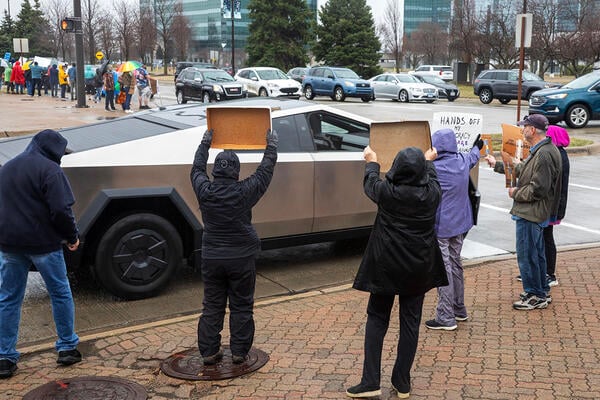
    On the other side of the country, a part-time lecturer at California State University, Fresno, has prompted outrage in conservative quarters over her social media posts, FOX26NEWS reported. Katherine Shurik, who teaches anthropology, allegedly posted an image of Trump in a casket with the caption “I have a dream for this to happen much sooner rather than later” and another of a gravestone with his name on it and a caption reading, “and take Musk and the rest of the Nazi (Republican) party members with you too!” Additionally, in a video of Shurik circulated by conservative influencers, she said students will “get extra credit for coming to the protest.” Some local news sites reported the extra credit was for protesting Tesla, owned by Musk.

    The university was quick to distance itself from Shurik’s posts this week.

    “While Fresno State firmly believes in the principles of free speech, we strongly condemn the abhorrent social media posts and comments made by one of our part-time instructors,” Fresno State officials wrote in a Tuesday statement. “As these views were published by the employee as a private citizen, they do not represent our university in any way. Fresno State firmly denounces wishes of death against any elected official, particularly the President of the United States—these go against our core educational values and are not consistent with our Principles of Community. As Americans and educators, we pride ourselves on democratic dialogue, not words of derision and contempt about the most important political figure of our country.”

    Shurik did not respond to a request for comment from Inside Higher Ed.

    Multiple social media users called for Fresno State to fire Shurik ,and local officials have also weighed in, including Gary Bredefeld, a member of the Fresno County Board of Supervisors.

    “This is a professor at Fresno State posting about her longing for the deaths of President Trump, Elon Musk and Republicans. These are the unhinged radicals teaching our young kids at schools and universities across the country,” he wrote in a Sunday post on Facebook. “People like this are hate-filled, radical lunatics and have no business teaching anywhere. I would expect the President of Fresno State to address this immediately and denounce these postings.”

    Even Musk himself noticed the uproar.

    “Calling for the death of the President is a serious crime,” he wrote in a reply to a post about Shurik.

    Source link

  • Improving Transfer Based on Success Stories

    Improving Transfer Based on Success Stories

    A new transfer playbook, released by the Aspen Institute and the Community College Research Center, offers strategies for improving outcomes for transfer students by examining higher ed institutions with the best records.

    The playbook notes that, for a decade, fewer than a fifth of community college students have successfully transferred and earned bachelor’s degrees, though many aspire to reach that goal. But the playbook stresses that better outcomes are possible. At colleges with the best overall transfer outcomes—those in the top 10 percent for all institutions—at least 52 percent of students transfer and at least 61 percent of transfer students earn bachelor’s degrees, far exceeding national averages. If all community colleges achieved these kinds of results, they could double the bachelor’s degree attainment rates for community college students from 16 percent to 32 percent, the playbook concludes.

    Based on interviews with college leaders, students and staff members at campuses with successful transfer pathways and partnerships, the playbook’s authors offer three core strategies for improving transfer, with examples of relevant practices and case studies.

    First, they recommend that executive leadership spearhead partnerships between community colleges and universities so improvements to transfer can be made at scale. They also suggest working toward more timely bachelor’s degree completion rates within majors by better aligning curriculum and instruction with transfer pathways. Lastly, they recommend tailoring advising and other supports for transfer students in ways that “foster trust and engagement.” For example, the playbook encourages community colleges to ensure transfer advising is offered to all students and occurs before, during and after the transfer process, with outreach to prospective students about transfer options as early as high school.

    “There is immense potential in the dreams and ambitions of bachelor’s-intending community college students—and the many who may have counted themselves out but have the ability to complete a bachelor’s and expand their career horizons,” the foreword to the playbook reads.  

    Source link

  • Scholars’ Stories of Losing Federal Funding

    Scholars’ Stories of Losing Federal Funding

    Sixteen researchers across a range disciplines from the biomedical sciences and STEM to education and political science share their experiences of losing research grants and what impact the loss of billions of dollars in federal funding will have on science, public health and education in Inside Higher Ed today.

    The Trump administration told researchers Rebecca Fielding-Miller, Nicholas Metheny, Abigail Hatcher and Sarah Peitzmeier that trainings connected to their National Institutes of Health grant focused on the prevention of intimate partner violence against pregnant and perinatal women were “antithetical to the scientific inquiry, do nothing to expand our knowledge of living systems, provide low returns on investment, and ultimately do not enhance health, lengthen life, or reduce illness.”

    “We could not disagree more,” Fielding-Miller, Metheny, Hatcher and Peitzmeier write. “Anyone who has cared for a child or for the person who gave birth to them knows that preventing maternal and infant death and abuse should be a nonpartisan issue. The current administration is intent on making even this issue into ‘us’ versus ‘them.’ When it comes to public health, there is no such thing.”

    Meanwhile, Judith Scott-Clayton writes that the decision to cancel a Department of Education grant funding a first-of-its-kind randomized evaluation of the Federal Work-Study program—four and a half years into a six-year project—will leave policymakers “flying blind.”

    “Since 1964, the FWS program has disbursed more than $95 billion in awards,” Scott-Clayton wrote. “In comparison, our grant was less than three-thousandths of 1 percent of that amount, and the amount remaining to finish our work and share our findings with the public was just a fraction of that.”

    Read all of the scholars’ stories here.

    Source link

  • Researchers, Higher Ed Union Fight NIH Grant Terminations

    Researchers, Higher Ed Union Fight NIH Grant Terminations

    Suzanne Kreiter/The Boston Globe/Getty Images

    Individual university researchers, a public health advocacy organization and a union representing more than 120,000 higher education workers are suing the National Institutes of Health after the agency terminated more than $2.4 billion in grants it claims support “non-scientific” projects that “no longer” effectuate agency priorities.

    “Plaintiffs and their members are facing the loss of jobs, staff, and income. Patients enrolled in NIH studies led by Plaintiffs face abrupt cancellations of treatment in which they have invested months of time with no explanation or plan for how to mitigate the harm,” according to a complaint of the lawsuit filed Wednesday afternoon. “As a result of Defendants’ Directives scientific advancement will be delayed, treatments will go undiscovered, human health will be compromised, and lives will be lost.”

    It’s the latest in a mounting series of legal challenges against the Trump administration’s blitz of executive actions aimed at rooting out so-called gender ideology; diversity, equity and inclusion initiatives; and alleged waste, fraud and abuse of taxpayer funds. Some of those lawsuits have already resulted in federal judges ordering injunctions and restoration of canceled grants.

    But this is one of the first to directly challenge the NIH’s grant cancellations; more legal challenges are expected.

    The lawsuit was filed by the American Public Health Association; the United Automobile, Aerospace and Agricultural Implement Workers and NIH-funded medical researchers from Harvard University; the Universities of Michigan and New Mexico; and the Center for Science in the Public Interest, which have all lost their grants. The American Civil Liberties Union is representing the plaintiffs.

    A NIH spokesperson said that the agency doesn’t comment on pending litigation.

    ‘Erosion of Scientific Freedom’

    The plaintiffs want the Massachusetts district court to declare the actions of the NIH “unlawful,” restore funding for at least the plaintiffs’ terminated grants and prevent the agency “from terminating any grants based on allegedly no longer effectuating agency priorities, or withholding review of applications.”

    The majority of the terminated grants focused on topics related to vaccine hesitancy, climate change, diversifying the biomedical research workforce, “countries of concern” (including China and South Africa), and the health of women, racial minorities and members of the LGBTQ+ community, according to the lawsuit.

    One of the plaintiffs, Brittany Charlton, who is the founding director of Harvard University’s LGBTQ Health Center of Excellence, has had five NIH grants terminated since President Donald Trump took office in January and launched a crusade to root out so-called gender ideology and diversity, equity and inclusion initiatives.

    Charlton said in an email to Inside Higher Ed that she’s lost nearly $6 million in NIH grants as a result of the agency’s directives, signifying “a potential end to my academic career.”

    But her motivation for signing on to the lawsuit extends beyond concern for her own livelihood.

    “This isn’t just a fight for my professional survival but a stand against the erosion of scientific freedom,” Charlton said. “[The grant cancellations set] a worrying precedent where scientific inquiry becomes vulnerable to political rhetoric. The concern here is not merely academic; it affects the very foundation of public health policy and the health of vulnerable communities.”

    Another plaintiff, Katie Edwards, a social work professor at the University of Michigan who researches violence prevention in minority communities, has had six NIH grants pulled this year. And a third plaintiff, Nicole Maphis, a first-generation college student and postdoctoral fellow at the University of New Mexico’s School of Medicine who researches the link between alcohol use and Alzheimer’s, is no longer in consideration for an NIH grant designed to help underrepresented researchers become faculty members.

    ‘Arbitrary and Capricious’

    The lawsuit argues that NIH didn’t have the authority to cancel those or any of the other grants the agency claims no longer effectuate agency priorities. That’s because the “no longer effectuates agency priorities” regulatory language the NIH has cited to justify its termination of particular grants won’t go into effect until October.

    Additionally, canceling the grants disregards “Congress’s express mandate that NIH fund research to address health equity and health disparities, include diverse populations in its studies, improve efforts to study the health of gender and sexual minorities, and enhance diversity in the bio-medical research profession,” according to the complaint.

    The lawsuit also says that the government violated numerous aspects of the Administrative Procedure Act—including a provision prohibiting agency action considered “arbitrary, capricious, an abuse of discretion, or otherwise not in accordance with law”—when it terminated the grants. It further asserts that the agency usurped Congress’s “exclusive power over federal spending” and violated the Fifth Amendment by offering “vague” justifications for terminating grants, including involvement with “transgender issues,” “DEI” or “amorphous equity objectives.”

    “Defendants have failed to develop any guidelines, definitions, or explanations to avoid arbitrary and capricious decision-making in determining the parameters of the agency’s prohibitions against research with some connection to DEI, gender, and other topics that fail Defendants’ ideological conformity screen,” the suit alleges.

    That leaves grantees “unsure, for example, which areas of study they can pursue, which populations they can focus on as study subjects, what they might argue to appeal grant terminations, and what the demographics of study participants must be” and “makes it impossible to determine how to reconfigure future research to stay within the bounds of NIH’s newest ‘priorities.’”

    Source link

  • March Brought Another Round of Job and Program Cuts

    March Brought Another Round of Job and Program Cuts

    March brought layoffs, buyouts and the elimination of multiple academic programs as universities sought to plug budget holes wrought by sector challenges and state budget issues.

    While many universities have announced hiring freezes and other moves due to the uncertainty of federal funding under Trump, the cuts below are not directly tied to the administration’s efforts to slash budgets and shrink the government. Instead, they are linked largely to dwindling enrollment or the loss of state funding.

    University of Dayton

    Officials at the private, Catholic research institution in Ohio announced cuts last month that affect 65 employees; 45 faculty members will not have their contracts renewed and 20 staff positions have been eliminated, The Dayton Daily News reported.

    Affected employees will reportedly be offered severance packages.

    Total cuts are projected to save the university $25 million over three years, the newspaper reported. Officials at the university said the moves were “focused on financial sustainability,” noting that while Dayton does not currently have a budget deficit, the change better positions it for the future.

    Wagner College

    The private liberal arts college in New York is looking to phase out as many as 21 programs in an effort to reverse recent enrollment declines, The Staten Island Advance reported.

    The changes reportedly could affect up to 40 full-time faculty members.

    Less popular academic programs—including anthropology, chemistry, English, history, math, modern languages, sociology, philosophy and physics—are among those that may be wound down. Officials told the newspaper that the process will be completed over the next 12 to 18 months.

    Kent State University

    Up to 30 administrative positions and nine majors are being eliminated at the public university in Ohio as part of a phased academic realignment that was approved by the board last month, WKYC reported. Kent State will also shrink the number of academic colleges from 10 to nine.

    The changes are part of a phased plan to be completed in 2028.

    The plans cites two goals: “First to strengthen academic affairs by reorganizing and realigning our academic units so that we are more cost efficient and therefore sustainable, and second, to ensure that we are providing the most in-demand, up-to-date and relevant academic programs and services for our learners,” executive vice president and provost Melody Tankersley said in an announcement last month following approval of the restructuring plan by Kent State’s board.

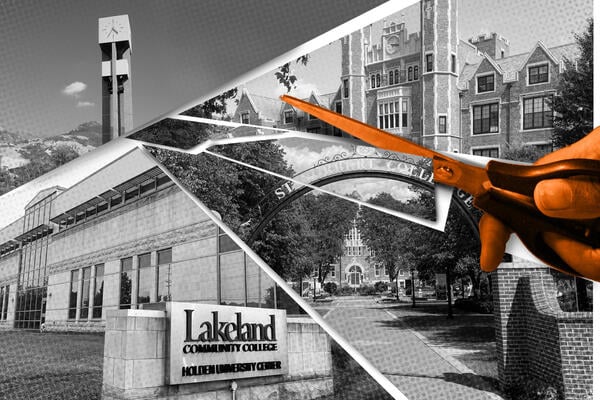
    Lakeland Community College

    Facing a $2 million budget deficit, the public two-year college in Ohio is laying off 10 faculty members and not replacing 14 professors set to retire, Ideastream Public Media reported.

    Another eight faculty members who will retire next year will also not be replaced.

    Between the cuts and retirements, Lakeland expects to save $2.3 million this year and another $800,000 next year. It will reinvest $225,000 in three faculty positions in manufacturing, welding and electrical engineering as it prioritizes workforce development.

    Lakeland also plans to close an unspecified number of low-enrollment programs.

    St. Norbert College

    The private, Catholic college in Wisconsin announced plans last month to lay off 27 professors and cut more than a dozen programs to address its budget deficit, Wisconsin Public Radio reported.

    Cuts will shave an estimated $5 million off the $12 million budget deficit. Of the 27 affected faculty members, 21 are set to lose their jobs in May, and the remaining six will be let go in 2026.

    Averett University

    Grappling with financial pressures, the small, private institution in Virginia announced plans last month to eliminate 15 jobs as part of cost-cutting measures, The Chatham Star-Tribune reported.

    Additionally, Cardinal News reported this week that Averett listed its equestrian center for sale.

    The university has navigated steep financial issues since last summer, when officials discovered a financial shortfall brought about by unauthorized withdrawals from the endowment by a former employee. While they said there was no evidence of embezzlement or misuse of the funds, the fiscal mismanagement prompted Averett to take a series of ongoing measures to fix its finances.

    Oklahoma State University

    Fallout continues at Oklahoma State, where the university laid off 12 Innovation Foundation employees after a recent audit uncovered financial missteps there, Oklahoma Voice reported.

    Affected staffers will not receive severance but will remain employed through June 1.

    In February, Oklahoma State president Kayse Shrum stepped down abruptly amid a review of improper transfers of legislatively appropriated funds. An audit later found that $41 million in state appropriations “were not properly restricted and in some instances were co-mingled with other funds” in violation of state laws and policies. In one instance, $11.5 million intended for other programs had been directed without board approval to OSU’s Innovation Foundation instead.

    St. Joseph’s University

    Officials offered buyouts to some faculty and staff last month as the private Jesuit university seeks to close a budget deficit following recent mergers, The Philadelphia Inquirer reported.

    St. Joseph’s absorbed the University of the Sciences in 2022 and added Pennsylvania College of Health Sciences in 2023, which officials told the newspaper left them with a “small deficit.” President Cheryl McConnell did not specify a dollar figure in an interview with the Inquirer.

    She added that there was no specific target number for buyouts, but when asked about potential layoffs, McConnell said it “depends on the nature of voluntary separation plan results.”

    Utah State University

    Voluntary buyouts are on the table and layoffs could be on the horizon at the public university following $17.3 million in budget cuts from the State Legislature, The Cache Valley Daily reported.

    Those cuts were spread across two years, with the university taking a $12.5 million hit this year. However, USU could restore that money through the state’s strategic reinvestment initiative, which allows universities to regain funding if leaders can identify areas for cuts and shift resources toward strategic initiatives favored by the state.

    Weber State University

    Elsewhere in Utah, Weber State is also grappling with budget issues imposed by the state.

    With anticipated budget cuts of $6.7 million due to the same strategic realignment initiative, Weber State is also offering voluntary separation incentives to employees, Deseret News reported. The university also plans to restructure some academic programs, including the College of Education.

    Budget changes in Utah will also affect the other six state institutions, but not all have made their plans public yet.

    Source link

  • Innovation, Collaboration During Challenging Times

    Innovation, Collaboration During Challenging Times

    I just returned from the UPCEA annual conference held in Denver. A record attendance of some 1,300 administrators, faculty and staff from member institutions gathered to share policies, practices, innovations and knowledge in advancing the mission of higher education in 2025. It was a thriving and exciting environment of energy and enthusiasm in seeking solutions to challenges that confront us today and into the future.

    Recent policy shifts regarding the federal funding of grants provided by the institutes and foundations that support university research were on the minds of most who attended. These topics provided the undercurrent of discussions in many of the sessions. The spirit was one of supporting each other in advancing their initiatives despite the prospect of cuts in federal support. The confluence of the demographic enrollment cliff of college-bound students due to the drop in births during the previous recession of 2007–09 and additional promised cuts in funding from federal and many state sources created an environment for collaboration on solving shared challenges rivaled only by that of the COVID-19 pandemic.

    A number of the sessions addressed innovations with cost savings, efficiencies and effectiveness gains that can be realized by thoughtfully introducing artificial intelligence into supporting many aspects of the higher education mission. The potential savings are significant if AI can take over duties of positions that become vacant or instances where staff are better utilized by shifting their efforts elsewhere.

    By fall 2025, readily available AI tools will be able to serve in course development, delivery and assessment:

    • Conceive, design, create online (even self-paced) courses
    • Adapt and update class materials with emerging concepts, societal situations and news context
    • Lead and assess class discussions—stimulate deeper thought and engagement
    • Assess course assignments with personalized recommendations to fill in the gaps in knowledge
    • Provide one-on-one counseling on academic matters and referrals for personal challenges
    • Create a summative assessment of course outcomes and initiate revisions for improvement
    • Generate a deep-thinking report for administrators and committees to consider

    By this fall, readily available AI tools will be able to serve in curriculum development, marketing and student onboarding:

    • Survey specified fields for addition or expansion of degree and certificate programs
    • Recommend detailed curriculum for new programs and suggest tuition/fees
    • Create marketing plans after developing a report on demand and competitors in the program area
    • Develop, track, implement and adapt marketing budget
    • Prepare and support student advising to optimize retention and completion
    • Prepare updated and revised plans for spring 2026

    By fall 2025, develop optimal staff allocation and review process:

    • Assess performance evaluations, recommend additional interviews as appropriate
    • Develop, refine and utilize departmental/college priority list to respond to revenue and enrollment trends for the year
    • Match staff skills with desired outcomes
    • Monitor productivity and accomplishments for each employee
    • Make recommendations for further efficiencies, having AI perform some tasks such as accounting and data analysis previously done by humans
    • Be responsive to employee aspirations and areas of greatest interest
    • Review and prepare updated and revised plans for spring 2026

    These tasks and many more can be accomplished by AI tools that can be acquired at modest costs. Of course, they must be carefully reviewed by human administrators to ensure fairness and accuracy are maintained.

    I learned from a number of those attending the UPCEA conference that, in these relatively early stages of AI implementation, many employees harbor fears of AI. Concerns center around human job security. While there are many tasks that AI can more efficiently and effectively perform than humans, most current jobs include aspects that are best performed by humans. So, in most cases, the use of AI will be in a role of augmentation of human work to make it more expedient and save time for other new tasks the human employees can best perform.

    This presents the need for upskilling to enable human staff to make the efficiencies possible by learning to work best with AI. Interestingly, in most cases experts say this will not require computer coding or other such skills. Rather, this will require personnel to understand the capabilities of AI in order to tap these skills to advance the goals of the unit and university. Positions in which humans and AI are coworkers will require excellent communication skills, organizational skills, critical thinking and creative thinking. AI performs well at analytical, synthetical, predictive and creative tasks, among others. It is adept at taking on leadership and managerial roles that recognize the unit and institutional priorities as well as employee preferences and abilities.

    How then can we best prepare our staff for optimizing their working relations with the new AI coworkers? I believe this begins with personal experience with AI tools. We all should become comfortable with conducting basic searches using a variety of chat bots. Learning to compose a proper prompt is the cornerstone of communicating with AI.

    The next step is to use a handful of the readily available deep-research tools to generate a report on a topic that is relevant to the staff member’s work. Compare and contrast those reports for quality, accuracy and the substance of cited material. Perform the research iteratively to improve or refine results. This Medium post offers a good summary of leading deep-research engines and best applications, although it was released in February and may be dated due to the Gemini version 2.5 Pro released on March 26. This new version by Google is topping many of the current ratings charts.

    In sum, we are facing changes of an unprecedented scale with the disruption of long-standing policies, funding sources and a shrinking incoming student pool. Fortunately, these changes are coming at the same time as AI is maturing into a dependable tool that can take on some of the slack that will come from not filling vacancies. However, to meet that need we must begin to provide training to our current and incoming employees to ensure that they can make the most of AI tools we will provide.

    Together, through the collaborative support of UPCEA and other associations, we in higher education will endure these challenges as we did those posed by the COVID pandemic.

    Source link

  • Wellesley Surpasses $100K Sticker Price

    Wellesley Surpasses $100K Sticker Price

    Jessica Rinaldi/The Boston Globe/Getty Images

    Wellesley College appears to be the first higher ed institution in the nation to hit the $100,000 annual sticker price.

    The cost to attend the all-women’s college this coming fall will be $100,541, as Boston Business Journal first reported. That includes direct costs of $92,440—which covers undergraduate tuition, housing, fees and meals—plus indirect costs, such as books, personal expenses, travel, transportation, and optional health insurance. Wellesley now appears to be the most expensive college in the country.

    Various other universities have approached the six-figure mark for undergraduate tuition and indirect costs in recent years but managed to remain below it. When Inside Higher Ed explored this issue last year, it appeared that Vanderbilt University might be the first to cross the threshold, with estimated costs for undergraduate students in certain programs, such as engineering, hitting almost $98,000. Others at or over the $90,000 line include the University of Chicago, the University of Southern California, Washington University in St. Louis and Tufts University, and a handful of other highly selective, private institutions.

    Wellesley spokesperson Stacey Schmeidel wrote in an email to Inside Higher Ed Tuesday that the college “meets 100% of the calculated need for all students” and is “committed to making a Wellesley education accessible to all.” Additionally, she noted that “loans are eliminated for students with total parent income less than $100,000 and calculated family contribution of less than $28,000. The average indebtedness of our 2023 graduates is $18,500, well below the national average.”

    She added that indirect costs vary by student and “the majority” do not pay sticker price.

    Schmeidel also wrote that more than 50 percent of students decline the optional health insurance, which, at $4,051, is the most expensive item on the list of indirect costs. Of those who do opt in, nearly half receive institutional grants to cover the entire cost, she noted.

    Despite the potential sticker shock, Wellesley’s website plugs an education that is “more affordable than you think.” Wellesley has a financial aid budget of more than $84 million, according to its website.

    That is also the case at many other well-endowed colleges where, regardless of the listed price, most students don’t pay the full amount. Tuition discounting has soared in recent years and remains well over 50 percent across the U.S. A recent study of 325 private nonprofit colleges conducted by the National Association of College and University Business Officers pegged the average tuition discount rate for first-time, full-time students at 56 percent, and 52 percent for all undergraduate students. Both numbers are all-time highs.

    While public concerns about higher education have often focused on college costs, debt and the return on investment, Wellesley and its high-priced peers are outliers in terms of cost. A recent College Board analysis found that in the 2024–25 academic year, the average sticker price was $43,350 for private nonprofit four-year institutions, $30,780 for out-of-state students attending public universities, and $11,610 for in-state students at public universities.

    Bryan Alexander, a senior scholar at Georgetown University who has been writing about college costs nearing the $100,000 mark since 2018, correctly predicted in 2023 that Wellesley would be one of the first institutions to reach six figures by the 2026–27 academic year.

    Asked what he thought about his prediction coming to pass, Alexander responded with multiple questions.

    “Will this pricing make the college more desirable, as a luxury good? Or will it drive away would-be students from sticker shock?” he wrote by email. “How many universities, scared of [the Trump administration], will make such a price hike to raise funds when grants are cut?”

    He also pondered what it might mean for public perception, writing, “Wellesley is a small liberal arts college, but some universities are also playing this pricing game. Will [small liberal arts colleges] become seen as too pricey, or will all of higher ed get tarred with this brush?”

    Source link

  • Cornell Student Who Faced Deportation Leaves the Country

    Cornell Student Who Faced Deportation Leaves the Country

    Momodou Taal, the Cornell University graduate student who said his institution effectively tried to deport him in the fall over his pro-Palestine activism, announced Monday he’s leaving the U.S. of his own accord under threat from the Trump administration.

    “I have lost faith I could walk the streets without being abducted,” Taal wrote on X. He added that “we are facing a government that has no respect for the judiciary or for the rule of the law.”

    On March 15, Taal, his professor and another Cornell Ph.D. student sued President Trump, the Department of Homeland Security and Homeland Security secretary Kristi Noem, challenging executive orders that empowered immigration officials to deport noncitizens they deem national security threats. Immigration officers have targeted multiple international students suspected of participating in pro-Palestine protests. Taal is a U.K. and Gambian citizen.

    A few days after he sued, Immigration and Customs Enforcement agents visited Taal in what Homeland Security acknowledged “was an attempt to detain him,” he said in a court filing. The State Department had revoked Taal’s visa, according to the lawsuit.

    Now his lawyers have dismissed the case. “Trump did not want me to have my day in court and sent ICE agents to my home,” Taal wrote on X.

    In an email to Inside Higher Ed Tuesday, an unnamed “senior” Homeland Security official called it “a privilege to be granted a visa to live and study” in the U.S.

    “When you advocate for violence and terrorism, that privilege should be revoked, and you should not be in this country,” the official said. “We are pleased to confirm that this Cornell University terrorist sympathizer heeded Secretary Noem’s advice to self-deport.”

    When asked for specifics on when Taal sympathized with terrorism, Homeland Security pointed to where Taal referenced in his Monday post the “Zionist genocide,” and wrote, “Long live the student intifada!” In his post, Taal wrote that the “repression of Palestinian solidarity is now being used to wage a wholesale attack on any form of expression that challenges oppressive and exploitative relations in the US.”

    Taal added, “If you have been led to think that your safety is only guaranteed by state kidnap, repression, deportation, the slaughter of children, and the suppression of the global majority, then let Gaza’s shards of glass be your mirror.”

    Source link

  • U of Washington Research Coordinators, Consultants Unionize

    U of Washington Research Coordinators, Consultants Unionize

    More than 700 University of Washington research coordinators and consultants have unionized, joining already organized research scientists and engineers there to create a bargaining unit more than 2,000 members strong, the union announced.

    UAW 4121 said in a news release Tuesday that research coordinators and consultants are largely health-care professionals focused on research.

    “They are responsible for running clinical trials, liaising with patients and scientists, and ensuring that research results are grounded in rigorous science,” the release said. “Despite the critical role they play at the university, many report job insecurity, a lack of transparency around career advancement and workload, low compensation relative to cost of living, and more as their reasons for forming a union.”

    “The University of Washington recognizes and respects the right of employees to organize,” university spokesperson Victor Balta wrote in an email to Inside Higher Ed. “UW values the research coordinators and consultants who help make vital work possible and we look forward to negotiating in good faith their inclusion into the existing UAW 4121 bargaining unit of research scientists and research engineers.”

    Mike Sellars, executive director of Washington State’s Public Employment Relations Commission, said his agency certified the unionization of the research coordinators and consultants Thursday. Nearly 400 employees submitted cards in favor of unionizing. A union spokesperson said cards were collected over the past year.

    Mike Miller, director of UAW Region 6, said in the news release, “As workers and workers rights’ are under assault by the Trump administration, it’s never been more important to have the rights and protections of a union.”

    Source link

  • Historians Defend Smithsonian After Trump’s Order

    Historians Defend Smithsonian After Trump’s Order

    The American Historical Association says that President Trump’s executive order targeting the Smithsonian Institution “egregiously misrepresents the work” of the organization and “completely misconstrues the nature of historical work.”

    In the executive order issued late last week, Trump criticized what he saw as “a concerted and widespread effort to rewrite our Nation’s history” that replaces “objective facts with a distorted narrative driven by ideology rather than truth.”

    The order cites an exhibit at the American Art Museum that examines the “role of sculpture in understanding and constructing the concept of race in the United States,” according to the museum’s website. The order also notes that the “National Museum of African American History and Culture has proclaimed that ‘hard work,’ ‘individualism,’ and ‘the nuclear family’ are aspects of ‘White culture.’”

    The order, titled “Restoring Truth And Sanity To American History,” puts Vice President JD Vance in charge of ensuring that Smithsonian museums, research centers and the National Zoo don’t put on exhibits or programs that “degrade shared American values, divide Americans based on race.”

    The AHA defended the work of historians in the statement released Monday, adding that “historians explore the past to understand how our nation has evolved.”

    “Our goal is neither criticism nor celebration; it is to understand—to increase our knowledge of—the past in ways that can help Americans to shape the future,” said the statement, which has been signed by 16 other organizations. “By providing a history with the integrity necessary to enable all Americans to be all they can possibly be, the Smithsonian is fulfilling its duty to all of us.”

    Source link